
This is the page for plant tissue culture class 12 — Chapter 7 of the official NCERT Biotechnology textbook, with the chapter PDF and a plain explanation of everything it contains.
Plant tissue culture (PTC) is the cultivation of undifferentiated plant cells, tissues or organs on synthetic media under aseptic conditions, and this chapter shows how a single plant cell can regenerate into a whole plant. The NCERT Class 12 Biotechnology Chapter 7 Plant Tissue Culture PDF is right here, served from the official NCERT portal. Everything below follows the current NCERT edition.
Open the official NCERT Class 12 Biotechnology Chapter 7 Plant Tissue Culture PDF on the NCERT textbook portal, which hosts the complete Class 12 Biotechnology book and serves every chapter file free of charge — no other copy is needed.
| What the chapter holds | Count | Where it is used |
|---|---|---|
| Printed pages | 18 | |
| Sections in the chapter | 5 | |
| Figures with NCERT captions | 4 | |
| Tables | 4 | |
| Exercise questions | 11 | answered in our NCERT Solutions |
| Official NCERT PDF | Download the chapter PDF | the chapter exactly as NCERT publishes it |
Plant Tissue Culture Class 12: Chapter at a Glance
Read this before you open the file, so you know what kind of chapter you are walking into. This is a descriptive, idea-heavy chapter, not a calculation chapter.
The chapter opens with a century of history — who discovered what, and when — then moves into technique: how an explant becomes a plant, and what goes into the nutrient medium that feeds it. Mid-chapter it classifies the four culture types and compares the two most-used media recipes.
The second half surveys the commercial applications, from micropropagation and artificial seeds to virus-free plants and secondary metabolites. The chapter closes with short descriptive exercises plus a multiple-choice set that includes assertion-reason pairs.
There are no formulas and no numerical problems in the chapter. Its difficulty is in sequences, definitions, and remembering who did what and when.
What This Chapter Covers: From Haberlandt to Commercial Applications
This section maps the chapter before you study it, so the details have somewhere to attach. The chapter is organised into sections 7.1 to 7.5, and each builds on the one before it.
7.1 Historical Perspective begins with Schwann and Schleiden’s nineteenth-century idea that the cell is the basic unit of life and can divide and grow. It then centres on Gottlieb Haberlandt, who proposed in 1902 that plant cells can be cultured on artificial media and that embryos can regenerate from vegetative cells.
Every prediction he made was later confirmed by experiment, which is why he is regarded as the Father of Plant Tissue Culture. The section also records how the auxin–kinetin balance was discovered, and how the Murashige and Skoog (MS) medium came to dominate the field.
7.2 Cell and Tissue Culture Techniques defines the explant, explains the two regeneration routes (organogenesis and somatic embryogenesis), lists the basic laboratory requirements, and gives the eight general steps of tissue culture using tomato cotyledons as the worked example.
7.3 Nutrient Media breaks a culture medium into six component groups and explains the pH rule that students routinely invert.
7.4 Culture Types separates organ culture, callus culture, cell suspension culture and protoplast culture, then compares the compositions of White’s and MS media.
7.5 Applications of Plant Cell and Tissue Culture covers micropropagation, artificial (synthetic) seed production, haploid and triploid production, somatic hybrids, virus-free plants, somaclonal variations, and production of secondary metabolites.
Milestones that built plant tissue culture
The book carries a full timeline of landmark discoveries. These eight rows are the ones the rest of the chapter keeps referring back to.
| Year | Landmark | Why it changed practice |
|---|---|---|
| 1902 | Haberlandt proposed that plant cells can be cultured on artificial media and developed the concept of in vitro cell culture | Founded the field; he is called the Father of Plant Tissue Culture |
| 1926 | Went discovered Indole Acetic Acid (IAA), the first plant growth hormone | Showed that hormones are necessary for plant tissue growth on synthetic media |
| 1957 | Skoog and Miller described chemical control of root and shoot differentiation | Gave the auxin–kinetin ratio rule that still decides rooting, shooting and callus |
| 1962 | Murashige and Skoog formulated MS medium with higher salt concentrations | Became the most widely used tissue culture medium |
| 1964 | Guha and Maheshwari produced the first androgenic haploid Datura plant by anther culture | Opened the route to haploid plants through anther culture |
| 1972 | Carlson and associates generated the first inter-specific somatic hybrids | Proved that the species barrier can be bypassed by protoplast fusion |
| 1981 | Larkin and Scowcroft introduced the term somaclonal variations | Named the new genetic variability appearing in regenerated plants |
| 1987 | Fujita and Tabata commercialised shikonin from Lithospermum erythrorhizon cell cultures | First evidence that secondary metabolites can be produced profitably in culture |
The book’s full timeline continues past 1993 with transgenics and other advances; the rows above are the ones section 7.1 actually teaches before the chapter moves on.
Key Concepts in Plant Tissue Culture, Explained
Everything in Chapter 7 is built from a small set of ideas. If you understand these five clearly, the rest of the chapter is only examples.
Totipotency and the Explant
Why this matters: every technique in the chapter depends on one property of plant cells, and every culture starts with one piece of plant.
Totipotency is the ability of a vegetative cell to divide and differentiate into any type of specialised cell, or to regenerate into a whole plant. This is why a fragment of leaf can become an entire plant — the cell already carries all the instructions it needs.
An explant is any plant part used to start a culture: leaf, apical meristem, embryo, cotyledon or hypocotyl. Not all explants respond equally. NCERT states that immature embryos are more responsive than apical meristems, which are generally more responsive than leaf explants on a given medium. If a protocol fails, the explant choice is the first thing to question.
Dedifferentiation, Redifferentiation and the Two Regeneration Routes
These three words describe the journey a specialised cell takes back to a whole plant. Students blur the two regeneration routes constantly, so keep them separate from the start.
Dedifferentiation is the process by which specialised explant cells start dividing and form a mass of undifferentiated cells called callus. Redifferentiation follows when the callus forms organ primordia, such as shoot or root primordia.
Organogenesis is the formation of various vegetative organs from cells or tissues in culture. Somatic embryogenesis is the formation of an embryo from somatic cells. The two are easily confused: organogenesis builds organs on a callus, while somatic embryogenesis builds an embryo from a somatic cell.
Somatic embryos are very similar to zygotic embryos, except that they are larger in size and different in origin.
The Auxin and Cytokinin Balance Rule
This is the chapter’s single most tested qualitative rule, and it is also the easiest to invert. Learn it as one sentence: auxin roots, kinetin shoots, both callus.
The rule comes from Skoog and Miller’s 1957 work: a relatively high level of auxin to kinetin causes rooting, the reverse causes shooting, and intermediate levels cause proliferation of callus.
Worked as a decision guide, the rule answers three realistic goals:
| Your goal | Which hormone to raise | Why |
|---|---|---|
| Roots before transferring plantlets to soil | Auxin | High auxin relative to kinetin favours rooting |
| Shoot multiplication for micropropagation | Cytokinin (kinetin) | Higher concentration of cytokinin results in shoot regeneration in general |
| Maintain an undifferentiated callus for suspension culture | Neither — keep both at intermediate levels | Intermediate auxin–kinetin levels favour callus proliferation |
What Goes Into a Nutrient Medium
A culture medium is a recipe. Six kinds of ingredients go in, and the pH must be controlled — this part of the chapter is straight memorisation, so use the mnemonic.
In Our Culture, Plants Grow Alone maps to the six component groups: Inorganic components, Organic supplements, Carbon source, Plant growth hormones, Gelling agents, Antibiotics.
- Inorganic components: macronutrients at milli-molar concentrations (C, Ca, H, K, Mg, N, O, P, S) and micronutrients at micro-molar concentrations (B, Co, Cu, Fe, Mn, Mo, Zn).
- Organic supplements: amino acids as a nitrogen source (arginine, asparagine, glycine, proline) and vitamins (thiamine, nicotinic acid, pyridoxine).
- Carbon source: sucrose at about 2–5 percent is best; glucose, fructose and mannose can substitute.
- Plant growth hormones: auxins and cytokinins are the most used; their ratio decides the organ produced.
- Gelling agents: agar is the most common for solid media.
- Antibiotics: suppress bacteria; antifungal agents control mould infections.
The pH of the nutrient media is adjusted to about 5.8 to 6.0. An increase in pH increases the hardness of the medium; a decrease leads to poor solidification and also affects nutrient uptake and salt solubility.
Comparing the two named media: MS has far higher salt concentrations than White’s — \( KNO_3 \) at 1900 mg/L versus 80 mg/L — and includes \( NH_4NO_3 \) at 1650 mg/L, which White’s lacks entirely. MS is the most widely used medium composition in plant tissue culture.
The Four Culture Types
Four kinds of culture, defined by what you grow. Each exists for a different job, so learn the purpose, not just the name.
- Organ culture: plant organs like roots, anther, ovary, embryo or endosperm grown in the laboratory, named by the organ (root culture, anther culture, embryo culture).
- Callus culture: the unorganised cell mass formed by dedifferentiation; commonly used for plant regeneration and genetic transformation studies.
- Cell suspension culture: single cells isolated by mechanical or enzymatic methods and grown in liquid medium; used for transformation, secondary metabolite production and induction of somatic embryos.
- Protoplast culture: cells whose walls have been digested away, providing the raw material for somatic hybridisation.
Reading the NCERT Figures in Chapter 7
The figures in this chapter are not decoration — each one is a procedure or a concept you should be able to redraw from memory. All four are explained below with their NCERT captions.
Fig 7.1: The Eight Steps of Regeneration, in Six Panels
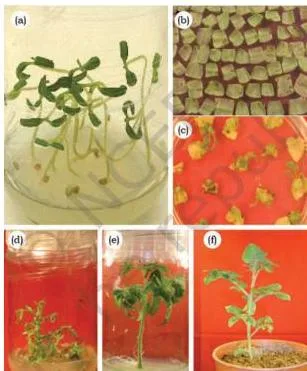
The six panels (a) to (f) are photographs of the chapter’s eight-step procedure for regenerating a tomato plant from cotyledon explants:
- (a) seeds germinated aseptically on culture medium in a bottle — these sterile seedlings supply the explants;
- (b) explant preparation from the germinated seedlings;
- (c) regenerating callus with shoot buds from the inoculated explants — the stage where dedifferentiation and redifferentiation are happening;
- (d) regenerating shoots ready to be transferred to rooting media;
- (e) rooting in the inoculated shoots;
- (f) a plantlet transferred to soil in a pot for hardening.
The steps behind the panels are: select and sterilise the nutrient medium (by autoclaving or micropore filters); prepare the explant; surface-sterilise it with sodium hypochlorite (explants from sterile seedlings can skip this); inoculate onto the medium; grow under controlled light, temperature and humidity; transfer to shoot-elongation medium; excise shoots onto a rooting medium; then harden the plantlet in pots before the field.
Remember the two sterilisation points. The medium is sterilised by autoclaving or micropore filtration, and the explant is sterilised separately with a disinfectant. Students commonly remember one and forget the other.
Fig 7.2: The Applications Map
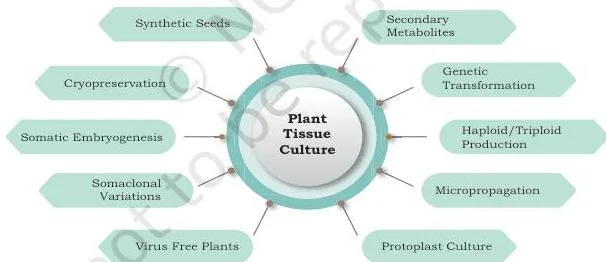
This figure is the map for section 7.5 — keep it open while you read that section. It organises the application list into: micropropagation, artificial (synthetic) seeds, haploid and triploid production, somatic hybrids, virus-free plants, somaclonal variations, and secondary metabolites.
Notice the three-way shape of the list. The first three entries are about making plants (micropropagation, synthetic seeds, haploids); the next two are about improving or cleaning plants (somatic hybrids, virus-free plants); the last two are about finding and producing useful chemicals or traits (somaclonal variation, secondary metabolites). Grouping the list this way makes it much easier to recall.
Fig 7.3: Anatomy of an Artificial Seed
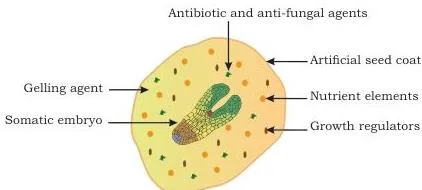
An artificial seed — also called a synthetic seed or somatic seed — is a somatic embryo wrapped in a protective encapsulation. The figure shows the two parts: the somatic embryo at the centre, and the encapsulating coating around it, with nutritional components and growth regulators added to mimic the structure of a conventional seed.
Key correction: the coating is a matrix such as calcium alginate, not a seed coat. The chapter’s own assertion-reason question (MCQ 19) flags exactly this misconception.
Why bother making them? Artificial seeds can be stored for a long time, and they allow rapid mass propagation of elite and hybrid varieties — including plants that normally propagate asexually, like carrot, grape and sandalwood.
Fig 7.4: Protoplast Fusion — Hybrid or Cybrid?
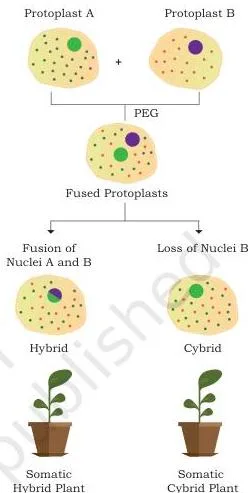
This is the hardest figure in the chapter because it contains a fork. Read it in order:
- The plant cell wall is digested with enzymes — cellulases and pectinases — so protoplasts are isolated from two different species (protoplast A and protoplast B).
- The protoplasts are brought into close contact and induced to fuse using polyethylene glycol (PEG).
- The fusion product is regenerated into a plant — and here the path forks.
- If the nuclear genomes of both parents combine, the result is a somatic hybrid (also called a parasexual hybrid). Inter-specific somatic hybrids were first produced by Carlson and associates in 1972.
- If the nuclear genome of one parent combines with the cytoplasmic genome (mitochondrial or plastid) of the other, the result is a cybrid. The process is called cybridisation.
Understanding why cybrids matter: cytoplasmic male sterility is controlled by the mitochondrial genome, and chloroplasts encode many key proteins of photosynthesis. In sexual reproduction the cytoplasmic genomes are mostly contributed by the female parent, so protoplast fusion is the only practical way to recombine cytoplasms of two parents.
The chapter’s MCQ 14 tests whether you know this definition — the correct term is cybridisation, and it is not among the options offered in that question.
Plant Tissue Culture Class 12: Definitions You Need
This chapter is definition-heavy, and its own summary reads almost like a glossary. These are the terms to know cold, with the section each belongs to.
| Term | Plain meaning | Section |
|---|---|---|
| Totipotency | The ability of a vegetative cell to divide and differentiate into any specialised cell, or to regenerate a whole plant | 7.1 |
| Explant | Any plant part — leaf, apical meristem, embryo, cotyledon, hypocotyl — used to start a culture | 7.2 |
| Dedifferentiation | Specialised explant cells dividing to form a mass of undifferentiated cells | 7.2 |
| Redifferentiation | Formation of organ primordia, such as shoot or root, from the callus | 7.2 |
| Organogenesis | Formation of various vegetative organs from cells or tissues in culture | 7.2 |
| Somatic embryogenesis | Formation of an embryo from somatic cells; the embryo resembles a zygotic embryo but is larger and different in origin | 7.2 |
| Callus | The unorganised mass of cells formed by dedifferentiation | 7.4 |
| Organ culture | Cultivation of plant organs (root, anther, ovary, embryo) in the laboratory, named by the organ | 7.4 |
| Cell suspension culture | Single cells cultured in liquid medium, used for transformation, secondary metabolites and somatic embryos | 7.4 |
| Protoplast | A plant cell whose wall has been digested away | 7.5 |
| Somatic hybrid | A fusion product combining the nuclear genomes of two parents; also called a parasexual hybrid | 7.5 |
| Cybrid | A fusion product with the nuclear genome of one parent and the cytoplasmic genome of the other | 7.5 |
| Somaclonal variation | Genetic variation observed in plants regenerated from cultured somatic tissues; such plants are somaclones | 7.5 |
| Artificial seed | A somatic embryo encapsulated in a protective matrix such as calcium alginate, with nutrients and growth regulators added | 7.5 |
| Double haploid | A haploid plant whose chromosome number is doubled with colchicine to produce a homozygous diploid | 7.5 |
| Micropropagation | Rapid multiplication of plants without sexual reproduction or seeds; every new plant is a clone | 7.5 |
Common Mistakes in Plant Tissue Culture (and the Corrections)
The mistakes in this chapter are conceptual, not numerical — you cannot catch them by rechecking a calculation. Four of them are literally encoded in the chapter’s own assertion-reason multiple-choice questions.
| The mistake | Correct rule | How to check yourself |
|---|---|---|
| Inverting the auxin–kinetin ratio | High auxin relative to kinetin causes rooting; the reverse causes shooting; intermediate levels cause callus proliferation | State the goal, then ask which hormone you raised: roots need auxin, shoots need kinetin |
| Confusing the two pH effects | Increase in pH increases medium hardness; decrease in pH causes poor solidification and affects nutrient uptake and salt solubility | Pair each direction with exactly one effect: up = harder, down = softer plus uptake changes |
| Calling the artificial seed coating a seed coat | The coating is an encapsulation of a matrix such as calcium alginate — not a seed coat (MCQ 19) | Remember that somatic embryos have no seed coat; the encapsulation mimics one |
| Saying meristems are virus-free because they lack vascular bundles | Virus particles have uneven distribution through the plant; apical and axillary meristems are generally free of them (MCQ 20) | The desert claim about vascular bundles is the trap — the true reason is uneven distribution of virus |
| Mixing up a somatic hybrid with a cybrid | Somatic hybrid = both nuclear genomes combined; cybrid = one parent’s nucleus with the other parent’s cytoplasmic genome (MCQ 14) | Ask which genome came from which parent: if the cytoplasm crossed over, it is a cybrid |
Exam Notes: How to Use Chapter 7 for Revision
This is a descriptive chapter, so revision means retrieval — testing yourself on definitions, sequences and who-did-what — not calculation practice.
The exercise set is made of short-answer concept questions covering the definition of PTC, media components, the general steps, applications, somatic hybridisation and somaclonal variations. The separate multiple-choice set adds assertion-reason pairs, so be ready for that format: you must judge the assertion and the reason independently before choosing.
Here is what each multiple-choice question actually tests:
| Question | Idea it tests | What to know |
|---|---|---|
| Q12 | Explant choice | Shoot apical meristem, embryo and leaf segments can all serve as explants |
| Q13 | Production of virus-free plants | Apical meristem is the suitable explant |
| Q14 | Cybrid versus hybrid | The process is called cybridisation — one parent’s nucleus with the other’s cytoplasmic genome |
| Q15 | MS medium composition | Antibiotics are not an essential component of MS medium |
| Q16 | Effect of lower pH | Decrease in pH causes poor solidification and interferes with nutrient uptake and salt solubility |
| Q17 | Where somaclonal variation appears | Plants regenerated through tissue culture |
| Q18 | What in vitro culture can produce | Virus-free plants, somatic hybrids and synthetic seeds are all possible |
| Q19 | Artificial seed structure (assertion-reason) | The seed-coat claim is false; the coat is a calcium alginate encapsulation |
| Q20 | Why meristems are virus-free (assertion-reason) | Assertion true, reason false — the reason is uneven virus distribution, not missing vascular bundles |
Two data tables repay memorising outright: the White’s versus MS medium comparison in section 7.4, and the list of twelve industrially important secondary metabolites in Box 3. For Box 3, group the compounds by use — antimalarials (artemisinin, quinine), anticarcinogens (taxol, vincristine), insecticidal (azadirachtin), cardiac tonic (digoxin) — and remember that shikonin was the first to be commercialised, in 1987.
Be able to draw and label Fig 7.1 (the regeneration sequence) and Fig 7.4 (protoplast fusion with its hybrid–cybrid fork). Figure reproduction is a fast way to earn marks in a descriptive chapter, and it is also the best memory test for sequences.
One honest warning: textbook contents and the examinable syllabus are not always identical. Check the current official CBSE syllabus for the exact scope of what is testable in this session.
Revision Summary: Plant Tissue Culture in One Screen
This is the chapter’s own SUMMARY restated as a revision checklist, grouped by how you need to know each item.
Memorise
- PTC = cultivation of undifferentiated plant cells, tissues or organs on artificial media under aseptic, controlled conditions.
- Explant sources: leaf, apical meristem, embryo, cotyledon, hypocotyl — with immature embryos most responsive.
- The six media components: inorganic, organic, carbon source, plant growth hormones, gelling agents, antibiotics.
- The four culture types: organ, callus, cell suspension, protoplast.
- Industrial compounds produced in culture: taxol, azadirachtin, shikonin, plus the full Box 3 list.
Understand
- The auxin–kinetin ratio rule: high auxin roots, high kinetin shoots, intermediate callus.
- Why cultured cells can accumulate higher concentrations of secondary metabolites than the parent plants — culture is controlled, so production is independent of season, environment and disease.
- Why somatic hybridisation can combine distantly related species — protoplast fusion bypasses the species barrier that blocks sexual crossing.
- Somatic hybrid versus cybrid: two nuclear genomes versus one nucleus plus the other parent’s cytoplasm.
Be able to draw
- Fig 7.1: the regeneration sequence — six panels, eight steps, two sterilisation points.
- Fig 7.4: protoplast fusion, showing where the path forks into somatic hybrid and cybrid.
- Fig 7.3: an artificial seed — somatic embryo inside an encapsulating matrix.
Related Resources: Class 12 Biotechnology
This listing is maintained for the 2026-27 academic session using the NCERT textbook information available to us. NCERT remains the authority for confirming the latest edition.
Chapter 7 sits inside the NCERT Class 12 Biotechnology textbook and is best studied after the earlier chapters on the foundations of biotechnology and the cell and organ cultures they describe. Use these pages to keep going:
- Class 12 Biotechnology notes index — all chapters of this textbook.
- Microbial, plant and animal cell and organ cultures and bioprocessing — the earlier chapter this one builds on.
- Animal cell culture — the parallel chapter on culturing animal cells.
- Class 12 hub — all Class 12 NCERT books and notes indexed.
Sources and Data Verification
All the content on this page is drawn from Chapter 7 of the NCERT Class 12 Biotechnology textbook, official edition — the same edition the download link above serves.
This page covers only that chapter, as published in the current NCERT edition, and is maintained for the current academic session.
NCERT is the authority for textbook editions and PDFs; CBSE is the authority for the examinable syllabus. A chapter appearing in the textbook does not by itself prove that every part of it is examinable — check the current official CBSE syllabus.
Reference: NCERT Class 12 Biotechnology textbook, chapter 7, official edition on ncert.nic.in.
Plant Tissue Culture Class 12 FAQs
What is totipotency in plant tissue culture?
Totipotency is the ability of a vegetative plant cell to divide and differentiate into any type of specialised cell, or to regenerate into a whole plant. It is the property that makes plant tissue culture possible — a leaf or stem cell already carries every instruction needed to rebuild the entire plant.
What is the difference between a somatic hybrid and a cybrid?
A somatic hybrid (parasexual hybrid) is the fusion product in which the nuclear genomes of both parents are combined. A cybrid results from cybridisation: the nuclear genome of one parent combines with the cytoplasmic genome — mitochondrial or plastid — of the other. Short version: somatic hybrid = two nuclei; cybrid = one nucleus with borrowed cytoplasm.
Why is apical meristem used to produce virus free plants?
Because virus particles have an uneven distribution throughout the plant body, and the apical or axillary meristems are generally free of them. A very small piece of apical meristem (less than 1 mm long) can therefore be cultured into a virus-free plant. The common wrong reason — that meristems lack vascular bundles — is exactly the trap built into the chapter’s MCQ 20.
What is the auxin and kinetin ratio rule in plant tissue culture?
A relatively high level of auxin to kinetin causes rooting, the reverse (high kinetin to auxin) causes shooting, and intermediate levels cause proliferation of callus. The rule was described by Skoog and Miller in 1957. Remember it as: auxin roots, kinetin shoots, both callus.
What are artificial seeds made of?
Artificial (synthetic or somatic) seeds are somatic embryos encapsulated in a protective matrix such as calcium alginate, with nutrients and growth regulators added to mimic a conventional seed. The coating is not a seed coat — that misconception is flagged in the chapter’s assertion-reason MCQ 19.
Why is MS medium used so widely in plant tissue culture?
The Murashige and Skoog (MS) medium, formulated in 1962 with higher salt concentrations than earlier media such as White’s, successfully initiated tissue culture from a large number of plant species. Because it works across so many species — and includes nitrogen sources like \( NH_4NO_3 \) that White’s lacks — it became the most widely used medium composition in plant tissue culture.
Explore Class 12 Biotechnology Books
Related chapters: