
Here is the official NCERT Class 12 Biotechnology Chapter 2 — the Host–Vector System chapter from the NCERT Biotechnology textbook for Class XII — with the official PDF right below.
This is the host–vector system class 12 chapter that explains the two-component idea behind gene cloning: every recombinant DNA experiment pairs a carrier DNA called a vector with a compatible host that replicates it.
Below the download link you will find a section-by-section tour of the chapter — its figures, its vocabulary, its exercises — so you know exactly what the file contains before you open it.
Download the Host–Vector System Class 12 Chapter PDF
Open the Host–Vector System Class 12 Biotechnology Chapter 2 PDF to read the official NCERT text of the chapter — figures, summary and closing exercises included — exactly as printed in the Class XII Biotechnology textbook.
The file is hosted on the official NCERT website (ncert.nic.in), so it is the authoritative edition of the chapter.
| What the chapter holds | Count | Where it is used |
|---|---|---|
| Printed pages | 18 | |
| Sections in the chapter | 10 | |
| Figures with NCERT captions | 16 | |
| Tables | 2 | |
| Exercise questions | 14 | answered in our NCERT Solutions |
| Official NCERT PDF | Download the chapter PDF | the chapter exactly as NCERT publishes it |
Chapter at a Glance
The table below lists what sits inside the chapter PDF — its sections, figures, data tables and exercise questions — so you can see the chapter’s extent at one glance. The teaching sections that follow explain what each of those parts means.
What This Chapter Covers and How It Flows
The chapter opens with the question everything else answers: how do you copy a single gene many times over? The answer is gene cloning, and the first two figures show the whole scheme at once.
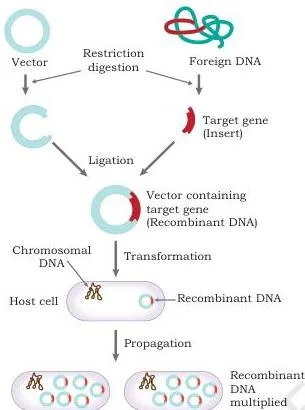
Fig. 2.1 shows gene cloning as a flow. The desired DNA — the insert or target gene — is first isolated from its source (section 2.1). It is then joined to a carrier vector, and the combined molecule is called recombinant DNA (rDNA).
The rDNA is introduced into a host, and the host’s genetic machinery replicates and expresses it. The insert alone cannot copy itself inside a foreign cell; it needs the vector’s replication sequences working inside a compatible host.
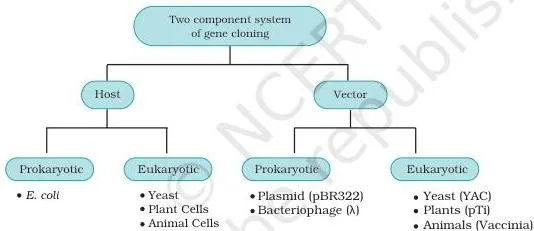
Fig. 2.2 is the chapter’s organising idea, drawn as two linked lists: hosts on one side, vectors on the other. Prokaryotic hosts such as E. coli and eukaryotic hosts such as yeast sit opposite the vectors that work inside them — plasmids, phages and artificial chromosomes. A host–vector system means choosing one entry from each column so the two work together.
The chapter then moves through that menu, section by section:
- Section 2.1 — the two key components: insert, vector, recombinant DNA, host, and the term gene cloning.
- Section 2.2 — what a host must be able to do, and the hosts most often used.
- Section 2.3 — the four features every vector needs, then the vector families: plasmids, lambda phage, M13, cosmids and phasmids.
- Section 2.4 — the eukaryotic host–vector system: yeast, the 2 µm plasmid, YAC, BAC and PAC.
- Section 2.5 — expression vectors that not only copy a gene but express it.
- Section 2.6 — shuttle vectors that replicate in two different hosts.
The chapter carries two data tables worth remembering — Table 2.1 lists common lambda vectors for E. coli with their maximum insert sizes, and Table 2.2 compares the insert sizes different vectors can carry. It closes with a summary and exercises.
Key Concepts: Hosts, Vectors and the Rules for Building Them
Everything in this chapter hangs on one pairing: a vector that carries foreign DNA and a host that copies it. Master that pairing and the long list of vector names stops being a memorisation problem — each vector is just a different answer to the same two questions: how to carry the insert, and how to make the host replicate it.
The Two-Component System (Section 2.1)
rDNA technology joins two different DNA molecules to isolate, propagate, characterise and manipulate genes, as Chapter 1 established. The process splits into two steps. First, the desired gene — the insert — is isolated from its source. Second, the insert is placed into a vector, a convenient carrier DNA.
The vector with the insert inside it is recombinant DNA, and the organism that receives it is the host. The host’s genetic machinery then propagates and expresses the rDNA. That whole process is what the chapter means by gene cloning. The vector supplies the sequences needed for replication; the host supplies the replication enzymes and proteins.
Chapter 1 laid the groundwork for this pairing; our recombinant DNA technology notes take you through it again.
What Makes a Good Host (Section 2.2)
A host is not just any cell. The chapter gives three requirements: the rDNA must enter the cell easily; the host must not treat the rDNA as foreign DNA and degrade it; and the host must supply all the enzymes and proteins needed for smooth replication of the vector along with the insert.
- E. coli — the most extensively used prokaryotic host. The K12 strain is one of the most common choices; E. coli grows fast, doubling its population about every 20 minutes.
- Bacillus subtilis — an important alternative when the aim is secretion of the protein encoded by the cloned gene.
- Yeast — the most widely used eukaryotic host.
The Four Features a Vector Must Have (Section 2.3)
In principle, any DNA that can replicate inside a host could act as a vector. In practice the chapter says a usable vector must satisfy four requirements — and exercise Q2 asks for them almost verbatim. Remember them as SOUS:
- S — Small size, high insert capacity: a small vector enters the host cell easily and still has room for a large insert.
- O — Origin of replication (ori): without it the vector cannot replicate autonomously inside the host.
- U — Unique restriction sites: too many sites would fragment the vector; unique sites let the insert be spliced in at one defined place.
- S — Selectable marker: at least one, such as tetracycline resistance (\( tet^R \)) or ampicillin resistance (\( amp^R \)), used to screen out transformants.
Plasmids and Their Types (Section 2.3.1)
A plasmid is a circular, double-stranded, extrachromosomal DNA capable of autonomous replication. Plasmids occur naturally in many bacteria, archaea and even eukaryotes such as yeast. Their sizes run from a few thousand base pairs to more than 100 kilobase pairs (kbp).
Plasmid DNA is replicated before every cell division, and at least one copy is segregated to each daughter cell, so the plasmid persists across generations. Three natural plasmid classes matter for cloning:
- R plasmids — carry genes that deactivate antibiotics such as ampicillin, tetracycline and chloramphenicol; this drug resistance makes them a major category for cloning.
- Col plasmids — produce toxins called colicins that kill other bacteria.
- F plasmids — carry transfer genes that build a pilus, a tube through which a plasmid copy passes to another cell of the same or a related species.
Some plasmids can integrate into the host chromosome; those are called episomes — the term Q9 asks you to name. Plasmids also differ in copy number. High or multi copy plasmids (10–30 copies per cell) follow relaxed replication, free from the control of chromosomal DNA replication.
Low or single copy plasmids follow stringent replication, under the same control as the chromosome, held at one or few copies per cell. High copy numbers give higher yields and stronger screening signals.
The Development Path: pBR313 to pBR322 to pUC19
Natural plasmids needed reshaping before they became convenient vectors, and the chapter traces that engineering in one clear line. Exercise Q4 asks you to discuss exactly this strategy.
- pBR313 — 9 kb, replicates in relaxed fashion (high copy number), carries the two selectable markers \( tet^R \) and \( amp^R \), and has several unique restriction sites. Its problem: more than half of its DNA was not essential for vector function.
- pBR322 — built by deleting most of the non-essential sequences of pBR313, shrinking the vector to 4,361 bp. It became the most widely used vector for gene cloning.
- Multiple cloning site (MCS), or polylinker — a short synthetic DNA fragment carrying many unique restriction sites, so foreign DNA cut at any of those sites can be inserted into that region.
- pUC19 — adds easy selection: it carries part of the \( lacZ \) gene (beta-galactosidase), enabling blue/white selection of recombinants. The method itself is explained in Chapter 3; here you only need to connect pUC19 to the idea of a convenient selection marker.
Lambda Phage Vectors (Section 2.3.2)
Bacteriophages — viruses that infect bacteria — are more efficient than plasmids for cloning large inserts. Lambda and M13 are the two most common phages used to build cloning vectors for E. coli.
Lambda has a head (capsid) containing the phage genome and a tail through which the genome is injected into the cell. Its genome is linear double-stranded DNA of 48,490 base pairs, with a 12-base single-stranded segment at each end called the cos sequence.
Once inside E. coli, the two cohesive ends pair up and are ligated by host enzymes, giving a circular genome of 48,502 base pairs; the sealed junction is the cos site.
Lambda can follow a lytic cycle — replicate, build new particles, lyse the cell — or a lysogenic cycle, integrating into the host chromosome as a prophage with no apparent harm to the host.
During multiplication the genome undergoes rolling circle replication, producing a long concatemer of copies separated by cos sites; the concatemer is cleaved at those sites and single copies are packaged into heads.
That packaging step sets the size limit. The middle region of the lambda genome, holding genes for lysogeny, is dispensable for lytic infection, so it can be replaced by an insert — provided the recombinant stays between 38 and 52 kbp for efficient packing.
Worked example (original numbers): suppose a replacement vector keeps 32 kbp of lambda DNA after its dispensable middle is removed.
- Step 1: State the packaging window — the recombinant must stay between 38 and 52 kbp.
- Step 2: Subtract the 32 kbp backbone to find the allowed insert range.
\[ 38\ \text{kbp} – 32\ \text{kbp} = 6\ \text{kbp}, \quad 52\ \text{kbp} – 32\ \text{kbp} = 20\ \text{kbp} \]
Step 3: Test an insert inside the range.
\[ 32\ \text{kbp} + 12\ \text{kbp} = 44\ \text{kbp} \]
Final answer: an insert of 12 kbp gives a 44 kbp recombinant, safely inside the 38–52 kbp window. An insert of 25 kbp would give 57 kbp and fail to pack efficiently.
Lambda-derived vectors fall into two classes. Insertion vectors have a single restriction site for the insert and take small inserts. Replacement vectors have a pair of cloning sites flanking a non-essential stuffer region that the insert replaces.
Table 2.1 lists examples: lambda gt10 (insertion, up to 6 kbp), lambda gt11 (insertion, up to 7.2 kbp, blue/white selection) and lambda EMBL3 (replacement, up to 20 kbp).
Bacteriophage M13 (Section 2.3.2)
M13 is a filamentous phage of E. coli, built differently from lambda. Its genome is a single-stranded circular DNA of about 6.4 kb, packaged in a tube-like capsid. Almost the entire genome encodes the genes (I–X) for coat protein, replication and assembly; only a small non-essential region flanking the origin, the intergenic region, is available for inserts.
M13 infects only E. coli cells carrying the F plasmid, because those cells have a tube-like pilus needed for the phage to attach and adsorb. Inside the host the single-stranded DNA becomes a double-stranded replicative form (RF); later, replication switches back to produce single-stranded genomes.
New phages are assembled and leave the cell without causing cell lysis — the key contrast with the lambda lytic cycle.
For vector construction, the double-stranded RF is used, and the insert is placed in the intergenic region so it does not interfere with replication. M13 can clone DNA larger than 42 kb, and the example vector M13mp18 facilitates blue/white selection of recombinants.
Cosmids and Phasmids (Sections 2.3.3 and 2.3.4)
Both are hybrid vectors, and students confuse them constantly — but the chapter gives each a precise recipe. Exercise Q7 and the assertion–reason question Q14 both test the difference.
| Feature | Cosmid | Phasmid |
|---|---|---|
| What it combines | plasmid DNA + lambda cos sites | lambda ends + linearised plasmid middle |
| Lambda content | as little as 250 bp of lambda DNA providing the cos junction, including sequences bound and cleaved by terminase | ends carrying all genes required for a lytic infection |
| How it behaves | replicates like a plasmid; can be packaged in vitro into lambda coats | forms plaques like a phage, or replicates as a plasmid if it carries the gene for the lambda repressor |
| Insert capacity | up to 45 kbp (section 2.3.3); Table 2.2 lists 23–40 kb | — |
A cosmid is a hybrid that replicates like a plasmid but can also be packaged in vitro into lambda phage coats: plasmid replication functions, unique restriction sites and selectable markers, combined with a lambda segment carrying the joined cos sites.
A phasmid (phagemid) is a true phage–plasmid hybrid: linear duplex DNA whose ends are lambda DNA with all the genes for a lytic infection, and whose middle is a linearised plasmid. Both replication functions remain intact.
Eukaryotic Hosts and Artificial Chromosomes (Section 2.4)
Cloning genes of higher organisms needs bigger vectors: eukaryotic genes contain introns that may be hundreds of kilobases long, and even an intron-free eukaryotic gene can exceed what a plasmid accepts. That is why the chapter introduces artificial chromosomes.
The most common eukaryotic host is baker’s yeast, Saccharomyces cerevisiae. It grows as single cells, forms colonies like E. coli, and has a long history of safe use in the food industry, so it is Generally Recognised As Safe (GRAS). Yeast also harbours a double-stranded circular 2 µm plasmid used to develop vectors.
A Yeast Artificial Chromosome (YAC) clones large inserts of 200–500 kb. Its components are two copies of a yeast telomeric sequence, a yeast centromeric sequence, a yeast ARS (an autonomously replicating sequence where DNA replication begins) and appropriate selectable markers.
The YAC has two forms: circular for growing in bacteria (it carries a bacterial origin and an antibiotic resistance gene), and linear for growing in yeast, with the telomere sequences at the ends. YAC-type vectors are called high capacity cloning vectors; their prokaryotic relatives are Bacterial Artificial Chromosomes (BACs) and Phage Artificial Chromosomes (PACs).
Use Table 2.2’s insert capacities to choose a vector — roughly, the larger the insert, the more elaborate the vector. This is the chapter’s own decision route:
| Insert size | Vector choice | Where the chapter says so |
|---|---|---|
| up to 10 kb | Plasmid | Table 2.2 |
| 8–25 kb | Bacteriophage (lambda) vectors | Table 2.2 |
| 23–40 kb (up to 45 kbp) | Cosmid | Table 2.2; section 2.3.3 |
| more than 42 kb | M13 | section 2.3.2 |
| 100–300 kb | PAC | Table 2.2 |
| up to 300 kb | BAC | Table 2.2 |
| 200–500 kb | YAC | Table 2.2 |
Expression Vectors and Heterologous Expression (Section 2.5)
Cloning vectors only propagate DNA; expression vectors also let the inserted gene be expressed efficiently. They may be plasmid- or virus-based, and they work by sandwiching the gene between control sequences.
An expression vector carries an efficient, generally inducible promoter so that expression can be regulated, unique restriction sites downstream for inserting the gene, and a transcription termination sequence near the 3′ end. The cloned gene inserted between the promoter (5′) and the terminator (3′) forms the expression cassette; that is why these are also called sandwich expression vectors.
Heterologous expression means expressing a gene in a host to which it is foreign, such as a eukaryotic gene in a prokaryote.
It works only under two conditions grounded in the chapter: the eukaryotic gene must (i) contain no introns, because the prokaryotic host has no splicing process, and (ii) require no post-translational modification such as glycosylation for biological activity, because the host cannot perform it.
Shuttle Vectors (Section 2.6)
Shuttle vectors are constructed by recombinant DNA techniques to replicate in two alternative hosts — two prokaryotes, or a prokaryote (usually E. coli) and eukaryotic cells including yeast, plants and animals. Most eukaryotic vectors are shuttles.
The defining detail: a shuttle vector contains two origins of replication, but in a given host only one origin is active at a time. Fig. 2.15 shows exactly this arrangement for E. coli and yeast.
Reading the Diagrams: What Each Figure Shows
The diagrams in this chapter are not decoration — each vector type is defined by the parts its figure labels. Learn the figures and you learn the vocabulary.
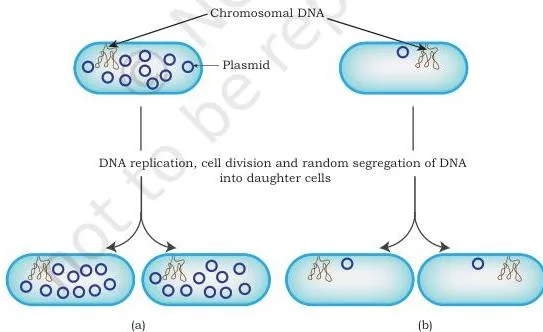
Fig. 2.3 draws the two copy-number classes from section 2.3.1. The high copy plasmid on the left replicates freely, giving 10–30 copies per cell under relaxed replication; the low copy plasmid on the right stays at one or few copies because its replication is tied to the same control as chromosomal DNA. More copies mean higher yields and stronger screening signals.
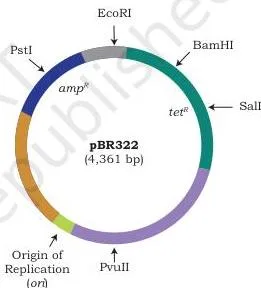
Fig. 2.4 is the map of pBR322, the 4,361 bp workhorse. Read it as a checklist against the four vector requirements: the ori for autonomous replication, one unique restriction site for each enzyme listed, and the two markers for screening. Because each site is unique, the vector is cut at exactly one place when you open it for an insert.
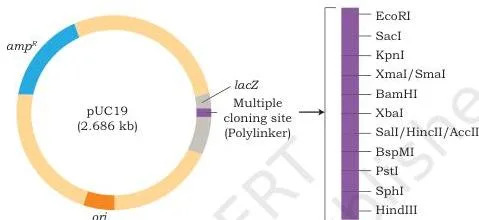
Fig. 2.5 shows the later-generation vector pUC19. Compare its marker set with pBR322: it keeps the ori and ampicillin resistance, and adds part of the lacZ gene encoding beta-galactosidase. That lacZ fragment enables blue/white selection — recombinants that take up an insert disrupt lacZ and are detected by colour — though the mechanism is explained in Chapter 3.
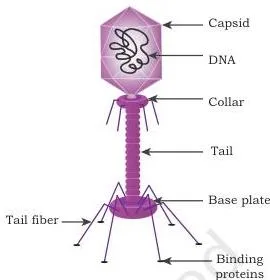
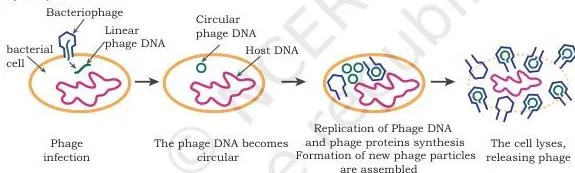
Fig. 2.6 is the virus itself; the chapter carries two illustrations of it. Lambda has two structural parts to know: the head (capsid), which contains the phage genome, and the tail, through which the genome is injected into E. coli. The whole particle exists to deliver that 48,490 bp linear DNA into the host cytoplasm.
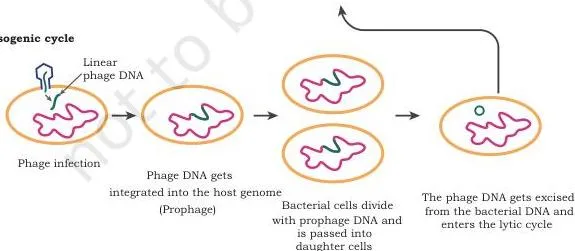
Fig. 2.7 explains how one phage can behave two ways. In the lytic cycle, the phage DNA is replicated, new particles are built, and the cell lyses to release them. In the lysogenic cycle, the phage DNA integrates into the host chromosome as a prophage. Which cycle lambda follows is the key lifestyle fact behind the chapter’s vector design.
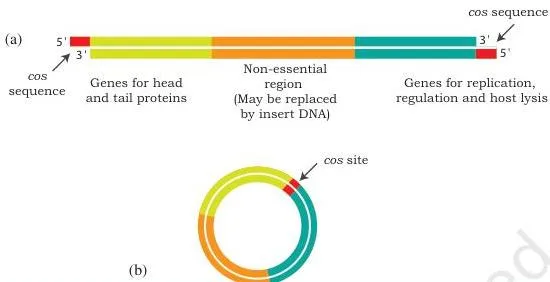
Fig. 2.8 shows the same genome in two states. Inside the particle it is linear, with the 12-base cos sequences at each end. Inside E. coli the ends pair, host enzymes ligate them, and the circle is sealed at the cos site — that is why the circular form is 48,502 base pairs versus 48,490 linear.
The cos site is also where the concatemer is cleaved during packaging, linking this figure to the 38–52 kbp size rule.
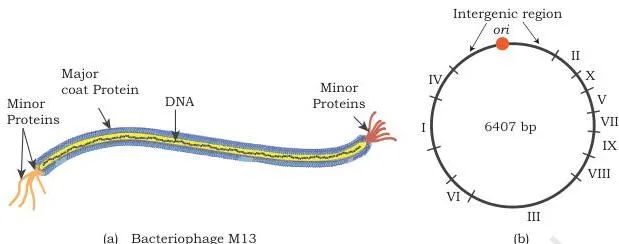
Fig. 2.9 introduces M13’s plan: a tube-like capsid around a single-stranded circular genome of about 6.4 kb. The genome map labels genes I to X — coat protein, replication, assembly — leaving only the small intergenic region as the safe place for foreign DNA. Because the genome is so fully loaded, the insert goes into one specific pocket.
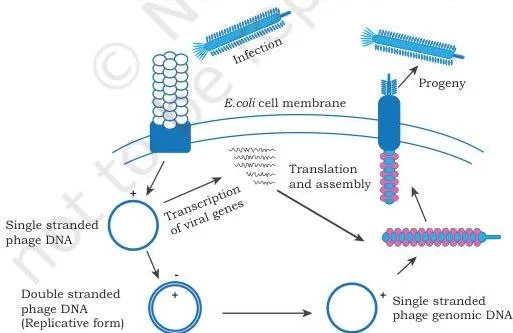
Fig. 2.10 traces M13’s infection without cell death. The single-stranded genome becomes a double-stranded replicative form, which researchers isolate and use as the vector; replication later switches back to single-stranded genomes that are assembled with capsid proteins and leave the cell. The absence of bursting is the contrast with lambda’s lytic cycle.
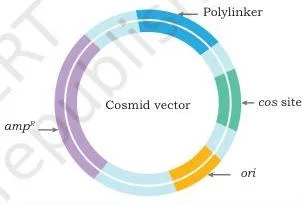
Fig. 2.11 shows a cosmid as the chapter defines it: plasmid parts — replication functions, unique restriction sites, selectable markers — plus a lambda DNA segment carrying the joined cos sites. As little as 250 bp of lambda DNA provides that cos junction. The result replicates like a plasmid yet can be packaged in vitro into lambda coats.
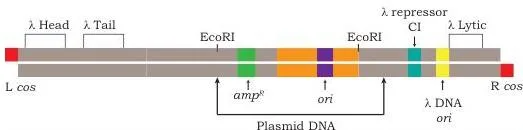
Fig. 2.12 differs from the cosmid in one layout detail: the phasmid’s ends are lambda DNA containing all the genes required for a lytic infection, and the middle is a linearised plasmid.
Both phage and plasmid replication functions stay intact, so inside E. coli a phasmid can form plaques like a phage — or, if it carries the lambda repressor gene, replicate as a plasmid.
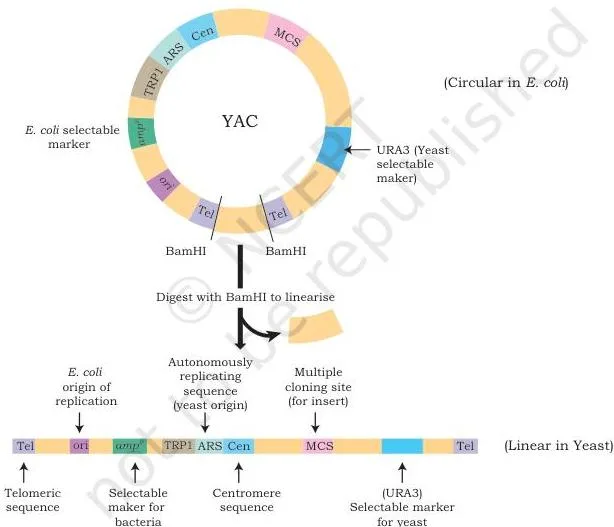
Fig. 2.13 labels the four parts that let a YAC behave like a real chromosome in yeast: two copies of a telomeric sequence at the ends, a centromeric sequence, an ARS where replication begins, and appropriate selectable markers. Remember the YAC’s two forms from section 2.4: circular for bacteria, linear for yeast.
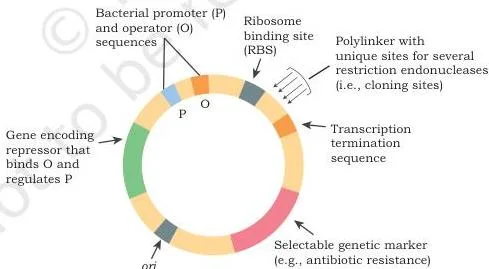
Fig. 2.14 is the anatomy of an expression vector. Read it left to right: an efficient, usually inducible promoter upstream (5′), unique restriction sites where the gene is inserted, and a transcription termination sequence near the 3′ end. The gene between promoter and terminator is the expression cassette — hence the name sandwich expression vector.
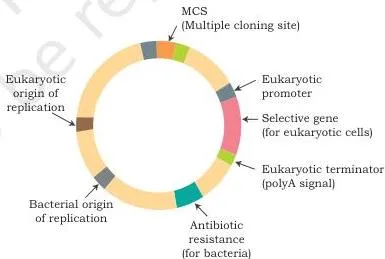
Fig. 2.15 shows a shuttle vector built for E. coli and yeast. The distinguishing detail is the pair of origins of replication — one recognised in each host — with the rule from section 2.6 that only one origin is active at a time in any given host. Two origins on the map is the signature of a shuttle vector.
Term by Term: Definitions You Will Be Asked
The vocabulary of this chapter is precise — mixing up cos site and ori, or cosmid and phasmid, costs exact marks. This table gives each term a working definition in plain words.
| Term | Plain definition |
|---|---|
| insert | the desired DNA molecule (target gene) isolated from its source for cloning |
| vector | a carrier DNA molecule into which the insert is placed; it provides sequences needed for replication in a host |
| recombinant DNA (rDNA) | the vector containing the inserted foreign DNA |
| host | the organism that receives the rDNA and supplies the enzymes and proteins for its replication and expression |
| gene cloning | the whole process of propagating and expressing an inserted gene through a compatible host–vector system |
| origin of replication (ori) | the sequence on the vector at which DNA replication begins, allowing autonomous replication in the host |
| selectable marker | a gene, such as \( tet^R \) or \( amp^R \), used to screen out transformants |
| plasmid | a circular, double-stranded, extrachromosomal DNA capable of autonomous replication |
| episome | a plasmid that can integrate into the host chromosome |
| R plasmid | a plasmid carrying genes that deactivate antibiotics such as ampicillin, tetracycline and chloramphenicol |
| Col plasmid | a plasmid that produces colicins, toxins that kill other bacteria |
| F plasmid | a plasmid with transfer genes that form a pilus for transferring a plasmid copy to another cell |
| relaxed replication | replication of high copy plasmids, free from control by chromosomal DNA replication (10–30 copies per cell) |
| stringent replication | replication of low copy plasmids, under the same control as chromosomal DNA replication (one or few copies per cell) |
| multiple cloning site (polylinker) | a short synthetic DNA fragment carrying many unique restriction sites for inserting foreign DNA |
| cos sequence | the 12-base single-stranded cohesive ends of the linear lambda genome, complementary to each other |
| cos site | the sealed junction formed when the cos sequences pair and are ligated after lambda DNA enters the host |
| prophage | lambda DNA integrated into the host chromosome in the lysogenic state |
| insertion vector | a lambda vector with a single restriction site for inserting foreign DNA |
| replacement vector | a lambda vector with a pair of cloning sites flanking a stuffer region that is replaced by the insert |
| replicative form (RF) | the double-stranded form of M13 DNA produced inside the host and used as the vector |
| cosmid | a hybrid of plasmid DNA and lambda cos sites that replicates like a plasmid and can be packaged in lambda coats |
| phasmid (phagemid) | a hybrid whose ends are lambda DNA with full lytic genes and whose middle is a linearised plasmid |
| yeast artificial chromosome (YAC) | a yeast-based vector carrying two telomeres, a centromere, an ARS and selectable markers; clones 200–500 kb inserts |
| autonomously replicating sequence (ARS) | a yeast sequence where DNA replication begins |
| expression cassette | the stretch of an expression vector between promoter and terminator that contains the cloned gene |
| heterologous expression | expressing a gene in a host to which it is foreign, such as a eukaryotic gene in a prokaryote |
| shuttle vector | a vector with two origins of replication that can replicate in two different hosts, one origin active at a time |
Common Mistakes Students Make in Host–Vector Systems
These are the slips the chapter’s own text and closing exercises warn against — each one is a confusion the book explicitly addresses. Read the correction column before attempting the questions.
| Common mistake | Correct rule | How to check your answer |
|---|---|---|
| Treating the cos site as a replication origin | cos is a 12-base cohesive-end junction that circularises the lambda genome and is cleaved during packaging; replication starts at the lambda origin | cos is an end/junction feature; ori is the replication-start feature — different sequences, different jobs |
| Thinking M13 kills its host | M13 assembles and exits without cell lysis; only lambda’s lytic cycle lyses the cell | the M13 life-cycle figure shows release with no bursting |
| Swapping relaxed and stringent replication | multi copy plasmids (10–30) follow relaxed replication; single copy plasmids follow stringent replication | Q10 — single copy is stringent because its replication is under the same control as chromosomal DNA |
| Mixing insertion and replacement lambda vectors | insertion vectors have one cloning site and take small inserts; replacement vectors have a pair of sites flanking a stuffer the insert replaces | Table 2.1 — lambda gt10/gt11 are insertion; lambda EMBL3 is replacement |
| Confusing cosmid with phasmid | cosmid = plasmid DNA + cos sites; phasmid = lambda ends with full lytic genes + linearised plasmid middle | Q7 and Q14 restate exactly this difference |
| Ignoring the 38–52 kbp packaging window | only recombinants inside this window pack efficiently into the lambda head | subtract the vector backbone from 38–52 kbp to find the allowed insert range |
| Assuming any cell can serve as host | the host must admit rDNA easily, must not degrade it as foreign DNA, and must supply replication enzymes and proteins | test the host against section 2.2’s three requirements |
| Expecting blue/white selection explained in this chapter | Chapter 2 only states that lacZ enables blue/white selection (pUC19, M13mp18); the mechanism is in Chapter 3 | use tetR/ampR marker logic for the screening questions in this chapter |
| Using the wrong cosmid insert size | section 2.3.3 says cosmids take inserts as large as 45 kbp; Table 2.2 lists 23–40 kb for typical cosmids | quote the table when comparing vectors; treat 45 kbp as the design ceiling |
| Calling an integrase-capable plasmid an R plasmid | a plasmid that integrates into the host chromosome is an episome; R plasmids are defined by drug-resistance genes | Q9 — the correct answer is episome |
How the Exercises Test Each Section
The end-of-chapter exercises mix formats to test both recall and reasoning: descriptive questions, one multiple choice question, one match-the-pair, and two assertion–reason items. Use the mapping below to revise each question against the section that answers it.
| Question | Section it tests | What a full answer must show |
|---|---|---|
| Q1 | 2.1 | the two-component idea: the vector supplies replication sequences, the host supplies replication functions; cloning depends on the pair working together |
| Q8 | 2.1 | the vector is required because the insert alone lacks the sequences needed for replication in a host |
| Q2 | 2.3 | all four vector features: small size with high insert capacity, ori, unique restriction sites, selectable marker |
| Q3 | 2.3.1 | plasmid definition plus the type classes: episome, R, Col, F, and the copy-number classes |
| Q4 | development of plasmid-based vectors | the pBR313 to pBR322 route: size reduction by deleting non-essential DNA, then the MCS/polylinker, then pUC19 with lacZ selection |
| Q5 | 2.3.2 (lambda) | structure (head, tail, 48,490 bp linear genome, cos ends), life cycles, insertion versus replacement vectors, 38–52 kbp packaging |
| Q6 | 2.3.2 (M13) | RF used as the vector, intergenic region, no cell lysis, large inserts, M13mp18 with blue/white selection |
| Q7 | 2.3.3 vs 2.3.4 | the two hybrid recipes: cosmid = plasmid + cos sites; phasmid = lambda ends + plasmid middle |
| Q9 | 2.3.1 | MCQ — correct answer: episome |
| Q10 | 2.3.1 | copy control — single copy plasmids replicate under the same control as chromosomal DNA, so replication is stringent |
| Q11 | 2.3.1 | the incorrect pair is multicopy plasmid paired with stringent replication — multicopy plasmids follow relaxed replication |
| Q12 | 2.4 | use high capacity vectors — YAC components, BAC, PAC — because large eukaryotic genes exceed plasmid capacity |
| Q13 | 2.3 | assertion–reason: both true, and the reason explains the assertion (selectable markers screen out transformants) |
| Q14 | 2.3.3 | assertion–reason: both true, and the reason explains the assertion (cosmid combines plasmid and lambda properties) |
Remember that textbook contents and the examinable syllabus are not always identical. Check the current official CBSE syllabus to confirm exactly which parts of this chapter are examinable this session.
The Chapter in One Read
A fast revision pass built from the chapter’s own closing summary, in plainer words.
- rDNA technology is a two-component host–vector system: the vector supplies the sequences needed for replication, and the host supplies the replication functions.
- A cloning vector must be small, carry an ori, have unique restriction sites and carry at least one selectable marker.
- Plasmids are circular, extrachromosomal, double-stranded DNA capable of autonomous replication.
- Lambda and M13 are the two phages whose genomes are most frequently used to build E. coli cloning vectors.
- Lambda vectors split into insertion vectors and replacement vectors; the recombinant must stay within 38–52 kbp for efficient packaging.
- M13 has a 6.4 kb single-stranded circular genome in a tubular capsid; M13mp18 enables blue/white selection of recombinants.
- Cosmids are hybrids that replicate like plasmids and can be packaged in vitro into lambda coats; their defining part is the cos junction.
- Phasmids are linear duplex hybrids: lambda ends carrying full lytic genes around a linearised plasmid middle.
- The common eukaryotic host is baker’s yeast, S. cerevisiae; YACs carry two telomeres, a centromere, an ARS and selectable markers, while BACs and PACs are the prokaryotic high-capacity relatives.
- Expression vectors carry promoter, insert and terminator in an expression cassette; heterologous expression needs intron-free genes that require no post-translational modification.
- Shuttle vectors hold two origins of replication, with only one active in any given host.
Related NCERT Chapters and Resources
This listing is maintained for the 2026-27 academic session using the NCERT textbook information available to us. NCERT remains the authority for confirming the latest edition.
Chapter 2 sits between two neighbours. Chapter 1 of the Class 12 Biotechnology book introduced recombinant DNA technology, which section 2.1 builds on, and Chapter 3 explains the blue/white selection this chapter promises from the pUC19 and M13 sections. The full textbook lives on the Class 12 Biotechnology book page, inside the Class 12 NCERT book hub.
For a faster revision pass, the Class 12 Biotechnology notes page gathers revision material for the whole book, and the Class 12 notes hub covers every subject; the CBSE notes home page is where any of our notes begins. Our gene cloning notes take the ideas of this chapter further.
The chapter described on this page is the official edition of the NCERT Class 12 Biotechnology textbook, available at ncert.nic.in.
Sources and Data Verification
- The section references, figure captions and terms on this page describe the NCERT Biotechnology textbook for Class XII, official edition on ncert.nic.in, Chapter 2 Host–Vector System.
- This page covers that single chapter only — not the other chapters of the book, nor other biotechnology or biology texts.
- The listing is maintained for the current academic session using the NCERT information available to us.
- NCERT settles the textbook, its editions and the official PDFs; CBSE settles the curriculum, syllabus and examinations.
Host–Vector System Class 12: Frequently Asked Questions
What is a host vector system in recombinant DNA technology?
A host–vector system is the two-component setup behind gene cloning: a vector (carrier DNA such as a plasmid or phage genome) supplies the sequences needed for replication, and a compatible host (such as E. coli K12 or yeast) supplies the enzymes and proteins that copy and express the recombinant DNA.
The insert is joined to the vector to form rDNA, the rDNA enters the host, and the host’s machinery propagates it.
How much foreign DNA can a plasmid, a cosmid, a BAC and a YAC carry?
From the chapter’s Table 2.2: a plasmid carries up to 10 kb, a cosmid 23–40 kb, a BAC up to 300 kb and a YAC 200–500 kb. The chapter text adds that some cosmid vectors accept inserts as large as 45 kbp, and M13 can clone more than 42 kb.
What is the difference between a cosmid and a phasmid?
A cosmid is plasmid DNA combined with the lambda cos sites — it replicates like a plasmid and can be packaged in vitro into lambda coats.
A phasmid (phagemid) has lambda DNA ends carrying all the lytic genes, with a linearised plasmid as the middle, so it can grow as a phage forming plaques or, if it carries the lambda repressor gene, replicate as a plasmid.
Why must a eukaryotic gene have no introns for expression in a prokaryotic host?
Because the prokaryotic host has no splicing process, it cannot remove introns. The chapter adds a second condition: the expressed protein must not require post-translational modification such as glycosylation for biological activity, because the host cannot perform it either.
Why must the insert in a lambda vector be between 38 and 52 kbp?
Because lambda packages its genome into the head efficiently only within that size window. The recombinant built from the vector backbone plus insert must fall inside 38–52 kbp; too small or too large a recombinant fails to pack efficiently into the lambda head.
Where can I download the official NCERT Class 12 Biotechnology Chapter 2 PDF?
From the official NCERT site: the chapter is hosted at ncert.nic.in/ncerts/l/lebt102.pdf. That file is the official chapter from the NCERT Biotechnology textbook for Class XII.
Reference: NCERT Class 12 Biotechnology textbook, chapter 2, official edition on ncert.nic.in.
Explore Class 12 Biotechnology Books
Related chapters:
- Applications of Recombinant DNA Technology
- Genome Engineering
- Microbial, Plant, Animal Cell, Organ Cultures and Bioprocessing