
Genome engineering class 12 is Chapter 5 of the NCERT Biotechnology textbook, printed in the book as “Genome Technology and Engineering”. The official chapter opens with the scientist profile of Stanley Norman Cohen, then covers genome mapping, DNA sequencing, CRISPR-Cas9 and protein engineering across 30 printed pages (NCERT, p. 1).
The official genome engineering class 12 NCERT chapter PDF is linked right below, on this page, maintained for the current academic session.
| What the chapter holds | Count | Where it is used |
|---|---|---|
| Printed pages | 30 | |
| Sections in the chapter | 16 | |
| Figures with NCERT captions | 13 | |
| Exercise questions | 21 | answered in our NCERT Solutions |
| Official NCERT PDF | Download the chapter PDF | the chapter exactly as NCERT publishes it |
Get the Official Genome Engineering Class 12 Chapter PDF
NCERT publishes the complete Class 12 Biotechnology book on its own website, and the chapter file is free to read or download. Open the genome engineering class 12 NCERT chapter PDF to see the official text of Chapter 5 exactly as it is printed, including the coloured figures and the closing summary and exercises.
Chapter 5 at a Glance: What’s Inside the PDF
This quick map of the chapter tells you how the file is organised before you open it.
| Component | Count in this chapter |
|---|---|
| Printed pages in the book | 30 |
| Sections and subsections | 16 |
| Captioned figures | 12 |
| Closing exercise questions | 21 |
| Worked examples or solved numericals | 0 |
The chapter is organised into six main sections:
- 5.1 Mapping of the Genome: genetic and physical maps, with RFLP, SSLP and STS as physical map features.
- 5.2 High-throughput DNA Sequencing: first-generation chain-termination sequencing, Illumina next-generation sequencing, and nanopore-based third-generation sequencing.
- 5.3 Other Genome-related Technologies: whole genome sequencing, targeted sequencing and metagenomics.
- 5.4 Genome Engineering: transposon-based knock-out and knock-in, and CRISPR-Cas9 genome editing.
- 5.5 Structural, Functional and Comparative Genomics: what each field studies and how they use sequencing data.
- 5.6 Protein Engineering: engineered proteins such as 6-His-tag, GFP tag, subtilisin, recombinant immunotoxin and humanised antibody.
The chapter closes with a one-page summary and 21 exercise questions, including two assertion-reason questions.
What This Chapter Teaches, Section by Section
The chapter moves in one logical direction: reading a genome (mapping and sequencing), then rewriting it (genome engineering), then using its products (protein engineering).
5.1 Mapping of the Genome introduces the genome — the complete DNA content of a cell — and the two ways of locating genes on it. A genetic map is built from crossover analysis: the more often two loci separate by recombination, the farther apart they sit, and the distance is measured in centimorgans.
A physical map uses actual DNA features such as restriction enzyme sites, repeat sequences (SSLP) and unique sequence landmarks (STS), so it can be drawn at much higher resolution than a genetic map.
5.2 High-throughput DNA Sequencing explains how whole genomes came to be readable. First-generation sequencing (chain termination) reads 800–1000 bases per capillary, with up to 96 capillaries running in parallel. Next-generation Illumina sequencing uses bridge amplification on a flow cell to sequence millions of fragments at once, producing short reads of 75–300 bases.
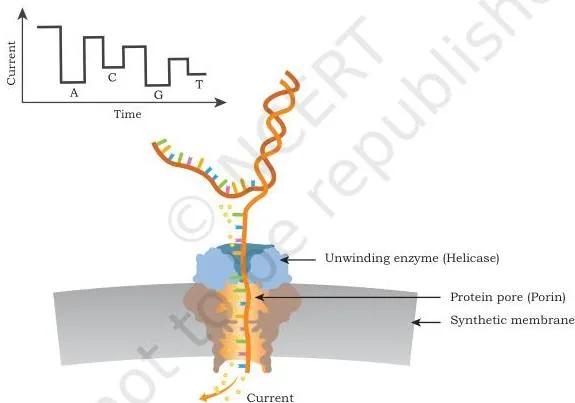
Third-generation nanopore sequencing reads very long molecules by detecting changes in ionic current as each base passes through a protein pore.
5.3 Other Genome-related Technologies covers the ways sequencing is applied. Whole genome sequencing reads an entire genome and can be reference-based or de novo; targeted sequencing reads only selected genes or regions, with clinical exome sequencing as a cost-effective diagnostic version; metagenomics sequences DNA directly from a whole microbial community without culturing any organism.
5.4 Genome Engineering is the heart of the chapter. Transposons (“jumping genes”) can be engineered to insert into a target gene — disrupting it for a knock-out or adding DNA for a knock-in.
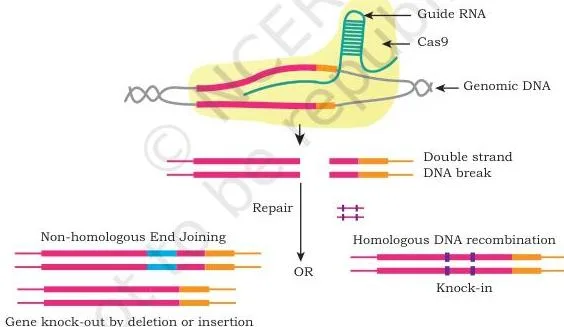
CRISPR-Cas9 uses a guide RNA to position the Cas9 enzyme at a chosen sequence, where it makes a double-strand break; the cell’s own template-based homologous repair then copies in an edited sequence supplied by the scientist.
5.5 Structural, Functional and Comparative Genomics describes what we do with genome sequences. Structural genomics studies 3D protein structure or chromosome organisation; functional genomics asks how the genome’s instructions are executed in a cell; comparative genomics compares genomes across species or individuals to find shared core genes and species-specific ones.
5.6 Protein Engineering shows how point mutations redesign proteins. The chapter works through five applications: bleach-stable subtilisin for detergents, 6-His-tag for purification on nickel columns, GFP tagging for localising proteins inside cells, recombinant immunotoxins that deliver a toxin to cancer cells, and humanised monoclonal antibodies that avoid immune rejection.
Key Concepts in Genome Engineering Class 12
These are the ideas the chapter builds on, in the order the book introduces them. The “Where it is” column cites the NCERT page in your book.
| Concept | What it means | Where it is |
|---|---|---|
| Genome | The complete genetic information (all DNA) in a cell | p. 3 |
| Genetic map and centimorgan | A map of loci arranged by recombination frequency; 1 cM = 1% cross-over | p. 5 |
| RFLP, SSLP, STS | Physical map features: restriction-site differences, repeat-length variants, unique landmark sequences | p. 6 |
| Chain-termination sequencing | First-generation method that builds a ladder of fluorescently ended DNA fragments | p. 9 |
| Illumina bridge amplification | Next-generation method that clusters millions of fragments on a flow cell for parallel sequencing | p. 10 |
| Nanopore sequencing | Third-generation method reading bases from ionic current changes across a protein pore | p. 12 |
| Whole genome sequencing | Sequencing an entire genome, using a reference genome or de novo | p. 14 |
| Targeted sequencing | Sequencing selected genes or regions, including clinical exome sequencing | p. 15 |
| Metagenomics | Sequencing DNA from a whole microbial community without culturing | p. 16 |
| Transposon knock-out / knock-in | Inserting a transposon to disable a gene (knock-out) or add functional DNA (knock-in) | p. 17 |
| CRISPR-Cas9 and guide RNA | Guide RNA positions Cas9 to make a double-strand break; template-based repair edits the sequence | p. 18 |
| Structural, functional, comparative genomics | Three fields studying protein/chromosome structure, gene function, and genome comparison | p. 21 |
| Protein engineering | Creating proteins with new properties; examples: 6-His-tag, GFP, recombinant immunotoxin | p. 22 |
Figure Walkthrough: NCERT Diagrams in Chapter 5 Explained

The figures carry most of the teaching in this chapter. Follow them with a finger on your own book; each one below matches the figure of the same number there.
Mapping figures: what a genome and a genome map look like
Fig. 5.1 defines the genome visually. For prokaryotes (bacteria), the genome is the DNA in the nucleoid plus the plasmids. For eukaryotes, it is the DNA in the nuclear chromosomes plus the DNA of organelles — mitochondria and chloroplasts (NCERT, p. 3).
The student should notice that “genome” is not just “chromosomal DNA”: the organelle DNA is counted as part of the eukaryotic genome.
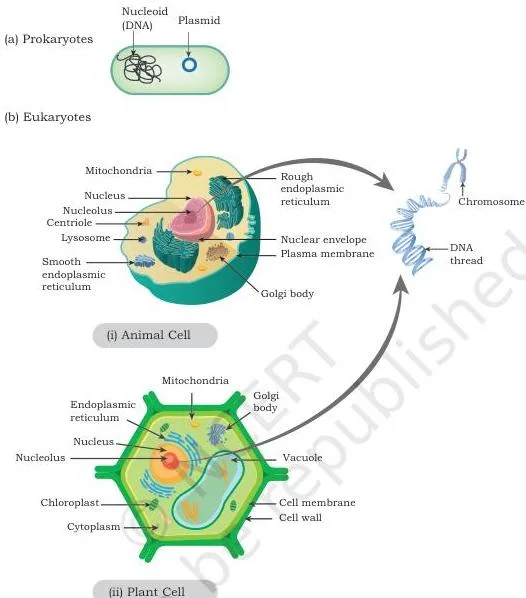
Fig. 5.2 shows the two kinds of map side by side: a circular map of a prokaryotic or organelle genome, and a linear eukaryotic map where loci a–h are arranged by genetic distance.
The same drawing style is later used for physical maps, so the figure teaches that genetic and physical maps differ in what they measure, not in how they look (NCERT, p. 5).
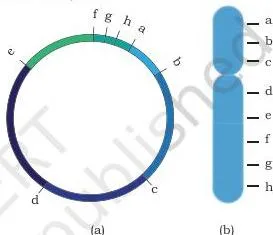
Fig. 5.3 explains RFLP by comparing two genomes that differ at a single restriction site. Genome (1) has site c, so cutting there produces two smaller fragments, which appear as two shorter bands (x). Genome (2) has lost site c, so the same cut produces one longer fragment, one larger band (y).
Loss or gain of a restriction site is exactly what RFLP detects (NCERT, p. 6).
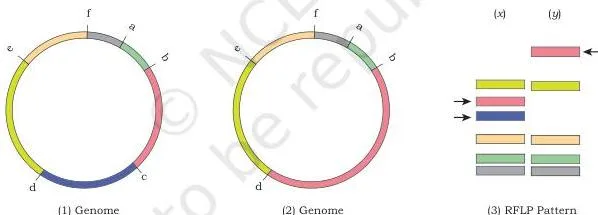
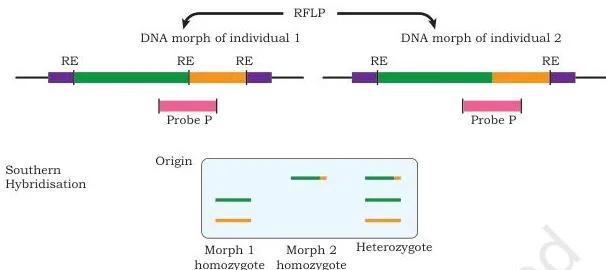
Fig. 5.4 shows why Southern hybridisation is needed: a probe P detects the two DNA morphs on a blot after the DNA is cut by a restriction enzyme, letting scientists see RFLP bands even when a gel would be too crowded to read (NCERT, p. 6).
Sequencing figures: how machines read DNA
Fig. 5.5 illustrates the Illumina workflow: DNA fragments with adaptors attach to oligonucleotides on a flow cell, form bridges, and are amplified into clusters of identical fragments. Fluorescently tagged bases are added one at a time, and each incorporated base is read by its fluorescence (NCERT, p. 10). The key idea is massive parallelism — millions of spots sequenced at once.
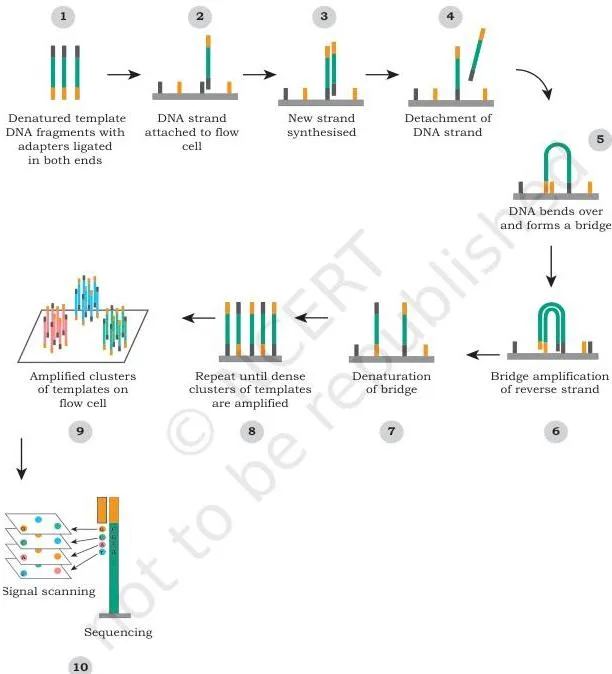
Fig. 5.6 shows nanopore sequencing in action. Yellow dots are ions flowing through a protein pore, maintaining an ionic current. As each base of single-stranded DNA passes through, it disrupts the current in a base-specific way; the example sequence read here is ACGT (NCERT, p. 12). An unwinding enzyme captures and feeds the DNA through the pore.
Engineering figures: how genomes are edited
Fig. 5.7 shows genome engineering through transposition. A transposon inserts itself into a target gene, breaking the coding frame, so the gene can no longer produce its normal product — a knock-out. If the inserted DNA adds a functional sequence, it is a knock-in (NCERT, p. 17).
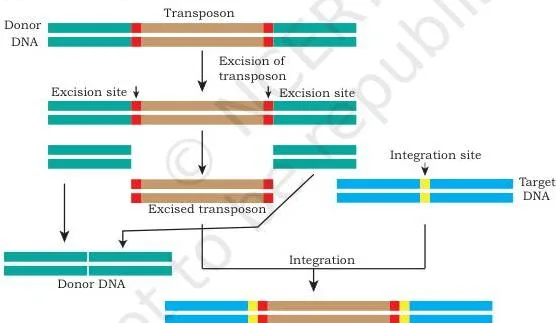
Fig. 5.8 is the most important engineering diagram in the chapter. A guide RNA positions the Cas9 complex at the target genomic DNA; Cas9 then makes a double-strand break. After the break, a supplied template DNA with the desired changes is used by the cell’s homologous repair machinery, so the edited sequence is written into the genome (NCERT, p. 18).
Cas9 cuts; homologous repair edits.
Protein engineering figures: redesigned proteins at work
Fig. 5.9 shows the catalytic triad of subtilisin — Ser 221, His 64 and Asp 32. Bleach oxidises Met 222 nearby and weakens the enzyme; replacing Met 222 with alanine by point mutation keeps the engineered subtilisin stable in bleach (NCERT, p. 22). The figure makes the triad’s spatial arrangement easy to remember.
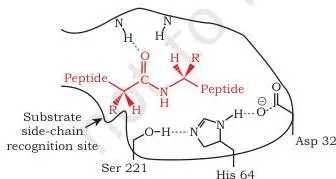
Fig. 5.10 demonstrates affinity purification. A recombinant protein carrying six consecutive histidines binds to nickel ions in the column while all other proteins wash through, and an elution buffer then releases the pure 6-His-tagged protein (NCERT, p. 22).
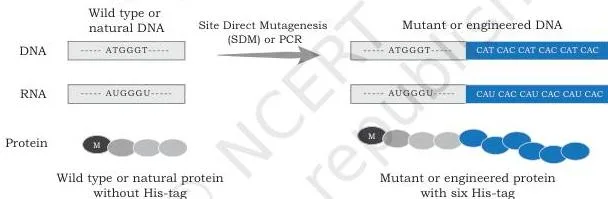
Fig. 5.11 shows GFP tagging for localisation. The GFP gene from the jellyfish Aequorea victoria is fused to a gene of interest; under UV light the engineered protein glows green, so its position inside the cell — here, the nucleus — can be seen by microscopy (NCERT, p. 22).
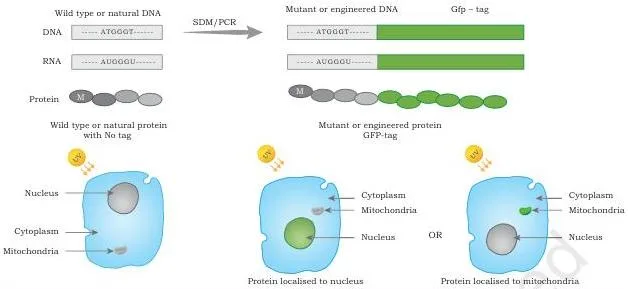
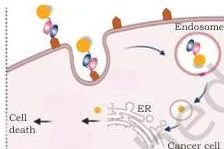
Fig. 5.12 traces how a recombinant immunotoxin is built and acts: a natural antibody’s variable light and heavy chains are joined by a linker into an scFv, its coding DNA is fused with toxin-coding DNA, the engineered protein binds to antigens on a cancer cell, is internalised by endocytosis, and the toxin is released in the cytosol to kill the cell (NCERT, p. 24).
Chapter 5 Definitions: Terms You Need to Remember
This quick-reference glossary collects the terminology the chapter expects you to know, each defined in one line in your own words.
| Term | Definition | Section |
|---|---|---|
| Genome | The complete DNA content of a cell, including organelle and plasmid DNA | 5.1 |
| Genetic map | Loci arranged by recombination frequency between them | 5.1.1 |
| Centimorgan (cM) | Genetic distance unit; 1 cM = 1% cross-over (recombination) | 5.1.1 |
| Recombination frequency | The rate at which two loci separate by crossing over; it measures relative distance | 5.1.1 |
| RFLP | Length variation in DNA fragments caused by gain or loss of a restriction site | 5.1.2 |
| SSLP | Simple sequence length polymorphism — repeat sequences of varying length used as map features | 5.1.2 |
| STS | Sequence tagged site — a unique 200–500 bp DNA sequence at a known genome location | 5.1.2 |
| Sequencing by chain termination | First-generation method using a ladder of fluorescently terminated DNA fragments | 5.2.1 |
| Bridge amplification | Illumina method that amplifies DNA fragments into clusters on a flow cell | 5.2.2 |
| Nanopore sequencing | Sequencing by detecting ionic current changes as bases pass through a protein pore | 5.2.3 |
| Whole genome sequencing | Determining the DNA sequence of an entire genome in one project | 5.3.1 |
| Targeted sequencing | Sequencing selected genes or regions, including clinical exome sequencing | 5.3.2 |
| Metagenomics | Sequencing DNA from an entire microbial community without culturing | 5.3.3 |
| Transposon | A “jumping gene” that moves from one genome location to another | 5.4.1 |
| Knock-out | Disabling a gene by disrupting its coding frame | 5.4.1 |
| Knock-in | Adding functional DNA at a genetic locus | 5.4.1 |
| Genome editing | Changing DNA by adding, removing or altering a specific sequence | 5.4.2 |
| Guide RNA | RNA that positions Cas9 at the DNA sequence to be edited | 5.4.2 |
| Structural genomics | Study of protein 3D structure or whole-genome physical organisation | 5.5.1 |
| Functional genomics | Study of how the genome’s information is executed in cell function | 5.5.2 |
| Comparative genomics | Comparison of genomes across species or individuals | 5.5.3 |
| Protein engineering | Designing proteins with new or improved properties via mutations | 5.6 |
| 6-His-tag | Six consecutive histidines that bind nickel, zinc or cobalt for purification | 5.6.1 |
| GFP | Green fluorescent protein from jellyfish, used to track protein location | 5.6.1 |
| Recombinant immunotoxin | A fusion of antibody selectivity with a cell-killing toxin | Box 2 |
| Humanised monoclonal antibody | A mouse antibody’s antigen-binding part transferred onto a human antibody | Box 3 |
Common Mistakes Students Make in Chapter 5 Genome Engineering
This chapter is concept-heavy, and most lost marks come from swapping similar ideas. The textbook draws the contrasts itself; these are the five places students trip.
| Mistake | Why it happens | Correction |
|---|---|---|
| Treating genetic map distance as physical distance | Both maps place loci along a line, so they look alike | A centimorgan measures recombination frequency (1 cM = 1% cross-over), never base pairs. Decreased recombination frequency means loci are genetically closer (NCERT, p. 5) |
| Miscounting RFLP fragments | The fragment rule is easy to misapply | In circular DNA, 1 cut = 1 fragment, 2 cuts = 2 fragments. In linear DNA, 1 cut = 2 fragments, 2 cuts = 3 fragments (NCERT, p. 6) |
| Thinking Cas9 inserts the new sequence | CRISPR is described as a “editing” tool, so students credit the enzyme with everything | Cas9 only cuts. The cell’s template-based homologous repair does the editing, copying the supplied template into the break site (NCERT, p. 18) |
| Swapping knock-out and knock-in | Both use transposon insertion and the words sound similar | Knock-out disables a gene by disrupting its coding frame; knock-in adds functional DNA at the locus (NCERT, p. 17) |
| Confusing WGS, targeted sequencing and metagenomics | All three are “sequencing” | WGS reads the whole genome; targeted sequencing reads selected regions; metagenomics reads DNA from a whole microbial community without culturing (NCERT, p. 14–16) |
One memory aid fixes the most common confusion of all: think of the guide RNA as a GPS that navigates to the right address, and Cas9 as the scissors that make the cut at that address. The repair machinery, not the scissors, rewrites the sentence.
How to Use Chapter 5 for Exam Preparation
This section maps the chapter’s own 21 exercise questions to the sections that answer them, so revision follows the book’s logic rather than your own order.
| Exercise questions | Section that answers them | What the questions test |
|---|---|---|
| Q1–2 | 5.1 | Definition of a genome; genetic vs physical mapping |
| Q3–4 | 5.1.2 | Restriction mapping; role of STS |
| Q5–6 | 5.2 | Development of sequencing; how next-generation overcomes first-generation |
| Q7 | 5.1.2 | Unit of physical mapping (RFLP fragment logic) |
| Q8 | 5.2.3 | Nanopore (third-generation) sequencing |
| Q9–11 | 5.3 | WGS, targeted sequencing, ChIP-seq/RNA-seq, metagenomics |
| Q12–14 | 5.4 (Q13 also 5.6) | Goals of genome engineering; transposons; CRISPR-Cas9 methodology |
| Q15 | 5.5 | Structural, functional and comparative genomics |
| Q16–19 | 5.6 | Applications; 6-His-tag purification; GFP tracking; recombinant immunotoxin |
| Q20 | 5.1.2 | Assertion-reason on RFLP |
| Q21 | 5.6 / Box 2 | Assertion-reason on recombinant immunotoxin |
For the two assertion-reason questions, test the assertion alone first, then the reason alone, then whether the reason actually explains the assertion. For Q20: the assertion is true and the reason is true, and the reason explains it — different individuals carry restriction sites at different positions, so the same enzyme produces different fragment lengths, which is exactly what RFLP detects.
For Q21: both statements are true, and the reason explains the assertion — fusing antibody coding DNA with toxin coding DNA is precisely how a recombinant immunotoxin is rationally engineered.
Long answers in this chapter earn their marks from methodology. A full-marks answer to Q14 should name the guide RNA, its two roles (complementary to target DNA, and binding Cas9), the double-strand break, and the template-based homologous repair that writes in the edited sequence. A full-marks answer to Q17 should give the numbered purification steps below.
Remember that textbook contents and the examinable syllabus are not always identical — check the current official CBSE syllabus to confirm the chapter’s scope this session.
Key Points to Retain From Chapter 5
This list condenses the chapter’s closing summary (NCERT, pp. 26–27) into points you can revise quickly.
- A genome is the complete DNA content of a cell — nucleoid and plasmid DNA in prokaryotes; nuclear, mitochondrial and plastid DNA in eukaryotes.
- Genome mapping has two approaches: genetic mapping (recombination-based, in centimorgans) and physical mapping (DNA features such as restriction sites, SSLP and STS).
- RFLP detects gain or loss of restriction sites through fragment-length changes on a gel; Southern hybridisation with a probe makes the pattern readable in complex genomes.
- STS are unique 200–500 bp sequences with known locations, used as PCR-detectable landmarks in physical maps.
- First-generation sequencing is chain-termination based: a fluorescent ladder separated by capillary gel electrophoresis, ~800–1000 bases per capillary.
- Next-generation Illumina sequencing uses bridge amplification on a flow cell for massive parallel sequencing, producing short reads of 75–300 bases.
- Nanopore (third-generation) sequencing reads long molecules (up to 1 Mb or more) from ionic current changes, in real time and at low cost.
- WGS sequences an entire genome, with reference-based or de novo assembly; the first bacterial WGS was of Haemophilus influenzae.
- Targeted sequencing and clinical exome sequencing focus on selected regions and are cheaper than WGS; ChIP-seq maps transcription-regulator binding sites, RNA-seq measures gene expression.
- Metagenomics sequences DNA from a whole microbial community without culturing, helping study gut microbes and extreme-environment organisms.
- Computational genomics uses high-performance computing — tools such as BLAST, ClustalW and Phylip — to analyse the large data sequencing generates.
- Genome engineering modifies a genome to add, remove or change function; transposon insertion gives knock-out (gene disabled) and knock-in (gene added).
- CRISPR-Cas9 editing: guide RNA positions Cas9, Cas9 cuts both strands, template-based homologous repair writes the edited sequence.
- Structural genomics covers protein 3D structure and chromosome organisation; comparative genomics finds core and species-specific genes; functional genomics links genome information to cell function.
- Protein engineering produces bleach-stable subtilisin, 6-His-tag purification, GFP localisation, recombinant immunotoxins and humanised monoclonal antibodies.
Related Resources: Class 12 Biotechnology Chapters
This listing is maintained for the 2026-27 academic session using the NCERT textbook information available to us. NCERT remains the authority for confirming the latest edition.
Put Chapter 5 in context with the rest of the book. The Class 12 NCERT books hub links every subject, and the Class 12 Biotechnology NCERT book page lists all chapters of this textbook. In the book’s own sequence, Chapter 4 covers recombinant DNA technology, which genome engineering builds on, and Chapter 6 moves to microbial, plant and animal cell cultures and bioprocessing.
For revision support on the same syllabus, the Class 12 Biotechnology notes include topic-wise pages such as applications of recombinant DNA technology and microbial, plant and animal cell cultures and bioprocessing, with the Class 12 notes hub as the entry point.
Reference: NCERT Class 12 Biotechnology textbook, chapter 5, official edition on ncert.nic.in.
Sources and Data Verification
The section structure, figures and exercise count described on this page come from the NCERT Class 12 Biotechnology textbook, Chapter 5 (“Genome Technology and Engineering”). NCERT publishes the official textbook editions and chapter PDFs on ncert.nic.in; the CBSE board sets the curriculum, syllabus and examinations.
This page is maintained for the current academic session using the NCERT information available to us. It is not a claim of 100% syllabus alignment, and it has not been reviewed by external subject experts — for examination scope, always check the official CBSE syllabus.
Genome Engineering Class 12 FAQs
Quick answers to the questions students search after downloading the chapter.
What is genome engineering in Class 12 Biotechnology?
Genome engineering is the technology used to modify a genome — adding, removing or changing one or more genes to introduce a new function or alter an existing one. The chapter presents two approaches: transposon-based knock-out and knock-in, and CRISPR-Cas9 genome editing (NCERT, p. 16).
What is the difference between genetic mapping and physical mapping?
Genetic mapping arranges loci by recombination frequency, measured in centimorgans, and gives a coarse map because few well-known phenotype loci are available. Physical mapping locates DNA features directly — restriction sites, SSLP repeats and STS markers — giving a high-resolution map (NCERT, pp. 5–6).
How does CRISPR-Cas9 edit a genome?
A guide RNA has one part complementary to the target DNA and one part that binds Cas9. The guide RNA positions Cas9 at the target sequence, Cas9 makes a double-strand break, and the cell then uses a supplied edited template in homologous repair to write the change into the genome (NCERT, p. 18).
What is the difference between whole genome sequencing and metagenomics?
Whole genome sequencing determines the complete DNA sequence of one organism’s genome. Metagenomics sequences the total genetic material of a whole microbial community directly from an environment — such as the animal gut — without culturing or separating the organisms (NCERT, pp. 14, 16).
How is a 6-His-tagged recombinant protein purified?
The protein carries six consecutive histidines, which bind metal ions such as nickel with high affinity at mildly alkaline pH. In affinity chromatography the tagged protein is immobilised on the metal in the column, other proteins are washed away, and an elution buffer releases the pure protein (NCERT, p. 22).
Where can I download the official Class 12 Biotechnology Chapter 5 genome engineering PDF?
From the official NCERT website at ncert.nic.in/ncerts/l/lebt105.pdf — the same link given at the top of this page. NCERT hosts the current edition of the full Class 12 Biotechnology textbook there.
Explore Class 12 Biotechnology Books
- Previous: Applications of Recombinant DNA Technology
- Next: Microbial, Plant, Animal Cell, Organ Cultures and Bioprocessing
Related chapters: