
Bioremediation Class 12 is Chapter 11 of the NCERT Class 12 Biotechnology textbook. The chapter runs 36 printed pages and explains how sewage, solid waste, biomedical waste and pesticide pollution are managed — first by conventional treatment, then by the living organisms that give the chapter its name.
The official NCERT PDF is right below, followed by a section map, a figure walkthrough and a revision summary of the chapter.
Download the Bioremediation Class 12 NCERT Chapter PDF
The Bioremediation Class 12 NCERT Chapter 11 PDF is the official chapter file, in the exact form NCERT publishes it on ncert.nic.in — the same document a school issues, with the complete text, all tables and every diagram in one printable file. Open it if you want the chapter as the book prints it, before you work through the breakdown below.
The rest of this page maps the chapter rather than copying it: what each section teaches, how to read the diagrams, and the definitions and rules worth memorising. Keep the PDF in one tab and this page in the other.
| What the chapter holds | Count | Where it is used |
|---|---|---|
| Printed pages | 36 | |
| Sections in the chapter | 9 | |
| Figures with NCERT captions | 12 | |
| Tables | 10 | |
| Exercise questions | 16 | answered in our NCERT Solutions |
| Official NCERT PDF | Download the chapter PDF | the chapter exactly as NCERT publishes it |
Chapter 11 at a Glance
The table below lists what this chapter actually contains — its sections, figures and exercises — so you know the size of the file before you open it.
What This Chapter Covers
Human activity pours pollutants into air, water and soil; this chapter explains how those wastes are managed by conventional means and by living organisms — the process called bioremediation.
| Chapter section | What it teaches | Why it matters |
|---|---|---|
| Chapter opener | Profile of Ananda Mohan Chakrabarty — the Indian-American microbiologist who built an oil-degrading Pseudomonas and fought the Diamond v. Chakrabarty patent case | Shows that engineered microbes for cleanup are possible, and patentable |
| 11.1 Waste Water Treatment | Sewage composition, BOD, primary/secondary/tertiary treatment | The most tested part of the chapter |
| 11.2 Solid Waste Management | Sources, health risks, dumping vs recycling, composting | Connects everyday waste to disease |
| 11.3 Management and Disposal of Biomedical Waste | BMWM Rules 2016 colour codes, WHO risk groups, radioactive waste | Rule-based marks, plus the Mayapuri case study |
| 11.4 Bioremediation of Pesticides | Pesticide classes, enzymes, in situ and ex situ strategies, Oilzapper, phytoremediation | The applied face of bioremediation |
Read the four sections in order: sewage first, then solid waste, then the biomedical rules, then the enzymes and strategies that actually do the cleaning. The key-concepts walkthrough below explains each one section by section.
Key Concepts in Chapter 11
Each idea below builds on the one before it, so work through them in order. The section number in each heading is where to follow along in the book.
Bioremediation: What the Name Means
The word splits into bio (living organisms) and remediate (to fix a problem). Domestic, agricultural and industrial activity releases pollutants into air, water and soil; many microorganisms can modify and degrade synthetic chemicals, so living organisms are employed to repair the damage — that is bioremediation.
Plants are part of the story too: using them is phytoremediation, covered in section 11.4. Every later section of the chapter — sewage, biomedical waste, pesticides — is this single idea applied to a different pollutant.
Sewage and the BOD Test
Before waste water can be treated you have to measure how dirty it is. That measurement is BOD (biochemical oxygen demand), and most treatment questions in this chapter build on it.
Sewage is the waste water of a home, community or industry, collectively — roughly 99 percent water and 1 percent suspended and soluble organic and inorganic matter (11.1.1). BOD is the oxygen required to stabilise decomposable organic matter and oxidisable inorganic matter by aerobic biological action (Box 1):
\[ \text{BOD} = (\text{D}_1 – \text{D}_2) \times \text{dilution factor} \]
where \( \text{D}_1 \) is the dissolved oxygen of the diluted sample before incubation and \( \text{D}_2 \) the value after five days at \( 20^\circ\text{C} \). When the organic load is too heavy to measure directly, the sample is diluted first; Box 1 gives the dilution factor table:
| Sample (mL) | Dilution water added (mL) | Dilution factor |
|---|---|---|
| 1000 | 0 | 1 |
| 500 | 500 | 2 |
| 200 | 800 | 5 |
| 100 | 900 | 10 |
| 50 | 950 | 20 |
| 20 | 980 | 50 |
Worked BOD calculation. A 100 mL sample of sewage is made up to 1000 mL with BOD-free water — dilution factor 10. The dissolved oxygen before incubation reads 8.0 mg/L and falls to 3.0 mg/L after five days at \( 20^\circ\text{C} \).
- Step 1: Find the oxygen consumed by the organic matter: \( \text{D}_1 – \text{D}_2 = 8.0 – 3.0 = 5.0\ \text{mg/L} \).
- Step 2: Multiply by the dilution factor: \( 5.0 \times 10 = 50\ \text{mg/L} \).
\[ \text{BOD} = (\text{D}_1 – \text{D}_2) \times \text{dilution factor} = (8.0 – 3.0) \times 10 = 50\ \text{mg/L} \]
Final answer: BOD = 50 mg/L — lower than the 100–300 mg/L that Table 11.1 lists for untreated domestic sewage, but still well above the treated-effluent ceiling of 25 mg/L, so this sample needs further treatment.
Strong versus weak sewage. A high BOD means more oxidisable organic matter — that is a strong sewage; a low BOD is weak sewage. Table 11.1 puts raw domestic sewage at a BOD of 100–300 mg/L before treatment and at up to 25 mg/L after it. Strong sewage entering a river quickly consumes dissolved oxygen, and fish die (Box 1).
Sewage also carries pathogens — coliforms, streptococci and others from Box 2 — which is why treatment matters for public health as much as for pollution.
The Three-Stage Sewage Treatment Plant
Raw sewage cannot be discharged into water bodies — it spreads disease and consumes dissolved oxygen — so it passes through a treatment plant in three stages (11.1.2 to 11.1.5).
- Primary (physical or mechanical). Screening removes bulky objects, a grit chamber settles sand and gravel, and sedimentation tanks concentrate the solids. The settled material is primary sludge, and BOD drops only 30–40 percent at this stage.
- Secondary (biological). Microorganisms do the work. Aerobic routes: the activated sludge process (compressed air is pumped through the effluent; the settled sludge, rich in conditioned bacteria, is partly recycled to the aeration tank), the trickling filter (effluent sprayed over a stone bed coated with a microbial film), and oxidation ponds. Anaerobic route: sludge digestion in the absence of oxygen, which takes 30–40 days and produces biogas with 60–70 percent methane; the residue is sold as fertiliser. Primary plus secondary removes up to 90 percent of BOD.
- Tertiary (advanced). Targets what secondary leaves behind: nitrates and phosphates. Lime precipitates phosphorus as insoluble calcium phosphate \( \text{Ca}_3(\text{PO}_4)_2 \); ammonia is stripped at high pH; carbon polishing removes dissolved organics; chlorination with sodium or calcium hypochlorite disinfects the effluent.
| Stage | Method | What it removes | What remains |
|---|---|---|---|
| Primary | Screening, grit chamber, sedimentation | Coarse solids (primary sludge) | Suspended organic matter; BOD cut by only 30–40 percent |
| Secondary | Activated sludge, trickling filter, oxidation ponds (aerobic); sludge digestion (anaerobic) | Suspended organic matter — up to ~90 percent BOD with primary | Nitrates and phosphates, some organics |
| Tertiary | Liming, ammonia stripping, carbon polishing, chlorination | Phosphorus, ammonia, dissolved organics; disinfection | Clean water — but still not drinking water |
Why the treated water is still not drinkable. The chapter’s conclusion is explicit: after tertiary treatment the effluent is clean water, but it still cannot be used as drinking water (11.1.5). Chlorination kills pathogens but does not make the effluent potable — so the water is safe to release, not safe to drink.
Why nutrients are removed at all: eutrophication. Nitrates and phosphates trigger the chain in Box 3: nutrients → algal bloom → surface algae block light → submerged plants die → decomposition of algae consumes oxygen → fish die. Answer any tertiary-treatment question with this chain and you have the “why” the examiner wants.
Two of the chapter’s MCQs come straight from this section: exercise 10 (lime removes phosphorus salts) and exercise 11 (maximum decomposition happens during secondary treatment).
Solid Waste: Sources, Risks and Management
Sewage is liquid waste; solid waste is everything else that is discarded — and its management is mostly about stopping waste from breeding disease.
Definition and sources (11.2). Solid waste is all non-liquid waste generated from households, streets, industrial, commercial and agricultural activities. Table 11.2 lists the major sources: residential, industrial, commercial, construction and demolition, municipal services, and agriculture.
The risks (11.2.1). Piled waste breeds mosquitoes: Aedes carries dengue and yellow fever, Anopheles malaria, Culex microfilariasis. Burning waste releases carcinogens, and rainwater washing through a dump produces leachate that pollutes surface and ground water. Box 5 ties the Surat plague to mishandled city waste and Delhi’s dengue outbreak to stagnant water.
Management (11.2.2). Two approaches govern everything: dumping and recycling (Fig 11.4). Sort waste at the point of generation; organic waste becomes compost; glass and plastic are reused; construction debris becomes floor filling; tyres are buried, never burnt, because burning emits toxic fumes. Community refuse pits sit away from water sources and are fenced.
Special wastes need expert handling:
- Medical waste — separated and incinerated; without an incinerator, treated with strong disinfectant; needles destroyed to prevent reuse.
- Slaughterhouse waste — handled by trained staff at designated sites.
- Industrial waste — processed by the industry itself under environmental rules.
- Toxic chemicals — disposed of per the manufacturer’s guidance, or with local health and environment officials.
Composting and the Microorganisms Behind It
Composting is the chapter’s example of natural recycling, and a compact test topic: one process, one temperature curve, one list of organisms.
Composting is the biological, chemical and physical process in which organisms break organic waste into carbon dioxide, water, heat and humus (11.2.2). Under optimal conditions it runs through three phases:
- Mesophilic — moderate temperature for a couple of days; soluble, readily degradable compounds break down fast.
- Thermophilic — above \( 40^\circ\text{C} \); pathogens are destroyed at \( 55^\circ\text{C} \) and above; aeration keeps the heap below \( 65^\circ\text{C} \). Proteins, fats, cellulose and hemicelluloses are degraded here.
- Maturation (curing) — the compost cools over months as the remaining organic matter finishes decomposing.
Optimum moisture is 45–65 percent.
The organisms, roughly in order of importance: bacteria make up 80–90 percent of the microbes in a gram of compost, with the genus Thermus dominating at the highest temperatures; actinomycetes, filamentous bacteria, degrade lignin, cellulose, chitin and even cardboard; fungi live in the outer layer through all phases; protozoa act as secondary consumers; worms and earthworms signal fertile soil — the basis of vermiculture.
Exercise 7 asks for exactly this organism list.
Biomedical Waste: The BMWM 2016 Colour Codes
Hospitals and laboratories generate waste that can infect anyone who touches it, so the Biomedical Waste Management Rules, 2016 divide it into four colour-coded categories. This is a rules-based topic where one wrong match costs a mark.
Biomedical waste is waste generated during diagnosis, treatment or immunisation of humans or animals, in research, in the production or testing of biologicals, and in health camps (11.3). Table 11.3 assigns the colours:
| Colour | What goes in the container |
|---|---|
| Yellow | Anatomical waste (human tissues, animal carcasses), soiled waste, expired medicines, chemical waste, contaminated bedding, microbiology and clinical laboratory waste |
| Red | Contaminated plastic waste — IV tubes, bottles, catheters, syringes without needles, urine bags, gloves |
| White | Sharps and metals — needles, blades, scalpels, anything that can puncture or cut (puncture-proof container) |
| Blue | Metallic body implants, broken or contaminated glass, vials, ampoules |
Memory aid: Yellow = body and chemicals, Red = plastic tubing, White = sharp blades, Blue = broken glass and implants.
The same waste is also classified by WHO into four risk groups on the basis of individual and community risk — rising from no or low risk (Group 1) to pathogens readily transmitted with no effective treatment available (Group 4). That basis of classification is the answer to exercise 16. Segregation must happen at the point of generation, by trained staff.
Radioactive waste follows separate rules: the Atomic Energy Regulatory Board (AERB) is the competent authority under the Atomic Energy (Safe Disposal of Radioactive Wastes) Rules, 1987. The chapter’s cautionary case is the Mayapuri radiological accident of April 2010, when a Cobalt-60 source sold to a Delhi scrap dealer was cut into eleven pieces, hospitalising eight people, one of whom died.
Exercise 15 (colour-code matching — the correct pair is White for sharp metals) is answered entirely from Table 11.3.
Pesticides, Biomagnification and Bioremediation
Pesticides protect crops and stored grain, but the same chemistry that kills pests can persist in the environment and poison everything else. This section explains which pesticides persist and which enzymes break them down (11.4, Box 9).
| Pesticide class | Examples | Persistence and key effect |
|---|---|---|
| Organochlorine | DDT, lindane, endosulfan, aldrin; atrazine (herbicide) | Very long; lipid-soluble, nervous system disrupter |
| Organophosphate | Parathion, malathion, dimecron | Less persistent; inhibits cholinesterase, so acetylcholine accumulates at synapses |
| Carbamates | Carbaryl, carbofuran | Less persistent; also cholinesterase inhibitors |
| Synthetic pyrethroids | Cypermethrin, deltamethrin | A few days; sunlight degrades them |
| Organometallic | Methylmercury | Very long; absorbed through skin, gut and respiration |
| Inorganic | Arsenic, mercury, cadmium, sulphur | Very long; coagulate proteins, affect the central nervous system |
DDT and biomagnification (Box 10). DDT was the first laboratory-synthesised pesticide, hailed for controlling malaria. Later, target insects developed resistance and non-target organisms were harmed — and because these chlorinated compounds are hydrophobic and lipid-soluble, they are essentially non-biodegradable. Agrochemicals enter plants and pass up trophic levels, accumulating in the tissues of organisms including humans; this is biomagnification.
The enzymes that do the cleaning (Box 11):
| Enzyme | Reaction it catalyses | What it degrades |
|---|---|---|
| Cytochrome P450 | Oxidation and reduction | Any xenobiotic (synthetic) compound |
| Esterase | Hydrolysis | Organophosphate and carbamate pesticides |
| Oxidase | Redox | Oxidation–reduction reactions |
| Peroxidase | Redox | Organometallic compounds |
| Transferase | Glutathione transfer, hydrolysis, redox | Electrophilic pesticides |
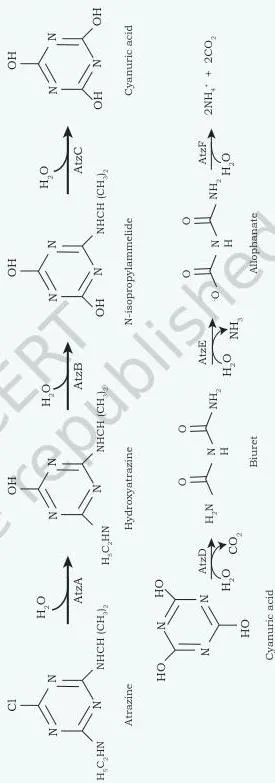
Key bacteria that carry out the breakdown are named in Box 12 — Pseudomonas, Aerobacter, Acinetobacter, Plesiomonas, Neisseria, Sphingomonas, Flavobacterium — and a series of Atz genes (Atz A to Atz F) lets Pseudomonas use the herbicide atrazine as a carbon source (Box 13).
Exercise 4 asks about xenobiotic compounds — synthetic chemicals foreign to biological systems — and their effect on soil productivity; exercise 12 asks for the hydrolytic enzyme, and the answer is esterase.
Bioremediation Strategies: In Situ and Ex Situ
Knowing the enzymes is the theory; this section is the application — where the cleanup happens, plus the two Indian technologies (the superbug and Oilzapper) the chapter is known for (11.4).
In situ means treating the contaminated site where it is. Intrinsic in situ bioremediation relies on microbes already present; it is cheap and causes little disruption, but it is slow and rarely complete.
Engineered in situ bioremediation circulates oxygen, nitrogen and growth-promoting substances into the soil through injection and extraction wells — the pollutant acts as the electron donor and oxygen as the electron acceptor (Fig 11.6).
Ex situ strategies excavate heavily contaminated soil and treat it separately:
- Slurry bioreactors — soil agitated with water and nutrients; mobile units exist.
- Land farming — nutrients and moisture applied to a prepared bed.
- Composting — contaminated soil mixed with agricultural waste.
- Biopiles — excavated soil mixed with leachate materials that drain toxicants out.
The superbug (Box 14). Ananda Mohan Chakrabarty took hydrocarbon-degrading plasmid genes from four Pseudomonas strains and, using rDNA technology, combined them into a single Pseudomonas putida that degrades camphor, naphthalene, octane and xylene. His 1980 Supreme Court case Diamond v. Chakrabarty made it possible to patent a recombinant microbe — the legal landmark behind the chapter’s opening profile.
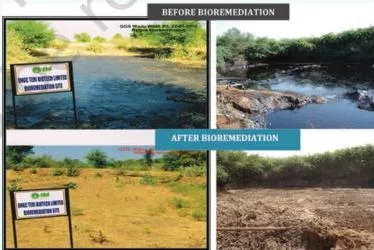
Oilzapper is TERI’s invention with the Department of Biotechnology: a consortium of five non-pathogenic bacterial strains immobilised on powdered corncob that degrades the aliphatic, aromatic and asphaltene fractions of oil sludge. TERI and ONGC run it jointly through the venture OTBL, and it has cleaned more than 7,50,000 metric tonnes of oil sludge in India and the Middle East.
Phytoremediation uses plants and their rhizosphere microbes — through chelation, methylation, pH change and altered redox reactions — to remediate toxicants. Nitrogen-fixing diazotrophs also produce plant hormones (IAA and gibberellins) while remediating heavy metals. Recall Table 11.4 as:
| Microbe | Host plant | Heavy metals remediated |
|---|---|---|
| Azotobacter chroococcum | Maize, mustard | Lead, zinc |
| Rhizobium leguminosarum | Maize | Lead, zinc |
| Rhizobium sp. | Pea, lentil | Nickel, zinc |
Two aquatic plants — Hydrilla verticilliata and Nymphaea alba — reduce chromium in polluted water, and Brassica napus and Helianthus annus (from Class XI) accumulate mercury and lead. Exercise 13’s answer follows from this section: sludge digestion belongs to sewage treatment, so it is not an ex situ bioremediation strategy.
Figure Walkthrough: The Key Diagrams of Chapter 11
These are the diagrams exam answers ask you to label or explain. Read each caption, then the “how to read it” lines below it — together they give a full figure answer.
Reading the Sewage Treatment Diagrams (Figs 11.1–11.3)
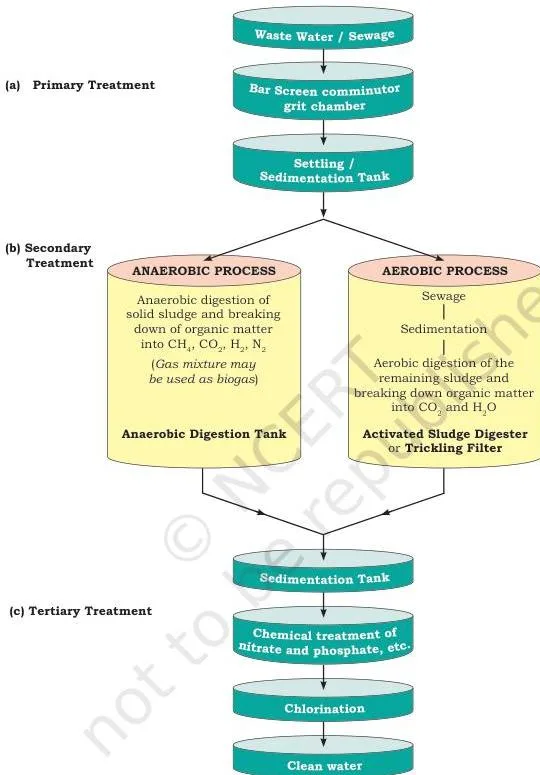
Follow the flow left to right. Screening and the grit chamber are the primary stage; the aeration and settling tanks are secondary; chemical dosing and chlorination are tertiary. If you can describe each box in one line, you can redraw the whole plant from memory.
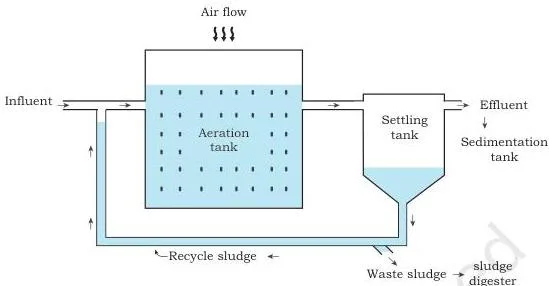
The exam point is the recycle loop: a portion of the settled activated sludge returns to the aeration tank to re-inoculate the incoming effluent, while the rest goes to the sludge digester. Draw the returning arrow and you have shown you understand the process.
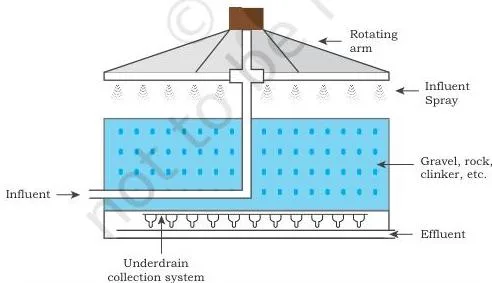
The rotating sprinkler arms saturate the effluent with oxygen as they spray it over the stone bed. The slimy microbial film coating the stones degrades the organic matter as the liquid seeps down, and the collected effluent moves to a sedimentation tank.
Solid Waste and Composting Diagrams (Figs 11.4–11.5)
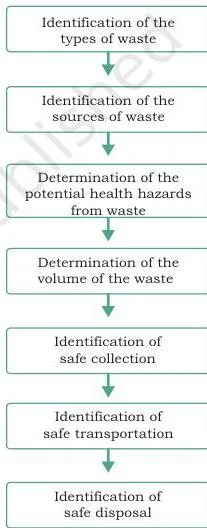
This diagram flows from waste generation to the two handling paths — dumping and recycling. Be able to name the stages in order: generation, sorting, then the chosen treatment route for each fraction.
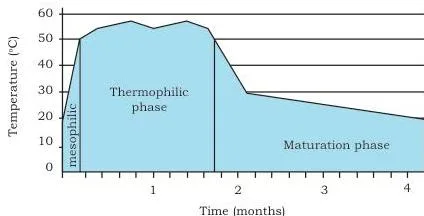
Label the curve: the early mesophilic rise, the thermophilic plateau above \( 40^\circ\text{C} \) (pathogens die at \( 55^\circ\text{C} \); aeration keeps it below \( 65^\circ\text{C} \)), then the long cooling tail of maturation. The curve is the whole composting story in one picture.
Bioremediation Diagrams and Field Photos (Superbug, Fig 11.6, Oilzapper)
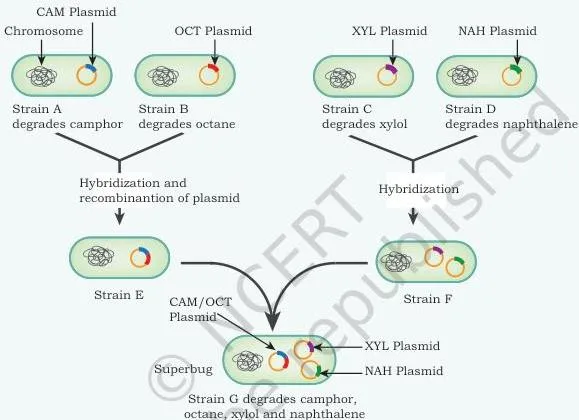
Read it as a construction story: four donor Pseudomonas strains each contribute plasmid-borne genes, and rDNA technology assembles them into one Pseudomonas putida — the superbug. This is the figure behind Box 14 and the chapter-opening Chakrabarty profile.
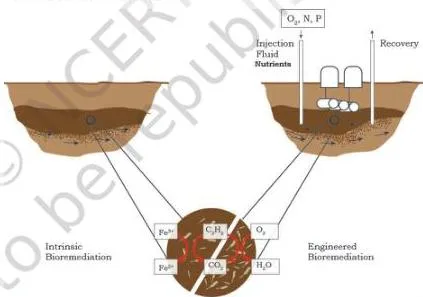
Two wells, two jobs: the injection well pushes oxygen and nutrients down into the contaminated soil, and the extraction well draws treated groundwater up. Remember the electron bookkeeping — the pollutant is the electron donor, oxygen the electron acceptor.
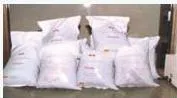
The sterile polybags hold the five non-pathogenic strains immobilised on powdered corncob. The carrier is what makes the product shippable to oil-contaminated sites.
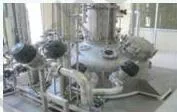
The photograph shows the fermenter fleet — the largest at 13 kL, the smallest at 10 L — that scales up the consortium for commercial production.
Definitions You Need to Know
These are the terms the chapter defines or builds on. Each row is one line — enough for a “define” question and a solid anchor for a longer answer.
| Term | Plain definition | Where it appears |
|---|---|---|
| Sewage | Waste water of a home, community or industry, collectively | 11.1 |
| BOD | Oxygen required to stabilise decomposable organic matter by aerobic biological action | 11.1.1, Box 1 |
| Strong sewage | High BOD — much oxidisable organic matter | Box 1 |
| Weak sewage | Lower BOD — comparatively less oxidisable matter | Box 1 |
| Primary sludge | Coarse solids settled out during primary treatment | 11.1.3 |
| Activated sludge | Bacteria-rich sludge settled in secondary treatment, partly recycled to the aeration tank | 11.1.4 |
| Trickling filter | Stone bed coated with a microbial film, over which effluent is sprayed | 11.1.4 |
| Eutrophication | Excessive growth of photosynthetic microorganisms caused by excess nutrients | Box 3 |
| Algal bloom | Rapid growth of algae in a water body | Box 3 |
| Oxidation pond / lagoon | Shallow pond oxygenated by wind and algal photosynthesis | 11.1.4 |
| Anaerobic sludge digestion | Oxygen-free digestion of sludge, producing methane-rich biogas | 11.1.4 |
| Chlorination | Final disinfection of tertiary effluent with sodium or calcium hypochlorite | 11.1.5 |
| Solid waste | All non-liquid waste from households, streets, industry, commerce and agriculture | 11.2 |
| Leachate | Polluted liquid seeping out of waste into surface or ground water | 11.2.1 |
| Composting | Organisms breaking organic waste into carbon dioxide, water, heat and humus | 11.2.2 |
| Xenobiotic | A synthetic compound foreign to biological systems | 11.4 |
| Biomagnification | Toxicants accumulating as they pass up trophic levels | 11.4 |
| Intrinsic in situ bioremediation | Natural on-site degradation by microbes already present | 11.4 |
| Engineered in situ bioremediation | On-site cleanup boosted by circulated oxygen and nutrients | 11.4 |
| Ex situ bioremediation | Excavated soil treated separately from the site | 11.4 |
| Phytoremediation | Using plants and rhizosphere microbes to remediate toxicants | 11.4 |
| Diazotrophs | Nitrogen-fixing bacteria | 11.4 |
Common Mistakes Students Make in Chapter 11
The chapter’s own boxes exist to prevent these errors. Read the mistake column first, then the correction — each row is one mark saved.
| Mistake | Correct rule | How to check your answer |
|---|---|---|
| Reading BOD as the dissolved oxygen currently in the water | BOD is the oxygen REQUIRED to stabilise the organic matter — \( (\text{D}_1 – \text{D}_2) \times \text{dilution factor} \) after five days at \( 20^\circ\text{C} \) (Box 1) | A single DO reading is not a BOD; a difference times a factor is |
| Treating tertiary effluent as drinking water | The final effluent is clean water but still cannot be used as drinking water; chlorination disinfects but does not make it potable (11.1.5) | If your answer ends “…so it is fit to drink,” it is wrong |
| Believing bioremediation always removes a toxicant completely | Bioremediation removes the toxicant completely OR alters its chemical nature into a less harmful form; intrinsic in situ bioremediation usually does not achieve complete remediation (11.4) | In exercise 14 the assertion overstates the process — “completely” is the trap word |
| Mixing up aerobic and anaerobic treatment | Activated sludge, trickling filters and oxidation ponds are aerobic; sludge digestion is anaerobic and produces methane (60–70 percent) | Name the gas — methane means anaerobic |
| Swapping the biomedical waste colour codes | Yellow = anatomical/soiled/chemical/lab waste, Red = contaminated plastic, White = sharps, Blue = glass and metallic implants (Table 11.3) | Recite the memory aid (Yellow-body, Red-plastic, White-sharp, Blue-glass) before any colour match |
| Blaming organic matter itself for eutrophication | The driver is excess nutrients, especially nitrates and phosphates, which trigger the algal bloom (Box 3) | Your answer should contain the word “nutrients”, not just “sewage” |
| Assuming primary treatment removes the organic load | Primary treatment removes coarse solids; BOD drops only 30–40 percent at this stage | If your answer gives primary treatment a ~90 percent BOD cut, you have confused the stages |
How the Chapter Is Tested: Exam Notes
The chapter ends with a set of exercises. The map below matches each one to the section that answers it and the question type, so you can revise by type rather than by question number.
| Question | Answered from | Type and what a full answer needs |
|---|---|---|
| 1 | 11.1.4 | Direct concept — name the microorganisms and their role in secondary treatment |
| 2 | 11.1.1, Box 1 | Concept — BOD as the measure of oxidisable organic matter (oxygen equivalence) |
| 3 | 11.4, Box 10 | Reasoning — trace the toxicant up trophic levels (biomagnification) |
| 4 | 11.4, Boxes 12–13 | Definition plus effect — xenobiotic compounds and soil productivity |
| 5 | 11.1.4 | Process — aerobic decomposition (activated sludge, filters, ponds) vs anaerobic sludge digestion |
| 6 | 11.2, Table 11.2 | Listing — the major sources and types of solid waste |
| 7 | 11.2.2 | Process — the role of bacteria, actinomycetes, fungi and protozoa in composting |
| 8 | 11.4, Box 10 | Reasoning — resistance in targets, harm to non-targets, persistence |
| 9 | 11.4, Box 11 | Process — enzymes converting pesticides into non-toxic products |
| 10 | 11.1.5 | MCQ — lime removes phosphorus salts (as insoluble calcium phosphate) |
| 11 | 11.1.4 | MCQ — maximum decomposition occurs during secondary treatment |
| 12 | 11.4, Box 11 | MCQ — esterase is the hydrolytic enzyme |
| 13 | 11.4 (strategies) | MCQ — sludge digestion is sewage treatment, not an ex situ bioremediation strategy |
| 14 | 11.4 (in situ) | Assertion-reason — “completely” overstates bioremediation; intrinsic in situ rarely achieves it |
| 15 | 11.3, Table 11.3 | MCQ — White is the sharps/needles colour |
| 16 | 11.3, Box 6 | Direct — WHO classifies by individual and community risk and the availability of treatment |
Four things are worth being able to reproduce from memory: the three treatment stages in order, the four biomedical colour codes, the five enzyme–pesticide matches, and the difference between intrinsic and engineered in situ bioremediation. Be ready to label the activated-sludge recycle loop and the composting temperature curve — both are classic label-a-diagram targets.
A full-marks answer to the process questions names the stage or organism AND states what it removes or produces.
Note that textbook contents and the examinable syllabus are not always identical — check the current official syllabus for what is examinable this session.
One-Page Revision Summary
Everything above, compressed into four blocks for the night before the exam. The bold terms are the ones to say out loud first.
Block 1 — Waste water. Sewage is roughly 99 percent water. BOD measures the oxygen equivalence of its organic matter. Primary treatment removes coarse solids; secondary removes suspended organic matter biologically — the aerobic routes are activated sludge, trickling filter and oxidation ponds, while sludge digestion is anaerobic and yields 60–70 percent methane. Tertiary removes nitrogen and phosphorus nutrients.
The final effluent is clean but not drinking water.
Block 2 — Solid waste. Solid waste is all non-liquid waste from households, streets, industry, commerce and agriculture. Two approaches: dumping and recycling. Sort at the generating point; organic waste becomes compost; tyres are buried, never burnt. Medical, slaughterhouse and industrial wastes need special handling.
Block 3 — Biomedical waste. BMWM Rules 2016 set four colour codes: Yellow (anatomical, soiled, chemical, lab waste), Red (contaminated plastic), White (sharps) and Blue (glass and metallic implants). Segregate at the point of generation. WHO risk groups 1–4 run from no or low risk to readily transmitted pathogens. Radioactive waste follows AERB rules — the Mayapuri Cobalt-60 accident is the cautionary case.
Block 4 — Pesticides. Classes: organochlorine, organophosphate, carbamate, synthetic pyrethroid, organometallic and inorganic. Persistence and lipid solubility drive biomagnification. Enzymes: cytochrome P450 (any xenobiotic), esterase (organophosphates and carbamates), oxidase, peroxidase (organometallics) and transferase. Strategies: intrinsic vs engineered in situ; ex situ — slurry bioreactor, land farming, composting, biopiles. Technologies to name: the superbug and Oilzapper.
Plants clean up through phytoremediation, with diazotrophs helping on heavy metals.
Colour memory aid: Yellow = body and chemicals, Red = plastic tubing, White = sharp blades, Blue = broken glass and implants.
Related Resources
This listing is maintained for the 2026-27 academic session using the NCERT textbook information available to us. NCERT remains the authority for confirming the latest edition.
Move to the rest of the Class 12 Biotechnology section, or back to the book page:
- Return to the NCERT Class 12 Biotechnology book page to open any other chapter of the book.
- Browse the Class 12 book hub for the other subjects.
- Use the Bioprocessing and Biomanufacturing notes and the Recent Innovations in Biotechnology notes for the chapters adjacent to this one.
- Find revision material for the whole subject on the Class 12 Biotechnology notes hub, the Class 12 notes hub, or the main notes home.
Sources and Data Verification
- All content on this page is drawn from the NCERT Class 12 Biotechnology textbook, Chapter 11 (Bioremediation), official NCERT edition, hosted on NCERT’s official website.
- This page covers that chapter only — not other chapters of the book, and not other Class 12 subjects.
- This listing is maintained for the current academic session using the NCERT information available to us.
- NCERT settles textbooks, editions and official PDFs; CBSE settles the curriculum, syllabus and examinations. A chapter appearing in a textbook is not proof that every part of it is examinable, so check the current official syllabus.
Reference: NCERT Class 12 Biotechnology textbook, chapter 11, official edition on ncert.nic.in.
Frequently Asked Questions
What is BOD and what does a high BOD value tell us?
BOD (biochemical oxygen demand) is the oxygen required to stabilise the decomposable organic matter in sewage by aerobic biological action — \( (\text{D}_1 – \text{D}_2) \times \text{dilution factor} \) after five days at \( 20^\circ\text{C} \) (Box 1).
A high BOD means the sewage is rich in oxidisable organic matter — a strong sewage — so it will quickly consume the dissolved oxygen of any water body it enters, killing fish and other aquatic fauna (11.1.1).
Why is tertiary treated sewage water not fit for drinking?
Because tertiary treatment removes nutrients, dissolved organics and pathogens, but the chapter’s conclusion is explicit: the final effluent is clean water but still cannot be used as drinking water (11.1.5). Chlorination kills pathogens but does not make the effluent potable.
What are the yellow, red, white and blue biomedical waste colour codes under BMWM Rules 2016?
The Biomedical Waste Management Rules, 2016 assign four colours: Yellow for anatomical waste, soiled waste, expired medicines, chemical waste, contaminated bedding and microbiology or clinical laboratory waste; Red for contaminated plastic waste such as IV tubes, catheters, urine bags and gloves; White for sharps — needles, blades and scalpels in a puncture-proof container; Blue for metallic body implants and broken or contaminated glass, vials and ampoules (Table 11.3).
Segregation happens at the point of generation by trained staff (11.3).
What is the difference between in situ and ex situ bioremediation?
In situ bioremediation treats the contaminated soil or water at the site: intrinsic, using naturally present microbes (slow, rarely complete, cheap), or engineered, where oxygen and nutrients are circulated through injection and extraction wells. Ex situ bioremediation excavates heavily contaminated soil and treats it elsewhere using slurry bioreactors, land farming, composting or biopiles (11.4).
What is Oilzapper and how does it clean oil spills?
Oilzapper is a technology developed by TERI with the Department of Biotechnology: a consortium of five non-pathogenic bacterial strains, immobilised on powdered corncob, that degrades the aliphatic, aromatic and asphaltene fractions of oil sludge. The TERI–ONGC joint venture OTBL handles implementation, and the product has cleaned more than 7,50,000 metric tonnes of oil sludge in India and the Middle East (11.4).
Which microorganisms and plants are used in phytoremediation for heavy metals?
The nitrogen-fixing diazotrophs Azotobacter chroococcum (with maize and mustard) and Rhizobium leguminosarum (with maize) remediate lead and zinc, while Rhizobium sp. with pea and lentil remediates nickel and zinc. The aquatic plants Hydrilla verticilliata and Nymphaea alba reduce chromium, and Brassica napus and Helianthus annus accumulate mercury and lead (11.4, Table 11.4).
Explore Class 12 Biotechnology Books
- Previous: Bioprocessing and Biomanufacturing
- Next: Recent Innovations in Biotechnology
Related chapters: