
Bioprocessing and Biomanufacturing Class 12 is Chapter 10 of the NCERT Biotechnology textbook — a 22-page chapter, and the official chapter PDF is on this page. The chapter tells one complete story: how the chance discovery of penicillin in 1928 pushed scientists to grow living cells in engineered vessels and turn their products into everyday goods.
Below you get the official NCERT Class 12 Biotechnology Chapter 10 (Bioprocessing and Biomanufacturing) PDF download, a guided tour of sections 10.1 to 10.4, every figure in the chapter explained, and the chapter’s tables turned into study form. Keep the PDF open in one tab and this guide in the other.
Download Bioprocessing and Biomanufacturing Class 12 Chapter PDF
The official NCERT Class 12 Biotechnology Chapter 10 (Bioprocessing and Biomanufacturing) PDF is hosted on the NCERT website and is the exact chapter file this page works from — open it beside this guide and follow the section and figure numbers as you read.
| What the chapter holds | Count | Where it is used |
|---|---|---|
| Printed pages | 22 | |
| Sections in the chapter | 6 | |
| Figures with NCERT captions | 9 | |
| Tables | 3 | |
| Exercise questions | 10 | answered in our NCERT Solutions |
| Official NCERT PDF | Download the chapter PDF | the chapter exactly as NCERT publishes it |
Bioprocessing and Biomanufacturing Class 12: Chapter at a Glance
This table shows how much the chapter holds — sections, figures, tables and exercise questions — so you can plan your reading before you start.
Inside the chapter you will also meet three numbered tables worth knowing by name: Table 10.1 compares filtration processes by pore size and pressure, Table 10.2 groups products by whether they are cell biomass, extracellular or intracellular, and Table 10.3 lists the major commercial products you will pair with their microbes.
What This Chapter Covers: From Penicillin to Bioreactors
This is the chapter’s map. Use it to find where each idea lives, then go to the Key Concepts section for the full explanation.
| Section | What it teaches | Why it matters |
|---|---|---|
| 10.1 Historical Perspective | Fleming’s 1928 discovery of penicillin from a contaminated plate of Staphylococcus aureus; Chain and Florey establishing it as an antibiotic; the 1945 Nobel Prize; the drive to mass-produce it. | It is the origin story — bioprocessing was born because a chance discovery could not meet demand. |
| 10.2 Instrumentation in Bioprocessing | What a bioreactor must provide (sterile environment, air supply, uniform mixing, temperature control, monitoring) and its parts; the stirred tank, air-lift and bubble column reactors. | The machine — Exercise 8’s matching questions come straight from the component list. |
| 10.3 Operational Stages of Bioprocess | The two stages — upstream (media, sterilisation, inoculum, conditions) and downstream (recovery, purification, effluent disposal) — and the three modes of operation. | The process — the heart of the chapter and the skeleton for Exercises 4, 5 and 6. |
| 10.4 Bioprocessing and Biomanufacturing of Desired Products | The commercial catalogue: ethanol, amino acids, organic acids, enzymes, antibiotics, vitamins, vaccines, recombinant proteins and plant metabolites. | The payoff — every microbe-to-product pairing in the chapter lives in this section and Table 10.3. |
The story that frames the whole chapter is from Section 10.1: in 1928, Alexander Fleming noticed that bacteria did not grow near a foreign mould in an unwashed contaminated plate — later identified as Penicillium notatum. Ernest Chain and Howard Florey established penicillin’s full potential as an antibiotic, and all three shared the 1945 Nobel Prize.
That single chance observation is why this chapter exists.
For notes-style revision of the whole syllabus as you go, the Class 12 Biotechnology notes hub collects the other chapters of this book.
Key Concepts in Bioprocessing and Biomanufacturing Class 12
Bioprocessing means using living systems — microbes, plant or animal cells, or their components such as enzymes — together with chemical engineering to make products at commercial scale. That scale is large: the chapter states an average working volume of 100 to 10,000 litres, which is why an engineered vessel replaces the laboratory flask.
Two words divide the chapter: metabolites. Primary metabolites come directly from primary metabolic pathways tied to essential functions such as growth and development. Secondary metabolites are intermediates or indirect products of separate secondary metabolic pathways — used in defence against pathogens and herbivores, tolerance to abiotic stress, and attraction of pollinators.
Because secondary metabolites are made in tiny natural amounts, bulk production needs the whole machinery this chapter describes.
Upstream Processing: Media, Inoculum, Aeration and Sterilisation
Upstream processing is the preparation stage of a bioprocess: everything that happens before the culture enters the bioreactor. Section 10.3.1 lists four components:
- optimising nutritional conditions and formulating artificial media for the culture
- sterilising the media, bioreactor and additional tools and equipment
- producing a pure, active, healthy inoculum in sufficient quantity
- optimising environmental conditions for growth and product formation
The inoculum — the culture used to start the process — must satisfy six criteria in Section 10.3.1:
- it should be healthy and in the log or exponential phase (actively dividing)
- it should not show a long lag phase after transfer
- it should be available in sufficient amount for an optimum inoculum size
- it should be in a suitable morphological form
- it should be free of contamination
- it should retain its product-forming capability
Aeration feeds oxygen to the submerged culture; the chapter notes that pure water holds at most about 8 g/L of dissolved oxygen, so the sparger must keep supplying sterilised air. Agitation spreads oxygen and nutrients uniformly, and it must stay gentle: animal cells are more shear-sensitive than plant cells, and plant cells more so than microbial cells.
Sterilisation protects the whole process. The chapter gives five contamination-avoidance points: sterilise the nutrient media, sterilise the bioreactor vessel, sterilise every material added during the process, keep aseptic conditions during fermentation, and use a pure culture as inoculum. Media formulations themselves belong to earlier chapters (the chapter cross-references Chapters 6–8 of this book).
Fig 10.4 summarises the full development pipeline — the walkthrough below reads it for you.
Modes of Bioprocess Operation: Batch, Fed-Batch and Continuous
The mode of operation decides how nutrients enter the vessel and how culture leaves it. Three modes appear in the chapter, and the differences between them are the most-tested idea in this chapter.
| Feature | Batch | Fed-batch | Continuous |
|---|---|---|---|
| What is added | Nothing after the start; nutrients are fixed initially | Growth-limiting substrate, fed intermittently or continuously | Fresh nutrient medium, continuously |
| What is removed | Nothing until the run ends | Nothing — the culture volume rises because only feed is added | Used medium, continuously |
| What stays constant | Nothing — substrate falls as cells rise through the growth phases | Substrate concentration S and rate of substrate utilisation Qs stay constant; cell biomass keeps increasing | At steady state, growth rate, product formation, S and Qs all stay constant |
| Why choose it | Simplest; a closed culture system | Keeps residual substrate very low and avoids its toxic effects | Gives an uninterrupted supply of the desired product |
Read the table as a story. A batch culture starts with everything it will ever get and consumes it. A fed-batch culture starts the same way but receives extra substrate whenever a component runs low. A continuous culture trades away its fixed identity for a steady state — new biomass forms at exactly the rate cells are lost from the vessel.
Fig 10.5 plots all three modes; the walkthrough below shows you how to read the curves.
Downstream Processing: Separation, Recovery and Purification
Downstream processing gets the product out of the broth after fermentation. The chapter gives two design rules: the chosen recovery process must be quick, and it must run at minimum investment and minimum cost.
The steps run in a fixed order. First, solids are separated from the culture fluid — filtration for large particles and cell biomass, centrifugation for particles between 100 µm and 0.1 µm.
If the product is intracellular, cells are then disrupted: physical methods (high-speed bead mills, high-pressure homogenisers, ultrasonication) or non-mechanical methods (surfactants, alkalis, organic solvents, osmotic shock, enzymatic degradation of the cell wall).
Next comes recovery. Liquid–liquid extraction uses a solvent in which the product is preferentially soluble: the solute-rich phase is the extract, and the leftover liquid is the raffinate. Purification follows, chiefly by precipitation (adding salts, organic solvents or ultrafiltration to recover proteins and antibiotics) and by membrane separation. The essential numbers from Table 10.1:
| Membrane process | Pore size | Molecular weight cutoff | Pressure drop |
|---|---|---|---|
| Microfiltration | 0.1–10 µm | below 1,000,000 Da | 10 psi |
| Ultrafiltration | 0.01–0.1 µm | 300–300,000 Da | 10–100 psi |
| Reverse osmosis | under 0.001 µm | below 300 Da | 100–800 psi |
Two techniques end the chapter’s list. In reverse osmosis, water is driven from a saline phase back to a pure phase by applied pressure slightly greater than the osmotic pressure — against the concentration gradient.
Dialysis removes low-molecular-weight solutes (organic acids of 100–500 Da, inorganic ions of 10–100 Da) through a selectively permeable membrane; the chapter’s own anchor is urea (molecular weight 60) in artificial kidney devices. Figs 10.6, 10.7 and 10.8 support all of this.
The Yield Coefficient: What the Equation Means, With a Worked Example
The chapter contains one equation you should be able to use, not just quote: the cellular yield coefficient Y. It measures how efficiently a culture converts the carbon source into cell mass:
\[ Y = \frac{\text{quantity of cell dry weight produced by the culture}}{\text{quantity of carbon substrate utilised}} \]
Both quantities are masses, so Y is expressed in grams of cells per gram of substrate. A value of 0.35 means the culture forms 0.35 g of dry cell mass for every gram of carbon source it consumes.
Worked example: a culture produces 42 g of dry cell mass after consuming 120 g of glucose. Then \[ Y = \frac{42\ \text{g}}{120\ \text{g}} = 0.35 \]
Therefore 0.35 g of cells forms per gram of glucose used, and the higher Y, the more efficiently the substrate is converted into biomass. The chapter uses Y to design economical media — estimate what a culture needs and avoid wasting media components.
The chapter also gives the stoichiometric summary of growth:
\[ \text{Carbon/energy source} + \text{nitrogen source} \rightarrow \text{biomass} + \text{products} + \text{CO}_2 + \text{water} + \text{heat} + \text{other requirements} \]
Knowing how much of each input a culture converts lets you formulate media with minimal wastage and optimum productivity.
Which Microbe Makes Which Product: A Study Table
The final section of the chapter is a product catalogue. This table collects every pairing the chapter names, so you can revise microbe-to-product without hunting through the prose.
| Product | Category | Organism used |
|---|---|---|
| Ethanol | Alcohol | Saccharomyces cerevisiae |
| L-glutamic acid | Amino acid | Corynebacterium glutamicum |
| Lysine | Amino acid | Mutants of Corynebacterium glutamicum |
| Lactic acid | Organic acid | Lactobacillus delbrueckii (also Lactobacillus sp.) |
| Citric acid | Organic acid | Aspergillus niger |
| Acetic acid | Organic acid | Acetobacter aceti |
| Butyric acid | Organic acid | Clostridium butylicum |
| Proteases | Enzymes | Bacillus spp. |
| Pectinase | Enzymes | Aspergillus niger |
| Penicillin | Antibiotic | Penicillium chrysogenum |
| Cyclosporin A | Immunosuppressive agent | Trichoderma polysporum |
| Statins | Cholesterol-lowering agent | Monascus purpureus |
| Streptokinase | Clot buster (enzyme) | Streptococcus species, genetically engineered |
| Vitamin B12 | Vitamin | Propionibacterium shermanii or Pseudomonas denitrificans |
| Riboflavin | Vitamin | Ashbya gossypii (preferred high-yielding strain) |
| Diphtheria vaccine | Vaccine | Corynebacterium diphtheriae |
| Insulin | Recombinant protein | Recombinant Escherichia coli |
| Shikonin | Pigment (naphthaquinone) | Lithospermum erythrorhizon |
| Taxol | Plant alkaloid | Taxus brevifolia |
| Berberine | Plant alkaloid | Coptis japonica |
| Ginseng | Plant product | Panax ginseng |
Two warnings. Aspergillus niger appears twice — pectinase (enzyme, Table 10.3) and citric acid (organic acid, Section 10.4) — and confusing the two is a classic slip. Saponin is the one product in the chapter’s plant list whose producing species the book does not name.
Figure Walkthrough: Reading Every Diagram in This Chapter
The figures are the chapter’s memory hooks — most exercise answers trace back to a labelled diagram. Read the caption, then the one-line reading tip, and you can redraw any of these from memory.
Fig 10.1: Anatomy of a Bioreactor
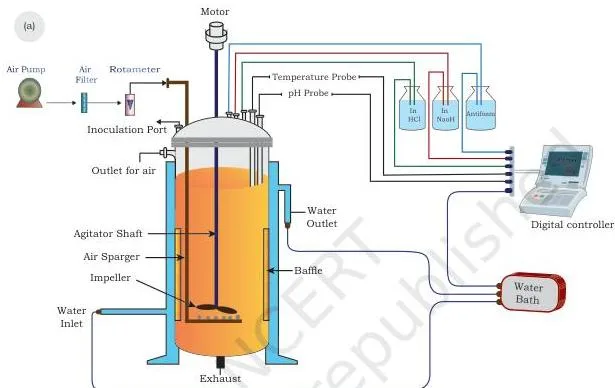
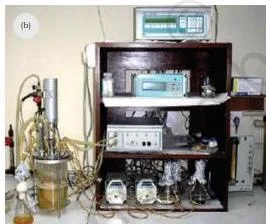
The labelled drawing is the answer key for Exercise 8.
Name each part with its job: the agitator shaft mixes the contents, with an impeller fixed at its bottom end to keep cells in homogeneous conditions for nutrient and oxygen transport; the sparger delivers a continuous supply of sterilised air through microfilters; the baffle breaks vortex formation, which would shift the centre of gravity and waste power; the jacket provides a surface for water at the desired temperature to circulate.
The probes sense temperature and pH; the digital controller reads them and commands a water bath (for temperature) and bottles of 1M NaOH and 1N HCl (for pH), adding acid or alkali as the probe dictates. Everything, including stirring speed in rpm, shows on the controller’s display.
The photograph is the same machine at laboratory scale — memorise the parts from the drawing and you can label the photo.
Fig 10.2: Three Bioreactor Designs
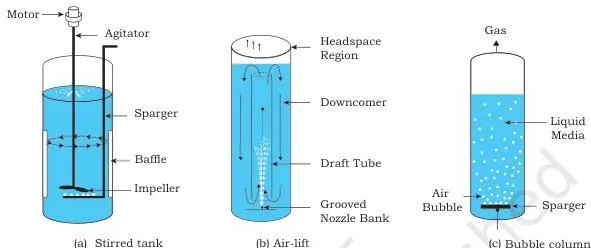
Three designs, one question: how do you mix a culture without harming the cells? The stirred tank reactor is the most conventional — an agitator shaft does the mixing, and the impeller’s design varies with the process. The air-lift reactor uses a draft tube that creates an air current, lifting the broth and cells up, down and around.
The bubble column reactor relies on air bubbles from a sparger jet; it offers a low-shear environment and high oxygen transfer per unit of power input.
Low shear matters for sensitive cells. The chapter’s ordering is animal cells more shear-sensitive than plant cells, and plant cells more shear-sensitive than microbial cells — so a gentle reactor like the bubble column suits fragile cultures.
Fig 10.3: The Two Stages of a Bioprocess
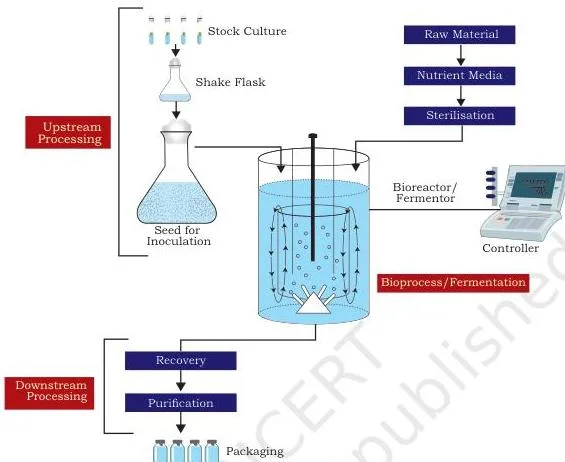
Read Fig 10.3 as a production line: upstream processing prepares, the bioreactor converts, downstream processing recovers. Upstream feeds in media optimisation, sterilisation, inoculum preparation and optimisation of growth conditions; the bioreactor grows the culture; downstream takes the broth through extraction, recovery and purification, then disposes of effluents.
This sequence is the skeleton for Exercise 4 (concept map) and Exercise 5 (describe the two stages).
Fig 10.4: The Bioprocess Development Pipeline
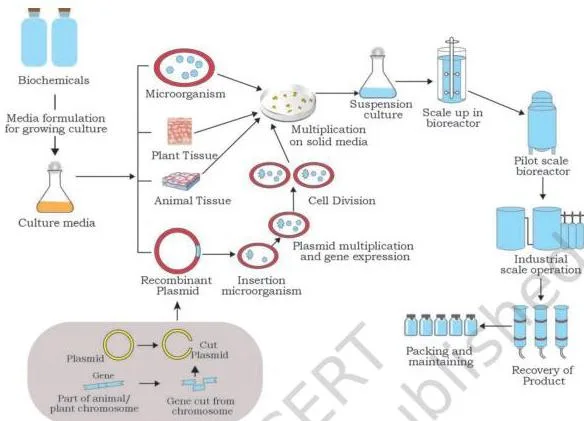
Fig 10.4 is the summary flow of bioprocess development, and the chapter closes the upstream section by pointing you to it. The key line: before a bioprocess is run, every parameter — media formulation, temperature, pH — is optimised separately. The figure shows how those preparation stages lead into the fermenter and then on to the product.
Fig 10.5: Reading the Growth Curves of the Three Modes
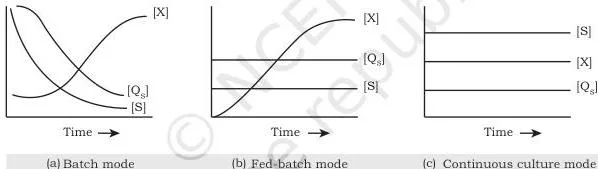
This is the chapter’s only graph-reading task, so learn the legend first: S is substrate concentration, X is microbial cells, and Qs is the rate of substrate utilisation.
Panel (a) batch: X climbs through the growth phases while S is consumed and falls — nothing stays flat. Panel (b) fed-batch: S and Qs remain constant while X (cell biomass/product) keeps increasing.
Panel (c) continuous: at steady state, the formation of new biomass is balanced by the loss of cells from the vessel, so growth rate, product formation, S and Qs all stay constant.
Reading rule: find the flat lines. S and Qs flat with X rising = fed-batch. Everything flat = continuous. Everything moving = batch.
Fig 10.6: Major Steps in Downstream Processing
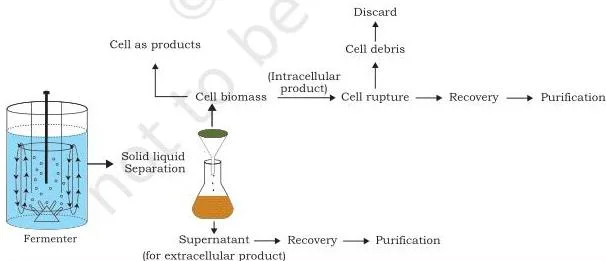
Fig 10.6 is the recovery flow, and its order of steps is the model answer for Exercise 6. For an intracellular product the sequence is:
- Separate solids (biomass) from the culture fluid by filtration or centrifugation.
- Disrupt the cells — bead mill, high-pressure homogeniser or ultrasonication (physical), or surfactants, alkalis, solvents, osmotic shock or enzymes (non-mechanical).
- Recover the released product by liquid–liquid extraction (or adsorption) and collect the extract.
- Purify by precipitation, membrane separation, dialysis or reverse osmosis, as the product demands.
- Finish with drying or distillation if needed, and dispose of the effluents.
Apply the chapter’s two design rules at every step: the process must be quick, and it must run at minimum investment and minimum cost.
Fig 10.7: Reverse Osmosis — Why the Water Moves Backwards
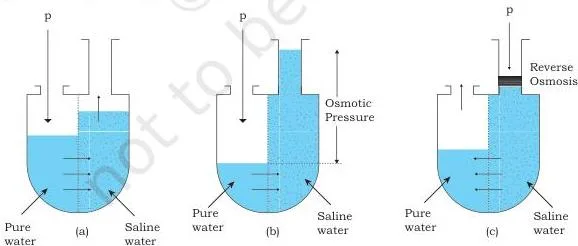
Three panels, three stages of one idea. In (a), a semipermeable membrane separates pure water from saline water and osmosis pulls water into the saline phase — it moves with the concentration gradient. In (b), that water movement raises the pressure of the saline side; this is the osmotic pressure.
In (c), pressure is applied to the salt-containing phase; as soon as it slightly exceeds the osmotic pressure, water moves in reverse — saline to pure, against the gradient. That is reverse osmosis.
Table 10.1 adds the numbers: RO pore size under 0.001 µm, molecular weight cutoff below 300 Da, pressure drop 100–800 psi, retaining all suspended and dissolved material. This is the skeleton for Exercise 7(a).
Fig 10.8: Dialysis — Small Solutes Leave, Big Ones Stay
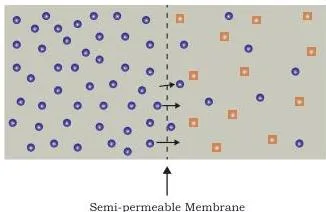
One membrane, two sizes of solute. The dialysis membrane is selectively permeable: low-molecular-weight solutes — organic acids of 100–500 Da, inorganic ions of 10–100 Da — pass through, while larger molecules stay behind.
The chapter’s anchor example is urea, molecular weight 60, which dialysis membranes remove from urine in artificial kidney devices. At equilibrium, the chemical potentials of the diffusing compounds on both sides of the membrane are equal. This is the skeleton for Exercise 7(b).
Definitions: Terms to Reproduce in Your Own Words
These are the terms you must be able to define cleanly under time pressure. Each definition below is in plain words — say them aloud once and they stick.
| Term | Meaning |
|---|---|
| Primary metabolite | Product of primary metabolic pathways, tied to essential functions such as growth and development (e.g., amino acids, organic acids). |
| Secondary metabolite | Intermediate or indirect product of separate secondary metabolic pathways, used in defence, stress tolerance and attraction (e.g., antibiotics, pigments). |
| Bioprocessing | Using living systems or their components with chemical engineering to make desired products at commercial scale. |
| Bioreactor / fermenter | Engineered glass or steel vessel that keeps a sterile, nutrient- and oxygen-rich culture at controlled temperature and pH. |
| Agitator shaft | Shaft with an impeller at its base that mixes contents, keeping cells in homogeneous conditions for nutrient and oxygen transport. |
| Sparger | Component that supplies a continuous stream of sterilised air, through microfilters, to submerged growing cells. |
| Baffle | Plate that breaks vortex formation so the centre of gravity stays stable and less power is needed. |
| Jacket | Surface around the vessel through which water at the desired temperature circulates. |
| Upstream processing | Preparation stage: media formulation, sterilisation, inoculum production and optimisation of growth and product conditions. |
| Downstream processing | Recovery stage: extraction, recovery and purification of the product, plus disposal of effluents. |
| Inoculum | Pure, healthy, actively dividing culture, free of contamination, used to start the bioprocess. |
| Batch culture | Closed culture system with an initial fixed amount of nutrients; nothing is added or removed during the run. |
| Fed-batch culture | Batch culture fed additional growth-limiting substrate intermittently or continuously; nothing is removed, so the volume rises. |
| Continuous culture | Open system in which fresh medium is added and used medium removed so that a steady state is maintained. |
| Filtration | Separating large particles and cell biomass from culture fluid using a filter medium. |
| Centrifugation | Spinning-based separation of particles in the 100 µm to 0.1 µm range. |
| Cell disruption | Rupturing cells to release intracellular products, by physical means or by chemical, osmotic or enzymatic treatment. |
| Liquid–liquid extraction | Treating a liquid mixture with a solvent in which the desired product is preferentially soluble. |
| Extract | The solute-rich phase left after extraction. |
| Raffinate | The residual liquid from which the solute has been removed. |
| Precipitation | Throwing proteins or antibiotics out of solution using salts, organic solvents or ultrafiltration. |
| Microfiltration | Membrane process with pores of 0.1–10 µm that retains suspended material such as bacteria. |
| Ultrafiltration | Membrane process with pores of 0.01–0.1 µm that retains macromolecules and colloids. |
| Reverse osmosis | Pressure-driven process in which applied pressure slightly above osmotic pressure drives water from the saline to the pure phase. |
| Dialysis | Removal of low-molecular-weight solutes (organic acids 100–500 Da, inorganic ions 10–100 Da) through a selectively permeable membrane. |
| Recombinant protein | Protein made by a gene expressed in a heterologous host — e.g., human insulin from recombinant E. coli. |
Common Mistakes in This Chapter
The chapter’s own content sets these traps — similar names and counterintuitive directions. Read the table before you attempt the exercises.
| Mistake | Correct rule | How to check your answer |
|---|---|---|
| Mixing up the four bioreactor parts — e.g., writing that the sparger mixes the culture. | Agitator mixes; sparger supplies sterilised air; baffle breaks the vortex; jacket circulates water at the desired temperature. | Memory aid ASBJ: Agitator mixes, Sparger supplies air, Baffle breaks the vortex, Jacket holds temperature. Then match Exercise 8. |
| Writing that secondary metabolites are made by primary metabolic pathways. | They are intermediates or indirect products of entirely separate secondary metabolic pathways. | Exercise 10 is (b): both statements are true, but the reason given is not the correct explanation. |
| Treating fed-batch like batch — nothing is added after the start. | Fed-batch adds growth-limiting substrate intermittently or continuously and removes nothing, so the culture volume rises. | Ask each mode: what goes in, what comes out, does the volume rise? |
| Writing that in reverse osmosis water moves to the saline side. | Osmotic pressure alone drives water pure to saline. Applied pressure slightly greater than the osmotic pressure drives it saline to pure, against the gradient. | Trace Fig 10.7 panels (a), (b), (c) in order — the applied-pressure arrow reverses the direction. |
| Reversing the separation size ranges. | Filtration separates large particles and cell biomass; centrifugation takes the 100 µm to 0.1 µm range. | Read the particle size: large solids to filtration, small particles to the centrifuge. |
| Writing that wine and beer are made by distillation. | Wine and beer are produced without distillation; whisky, brandy and rum are produced by distillation of the fermented broth. | Separate the drink from its process: no distillation for wine and beer, distillation for the spirits. |
Exam Notes: What the Ten Exercises Test
All ten exercises in the chapter map onto the sections. Use the table to aim your revision at the right section, then check the definite answers below it.
| Exercise | Concept it tests | Where the answer lives |
|---|---|---|
| 1 | Functions of primary versus secondary metabolites, with an example | The chapter’s opening, before Section 10.1 |
| 2 | Challenges encountered during bioprocess development | Sections 10.1 and 10.3.1 |
| 3 | Design and components of a typical bioreactor, with applications | Section 10.2 and Fig 10.1 |
| 4 | Operational stages of a bioprocess as a concept map | Section 10.3 and Fig 10.3 |
| 5 | Upstream processing and downstream processing | Section 10.3.1 |
| 6 | Recovery and purification of an intracellular product with a flow diagram | Downstream processing and Fig 10.6 |
| 7 | Short notes on reverse osmosis and dialysis | Recovery: Figs 10.7 and 10.8 |
| 8 | Matching bioreactor parts to their functions | Section 10.2 component descriptions |
| 9 | Identifying the closed culture system | Modes of Bioprocess Operation |
| 10 | Assertion–reason on secondary metabolites | The chapter’s opening |
The closed-answer exercises have definite answers. Exercise 9’s blank is (b) batch — a closed culture system with an initial fixed amount of nutrients. Exercise 8 matches agitator to mixing (iii), sparger to continuous air supply (iv), baffle to breaking the vortex (i), and jacket to water circulation at the desired temperature (ii).
Exercise 10 is (b): both statements are true, but the fact that secondary metabolites are intermediate products does not explain why they function in defence, so the reason is not the correct explanation.
For the long answers, the full-marks essentials are: name every stage or component in order, add one example from the chapter, and — for Exercise 6 — draw the flow diagram as a clear sequence from broth to purified product. Textbook contents and the examinable syllabus are not always identical; check the current official CBSE syllabus for the question pattern.
The Chapter in Ten Points
If you have two minutes, read these ten points — they carry the chapter’s own summary in plain words.
- Every living system makes metabolites through its metabolic processes; primary ones support growth and development, secondary ones serve defence, stress tolerance and attraction.
- Secondary metabolites are produced in very small amounts in nature, so scaling them up for industry is the reason bioprocess engineering exists.
- A bioreactor or fermenter is an engineered vessel that provides optimum conditions for product formation; different configurations suit different needs.
- A bioprocess is operated in two stages: upstream processing and downstream processing.
- Upstream covers formulation and sterilisation of media and equipment, and production of a pure, healthy, active culture for inoculation.
- Growth of the organism under optimised conditions for desired product formation takes place in the bioreactor or fermenter.
- Three modes of operation exist: batch (closed vessel), fed-batch (growth-limiting substrate fed intermittently or continuously) and continuous (substrate fed continuously with a steady state).
- Downstream processing recovers and purifies the product using techniques such as reverse osmosis, distillation and drying.
- Many products of animal, plant and microbial origin have been commercialised to date.
- One equation connects the economics of it all: the cellular yield coefficient Y — cell dry weight produced per unit of carbon substrate utilised.
Related Resources
This listing is maintained for the 2026-27 academic session using the NCERT textbook information available to us. NCERT remains the authority for confirming the latest edition.
Continue with the rest of the book and the site:
- NCERT Class 12 Biotechnology book — the full chapter list of this textbook
- Class 12 NCERT books — the hub for every Class 12 subject
- Chapter 9: Stem Cell Culture and Organ Culture — the chapter before this one
- Chapter 11: Bioremediation — the chapter that follows
- CBSE notes home — all subjects and classes on the site
Sources and Data Verification
The figures and content on this page describe the NCERT Class 12 Biotechnology textbook, Chapter 10, ‘Bioprocessing and Biomanufacturing’, in the official NCERT edition published on ncert.nic.in. You can verify the current edition of the book on the NCERT textbook portal.
This page covers that one chapter of that one book. It does not describe other chapters of this book or other Class 12 subjects, and it is not a statement of the full CBSE curriculum.
It is maintained for the current academic session. NCERT settles textbook editions and official PDFs; CBSE settles the curriculum, syllabus and examinations.
Frequently Asked Questions
What is the difference between upstream and downstream processing?
Upstream processing is the preparation stage — formulating the nutrient medium, sterilising media and equipment, preparing the inoculum, and optimising growth conditions. Downstream processing is the recovery stage — extracting the product from the broth, purifying it, and disposing of effluents. Together they are the two halves of every bioprocess (Section 10.3).
What are batch, fed-batch and continuous modes of bioprocess operation?
Batch is a closed system with an initial fixed amount of nutrients and nothing added or removed during the run. Fed-batch adds the growth-limiting substrate intermittently or continuously while removing nothing, so the volume rises. Continuous mode adds fresh medium and removes used medium at the same rate, holding a steady state in which growth balances cell loss.
Is a fermenter the same as a bioreactor?
Yes — the chapter uses the two words interchangeably: industrial bioprocesses are carried out in vessels called fermenters or bioreactors. Both names refer to the engineered vessel that maintains sterile, nutrient-rich, temperature- and pH-controlled conditions for cell culture.
How do you calculate the cellular yield coefficient Y in bioprocessing?
Divide the quantity of cell dry weight produced by the culture by the quantity of carbon substrate utilised. Example: 42 g of dry cell mass from 120 g of glucose gives Y = 42/120 = 0.35, meaning 0.35 g of cells per gram of glucose. The higher Y, the more efficiently the culture converts substrate into biomass.
Which microorganism produces penicillin, taxol, shikonin and statins?
Penicillin comes from Penicillium chrysogenum, taxol from the plant Taxus brevifolia, shikonin from the plant Lithospermum erythrorhizon, and statins from the yeast Monascus purpureus. The complete pairing list is in the microbe-to-product table above.
Does every part of this chapter carry weight in the CBSE exam?
That cannot be promised from the textbook alone — textbook contents and the examinable syllabus are not always identical, and the CBSE paper follows the official curriculum. What is safe to say: the concepts this chapter expects you to master — bioreactor parts, the three modes, upstream and downstream processing, and the product table — are standard bioprocessing knowledge.
Check the current official CBSE syllabus for the question pattern.
Reference: NCERT Class 12 Biotechnology textbook, chapter 10, official edition on ncert.nic.in.
Explore Class 12 Biotechnology Books
- Previous: Stem Cell Culture and Organ Culture
- Next: Bioremediation
Related chapters: