Looking for the current challenges facing the indian economy class 11? The NCERT Class 11 Economics chapter you need is Chapter 4 of Indian Economic Development — Human Capital Formation in India — and the official PDF is right here.
This page walks you through what the chapter contains, section by section, with NCERT page numbers, so you can jump straight to the part you need.
The chapter’s one idea, in one line: spending on education, health, training, migration and information is investment in people, and its return is higher productivity, higher income and faster economic growth.
Download the NCERT Class 11 Economics Chapter 4 PDF
This is the official NCERT edition (English medium) of Indian Economic Development for Class 11 — the file schools and examiners work from. Keep it open beside this page; everything below is a companion to the textbook, not a replacement for it.
Download the NCERT Class 11 Economics Current Challenges Facing the Indian Economy Chapter 4 PDF — the complete official chapter, from the Alfred Marshall epigraph on the opening page to the exercises and suggested activities at the end — and open it whenever you need the textbook’s own wording.
Chapter 4 at a Glance: What Is Inside This PDF
The chapter is built around a single argument: spending on people is investment, and its return is a more productive, higher-earning workforce. It develops that argument in five numbered sections plus a conclusion, from the meaning of human capital to a full review of India’s education sector.
It opens with an Alfred Marshall epigraph on education as investment, works through a boxed comparison of physical and human capital, reads the long-run development indicators, and closes with a Recap list, exercises, suggested additional activities and a short reading list. The table below shows how much the chapter holds.
| What the chapter holds | Count | Where it is used |
|---|---|---|
| Printed pages | 18 | |
| Sections in the chapter | 6 | |
| Figures with NCERT captions | 9 | |
| Tables | 2 | |
| Exercise questions | 20 | answered in our NCERT Solutions |
| Official NCERT PDF | Download the chapter PDF | the chapter exactly as NCERT publishes it |
What This Chapter Covers: A Guided Tour
The chapter’s argument in one line: education, health, training, migration and information are investments in people, and the payoff is higher productivity, higher income and faster growth. The map below shows each section, the pages it occupies, and the one point to carry out of it.
| Section (NCERT pages) | What it establishes | Key data or term to note |
|---|---|---|
| 4.1 Introduction (p. 59) | Educated labour earns more and contributes more to growth | The Alfred Marshall epigraph; educated workers adopt new technologies faster |
| 4.2 What is Human Capital (p. 60) | Human resources become human capital through investment | The four questions the chapter sets out to answer |
| 4.3 Sources of Human Capital (pp. 60–61) | Five sources, each with its own return | Education, health, on-the-job training, migration, information |
| Box 4.1 (pp. 62–63) | Physical and human capital compared | Tangible vs intangible; separable vs inseparable; external benefit |
| Human capital and economic growth (pp. 63–64) | Causality runs both ways; the evidence is nebulous | Seventh Five Year Plan: a trained population becomes an asset |
| Table 4.1 (p. 65) | Education and health indicators, 1951 to 2018-22 | Income up; death rates down; literacy up |
| NEP 2020 and Box 4.2 (pp. 65–66) | The turn toward a knowledge economy | Big data and AI; the IT-in-rural-India debate |
| 4.4 Human Capital and Human Development (p. 66) | Means to an end vs ends in themselves | The rights argument for basic education and health |
| 4.5 State of Human Capital Formation (p. 67) | Why the government must intervene | Private and social benefits; providers’ monopoly power |
| 4.6 Education Sector in India (pp. 68–71) | Spending, attainment, gender equity, higher education | 6 per cent of GDP target vs actual spending; Tables 4.1 and 4.2 |
| 4.8 Conclusion (p. 71) | Spread education and health to reach growth with equity | India’s rich stock of scientific and technical manpower |
Key Concepts: Human Capital, Its Sources and Its Payoffs
This is the chapter’s core, best learned in the order the book itself follows. The idea to hold on to: people can be capital, because investment in them raises their future productive capacity and income just as investment in machines does.
What is human capital (NCERT, p. 60)
The chapter begins with an analogy. A country can turn physical resources such as land into physical capital such as factories; in the same way, it can turn human resources — nurses, farmers, teachers, students — into human capital such as engineers and doctors (NCERT, p. 60).
The twist is that producing human capital requires existing human capital: competent professors and professionals must train the next generation. Investment in people is thus the prerequisite for more investment in people. The chapter then poses the four questions it will answer:
- What are the sources of human capital?
- Is there a relation between human capital and a country’s economic growth?
- Is human capital formation linked to human development?
- What role can the government play in human capital formation in India?
The five sources of human capital (NCERT, pp. 60–61)
Human capital formation is the outcome of investment in five areas. Education is the best known, but the other four are equally examinable.
| Source | What the spending covers | The return it brings |
|---|---|---|
| Education | Schooling and skill-building | Higher future income; better choices in life; innovation; faster absorption of new technology |
| Health | Preventive medicine (vaccination), curative medicine (treatment during illness), social medicine (health literacy), clean water and sanitation | An uninterrupted supply of healthy labour, with no productivity lost to illness |
| On-the-job training | Training inside the firm under a skilled worker, or off-campus courses | Higher worker productivity, worth more than the cost of training |
| Migration | Transport, higher living costs, and the psychic cost of a strange socio-cultural set-up | Higher salaries than at home, which outweigh all the costs |
| Information | Knowledge of the labour, education and health markets | Better decisions on investing in skills, and better use of the human capital stock |
Why this list matters: an answer that names only education misses the chapter’s central point that human capital is built from five kinds of deliberate spending. Migration, for instance, is an investment because in India the rural-urban flow is largely unemployment-driven, while engineers and doctors move abroad for higher salaries (NCERT, p. 61).
Physical capital vs human capital (Box 4.1, pp. 62–63)
Both capitals are outcomes of conscious investment decisions, and physical capital is the base concept for thinking about human capital. But they differ in five striking ways.
| Dimension | Physical capital | Human capital |
|---|---|---|
| Tangibility | Tangible; can be sold in the market like any commodity | Intangible; built into the body and mind of its owner; only its services are sold |
| Separability from owner | Separable — a bus can run without its owner present | Inseparable — the trained worker must be present at the place of production |
| Mobility between countries | Fully mobile, apart from trade restrictions | Not perfectly mobile; nationality and culture restrict movement |
| Depreciation | Wears out with use; becomes obsolete when technology changes | Ages, but continued investment in education and health slows the decay and helps cope with new technology |
| Benefits | Only private benefit, to those who pay for the product | Private benefit plus external benefit — society gains too |
The external benefit is the point most answers understate: an educated person strengthens democratic participation, and a healthy person stops the spread of contagious disease (NCERT, p. 62). That social gain is why the chapter later argues for government spending.
Human capital and economic growth (NCERT, pp. 63–64)
Economic growth means the increase in a country’s real national income. An educated worker’s skill is greater, so the contribution to national income is greater; a healthy worker supplies labour without interruption. Both raise an individual’s income-generating capacity, and the raised productivity also stimulates innovation and the absorption of new technologies (NCERT, p. 63).
The chapter is careful about the evidence, and so should your answer be. It calls the empirical proof that education causes growth “nebulous” — cloudy — because of measurement problems: years of schooling, teacher-pupil ratio and enrolment rates do not capture the quality of education, and health spending, life expectancy and mortality rates do not fully capture health status (NCERT, p. 64).
Cross-country data show convergence in human capital measures but no convergence in per capita real income, and causality flows in both directions: higher income builds human capital, and human capital raises income.
India recognised this long ago — the Seventh Five Year Plan argued that a large population, trained and educated on sound lines, can itself become an asset in accelerating growth (NCERT, p. 64).
Human capital vs human development (NCERT, p. 66)
The two terms sound alike, but the book draws a sharp line between them. Human development is the broader term because it changes what education and health are for.
| Point of comparison | Human capital | Human development |
|---|---|---|
| Stand on education and health | A means to raise labour productivity | Integral to human well-being itself |
| Stand on people | Means to an end — the end is more output | Ends in themselves |
| Is education “unproductive” without an output gain? | Yes | No — it is still valuable |
| Rights | No rights implied | Every person has a right to basic education and basic health care |
The education sector in India: what the tables show (NCERT, pp. 68–71)
The chapter’s analysis of India’s education sector is built on two data tables, and both repay careful reading.
Table 4.1 (p. 65) reads in three lines, from 1951 to 2018-22:
- Income rose: real per capita income went from Rs 7,651 to Rs 94,054.
- Death rates fell: the crude death rate dropped from 25.1 to 6.0 per thousand, and infant mortality from 146 to 28.
- People live longer and read more: life expectancy at birth rose from around 37 years to about 69 years (male) and 71 years (female); literacy climbed from 16.67 per cent to 78 per cent.
The book’s reading of these trends: education and health improved together with income, and each sector’s growth reinforced the others (NCERT, p. 65).
Expenditure: between 1952 and 2020, education rose from 7.92 per cent to 16.54 per cent of total government expenditure, and from 0.64 per cent to 4.47 per cent of GDP — a rise that was not uniform (NCERT, p. 68).
The 6 per cent target: the Education Commission (1964–66) recommended that at least 6 per cent of GDP be spent on education. The actual ratio, a little over 4 per cent, has stayed below it. The Tapas Majumdar Committee (1999) estimated that around Rs 1.37 lakh crore over ten years would bring all children aged 6–14 into school (NCERT, p. 69).
The legal backstop: the Right of Children to Free and Compulsory Education Act, 2009 made free education a fundamental right for children aged 6–14, and a 2 per cent education cess on all Union taxes is earmarked for elementary education (NCERT, p. 69).
Spending still varies by state: per-student public expenditure on elementary education in 2026-27 ranged from Rs 96,968 in Sikkim to Rs 10,710 in Bihar (NCERT, p. 68).
Table 4.2 (p. 70) — educational attainment: the three indicators are adult literacy rate (age 15+), primary completion rate and youth literacy rate (ages 15–24). Males and females improved from 1990 to 2026-27 across all three indicators, and the gender gap narrowed; female primary completion rose from 61 per cent to 96 per cent and now sits above the male figure.
An answer on educational achievement is incomplete if it gives only one of these three indicators.
The qualification to remember: despite rising literacy, the absolute number of illiterates is as large as India’s population at independence. The Constitution’s 1950 promise — free and compulsory education for all children up to 14 within ten years — remains unfulfilled; had it been met, India would have cent per cent literacy today (NCERT, p. 70).
Higher education and educated unemployment: the education pyramid is steep, so fewer and fewer people reach the top.
The highest unemployment is among the educated: NSSO data for 2026-27 put unemployment at 19 per cent for rural male graduates, 16 per cent for urban male graduates, and nearly 30 per cent for rural female graduates, against only 3–6 per cent for primary-educated youth in rural and urban areas. The Periodic Labour Force Survey 2026-27 shows moderate improvement (NCERT, p. 71).
Why do the educated face higher unemployment than the less educated? The chapter connects the puzzle to the quality of higher education: institutions need to impart employable skills, and the government should raise the standard of higher education institutions as well as increase allocation for them (NCERT, p. 71).
Figure Walkthrough: What the Images in This Chapter Show
The chapter uses photographs to make several of its arguments visually. Each image below carries the book’s own caption, and each is worth knowing because a question that refers to a figure is really testing the concept behind it.
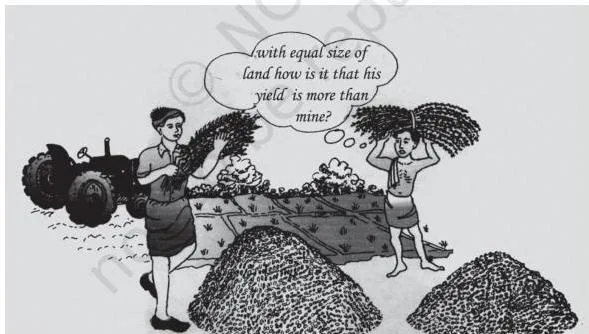
The chapter opens with this photograph to make its first claim concrete: a farmer who is educated and trained is a more productive farmer. The same acres of land yield more in trained hands, which is why the book treats education and training as investment rather than consumption (NCERT, p. 59).
This photograph illustrates the fourth source of human capital. People migrate because the jobs they find fetch higher salaries, and the higher earnings outweigh the transport costs, the higher cost of living, and the psychic cost of living in a strange set-up (NCERT, p. 61).
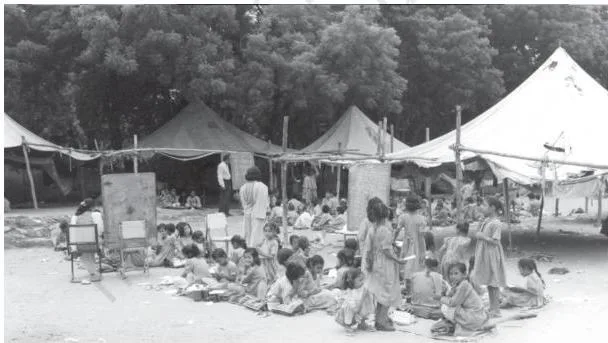
The book prints three discussion questions beneath this image (NCERT, p. 63):
- (a) What are the advantages of having a proper classroom?
- (b) Are the children going to this school receiving quality education?
- (c) Why do these schools not have buildings?
Answering with the chapter’s argument: a proper classroom is part of educational infrastructure — it supports learning and health, and quality education needs trained teachers and decent facilities. Makeshift premises therefore signal underinvestment, the very gap the chapter explains through the below-target education expenditure (NCERT, pp. 68–69).
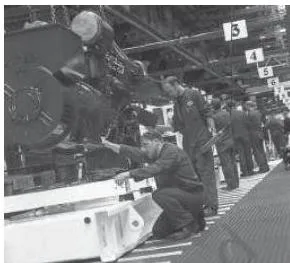
India’s scientific and technical manpower is presented as a rich ingredient of human capital. The chapter’s conclusion returns to this point: the stock exists, and the task is to improve its quality and create conditions that keep it working in India (NCERT, pp. 64, 71).
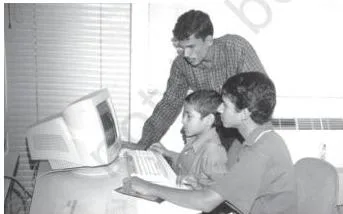
This image connects the chapter to the knowledge economy. NEP 2020 argues that with big data, machine learning and artificial intelligence taking over unskilled jobs, India needs skilled labour in mathematics, computer science and data science alongside the sciences, social sciences and humanities (NCERT, p. 65).
Box 4.2 pushes the discussion further with a question worth preparing: will IT-based services in rural areas lead to human development? The box’s caution is that the value of IT depends on the existing level of economic development (NCERT, pp. 65–66).
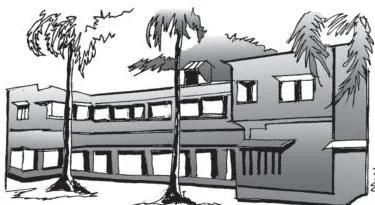
This image sits inside the spending discussion. Buildings, classrooms and facilities are what per-student expenditure buys; the chapter calls investment in them inevitable, and their absence is why the expenditure ratios — 16.54 per cent of government spending and 4.47 per cent of GDP — matter (NCERT, pp. 68–69).

The chapter places the line about the 2 per cent education cess beside this image: the Government of India levies it on all Union taxes and earmarks the revenue for elementary education (NCERT, p. 69). It is the chapter’s concrete example of how the state funds the goals discussed above.
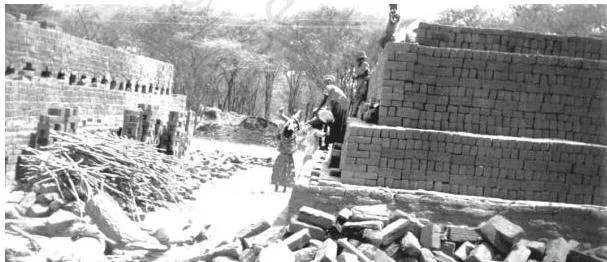
Dropouts matter because a child who leaves school early becomes child labour — and the investment already made in that child is lost. That is why the book calls the flow of dropouts into child labour a loss to human capital (NCERT, p. 70). It pairs this image with the Work These Out box on dropout case studies.
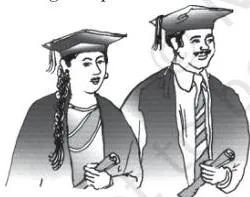
The steep education pyramid in this image shows that fewer and fewer Indians reach higher education. The chapter reads it together with the unemployment data: the few who do reach the top are the ones most likely to be unemployed, which is why it argues for higher allocation and better standards so that institutions impart employable skills (NCERT, p. 71).
Definitions: The Terms to Write in Your Answer
These are the chapter’s own terms, each tied to its NCERT page. Using them precisely is what separates a complete answer from a partial one.
| Term | Definition | NCERT page |
|---|---|---|
| Human capital | The stock of skills, knowledge and health that makes a person productive, created by investment in people | p. 60 |
| Human capital formation | The process of investment in education, health, training, migration and information that raises people’s productive capacity and future income | p. 60 |
| On-the-job training | Firms’ spending on training workers, in the firm under a skilled worker or off-campus, whose return is higher labour productivity | p. 61 |
| Preventive, curative and social medicine | Three forms of health spending: vaccination (prevention), medical intervention during illness (cure), and spread of health literacy (social) | pp. 60–61 |
| External benefit | A benefit of human capital that flows to society and not only to the owner, such as an educated citizen strengthening democracy | p. 63 |
| Knowledge economy | An economy whose growth depends on producing and using knowledge, often through IT — the chapter’s future vision for India | pp. 65–66 |
| Human development | The view that education and health are integral to well-being itself, so people are ends and not means to higher output | p. 66 |
| Education cess | A 2 per cent levy on all Union taxes whose revenue is earmarked for elementary education | p. 69 |
| Right of Children to Free and Compulsory Education Act, 2009 | The law that made free education a fundamental right of every child aged 6–14 | p. 69 |
| Educational attainment | A country’s educational achievement, measured by adult literacy, primary completion rate and youth literacy | p. 70 |
Work This Out and the Suggested Activities
The book threads activity boxes through its text, and schools regularly set these as homework. Each is short, and each is marked by its page.
- p. 60 — Compare how three families — very poor, middle class and affluent — spend on the education of male and female children.
- p. 66 — For a construction worker, maid-servant, dhobi or peon, find out how long illness affects (i) job security and (ii) wages.
- p. 67 — Identify the objectives and functions of NCERT, UGC, AICTE and ICMR.
- p. 69 — Prepare dropout case studies at primary, Class VIII and Class X level, and discuss “school dropouts give way to child labour” as a loss to human capital.
- p. 73 — Suggested additional activities: how the Human Development Index is calculated and India’s position; the knowledge-economy debate; interpreting Table 4.2; the “Each one — teach one” idea; listing sources of information on education, health and labour; and summarising the social-sector chapter of the Economic Survey.
Common Mistakes Students Make in This Chapter
Most marks in this chapter are lost to conceptual confusion, not missing facts. The table below names the confusions before you make them, with the page that settles each.
| Mistake | Correct rule | How to check your answer |
|---|---|---|
| Using “human capital” and “human development” interchangeably | Human capital treats people as a means to higher output; human development treats people as ends in themselves (p. 66) | Ask: does my sentence discuss productivity gain (human capital) or well-being and rights (human development)? |
| Treating physical and human capital as identical | They differ in tangibility, separability from the owner, mobility across countries, depreciation and external benefits (pp. 62–63) | Did I name at least one dissimilarity from Box 4.1? |
| Answering “sources of human capital” with education alone | The five sources: education, health, on-the-job training, migration, information (pp. 60–61) | Count the sources in my answer — all five? |
| Writing that India spends 6 per cent of GDP on education | 6 per cent is the long-standing target; actual spending is a little over 4 per cent (pp. 68–69) | Did I separate “target” from “actual”? |
| Asserting a one-way link from education to growth | The empirical evidence is nebulous, and causality runs in both directions (p. 64) | Did I write “education causes growth” without the both-ways qualification? |
| Giving only the literacy rate as an indicator of educational achievement | The chapter lists three indicators: adult literacy, primary completion rate, youth literacy (p. 70) | Did I name all three, and quote Table 4.2? |
| Celebrating rising literacy without noting the absolute backlog | The absolute number of illiterates is roughly equal to India’s population at independence (p. 70) | Did I mention the absolute number, not just the rising percentage? |
| Quoting educated-unemployment data without context | NSSO 2026-27: 19 per cent of rural male graduates unemployed, nearly 30 per cent of rural female graduates, only 3–6 per cent of primary-educated youth; PLFS 2026-27 shows moderate improvement (p. 71) | Did I give the group, the year, and the comparison with the less educated? |
Exam Notes: How to Revise This Chapter
One caution first: textbook contents and the examinable syllabus are not always identical — check the current official CBSE syllabus for what is examinable this session. Nothing below promises which questions will appear.
All the exercises in this chapter are short-answer and reasoning questions — there are no objective-type or numerical questions. The map below pairs each question with the pages that answer it.
| Exercise | Where the answer is (NCERT pages) |
|---|---|
| Q1 — the two major sources of human capital | pp. 60–61, 67 — education and health |
| Q2 — indicators of educational achievement | p. 70 — adult literacy, primary completion rate, youth literacy |
| Q3 — regional differences in educational attainment | p. 68 — per-student spending: Sikkim Rs 96,968, Bihar Rs 10,710 |
| Q4 — differences between human capital and human development | p. 66 — means to an end vs ends in themselves |
| Q5 — human development as the broader term | p. 66 — well-being and rights, not just productivity |
| Q6 — factors contributing to human capital formation | pp. 60–61 — all five sources |
| Q7 — government organisations facilitating schools and hospitals | p. 67 — NCERT, UGC, AICTE, ICMR |
| Q8 — education as an input to development | p. 59 — income, choices, innovation, technology adaptation |
| Q9 — health infrastructure and migration as sources | pp. 60–61 — healthy labour supply; higher earnings outweigh costs |
| Q10 — need for information on health and education | p. 61 — sound investment decisions and use of the stock |
| Q11 — how investment in human capital contributes to growth | pp. 63–64 — higher productivity and income |
| Q12 — comment on education, inequality and unemployment | p. 71 — educated unemployment data and the employable-skills argument |
| Q13 — role of education in economic development | pp. 59, 63–64 |
| Q14 — how education investment stimulates growth | pp. 63–64 — innovation, technology absorption, higher national income |
| Q15 — need for on-the-job training | p. 61 — enhanced productivity worth more than the cost |
| Q16 — relationship between human capital and growth | p. 64 — two-way causality; nebulous evidence |
| Q17 — need for women’s education | p. 71 — independence, social status, fertility, health of women and children |
| Q18 — why government intervention is needed | p. 67 — private and social benefits, irreversible decisions, information gaps, monopoly power |
| Q19 — problems of human capital formation in India | pp. 68–71 — spending gap, regional variation, dropouts, illiterates, educated unemployment |
| Q20 — should the government regulate fees? | pp. 67–68 — argue from information gaps, monopoly power and exploitation |
Question 20 carries a photograph in the book; treat it as context and answer from the intervention argument — the chapter supports regulating fees so private providers adhere to standards and charge the correct price. Do not try to describe the image itself.
Data to remember:
- Education as a share of total government expenditure: 7.92 per cent (1952) to 16.54 per cent (2020).
- Education as a share of GDP: 0.64 per cent (1952) to 4.47 per cent (2020); the target is 6 per cent (Education Commission, 1964–66).
- Tapas Majumdar Committee (1999): around Rs 1.37 lakh crore over ten years for the 6–14 age group.
- Right of Children to Free and Compulsory Education Act, 2009; 2 per cent education cess on Union taxes.
- Direction of every trend in Table 4.1 (1951 to 2018-22): income up, death rates down, life expectancy up, literacy up.
- Direction of every trend in Table 4.2 (1990 to 2026-27): all three attainment indicators up, gender gap narrowing.
Answer-writing tip: whenever a question asks about the benefits of education or health, name both private and external benefits (NCERT, p. 63) — that separation is a standard step towards the full explanation. For the concept contrasts (Q4, Q5, Q16), state both sides explicitly rather than describing only one.
Chapter Recap: The Six Points NCERT Asks You to Remember
The book closes with its own six-point recap; here it is in shorter words, all of it traceable to the pages above.
- Investment in education converts human beings into human capital — an acquired ability, produced by deliberate investment, that raises future income (p. 60).
- The sources of human capital formation are education, on-the-job training, health, migration and information (pp. 60–61).
- Physical capital is the base concept for human capital; the two forms are similar in some ways and strikingly dissimilar in others (pp. 62–63).
- Investment in human capital is efficient and growth enhancing (p. 64).
- Human development holds that education and health are integral to well-being — only literate, healthy people can make other choices they value (p. 66).
- The share of education in total government expenditure shows how the government ranks education among its priorities (p. 68).
Related Resources: The Rest of Class 11 Economics
Human Capital Formation in India is Chapter 4 of Indian Economic Development, and it is the chapter that begins the part of the book on current challenges facing the Indian economy. For the rest of the textbook:
- Class 11 Economics book page — every chapter of Indian Economic Development
- Class 11 hub — all NCERT Class 11 books on this site
- Previous chapter (Chapter 3) — what the book covers before this unit
- Next chapter (Chapter 5) — the next challenge facing the Indian economy
For shorter study material: the Class 11 Economics revision notes, the Class 11 notes hub, and the CBSE notes index cover the same ground in condensed form. The statistics chapters, such as Organisation of Data, and later challenges, such as Rural Development, are natural next stops.
Reference: NCERT Class 11 Economics textbook, chapter 4, official edition on ncert.nic.in.
NCERT publishes the textbook and its official PDFs (on ncert.nic.in); CBSE settles the examinable syllabus, so check the current official CBSE syllabus for what is examinable this session.
FAQs: Human Capital Formation in India
What is human capital formation?
It is the process of investment in people — education, health, on-the-job training, migration and information — that raises their productive capacity and expected future income (NCERT, pp. 60–61). It is how a country converts human resources such as nurses, farmers and teachers into human capital such as engineers and doctors.
What are the main sources of human capital formation?
Five: education, which raises future income and enables better choices; health, which keeps the labour supply uninterrupted; on-the-job training, whose return is higher productivity; migration, where higher salaries outweigh transport, living and psychic costs; and information, which improves decisions about where and how to invest in skills (NCERT, pp. 60–61).
What is the difference between human capital and human development?
Human capital treats education and health as means to raise labour productivity — people are the means, and output is the end. Human development treats education and health as integral to well-being — people are ends in themselves — and holds that every person has a right to basic education and health even if these do not raise output (NCERT, p. 66).
Human development is therefore the broader term.
Why does the government need to intervene in education and health sectors?
For four reasons the chapter gives: education and health create both private and social benefits; the decisions are long-term and nearly irreversible; consumers lack complete information about quality and costs, which gives providers monopoly power and room for exploitation; and when basic education and health are treated as rights, the state must make them available to those who cannot afford them (NCERT, p. 67).
What are the main problems of human capital formation in India?
Education spending sits at a little over 4 per cent of GDP against the long-standing 6 per cent target; per-student spending varies hugely across states (Rs 96,968 in Sikkim versus Rs 10,710 in Bihar, 2026-27); dropouts feed child labour; the absolute number of illiterates equals roughly India’s population at independence; and the highest unemployment is among the educated (NCERT, pp. 68–71).
Which chapters come under Current Challenges Facing the Indian Economy in Class 11 Economics?
The chapter this page holds is Chapter 4 of Indian Economic Development, titled Human Capital Formation in India, and it belongs to the part of the book on current challenges facing the Indian economy. The chapters that follow it take up the other challenges and are linked in the Related Resources section above.
Explore Class 11 Economics Books
- Previous: Organisation of Data
- Next: Rural Development
Related chapters:
- Development Policies and Experience (1947-90)
- Why Economics?
- Indian Economy