This page carries the Economic Reforms Since 1991 Class 11 chapter — Chapter 3 of the NCERT Economics book Indian Economic Development, printed from page 35 to page 56. The official chapter PDF is linked below, followed by a section-by-section map, the key terms, the two figures and a worked reading of the exercises.
Economic Reforms Since 1991 Class 11: Download the Chapter PDF
Open the official NCERT Class 11 Economics Chapter 3 Economic Reforms Since 1991 PDF to read the chapter exactly as printed — the complete text from page 35 to page 56, straight from ncert.nic.in and free to download.
| What the chapter holds | Count | Where it is used |
|---|---|---|
| Printed pages | 21 | |
| Sections in the chapter | 5 | |
| Figures with NCERT captions | 2 | |
| Tables | 4 | |
| Exercise questions | 16 | answered in our NCERT Solutions |
| Official NCERT PDF | Download the chapter PDF | the chapter exactly as NCERT publishes it |
Reference: NCERT Class 11 Economics textbook, chapter 3, Indian Economic Development, official edition on ncert.nic.in.
The file is the official NCERT edition of the chapter, the same version schools use, and there is no charge for it.
Chapter 3 at a Glance: What the PDF Contains
This table lists the chapter’s contents from the NCERT edition — the number of sections, figures, tables and exercise questions inside the PDF. Use it to gauge the chapter’s size before opening the file.
What This Chapter Covers: From the 1991 Crisis to the Reform Appraisal
The chapter moves in a straight line: it explains why the reforms happened, works through each of the three reform policies, then judges what they delivered. The table below maps every element of the chapter to its page, so you can jump straight to the part you need.
| Chapter element | NCERT pages | What it does |
|---|---|---|
| 3.1 Introduction | p. 39 | Sets up how and why India’s development strategy changed in 1991. |
| 3.2 Background | pp. 39–40 | Traces the spending, borrowing and trade problems that became the 1991 crisis. |
| 3.3 Liberalisation | pp. 40–42 | Covers deregulation of industry, finance, taxes, foreign exchange and trade. |
| Work These Out | p. 43 | Activities on banks, taxes and reserves, including the foreign currency table. |
| 3.4 Privatisation | pp. 44–45 | Defines privatisation and disinvestment and how PSUs were opened to private capital. |
| Box 3.1 Navratnas and Public Enterprise Policies | p. 44 | Explains maharatna, navratna and miniratna status with company examples. |
| 3.5 Globalisation | pp. 45–47 | Covers outsourcing, the WTO and integration with the world economy. |
| Box 3.2 Global Footprint | p. 46 | Gives examples of Indian companies operating across the world. |
| Table 3.1 Growth of GDP and Major Sectors | p. 47 | The data backbone of the assessment — sector growth rates across periods. |
| 3.6 Indian Economy During Reforms: An Assessment | pp. 48–51 | Judges the reforms’ record on growth, foreign investment, agriculture, industry and disinvestment. |
| Reforms and Fiscal Policies | pp. 50–51 | The effect of tax and tariff cuts on public revenue and social spending. |
| Box 3.3 Siricilla Tragedy | p. 51 | Powerloom weavers’ suicides as the social cost of power sector reform. |
| 3.7 Conclusion | p. 51 | The two-sided debate: globalisation as opportunity vs globalisation as threat. |
| Recap | p. 52 | The chapter’s official summary of its own arguments. |
| Exercises | p. 53 | Questions on every section, from the crisis to the reform assessment. |
| Suggested Additional Activities | p. 54 | Graph work, the public-private dual system and the WTO debate activity. |
| Books and Government Reports and Websites | pp. 55–56 | The chapter’s reading list and official data sources, including dipam.gov.in. |
Key Concepts: The Crisis, the New Economic Policy and the Three Reforms
This section explains the ideas the chapter builds on, in the order the book presents them. Each subsection ends with the page in the book where you can read the original.
The 1991 balance of payments crisis and the New Economic Policy
The 1991 reforms were not a plan India chose at leisure; they were the response to an economic emergency. Learn this crisis chain once and the rest of the chapter falls into place. The chain runs from government overspending to the $7 billion loan (NCERT, pp. 38–40):
- Through the 1980s the government spent more than it earned, so it borrowed to finance the deficit — from banks, from people and from international financial institutions.
- Development spending on unemployment, poverty and population did not generate the extra revenue to cover itself, and income from public sector undertakings stayed low.
- Borrowed foreign exchange reserves were sometimes spent on consumption needs; exports were not boosted enough to pay for imports, which kept growing faster.
- By the late 1980s expenditure exceeded revenue by such large margins that borrowing became unsustainable, and prices of essential goods rose sharply.
- Foreign exchange reserves fell below the level needed to finance even two weeks of imports, leaving nothing to pay interest to international lenders.
- No country or international funder was willing to lend, so India approached the World Bank (IBRD) and the IMF and received $7 billion — on condition that it liberalised and opened up the economy (NCERT, p. 39).
India accepted the conditionalities and announced the New Economic Policy (NEP), aimed at creating a more competitive environment and removing barriers to the entry and growth of firms (NCERT, pp. 39–40).
The NEP’s measures fall into two groups. Stabilisation measures are short-term: correcting the balance of payments and bringing inflation under control. Structural reform measures are long-term: improving efficiency and international competitiveness by removing rigidities in the economy (NCERT, p. 40). All the reform policies fall under three heads — liberalisation, privatisation and globalisation.
Liberalisation: removing the old controls
Liberalisation ends the rules and licences that restricted private economic activity. The chapter works through five areas where controls were dismantled (NCERT, pp. 40–42):
- Industrial deregulation: industrial licensing was abolished for almost all products, except alcohol, cigarettes, hazardous chemicals, industrial explosives, electronics, aerospace, and drugs and pharmaceuticals. Only part of atomic energy generation and some core railway transport activities remain reserved for the public sector, and markets now determine most prices.
- Financial sector: the RBI’s role moved from regulator to facilitator. Private Indian and foreign banks were allowed, the foreign investment limit in banks was raised to around 74 per cent, eligible banks can open branches without RBI approval, and Foreign Institutional Investors (FIIs) such as merchant bankers, mutual funds and pension funds can invest in Indian financial markets.
- Tax reforms: direct taxes on individual incomes and business profits were cut — moderate rates encourage savings and voluntary disclosure and reduce tax evasion — and corporation tax was gradually reduced. A 2016 constitutional amendment enabled the Goods and Services Tax (GST), aiming at ‘one nation, one tax and one market’.
- Foreign exchange: the rupee was devalued in 1991 as an immediate crisis measure; after that, markets were left to determine exchange rates based on demand and supply of foreign exchange.
- Trade policy: quantitative restrictions on imports and exports were dismantled, tariff rates were cut, and import licensing was removed except for hazardous and environmentally sensitive industries. Restrictions on manufactured consumer goods and agricultural products ended fully in April 2001, and export duties were removed.
Privatisation and disinvestment
Privatisation is the second head of reform — reducing the government’s role in running businesses. The word to keep distinct is disinvestment.
Privatisation means shedding the ownership or management of a government-owned enterprise, either by the government withdrawing from ownership and management or by outright sale of the enterprise (NCERT, p. 44).
Selling off part of the equity of a public sector enterprise to the public is disinvestment. The government’s stated purposes were to improve financial discipline, facilitate modernisation, and put private capital and managerial capability to work in the enterprises (NCERT, p. 44).
Box 3.1 (NCERT, p. 44) explains the status ladder that gives PSEs greater financial, managerial and operational autonomy so they can compete in a liberalised global environment:
- Maharatnas — Indian Oil Corporation Limited, Steel Authority of India Limited.
- Navratnas — Hindustan Aeronautics Limited, Mahanagar Telephone Nigam Limited, Indian Railway Catering and Tourism Corporation Limited.
- Miniratnas — Bharat Sanchar Nigam Limited, Airport Authority of India.
The chapter reports that granting these statuses resulted in better performance. Scholars allege, however, that the government partly privatised these companies through disinvestment instead of enabling them to become global players; the government has since decided to retain them in the public sector and let them raise resources from financial markets (NCERT, p. 44).
Globalisation, outsourcing and the WTO
Globalisation is the third head, with a twist: the chapter calls it the outcome of the first two policies rather than a separate policy.
Globalisation means integration of the Indian economy with the world economy. The chapter calls it a complex phenomenon that creates networks transcending economic, social and geographical boundaries — turning the world into a borderless space where events miles away can influence what happens in India (NCERT, p. 45).
Outsourcing is one important outcome of globalisation. A company hires a service from an outside provider, usually in another country, that it previously handled internally — call centres (BPO), record keeping, accountancy, banking services, music recording, film editing, book transcription, clinical advice, even teaching (NCERT, pp. 45–46).
Fast communication and the internet made this possible: text, voice and visual data are digitised and transmitted in real time across continents. India became the destination because the work can be done here at a cheaper cost with reasonable skill and accuracy — its low wage rates and skilled manpower are the advantages (NCERT, p. 46).
The World Trade Organisation (WTO) was founded in 1995 as the successor to GATT, the trade organisation established in 1948 with 23 countries. It is meant to establish a rule-based trading regime in which nations cannot place arbitrary restrictions on trade (NCERT, p. 46).
The WTO’s agreements cover trade in goods and services, aiming at optimum utilisation of world resources. India, as a member, has kept its commitments by removing quantitative restrictions on imports and reducing tariff rates (NCERT, p. 47).
How the economy performed during the reforms
The last section turns from policy to results: three decades on, what did the reforms deliver? Start with Table 3.1 (NCERT, p. 47), the chapter’s evidence backbone.
Read the table by rows and by periods. Total GDP growth rises from 5.6 per cent in 1980–91 to 9.4 per cent in 2026-27 — the headline success. But the sector rows tell a different story: agriculture’s growth falls from 3.6 to 3.3 to 2.3 per cent in the early periods, industry fluctuates (7.1 to 6.5 to 9.4), and services climb from 6.7 to 8.2 per cent (NCERT, p. 48).
In several later periods services grew faster than the overall GDP. The footnote is worth reading closely: the 2026-27 figures, marked with an asterisk, are Gross Value Added (GVA), estimated from GDP by adding subsidies on production and subtracting indirect taxes (NCERT, p. 47). In short, GDP growth during the reform period was driven mainly by the service sector.
Foreign money is the second headline. Foreign investment (FDI plus FII) rose from about US $100 million in 1990–91 to US $23 billion in 2026-27 (NCERT, p. 48).
Foreign exchange reserves rose from about US $6 billion in 1990–91 to about US $646 billion in 2026-27. India is now one of the world’s largest holders of reserves, and since 1991 has become a successful exporter of auto parts, pharmaceutical goods, engineering goods, IT software and textiles (NCERT, p. 48).
The chapter then lists what the reforms did not fix (NCERT, pp. 48–51):
- Employment: reform-led growth did not generate sufficient employment opportunities.
- Agriculture: growth decelerated; public investment in irrigation, power, roads, market linkages and research fell; partial removal of the fertiliser subsidy raised costs for small and marginal farmers; lower import duties, low minimum support prices and lifting of quantitative restrictions exposed farmers to international competition. Export-oriented policy shifted land towards cash crops, pressing food-grain prices.
- Industry: growth slowed because cheaper imports replaced domestic demand and infrastructure investment was inadequate. Developed countries’ non-tariff barriers still block access — the chapter notes the USA had not removed its quota on textile imports from India and China.
- Disinvestment: critics say PSE assets were undervalued and sold to the private sector, and that proceeds were used to offset revenue shortages rather than to develop the enterprises or build social infrastructure. The 1991-92 target was ₹2,500 crore (₹3,040 crore was raised); in 2026-27 about ₹46,000 crore was raised (NCERT, p. 50).
- Fiscal policy: tax and tariff cuts reduced public revenue, tax incentives for foreign investors cut it further, and the result fell on developmental and welfare expenditure (NCERT, pp. 50–51).
Box 3.3 (NCERT, p. 51) gives the reforms a human face. Power sector reforms ended subsidised electricity and raised tariffs; in Andhra Pradesh’s powerloom industry, weavers’ wages fell with power cuts and 50 workers committed suicide in the town of Siricilla. The box asks what could revive small industries affected by reforms — the chapter’s reminder that reform costs fall on real people.
Here is the three-way comparison the chapter keeps coming back to:
| Policy | What it does | NCERT page |
|---|---|---|
| Liberalisation | Removes the controls and licences that restricted private activity — industrial licensing, price controls, import restrictions. | p. 40 |
| Privatisation | Reduces the government’s role in ownership and management of public enterprises, mainly by selling equity. | p. 44 |
| Globalisation | Integrates the Indian economy with the world economy; the chapter calls it the outcome of the other two policies. | pp. 45, 52 |
Reading Figures 3.1 and 3.2: Outsourcing and IT Exports
The chapter carries two photographs, and each one stands for a key argument. Reading them with their captions fixes the concept faster than the prose alone.
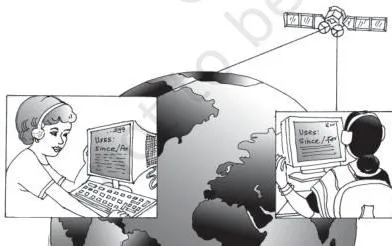
Figure 3.1 (NCERT, p. 46) stands for the outsourcing argument. Companies in developed countries buy services such as call centres, record keeping and accountancy from India at lower cost, and the caption’s point is that this creates employment in big cities.
The advantages that make it work are the ones the text lists alongside: low wages and skilled manpower, connected by fast communication and the internet (NCERT, p. 46).
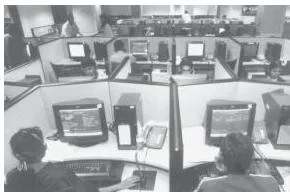
Figure 3.2 (NCERT, p. 48) belongs to the assessment part of the chapter. Since 1991 India has been a successful exporter of IT software, and the service sector has grown faster than agriculture and industry through the reform period (NCERT, pp. 48–49). The caption makes the point the chapter needs: the IT industry is a major contributor to India’s exports.
Key Terms and Definitions with Page References
This chapter introduces policy terms that reappear in the rest of the book. These plain definitions anchor each one, with the page where the book uses it.
| Term | Plain meaning | NCERT page |
|---|---|---|
| Foreign exchange reserves | Foreign currencies a country holds, maintained mainly to import essentials like petroleum and to make international payments. | p. 38 |
| Deficit | The gap when government spending exceeds its income; the government borrows to fill it. | p. 39 |
| New Economic Policy (NEP) | The set of wide-ranging reforms announced in 1991 after India accepted World Bank and IMF conditions. | pp. 39–40 |
| Devaluation | A deliberate government decision to lower the rupee’s value against foreign currencies, taken in 1991 to resolve the crisis. | p. 42 |
| Liberalisation | Ending the rules and licences that restricted economic activity, opening sectors of the economy. | p. 40 |
| Privatisation | Withdrawal of government from ownership or management of an enterprise, or its outright sale. | p. 44 |
| Disinvestment | Selling part of the equity of a public sector enterprise to the public. | p. 44 |
| Globalisation | Integration of a country’s economy with the world economy; an outcome of liberalisation and privatisation. | p. 45 |
| Outsourcing | Hiring a service from an external provider, usually in another country, that a firm previously handled internally. | pp. 45–46 |
| Quantitative restrictions and tariffs | Limits on the quantity of imports (QRs) and taxes on imported goods (tariffs), used to protect domestic industry. | p. 42 |
| FDI and FII | Foreign direct investment in Indian enterprises and foreign institutional investment in Indian financial markets by bodies like mutual funds and pension funds. | pp. 41, 48 |
| Fiscal policy | The government’s taxation and public expenditure policies together. | p. 42 |
Common Mistakes Students Make in This Chapter
These mistakes happen because the terms are abstract and similar-sounding. This chapter has no ‘Points to Ponder’ box — the Recap on page 52 and the Work These Out debates are the book’s own version of that guidance.
| Mistake | Correct rule | NCERT page |
|---|---|---|
| Treating liberalisation, privatisation and globalisation as three parallel policies. | Globalisation is the outcome of the liberalisation and privatisation policies. | pp. 51–52 |
| Using privatisation and disinvestment as synonyms. | Privatisation is the withdrawal of government from ownership or management; disinvestment — selling part of a PSE’s equity — is one route to it. | p. 44 |
| Believing the reforms were a freely chosen plan. | They followed the balance of payments crisis and the conditions attached to the World Bank and IMF loan. | p. 39 |
| Assuming the reforms raised growth in every sector. | Growth was driven by services; agriculture decelerated and industry slowed. | pp. 48–50 |
| Treating the 1991 devaluation as an ordinary market movement. | Devaluation was a deliberate 1991 government measure; only afterwards were markets allowed to set the exchange rate. | p. 42 |
| Dating GST to the 1991 reforms. | GST followed the 2016 constitutional amendment that empowered governments to impose it. | p. 42 |
Using This Chapter in Exams: How the Exercises Map to the Text
This section turns the chapter text into well-structured answers: first a map of what each exercise tests, then a worked structure for the agree-or-disagree questions this chapter is known for.
| Exercise | What it tests | NCERT pages to use |
|---|---|---|
| Q1 | Why the reforms were needed — the crisis and its background. | pp. 38–39 |
| Q2 | The case for WTO membership — globalisation and trade rules. | pp. 45–46 |
| Q3 | The RBI’s changing role — financial sector reforms. | pp. 40–41 |
| Q4 | How the RBI regulates commercial banks — financial sector norms. | pp. 40–41 |
| Q5 | Meaning of devaluation of the rupee — foreign exchange reforms. | p. 42 |
| Q6 | Three distinctions: strategic vs minority sale; bilateral vs multilateral trade; tariff vs non-tariff barriers. | pp. 42–47 |
| Q7 | Purpose of tariffs — trade policy. | p. 42 |
| Q8 | Meaning of quantitative restrictions — import controls. | p. 42 |
| Q9 | Privatisation of profit-making PSUs — the disinvestment debate. | p. 44 |
| Q10 | Outsourcing’s costs and benefits for India. | pp. 45–46 |
| Q11 | India’s advantages as an outsourcing destination. | pp. 45–46 |
| Q12 | The navaratna policy and PSU performance. | p. 44 (Box 3.1) |
| Q13 | Reasons for high service sector growth. | pp. 47–49 |
| Q14 | Why reforms hurt agriculture. | pp. 49–50 |
| Q15 | Why industry performed poorly. | p. 50 |
| Q16 | Reforms in the light of social justice and welfare. | pp. 50–51 |
Answering a ‘Do you agree?’ question
Questions 9, 10 and 12 ask you to take a position. A full answer needs four moves, demonstrated here on Q9 — ‘Those public sector undertakings which are making profits should be privatised. Do you agree with this view? Why?’
- State your position in the first line — for example, ‘I do not agree that every profit-making PSU should be privatised.’
- Give the chapter’s argument for privatisation: the purpose of selling equity was to improve financial discipline, facilitate modernisation, and make use of private capital and managerial skill (NCERT, p. 44).
- Give the counter-evidence: granting maharatna, navratna and miniratna status — autonomy without privatisation — resulted in better performance, the government has since decided to retain these companies in the public sector, and critics say disinvestment proceeds went to offset revenue shortages rather than develop the enterprises (NCERT, pp. 44, 50).
- Close with your reasoned view, such as: autonomy and accountability improved performance, so privatising every profitable PSU does not automatically follow.
This is a structure, not a model answer to copy — your position and examples must be your own, drawn from the chapter. Questions 10 and 12 work the same way: state your view, present the supporting and opposing evidence, close with a reasoned position.
The Suggested Additional Activities (p. 54) practise exactly this reasoning — the Mahadeva groundnut farm case in the Work These Out on page 49, the WTO debate activity, and the question of whether India had any alternative to the World Bank and IMF loan.
One honest note: textbook contents and the examinable syllabus are not always identical — check the current official syllabus before deciding how deeply to revise each box.
The Chapter’s Recap in Brief
This mirrors the chapter’s official Recap on page 52 plus its two-sided conclusion on page 51, in our words. Use it as a night-before checklist.
- Before 1991 the economy was running on borrowed money: foreign exchange reserves fell while imports grew without matching exports, and inflation climbed.
- The 1991 financial crisis and the World Bank-IMF loan forced a change of direction; India accepted the conditionalities and announced the New Economic Policy.
- Domestic reforms targeted the industrial and financial sectors; external reforms deregulated foreign exchange and liberalised imports.
- The public sector’s role was reduced and opened to private owners through disinvestment and liberalisation.
- Globalisation is the outcome of liberalisation and privatisation — the integration of the Indian economy with the world economy.
- The WTO is meant to establish a rule-based trade regime, and outsourcing has emerged as a major activity in industrial and service sectors.
- During the reforms, agriculture and industry grew more slowly while the service sector registered growth.
- Reforms did not benefit agriculture: public investment in the sector declined, and farmers faced international competition.
- Industry slowed because of cheaper imports and lower investment, and the Siricilla tragedy shows the social cost when small producers are exposed.
- The conclusion is two-sided: globalisation as an opportunity for global markets and technology, against the view that it widens disparities and concentrates growth in select service areas.
Related Chapters and Resources
The 1991 reforms are the dividing line in this book: the previous chapter, Indian Economy 1950–1990, describes the pre-reform model that ran into crisis, and every chapter after this one deals with problems the reform era left behind.
For the surrounding book, browse the Class 11 Economics notes and the Class 11 study hub. The debate continues in the next unit, Current Challenges Facing the Indian Economy, which takes up poverty and employment, and the CBSE notes home page holds the full set of chapters.
Two official sources complete your reading. The NCERT textbook page for Indian Economic Development lists the PDF of every chapter in this book. The chapter’s own Government Reports and Websites list (NCERT, p. 56) names the Department of Investment and Public Asset Management — dipam.gov.in — as the official source for disinvestment data.
Reference: NCERT Class 11 Economics textbook, chapter 3, Indian Economic Development, official edition on ncert.nic.in.
Sources and data verification
- The contents on this page describe Chapter 3 of the NCERT Class 11 Economics textbook Indian Economic Development, from the official edition published on ncert.nic.in.
- This page covers only this chapter of this book; it does not cover the rest of the textbook or other Class 11 Economics resources.
- This listing is maintained for the current academic session using the NCERT information available to us.
- NCERT settles the textbook, its editions and the official PDFs; CBSE settles the curriculum, syllabus and examinations. Textbook contents and the examinable syllabus are not always identical — check the current official syllabus.
Frequently Asked Questions
Why were economic reforms introduced in India in 1991?
Because of a balance of payments crisis: the government could not repay its external borrowings, foreign exchange reserves fell below the level needed to finance even a fortnight of imports, imports grew faster than exports and prices of essential goods rose sharply (NCERT, p. 38).
The reforms were the response to that crisis, made under the conditions attached to the World Bank and IMF loan. The New Economic Policy of 1991 was the result (NCERT, p. 39).
What is the difference between liberalisation, privatisation and globalisation?
Liberalisation means ending the controls and licences that restricted economic activity; privatisation means reducing the government’s ownership or management of public enterprises, mainly through disinvestment; globalisation means the integration of the Indian economy with the world economy (NCERT, pp. 40, 44, 45).
The chapter is careful to call globalisation the outcome of the liberalisation and privatisation policies, not a third independent policy (NCERT, p. 52).
What is disinvestment and how is it different from privatisation?
Disinvestment is selling part of the equity of a public sector enterprise to the public (NCERT, p. 44). Privatisation is the wider process — the withdrawal of the government from the ownership or management of an enterprise, or its outright sale. Disinvestment is one route to privatisation, which is why the chapter says the government ‘partly privatised’ companies through it (NCERT, p. 44).
Why did India borrow from the World Bank and IMF in 1991?
India’s foreign exchange reserves were not enough to finance imports for more than two weeks, and there was no money to pay interest to international lenders; no country or funder was willing to lend (NCERT, p. 39). India approached the World Bank (IBRD) and the IMF and received $7 billion to manage the crisis.
In return, India agreed to liberalise and open up the economy (NCERT, p. 39).
How did the reform process affect Indian agriculture and industry?
Agriculture was adversely affected: public investment in irrigation, power, roads and research fell, the partial removal of the fertiliser subsidy raised costs, and lower import duties plus the lifting of quantitative restrictions exposed farmers to international competition (NCERT, p. 49).
Industry slowed because cheaper imports replaced domestic demand and infrastructure investment was inadequate, while developed countries’ non-tariff barriers blocked access to their markets (NCERT, p. 50). Services, by contrast, grew faster than overall GDP (NCERT, p. 49).
What is the WTO and why is India a member of it?
The WTO, founded in 1995 as the successor to GATT, is expected to establish a rule-based trading regime in which nations cannot place arbitrary restrictions on trade; its agreements cover trade in goods and services (NCERT, p. 46).
India is a member and has been at the forefront of framing fair global rules, and it has kept its commitments by removing quantitative restrictions on imports and reducing tariff rates (NCERT, p. 47).
Reference: NCERT Class 11 Economics textbook, chapter 3, Indian Economic Development, official edition on ncert.nic.in.
Explore Class 11 Economics Books
- Previous: Collection of Data
- Next: Current Challenges Facing the Indian Economy
Related chapters:
- Development Policies and Experience (1947-90)
- Why Economics?
- Indian Economy