
The Rise of Nationalism in Europe Class 10 is Chapter 1 of NCERT’s history textbook India and the Contemporary World II. It runs from page 3 to page 28 and traces how the nation-state was forged in nineteenth-century Europe — from the French Revolution to the Balkan crisis that led into 1914.
The official NCERT chapter PDF is linked right below, with a full breakdown of what the chapter contains.
Download the Rise of Nationalism in Europe Class 10 Chapter PDF
This is the official NCERT edition of India and the Contemporary World II used by CBSE schools — the exact file the board prescribes for this chapter.
For reading or revision straight from the textbook, open the rise of nationalism in europe class 10 chapter PDF (India and the Contemporary World II) on the official NCERT portal; it is the same chapter text, page by page, that the book prints.
| What the chapter holds | Count | Where it is used |
|---|---|---|
| Printed pages | 28 | |
| Sections in the chapter | 10 | |
| Figures with NCERT captions | 10 | |
| Tables | 1 | |
| Activities | 9 | |
| Official NCERT PDF | Download the chapter PDF | the chapter exactly as NCERT publishes it |
Chapter at a Glance
The table below lists what the chapter holds — its sections, figures, maps, activities and question sets — so you know the shape of the file before you open it.
This is a history chapter, so it closes with question sets rather than numbered exercises: the last page (p. 28) carries Write in brief, Discuss and a Project. The numbered sections run like this:
- 1 The French Revolution and the Idea of the Nation (p. 5)
- 2 The Making of Nationalism in Europe (p. 8) — 2.1 The Aristocracy and the New Middle Class · 2.2 What did Liberal Nationalism Stand for? (p. 9) · 2.3 A New Conservatism after 1815 (p. 10) · 2.4 The Revolutionaries (p. 12)
- 3 The Age of Revolutions: 1830–1848 (p. 13) — 3.1 The Romantic Imagination and National Feeling · 3.2 Hunger, Hardship and Popular Revolt · 3.3 1848: The Revolution of the Liberals (p. 17)
- 4.1 Germany – Can the Army be the Architect of a Nation? (p. 19) · 4.2 Italy Unified (p. 20) · 4.3 The Strange Case of Britain (p. 21)
- 5 Visualising the Nation (p. 23)
- 6 Nationalism and Imperialism (p. 26)
What This Chapter Covers
This is a survey of how the nation-state replaced Europe’s multi-national dynastic empires during the nineteenth century (NCERT, p. 3). Every idea in the chapter connects to one arc, and the table below maps the whole argument, movement by movement.
| Movement | NCERT pages | What happens in it |
|---|---|---|
| Sorrieu’s dream (1848) | p. 3 | A French artist visualises the peoples of Europe marching as nations before the statue of Liberty — an ideal, not a reality. |
| The French Revolution | p. 5 | The first clear expression of nationalism: sovereignty passes from the monarch to citizens. |
| Napoleon’s Europe | pp. 6–7 | Revolutionary reforms are carried abroad; the initial welcome turns to hostility. |
| The making of nationalism | pp. 8–12 | The aristocracy and the new middle class; liberalism; the zollverein; conservatism after 1815; Mazzini’s secret societies. |
| The age of revolutions | pp. 13–18 | France 1830, Greek independence, Romanticism, hunger revolts, the Frankfurt parliament and the women’s question. |
| The unifications | pp. 19–22 | Germany by Prussia’s wars, Italy by Piedmont and Garibaldi, Britain by gradual absorption. |
| Visualising the nation | pp. 23–24 | Marianne and Germania give the nation a female face. |
| Nationalism to imperialism | pp. 26–27 | The Balkans and big-power rivalry lead to the First World War. |
The whole argument in one line: nationalism is dreamed as a liberal ideal, built into a nation by the French Revolution, carried abroad by Napoleon, repressed by the 1815 settlement, revived by the revolutions of 1830–1848, captured by rulers who unify Germany and Italy from above, and finally hardened into the imperialist rivalry that produces 1914.
Key Concepts in the Chapter
The chapter builds one idea on another, so each block below explains one concept, what it means, and where it appears in the book. Page numbers refer to the NCERT edition.
What a Nation-State Is: Sorrieu’s Dream and Renan’s Answer
Keep two definitions separate. A modern state is a centralised power ruling a clearly defined territory, while a nation-state is one in which the majority of citizens share a common identity and a common history or descent (NCERT, p. 3). That commonness was not ancient — it was forged through struggles, by leaders and ordinary people (NCERT, p. 3).
The book opens with Frédéric Sorrieu’s 1848 print (Fig. 1, p. 3): the peoples of Europe and America march past a statue of Liberty, and the shattered remains of absolutist institutions lie on the ground.
Each people is identified by its flag and costume — yet the Germans carry the black, red and gold flag for a united nation that did not yet exist (NCERT, p. 3). It is a utopian vision, an ideal of nations that the rest of the chapter shows being made real, and deformed.
For the harder, opposite definition, turn to Ernst Renan’s 1882 lecture ‘What is a Nation?’ (p. 4). A nation, for Renan, is not race, language, religion or territory; it is common glories in the past and a common will in the present — what he called a ‘daily plebiscite’ (NCERT, p. 4).
The French Revolution and the Birth of the Nation
1789 is where nationalism first speaks clearly: the revolution transferred sovereignty from the monarchy to a body of French citizens and proclaimed that the people constitute the nation (NCERT, p. 5). The revolutionaries then built a collective identity through the measures below — this same list is the answer plan for the page-28 question on the steps they took.
- The ideas of la patrie (fatherland) and le citoyen (citizen) — a united community with equal rights under a constitution (p. 5).
- The tricolour replaced the former royal standard (p. 5).
- The Estates General was elected by active citizens and renamed the National Assembly (p. 5).
- New hymns were composed, oaths taken and martyrs commemorated, all in the nation’s name (p. 5).
- A centralised administration formulated uniform laws; internal customs duties and dues were abolished; a uniform system of weights and measures was adopted (p. 5).
- Regional dialects were discouraged, and French as spoken and written in Paris became the common language (p. 5).
- The revolution declared its mission to liberate the peoples of Europe from despotism (p. 5).
In the 1790s these ideas travelled with the French armies — but first through the Jacobin clubs set up by students and the educated middle classes across Europe, whose campaigns prepared the way for the troops (NCERT, p. 5).
Napoleon’s Reforms: Freedom or Conquest?
Napoleon is the chapter’s first contradiction. He destroyed democracy in France by returning to monarchy, yet in administration he incorporated revolutionary principles to make the whole system more rational and efficient (NCERT, p. 6).
The Civil Code of 1804 — the Napoleonic Code — abolished all privileges based on birth, established equality before the law, and secured the right to property (NCERT, p. 6).
In the lands under his control — Holland, Switzerland, Italy and Germany — Napoleon simplified administrative divisions, abolished the feudal system, freed peasants from serfdom and manorial dues, removed guild restrictions, and improved transport and communication (NCERT, p. 6).
The reactions were mixed (NCERT, p. 7). The French were welcomed as liberators in Holland, Switzerland, Brussels, Mainz, Milan and Warsaw — but enthusiasm turned to hostility over increased taxation, censorship, and forced conscription into the French armies (NCERT, p. 7).
Fig. 4 on page 7 shows the souring: French soldiers seize a peasant’s cart, harass young women and force a peasant to his knees, while a sarcastic plaque reads ‘Take freedom and equality from us, the model of humanity.’
Liberalism and the New Middle Class
Liberalism (from the Latin liber, free) was the ideology of the new middle classes: freedom for the individual and equality of all before the law (NCERT, p. 9). Politically it meant government by consent, an end to autocracy and clerical privileges, a constitution and representative parliament — and the inviolability of private property (NCERT, p. 9).
The correction that matters in exams: equality before the law did not mean universal suffrage. In revolutionary France only property-owning men could vote and stand for election; the Napoleonic Code went back to limited suffrage and reduced women to the status of a minor, subject to fathers and husbands (NCERT, pp. 6, 9).
Economically, liberalism meant free markets. The book’s proof is a merchant travelling from Hamburg to Nuremberg in 1833: he passed 11 customs barriers and paid about 5 per cent duty at each (NCERT, p. 9). Worse, every region measured goods differently — one elle of cloth meant:
| City | Length of one elle of cloth |
|---|---|
| Frankfurt | 54.7 cm |
| Mainz | 55.1 cm |
| Nuremberg | 65.6 cm |
| Freiburg | 53.5 cm |
The same named measure meant a different quantity in every town — a merchant could not even know what he was buying. The zollverein, a customs union formed in 1834 at Prussia’s initiative, abolished tariff barriers and reduced the currencies of the German states from over thirty to two; railways later harnessed economic interests to national unification (NCERT, p. 9).
Friedrich List, quoted on page 10, put the aim plainly: economic union would bind the Germans into a nation and awaken national feeling.
The New Conservatism and the Vienna Settlement
Conservatism was the spirit of European governments after Napoleon’s defeat in 1815: preserve the established institutions of state and society — monarchy, the Church, social hierarchies, property and the family (NCERT, p. 10).
The nuance the chapter stresses: most conservatives did not want to return to pre-revolutionary society. They borrowed Napoleon’s modernisation — a modern army, an efficient bureaucracy, a dynamic economy — to make autocratic monarchy stronger (NCERT, p. 10).
The Treaty of Vienna (1815), hosted by the Austrian Chancellor Metternich, undid most of Napoleon’s changes: the Bourbon dynasty was restored, France lost its annexed territories, buffer states were created (the Netherlands with Belgium in the north, Genoa added to Piedmont in the south), Prussia gained western territories, Austria took control of northern Italy, and the German confederation of 39 states was left untouched (NCERT, pp. 10–11).
These conservative regimes were autocratic and imposed censorship; the caricature ‘The Club of Thinkers’ (Fig. 6, p. 11) shows discussion being silenced by muzzling club members. Freedom of the press became a central demand of the liberal-nationalists who criticised the new order (NCERT, p. 11).
| Issue | Liberal nationalism (before 1848) | Conservatism (after 1815) | NCERT page |
|---|---|---|---|
| Suffrage | Government by consent through a constitution and parliament, but only property-owning men voted; women and the propertyless were excluded (NCERT, p. 9). | No popular suffrage at all; monarchy and established institutions were to be preserved (NCERT, p. 10). | pp. 9–10 |
| Press freedom | Freedom of the press was a central liberal demand against censorship (NCERT, p. 11). | Censorship laws controlled what was said in newspapers, books, plays and songs (NCERT, p. 10). | pp. 10–11 |
| The Church | Liberalism demanded an end to clerical privileges (NCERT, p. 9). | The Church was an established institution to be preserved (NCERT, p. 10). | pp. 9–10 |
| Private property | The inviolability of private property was a core liberal principle (NCERT, p. 9). | Property was among the traditional institutions conservatism defended (NCERT, p. 10). | pp. 9–10 |
| Change | Progress through constitutional reform and representative government. | Gradual development preferred; tradition and established customs stressed (NCERT, p. 10). | pp. 9–10 |
The Age of Revolutions, 1830–1848
After 1815, liberalism and nationalism became associated with revolution in many regions — led by the educated middle classes: professors, school-teachers, clerks and commercial men (NCERT, p. 13).
The first upheaval came in France in July 1830: the restored Bourbon kings were overthrown, and liberal revolutionaries installed a constitutional monarchy under Louis Philippe. ‘When France sneezes,’ Metternich remarked, ‘the rest of Europe catches cold’ (NCERT, p. 13). The spark led to an uprising in Brussels, and Belgium broke away from the United Kingdom of the Netherlands (NCERT, p. 13).
The Greek war of independence mobilised nationalist feeling among the educated elite across Europe. Greece had been part of the Ottoman Empire since the fifteenth century; its struggle began in 1821 and won wide sympathy from West Europeans who saw Greece as the cradle of European civilisation.
The poet Lord Byron organised funds and went to fight, dying of fever in 1824; the Treaty of Constantinople of 1832 recognised Greece as an independent nation (NCERT, p. 13).
Romanticism built national feeling through culture rather than war: art and poetry, stories and music, with emotion, intuition and mystical feeling placed over reason (NCERT, pp. 13–14). Herder claimed the true spirit of the nation — the volkgeist — lived among the common people, das volk, so folk songs and dances were collected as nation-building (NCERT, p. 14).
In partitioned Poland, music kept national feeling alive: Karol Kurpinski turned folk dances like the polonaise and mazurka into nationalist symbols, and clergy used Polish for church gatherings until Russian authorities jailed large numbers of them (NCERT, pp. 14–15). The Grimm brothers collected folktales and published a 33-volume dictionary of the German language as part of the same project (NCERT, p. 15).
Hunger drove the second wave. The first half of the century brought enormous population growth, overcrowded slums in the cities, and competition from cheap English machine-made goods (NCERT, p. 15). In 1845 Silesian weavers revolted after contractors drastically cut their payments; troops fired, and eleven weavers were shot (NCERT, p. 16).
In February 1848 Paris rose, barricades went up, Louis Philippe fled, and a Republic was proclaimed with universal male suffrage and the right to work (NCERT, p. 15).
Running parallel was the liberals’ revolution of 1848: in Frankfurt, 831 elected representatives came together in the Church of St Paul and drafted a constitution for a German nation headed by a monarchy subject to a parliament.
King Friedrich Wilhelm IV of Prussia rejected the crown, the opposition of the aristocracy and military hardened, and the assembly was forced to disband (NCERT, p. 17).
The women’s question split the liberal movement itself. Women had formed their own political associations, founded newspapers and taken part in demonstrations, yet in the election of the Frankfurt Assembly they were denied suffrage and admitted only as observers in the visitors’ gallery (NCERT, p. 17).
The book’s three texts on page 17 — Carl Welcker’s separate-spheres argument, Louise Otto-Peters’ ‘Liberty is indivisible!’, and an anonymous reader’s letter demanding votes for propertied women — show the fight over what ‘equality’ meant inside liberalism.
Germany, Italy and Britain: Three Paths to a Nation
After 1848, nationalism in Europe moved away from its association with democracy and revolution, and unifications became state projects (NCERT, p. 19).
Germany: the liberal initiative of 1848 was repressed by the combined forces of the monarchy and the military, supported by the Prussian landowners, the Junkers. Prussia then took the lead; its chief minister, Otto von Bismarck, was the architect, working with the Prussian army and bureaucracy.
Three wars over seven years — with Denmark, Austria and France — ended in Prussian victory, and on 18 January 1871 Kaiser William I was proclaimed German Emperor in the Hall of Mirrors at Versailles. The new state modernised currency, banking, legal and judicial systems, with Prussian practices as the model (NCERT, p. 19).
Italy: in the mid-nineteenth century Italy was divided into seven states — the north under the Austrian Habsburgs, the centre under the Pope, the south under the Bourbon kings of Spain, with only Sardinia-Piedmont ruled by an Italian princely house (NCERT, p. 20).
Mazzini’s earlier programme for a unitary republic failed in 1831 and 1848, so the mantle fell on Sardinia-Piedmont under King Victor Emmanuel II. Chief Minister Cavour — neither a revolutionary nor a democrat, and a better speaker of French than Italian — engineered a diplomatic alliance with France and defeated Austria in 1859.
The next year Garibaldi‘s armed volunteers marched into South Italy and the Kingdom of the Two Sicilies, winning peasant support and driving out the Spanish rulers. Victor Emmanuel II was proclaimed king of united Italy in 1861; the Papal States joined only in 1870 (NCERT, pp. 20–22).
The book’s anecdote says much: most peasants had never heard of Italia and believed La Talia was Victor Emmanuel’s wife (NCERT, p. 21).
Britain: the ‘strange case’ — there was no British nation before the eighteenth century, only English, Welsh, Scot and Irish ethnic identities. The English parliament, which had seized power from the monarchy in 1688, was the instrument through which a nation-state with England at its centre was forged.
The Act of Union (1707) with Scotland created the ‘United Kingdom of Great Britain’; Scottish Gaelic and Highland culture were systematically suppressed, and after the failed 1798 revolt Ireland was forcibly incorporated in 1801. A ‘British nation’ was then propagated through the Union Jack, the anthem and the English language (NCERT, p. 21).
| Germany | Italy | Britain | |
|---|---|---|---|
| Who led | Prussia — Bismarck, the army and bureaucracy (NCERT, p. 19) | Sardinia-Piedmont — Victor Emmanuel II, Cavour’s diplomacy, Garibaldi’s volunteers (NCERT, pp. 20–21) | The English parliament and the English state (NCERT, p. 21) |
| Key dates | 1866–71; Emperor proclaimed 18 January 1871 (NCERT, p. 19) | 1859–70; king proclaimed 1861; Papal States joined 1870 (NCERT, pp. 20–22) | Act of Union with Scotland 1707; Ireland incorporated 1801 (NCERT, p. 21) |
| Method | Three wars over seven years — with Denmark, Austria and France (NCERT, p. 19) | Alliance with France, defeat of Austria in 1859, march into South Italy in 1860 (NCERT, pp. 20–21) | Gradual extension of English influence and suppression of local culture (NCERT, p. 21) |
| Nature | Unification from above by a monarchical state | Elite diplomacy plus a mass volunteer army | A long-drawn-out process, no revolution (NCERT, p. 21) |
Visualising the Nation: Allegory, Marianne and Germania
How does one give a face to a nation? Eighteenth- and nineteenth-century artists personified the nation as a female figure — an allegory, a concrete form for an abstract idea (NCERT, p. 23). The female figure stood for no particular woman; it gave the nation a visible, everyday shape.
In France the allegory was christened Marianne, a popular Christian name that underlined the idea of a people’s nation. Her attributes came from Liberty and the Republic — the red cap, the tricolour, the cockade — and her statues stood in public squares, while her image was stamped on coins and postage stamps (NCERT, p. 23).
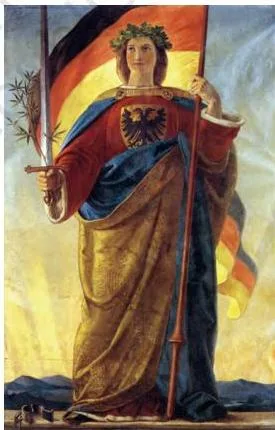
Germania became the allegory of the German nation, wearing a crown of oak leaves because the German oak stands for heroism (NCERT, p. 23).
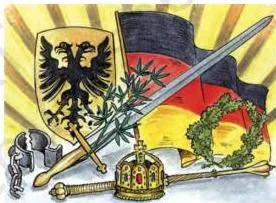
Box 3 on page 24 is a ready-made symbol bank for image questions. Each attribute and its meaning, in your own words:
| Attribute | What it signified |
|---|---|
| Broken chains | Being freed |
| Breastplate with eagle | Strength — symbol of the German empire |
| Crown of oak leaves | Heroism |
| Sword | Readiness to fight |
| Olive branch around the sword | Willingness to make peace |
| Black, red and gold tricolour | Flag of the liberal-nationalists of 1848, banned by the German dukes |
| Rays of the rising sun | Beginning of a new era |
All entries from NCERT, p. 24.
From Nationalism to Imperialism: The Balkans
By the last quarter of the nineteenth century, nationalism no longer kept its idealistic liberal-democratic character; it became a narrow creed, intolerant of other groups and ready for war, and the major powers manipulated the nationalist aspirations of subject peoples for their own imperialist aims (NCERT, p. 26).
The most serious source of tension after 1871 was the Balkans — a region of geographical and ethnic variation covering modern-day Romania, Bulgaria, Albania, Greece, Macedonia, Croatia, Bosnia-Herzegovina, Slovenia, Serbia and Montenegro, whose inhabitants were broadly known as Slavs. A large part was under the Ottoman Empire; romantic nationalism there, together with the empire’s disintegration, made the region explosive (NCERT, p. 26).
The Balkan peoples based their claims for independence on nationality, and used history to prove they had once been free before being subjugated (NCERT, p. 26).
The exam-critical point: the Balkans were also the scene of big-power rivalry. Russia, Germany, England and Austro-Hungary each tried to counter the others’ hold and extend its own control. That rivalry produced a series of wars in the region and finally the First World War (NCERT, p. 26).
Fig. 20 on page 27 shows the mindset: Britannia triumphant over the globe while colonies appear as tigers, elephants and primitive people — domination of the world as the basis of national pride.
| Liberal-democratic nationalism | Narrow imperialist nationalism | |
|---|---|---|
| When | First half of the century, up to 1848 | Last quarter of the century, after 1871 |
| Character | Linked to liberty, democracy and revolution; Mazzini’s democratic republics (NCERT, p. 12) | A narrow creed, intolerant, ready for war, manipulated by big powers (NCERT, p. 26) |
| Example | The Frankfurt parliament’s constitution for a united Germany (NCERT, p. 17) | Balkan struggles entangled with big-power rivalry (NCERT, p. 26) |
The chapter closes with the global turn: colonised peoples developed their own specific varieties of nationalism against imperial domination, and the idea that societies should be organised into nation-states came to be accepted as natural and universal (NCERT, p. 27).
Reading the Chapter’s Images: A Figure Walkthrough
This chapter is built on images, and almost every Activity box asks the same thing: describe what you see, then interpret what it means. Use this three-step method and image questions answer themselves:
- Describe — say exactly what is physically in the picture: figures, objects, clothes, flags, captions.
- Interpret — read the symbols (the Box 3 chart on p. 24 gives you Germania’s attributes) and say what they stand for.
- Connect — tie the picture to the event or idea it illustrates, using the page where it appears.
The five groups below apply the method to the chapter’s key visuals.
The French in Europe: Liberators in Print, Oppressors in Caricature
When the news of the events in France reached the different cities of Europe, students and other members of educated middle classes began setting up Jacobin clubs (NCERT, p. 5). This image is the visual proof: revolutionary ideas travelled through clubs before the armies did.
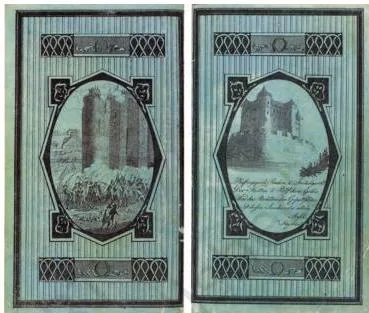
The cover pairs the storming of the Bastille with a similar fortress that represents despotic rule in the German province of Kassel, under the slogan ‘The people must seize their own freedom!’ Rebmann, who lived in Mainz, was himself a member of a German Jacobin group (NCERT, p. 5).
The second image shows the other side of the story. However, in the areas conquered, the reactions of the local populations to French rule were mixed (NCERT, p. 7).
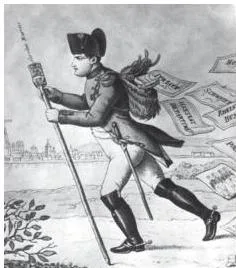
This colour print by the German painter Karl Kaspar Fritz shows the occupation of Zweibrücken by French armies.
The soldiers, in blue, white and red uniforms, are portrayed as oppressors — seizing a peasant’s cart on the left, harassing young women in the centre, forcing a peasant to his knees — while the plaque on the Tree of Liberty reads sarcastically: ‘Take freedom and equality from us, the model of humanity’ (NCERT, p. 7).
The book’s words and images agree: the welcome turned to hostility over taxation, censorship and forced conscription.
Mazzini and the Underground Revolutionaries
One such individual was the Italian revolutionary Giuseppe Mazzini (NCERT, p. 12) — the chapter’s example of how post-1815 repression drove liberals underground.
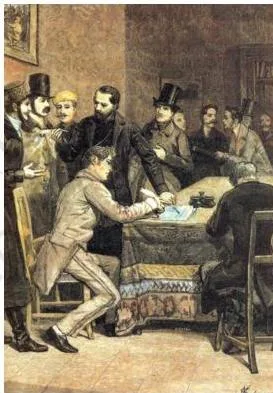
Born in Genoa in 1805, Mazzini joined the secret society of the Carbonari, was exiled in 1831 at the age of 26, and then founded Young Italy in Marseilles and Young Europe in Berne, whose members came from Poland, France, Italy and the German states.
He believed God had intended nations to be the natural units of mankind, so Italy had to become a single unified republic (NCERT, p. 12). Metternich called him ‘the most dangerous enemy of our social order’ — the measure of how much the conservatives feared him.
Bismarck, the German Empire and the Hall of Mirrors
The nation-building process in Germany had demonstrated the dominance of Prussian state power (NCERT, p. 19) — and this painting was made to celebrate exactly that.
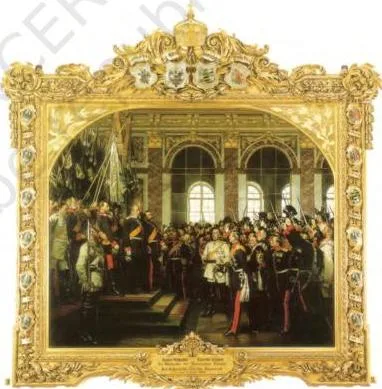
Anton von Werner’s monumental painting (2.7 m × 2.7 m) shows the assembly of German princes, army representatives and Prussian ministers on the bitterly cold morning of 18 January 1871. The Kaiser stands at the centre with General von Roon, Bismarck near them — a military-state ceremony held inside France’s own palace, which is the point: Prussia’s dominance sealed the unification (NCERT, p. 19).
The artist completed the work and presented it to Bismarck on his 70th birthday in 1885.
Fig. 13 on page 20 turns from pomp to mockery — a caricature of Bismarck in the German reichstag.
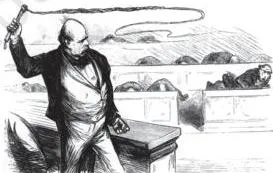
The page-20 activity asks you to describe the caricature, say how it represents the relationship between Bismarck and the elected deputies, and state what interpretation of democratic processes the artist is conveying. Read it against the chapter: the 1848 liberal initiative had been repressed, and unification was carried out by the army and bureaucracy (NCERT, p. 19).
The artist shows Bismarck overwhelming the parliament — the suggestion is that the new German democracy could not stand against him.
Italy Before and After: Maps and the Boot of Italy
Chief Minister Cavour, who led the movement to unify the regions of Italy, was neither a revolutionary nor a democrat (NCERT, p. 21) — and the maps show why unification had to be engineered from above.
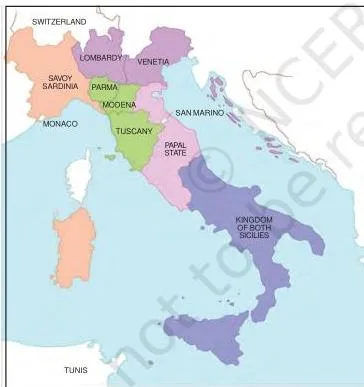
Italy was divided into seven states: the north under the Austrian Habsburgs, the centre under the Pope, the south under the Bourbon kings of Spain, and only Sardinia-Piedmont ruled by an Italian princely house (NCERT, p. 20).
The page-21 activity asks whether people in these regions thought of themselves as Italians — and the chapter’s own ‘La Talia’ anecdote answers that most ordinary people did not (NCERT, p. 21).
In 1867, Garibaldi led an army of volunteers to Rome to fight the last obstacle to the unification of Italy, the Papal States where a French garrison was stationed (NCERT, p. 22) — and the English caricaturist of 1859 had already drawn the whole strategy as a boot.
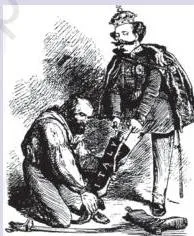
The artist shows Garibaldi holding the base of the boot while the King enters from the top — the statement is that unification was led from above by Sardinia-Piedmont, with Garibaldi’s volunteers doing the heavy lifting, not by a popular groundswell.
Box 2 fills in Garibaldi’s career: sailor in the merchant navy, member of Young Italy from 1833, exile in South America till 1848, leader of the Expedition of the Thousand in 1860 (volunteers growing to about 30,000, the Red Shirts), and the failed 1867 march on Rome before the Papal States finally joined in 1870 (NCERT, p. 22).
Marianne and Germania: Giving the Nation a Face
The chapter’s most image-heavy questions are about allegory — an abstract idea such as greed, envy, freedom or liberty expressed through a person or a thing (NCERT, p. 23). Start with the painting of Germania that hung over the Frankfurt parliament.
Philip Veit prepared this painting of Germania on a cotton banner so it could hang from the ceiling of the Church of St Paul, where the Frankfurt parliament was convened in March 1848 (NCERT, p. 23).
The page-24 activity asks you to identify her attributes using the Box 3 chart — the oak-leaf crown (heroism), the sword (readiness to fight), the olive branch (willingness to make peace) — and to explain a telling change: in Veit’s earlier 1836 version the Kaiser’s crown stood where the broken chain now appears.
The broken chain signals being freed; the liberal nation of 1848 had replaced the old monarchical symbol (NCERT, p. 24).
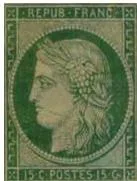
France put its allegory on everyday objects so citizens would identify with the nation daily.
Marianne — a popular Christian name, chosen deliberately — carried the red cap, tricolour and cockade of Liberty and the Republic. Statues of her stood in public squares, and her image was marked on coins and stamps (NCERT, p. 23). An image on a stamp is the smallest possible daily reminder of the nation.
Then the dream failed — and the allegory fell with it.
The activity next to this image asks what historical events Hübner was referring to. The answer sits in the chapter: the Frankfurt parliament’s constitution was rejected, and troops forced the assembly to disband (NCERT, p. 17). Germania lies fallen because the liberal nation that the 1848 revolutionaries dreamed of did not come into being.
Glossary: The Words You Need to Answer Correctly
The book prints ‘New words’ boxes throughout; using these terms precisely in an answer is half the mark. Here is each one in plain words.
| Term | Meaning (in your own words) | NCERT page |
|---|---|---|
| Absolutist | A monarchical government with no restraints on its power — centralised, militarised and repressive | p. 3 |
| Utopian | A vision of a society so ideal that it is unlikely to actually exist | p. 3 |
| Plebiscite | A direct vote by which all the people of a region accept or reject a proposal | p. 4 |
| Suffrage | The right to vote | p. 9 |
| Conservatism | A political philosophy stressing tradition, established institutions and customs, preferring gradual development to quick change | p. 10 |
| Feminist | Awareness of women’s rights based on the belief in social, economic and political equality of the genders | p. 17 |
| Ideology | A system of ideas reflecting a particular social and political vision | p. 18 |
| Ethnic | Relating to a common racial, tribal or cultural origin that a community identifies with or claims | p. 22 |
| Allegory | An abstract idea expressed through a person or a thing; an allegorical story has both a literal and a symbolic meaning | p. 23 |
Common Mistakes Students Make in This Chapter
This chapter trips students in the same few places every year, and the book itself gives the corrections. Check your answer against the middle column before you write it.
| Mistake | Correct rule | How to check your answer |
|---|---|---|
| ‘The French Revolution gave everyone the vote.’ | Only property-owning men voted; the Napoleonic Code later reduced women to the status of a minor (NCERT, pp. 6, 9). | Ask: who was excluded? Propertyless men and all women. |
| ‘Napoleon was only a conqueror.’ | He destroyed democracy in France but carried revolutionary principles in administration — the Civil Code abolished privileges of birth and secured equality before the law (NCERT, pp. 6–7). | Name the Civil Code of 1804 and its three effects. |
| ‘Liberalism = democracy for all.’ | Liberals wanted equality before the law and government by consent, but supported limited suffrage, excluding women and the propertyless (NCERT, p. 9). | Check who actually voted in revolutionary France. |
| ‘All nationalism is the same.’ | Before 1848 nationalism was tied to liberty and democracy; after 1871 it became a narrow, aggressive, imperialist creed (NCERT, pp. 19, 26). | Compare Mazzini’s aim with Balkan nationalism. |
| ‘Germany and Italy were unified by popular movements.’ | The liberal initiatives were repressed; Germany was unified by Prussia’s army and Bismarck’s three wars, Italy by Sardinia-Piedmont, Cavour’s diplomacy and Garibaldi’s volunteers (NCERT, pp. 19–21). | Name the monarchs, generals and statesmen who carried out each unification. |
| ‘Britain became a nation by revolution, like France.’ | Britain is the ‘strange case’: a gradual process of English dominance over Scotland (Act of Union 1707) and Ireland (1801) (NCERT, p. 21). | Date the Act of Union and the incorporation of Ireland. |
| ‘Balkan nationalism alone caused the First World War.’ | The book stresses Balkan nationalist struggles plus big-power rivalry — Russia, Germany, England and Austro-Hungary — over the region (NCERT, p. 26). | List the powers that competed in the Balkans. |
How to Revise This Chapter
This is a history chapter, so revision means dates, names, symbols and the order of events — there are no formulas to learn. Five things to do.
1. Build your revision spine from the ‘Some important dates’ box on page 8. If you can list these seven dates in order, every other fact in the chapter can be anchored to one of them.
| Date | Event it anchors |
|---|---|
| 1797 | Napoleon invades Italy; Napoleonic wars begin |
| 1814–15 | Fall of Napoleon; the Vienna Peace Settlement |
| 1821 | Greek struggle for independence begins |
| 1848 | Revolutions in Europe; middle classes demand constitutions; Italians, Germans and others demand nation-states |
| 1859–70 | Unification of Italy |
| 1866–71 | Unification of Germany |
| 1905 | Slav nationalism gathers force in the Habsburg and Ottoman Empires |
All entries from NCERT, p. 8.
2. Practise image questions using the activities. Almost every Activity box in the chapter asks the same two things — describe what you see, then interpret what it means — and the Figure Walkthrough above is the method to use.
3. Use Box 3 (p. 24) as a ready-made symbol answer bank. The seven attributes and their meanings are listed in full in the Visualising the Nation section above.
4. Know what the chapter’s own closing questions ask. Page 28 ends the chapter with three sets — Write in brief, Discuss and a Project. The Write in brief items map directly to the Key Concepts blocks above:
| Page-28 question set | What it asks | Where this page answers it |
|---|---|---|
| Write in brief, Q1 | Short notes: Mazzini, Cavour, the Greek war, the Frankfurt parliament, the role of women | The Age of Revolutions block; the Mazzini figure walkthrough |
| Write in brief, Q2 | Steps the French revolutionaries took to create a sense of collective identity | The French Revolution block — the worked answer plan |
| Write in brief, Q3 | Who were Marianne and Germania, and how were they portrayed | The Visualising the Nation block and the allegory figures |
| Write in brief, Q4 | Briefly trace the process of German unification | The Three Paths block — Germany row |
| Write in brief, Q5 | What changes Napoleon introduced to make administration efficient | The Napoleon’s Reforms block |
| Discuss set | The 1848 revolution of the liberals, culture and nationalism, nation-building in two countries, Britain, the Balkans | Spread across the Key Concepts; use the quick walk below for the overview |
| Project | Nationalist symbols in countries outside Europe | Beyond the chapter — the book asks you to research this yourself |
5. One honest caveat: textbook contents and the examinable syllabus are not always identical — check the current official CBSE syllabus before assuming every part of this chapter is examinable this session.
The Chapter in One Page: A Quick Walk
This is the night-before version of the whole chapter, in the order the argument actually moves. Read it top to bottom and you have the full story.
- Dream first (p. 3). Sorrieu’s 1848 print imagines Europe as democratic republics marching before the statue of Liberty — an ideal vision, since the Germans carried a flag for a nation that did not yet exist.
- The French Revolution makes the nation (p. 5). Sovereignty moves from the monarch to the citizens; the tricolour, the National Assembly, hymns, oaths, uniform laws and a common language create a shared identity.
- Napoleon spreads — and loses — the idea (pp. 6–7). The Civil Code abolishes privileges of birth and secures equality before the law; conquered peoples first welcome the French, then resent taxation, censorship and conscription.
- Society is remade (p. 8). A small landed aristocracy dominates, but a new educated middle class rises with industry and trade and carries liberal ideas.
- Liberalism and its limits (p. 9). Freedom of the individual, equality before the law, government by consent — but only property-owning men vote; women and the propertyless are excluded.
- Economic unity first (pp. 9–10). The zollverein of 1834 abolishes tariff barriers and cuts currencies from over thirty to two; Friedrich List sees economic union as the road to national feeling.
- The conservative turn (pp. 10–11). After 1815 the Treaty of Vienna restores monarchies, builds buffer states around France and censors dissent; revolutionaries like Mazzini go underground (p. 12).
- Revolutions return (pp. 13–18). France 1830, Greek independence, Romanticism and folk culture, the Silesian weavers’ revolt, and the revolutions of 1848 culminate in the Frankfurt parliament — which fails when the King of Prussia rejects the crown.
- Unification from above (pp. 19–22). Germany is forged by Bismarck’s three wars (1871), Italy by Cavour’s diplomacy and Garibaldi’s volunteers (1861), while Britain is the strange case of gradual English absorption of Scotland and Ireland.
- The nation gets a face (pp. 23–24). Marianne and Germania personify the abstract nation; broken chains, the oak crown, the sword and the olive branch each carry a meaning you must read.
- Nationalism turns imperial (pp. 26–27). In the Balkans, nationalist struggles mix with big-power rivalry and lead to a series of wars and finally the First World War; beyond Europe, colonised peoples forge their own nationalisms.
Related Resources
This listing is maintained for the 2026-27 academic session using the NCERT textbook information available to us. NCERT remains the authority for confirming the latest edition.
Once this chapter is done, the natural next step is the chapter that follows it in the same book — Nationalism in India, which applies the same questions to the Indian freedom struggle. For study help across the subject, use the Class 10 Social Science notes hub, or go broader with the Class 10 revision notes and the main CBSE notes directory.
Topics from other parts of the syllabus, such as Forest and Wildlife Resources, are covered there too. The official file remains available on NCERT’s textbook portal if you need to download it again.
Sources and Data Verification
Four things you should know about what this page is based on.
- This page describes NCERT’s Class 10 Social Science textbook India and the Contemporary World II, Chapter 1, ‘The Rise of Nationalism in Europe’. The chapter occupies textbook pages 3–28, and the official edition is available on ncert.nic.in.
- This page covers that one book and chapter only. It does not cover the other Class 10 Social Science books — Contemporary India II, Democratic Politics II or Understanding Economic Development.
- The listing is maintained for the current academic session using the NCERT information available to this site.
- NCERT settles textbooks, editions and PDFs; CBSE settles curriculum, syllabus and examinations. Textbook contents and the examinable syllabus are not always identical, so check the current official CBSE announcements before exams.
Reference: NCERT Class 10 Social Science textbook (India and the Contemporary World II), chapter 1, official edition on ncert.nic.in.
Frequently Asked Questions
What is the main theme of The Rise of Nationalism in Europe Class 10?
The chapter traces how the nation-state emerged in nineteenth-century Europe in place of the multi-national dynastic empires (NCERT, p. 3). It follows the idea of nationalism from the French Revolution and Napoleon’s reforms, through liberal nationalism and the revolutions of 1830–1848, to the state-led unifications of Germany and Italy, and finally its turn into imperialism in the Balkans (NCERT, pp. 5–27).
How did the French Revolution create a sense of collective identity among the French people?
By transferring sovereignty from the monarch to a body of citizens (NCERT, p. 5). The revolutionaries introduced the tricolour, renamed the Estates General as the National Assembly, composed new hymns and oaths, created a centralised administration with uniform laws, abolished internal customs duties, and made French as spoken in Paris the common language (NCERT, p. 5).
The French Revolution block above gives the complete list, with a page anchor for every measure.
Who were Marianne and Germania, and why were they used as symbols of the nation?
They were female allegories invented by artists to personify the nation (NCERT, p. 23). Marianne, a popular Christian name in France, was drawn with the red cap, tricolour and cockade of Liberty and the Republic, and placed on statues, coins and stamps; Germania wore a crown of oak leaves because the German oak stands for heroism (NCERT, p. 23).
A female figure gave the abstract idea of the nation a concrete, everyday form that citizens could identify with.
How was Germany unified in 1871?
By Prussia, not by popular revolution. The liberal initiative of 1848 was repressed by the monarchy, the military and the Prussian Junkers, and chief minister Otto von Bismarck then carried out unification with the Prussian army and bureaucracy (NCERT, p. 19).
Three wars over seven years — with Denmark, Austria and France — ended in Prussian victory, and Kaiser William I was proclaimed German Emperor at Versailles on 18 January 1871 (NCERT, p. 19).
Why did nationalist tensions emerge in the Balkans?
The Balkans was a region of geographical and ethnic variation, largely under the Ottoman Empire; romantic nationalism there, together with the empire’s disintegration, made the region explosive (NCERT, p. 26).
The Balkan peoples based their claims for independence on nationality and history, while the big powers — Russia, Germany, England and Austro-Hungary — each tried to extend control over the area, leading to a series of wars and finally the First World War (NCERT, p. 26).
How is The Rise of Nationalism in Europe different from Nationalism in India?
The European chapter studies the nineteenth-century birth and corruption of nationalism in Europe itself; Nationalism in India studies how a colonised people forged a collective national identity against British rule.
The chapter makes the link itself: European ideas of nationalism were nowhere replicated, and every colonised people developed its own specific variety of nationalism, while the nation-state came to be accepted as universal (NCERT, p. 27).
Explore Class 10 Social Science Books
Class 10 Social Science on LearnCBSE:
Related chapters: