
Nationalism in India Class 10 is the second chapter of the NCERT Social Science book India and the Contemporary World II (History). It runs 22 printed pages, from page 28 to page 49, and follows the national movement from the end of the First World War to the Quit India call of 1942.
The official chapter PDF is right here, followed by a map of the chapter’s sections, its key concepts, figures, definitions and exercises.
Download Nationalism in India Class 10 Chapter 2 PDF
The file below is NCERT’s own PDF of the chapter — the same text, figures and exercises that appear in the printed book, with nothing added or removed.
Open or save the Download the Nationalism in India Class 10 chapter PDF straight from the NCERT server to read all 22 pages of the chapter offline, with every photograph and exercise exactly as printed.
| What the chapter holds | Count | Where it is used |
|---|---|---|
| Printed pages | 22 | |
| Sections in the chapter | 9 | |
| Figures with NCERT captions | 12 | |
| Activities | 5 | |
| Official NCERT PDF | Download the chapter PDF | the chapter exactly as NCERT publishes it |
Nationalism in India Class 10: Chapter at a Glance
The table below is a quick inventory of the chapter — its sections, figures, activities and exercise blocks — so you can see at once what the PDF holds before you start reading.
What This Chapter Covers: From the First World War to Quit India
This chapter follows the national movement in India from the early 1920s to 1942. The table below maps each block of the chapter with the pages it occupies, so you can jump straight to the part you are stuck on.
| Chapter section | What happens in it | NCERT page |
|---|---|---|
| The First World War, Khilafat and Non-Cooperation | War hardship and forced recruitment; the idea of satyagraha; the Rowlatt Act and Jallianwala Bagh; why non-cooperation was launched | pp. 30-33 |
| Differing Strands within the Movement | How towns, peasants, tribals and plantation workers each understood swaraj | pp. 33-37 |
| Towards Civil Disobedience | The Simon Commission; Purna Swaraj; the Salt March; breaking colonial laws; the Gandhi-Irwin Pact | pp. 37-41 |
| How Participants Saw the Movement, and Its Limits | Who joined and who stayed out; dalits, separate electorates and the Poona Pact; Hindu-Muslim distrust | pp. 41-45 |
| The Sense of Collective Belonging | Bharat Mata, folklore, flags and a new reading of Indian history | pp. 46-48 |
| Quit India Movement | The 1942 call for the complete withdrawal of the British | pp. 48-49 |
Five activity boxes are planted inside the text — design a poster for the Non-Cooperation call, imagine you are a peasant in 1920, find other captured revolutionaries, decide what Gandhiji meant by active resistance, and judge whether the Bharat Mata images appeal to everyone. The chapter closes with a “Write in brief” set, a “Discuss” set and a project on Indo-China.
Key Concepts: Satyagraha, Swaraj and the Two Mass Movements
The chapter really turns on two questions — what did swaraj mean, and how did different Indians try to win it. The concepts below are the ones the book builds on, in the order it presents them.
The Idea of Satyagraha
Gandhi returned to India in January 1915 after two decades in South Africa, where he had fought racist laws through mass marches (NCERT, p. 30). He called his method satyagraha — truth-force. The core belief: if your cause is true and your struggle is against injustice, you do not need physical force, because non-violence can win by appealing to the oppressor’s conscience.
No vengeance, no aggression — and Gandhi insisted this was a weapon only the strong could use, not the weak (NCERT, p. 31).
Before the all-India campaigns, he tested satyagraha in three places: Champaran in Bihar (1917), against the oppressive plantation system; Ahmedabad (1918), among cotton mill workers; and Kheda in Gujarat (1918), where peasants hit by crop failure and plague demanded that revenue collection be relaxed (NCERT, pp. 30-31).
The Rowlatt Act and Jallianwala Bagh
In 1919 Gandhi launched his first nationwide satyagraha against the Rowlatt Act, a law rushed through the Imperial Legislative Council despite united opposition from Indian members. It allowed political prisoners to be detained without trial for two years (NCERT, p. 31). The protest began with a hartal on 6 April — shops closed, railway workshops struck, and the British clamped down hard.
On 13 April a crowd gathered in the enclosed ground of Jallianwala Bagh — some to protest, many from outside the city for the Baisakhi fair, unaware that martial law had been imposed.
General Dyer blocked the exits and fired on the crowd, killing hundreds; he later said his object was to produce a “moral effect”, a feeling of terror and awe among satyagrahis (NCERT, p. 31).
The backlash spread through north Indian towns, and the government answered with humiliation — crawling orders, flogging, even bombing villages near Gujranwala — until Gandhi called the Rowlatt satyagraha off (NCERT, p. 32).
Why Non-Cooperation
Gandhi’s argument came from his 1909 book Hind Swaraj: British rule existed only because Indians cooperated with it. Refuse that cooperation — surrender titles, boycott courts, schools, councils, the army and foreign goods — and British rule would collapse; if the government turned repressive, a full civil disobedience campaign would follow (NCERT, p. 32).
The Khilafat issue brought Hindus and Muslims into one campaign: after the First World War, the Ottoman emperor (the Khalifa) faced a harsh peace treaty, and a Khilafat Committee was formed in Bombay in March 1919. The Ali brothers, Muhammad Ali and Shaukat Ali, joined Gandhi in pressing for united mass action (NCERT, p. 32).
After months of debate inside the Congress, the Nagpur session of December 1920 adopted the Non-Cooperation programme.
What Swaraj Meant to Eight Different Social Groups
The Non-Cooperation-Khilafat Movement began in January 1921, and every group that joined carried its own idea of what swaraj was (NCERT, p. 34). The table below shows what swaraj meant to eight different social groups in the chapter, in the order the book introduces them.
| Social group | What swaraj meant to them | NCERT page |
|---|---|---|
| Students, teachers and lawyers | Giving up government schools, courts and councils for the national cause | p. 34 |
| Merchants and traders | A chance to refuse foreign goods and foreign trade; imports of foreign cloth halved from Rs 102 crore to Rs 57 crore in 1921-22 | p. 34 |
| Awadh peasants | An end to high rents, begar (forced unpaid labour) and eviction; lower revenue; social boycott of oppressive landlords | p. 35 |
| Tribal peasants of the Gudem Hills | Return of the right to graze cattle and collect forest produce — freedom from colonial forest rules | pp. 35-36 |
| Plantation workers in Assam | The right to leave the tea gardens freely and keep their link with the home village | p. 36 |
| Rich peasants (Patidars, Jats) | A struggle against high revenue demand during the trade depression | p. 41 |
| Poor peasants and small tenants | Remission of the unpaid rent they owed to landlords | pp. 41-42 |
| Business classes | An end to colonial restrictions so trade and industry could flourish | p. 42 |
Two more groups the book treats separately: industrial workers joined selectively (they used the boycott of foreign goods in their own fights against low wages), and women began to see service to the nation as a sacred duty (NCERT, pp. 42-43).
The Gudem rebellion and the plantation workers’ flight both ended in defeat — Alluri Sitaram Raju was captured in May 1924 and executed, and the workers who left the tea gardens were stranded by a strike, caught and beaten (NCERT, pp. 36, 42).
Towards Civil Disobedience
After the withdrawal of Non-Cooperation, the Congress split. Some leaders, like C. R. Das and Motilal Nehru, formed the Swaraj Party to fight inside the councils; younger leaders like Nehru and Bose wanted more radical mass agitation (NCERT, p. 38).
Two forces reopened mass politics: the world economic depression, which pushed agricultural prices down from 1926 and collapsed them after 1930, and the all-British Simon Commission of 1928, greeted with the slogan “Go back Simon”. Lala Lajpat Rai was assaulted during a protest against it and died of his injuries (NCERT, p. 38).
The Lahore Congress of December 1929, under Jawaharlal Nehru’s presidency, demanded Purna Swaraj — full independence — and 26 January 1930 was pledged as Independence Day (NCERT, p. 38). But the pledge drew little attention, so Gandhi had to connect freedom to everyday life. He chose salt.
On 31 January 1930 he sent Viceroy Irwin eleven wide-ranging demands so that all classes could identify with the campaign; the most stirring was the abolition of the salt tax. The letter was an ultimatum — if the demands were not met by 11 March, civil disobedience would begin.
Irwin would not negotiate, so Gandhi set out from his Sabarmati ashram with 78 volunteers on a march of over 240 miles to Dandi, walking about 10 miles a day for 24 days, and on 6 April he broke the salt law by boiling sea water (NCERT, p. 39).
Non-Cooperation vs Civil Disobedience: The Two Mass Movements
The chapter itself asks how the second movement differed from the first (NCERT, p. 39). This table fixes the answer.
| Feature | Non-Cooperation Movement (1921-22) | Civil Disobedience Movement (1930-34) |
|---|---|---|
| Demand | Swaraj, alongside the Khilafat cause | Purna Swaraj, declared at Lahore in December 1929 |
| Method | Refusing cooperation — surrendering titles; boycotting schools, courts, councils and foreign goods | Breaking colonial laws — the salt law, forest laws, revenue and chaukidari tax refusal |
| Launch | January 1921, after the Nagpur Congress | 6 April 1930, with the breaking of the salt law at Dandi |
| Symbolic act | The burning of foreign cloth | Manufacturing salt from sea water |
| End | Withdrawn in February 1922 after Chauri Chaura | Called off by the Gandhi-Irwin Pact (5 March 1931); relaunched in 1932, lost momentum by 1934 |
The book’s own contrast is simple: in 1930 people were asked not only to refuse cooperation, as in 1921-22, but also to break colonial laws (NCERT, p. 39). Repression was brutal — peaceful satyagrahis were attacked and about 100,000 people were arrested (NCERT, p. 40).
The Limits of Civil Disobedience
Two groups stayed largely out of the movement — dalits and many Muslims — and the reasons matter for any long-answer question.
From around the 1930s the “untouchables” began to call themselves dalit, the oppressed (NCERT, p. 43). Gandhi declared that swaraj would not come for a hundred years if untouchability was not eliminated; he called dalits harijan, “children of God”, and organised satyagraha for temple entry and access to public wells, tanks, roads and schools (NCERT, p. 43). But Dr B. R.
Ambedkar, who organised the Depressed Classes Association in 1930, wanted political power — reserved seats and a separate electorate — and clashed with Gandhi at the second Round Table Conference (NCERT, p. 43).
When the British conceded separate electorates, Gandhi began a fast unto death. The result was the Poona Pact of September 1932: the Depressed Classes received reserved seats in provincial and central legislative councils, but those seats were voted on by the general electorate, not by a separate one (NCERT, p. 44).
Muslim alienation, meanwhile, grew after Khilafat declined, especially as the Congress came to be associated with Hindu religious nationalist groups like the Hindu Mahasabha; riots deepened the divide. Jinnah was willing to drop separate electorates if Muslims got reserved seats in the Central Assembly and proportional representation in Muslim-dominated provinces, but M. R.
Jayakar of the Hindu Mahasabha blocked the compromise (NCERT, p. 44).
The Sense of Collective Belonging
Beyond politics, nationalism had to be felt — people had to believe they were one nation. The chapter shows four cultural ways this happened (NCERT, pp. 46-48).
- Bharat Mata: the image was created by Bankim Chandra Chattopadhyay, whose hymn “Vande Mataram” (1870s) was later sung widely during the Swadeshi movement; Abanindranath Tagore painted the calm, ascetic Bharat Mata in 1905 (NCERT, p. 47).
- Folklore: nationalists collected folk songs and legends to recover a “true” traditional culture — Rabindranath Tagore in Bengal, Natesa Sastri’s four-volume Folklore of Southern India in Madras (NCERT, p. 47).
- Flags: the Swadeshi tricolour (red, green, yellow) carried eight lotuses for eight provinces and a crescent moon for Hindus and Muslims; Gandhi’s 1921 Swaraj flag carried a spinning wheel for the ideal of self-help (NCERT, pp. 47-48).
- Reinterpreting history: against the British view of Indians as backward, nationalists wrote of ancient India’s achievements in art, science and trade, and of a decline under colonialism — pride in the past became a reason to struggle (NCERT, p. 48).
One caution the book adds: when the past being glorified was Hindu, and the images came from Hindu iconography, people of other communities felt left out (NCERT, p. 48).
Walking Through the Chapter’s Figures
NCERT uses these photographs and prints as historical evidence, not decoration, and one end exercise asks you to compare Bharat Mata with Germania from Chapter 1. Each figure below carries the book’s own caption, with a reading of what it shows.
Images of Protest and Repression
Fig. 1 shows the mass processions that became a common feature from 6 April 1919 — the day of the hartal against the Rowlatt Act. The chapter opens with it because it wants you to see nationalism as crowds in the street, not just leaders in a hall (NCERT, p. 29).
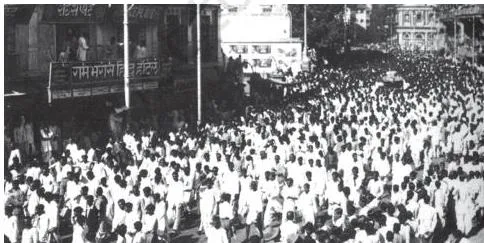
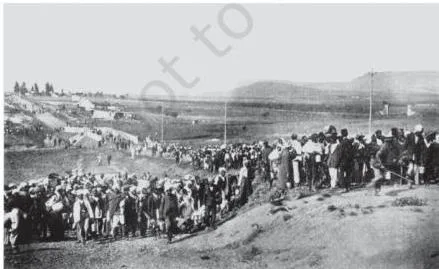
Fig. 2 belongs to Gandhi’s South African years — Indian workers marching through Volksrust on 6 November 1913, led by Gandhi from Newcastle towards Transvaal. When he was arrested, thousands more workers joined the satyagraha against racist laws; the book treats this as the training ground for the method used later in India (NCERT, p. 30).
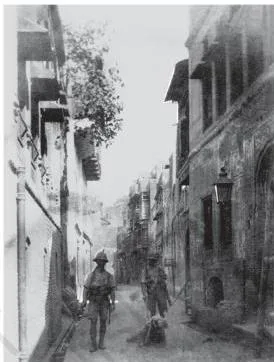
The two images of repression are deliberately shocking. Fig. 3 records General Dyer’s “crawling orders” at Amritsar in 1919 — satyagrahis forced to crawl on the streets under British supervision. Fig. 8 shows police attacking peaceful satyagrahis during the Civil Disobedience Movement of 1930 (NCERT, pp. 32, 40). Both ask you to notice who is acting and who is suffering.
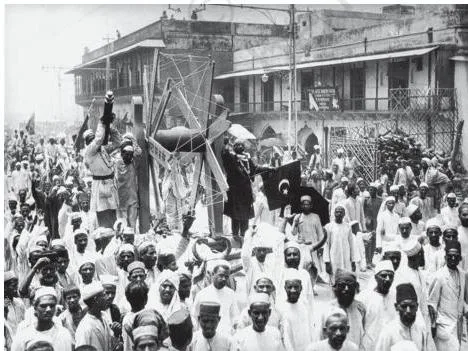
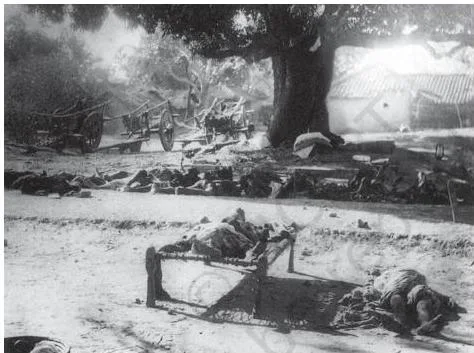
The boycott image and the Chauri Chaura image sit at opposite ends of the Non-Cooperation story. Fig. 4 (July 1922) shows the burning of foreign cloth — the symbol of Western economic and cultural domination — while Fig. 5 records the bazaar clash at Chauri Chaura in 1922, on hearing of which Gandhi called a halt to the movement (NCERT, pp. 33, 37).
Leaders and the Nation
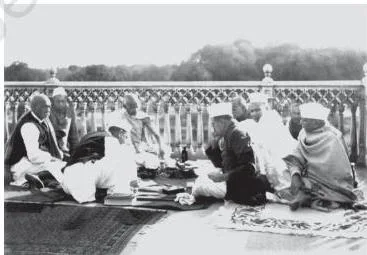
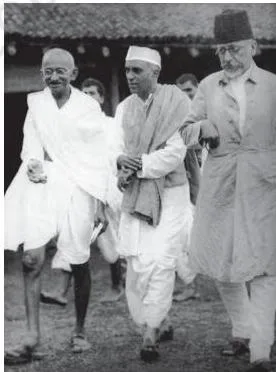
Fig. 6, the Allahabad meeting of 1931, is a group portrait of the Congress high command — Gandhi flanked by Patel (far left), Nehru (far right) and Bose (fifth from the right). Fig. 10 shows Gandhi, Nehru and Maulana Azad together at Sevagram Ashram in 1935, a reminder that the movement tried to keep Hindus and Muslims together even as communal distrust grew (NCERT, pp. 38, 44).
The Nation as Mother: Comparing the Two Bharat Matas
Fig. 12, Abanindranath Tagore’s 1905 Bharat Mata, presents the nation as an ascetic, calm, spiritual woman dispensing learning, food and clothing — devotion to her became evidence of one’s nationalism. Fig. 13 shows a popular print of Nehru holding Bharat Mata and the map of India close to his heart, part of a print tradition in which leaders offered their heads to the mother.
Fig. 14a, a later print, is a deliberate contrast: Bharat Mata stands with a trishul beside a lion and an elephant — symbols of power and authority, not ascetic calm (NCERT, pp. 47-48).
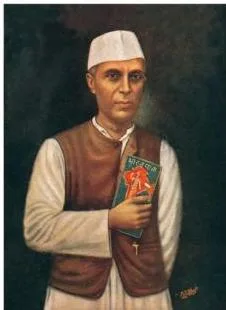
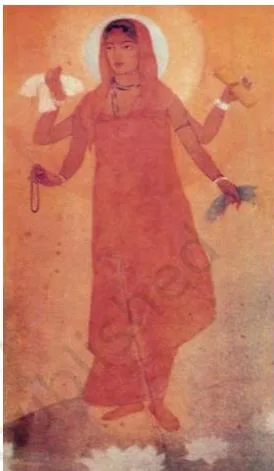
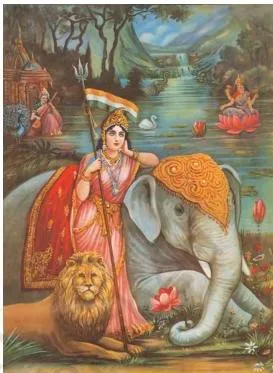
These two Bharat Matas are the chapter’s comparison exercise: set either beside Germania from Chapter 1, and you are comparing how different nationalisms imagined their nation — as mother, as goddess, as guardian of liberty. The chapter also prints an early-twentieth-century image of Bal Gangadhar Tilak framed by a temple, a church and a masjid as symbols of unity (NCERT, p. 46).
The Quit India Procession
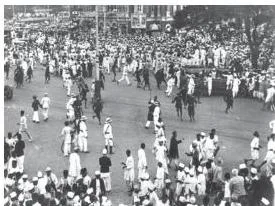
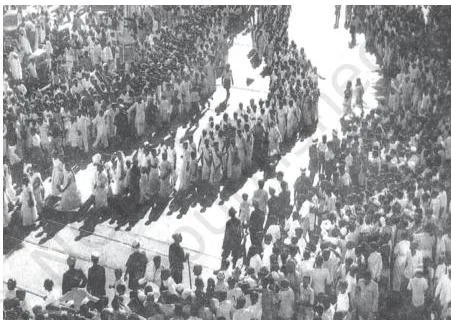
The chapter’s final image is a women’s procession in Bombay during the Quit India Movement of 1942. The book calls Quit India a true mass movement that drew in thousands of ordinary people — students, workers and peasants — and this photograph closes its argument that Indian nationalism was made by many hands (NCERT, p. 49).
Definitions: New Words in Nationalism in India
The chapter prints “New words” boxes for four terms and uses several more that a precise answer must define. Here they are in one table, in the student’s own words.
| Term | Meaning | NCERT page |
|---|---|---|
| Forced recruitment | The colonial state forcing villagers to join the army | p. 30 |
| Satyagraha | Gandhi’s method of mass agitation based on truth and non-violence — active resistance, not passive | pp. 30-31 |
| Hartal | A one-day strike closing shops and workplaces, used as a protest | p. 31 |
| Rowlatt Act | A 1919 law allowing detention of political prisoners without trial for two years | p. 31 |
| Boycott | Refusing to deal and associate with people, participate in activities, or buy and use things — usually a form of protest | p. 33 |
| Picket | Blocking the entrance to a shop, factory or office to stop people using it | p. 34 |
| Begar | Labour that villagers were forced to contribute without any payment | p. 35 |
| Swaraj | Self-rule or freedom; the term meant different things to different social groups | pp. 33-36 |
| Purna Swaraj | Full independence, demanded at the Lahore Congress of December 1929 | p. 38 |
| Dalit | The name the “untouchables” began using for themselves from around the 1930s — the oppressed | pp. 42-43 |
| Harijan | Gandhi’s term for dalits — “children of God” | p. 43 |
| Separate electorates | Electorates in which only members of one community vote for their own representatives | p. 43 |
| Poona Pact | The 1932 agreement giving the Depressed Classes reserved seats voted on by the general electorate | p. 44 |
Common Mistakes Students Make in This Chapter
Most errors in this chapter come from reading its terms too quickly — satyagraha, swaraj and the two movements get blurred. The table names each mistake and the correction the book gives.
| Mistake | Correct rule | How to check your answer |
|---|---|---|
| “Satyagraha is passive resistance” | Gandhi called it active resistance; it can be used only by the strong and “calls for intense activity” (NCERT, p. 31) | Re-read the box “Mahatma Gandhi on Satyagraha” — it rejects “passive resistance” in its first lines |
| “Non-Cooperation and Civil Disobedience are the same movement” | Non-Cooperation refused cooperation; Civil Disobedience broke colonial laws (NCERT, p. 39) | The book poses this exact difference when the Salt March begins — see p. 39 |
| “Swaraj meant the same thing to every Indian” | Towns, peasants, tribals, plantation workers, rich and poor peasants each defined it differently (NCERT, pp. 34-42) | Check the “eight different social groups” table above — each group’s swaraj is distinct |
| “Both movements were withdrawn for the same reason” | Non-Cooperation ended after the Chauri Chaura violence (NCERT, p. 37); Civil Disobedience was called off through the Gandhi-Irwin Pact (NCERT, p. 40) | The “Some important dates” box (p. 42) puts February 1922 and March 1931 side by side |
| “The Poona Pact gave dalits separate electorates” | It gave reserved seats that were voted on by the general electorate (NCERT, p. 44) | Read the pact sentence on p. 44: “voted in by the general electorate” |
| “The movement was led only by men” | Women marched, manufactured salt, picketed and went to jail in large numbers during Civil Disobedience (NCERT, pp. 42-43) | The caption of Fig. 9 (p. 42) notes old women and mothers with children among the marchers |
Exam Notes: How the Chapter Asks You to Respond
The chapter ends with “Write in brief”, “Discuss” and a “Project”, and drops discussion boxes inside the text. This map tells you which section answers which task.
| Task | What it asks | Where the material is |
|---|---|---|
| Write in brief Q1(a) | Why nationalism in the colonies is linked to an anti-colonial movement | p. 29 (chapter opening) |
| Write in brief Q1(b) | How the First World War helped the national movement | p. 30 |
| Write in brief Q1(c) | Why the Rowlatt Act outraged Indians | p. 31 |
| Write in brief Q1(d) | Why Gandhiji withdrew the Non-Cooperation Movement | pp. 37-38 |
| Write in brief Q2 | Define satyagraha | pp. 30-31 |
| Write in brief Q3 | A newspaper report on the Jallianwala Bagh massacre or the Simon Commission | pp. 31, 38 (model answer below) |
| Write in brief Q4 | Compare Bharat Mata with Germania from Chapter 1 | pp. 46-48 |
| Discuss Q1 | Social groups in the Non-Cooperation Movement — list them, then write about any three | pp. 33-36 |
| Discuss Q2 | Why the Salt March was an effective symbol of resistance | pp. 38-40 |
| Discuss Q3 | Imagine you are a woman in the Civil Disobedience Movement | pp. 41-43 |
| Discuss Q4 | Why leaders differed sharply over separate electorates | pp. 43-45 (Source D, p. 45) |
| Project | Compare India’s national movement with Indo-China | Chapter-wide; the activity on p. 36 gives a starting point |
Model Answer: Newspaper Report on the Jallianwala Bagh Massacre
This is a worked example for “Write in brief” Q3(a), built only from facts the chapter gives (NCERT, pp. 31-32). A full report needs a headline, a dateline, the date and place, who did what, and the aftermath.
Headline: Hundreds Killed as General Dyer Fires on Unarmed Crowd in Amritsar Amritsar, 13 April 1919. A large crowd that had gathered in the enclosed ground of Jallianwala Bagh — some to protest the government’s new repressive measures, others to attend the annual Baisakhi fair — was fired upon tonight by troops under General Dyer.
Many villagers present were from outside the city and unaware that martial law had been imposed. Dyer blocked the exit points before opening fire, killing hundreds. He later declared that his object was to produce a “moral effect”, to create in the minds of satyagrahis a feeling of terror and awe.
News of the massacre has spread through north Indian towns, where crowds have taken to the streets, with strikes, clashes with the police and attacks on government buildings. The government has answered with brutal repression: satyagrahis have been forced to crawl on the streets and salute British officers, people have been flogged, and villages around Gujranwala have been bombed.
For the Simon Commission report (Q3b), use the same shape: arrival in India in 1928, the all-British composition of the commission, the “Go back Simon” demonstrations, and the assault on Lala Lajpat Rai (NCERT, p. 38).
One caution: textbook contents and the examinable syllabus are not always identical — check the current official syllabus before deciding what to revise.
The Chapter in One Read: Nationalism in India from 1919 to 1942
The whole chapter is one story: hardship under colonial rule, Gandhi’s new method of struggle, two mass movements, the many groups who joined them, the limits of that unity, and the cultural symbols that made Indians feel like one nation.
- War and hardship: prices doubled between 1913 and 1918, villages were forced to supply soldiers, and famine and influenza killed 12 to 13 million people (NCERT, p. 30).
- A new method: satyagraha — truth and non-violence — tested in Champaran, Ahmedabad and Kheda (NCERT, pp. 30-31).
- The first shock: the Rowlatt Act, the 6 April hartal, and the Jallianwala Bagh massacre of 13 April 1919 (NCERT, p. 31).
- Unity attempt: the Khilafat cause joined to swaraj produced the Non-Cooperation-Khilafat Movement from January 1921 (NCERT, pp. 32-33).
- Diverse meanings: towns, Awadh peasants, Gudem tribals and Assam plantation workers each gave swaraj their own content (NCERT, pp. 34-36).
- Turning point: Chauri Chaura, February 1922 — Gandhi called a halt to the movement (NCERT, p. 37).
- Rebuilding: the Simon Commission, Lahore Congress’s Purna Swaraj, the Salt March of 1930 and the Civil Disobedience Movement; the Gandhi-Irwin Pact of March 1931 (NCERT, pp. 38-40).
- Participants and limits: rich and poor peasants, business classes, selective workers’ and women’s participation; dalits and alienated Muslims stayed out (NCERT, pp. 41-45).
- Feeling the nation: Bharat Mata, folklore, flags and a proud rereading of history (NCERT, pp. 46-48).
- Final push: the Quit India Movement of 1942 (NCERT, pp. 48-49).
The chapter’s own date box fixes the chronology (NCERT, p. 42); the table below adds the Quit India climax.
| Year | Event |
|---|---|
| 1918-19 | Distressed UP peasants organised by Baba Ramchandra |
| April 1919 | Hartal against the Rowlatt Act; Jallianwala Bagh massacre |
| January 1921 | Non-Cooperation and Khilafat movement launched |
| February 1922 | Chauri Chaura; Gandhiji withdraws the Non-Cooperation Movement |
| May 1924 | Alluri Sitarama Raju arrested, ending the two-year armed tribal struggle |
| December 1929 | Lahore Congress adopts the demand for Purna Swaraj |
| 1930 | Ambedkar establishes the Depressed Classes Association |
| March 1930 | Salt law broken at Dandi; Civil Disobedience Movement begins |
| March 1931 | Gandhi-Irwin Pact; Civil Disobedience called off |
| December 1931 | Second Round Table Conference |
| 1932 | Civil Disobedience relaunched; Poona Pact signed in September |
| 1942 | Quit India resolution (Wardha, 14 July; Bombay, 8 August) |
The chapter ends where it began — with a question of unity. What was emerging, it concludes, was a nation with many voices wanting freedom from colonial rule (NCERT, p. 49).
Sources and Data Verification
This listing is maintained for the 2026-27 academic session using the NCERT textbook information available to us. NCERT remains the authority for confirming the latest edition.
Reference: NCERT Class 10 Social Science textbook, chapter 2, official edition on ncert.nic.in.
- This page describes India and the Contemporary World II (History) only — the Nationalism in India chapter, printed on pages 28-49 of the book. It does not cover the Geography, Political Science or Economics books of Class 10 Social Science.
- The chapter sections, figures, captions and page numbers above come from NCERT’s published textbook and are maintained for the current academic session.
- NCERT settles textbook editions and official PDFs; CBSE settles the curriculum, syllabus and examinations. For the current official PDF, the source is ncert.nic.in.
- This listing is a direct description of NCERT’s published chapter; no independent expert review of it has been claimed or performed.
Related Resources for Class 10 Social Science
If Nationalism in India Class 10 is one stop in a longer revision run, these pages sit next to it.
The Class 10 Social Science hub gathers notes for all four books of the subject.
The previous chapter, The Rise of Nationalism in Europe — also on the Class 10 Social Science hub — is the one you need for the Bharat Mata vs Germania comparison in “Write in brief” Q4, and the next chapter, The Making of a Global World, follows the same book.
For the whole year’s revision, use the Class 10 hub and the CBSE notes home. Teachers planning a lesson may find the notes for the teacher useful, and if you are also working through the Geography book, the water resources chapter notes sit nearby. The official source for every NCERT textbook is ncert.nic.in.
Nationalism in India Class 10: FAQ
Why did Gandhiji withdraw the Non-Cooperation Movement?
Because the movement was turning violent. In February 1922, a peaceful demonstration at Chauri Chaura in Gorakhpur became a violent clash with the police, and on hearing of the incident Gandhi called a halt to the movement (NCERT, p. 37). He felt satyagrahis needed proper training before they could handle mass struggles (NCERT, p. 38).
What is the difference between the Non-Cooperation Movement and the Civil Disobedience Movement?
Non-Cooperation refused to cooperate — surrendering titles and boycotting schools, courts, councils and foreign goods. Civil Disobedience went further and broke colonial laws, beginning with the salt law at Dandi on 6 April 1930 (NCERT, p. 39). The first was withdrawn after Chauri Chaura (1922); the second was called off by the Gandhi-Irwin Pact (March 1931), relaunched in 1932, and faded by 1934.
Why did Gandhiji choose salt as the symbol for the Civil Disobedience Movement?
Because salt was consumed by rich and poor alike and was one of the most essential items of food. Gandhi argued that the salt tax and the government monopoly over its production revealed the most oppressive face of British rule (NCERT, p. 39). A symbol everyone experienced daily made the abstract demand for Purna Swaraj concrete.
What did swaraj mean to different social groups in Nationalism in India?
It varied. Townspeople saw it as non-cooperation with British institutions; Awadh peasants as an end to high rents, begar and eviction; Gudem tribals as freedom from forest rules, won by force if necessary; and plantation workers as the right to leave the tea gardens and return to their villages (NCERT, pp. 34-36).
Rich peasants fought high revenues, poor peasants wanted rent remission, and business wanted an end to colonial restrictions (NCERT, pp. 41-42).
Why did Dr Ambedkar demand separate electorates, and what did the Poona Pact actually give?
Ambedkar believed political empowerment would resolve the social disabilities of dalits, so he demanded reserved seats and a separate electorate that would choose dalit members for legislative councils (NCERT, p. 43). He clashed with Gandhi at the second Round Table Conference, and Gandhi fasted against the British concession.
The Poona Pact of September 1932 gave the Depressed Classes reserved seats in provincial and central councils — but voted on by the general electorate, not a separate one (NCERT, p. 44).
How is the idea of Bharat Mata connected to nationalism in this chapter?
The image gave the nation a face people could feel devotion for. Bankim Chandra Chattopadhyay created Bharat Mata and wrote “Vande Mataram” in the 1870s; Abanindranath Tagore painted the ascetic Bharat Mata in 1905 (NCERT, p. 47).
Devotion to the mother figure became evidence of nationalism, and later prints — including the Bharat Mata with a trishul, lion and elephant — changed her meaning from serenity to power (NCERT, pp. 47-48).
Reference: NCERT Class 10 Social Science textbook, chapter 2, official edition on ncert.nic.in.
Explore Class 10 Social Science Books
Class 10 Social Science on LearnCBSE:
Related chapters: