
This is Chapter 5, “Print Culture and the Modern World”, from the NCERT Class 10 Social Science book India and the Contemporary World II. The chapter runs from printed page 105 to page 128 and traces the history of print from its beginnings in East Asia, through Europe, to India. The official print culture and the modern world class 10 chapter PDF is right below.
Print Culture and the Modern World Class 10 PDF
The chapter is part of the NCERT Social Science book India and the Contemporary World II, published in its current edition on ncert.nic.in.
You can open the official file directly from the NCERT website: NCERT Class 10 Social Science Chapter 5 Print Culture and the Modern World PDF — it loads straight in your browser, so you can read it online or save it for later.
| What the chapter holds | Count | Where it is used |
|---|---|---|
| Printed pages | 26 | |
| Sections in the chapter | 13 | |
| Figures with NCERT captions | 19 | |
| Activities | 5 | |
| Official NCERT PDF | Download the chapter PDF | the chapter exactly as NCERT publishes it |
Chapter at a Glance: What Is Inside the PDF
The table below shows what this chapter contains and where it sits in the book.
The chapter belongs to the closing section of the book, “Everyday Life, Culture and Politics”. It is one of the history chapters in the Class 10 Social Science book set, and it follows Chapter 4, The Age of Industrialisation.
What This Chapter Covers, Section by Section
This chapter moves in a clear arc — East Asia to Europe to India — and this map shows where each stage starts.
| Section (as titled in the book) | Printed page | What it covers |
|---|---|---|
| The First Printed Books | 106 | Woodblock hand printing in China, the Diamond Sutra, print in Japan and ukiyo |
| Print Comes to Europe | 108 | The silk route, Marco Polo in 1295, why manuscripts could not meet demand |
| Gutenberg and the Printing Press | 109 | The olive-press model, movable metal type, the Bible, the print revolution |
| The Print Revolution and Its Impact | 111 | A new reading public, religious debates and the fear of print, print and dissent |
| The Reading Mania | 114 | Chapbooks and almanacs, periodicals, and the debate over print and the French Revolution (p. 115) |
| The Nineteenth Century | 117 | Child, women and worker readers, then faster presses (p. 118) |
| India and the World of Print | 119 | Manuscripts before print, and the arrival of presses via Goa and the Bengal Gazette (p. 120) |
| Religious Reform and Public Debates | 121 | Rammohun Roy, the ulama and Deoband, printed religious texts |
| New Forms of Publication | 123 | Novels and print images, women and print (p. 124), print and the poor (p. 126) |
| Print and Censorship | 127 | The Vernacular Press Act 1878, Tilak, wartime controls, Gandhi in 1922 |
| Closing pages (Write in brief, Discuss, Project) | 128 | The chapter’s own practice questions |
Key Concepts: The Story the Chapter Tells
This section goes through the chapter’s ideas in the order the book presents them, so each topic carries into the next. Each idea below opens with one plain sentence about what it is and why the chapter includes it.
Print Began in East Asia, Not Europe
The chapter starts in China because that is where print actually began. From AD 594, books in China were made by rubbing paper against the inked surface of woodblocks.
Because the thin paper could only be printed on one side, books took an accordion form, folded and stitched at the side, and skilled craftsmen could reproduce the beauty of calligraphy with remarkable accuracy (NCERT, p. 106).
- The imperial state was the biggest producer, because its civil service examinations demanded vast numbers of printed textbooks.
- From the seventeenth century, urban culture diversified print: merchants collected trade information, and reading became a leisure activity for fiction, poetry and plays.
- Women joined this reading culture — wives of scholar-officials published their work, and courtesans wrote about their lives.
- Mechanical presses arrived in the late nineteenth century, and Shanghai became the hub of the new print culture.
Buddhist missionaries carried hand printing to Japan around AD 768-770. The chapter names the Diamond Sutra, printed in China in AD 868, as the oldest printed book it records. Korea’s Tripitaka Koreana was carved on about 80,000 woodblocks in the mid-thirteenth century and was placed on UNESCO’s Memory of the World Register in 2007 (NCERT, pp. 106-107).
The takeaway: print was old, established and Asian centuries before Europe — which corrects the common “Gutenberg invented printing” error.
Gutenberg and the First Printing Press
Europe had woodblocks and handwritten manuscripts, but both were too slow and too fragile for the growing demand for books. Chinese paper reached Europe in the eleventh century by the silk route, and in 1295 Marco Polo returned from China with knowledge of woodblock printing.
The rich kept luxury manuscripts on vellum, while merchants and students bought cheaper printed copies — but copying by hand stayed expensive, laborious and slow (NCERT, p. 108).
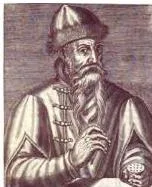
Johann Gutenberg, a merchant’s son trained as a goldsmith, built the first-known printing press at Strasbourg in the 1430s. He used the olive press as his model and cast metal types for the 26 letters of the Roman alphabet, perfecting the system by 1448. His first book was the Bible — about 180 copies in three years.
The print revolution followed: 20 million books flooded Europe in the second half of the fifteenth century, and roughly 200 million in the sixteenth (NCERT, pp. 108-109).
- Speed: the Gutenberg press printed 250 sheets on one side per hour, far faster than carving a wooden block for each page.
- Old habits survived: early printed books imitated manuscripts, with hand-painted borders and blank spaces that buyers could decorate to order. New technology does not instantly displace old practice.
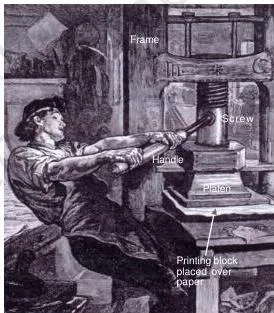
- Job roles: the platen pressed paper onto the inked type, the compositor set the text, and the galley was the metal frame that held it (NCERT, p. 110).
The New Reading Public and the Fear of Print
The print revolution was not just faster book production — it changed who could hold an idea and who could spread one. Cheaper books created a new reading public: where there had once been a hearing public, there was now a reading public.
Publishers printed ballads and folk tales for the semi-literate, and these were sung and recited in village gatherings and taverns, so oral culture entered print and the line between the two blurred (NCERT, p. 111).
Religious change showed print’s power. In 1517 Martin Luther wrote his Ninety Five Theses criticising the Roman Catholic Church and posted them on a church door in Wittenberg. His writings were reproduced in vast numbers, his New Testament sold 5,000 copies within a few weeks, and the Protestant Reformation began.
Luther called print “the ultimate gift of God and the greatest one” (NCERT, p. 112).
Print also frightened people. Authorities feared that uncontrolled reading would spread rebellious and irreligious thoughts. Menocchio, a miller who reinterpreted the Bible, was hauled up twice and executed; the Inquisition hunted heretics; and the Church began its Index of Prohibited Books in 1558.
Even Erasmus, the Catholic reformer, worried that a glut of harmful books would destroy the value of good ones (NCERT, p. 113).
Reading Mania and the French Revolution
By the eighteenth century reading had become a mania — and historians have argued that this mania helped cause the French Revolution. The chapter gives three arguments, then doubts them. Literacy rose as churches set up village schools; in parts of Europe it reached 60-80 per cent by the end of the eighteenth century.
Penny chapbooks carried by pedlars, almanacs, the cheap blue-covered Bibliotheque Bleue in France, and the new periodical press fed the demand, and thinkers such as Newton, Voltaire and Rousseau reached a wide audience (NCERT, p. 114). Novelist Louise-Sebastien Mercier called the press “the most powerful engine of progress” and proclaimed, “Tremble, therefore, tyrants of the world!” (NCERT, p. 115).
The three arguments that connect print culture to the French Revolution:
- Enlightenment ideas: print popularised thinkers who attacked tradition, superstition and despotism, and demanded that everything be judged by reason.
- Dialogue and debate: print created a public culture in which values, norms and institutions were re-evaluated and discussed.
- Anti-royal satire: by the 1780s an outpouring of literature and cartoons mocked royal morality and made the people’s suffering visible.
The chapter’s caution: readers did not absorb everything they read. They were also exposed to monarchical and Church propaganda, accepted some ideas, rejected others, and interpreted things their own way. Print did not directly shape their minds — it opened up the possibility of thinking differently (NCERT, p. 115).
New Readers and Faster Machines in the Nineteenth Century
In the nineteenth century the reading public stopped being a narrow elite — children, women and workers all became readers, and the machines that printed for them grew much faster.
Readers. Compulsory primary education made children a major market; a children’s press appeared in France in 1857, and the Grimm Brothers published their edited folk tales in 1812. Women read penny magazines and conduct manuals, and women novelists — Jane Austen, the Bronte sisters, George Eliot — defined a new image of womanhood as strong-willed and independent.
Lending libraries educated white-collar workers and artisans, and some self-educated workers wrote political tracts and autobiographies. The Yorkshire mechanic Thomas Wood rented newspapers and read them by firelight because he could not afford candles (NCERT, p. 117).
Machines. The metal press of the late eighteenth century was followed by Richard M. Hoe’s power-driven cylindrical press (8,000 sheets per hour), the offset press that printed up to six colours, and electrically operated presses.
Publishers serialised novels in periodicals, sold the Shilling Series in 1920s England, and turned to cheap paperbacks when the Great Depression threatened book sales (NCERT, p. 118).
India Before Print: Manuscripts and Missionaries
The chapter turns to India with the same question it asked about Europe — what existed before print, and how did print arrive? India had a rich manuscript tradition in Sanskrit, Arabic, Persian and the vernacular languages. Manuscripts were copied on palm leaves or handmade paper, often beautifully illustrated, and pressed between wooden covers or sewn together.
They were expensive and fragile, and could not be read easily because scripts were written in different styles — so they were little used in everyday life. In Bengal’s village schools, students often learnt to write without reading texts at all (NCERT, p. 119).
Print arrived with Portuguese missionaries in Goa in the mid-sixteenth century. Jesuit priests printed Konkani and Kanara tracts — about 50 books by 1674. The first Tamil book was printed at Cochin in 1579, and the first Malayalam book in 1713.
English printing lagged: the East India Company imported presses from the late seventeenth century, but it was James Augustus Hickey’s privately owned Bengal Gazette, from 1780, that began English printing in India. Hickey printed gossip about Company officials, Governor-General Warren Hastings persecuted him, and Gangadhar Bhattacharya later brought out an Indian Bengal Gazette close to Rammohun Roy (NCERT, p. 120).
Print in Colonial India: Debates, New Writing and Censorship
Once print arrived in India it became a battlefield — for religious reformers, for nationalists, and against the colonial censor.
Religious reform and public debate. Rammohun Roy published the Sambad Kaumudi from 1821, and the orthodox press answered with the Samachar Chandrika. Persian newspapers appeared from 1822, and the Gujarati Bombay Samachar in the same year. The ulama feared conversion and the collapse of Muslim dynasties; the Deoband Seminary, founded in 1867, published thousands of fatwas.
Tulsidas’s Ramcharitmanas was first printed in Calcutta in 1810, and cheap lithographic editions soon flooded north India. Newspapers connected communities across distances, creating pan-Indian identities (NCERT, p. 121).
New forms of publication. The novel, lyrics, short stories and essays reflected everyday lives. A new visual culture emerged: Raja Ravi Varma’s mythological paintings were mass-printed at the Ravi Varma Press, and cheap prints and calendars reached even poor homes. Caricatures and cartoons appeared from the 1870s, some mocking Westernised Indians, others criticising imperial rule (NCERT, p. 123).
Women and print. Rashsundari Debi learnt to read in the secrecy of her kitchen and published Amar Jiban in 1876 — the first full-length autobiography in Bengali. Kailashbashini Debi wrote about women’s confinement in the 1860s; Tarabai Shinde and Pandita Ramabai wrote angrily about the lives of upper-caste widows in the 1880s.
Conservative families feared that literate women would be corrupted or widowed, yet some rebel women learnt secretly anyway. Hindi printing began seriously from the 1870s, and the Battala quarter of Calcutta produced cheap, illustrated popular books (NCERT, pp. 124-125).
Print and the poor. Cheap books were sold at crossroads in Madras towns, and public libraries spread from the early twentieth century. Jyotiba Phule’s Gulamgiri (1871) attacked caste injustice; Ambedkar and Periyar wrote powerfully on caste in the twentieth century.
Kashibaba, a Kanpur millworker, showed the links between caste and class exploitation in Chhote Aur Bade Ka Sawal (1938), and Bangalore millworkers set up their own libraries in the 1930s (NCERT, p. 126).
Print and censorship. After 1857 the colonial state turned against the “native” press. The Vernacular Press Act of 1878, modelled on the Irish Press Laws, gave the government extensive rights to censor vernacular papers, warn them, and seize their presses. Tilak wrote with sympathy about deported revolutionaries in Kesari and was imprisoned in 1908.
Wartime controls followed: the Defence of India Rules in the First World War, the Rowlatt report of 1919, and the Defence of India Act in the Second World War, under which about 90 newspapers were suppressed in August 1942. Gandhi’s 1922 statement insisted that the fight for Swaraj was a fight for liberty of speech, press and association (NCERT, p. 127).
Key Figures in the Chapter and What They Show


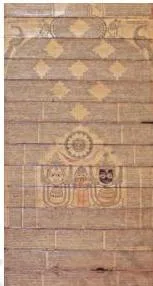
The chapter uses images as historical evidence, not decoration. This walkthrough explains each key figure so a reader can “read” it — what the image shows and why the chapter places it where it does.
A Royal Workshop Copying Books by Hand
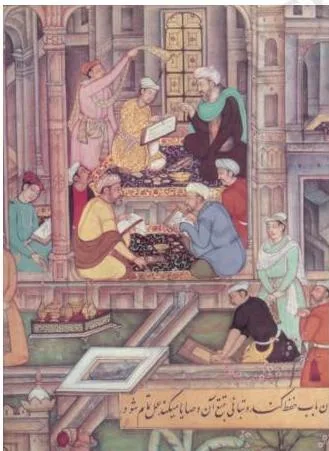
The chapter opens on page 105 with this workshop: the text is dictated, written and illustrated all by hand, in one room. It shows the world print would replace, and the caption asks what happened to these hand arts when printing machines arrived.
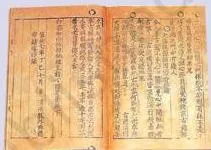
Calligraphy and the Diamond Sutra
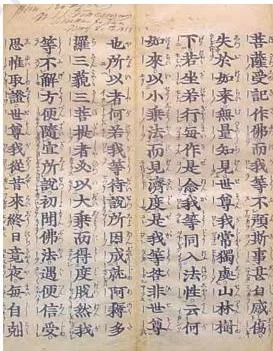
This is the book’s margin definition of calligraphy, beside Fig. 2a, a page from the Diamond Sutra. The Sutra, printed in AD 868, is the oldest printed book the chapter names, and its precise characters show how skilled woodblock craftsmen could duplicate the beauty of handwriting (NCERT, p. 106).
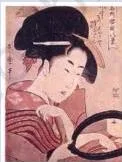
An Ukiyo Print by Kitagawa Utamaro
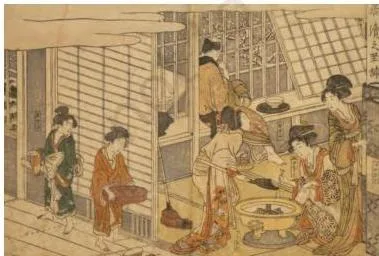
Ukiyo means “pictures of the floating world” — ordinary urban life in Edo. These prints were a commercial culture: publishers commissioned artists, and carvers made woodblocks from their drawings, destroying the original in the process. The prints travelled to Europe and influenced artists such as Manet, Monet and Van Gogh (NCERT, p. 107).
Pages of Gutenberg’s Bible
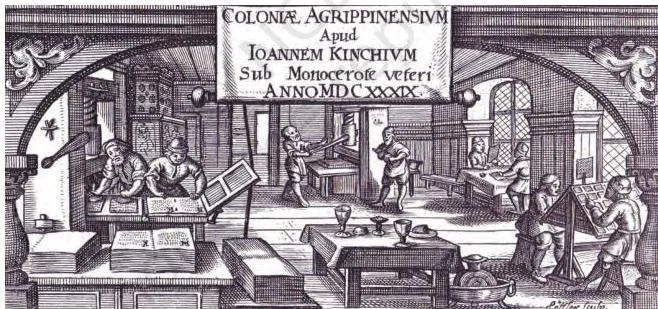
These pages (Fig. 7) mix new and old technology: the text was printed with movable metal type, but the borders were painted and illuminated by hand, and the colour inside the letters was added to highlight holy words. No two of the roughly 180 copies were identical, and elites valued that uniqueness.
The chapter uses it to show how print first imitated the manuscript (NCERT, p. 110).
L’Imprimerie: A Divine Printing Press
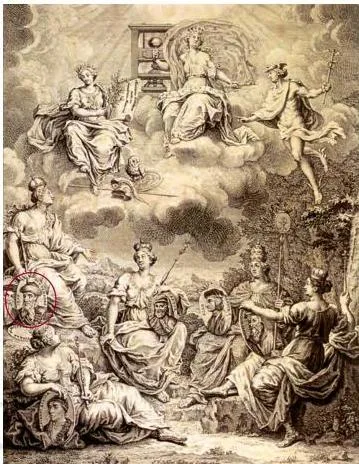
This is Fig. 9, J.V. Schley’s L’Imprimerie (1739), shown beside the chapter’s account of Martin Luther. The press descends from heaven carried by a goddess, blessed by Minerva, the goddess of wisdom, and Mercury, and framed by portraits of six pioneer printers — Gutenberg is the encircled figure.
It captures how Europe celebrated print as a divine gift (NCERT, p. 112).
The Macabre Dance: Print and the End of the World
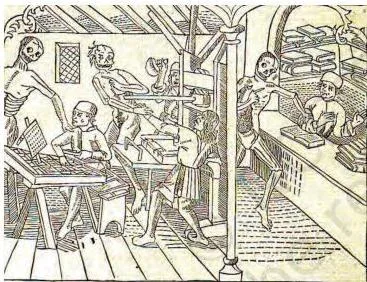
This is Fig. 10, the macabre dance — a sixteenth-century woodcut in which skeletal figures control the printer and his workers, deciding what is to be produced.
The chapter uses it to dramatise the fear of print: the coming of print was associated with the end of the world, the same fear that cost Menocchio his life and produced the Index of Prohibited Books (NCERT, p. 113).
The Nobility and the Common People Before 1789
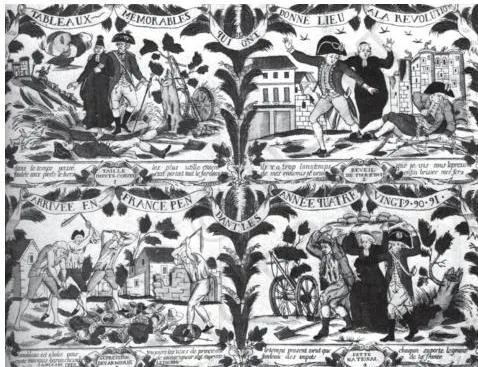
This is Fig. 11, the cartoon of the nobility and the common people: peasants, artisans and workers struggle while the nobility oppress them and enjoy life. Circulating cartoons like this one shaped thinking before 1789, and this is the third argument — anti-royal satire — connecting print to the French Revolution (NCERT, p. 116).
A Palm-Leaf Gita Govinda
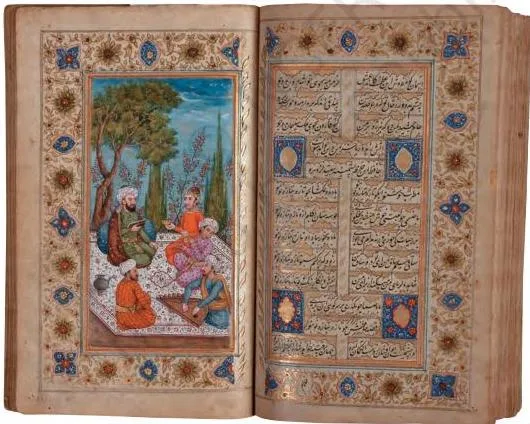
This palm-leaf manuscript in accordion format stands for India’s rich pre-print tradition. The chapter contrasts such beautiful, fragile handwritten books with the cheap printed texts that followed — manuscripts were produced into the late nineteenth century, but they could not be widely read (NCERT, p. 119).
A Ravi Varma Print for Mass Circulation
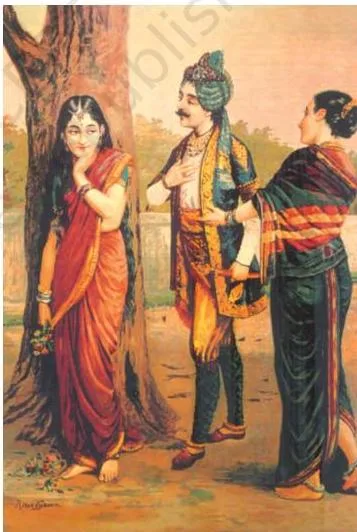
This is Fig. 17, Raja Ritudhwaj rescuing Princess Madalsa. With presses able to reproduce images cheaply, Ravi Varma’s mythological paintings reached every bazaar, and cheap prints began shaping popular ideas about modernity, tradition, religion and politics (NCERT, p. 123).
Ghor Kali and the Fear of Changing Families
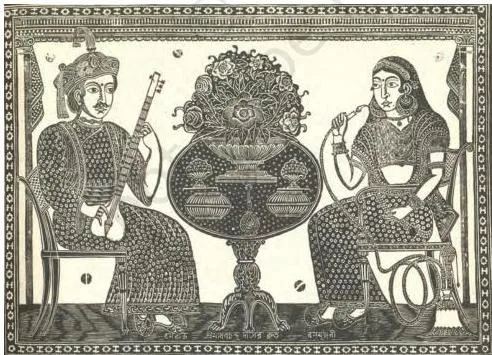
This late-nineteenth-century woodcut, Ghor Kali (The End of the World), inverts family order: the wife dominates from her husband’s shoulder while he drags his mother by a noose. It expresses anxiety about women’s education and changing roles — the same fear the chapter’s activity asks you to compare across Figures 19, 20 and 21 (NCERT, p. 125).
Glossary: The Chapter’s Terms in Simpler Words
The book defines its difficult words in the margins as you read; here they are together, in plainer language, with the page each one appears on.
| Term | What it means | NCERT page |
|---|---|---|
| Calligraphy | Decorative, artistic handwriting that turns letters into visual art | 106 |
| Vellum | Writing material made from animal skin, used for expensive manuscripts | 108 |
| Platen | The flat board that presses paper against the inked type to make the print | 109 |
| Compositor | The worker who arranges metal letters into the words and lines of a page | 110 |
| Galley | The metal frame in which the type is laid out for printing | 110 |
| Ballad | A story or folk tale written in verse, meant to be sung or recited | 111 |
| Taverns | Public houses where people met over food and drink to exchange news | 111 |
| Protestant Reformation | The sixteenth-century movement that split the Roman Catholic Church; Luther was its leading figure | 112 |
| Inquisition | A Roman Catholic court set up to identify and punish heretics | 113 |
| Heretical | Holding beliefs that contradict the Church’s official teaching, severely punished in medieval Europe | 113 |
| Seditious | Speech or writing seen as opposing the government | 113 |
| Almanac | A yearly publication with astronomical data — the sun, moon, tides, eclipses — plus everyday information | 114 |
| Chapbook | A small, cheap pocket book sold by travelling pedlars called chapmen | 114 |
| Despotism | Rule by one person with absolute, unchecked power — a tyrant’s government | 115 |
| Ulama | Muslim legal scholars who interpret Islamic law | 121 |
| Fatwa | A legal opinion on Islamic law issued by a qualified scholar | 121 |
Common Mistakes Students Make in This Chapter
This chapter is about chronology and cause-effect, and that is where students slip. The table names the error before you make it, gives the correct rule, and tells you how to check.
| Mistake | Correct rule | How to check your answer |
|---|---|---|
| “Gutenberg invented printing.” | Print began as woodblock hand printing in China, Japan and Korea centuries earlier; Gutenberg’s contribution was the movable metal type press in Europe (pp. 106-108). | Ask who printed the Diamond Sutra in AD 868 — China, not Gutenberg. |
| “The Diamond Sutra and Gutenberg’s Bible are the same kind of first.” | The Diamond Sutra (AD 868) is the oldest printed book the chapter names; Gutenberg’s Bible is the first book printed in Europe with movable metal type (pp. 106, 109). | Different claims: “oldest printed book” vs “first in Europe with movable type”. |
| “Marco Polo brought the printing press to Europe.” | Marco Polo returned in 1295 with knowledge of Chinese woodblock printing; the press was Gutenberg’s later invention (pp. 108-109). | Check dates: Polo 1295, Gutenberg 1430s. |
| “Print caused the French Revolution.” | The chapter says print popularised Enlightenment ideas, created debate and circulated anti-royal satire — but readers also absorbed propaganda and rejected some ideas, so print opened the possibility of thinking differently (p. 115). | Mention both sides of the argument, including the chapter’s caution. |
| “The Vernacular Press Act censored the English press.” | It targeted the vernacular (Indian-language) press after 1857, modelled on the Irish Press Laws (p. 127). | The word “vernacular” means Indian languages — the English press was not its target. |
| Confusing the two Bengal Gazettes. | James Augustus Hickey’s Bengal Gazette (1780) was a private English weekly; Gangadhar Bhattacharya’s Bengal Gazette was an Indian weekly close to Rammohun Roy (p. 120). | Ask who edited it — Hickey or Bhattacharya — and which language it was in. |
Exam Notes: What This Chapter Emphasises
The chapter ends with its own practice questions on page 128 — the clearest guide to how this material is examined. Only the CBSE official syllabus decides what carries weight, so use it to check, but the book’s own question design tells you what kind of answers are expected.
- Write in brief asks for reasons (woodblock printing reaching Europe after 1295; Luther’s praise of print; the Church’s Index of Prohibited Books; Gandhi on Swaraj), short notes (the Gutenberg Press, Erasmus’s view of the printed book, the Vernacular Press Act), and what print meant for women, the poor and reformers.
- Discuss asks for comparative and reasoning answers: why Europeans believed print would end despotism, why people feared easy access to books (choose one example from Europe and one from India), the effects of print on the poor in nineteenth-century India, and how print culture assisted the growth of nationalism.
- Project invites you to research how print technology has changed in the last 100 years and what the consequences were.
The chapter also embeds short sources for practice. Source D (NCERT, p. 122) compares native newspapers to the role of the Opposition in the House of Commons — practise reading such a source and saying what it reveals about the time.
And the chapter’s activities are free practice: the Marco Polo letter (p. 108), the bookseller’s poster (p. 111), the pre-revolution cartoon (p. 116), the railway advertisement (p. 118), and the family-role woodcuts (p. 126). An answer on the French Revolution that includes the chapter’s own caution shows close reading and is worth including.
Here are the anchor dates to fix in your memory:
| Year | Event |
|---|---|
| 1295 | Marco Polo returns from China with knowledge of woodblock printing (p. 108) |
| 1430s | Gutenberg develops the first-known press at Strasbourg (p. 108) |
| 1448 | Gutenberg perfects his system (p. 109) |
| 1517 | Luther writes the Ninety Five Theses (p. 112) |
| 1558 | The Church begins its Index of Prohibited Books (p. 113) |
| 1780 | Hickey begins the Bengal Gazette (p. 120) |
| 1810 | The Ramcharitmanas is first printed, in Calcutta (p. 121) |
| 1867 | The Deoband Seminary is founded (p. 121) |
| 1871 | Jyotiba Phule’s Gulamgiri (p. 126) |
| 1876 | Rashsundari Debi’s Amar Jiban is published (p. 124) |
| 1878 | The Vernacular Press Act is passed (p. 127) |
| 1908 | Tilak is imprisoned after writing in Kesari (p. 127) |
| 1922 | Gandhi’s statement on liberty of speech and press (p. 127) |
| 1938 | Kashibaba’s Chhote Aur Bade Ka Sawal (p. 126) |
For long answers, connect each person to their point in the chapter:
| Person | What they connect to |
|---|---|
| Gutenberg | Movable metal type press; printed the Bible (p. 109) |
| Martin Luther | Ninety Five Theses; Protestant Reformation; praised print (p. 112) |
| Erasmus | Feared the glut of books (p. 113) |
| Mercier | “Tremble, therefore, tyrants of the world!” (p. 115) |
| James Augustus Hickey | First English paper in India, the Bengal Gazette, 1780 (p. 120) |
| Rammohun Roy | Sambad Kaumudi from 1821 (p. 121) |
| Rashsundari Debi | Amar Jiban, first full-length Bengali autobiography (p. 124) |
| Jyotiba Phule | Gulamgiri, caste protest (p. 126) |
| Kashibaba | Kanpur millworker; caste-class links in Chhote Aur Bade Ka Sawal (p. 126) |
| Bal Gangadhar Tilak | Kesari; imprisoned 1908 (p. 127) |
| Gandhi | 1922 defence of liberty of speech, press and association (p. 127) |
The Chapter in Brief
If you have ten minutes, read this list — it is the chapter’s argument from first page to last.
- Print began as woodblock hand printing in China, Japan and Korea; the Diamond Sutra (AD 868) is the oldest printed book the chapter names (p. 106).
- European manuscripts were too slow and fragile; Gutenberg’s movable metal type press (perfected 1448) printed the Bible, and the print revolution followed (pp. 108-109).
- Print created a new reading public and blurred the line between oral and print culture (p. 111).
- Print spread Luther’s Reformation ideas but also frightened authorities — the Inquisition and the Index of Prohibited Books (1558) followed (pp. 112-113).
- Rising literacy produced a reading mania — chapbooks, almanacs, periodicals — and defenders like Mercier believed print would end despotism (pp. 114-115).
- Historians link print to the French Revolution through three arguments, but the chapter cautions that readers did not accept everything they read (p. 115).
- In the nineteenth century children, women and workers became readers, and presses grew faster — cylindrical, then offset (pp. 117-118).
- India had a rich manuscript tradition; print arrived with Portuguese missionaries in Goa in the mid-sixteenth century, and the first English paper was Hickey’s Bengal Gazette (1780) (pp. 119-120).
- Print fuelled religious reform debates, new novels and visual culture, women’s writing and caste protest (pp. 121-126).
- The colonial state answered with censorship — the Vernacular Press Act of 1878, wartime controls, and Gandhi’s 1922 defence of press liberty (p. 127).
Related Chapters and Resources
This listing is maintained for the 2026-27 academic session using the NCERT textbook information available to us. NCERT remains the authority for confirming the latest edition.
For the rest of the book, see the NCERT Class 10 Social Science book page. The previous chapter in this book, The Age of Industrialisation, covers how industry reshaped the same modern world. The official NCERT textbook page for India and the Contemporary World II hosts the complete book on ncert.nic.in.
For quick revision, our Class 10 Social Science notes cover the whole syllabus, with chapters like Globalisation and the Indian Economy and Manufacturing Industries.
Reference: NCERT Class 10 India and the Contemporary World II textbook, chapter 5, official edition on ncert.nic.in.
Sources and Data Verification
- This page describes Chapter 5 of the NCERT textbook India and the Contemporary World II (Class 10 Social Science), as published in the current NCERT edition on ncert.nic.in.
- It covers this chapter only — section headings, figure captions, questions and page numbers are those of the printed book. The other chapters of the book are covered on their own pages.
- It is maintained for the current academic session using the NCERT edition available on ncert.nic.in.
- NCERT settles textbooks, editions and PDFs; CBSE settles curriculum, syllabus and examinations. Textbook contents and the examinable syllabus are not always identical — check the current official CBSE syllabus.
FAQs: Print Culture and the Modern World Class 10
What is the chapter Print Culture and the Modern World about?
It is Chapter 5 of the NCERT Class 10 Social Science book India and the Contemporary World II. It traces the history of print from its beginnings in East Asia, through Europe, to India, and shows how print changed reading, religion, politics and public life (NCERT, p. 105).
Which was the first printed book in the world?
The Buddhist Diamond Sutra, printed in China in AD 868 — the oldest printed book the chapter names. Gutenberg’s Bible is the first book printed in Europe with movable metal type, not the world’s first printed book (NCERT, pp. 106, 109).
Who invented the printing press?
Johann Gutenberg developed the first-known printing press at Strasbourg, Germany, in the 1430s. He adapted the olive press and cast metal types for letters, perfecting the system by 1448 (NCERT, pp. 108-109).
How did print culture contribute to the French Revolution?
Through three arguments: it spread Enlightenment ideas that attacked tradition and despotism, it created a culture of dialogue and debate, and by the 1780s it circulated literature and cartoons mocking royalty. The chapter cautions that readers accepted some ideas and rejected others, so print opened the possibility of thinking differently rather than directly shaping minds (NCERT, pp. 115-116).
How did the printing press come to India?
Portuguese missionaries brought it to Goa in the mid-sixteenth century. The first Tamil book was printed at Cochin in 1579, and English printing began with James Augustus Hickey’s Bengal Gazette in 1780 (NCERT, pp. 119-120).
What was the Vernacular Press Act of 1878?
A colonial law modelled on the Irish Press Laws that gave the government extensive rights to censor reports and editorials in the vernacular press, and to seize presses after warnings (NCERT, p. 127).
Explore Class 10 Social Science Books
Class 10 Social Science on LearnCBSE:
Related chapters: