
This page covers Water Resources Class 10 — Chapter 3 of the NCERT Geography textbook Contemporary India II, printed on pages 18-29 of the NCERT edition for the current academic session. It answers one central question: why does a renewable resource like water still run short?
The official chapter PDF is right below, followed by a section-by-section explanation with page numbers, so you can follow in your own book.
Download the Water Resources Class 10 NCERT PDF
This listing is maintained for the 2026-27 academic session using the NCERT textbook information available to us. NCERT remains the authority for confirming the latest edition.
The download below opens the official NCERT website, so the text, photographs and diagrams match the printed book exactly. Use it to read the chapter in full, or to follow along with the explanation on this page.
Open the Water Resources Class 10 NCERT chapter PDF from ncert.nic.in whenever you need the chapter in its original layout — the same pagination, photographs and exercises that appear in the printed Contemporary India II.
| What the chapter holds | Count | Where it is used |
|---|---|---|
| Printed pages | 11 | |
| Figures with NCERT captions | 13 | |
| Exercise questions | 3 | answered in our NCERT Solutions |
| Activities | 6 | |
| Official NCERT PDF | Download the chapter PDF | the chapter exactly as NCERT publishes it |
Chapter 3 at a Glance
The table below lists what the official NCERT file holds — its sections, figures and exercise questions — tallied from the published book.
The chapter’s own headings run in this order: ‘Water Resources’, ‘Water Scarcity and the Need for Water Conservation and Management’, ‘Multi-Purpose River Projects and Integrated Water Resources Management’, ‘Rainwater Harvesting’, and the closing ‘Bamboo Drip Irrigation System’.
Between them sit ‘Do you know?’ panels on Atal Bhujal Yojana, Jal Jeevan Mission, Sardar Sarovar and the Krishna-Godavari dispute; ‘Interesting Fact’ panels on Shillong and Tamil Nadu; a flood-safety box; and the exercises that end the chapter.
What This Chapter Covers: Three Connected Ideas
The chapter builds one argument, and once you see it the whole book falls into place. Three-fourths of the earth is water, and the hydrological cycle renews surface runoff and groundwater, making water a renewable resource (NCERT, p. 18).
Yet the same chapter quotes a prediction that nearly two billion people will live in absolute water scarcity by 2025 (NCERT, p. 18). Its task is to resolve that contradiction, and it does so in three steps.
- The scarcity puzzle: scarcity is usually caused by over-exploitation, excessive use, unequal access and pollution — not by low rainfall alone (NCERT, p. 20).
- The dam response: post-Independence India built multi-purpose river projects, celebrated by Jawaharlal Nehru as the ‘temples of modern India’, then faced their social and ecological costs (NCERT, pp. 21-23).
- The harvesting response: traditional and revived techniques — tankas, kuls, khadins, johads, rooftop systems and Meghalaya’s bamboo drip — offer a lighter alternative (NCERT, pp. 25-28).
You will also meet special boxes the chapter itself highlights: ‘Do you know?’ panels on Atal Bhujal Yojana and Jal Jeevan Mission (p. 21) and on Sardar Sarovar and the Krishna-Godavari dispute (p. 23); ‘Interesting Fact’ panels on Shillong and Tamil Nadu (p. 27); a flood-safety box (p. 25); six activity prompts; and the exercises that close the chapter.
Water Scarcity: Why High Rainfall Can Still Mean Shortage
This section explains the chapter’s core idea: water scarcity is a mismatch between usable water and demand, so a rainy region can still run short.
Most people picture deserts when they hear ‘water shortage’, but the book says scarcity is usually caused by over-exploitation, excessive use and unequal access, with polluted water as a separate cause (NCERT, p. 20).
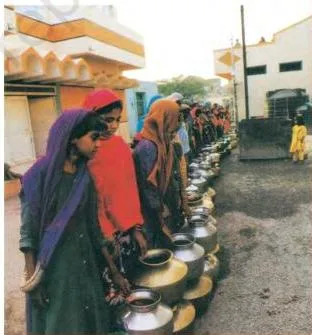
Fig. 3.1 shows what scarcity looks like in daily life. The chapter pairs it with a photograph that frames the whole problem: after a record 180 mm overnight downpour, a boy collects drinking water from the flooded streets of Kolkata — water everywhere, but not a drop to drink (NCERT, p. 20).

Think about what the photograph proves: rain fell in abundance, yet usable water was still scarce. That is the exact puzzle the chapter builds upon — scarcity is not the weather, it is how water is used and shared.
Bring the chapter’s first exercise question (Q1 i) to this table: it gives four situations and asks you to classify each as suffering or not suffering from water scarcity. The deciding rule is whether demand and quality allow the available water to be used.
| Situation (from Q1 i) | Suffering from scarcity? | Why (chapter’s reasoning) |
|---|---|---|
| (a) Region with high annual rainfall | No | Rainfall continuously renews surface runoff and groundwater |
| (b) High annual rainfall and large population | Yes | Large demand for domestic water and food over-exploits the supply |
| (c) High annual rainfall but highly polluted water | Yes | Polluted water is hazardous, so the quantity cannot be used (NCERT, p. 20) |
| (d) Low rainfall and low population | No | Demand stays within the available supply |
The pattern to take away: scarcity follows when demand outgrows usable supply. Large populations need more domestic water and more food, so irrigated agriculture — the largest consumer of water — expands into dry-season farming, and groundwater levels fall (NCERT, p. 20).
Two more pressure points follow in the chapter. Industries are heavy water users and also need power, much of it hydroelectric, and multiplying urban housing societies run their own groundwater pumps, depleting fragile aquifers in several cities (NCERT, p. 20).
Quality is a separate cause of scarcity: domestic and industrial wastes, chemicals, pesticides and fertilisers can make ample water hazardous for human use (NCERT, p. 20). That is why the chapter introduces the Jal Jeevan Mission, which aims to give every rural household assured potable piped water (NCERT, p. 21).
The chapter’s own paradox for this section is Shillong: Cherrapunji and Mawsynram, 55 km away, receive the highest rainfall in the world, yet the state capital faces acute water shortage — which is why nearly every household there harvests rooftop rain (NCERT, p. 27).
Multi-Purpose River Projects: The Temples and Their Costs
This section examines the first big response to water shortage — building dams — and then the reasons large projects came under opposition.
A dam is a barrier across flowing water that obstructs, directs or retards the flow, creating a reservoir. The word ‘dam’ often refers to the reservoir itself, and most dams have a spillway over which water flows (NCERT, p. 22).
Dams were once built simply to impound water for later irrigation. Today they are multi-purpose projects: the impounded water serves electricity generation, domestic and industrial supply, flood control, recreation, inland navigation and fish breeding, all integrated with one another (NCERT, p. 22).
Keep the two textbook examples ready: Bhakra-Nangal on the Sutlej-Beas basin produces hydel power and irrigation, and Hirakud on the Mahanadi combines water conservation with flood control (NCERT, p. 22).
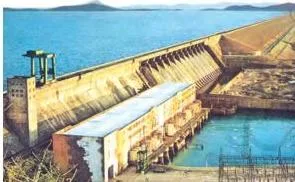
Fig. 3.2 shows Hirakud itself — the barrier across the Mahanadi holding back the reservoir that the word ‘dam’ refers to.
After Independence these projects were the vehicles of national development. Jawaharlal Nehru proudly called dams the ‘temples of modern India’, because they would integrate agricultural development with rapid industrialisation (NCERT, p. 22).
The tradition is ancient. The chapter lists sophisticated hydraulic structures built in India over thousands of years:
- Sringaverapura near Allahabad (first century BC): a channel for the flood water of the river Ganga (NCERT, p. 21).
- Chandragupta Maurya’s time: dams, lakes and irrigation systems extensively built (NCERT, p. 21).
- Kalinga (Odisha), Nagarjunakonda (Andhra Pradesh), Bennur (Karnataka), Kolhapur (Maharashtra): sophisticated irrigation works (NCERT, p. 21).
- Eleventh century: Bhopal Lake, one of the largest artificial lakes of its time (NCERT, p. 21).
- Thirteenth-fourteenth century: the Hauz Khas tank in Delhi, built by Allauddin Khilji to supply the Siri Fort area (NCERT, p. 22).
But in recent years multi-purpose projects and large dams have come under great scrutiny and opposition. Damming changes the river’s natural flow and sediment flow; the reservoir traps sediment, making stream beds rockier and habitats poorer for aquatic life; dams fragment rivers and block fish spawning; and reservoirs on floodplains submerge existing vegetation and soil (NCERT, p. 22).
Then come the harshest findings. Dams built to control floods have themselves triggered floods through sedimentation, and big dams have mostly failed to control floods when rainfall is excessive (NCERT, p. 23).
Floodplains are deprived of silt, a natural fertiliser; projects have induced earthquakes and spread water-borne diseases and pests; and irrigation has shifted cropping towards water-intensive commercial crops, causing salinisation of the soil (NCERT, p. 23).
The two sides of the dam debate, set out as the chapter gives them:
| Advantages (arguments in favour) | Disadvantages (the critique) |
|---|---|
| Bring water to areas that suffer scarcity | Large-scale displacement and loss of livelihood |
| Regulate river flow and help control floods | Sedimentation can trigger the very floods dams were meant to stop |
| Generate electricity for homes and industries | Reservoir-triggered earthquakes and water-borne diseases |
| Support irrigation, navigation and fish breeding | Rockier stream beds, blocked fish spawning, submerged vegetation |
| Reduce dependence on drought-prone cropping | Salinisation from water-intensive crops; floodplains lose silt |
This table is the skeleton for two exercises: comparing the advantages and disadvantages of multi-purpose projects (Q2 iii), and spotting the statement that is not in favour of multi-purpose projects (Q1 ii) — the odd one out is (c) large-scale displacement and loss of livelihood.
The ‘Do you know?’ panels add real cases. Sardar Sarovar on the Narmada in Gujarat serves Maharashtra, Madhya Pradesh, Gujarat and Rajasthan, bringing water to drought-prone and desert areas (NCERT, p. 23). The Krishna-Godavari dispute arose because Karnataka and Andhra Pradesh objected to Maharashtra diverting more water at Koyna, which would reduce downstream flow in their states (NCERT, p. 23).

The map on page 24, ‘India: Major Rivers and Dams’, is the chapter’s own reference exercise: locating each project on its river and basin.
Anchor three pairs — Bhakra-Nangal on the Sutlej-Beas basin in the north, Hirakud on the Mahanadi in Odisha, and Sardar Sarovar on the Narmada in the west. Once you can place these three, you can read any other named project on the map the same way (NCERT, pp. 22-24).
The chapter also carries a folk Bhadu song from the Damodar valley, which calls the Damodar the ‘river of sorrow’ for the floods that troubled the region — a reminder that rivers shaped daily life long before dams (NCERT, p. 22).
Rainwater Harvesting and the Bamboo Drip System
This section teaches the chapter’s second response to scarcity: harvesting rain, groundwater, river water and flood water where it falls. The book calls water harvesting a viable alternative to big dams, both socio-economically and environmentally lighter (NCERT, p. 25).
People had in-depth knowledge of their rainfall regimes and soil types, and developed wide-ranging techniques to harvest rainwater, groundwater, river water and flood water in keeping with local conditions. The region-technique pairing below is the chapter’s own list, and a favourite short-answer question (NCERT, p. 25).
| Technique | Region | What it was used for |
|---|---|---|
| Guls and kuls (diversion channels) | Western Himalayas | Diverting hill streams for agriculture |
| Rooftop rainwater harvesting | Rajasthan, especially semi-arid areas | Storing drinking water |
| Inundation channels | Bengal flood plains | Irrigating fields from flood water |
| Khadins | Jaisalmer, Rajasthan | Fields turned into rain-fed storage; water stands and moistens the soil |
| Johads | Other parts of Rajasthan | Similar rain-fed storage for standing water on fields |
| Tankas (underground tanks) | Bikaner, Phalodi and Barmer households | Storing drinking water from sloping roofs |
| Bamboo drip irrigation | Meghalaya | Tapping stream and spring water, delivered drop by drop at the roots |
The most detailed example is the tanka of semi-arid Rajasthan. Almost all houses in Bikaner, Phalodi and Barmer had underground tanks, some as large as a big room — one Phalodi tank measured 6.1 metres deep, 4.27 metres long and 2.44 metres wide.
A pipe connected the sloping roof to the tanka, and rain falling on the roof travelled down the pipe into the underground tank (NCERT, p. 25).
Two rules about the tanka matter for exams. First, the first spell of rain was deliberately not collected, because it cleaned the roofs and the pipes (NCERT, p. 26).
Second, the water could be stored till the next rainfall, making the tanka an extremely reliable summer source. This rainwater — palar pani — is considered the purest form of natural water (NCERT, pp. 25-26).
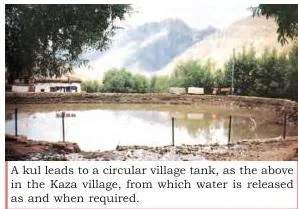
Fig. 3.5 shows the older hill tradition: a kul leads to a circular village tank, as here in Kaza village, and water is released from the tank as and when required. Harvest the rain, store it, then decide when to use it.
Rooftop harvesting declined in western Rajasthan because the perennial Indira Gandhi Canal made plenty of water available. Some houses still maintain their tankas because they do not like the taste of tap water (NCERT, p. 27).
The chapter then shows how the tradition is being adapted today. In Gendathur, a remote village in Mysuru, Karnataka, nearly 200 households have installed rooftop systems that collect about 50,000 litres each a year, from 1,000 mm of precipitation at 80 per cent collection efficiency (NCERT, p. 27).
Do the multiplication yourself: 200 households at about 50,000 litres each comes to roughly one crore litres a year, so check how your edition prints the chapter’s total before quoting it (NCERT, p. 27).
Try the estimate with your own numbers, using the chapter’s collection-efficiency approach:
Step 1: Convert rainfall into metres.
For a place receiving 800 mm, depth = \(0.8\ \text{m}\).
Step 2: Find the volume of rain falling on a 100 m² roof.
\[ \text{Volume} = 100\ \text{m}^2 \times 0.8\ \text{m} = 80\ \text{m}^3 = 80{,}000\ \text{litres} \]
Step 3: Apply the 80 per cent collection efficiency.
\[ \text{Collectible water} = 80{,}000 \times 0.8 = 64{,}000\ \text{litres per year} \]
Final answer: a 100 m² roof at 800 mm of rainfall with 80 per cent efficiency harvests about 64,000 litres a year.
Same method, new numbers: rainfall in metres times roof area, reduced by collection efficiency. That is exactly how the chapter derives Gendathur’s per-house figure (NCERT, p. 27).
Two legal and social facts complete the revival story. Tamil Nadu is the first Indian state to make rooftop rainwater harvesting structures compulsory for all houses, with legal provisions to punish defaulters (NCERT, p. 27). In Shillong, nearly every household harvests rooftop rain, meeting 15-25 per cent of its water requirement that way (NCERT, p. 27).
The chapter closes its survey with Meghalaya’s 200-year-old bamboo drip irrigation system. Stream and spring water enters bamboo pipes — about 18-20 litres — travels hundreds of metres, and ends as just 20-80 drops per minute at the plant’s roots (NCERT, p. 28).
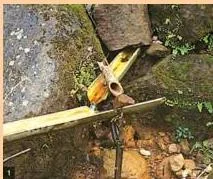

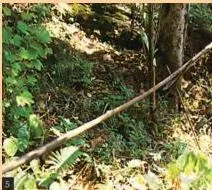
Read the three photographs as one system. Picture 1 shows bamboo pipes diverting perennial hilltop springs downhill by gravity (NCERT, p. 28).
Pictures 2 and 3 show channel sections distributing the water into branches at the plant site, with the flow controlled by manipulating pipe positions. Picture 4 shows pipes carried high above the land where they cross a road.
Every stage slows the water until it drops near the roots — that is the drip. The chapter also includes a ‘Basic Safety Precautions’ box for floods: watch weather bulletins, prepare an emergency kit, never enter flood water, and use boiled drinking water (NCERT, p. 25).
Figure Walkthrough: Reading the Diagrams Closely

Diagrams carry a large share of this chapter’s most-repeated questions, and the labels inside the figures are the answers. Two diagrams repay close reading: the rooftop harvesting system (Fig. 3.3) and the ‘counting the raindrops’ poster (Fig. 3.4).

Fig. 3.3 traces the complete journey of a raindrop in a modern rooftop system (NCERT, p. 26):
- Rainwater from the rooftop is collected through a PVC pipe.
- The water is filtered using sand and bricks.
- An underground pipe carries it to a sump for immediate use.
- Excess water from the sump is taken to a well.
- Water from the well recharges the underground (groundwater).
- Later, water can be drawn back from the well when needed.
The figure also marks the two recharge routes — (a) recharge through a hand pump and (b) recharge through an abandoned dugwell. Recharge means letting water seep down to refill the groundwater below. The well matters because it turns extra rain into banked groundwater the house can draw later.
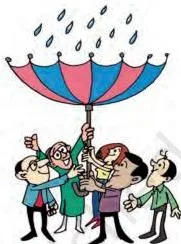
Fig. 3.4 is different in kind: a public campaign poster reading ‘This monsoon, join us in counting the raindrops’. The chapter uses it to make conservation personal — if citizens join in measuring and saving rain, the answer to scarcity does not rest on big dams alone (NCERT, p. 26).
The checklist below summarises the chapter’s key figures and the one thing to notice in each.
| Figure | Page | What to notice |
|---|---|---|
| Fig. 3.1 Water Scarcity | 20 | Scarcity is a daily reality of fetching and carrying water |
| Fig. 3.2 Hirakud Dam | 22 | A large dam on the Mahanadi — a multi-purpose project in one image |
| Fig. 3.3 Rooftop Rainwater Harvesting | 26 | The full path: roof, PVC pipe, sand-brick filter, sump, well, recharge |
| Fig. 3.4 Counting the raindrops | 26 | A poster for public participation in conservation |
| Fig. 3.5 Traditional method of rainwater harvesting | 26 | A kul feeding a circular village tank at Kaza |
| Fig. 3.6 Gendathur rooftop system | 27 | Thar tanka tradition — water taken from a neighbour’s roof into an underground tanka |
| Fig. 3.7 Bamboo drip irrigation | 28 | Gravity, branching pipes, road crossing, drop-by-drop delivery |
Key Terms and Definitions from the Chapter
Quick one-line definitions of the terms the chapter introduces, with the NCERT page beside each — enough for definition and short-answer work.
| Term | Meaning | Page |
|---|---|---|
| Hydrological cycle | The continuous movement of water that renews and recharges freshwater | 18 |
| Renewable resource | A resource continually renewed and recharged by natural processes | 18 |
| Water scarcity | A shortage of usable water, usually from over-exploitation, excessive use, unequal access or pollution | 20 |
| Over-exploitation | Using a resource faster than it can renew, such as pumping groundwater faster than recharge | 20 |
| Multi-purpose project | A dam project integrating several uses of impounded water — irrigation, power, supply, flood control and more | 22 |
| Reservoir | The lake formed behind a dam; ‘dam’ often means this impoundment | 22 |
| Spillway | The section of a dam over or through which water flows | 22 |
| Sedimentation | The settling of silt at the reservoir bottom, robbing downstream plains of natural fertiliser | 22-23 |
| Salinisation | Salt building up in soil, often from water-intensive irrigation | 23 |
| Rooftop rainwater harvesting | Collecting rain from a roof through pipes into a storage tank | 25-26 |
| Tanka | An underground tank in Rajasthan storing drinking water from a sloping roof | 25 |
| Khadin | A rain-fed field storage in Jaisalmer that lets water stand and moisten the soil | 25 |
| Johad | A similar rain-fed storage structure in other parts of Rajasthan | 25 |
| Gul / kul | A diversion channel in the Western Himalayas that carries hill water to fields | 25 |
| Inundation channels | Channels in the Bengal flood plains that bring flood water onto fields | 25 |
| Bamboo drip irrigation | A Meghalaya system delivering stream water drop by drop through bamboo pipes | 28 |
Common Mistakes Students Make in This Chapter
These are the points where readers of this chapter routinely lose marks, each with a one-line fix.
| Mistake | Correct rule | How to check your answer |
|---|---|---|
| Saying water scarcity is simply low rainfall | Scarcity is mostly over-exploitation, excessive use, unequal access and pollution (NCERT, p. 20) | Run the situation through the four-case table from Q1(i) |
| Collecting the first spell of rain | The first spell is deliberately not collected — it cleans the roofs and pipes (NCERT, p. 26) | If your tanka answer collects it, the answer is wrong |
| Mixing up regional techniques | Guls/kuls are Himalayan; khadins/johads are Rajasthan; inundation channels are Bengal; tankas are Rajasthan households (NCERT, pp. 25-26) | Match technique to region before writing anything |
| Praising dams while forgetting their costs | Sedimentation can trigger the very floods dams were built to control (NCERT, p. 23) | Your ‘disadvantages’ answer must mention floods, displacement, earthquakes, salinisation |
| Confusing government schemes | Atal Jal = groundwater behaviour change; Jal Jeevan Mission = potable piped water; PMKSY = protective irrigation; Indira Gandhi Canal = why tankas declined (NCERT, pp. 21, 23, 27) | One scheme per sentence; name what each actually delivers |
| Quoting the Gendathur total without re-checking | 200 houses at 50,000 litres each is about one crore litres, whatever your edition prints (NCERT, p. 27) | Multiply before you quote any Gendathur number |
Treat these four as separate revision items — they all sound like ‘water schemes’ and are easy to muddle.
| Scheme / project | What it does | Page |
|---|---|---|
| Atal Bhujal Yojana (Atal Jal) | Groundwater management in 8,220 water-stressed gram panchayats; shifts behaviour from consumption to conservation | 21 |
| Jal Jeevan Mission | Assured potable piped water for every rural household, at 55 litres per person per day | 21 |
| Pradhan Mantri Krishi Sinchayee Yojana | Protective irrigation for all farms — ‘har khet ko pani’ and ‘per drop more crop’ | 23 |
| Indira Gandhi Canal | A perennial canal; its water supply is why western Rajasthan tankas fell out of use | 27 |
Exam Pointers: How the Chapter’s Exercises Test You
The chapter’s exercises are not random — question by question they retrace the three sections above.
- Q1(i) tests the scarcity-causes distinction: the four situations are exactly the four-case table from the Water Scarcity section.
- Q1(ii) asks which statement is not an argument in favour of multi-purpose projects: the answer is (c) ‘large scale displacements and loss of livelihood’ — the other three are genuine advantages.
- Q1(iii) gives three deliberately false statements to rewrite — a built-in revision quiz. Correct versions: (a) urban centres have over-exploited water, not used it properly; (b) damming does affect a river’s natural flow and sediment flow; (c) rooftop harvesting in Rajasthan has declined despite the Indira Gandhi Canal (NCERT, pp. 20, 22, 27).
For the 30-word answers: water becomes renewable through the hydrological cycle (NCERT, p. 18); scarcity’s main causes are over-exploitation, excessive use, unequal access and pollution (NCERT, p. 20); and the advantages-versus-disadvantages comparison is the table in the multi-purpose section above.
For the 120-word answer on rainwater harvesting in Rajasthan, follow the chapter’s own order (NCERT, pp. 25-26):
- Where: semi-arid Rajasthan, especially Bikaner, Phalodi and Barmer.
- The structure: an underground tanka in the house or courtyard, connected by a pipe to the sloping roof.
- The rule: the first spell is not collected — it cleans the roof and pipes.
- Storage and quality: water stays in the tanka till the next rainfall, kept cool underground; palar pani is called the purest natural water.
- Bonus mark: underground rooms beside the tanka stayed cool in summer.
For the 120-word answer on modern adaptations, join Gendathur’s rainfall and efficiency figures, Tamil Nadu’s compulsory rooftop law, Shillong’s near-universal structures, and the Fig. 3.3 route — PVC pipe, sand-and-brick filter, sump, well recharge (NCERT, pp. 26-27).
One honest caution: textbook contents and the examinable syllabus are not always identical — check the current official syllabus before treating any chapter section as examinable. For more practice, the Class 10 Social Science notes on this site carry the same topics as questions and answers.
Chapter Summary: The Core Ideas in Brief
The whole chapter is one argument in three movements.
- The water paradox (NCERT, pp. 18-21): water is renewable through the hydrological cycle, yet nearly two billion people may face absolute scarcity by 2025 — because over-exploitation, excessive use, unequal access and pollution matter more than rainfall.
- The dam debate (NCERT, pp. 21-24): multi-purpose projects were built as ‘temples of modern India’ to integrate irrigation, power, supply and flood control — but sedimentation, reservoir-triggered floods, displacement, earthquakes and salinisation turned opinion against them.
- The harvesting alternative (NCERT, pp. 25-28): ancient knowledge of rainfall and soils produced tankas, kuls, khadins, johads and inundation channels; the modern revival runs from Gendathur and Tamil Nadu to Shillong, and Meghalaya’s bamboo drip shows how little infrastructure wise water use needs.
Check yourself with the chapter’s exercises — the false-statement rewrites in particular test exactly these connections.
Related Chapters and Resources
Water Resources sits between Forest and Wildlife Resources (Chapter 2) and Agriculture (Chapter 4) in Contemporary India II. The three chapters together tell the story of India’s resources and how they are used.
Continue with the Forest and Wildlife Resources chapter or move ahead to the Agriculture chapter, and browse the Class 10 Social Science book hub for all the chapters in the book.
The official NCERT textbook portal is the authoritative place to confirm the current edition and chapter set.
For revision, see the Agriculture chapter notes, the Sectors of the Indian Economy notes, or the full Class 10 study material in the notes directory.
Sources and Data Verification
- The content and figures on this page describe NCERT Class 10 Geography textbook Contemporary India II, Chapter 3 ‘Water Resources’, official edition published by NCERT.
- This page covers Chapter 3 only — not the full book, and not the CBSE syllabus or its subject scheme.
- The information above is kept current with the NCERT material available to us. Textbook contents and the examinable syllabus are not always identical — check the current official syllabus.
- NCERT settles textbooks, editions and PDFs; CBSE settles the curriculum, syllabus and examinations.
FAQ: Water Resources Class 10
How does water become a renewable resource in this chapter?
Freshwater comes from surface runoff and groundwater, and both are continually renewed and recharged through the hydrological cycle. Because all water moves within this cycle, water is called a renewable resource (NCERT, p. 18).
Can water scarcity occur even where rainfall is high?
Yes — that is the chapter’s central point. Scarcity is usually caused by over-exploitation, excessive use, unequal access and pollution, not by low rainfall (NCERT, p. 20). The textbook examples are the boy collecting drinking water in Kolkata after a 180 mm downpour, and Shillong facing acute shortage while Cherrapunji and Mawsynram, 55 km away, receive the world’s highest rainfall (NCERT, pp. 20, 27).
Why does the chapter call multi-purpose river projects both useful and damaging?
They are useful because one dam integrates irrigation, electricity, domestic and industrial supply, flood control, recreation, navigation and fish breeding (NCERT, p. 22). They are damaging because damming alters natural and sediment flow, submerges vegetation, blocks fish spawning, can trigger floods and earthquakes, spreads water-borne diseases and causes salinisation — besides displacing people and livelihoods (NCERT, pp. 22-23).
How is rooftop rainwater harvesting carried out in the semi-arid regions of Rajasthan?
Houses in Bikaner, Phalodi and Barmer had underground tankas connected by a pipe to the sloping roof. Rain ran down the pipe into the tanka; the first spell was not collected because it cleaned the roof and pipes. The stored rainwater — palar pani — lasted till the next rainfall and was considered the purest natural water (NCERT, pp. 25-26).
Which traditional water harvesting method is used in which region of India?
The chapter pairs each technique with a region: guls and kuls in the Western Himalayas for agriculture, rooftop rainwater harvesting in Rajasthan for drinking water, inundation channels in the Bengal flood plains, khadins in Jaisalmer and johads elsewhere in Rajasthan, tankas in Rajasthan households, and bamboo drip irrigation in Meghalaya (NCERT, p. 25).
Why did rooftop rainwater harvesting decline in western Rajasthan?
Because the perennial Indira Gandhi Canal made plenty of water available, the practice faded — although some houses still keep their tankas since they prefer the taste of tanka water to tap water (NCERT, p. 27).
Reference: NCERT Class 10 Social Science textbook, chapter 3, official edition on ncert.nic.in.
Explore Class 10 Social Science Books
Class 10 Social Science on LearnCBSE:
Related chapters:
- Resources and Development
- Power-sharing
- The Rise of Nationalism in Europe