
Forest and Wildlife Resources Class 10 is Chapter 2 of the NCERT Contemporary India II textbook, the Geography book used for CBSE Class 10 Social Science.
It runs from NCERT page 12 to page 18 and covers why India’s biodiversity matters, how the Wildlife (Protection) Act 1972 and Project Tiger tried to save it, how Indian forests are classified, and the community efforts — Chipko, Beej Bachao Andolan, joint forest management and sacred groves — that conserve it today. The official NCERT chapter PDF is linked right below.
Download the NCERT Forest and Wildlife Resources Class 10 Chapter 2 PDF
This listing is maintained for the 2026-27 academic session using the NCERT textbook information available to us. NCERT remains the authority for confirming the latest edition.
The file below is the official NCERT edition of this chapter, published on the NCERT website for the current academic session. Open the NCERT Class 10 Social Science Contemporary India II Chapter 2 Forest and Wildlife Resources PDF to read the complete chapter text, its figures and the exercise page exactly as printed in the textbook.
| What the chapter holds | Count | Where it is used |
|---|---|---|
| Printed pages | 6 | |
| Figures with NCERT captions | 6 | |
| Tables | 1 | |
| Exercise questions | 4 | answered in our NCERT Solutions |
| Activities | 3 | |
| Official NCERT PDF | Download the chapter PDF | the chapter exactly as NCERT publishes it |
Chapter at a Glance: What Is Inside the PDF
The table below shows the chapter’s structure as recorded from the official NCERT file — how many pages it runs, the sections and figures it contains, the three Activities built into the text, and its four end-of-chapter exercises.
Within those pages, the chapter moves through the following parts:
- Biodiversity and India’s flora and fauna — the opening argument that humans depend on the web of living things (NCERT pages 12–13).
- Conservation and the legal response — why conservation is needed, the Indian Wildlife (Protection) Act 1972 and the protected-species list (NCERT pages 13–14).
- Project Tiger — the 1973 rescue programme, its threats and named tiger reserves (NCERT page 14).
- Types and distribution of forests — reserved, protected and unclassified forests, and how Indian states differ (NCERT page 15).
- Gharial on the brink — a case study of a critically endangered crocodile in its last wild breeding sites (NCERT page 16).
- Community and conservation — Sariska, the Alwar villages, Chipko, Beej Bachao Andolan, Navdanya, joint forest management and sacred groves (NCERT pages 16–17).
- Exercises — one multiple choice question, one matching exercise and four short and long answer questions (NCERT page 18).
What This Chapter Covers: From Biodiversity to Community Conservation
Knowing the chapter’s argument in advance makes every detail below easier to hold together. This section gives you that one-paragraph map.
The chapter opens with a Lepcha folk song and a simple claim: humans are one part of a complex ecological web, and the plants, animals and micro-organisms in it recreate the air, water and soil we cannot survive without (NCERT pages 12–13).
Because India is one of the world’s richest countries in biological diversity, the chapter treats that web as worth protecting, not just admiring.
The middle of the chapter is a history of protection. Conservationists demanded a national wildlife programme in the 1960s and 1970s; the result was the Indian Wildlife (Protection) Act 1972, which banned hunting, protected habitats and restricted wildlife trade, followed by Project Tiger in 1973 (NCERT pages 13–14). Protection later widened from mammals to insects (1980, 1986) and plants (1991).
The chapter then sorts India’s forests into reserved, protected and unclassified categories and shows which states hold which (NCERT page 15).
The last stretch turns the spotlight on people. A gharial case study shows a species at the edge of extinction and links its fate to habitat and river pollution (NCERT page 16).
Then the chapter shows conservation working from below: villagers in Sariska and Alwar protecting land themselves, the Chipko movement, Beej Bachao Andolan, Navdanya, joint forest management and sacred groves (NCERT pages 16–17). Three Activities ask students to collect local nature stories, mark wildlife sanctuaries and national parks on a map of India, and write a short essay on everyday conservation practices.
Key Concepts in Forest and Wildlife Resources
This is the section to study slowly. Each idea appears here in the order the chapter itself builds them, in plainer words, with the NCERT page so you can follow along in your book.
Biodiversity and why the chapter starts with it
Biodiversity is the immense richness of wildlife and cultivated species — diverse in form and function, yet closely integrated through multiple networks of interdependence (NCERT pages 12–13). The chapter opens with it because everything else follows from it: forests are primary producers, and all other living beings, including humans, depend on them.
India is one of the world’s richest countries in biological diversity, and the variety still to be discovered is possibly two or three times what we already know. These flora and fauna are so integrated into daily life that they are taken for granted — but they are under great stress from insensitivity to the environment (NCERT pages 12–13).
Why conservation is necessary
Conservation means protecting what remains in the face of rapid decline in wildlife and forests. The chapter gives two reasons. First, conservation preserves ecological diversity and our life support systems — water, air and soil. Second, it preserves genetic diversity, which keeps species and breeding healthy: agriculture still depends on traditional crop varieties, and fisheries depend on aquatic biodiversity (NCERT page 13).
The Indian Wildlife (Protection) Act 1972
In the 1960s and 1970s, conservationists pressed for a national wildlife protection programme. The Indian Wildlife (Protection) Act was implemented in 1972 with provisions for protecting habitats and an all-India list of protected species. Its thrust was threefold: banning hunting, giving legal protection to habitats, and restricting trade in wildlife (NCERT pages 13–14).
The central government also announced projects for gravely threatened species: the tiger, the one-horned rhinoceros, the Kashmir stag (hangul), three types of crocodiles — fresh water, saltwater and the gharial — and the Asiatic lion.
Most recently, the Indian elephant, the black buck (chinkara), the great Indian bustard (godawan) and the snow leopard have received full or partial legal protection against hunting and trade throughout India.
| Year | Step taken in wildlife protection |
|---|---|
| 1972 | Indian Wildlife (Protection) Act — hunting banned, habitats protected, wildlife trade restricted |
| 1973 | Project Tiger launched after the tiger population fell to 1,827 |
| 1980 & 1986 | Insects added to the protected list — hundreds of butterflies, moths, beetles and a dragonfly |
| 1991 | Plants added for the first time, starting with six species |
| 1988 | Joint forest management in formal existence — Odisha passed the first resolution |
The chronology table above is worth memorising as a single block — exam answers love the order (NCERT pages 13–14, 16–17).
Project Tiger, 1973
Project Tiger is one of the world’s best-publicised wildlife campaigns. In 1973, the authorities realised the tiger population had dwindled to 1,827 from an estimated 55,000 at the turn of the century.
The threats named in the chapter are poaching for trade, shrinking habitat, depletion of the prey base and a growing human population; the trade in tiger skins and the use of tiger bones in traditional medicines pushed the species towards extinction (NCERT page 14).
Tiger conservation was viewed not only as saving an endangered species but as a means of preserving biotypes of sizeable magnitude. Since India and Nepal provide habitat to about two-thirds of the surviving tiger population, these two nations became prime targets for poaching.
The reserves named in the chapter are Corbett (Uttarakhand), Sunderbans (West Bengal), Bandhavgarh (Madhya Pradesh), Sariska (Rajasthan), Manas (Assam) and Periyar (Kerala) (NCERT page 14).
Types and distribution of forests
Most of India’s forest and wildlife resources are owned or managed by the government through the Forest Department and other departments. They fall into three categories, and the difference between them is one of the chapter’s most-tested points (NCERT page 15).
| Category | Proportion of forest land | Who owns it | Conservation value | Example states |
|---|---|---|---|---|
| Reserved forests | More than half of total forest land | Government | Regarded as the most valuable for conservation of forest and wildlife resources | Jammu and Kashmir, Andhra Pradesh, Uttarakhand, Kerala, Tamil Nadu, West Bengal, Maharashtra |
| Protected forests | Almost one-third of total forest area | Government (Forest Department) | Protected from any further depletion | Bihar, Haryana, Punjab, Himachal Pradesh, Odisha, Rajasthan |
| Unclassified forests | Remaining area | Both government and private individuals and communities | Other forests and wastelands; not conservation-classified | All north-eastern states and parts of Gujarat |
Reserved and protected forests together are called permanent forest estates, maintained for producing timber and other forest produce and for protective reasons. Madhya Pradesh has the largest area under permanent forests — 75 per cent of its total forest area (NCERT page 15).
Memory aid: reserved-heavy states are the long southern/eastern list, protected-heavy states are the northern and western list, and unclassified-heavy means the north-east plus parts of Gujarat.
Gharial on the brink
The chapter’s case study, written by Romulus Whitaker and Janaki Lenin, reports that the gharial population has been at its lowest since the 1970s.
In the breeding season, an adult male gharial advertises its presence with clapping sounds across the water; the five-km stretch of the Gowa River in Katerniaghat Wildlife Sanctuary is one of only three wild breeding sites left in the world for this critically endangered crocodilian.
A mid-text note records the conservation response: captive gharial at the Madras Crocodile Bank Trust were hatched and, once they reached about a metre in length, released into the wild (NCERT page 16).
Community and conservation
Conservation in India is not only a government project. Local communities are struggling to conserve habitats alongside officials because only that secures their own long-term livelihood (NCERT page 16). The chapter gives five examples:
- Sariska Tiger Reserve, Rajasthan — villagers fought against mining by citing the Wildlife Protection Act.
- Alwar district, Rajasthan — five villages declared 1,200 hectares of forest as the Bhairodev Dakav ‘Sonchuri’, with their own rules that do not allow hunting, protecting the wildlife against outside encroachment.
- Chipko movement — resisted deforestation in the Himalayas and showed that community afforestation with indigenous species can succeed.
- Beej Bachao Andolan (Tehri) and Navdanya — farmer and citizens’ groups showing that diversified crop production without synthetic chemicals is possible and economically viable.
- Joint forest management (JFM) — village institutions protect degraded forest land and, in return, receive non-timber forest produce and a share in the timber harvested from successful protection (NCERT pages 16–17).
Sacred groves
Nature worship is an age-old tribal belief that all creations of nature have to be protected, and it has preserved several virgin forests in pristine form as sacred groves — patches of forest left untouched because they are believed to belong to gods and goddesses.
The Mundas and Santhal of the Chota Nagpur region worship mahua and kadamba trees; the tribals of Odisha and Bihar worship tamarind and mango at weddings. Temple macaques and langurs are fed daily and treated as part of the devotees; in Bishnoi villages, blackbuck, chinkara, nilgai and peacocks live unharmed as part of the community (NCERT page 17).
Figure Walkthrough: Kaziranga and the Gharial Case Study
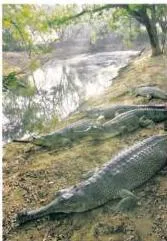
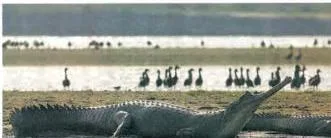

This chapter carries one captioned photograph and a newspaper clipping inside the case-study box. Reading them actively — not glancing past them — is the fastest way to see what conservation actually looks like.
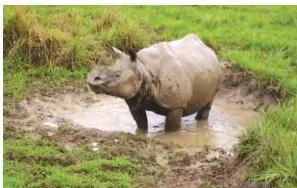
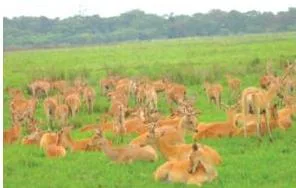
The photograph shows a one-horned rhinoceros and deer sharing the same grassland at Kaziranga National Park. That coexistence is exactly the point of the conservation drive described earlier in the chapter: the Wildlife (Protection) Act created national parks and sanctuaries, and this is a protected habitat where large herbivores live together instead of being hunted.
The one-horned rhinoceros is one of the species the chapter names as gravely threatened and given project protection (NCERT pages 13–14), so the photo is living evidence of what the 1972 Act and the projects that followed were meant to achieve.

The chapter embeds this clipping — headlined “Bird deaths blamed on dirty Yamuna” and citing a Delhi government report pointing to toxic elements in stagnant water — inside the gharial box, then asks: “Can you find out the reasons for the above-mentioned problems?” (NCERT page 16).
The image deliberately widens the lens from one species to a whole river system: the gharial is in crisis because its habitat and water are in crisis. Pollution that kills birds on the Yamuna and the loss of wild breeding sites on the Gowa are the same story at different scales.
Definitions: Important Terms in This Chapter
Use this glossary whenever a term slows you down while reading the chapter. Each definition is in plain words, with the page where the chapter explains it.
- Biodiversity — the immense richness of wildlife and cultivated species, diverse in form and function but closely integrated through multiple networks of interdependencies (NCERT pages 12–13).
- Reserved forests — more than half of India’s forest land, regarded as the most valuable for conservation of forest and wildlife resources (NCERT page 15).
- Protected forests — almost one-third of the total forest area, declared by the Forest Department and protected from any further depletion (NCERT page 15).
- Unclassified forests — other forests and wastelands belonging to both government and private individuals and communities (NCERT page 15).
- Permanent forest estates — reserved and protected forests taken together, maintained for producing timber and other forest produce and for protective reasons (NCERT page 15).
- Sacred groves — patches of virgin forest left untouched by local people because they are believed to be the forests of gods and goddesses (NCERT page 17).
- Joint forest management (JFM) — a programme, in formal existence since 1988, in which village institutions protect degraded forest land in return for non-timber forest produce and a share in the timber from successful protection (NCERT pages 16–17).
- Chipko movement — a Himalayan movement that resisted deforestation and demonstrated successful community afforestation with indigenous species (NCERT page 16).
- Beej Bachao Andolan — a farmers’ and citizens’ group in Tehri that showed diversified crop production without synthetic chemicals is possible and economically viable (NCERT page 16).
- Navdanya — a similar group that promotes adequate levels of diversified crop production without synthetic chemicals (NCERT page 16).
- Gharial — a critically endangered crocodilian whose population has been at its lowest since the 1970s, with only a few wild breeding sites left in the world (NCERT page 16).
Common Mistakes Students Make in This Chapter
These are the five errors this chapter reliably produces — in homework, in class tests, and in board answers. Name them before they happen and you avoid them entirely.
| Mistake | Correct rule | How to check your answer |
|---|---|---|
| “Protected forests” sounds like the strongest protection | Reserved forests are the most valuable for conservation; protected forests are merely guarded from further depletion (NCERT page 15) | The chapter’s matching exercise on page 18 gives it away: “most valuable” belongs with reserved, “protected from further depletion” belongs with protected |
| Mixing up the chronology | 1972 Act → 1973 Project Tiger → insects added 1980 and 1986 → plants added 1991 → JFM formal since 1988 (NCERT pages 13–14, 16–17) | Recite the dates in order and attach one event to each |
| Confusing community-led and government-led strategies | Chipko, Beej Bachao and JFM involve communities; demarcation of wildlife sanctuaries is a government action (NCERT page 18) | Ask: “Who decided this?” — if the Forest Department demarcates, it is not direct community participation |
| Quoting the numbers loosely | 1,827 tigers in 1973 vs about 55,000 at the turn of the century; about two-thirds of the surviving tiger population in India and Nepal; 1,200 hectares by five Alwar villages; 75 per cent of Madhya Pradesh under permanent forests (NCERT pages 14–16) | Write the exact figure next to the exact event — no rounding allowed |
| Overstating what JFM gives villagers | Villagers get intermediary benefits — non-timber forest produce and a share in timber from successful protection — not ownership of forest land (NCERT pages 16–17) | Re-read the sentence: “entrepreneurial benefits”, not land rights |
Exam Notes: How This Chapter Is Asked
This section maps each of the four exercises on NCERT page 18 to the concept it tests, so you know what a full-marks answer must include.
- Multiple choice question (Q1) — tests the community-led vs government-led distinction. The answer is demarcation of wildlife sanctuaries; joint forest management, the Chipko Movement and Beej Bachao Andolan are all community-involving strategies (NCERT page 18).
- Matching exercise (Q2) — tests the three forest categories. Match reserved forests with “most valuable for conservation”, protected forests with “protected from any further depletion”, and unclassed forests with “other forests and wastelands belonging to both government and private individuals and communities” (NCERT page 18).
- 30-word questions (Q3) — tests the biodiversity definition and human impact on flora and fauna (NCERT page 18).
- 120-word questions (Q4) — tests community conservation examples and good practices (NCERT page 18).
Scaffold for the 30-word biodiversity answer: open with what biodiversity is — the immense variety of wildlife and cultivated species woven together in an interdependent system; then give why humans depend on it — plants, animals and micro-organisms recreate the air, water and soil that produce our food; close with one supporting example, such as forests as primary producers or India being among the world’s richest countries in biological diversity.
Scaffold for the 120-word community-conservation answer: open with one sentence that communities in India have conserved habitats alongside government officials — and sometimes without them; give two named examples with one concrete detail each, such as the Sariska villagers who fought mining by citing the Wildlife Protection Act, or the five Alwar villages that declared 1,200 hectares as the Bhairodev Dakav ‘Sonchuri’ with no-hunting rules; add a supporting example like the Chipko movement or joint forest management; close with the chapter’s lesson — local communities must be involved in natural resource management, and only people-centric, environment-friendly and economically rewarding activities should be accepted.
Textbook contents and the examinable syllabus are not always identical — check the current official syllabus before you decide what to prioritise.
Revision Summary: Forest and Wildlife Resources in One Page
If you have five minutes, this is the whole chapter in bullets.
- Biodiversity is the web we depend on — India is one of the world’s richest countries in biological diversity, and humans rely on the system for air, water, soil and food (NCERT pages 12–13).
- Conservation preserves two things — ecological diversity (life support systems) and genetic diversity (species and breeding) (NCERT page 13).
- The legal framework — the Indian Wildlife (Protection) Act 1972 banned hunting, protected habitats and restricted trade; Project Tiger 1973 rescued the tiger; protection widened to insects (1980, 1986) and plants (1991) (NCERT pages 13–14).
- Forests are classified — reserved (most valuable), protected (guarded from further depletion) and unclassified, with Madhya Pradesh holding 75 per cent of its forest area as permanent forest (NCERT page 15).
- Even a critically endangered species can be brought back — the gharial’s population is at its lowest since the 1970s, with only a few wild breeding sites, and captive-hatched young are released once they reach about a metre in length (NCERT page 16).
- Communities conserve too — Chipko, Beej Bachao Andolan, Navdanya, joint forest management and sacred groves all show local people protecting nature (NCERT pages 16–17).
- The closing point — local communities must be involved in natural resource management, and only people-centric, environment-friendly and economically rewarding activities should be accepted (NCERT page 17).
Numbers worth memorising: 1972, 1973, 1988 · 1,827 · 55,000 · 75 per cent · 1,200 hectares.
Related Resources: Class 10 Social Science Chapters
Continue with the chapters around this one. Class 10 Social Science notes on this site collect every Geography chapter in one place, including the sibling chapters to this one: Resources and Development (Chapter 1) sets up the resource framework, and Water Resources (Chapter 3) carries the same conservation argument into rivers and groundwater.
Start from the Class 10 hub for the rest of the Social Science books, or go to the CBSE notes home for every class and subject. You can always return to the official NCERT Forest and Wildlife Resources chapter PDF on ncert.nic.in, and verify any edition on the NCERT textbook portal.
Reference: NCERT Class 10 Contemporary India II textbook, chapter 2, official edition on ncert.nic.in.
Sources and Data Verification
Four things are worth stating plainly about where this page’s facts come from.
- The chapter details above describe the NCERT Contemporary India II textbook, Class 10, official edition published and hosted by NCERT on ncert.nic.in.
- This page covers Chapter 2 (Forest and Wildlife Resources) of Contemporary India II only — it does not cover the other Social Science books or other Class 10 subjects.
- The page is maintained for the current academic session using the NCERT information available to us.
- NCERT settles textbooks, editions and official PDFs, while CBSE settles the curriculum, syllabus and examinations.
FAQs: Forest and Wildlife Resources Class 10
Why are reserved forests more valuable than protected forests?
Because the chapter says so directly: reserved forests are “regarded as the most valuable as far as the conservation of forest and wildlife resources are concerned”, while protected forests are only “protected from any further depletion” (NCERT page 15). The name “protected” sounds stronger, but the actual conservation value is the reverse.
What is the difference between the Indian Wildlife (Protection) Act 1972 and Project Tiger 1973?
The 1972 Act is the legal framework — it banned hunting, gave legal protection to habitats and restricted wildlife trade. Project Tiger, launched in 1973, is a specific project under that protection drive, focused on the tiger after its population fell to 1,827; it is also a means of preserving whole biotypes, not just one species (NCERT pages 13–14).
Which conservation strategies in this chapter involve local communities directly?
The ones the chapter lists are the Sariska villagers fighting mining, the five Alwar villages declaring 1,200 hectares as the Bhairodev Dakav ‘Sonchuri’, the Chipko movement, Beej Bachao Andolan, Navdanya, joint forest management and sacred groves (NCERT pages 16–17). The chapter’s MCQ tests the opposite case: demarcation of wildlife sanctuaries is a government action, not direct community participation (NCERT page 18).
Which state passed the first joint forest management resolution and in which year?
Odisha passed the first resolution for joint forest management, and the programme has been in formal existence since 1988 (NCERT pages 16–17).
What are sacred groves and how do they help conserve biodiversity?
Sacred groves are patches of virgin forest left untouched by local people because they are believed to be the abodes of gods and goddesses. Because any interference with them is banned, they preserve diverse and rare species in pristine form — the chapter calls them “a wealth of diverse and rare species” (NCERT page 17).
How do I write the 30-word answer on biodiversity for the chapter exercise?
Define biodiversity in one line as the immense richness of wildlife and cultivated species integrated in an interdependent system, then give one line on why it matters to humans — plants, animals and micro-organisms recreate the air, water and soil that produce our food — and close with one supporting example such as India being among the world’s richest countries in biological diversity (NCERT pages 12–13, 18).
Explore Class 10 Social Science Books
Class 10 Social Science on LearnCBSE:
Related chapters:
- Resources and Development
- Power-sharing
- The Rise of Nationalism in Europe