
This page gives you the Minerals and Energy Resources Class 10 chapter from NCERT’s Social Science Geography textbook Contemporary India II — Chapter 5, printed on textbook pages 41 to 56. The official chapter PDF is right below, followed by a plain-language walkthrough of the chapter itself: its definitions, India’s mineral belts, the five modes of occurrence, energy sources, maps and closing exercises.
Download the Minerals and Energy Resources Class 10 PDF
The file below is the unmodified official chapter as NCERT published it — open the Minerals and Energy Resources Class 10 chapter PDF to read the complete text, the distribution maps and the closing crossword on any phone, tablet or computer, free of charge.
| What the chapter holds | Count | Where it is used |
|---|---|---|
| Printed pages | 16 | |
| Figures with NCERT captions | 19 | |
| Tables | 1 | |
| Activities | 4 | |
| Official NCERT PDF | Download the chapter PDF | the chapter exactly as NCERT publishes it |
What This NCERT Chapter Contains
This section tells you what is inside the file, so you know where each topic sits before you open it. The count table above shows how much the chapter holds; the walkthrough below describes what it teaches.
The chapter opens with a short story: Haban arrives in Guwahati from a remote village and is amazed that buses and trains — built of iron and aluminium, driven by engines — can move, while his village house cannot. Ba’s answer introduces the chapter’s driving question: where do metals, and the energy to run machines, come from?
From there the chapter moves through:
- the toothpaste box — the abrasive minerals (silica, limestone, aluminium oxide, phosphate minerals), fluorite for fluoride, titanium oxide from rutile, ilmenite and anatase for whiteness, and mica for sparkle (p. 41);
- what a mineral is, and when a mineral deposit becomes an ore (pp. 41-42);
- the five modes of occurrence of minerals (pp. 42-43);
- the classification of minerals — ferrous, non-ferrous, rock and non-metallic — with India’s distribution (pp. 43-48);
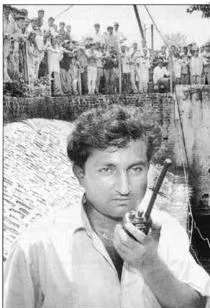
- the hazards of mining, followed by 1990s newspaper clippings on coal-fire disasters and mine safety (pp. 47-48);
- conservation of minerals (p. 48);
- energy resources — conventional first, then non-conventional — and their conservation (pp. 49-55);
- the closing exercises and the crossword activity (pp. 55-56).
The chapter carries four activities: researching GAIL’s cross-country natural gas pipeline network, naming river valley projects and the dams built on them, collecting information about newly established solar power plants, and the mineral crossword that closes the chapter.
How the Chapter Is Organised
This walkthrough shows the chapter’s order, so you always know which part you are in. The chapter builds one argument: minerals are extracted, distributed unevenly, mined unsafely, and wasted — so they must be conserved and replaced by other energy sources.
- Opening story of Haban and Ba, introducing metals and energy (p. 41).
- Definitions: what a mineral is, and the term ore (pp. 41-42).
- The five modes of occurrence of minerals (pp. 42-43).
- Classification of minerals and the distribution of India’s reserves, mineral by mineral (pp. 43-48).
- Hazards of mining and the coal-fire news clippings (pp. 47-48).
- Conservation of minerals (p. 48).
- Energy resources: conventional, then non-conventional (pp. 49-55).
- Conservation of energy resources (p. 54).
- Closing exercises and the crossword activity (pp. 55-56).
The page numbers let you follow along in your printed book, where the chapter runs from page 41 to page 56.
Key Concepts in Minerals and Energy Resources
This section is for understanding, not memorising. Each subsection below explains one idea from the chapter in plain words, with the textbook page beside it so you can check your own copy.
What Is a Mineral, and When Does a Deposit Become an Ore?
These two definitions carry the whole chapter, so get them exact. Geologists define a mineral as a “homogenous, naturally occurring substance with a definable internal structure” (NCERT, p. 41). Minerals range from the hardest diamond to the softest talc. Rocks are combinations of minerals; limestone is a rare rock made of a single mineral.
Over 2,000 minerals are known, but only a few are abundant.
The term ore adds an economic test. An ore is an accumulation of a mineral mixed with other elements, in sufficient concentration to make its extraction commercially viable (NCERT, p. 42). Three factors decide viability, the chapter says: the concentration of the mineral in the ore, the ease of extraction, and closeness to the market (NCERT, p. 43).
The Five Modes of Mineral Occurrence
Minerals are found in five kinds of places, and the mode of occurrence decides how easily — and cheaply — they can be mined. The chapter lists them as:
- Veins and lodes — in cracks, crevices, faults and joints of igneous and metamorphic rocks; tin, copper, zinc and lead (p. 42).
- Beds or layers — in sedimentary rocks, deposited and concentrated in horizontal strata; coal, and by evaporation, gypsum, potash salt and sodium salt (p. 42).
- Residual mass of weathered material — surface rocks decompose and soluble parts are removed, leaving ores behind; bauxite forms this way (p. 42).
- Placer deposits — alluvial deposits in the sands of valley floors and hill bases, of minerals not corroded by water; gold, silver, tin and platinum (p. 43).
- Ocean waters — common salt, magnesium and bromine, plus manganese nodules on ocean beds (p. 43).
The chapter’s memory aid for these five: the first letters V-B-R-P-O, “Very Big Rivers Pour Out” (pp. 42-43).
Classification of Minerals and Where India’s Reserves Lie
India has rich but unevenly distributed minerals; the chapter sorts them into four groups and names the regions that produce each one. The table below links each mineral to its group, its uses and its producing areas, with the textbook page for every row.
| Mineral | Group | Main uses | Producing areas in India | NCERT page |
|---|---|---|---|---|
| Iron ore (magnetite, hematite) | Ferrous | Backbone of industrial development; magnetite (finest, up to 70% iron) for the electrical industry; hematite (50-60% iron) the most used industrially | Four belts in Odisha, Jharkhand, Chhattisgarh, Karnataka and Goa | pp. 43-44 |
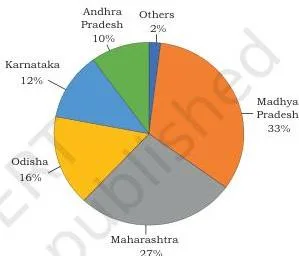
| Manganese | Ferrous | Steel making and ferro-manganese alloy; bleaching powder, insecticides, paints | See Fig. 5.3 state-wise chart | p. 45 |
| Copper | Non-ferrous | Electrical cables, electronics, chemical industries | Balaghat (Madhya Pradesh), Khetri (Rajasthan), Singhbhum (Jharkhand) | p. 46 |
| Bauxite | Non-ferrous | Source of alumina, then aluminium | Amarkantak plateau, Maikal hills, Bilaspur-Katni plateau; Odisha largest producer in 2026-27 | p. 46 |
| Limestone | Rock mineral | Basic raw material for the cement industry; essential for smelting iron ore | Sedimentary rocks of most geological formations | p. 47 |
| Mica | Non-metallic | Electric and electronic industries for its insulating properties | Koderma-Gaya-Hazaribagh belt (Jharkhand), Ajmer (Rajasthan), Nellore belt (Andhra Pradesh) | p. 47 |
Three points from this part are exam favourites. Ferrous minerals account for about three-fourths of the total value of metallic mineral production (p. 43). India is critically deficient in copper reserves and production, despite its wide uses (p. 46).
And the four iron ore belts export through named ports — Bailadila ore via Vishakhapatnam, Kudremukh ore as slurry through a pipeline to Mangaluru, and Goa ore via Marmagao (p. 44).
The chapter also notes a curiosity: most Indian minerals are nationalised, but in Meghalaya, coal is mined by families through long narrow tunnels — “rat-hole” mining — which the National Green Tribunal has declared illegal (p. 43).
Energy Resources: Conventional and Non-Conventional
Energy is the second half of the chapter. The dividing line is simple: conventional sources are the established ones, many of them non-renewable; non-conventional sources are the newer renewable alternatives.
Conventional sources (p. 49): firewood, cattle dung cake, coal, petroleum, natural gas and electricity — both hydel and thermal. By one estimate in the chapter, firewood and dung cake meet more than 70 per cent of rural household energy needs, but burning dung cake is discouraged because it wastes manure that agriculture needs.
The coal quality ladder runs from lowest to highest: peat (decaying swamp plants; low carbon, high moisture, low heating capacity) → lignite (low-grade brown coal; the principal reserves at Neyveli in Tamil Nadu) → bituminous (the most popular coal in commercial use; metallurgical coal for smelting iron) → anthracite (the highest quality hard coal) (pp. 49-50).
Coal also comes in two geological ages: Gondwana coal, a little over 200 million years old, in the Damodar valley — Jharia, Raniganj, Bokaro — plus the Godavari, Mahanadi, Son and Wardha valleys; and tertiary coal, about 55 million years old, in Meghalaya, Assam, Arunachal Pradesh and Nagaland (p. 50).
Because coal is bulky and loses weight as ash, heavy industries and thermal power stations are located on or near coalfields.
Petroleum (p. 51): found in anticlines and fault traps of tertiary-age rocks. Major production: Mumbai High, Gujarat (Ankeleshwar the most important field) and Assam — the oldest oil-producing state, with Digboi, Naharkatiya and Moran-Hugrijan.
Natural gas (p. 51): found with petroleum and released when crude oil is brought to the surface. GAIL’s first 1,700 km Hazira-Vijaipur-Jagdishpur (HVJ) pipeline linked Mumbai High and Bassein fields to fertilizer, power and industrial complexes; cross-country gas infrastructure has since grown to 18,500 km, with new reserves in the Krishna-Godavari basin on the east coast.
Electricity (p. 51): per-capita consumption is treated as an index of development. Hydro electricity comes from running water driving turbines (renewable); thermal power comes from burning coal, petroleum or natural gas (non-renewable). India’s multi-purpose projects include Bhakra Nangal and the Damodar Valley Corporation.
Non-conventional sources (p. 53): the chapter names six — nuclear or atomic energy, solar, wind, tidal, geothermal and biogas. Nuclear and atomic energy use uranium (Jharkhand and the Aravalli ranges of Rajasthan) and thorium (the Monazite sands of Kerala). Solar energy suits India because it is a tropical country, and photovoltaic technology converts sunlight directly into electricity.
The largest wind farm cluster runs from Nagarcoil to Madurai in Tamil Nadu. Biogas — gobar gas plants — gives farmers the twin benefit of fuel and improved manure.
Tidal energy finds ideal conditions in the Gulf of Khambhat, the Gulf of Kachchh and the Sunderban delta; geothermal projects operate in the Parvati valley near Manikaran (Himachal Pradesh) and the Puga Valley in Ladakh (pp. 53-54).
The section ends with the conservation argument: “energy saved is energy produced” (p. 54).
Reading the Chapter’s Maps and Diagrams



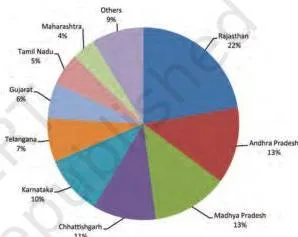
Map questions in this chapter come straight from these figures. The rule for every production chart: read the largest slice first, then compare the next largest. The rule for the distribution maps: read them by region, not by individual symbols.
The distribution map (p. 46): The chapter’s largest map, “India: Distribution of Iron Ore, Manganese, Bauxite and Mica”, is the one to practise for map work.
Iron ore concentrates in the four belts of Odisha, Jharkhand, Chhattisgarh, Karnataka and Goa; bauxite appears on the Amarkantak plateau, the Maikal hills and the Bilaspur-Katni plateau; mica sits on the northern edge of the Chota Nagpur plateau, where the Koderma-Gaya-Hazaribagh belt lies.
Figure 5.3, manganese (p. 45): A pie chart of state-wise production shares for 2026-27. Find the largest slice, read the state named on it, and you have the leading producer; then compare the smaller slices. Link the chart to the chapter’s fact that nearly 10 kg of manganese is needed to make one tonne of steel.
Figure 5.5, bauxite (p. 47): The same “largest slice” reading for 2026-27. The chapter states that Odisha was the largest bauxite-producing state, with the Panchpatmali deposits in Koraput district the most important.
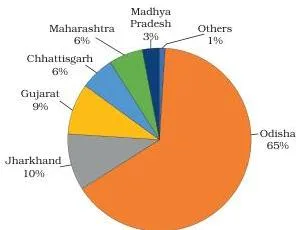
Figure 5.7, limestone (p. 48): A 2026-27 share chart; identify the leading state by its slice. Connect it to limestone’s two roles: the basic raw material for cement and essential for smelting iron ore in the blast furnace.
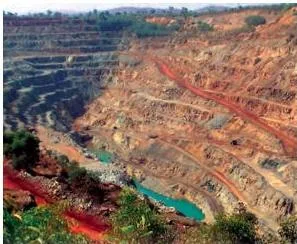
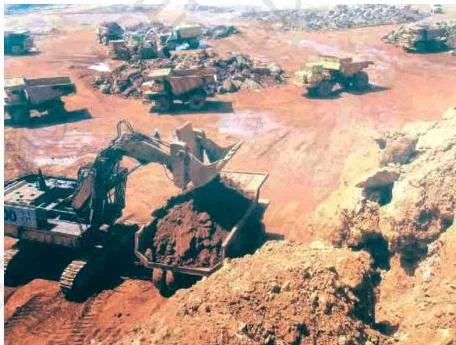
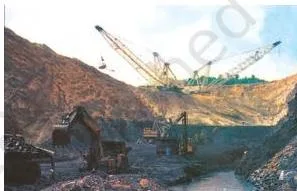
Figures 5.2, 5.4 and 5.6, mine photos (pp. 45, 47): The iron ore mine, the copper mines at Malanjkhand and the bauxite mine show what extraction looks like on the ground. Malanjkhand connects to the chapter’s point that the Balaghat mines of Madhya Pradesh are among the leading copper producers.
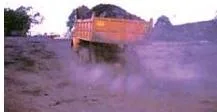
Figure 5.8, air pollution (p. 48): Dust rising from a mining area illustrates the hazards of mining: miners inhale dust and fumes, water sources get contaminated, and waste and slurry degrade land and increase river pollution.

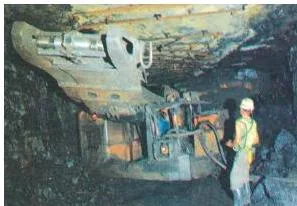
Figures 5.9(a) and 5.9(b), coal mine views (p. 50): Views from inside and outside a coal mine. They pair with the remark that coal is bulky and loses weight as ash, which is why heavy industries and thermal power stations are built on or near coalfields.
The coal distribution map (p. 50): This map doubles as a geological-age map: Gondwana coals, a little over 200 million years old, lie in the Damodar valley (Jharia, Raniganj, Bokaro) and the southern valleys, while tertiary coals, about 55 million years old, lie in Meghalaya, Assam, Arunachal Pradesh and Nagaland.
The thermal electricity figure (p. 52): The caption states it plainly: thermal electricity is generated by using coal, petroleum and natural gas. The same page carries the map of the distribution of nuclear and thermal power plants — thermal plants cluster near coalfields, while nuclear plants depend on uranium and thorium supplies.
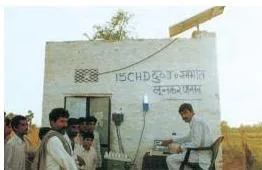
Figures 5.10, 5.11 and 5.12, non-conventional energy (pp. 54-55): The solar-operated electronic milk testing equipment shows photovoltaic technology working in a rural setting; the windmills at Nagarcoil sit inside the chapter’s largest wind farm cluster, from Nagarcoil to Madurai; and the biogas plant illustrates the gobar gas system that gives a farmer both fuel and manure.
“Do you know?” box (p. 44): “Kudre” means horse in Kannada, and the Kudremukh peak in the Western Ghats resembles a horse’s face. The Kudremukh mines are a 100 per cent export unit, and the ore travels as slurry through a pipeline to a port near Mangaluru.
Quick Definitions from the Chapter
Use this as a lookup table while you read: every term the chapter defines, in one short clause, with the page to verify. Learn the exact wording of the first two — mineral and ore — because the textbook quotes them directly.
| Term | What it means | NCERT page |
|---|---|---|
| Mineral | A homogeneous, naturally occurring substance with a definable internal structure | 41 |
| Ore | An accumulation of a mineral mixed with other elements, concentrated enough to make extraction commercially viable | 42 |
| Veins and lodes | Mineral occurrences in cracks, crevices, faults and joints of rocks; smaller are veins, larger are lodes | 42 |
| Placer deposits | Alluvial deposits in valley-floor sands and hill bases, of minerals not corroded by water | 43 |
| Magnetite | The finest iron ore, with up to 70 per cent iron and magnetic qualities valuable in the electrical industry | 43 |
| Hematite | The most important industrial iron ore, with 50-60 per cent iron | 43 |
| Bauxite | A clay-like ore from which alumina and then aluminium are obtained | 46 |
| Limestone | A rock mineral of calcium carbonates; raw material for cement and essential for smelting iron ore | 47 |
| Mica | A mineral of plates or leaves that splits into thin sheets; indispensable in electric and electronic industries | 47 |
| Peat | The first stage of coal — decaying swamp plants with low carbon, high moisture and low heating capacity | 49 |
| Lignite | Low-grade brown coal, soft with high moisture; principal reserves at Neyveli | 49 |
| Bituminous coal | The most popular coal in commercial use; high-grade metallurgical coal for smelting iron | 49 |
| Anthracite | The highest quality hard coal | 49 |
| Hydro electricity | Power generated by running water driving hydro turbines; a renewable resource | 51 |
| Thermal power | Power from burning coal, petroleum and natural gas to drive turbines; uses non-renewable fuels | 51 |
| Biogas / gobar gas | Gas produced by decomposing organic waste; cattle-dung plants are called gobar gas plants | 54 |
| Tidal energy | Electricity generated from ocean tides using floodgate dams built across inlets | 54 |
| Geothermal energy | Heat and electricity produced using heat from the interior of the earth, via steam driving turbines | 54 |
Common Mistakes Students Make in This Chapter
These six errors come up again and again because the pairs look alike. Read each row twice: once for the wrong idea, once for the rule that fixes it.
| Mistake | Correct rule | How to check your answer |
|---|---|---|
| Calling hematite the finest iron ore | Magnetite is the finest, with up to 70 per cent iron; hematite has 50-60 per cent and is the most used industrially | Quote the chapter’s pair: magnetite = finest, hematite = most used (p. 43) |
| Assigning uranium to Kerala | The Monazite sands of Kerala are rich in thorium; uranium is in Jharkhand and the Aravalli ranges | Match source to mineral: uranium-Jharkhand/Aravalli, thorium-Kerala (p. 53) |
| Writing “bauxite” when the question asks for the metal | Bauxite is the clay-like ore; aluminium is the metal obtained from it | The chapter says alumina, and later aluminium, is obtained from bauxite (p. 46) |
| Listing hydel power under non-conventional sources | Electricity — both hydel and thermal — is conventional; atomic energy is non-conventional | Compare the two NCERT lists on pp. 49 and 53 |
| Saying India is rich in copper | India is critically deficient in copper reserves and production | Check the first line of the copper section (p. 46) |
| Mixing up the coal ages and coalfields | Jharia, Raniganj and Bokaro are Gondwana coals in the Damodar valley; the northeastern states hold tertiary coals | Attach every coalfield to its age group on p. 50 |
Preparing This Chapter for Exams
This section maps the chapter’s own closing exercises to the concepts they test, so you practise the right skill. The chapter ends with multiple-choice questions, short answers of about 30 words, long answers of about 120 words, and a crossword activity.
What the MCQs target: precise single facts. The four questions in the chapter ask: which mineral forms by decomposition of rocks (bauxite); Koderma is the leading producer of which mineral (mica); minerals deposited in strata belong to which rocks (sedimentary); and which mineral is contained in Monazite sand (thorium). Revise these as fact-name pairs.
Model answer structure for a 30-word distinction — “distinguish between ferrous and non-ferrous minerals”:
- Define each in one clause: ferrous minerals contain iron; non-ferrous minerals do not.
- Give one example each: iron ore and manganese, against copper, bauxite, lead, zinc and gold.
- Close with the chapter’s significance line: ferrous minerals give about three-fourths of the value of metallic mineral production.
Following that structure gives an answer close to 30 words, for example: “Ferrous minerals contain iron, for example iron ore and manganese; non-ferrous minerals, such as copper and bauxite, do not. Ferrous minerals supply about three-fourths of metallic mineral production value and support metallurgical industries.”
What the 120-word answers need: “Distribution of coal in India” expects the two geological ages (Gondwana in the Damodar and southern valleys, tertiary in the northeast), the named coalfields, and the bulky-coal point about industries locating near coalfields.
“Why solar energy has a bright future in India” expects the tropical advantage, photovoltaic technology, and the rural and remote-area benefit that cuts dependence on firewood and dung cakes.
Map practice: the distribution map (p. 46), the coal-oil-gas map (p. 50) and the nuclear and thermal power plant map (p. 52) are the basis of map questions. Practise locating the four iron ore belts, the mica belt, Neyveli, Mumbai High, the Krishna-Godavari basin and the power plant regions.
One honest note: textbook contents and the examinable syllabus are not always identical — check the current official CBSE syllabus for what is assessable this session.
Minerals and Energy Resources Class 10: Chapter Recap
Ten lines for the night before: each bullet is one idea from the chapter, in the order the chapter argues it.
- A mineral is a homogeneous, naturally occurring substance with a definable internal structure; an ore is a mineral concentration rich enough to extract commercially (pp. 41-42).
- Minerals occur in five modes: veins and lodes, beds and layers, residual weathered masses, placer deposits, and ocean waters — V-B-R-P-O, “Very Big Rivers Pour Out” (pp. 42-43).
- Minerals classify as ferrous, non-ferrous, rock and non-metallic; ferrous minerals are about three-fourths of metallic mineral production value (p. 43).
- Key belts: four iron ore belts; the Koderma-Gaya-Hazaribagh mica belt; bauxite on the Amarkantak plateau, Maikal hills and Bilaspur-Katni (pp. 44-47).
- Mining is hazardous: pulmonary diseases, collapsing roofs, fires, contaminated water and degraded land (p. 48).
- Minerals are finite and non-renewable: workable deposits are about one per cent of the earth’s crust, and replenishment is far slower than consumption (p. 48).
- Conventional energy: firewood, dung cake, coal, petroleum, natural gas and electricity; non-conventional: solar, wind, tidal, geothermal, biogas and atomic (pp. 49, 53).
- The coal ladder runs peat → lignite → bituminous → anthracite; Gondwana coal is in the Damodar valley, tertiary coal in the northeast (pp. 49-50).
- Non-conventional locations to remember: Neyveli lignite, Kerala thorium, Nagarcoil-Madurai wind, Khambhat-Kachchh-Sunderbans tidal, Manikaran and Puga geothermal (pp. 50-54).
- Conserve both minerals and energy: “energy saved is energy produced” (p. 54).
Related NCERT Chapters and Resources
When you finish this chapter, these pages let you move on without another search. The Class 10 Social Science notes hub holds resources for Geography, History, Political Science and Economics together. The Class 10 study hub gathers notes for every subject at this level, and the CBSE notes home page organises them by class.
The next chapter, Manufacturing Industries, follows naturally: it explains the industries that process the minerals this chapter describes. On the economics side of Class 10 Social Science, Globalisation and the Indian Economy carries the trade and development argument forward.
Reference: NCERT Class 10 Contemporary India II textbook, chapter 5, official edition on ncert.nic.in.
Sources and Data Verification
The content and figures on this page describe the NCERT textbook Contemporary India II (Geography, Class 10 Social Science), Chapter 5, “Minerals and Energy Resources”, official edition on ncert.nic.in, textbook pages 41-56. This page covers only this chapter of this book; it does not cover other books or subjects.
It is maintained for the current academic session using the NCERT information available to us. NCERT settles textbooks, editions and PDFs; CBSE settles curriculum, syllabus and examinations. This page is not an official NCERT publication and has not been reviewed by NCERT or CBSE.
Frequently Asked Questions
Which minerals are used to make toothpaste?
Abrasive minerals — silica, limestone, aluminium oxide and various phosphate minerals — do the cleaning. Fluoride to reduce cavities comes from the mineral fluorite, whiteness comes from titanium oxide obtained from rutile, ilmenite and anatase, and the sparkle comes from mica (p. 41).
What is the difference between a mineral and an ore?
A mineral is a homogeneous, naturally occurring substance with a definable internal structure. An ore is an accumulation of a mineral mixed with other elements, concentrated enough to make extraction commercially viable (pp. 41-42).
Why does the chapter call mineral resources finite and non-renewable?
Workable mineral deposits are only about one per cent of the earth’s crust, and they took millions of years to form and concentrate. The geological processes are so slow that the rates of replenishment are infinitely small compared with present rates of consumption (p. 48).
Which are the major iron ore belts in India?
The Odisha-Jharkhand belt (Badampahar, Gua, Noamundi), the Durg-Bastar-Chandrapur belt in Chhattisgarh-Maharashtra (Bailadila), the Ballari-Chitradurga-Chikkamagaluru-Tumakuru belt in Karnataka (Kudremukh), and the Maharashtra-Goa belt, exported through Marmagao port (p. 44).
What is the difference between conventional and non-conventional sources of energy?
Conventional sources — firewood, cattle dung cake, coal, petroleum, natural gas and electricity (hydel and thermal) — are the established sources. Non-conventional sources — solar, wind, tidal, geothermal, biogas and atomic energy — are the renewable alternatives India is developing (pp. 49, 53).
Why is solar energy said to have a bright future in India?
India is a tropical country with enormous possibilities for tapping solar energy. Photovoltaic technology converts sunlight directly into electricity, and solar power is becoming popular in rural and remote areas, reducing dependence on firewood and dung cakes and supporting environmental conservation (p. 53).
Explore Class 10 Social Science Books
Class 10 Social Science on LearnCBSE:
Related chapters:
- Resources and Development
- Power-sharing
- The Rise of Nationalism in Europe