
For the manufacturing industries class 10 chapter, NCERT’s Contemporary India II carries it as Chapter 6 across 13 printed pages (57–69). The official PDF is right below, followed by a section-by-section preview of what the chapter contains: classifications, India’s major industries and their locations, pollution control, and the chapter’s exercises. If you already have the book open, the breakdown shows where each idea lives.
| What the chapter holds | Count | Where it is used |
|---|---|---|
| Printed pages | 13 | |
| Figures with NCERT captions | 7 | |
| Tables | 3 | |
| Exercise questions | 3 | answered in our NCERT Solutions |
| Activities | 7 | |
| Official NCERT PDF | Download the chapter PDF | the chapter exactly as NCERT publishes it |
NCERT Class 10 Social Science Chapter 6 Manufacturing Industries PDF
Download the NCERT Class 10 Social Science Contemporary India II Chapter 6 Manufacturing Industries PDF from the official NCERT website, where the textbook and every chapter are published free of cost. Opening the file directly is the fastest way to read the chapter’s maps, photographs and exercises in their original layout.
Chapter at a Glance: What Is Inside the PDF
The table on this page lists what the chapter file holds — its page range, sections, figures, activities and exercise questions, all counted from the book itself — so you can judge the chapter’s size at a glance. The sections below explain what each part of the chapter teaches.
What This Chapter Covers: Manufacturing as the Backbone of the Economy
The chapter opens in a Diwali market, where Harish wonders how shoes, clothes, utensils, sugar and diyas can be made in such quantities. His father’s answer is the chapter’s subject: machines in large industries make most of these goods, some utensils come from small industries, and individual artisans make diyas in household industry.
That scene leads to the formal definition — manufacturing is the production of goods in large quantities after processing raw materials into more valuable products (NCERT, p. 57). Manufacturing belongs to the secondary sector, where workers turn primary materials into finished goods in steel factories, textile mills, breweries and bakeries.
NCERT calls the manufacturing sector the backbone of development: it modernises agriculture, creates jobs beyond farm income, earns foreign exchange through exports, and was the philosophy behind public and joint sector industries meant to reduce regional disparities (NCERT, p. 57). In a globalised economy, the chapter adds, self-sufficiency alone is not enough — goods must match international quality to compete (NCERT, p. 58).
After the importance section, the chapter follows a clear sequence: how industries are classified (p. 58), a profile of each major industry from cotton textiles to information technology (p. 59–65), and finally industrial pollution with its control and the NTPC case study (p. 65–68). The rest of this page follows that order.
Key Concepts: How Industries Are Classified
The chapter’s organising idea is that the same industry can be described on several axes at once — what raw material it uses, what role it plays, how much it invests, and who owns it. The section opens with an activity: list the manufactured products you use daily, from transistors to petrol, then sort them into categories (NCERT, p. 58).
| Classification basis | Categories in the chapter | NCERT examples and page |
|---|---|---|
| Source of raw materials | Agro-based / mineral-based | Cotton, jute, silk, sugar, tea, coffee, edible oil (agro); iron and steel, cement, aluminium, machine tools, petrochemicals (mineral) — p. 58 |
| Main role | Basic (key) / consumer | Basic: iron and steel, copper and aluminium smelting, which supply raw materials to other industries; consumer: sugar, toothpaste, paper, sewing machines, fans — p. 58 |
| Capital investment | Small-scale / large-scale | Small-scale is defined by the maximum investment allowed on a unit’s assets — at present ₹1 crore, a limit that has changed over time — p. 59 |
| Ownership | Public / private / joint / cooperative | Public: BHEL, SAIL; private: TISCO, Bajaj Auto, Dabur; joint: Oil India Ltd; cooperative: sugar industry in Maharashtra, coir industry in Kerala — p. 59 |
| Bulk and weight of raw material and finished goods | Heavy / light | Heavy: iron and steel; light: electrical goods — p. 59 |
The useful habit is to classify one industry on every axis. Iron and steel, for instance, is mineral-based, heavy, mostly public or private by ownership, and — most importantly — a basic industry: all other industries depend on it for their machinery (NCERT, p. 62).
Calling it a consumer industry is the chapter’s most common confusion, because steel reaches a consumer only after many more stages.
One number anchors the iron and steel section: iron ore, coking coal and limestone are required in the approximate ratio 4 : 2 : 1, with some manganese added to harden the steel (NCERT, p. 62). Since the raw materials and finished goods are all heavy and bulky, transport costs are heavy too — which is why the chapter asks where steel plants should ideally be located.
Its answer is the Chhotanagpur plateau region, with low-cost iron ore, high-grade raw materials in proximity, cheap labour and a growing home market (NCERT, p. 63).
Key Concepts: India’s Major Industries and Where They Are Located
Most of the chapter is a tour of India’s major industry groups. For each one the book gives the raw material, the locations, and the locational factor that explains why the industry sits where it does.
| Industry | Raw material named in the chapter | Important locations | Locational logic |
|---|---|---|---|
| Cotton textiles | Raw cotton; yarn is itself an industrial product | Spinning centralised in Maharashtra, Gujarat and Tamil Nadu; weaving decentralised | Cotton-growing belt: raw cotton, market, transport and ports, labour, moist climate — p. 60 |
| Jute textiles | Raw jute | A narrow belt along the Hugli river in West Bengal | Proximity to jute areas, inexpensive water transport, abundant water for processing, cheap labour, Kolkata’s port and banking — p. 60–61 |
| Sugar | Sugarcane | UP, Bihar, Maharashtra, Karnataka, Tamil Nadu, Andhra Pradesh, Gujarat, Punjab, Haryana, Madhya Pradesh; 60% of mills in UP and Bihar, now shifting to Maharashtra | Bulky cane loses sucrose in haulage; short season; Maharashtra’s cane has higher sucrose and a longer crushing season — p. 61 |
| Iron and steel | Iron ore, coking coal, limestone (4 : 2 : 1), manganese | Maximum concentration in the Chhotanagpur plateau region | Low-cost iron ore, high-grade raw materials in proximity, cheap labour, growing home market — p. 63 |
| Aluminium smelting | Bauxite (very bulky, dark reddish rock); 4 to 6 tonnes of bauxite become 2 tonnes of alumina, which become 1 tonne of aluminium | Odisha, West Bengal, Kerala, Uttar Pradesh, Chhattisgarh, Maharashtra, Tamil Nadu | Regular supply of electricity and assured raw material at minimum cost — p. 64 |
| Chemicals and fertilisers | Inorganic chemicals (sulphuric acid, soda ash); organic chemicals (petrochemicals); potash is entirely imported | Widely spread; organic plants near oil refineries and petrochemical plants; Gujarat, Tamil Nadu, UP, Punjab and Kerala lead in fertilisers | The chemical industry is its own largest consumer — p. 64 |
| Cement | Limestone, silica, gypsum — bulky and heavy | Gujarat plants with access to Gulf markets; first plant at Chennai in 1904 | Bulky raw materials need coal, electric power and rail transport — p. 65 |
| Automobiles | Steel and fabricated components | Delhi, Gurugram, Mumbai, Pune, Chennai, Kolkata, Lucknow, Indore, Hyderabad, Jamshedpur, Bengaluru | Liberalisation brought new models that stimulated demand — p. 65 |
| Information technology and electronics | Electronic components | Bengaluru as the electronic capital; other centres in Mumbai, Delhi, Hyderabad, Pune, Chennai, Kolkata, Lucknow, Coimbatore | Major impact on employment generation; growth in both hardware and software — p. 65 |
The textile section carries the chapter’s clearest example of value addition. The industry is self-reliant and complete in its value chain, from raw cotton to the highest value-added products, and contributes significantly to industrial production, employment and foreign exchange earnings (NCERT, p. 60).
The first successful textile mill was set up in Mumbai in 1854, and the early industry concentrated in the cotton belt of Maharashtra and Gujarat. Spinning stayed centralised in Maharashtra, Gujarat and Tamil Nadu, while weaving was deliberately decentralised to absorb traditional skills in cotton, silk, zari and embroidery.
Jute mills cluster along the Hugli river because of the factors in the table — the first jute mill was set up at Rishra near Kolkata in 1855. One historical detail matters: after Partition in 1947 the mills remained in India but three-fourths of the jute-producing area went to Bangladesh, so the industry’s raw-material base and its mills were split (NCERT, p. 60).
Sugar is the chapter’s edge case, because it is a seasonal industry and needs a different locational logic from continuous industries. Sugarcane is bulky, and its sucrose content falls during haulage, so mills must sit close to the cane fields; the short crushing season suits the cooperative sector, where producers pool resources and share profits (NCERT, p. 61).
That is why mills are shifting to Maharashtra — the cane there has a higher sucrose content, the cooler climate gives a longer crushing season, and the cooperatives are more successful.
Aluminium smelting is the second most important metallurgical industry in India, and its logic is power: bauxite is bulky, so the raw material must be assured at minimum cost, and smelting needs a regular supply of electricity (NCERT, p. 64).
Cement, at the other end, is pulled around by transport — its raw materials are bulky and heavy, so it needs coal, electric power and rail transport, plus port access to markets like the Gulf countries (NCERT, p. 65).
Key Concepts: Industrial Pollution and Its Control
The chapter’s second half turns from where industries are located to what they do to the environment. It names four types of pollution — air, water, land and noise — and then describes thermal pollution of water as an additional effect (NCERT, p. 65).
| Pollution type | Main sources named in the chapter | Control measures named in the chapter |
|---|---|---|
| Air | Sulphur dioxide and carbon monoxide; particulate matter such as dust, sprays, mist and smoke; smoke from chemical and paper factories, brick kilns, refineries and smelting plants; toxic gas leaks such as the Bhopal Gas tragedy | Electrostatic precipitators, fabric filters, scrubbers and inertial separators on smoke stacks; switching from coal to oil or gas — p. 66 |
| Water | Organic and inorganic wastes from paper, pulp, chemical, textile and dyeing, petroleum refining, tanning and electroplating industries; dyes, detergents, acids, salts, heavy metals such as lead and mercury; fly ash, phospho-gypsum and iron and steel slags | Minimising water use by reusing and recycling it in successive stages; rainwater harvesting; three-phase effluent treatment before release — p. 66 |
| Land | Dumping of glass, harmful chemicals, industrial effluents, packaging, salts and garbage; rainwater carries pollutants into the soil and groundwater | Legal regulation of groundwater overdrawing; treating wastes before disposal — p. 66 |
| Noise | Industrial and construction activity, machinery, factory equipment, generators, saws, pneumatic and electric drills | Silencers on generators; redesigning machinery for energy efficiency and less noise; noise-absorbing material; earplugs and earphones — p. 66 |
| Thermal (of water) | Hot water from factories and thermal plants drained into rivers and ponds before cooling | Treating hot water and effluents before release, as part of the three-phase treatment — p. 66 |
Two facts from this section are worth lifting in full. First, every litre of waste water discharged by industry pollutes eight times the quantity of freshwater (NCERT, p. 66).
Second, treatment of industrial effluents happens in three phases: primary treatment by mechanical means (screening, grinding, flocculation and sedimentation), secondary treatment by biological process, and tertiary treatment by biological, chemical and physical processes that includes recycling of wastewater (NCERT, p. 66).
The chapter closes the section with NTPC showing the way.
NTPC holds ISO certification for its Environment Management System (EMS 14001), and the chapter lists how it works: optimum use of equipment with the latest techniques, minimising waste through maximum ash utilisation, green belts to nurture ecological balance, reducing pollution through ash pond management with an ash-water recycling system, and ecological monitoring with an online database for all its power stations (NCERT, p. 68).
This five-point list is the content behind the last exercise question, so it is worth learning as one block.
Figure Walkthrough: Reading the Diagrams in the Chapter
The chapter’s figures do two jobs: they make value addition visible, and they put real plants and control measures in front of you. Reading each one with its caption is how you quote the chapter accurately in an answer.

This diagram in the agro-based section shows why NCERT calls the textile industry self-reliant and complete in its value chain: cotton gains value at every stage as it becomes yarn, cloth and finished garments (NCERT, p. 60). It is the visual form of the chapter’s definition of manufacturing — processing raw materials into more valuable products.

This photograph records where India’s jute industry began. The date and place matter to the Hugli-basin story: 1855 saw the first jute mill at Rishra near Kolkata, and the mills that followed lined the river because of the transport, water and labour advantages the chapter lists (NCERT, p. 60).
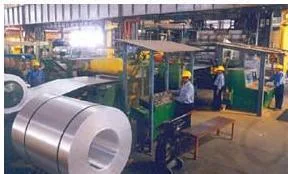
This photograph shows the stage of aluminium manufacture that comes after smelting — rolling the metal into strips. It sits in the section that explains why aluminium smelters need bulky bauxite at minimum cost and a regular supply of cheap electricity (NCERT, p. 64).
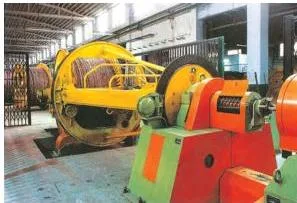
This photograph belongs to the information technology and electronics section. The industry’s product range — from transistor sets to televisions, telephones, cellular telecom, radars and computers — includes the cables being manufactured here, and the chapter stresses the industry’s major impact on employment generation (NCERT, p. 65).

This text-box figure carries one of the chapter’s control measures. Dumped wastes let rainwater carry pollutants into the soil and groundwater, so where industry threatens groundwater reserves, overdrawing of those reserves needs legal regulation (NCERT, p. 66).
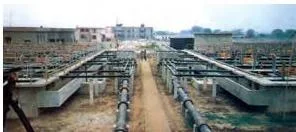
This photograph makes effluent treatment concrete. Under the Yamuna action plan, the plant at Faridabad treats sewage and industrial wastewater before it reaches the river — the chapter’s point that hot water and effluents must be treated before release into rivers and ponds (NCERT, p. 66).
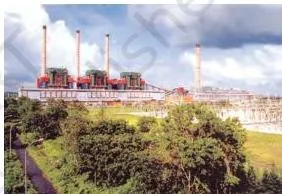
The Ramagundam photograph closes the NTPC case study. The corporation’s ISO 14001-certified environment management system — ash utilisation, green belts, ash pond management, ash-water recycling and online monitoring — is the chapter’s model of a large company integrating environmental concerns with its operations (NCERT, p. 68).
Key Definitions: Terms the Chapter Expects You to Know
These are the terms the chapter expects you to define in its own sense. The table is the night-before reference block.
| Term | Meaning in this chapter | Page |
|---|---|---|
| Manufacturing | Production of goods in large quantities after processing raw materials into more valuable products | p. 57 |
| Secondary sector | Activities that turn primary materials into finished goods — workers in steel, textile, brewery and bakery units | p. 57 |
| Agro-based industry | An industry using agricultural raw materials, such as cotton, jute, silk, sugar, tea, coffee and edible oil | p. 58 |
| Mineral-based industry | An industry using minerals and metals as raw materials, such as iron and steel, cement, aluminium and petrochemicals | p. 58 |
| Basic (key) industry | An industry whose products become raw materials for other goods — iron and steel, copper smelting, aluminium smelting | p. 58 |
| Consumer industry | An industry producing goods for direct use by consumers, such as sugar, toothpaste, paper and fans | p. 58 |
| Small-scale industry | A unit whose investment on assets stays within a government ceiling — at present ₹1 crore, a limit that has changed over time | p. 59 |
| Joint sector | Industry run jointly by the state and individuals or a group of individuals — for example Oil India Ltd | p. 59 |
| Cooperative sector | Industry owned and operated by producers or suppliers of raw materials, workers, or both, sharing profits and losses | p. 59 |
| Thermal pollution | Pollution of water by hot water drained from factories and thermal plants before it cools | p. 66 |
Common Mistakes in This Chapter (and How to Avoid Them)
The chapter’s own questions — “why do you think it is so?” — point at the places readers slip. The table names each mistake before you make it.
| Mistake | Correct rule | Why it happens / how to check |
|---|---|---|
| “Iron and steel is a consumer industry.” | It is the basic (key) industry: all other industries depend on it for their machinery (p. 62). | The role axis and product axis get mixed. Check by asking: does it sell to consumers directly, or supply other industries? (p. 58) |
| “Sugar mills can sit far from the farms.” | Mills cluster in cane belts because bulky sugarcane loses sucrose during haulage and the crushing season is short (p. 61). | Generic bulk logic is applied without the sucrose-loss detail. A seasonal industry suits the cooperative sector. |
| “Bauxite is the ore for steel.” | Bauxite feeds aluminium smelting; steel uses iron ore, coking coal and limestone in a 4 : 2 : 1 ratio (p. 62, 64). | Both are mineral-based metal industries, so the ores blur. Link each ore to its product and its ratio. |
| “Thermal pollution is one of the four types.” | The chapter names four — air, water, land and noise — and describes thermal pollution of water as an extra effect (p. 65–66). | The word “pollution” attaches to the list. In list answers name the four first, then add thermal separately. |
| “The steel ratio is 2 : 4 : 1.” | It is 4 : 2 : 1 — iron ore : coking coal : limestone — with some manganese to harden the steel (p. 62). | The order is memorised without the substances. Anchor it: 4 parts ore, 2 parts coal, 1 part limestone. |
Exam Notes: Working With the Chapter’s Exercises
The chapter ends with exercises on pages 68–69. Mapping each set to the section that answers it makes revision faster.
The multiple-choice questions (p. 68) — bauxite and electronics
The first question asks which industry uses bauxite. The aluminium section answers it directly, naming bauxite as the raw material used in the smelters, so the choice is Aluminium Smelting (NCERT, p. 64).
The next asks which industry manufactures telephones and computers — the electronics industry, whose product range the chapter lists from transistor sets to televisions, telephones, cellular telecom, radars and computers (NCERT, p. 65). Two one-line facts, one from each section, settle both.
Short answers in 30 words (p. 68) — manufacturing and basic industries
“What is manufacturing?” needs the definition on NCERT p. 57 in one sentence: production of goods in large quantities after processing raw materials into more valuable products. “What are basic industries? Give an example.”
needs the role-axis definition — industries that supply their products as raw materials for manufacturing other goods — with iron and steel or aluminium smelting as the example (NCERT, p. 58). The 30-word limit is the style signal: definitions, not paragraphs.
Long answers in 120 words (p. 69) — pollution and its control
“How do industries pollute the environment?” is answered by the pollution section: name all four types — air, water, land and noise — give one typical source for each, and add thermal pollution of water as an additional point (NCERT, p. 65–66).
“Discuss the steps to be taken to minimise environmental degradation by industry” is answered by the control list: reuse and recycle water, harvest rainwater, treat effluents in three phases, fit precipitators and filters for particulates, switch from coal to oil or gas, fit silencers, and regulate groundwater overdrawing (NCERT, p. 66) — then NTPC’s ISO 14001 practices as the worked model (NCERT, p. 68).
A 120-word answer scores by naming each step explicitly, not by describing it loosely.
One honest warning: textbook contents and the examinable syllabus are not always identical — the current official CBSE syllabus is the final authority on what will be examined.
Revision Summary: The Chapter in 10 Lines
- Manufacturing means producing goods in large quantities by processing raw materials into more valuable products; it is a secondary-sector activity (p. 57).
- Manufacturing is the backbone of development — it modernises agriculture, creates jobs, earns foreign exchange and can reduce regional disparities (p. 57).
- The same industry classifies on four axes: raw material (agro/mineral), role (basic/consumer), capital (small/large), ownership (public/private/joint/cooperative) (p. 58–59).
- The textile industry is the only one self-reliant and complete in its value chain; the first successful mill opened in Mumbai in 1854 (p. 60).
- Jute mills sit in a narrow Hugli basin belt; the first jute mill came up at Rishra near Kolkata in 1855 (p. 60–61).
- Sugar: bulky cane loses sucrose during haulage, so mills hug cane belts; the seasonal industry suits cooperatives and is shifting to Maharashtra (p. 61).
- Iron and steel is the basic industry; inputs run 4 : 2 : 1 (iron ore : coking coal : limestone); the Chhotanagpur plateau has the maximum concentration (p. 62–63).
- Aluminium: 4 to 6 tonnes of bauxite become 2 tonnes of alumina, which become 1 tonne of aluminium; it needs regular cheap electricity (p. 64).
- Industries pollute air, water, land and noise, plus thermal pollution of water; one litre of wastewater pollutes eight litres of freshwater (p. 65–66).
- Control: three-phase effluent treatment, water reuse, rainwater harvesting, air filters and silencers; NTPC’s ISO 14001 system is the model (p. 66–68).
Related Resources: Other Chapters in This Book
This listing is maintained for the 2026-27 academic session using the NCERT textbook information available to us. NCERT remains the authority for confirming the latest edition.
This chapter follows Minerals and Energy Resources, which supplies the raw-material geography the industries here depend on, and it leads into Lifelines of National Economy, the next chapter in the same book, on transport and trade.
For revision, the Class 10 Social Science notes hub organises every chapter in the book, and the Class 10 study resources page covers the rest of the subjects.
The Consumer Rights notes cover the economics side of the goods this chapter’s opening market scene describes. If you are working across subjects, the CBSE notes home page is the index to everything on the site. The official NCERT website (ncert.nic.in) carries the complete textbook and every chapter PDF.
Sources and Data Verification
The page describes the NCERT Class 10 Social Science textbook Contemporary India II, Chapter 6 Manufacturing Industries, pages 57–69, in the official NCERT edition published on ncert.nic.in. Figures, captions, definitions and exercise texts quoted here come from that edition, and the chapter counts in the table above are taken from the same book.
NCERT settles textbook content and editions; CBSE settles curriculum, syllabus and examinations. Textbook contents and the examinable syllabus are not always identical — the current official CBSE syllabus is the authority on what will be examined.
FAQs
What is manufacturing in Class 10 Social Science Chapter 6?
Manufacturing is the production of goods in large quantities, after processing raw materials into more valuable products (NCERT, p. 57). Paper from wood, sugar from sugarcane, iron and steel from iron ore, and aluminium from bauxite are the chapter’s examples. It is a secondary-sector activity: workers in steel factories, textile mills and bakeries turn primary materials into finished goods.
How are industries classified in Manufacturing Industries?
On four main axes (NCERT, p. 58–59): by source of raw materials — agro-based or mineral-based; by main role — basic (key) or consumer; by capital investment — small-scale (assets up to ₹1 crore at present) or large-scale; and by ownership — public, private, joint or cooperative. The chapter also separates heavy from light industries by the bulk and weight of raw materials and finished goods.
Why are sugar mills located close to sugarcane-producing areas?
Sugarcane is a bulky raw material, and its sucrose content falls during haulage, so carrying it far is wasteful; the crushing season is also short (NCERT, p. 61). For the same reason the industry is seasonal and suits the cooperative sector.
Mills are shifting to Maharashtra because the cane there has a higher sucrose content, the cooler climate gives a longer crushing season, and its cooperatives are more successful.
Why does aluminium smelting need cheap and regular electricity?
The chapter names a regular supply of electricity and an assured source of raw material at minimum cost as the two prime factors for locating the industry (NCERT, p. 64). Bauxite is a very bulky, dark reddish rock, and the process is power-hungry: 4 to 6 tonnes of bauxite become 2 tonnes of alumina, which become 1 tonne of aluminium.
That is why smelters are placed where power is cheap and continuous.
What are the four types of industrial pollution mentioned in the chapter?
Air, water, land and noise (NCERT, p. 65). The chapter also describes thermal pollution — hot water from factories and thermal plants drained into rivers and ponds before cooling.
Air pollution brings sulphur dioxide, carbon monoxide and smoke; water pollution brings dyes, detergents, acids and heavy metals like lead and mercury; land pollution comes from dumped wastes; and noise pollution can cause hearing impairment, increased heart rate and blood pressure.
Reference: NCERT Class 10 Social Science Contemporary India II textbook, Chapter 6 Manufacturing Industries, official edition on ncert.nic.in.
Explore Class 10 Social Science Books
Class 10 Social Science on LearnCBSE:
Related chapters:
- Resources and Development
- Power-sharing
- The Rise of Nationalism in Europe