
The Thief’s Story Class 10 is Chapter 2 of NCERT’s English supplementary reader, Footprints Without Feet — a short story by Ruskin Bond that runs to six printed pages in the official PDF.
The official file and the guide are both on this page: download the chapter exactly as NCERT printed it, then read the plain-language walkthrough below so the plot, the characters and the ending make sense the first time you read the story.
Download The Thief’s Story Class 10 PDF
Open The Thief’s Story Class 10 PDF on NCERT’s official site to read the chapter exactly as the book prints it — the teaser, the story, the glossary and the questions together in one file, with nothing added.
One check before you download: this is the supplementary reader Footprints Without Feet, a different book from First Flight. Match the cover before you save the file, because both books are Class 10 English readers published by NCERT.
| What the chapter holds | Count | Where it is used |
|---|---|---|
| Printed pages | 6 | |
| Figures with NCERT captions | 1 | |
| Official NCERT PDF | Download the chapter PDF | the chapter exactly as NCERT publishes it |
The Thief’s Story Class 10: Chapter at a Glance
The chapter follows the structure NCERT gives every story in this reader — a teaser question opens it, the story follows, and the glossary and question blocks close it. The table below shows what the file holds; the list under it names the blocks in the order the chapter presents them.
- Opening teaser — “A young boy makes friends with Anil. Anil trusts him completely and employs him. Does the boy betray his trust?” asks the question the whole story answers.
- READ AND FIND OUT — two sets of short questions checking comprehension, one in each half of the story.
- The story itself — a complete first-person short story narrated by the thief.
- GLOSSARY — five words with the meaning each carries in this story.
- Think about it — the two longer questions that go beyond the plot.
- Talk about it — four discussion prompts for the classroom.
- Suggested reading — three stories NCERT points you toward after this one.
What The Thief’s Story Covers: the Story in Six Moves
This is a complete short story told from inside the thief’s own head, not an explanatory chapter, so the fastest way to understand it is to follow its six moves in order. Each row below ties one stage of the plot to a line from the story itself.
| Stage | What happens | The line the stage turns on |
|---|---|---|
| 1. Meeting | Hari, 15 and homeless, spots Anil at a wrestling match, lies about his name and his cooking, and talks his way into a job. | “A little flattery helps in making friends.” |
| 2. Settling in | A month of morning tea, daily shopping with a rupee or so quietly kept, and the first lesson — writing his own name. | “He also taught me to write my name.” |
| 3. The temptation | Anil comes home saying he has sold a book to a publisher, and tucks the bundle of notes under the mattress at night. | “He had just sold a book to a publisher.” |
| 4. The theft | Hari takes 600 rupees, runs for the Lucknow Express, hesitates on the platform and lets the train go. | “600 rupees in fifties!” |
| 5. The return | Cold, wet and friendless, Hari decides that learning matters more than the money and slips the notes back under the mattress. | “I should go back to Anil.” |
| 6. The morning after | Anil offers a fifty-rupee note as regular pay, and the story closes with the first full writing lesson. | “Today we’ll start writing sentences.” |
Key Concepts in The Thief’s Story: Characters and Ideas
Everything in the story turns on the difference between the two men on the balcony: a boy who steals because stealing is all he knows, and a man who keeps trusting because that is who he is.
| Hari Singh, the narrator | Anil, the writer | |
|---|---|---|
| Who he is | 15 years old, an experienced thief who calls himself “a fairly successful hand”, and who changes his name every month. | About 25, tall and lean, an easy-going writer who has just sold his first book. |
| How the story sees him | Thin, scarred, always performing — flattering Anil and smiling in his “most appealing way”. | Unworried, with a clear, unlined face — the face that shows no sign of worry or anxiety. |
| His goal | “To be a really big man, a clever and respected man” — harder than stealing. | To write and sell his writing; the money from the book is what he brings home that night. |
| What he does with the money | Takes the 600 rupees, then brings them back. | Never mentions the theft; pays Hari a fifty-rupee note and keeps the routine going. |
| The story’s label for him | “I was still a thief when I met Anil.” — the opening frame. | “He was the most trusting person I had ever met.” |
Beyond the two characters, the story works on three ideas:
- Trust versus betrayal — the teaser question asks it before the story starts, and the theft puts Anil’s trust to the test.
- Education as the real way out — Hari’s first lesson is writing his name; what pulls him back is the offer of whole sentences.
- Stealing money versus stealing trust — Hari predicts Anil’s face will show sadness “for the loss of trust”, not for the cash.
Quotes bank: five lines that carry the story
Five short lines do most of the work in this story; each row pairs the line with the speaker and the idea it carries.
| Line from the story | Who says it | What it carries |
|---|---|---|
| “I was still a thief when I met Anil.” | Hari, opening the story | Frames the whole tale as a thief’s confession, before any change. |
| “It’s easy to rob a greedy man…” | Hari, explaining himself | The thief’s logic — robbing the careless is hard because they hardly notice. |
| “For the loss of trust.” | Hari, imagining Anil | Why this robbery is different: the sadness would not be about money. |
| “To be a really big man, a clever and respected man, was something else.” | Hari, on the rainy night | His real ambition — and the reason stealing stops being enough. |
| “Today we’ll start writing sentences.” | Anil, the last line | The second chance, offered without a single word about the theft. |
The Illustration in the Chapter: “It Was Quite Pleasant Working for Anil.”
The chapter carries a single illustration, captioned with a line from the first half of the story.
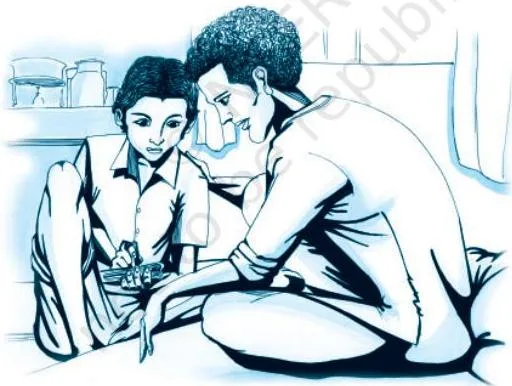
The caption belongs to the end of the first half, when Hari has settled into the routine of tea, shopping and name-writing — and just before Anil brings home the money. The irony is that the thief is comfortable, and that comfort is exactly what makes robbing Anil difficult.
The illustration marks the calm before the theft. The same phrase gains a second meaning the next morning, when Anil announces that the boy will be paid regularly.
Glossary Words from the Chapter, Explained
The chapter’s GLOSSARY lists five words that all do visible work in the story. The table pairs each word with its plain meaning and the moment it belongs to.
| Word | Plain meaning | Where it matters in the story |
|---|---|---|
| flattery | Insincere praise — praise given to please, not because it is meant. | Hari opens the conversation with a compliment about wrestling; that is the flattery that gets Anil talking to him. |
| modestly | Without boasting; in a humble way. | Hari answers “I do wrestle a bit”, pretending to be modest even though he is thin and no wrestler. |
| grunting | Making low guttural sounds. | The wrestlers at the match make these sounds as they lift and throw each other. |
| appealing | Attractive, in a way that wins people over. | Hari’s “most appealing smile”, switched on whenever he needs to persuade someone. |
| unlined | Showing no sign of worry or anxiety. | Anil’s clear, smooth face at night — the narrator contrasts it with his own scarred one. |
Common Mistakes Students Make With This Story
The story is short, but its quiet ending is easy to misread. Each mistake below is a place where a careless answer gets the text wrong.
| Mistake | What the text actually says | How to check your answer |
|---|---|---|
| Treating “Hari Singh” as the boy’s real name. | He invents a new name every month, and says so while he is lying to Anil. | Find the line “I took a new name every month.” — it sits right after the lie. |
| Confusing the narrator with the author. | This is first-person fiction: the “I” is the 15-year-old thief, not Ruskin Bond, who wrote the story. | Look at the by-line. “RUSKIN BOND” signs after the last line; the narrator never claims to be him. |
| Claiming Anil never found out. | Anil knows. The text says: “He knew. But neither his lips nor his eyes showed anything.” | Two supporting clues — the note is still wet from the rain, and the writing lesson starts the very same morning. |
| Reading Anil as careless or foolish. | Hari himself calls Anil “the most trusting person I had ever met”, and the story treats that trust as strength. | Notice that the narrative never mocks Anil for trusting — it shows the trust changing Hari. |
| Answering “Why did Anil not hand him over?” without evidence. | The chapter’s own question expects textual support — the silent reaction, the damp note, the paid work. | Every claim in your answer should point to one of those details from the text. |
Exam Notes: How the Chapter’s Own Questions Prepare You
This chapter teaches itself — the question blocks printed after the story are the practice set. Working through them in order covers the points the chapter itself treats as important.
- READ AND FIND OUT — the first set checks the opening: who the “I” is, what he is “a fairly successful hand” at, and what he gets back from Anil for his work.
- READ AND FIND OUT — the second set checks the theft: how Hari expects Anil to react, what he says about the reactions of robbed people, and whether Anil realises what happened.
- Think about it — two questions: whether Hari’s feelings about education change over time, and why Anil chooses not to call the police.
- Talk about it — four discussion prompts: real-life Hari and Anil, the struggling-writer detail, the circumstances that turn a 15-year-old into a thief, and the setting-and-language question.
The story’s material lends itself to a few familiar question shapes: character sketches of the two contrasting men, the theme of trust and second chances, the role of education, the setting, and the meaning of the title. Nothing is guaranteed to appear — this list simply names what the chapter’s content supports.
Model answer plan: “Why did Hari Singh go back to Anil?”
A full answer runs on three legs — point, evidence, explanation:
- Point: Hari returns because education is the only road to the man he wants to become; stealing cannot make him a clever and respected man.
- Evidence: soaked and friendless, he tells himself that whole sentences “could one day bring me more than a few hundred rupees”, that stealing is as simple to be caught as to do, and that being a really big man is something else altogether. He goes back “if only to learn to read and write”.
- Explanation: the return is not guilt over the money — it is hope of a future, and Anil is the only person offering him that future.
One honest caveat: textbook contents and the examinable syllabus are not always identical. Check the current official Class 10 English syllabus on the CBSE academic site before deciding what to prepare.
Talk about it prompts worth preparing
Four prompts ask for an opinion backed by the text:
- whether people like Anil and Hari exist outside fiction;
- whether Anil’s life as a struggling writer explains why he behaves as he does;
- what circumstances could push a 15-year-old into theft; and
- where the story is set, and which language the characters would really speak to each other.
Last-Night Revision: The Thief’s Story in Brief
The whole chapter on one screen. Run through the arc, then hold on to the ending — the damp note and the writing lesson are the clues that close the story.
- At a wrestling match, 15-year-old Hari approaches Anil, lies about his name and his cooking, and is taken in. He sleeps on the balcony of Anil’s room over the Jumna Sweet Shop.
- He earns his keep: morning tea, daily shopping with about a rupee quietly kept, and a first lesson — writing his own name.
- Anil gives him a key and never checks on him; Hari calls him “the most trusting person I had ever met”.
- That trust is why the theft is difficult — robbing a greedy man is easy, robbing someone who will not even notice takes the pleasure out of it.
- Anil sells a book to a publisher and tucks the bundle of notes under the mattress.
- Hari takes the 600 rupees and runs for the 10.30 Express to Lucknow, but hesitates at the moving train and loses the chance to escape.
- With no friends and no wish to be noticed, he spends a cold, rainy November night between the bazaar and the maidan, the notes going damp in his clothes.
- Under the clock tower at midnight he decides that education can earn him more than the stolen money ever will — and that being respected is harder than stealing.
- He creeps back, returns the notes under the mattress, and lies awake until morning.
- Anil hands him a fifty-rupee note still wet from the night’s rain and says he will now be paid regularly.
- Then the first full writing lesson begins — “Today we’ll start writing sentences.” The teaser’s question is answered: he steals, he returns, and Anil’s silence gives him a second chance. The story ends on the possibility of change.
The chapter’s two Think about it questions, answered in one line each:
- Education: Hari values it from the first lesson — it excites him, and by the rainy night it becomes his real motive for going back.
- No police: Anil does not report the theft because the trust and the person matter to him more than the money; he answers it with paid work and a writing lesson.
Related Resources and Suggested Reading
This listing is maintained for the 2026-27 academic session using the NCERT textbook information available to us. NCERT remains the authority for confirming the latest edition.
This chapter sits between two neighbours in the same reader — A Triumph of Surgery before it, The Midnight Visitor after it. These pages on the site give more help:
- Class 10 English notes — help for every chapter across both readers.
- Class 10 hub — all subjects in one place.
- CBSE notes index — search any class or topic.
- Words and Expressions 2: A Letter to God — the companion workbook unit for the first chapter of First Flight.
- First Flight: Two Stories about Flying — a First Flight chapter useful for comparison work.
NCERT closes the chapter with a Suggested reading list of three stories — “He Said It with Arsenic” by Ruskin Bond, “Vanka” by Anton Chekhov, and “A Scandal in Bohemia” by Arthur Conan Doyle. These are NCERT’s own follow-up suggestions, and all three reward anyone who liked the short-story form here.
Reference: NCERT Class 10 English textbook, chapter 2, official edition on ncert.nic.in.
Sources and Data Verification
- This page describes Chapter 2 of the NCERT Class 10 English supplementary reader, Footprints Without Feet, in the edition published on ncert.nic.in.
- It covers this chapter only — not the reader’s other nine chapters, and not the First Flight book.
- It is maintained for the current academic session using the NCERT edition available to us.
- NCERT settles the textbook, its editions and its official PDFs; CBSE settles the curriculum, the syllabus and the examinations.
The Thief’s Story Class 10: Frequently Asked Questions
Quick answers to the questions students search most, each grounded in the chapter text.
Why did Hari Singh return the money to Anil?
He returned it because education had come to matter more than the 600 rupees. On the rainy night he sees that whole sentences could one day bring him more than a few hundred rupees, that being respected is harder than stealing, and that Anil is the only person offering him that future.
He walks back and returns the notes so the lessons continue.
Did Anil know that Hari Singh stole the money?
Yes — the text says so outright: “He knew. But neither his lips nor his eyes showed anything.” Two clues support it: the fifty-rupee note he hands over is still wet from the night’s rain, and the first full writing lesson begins the same morning. He knows, and he chooses silence.
Who is the narrator of The Thief’s Story?
The narrator is the 15-year-old thief himself, speaking in the first person — the story opens with “I was still a thief when I met Anil.” His name is unreliable: he invents “Hari Singh” on the spot and takes a new name every month. Ruskin Bond wrote the story; the narrator is his character.
Why did Anil not hand the thief over to the police?
Because the loss that matters to Anil is not the money. Hari predicts his face will show only a touch of sadness — not for the loss of money, but for the loss of trust. Anil answers the theft with silence, a paid fifty-rupee note and a writing lesson, treating the person as worth more than the stolen notes.
What is the setting of The Thief’s Story?
The story moves through the everyday places of a small Indian town: Anil’s room over the Jumna Sweet Shop, the wrestling maidan, the bazaar with its clock tower, the railway station, and the Lucknow Express that Hari misses. It is early November, and the night’s rain soaks him as he wanders.
The place names are the clues the chapter gives for the setting-and-language discussion question.
What is the moral or theme of The Thief’s Story?
The central theme is trust — and the difference between stealing money and stealing trust. Hari almost keeps the money, but he cannot bear what the theft would cost: Anil’s face would show sadness for the loss of trust, not cash.
Education is the second theme — whole sentences are Hari’s way out of being only a thief — and the ending is about second chances and the possibility of change.
Explore Class 10 English Books
- Previous: A Letter to God
- Next: Two Stories about Flying
Class 10 English on LearnCBSE:
Related chapters: