
From the Diary of Anne Frank Class 10 is chapter 4 of the NCERT English textbook First Flight, printed across pages 49 to 62.
The official NCERT PDF of the chapter is available right here, one link below. This chapter slot also carries the poem Amanda!, so the extract, the exercises and the poem all sit in the same file.
| What the chapter holds | Count | Where it is used |
|---|---|---|
| Printed pages | 15 | |
| Figures with NCERT captions | 2 | |
| Tables | 3 | |
| Exercise questions | 7 | answered in our NCERT Solutions |
| In-text questions | 9 | |
| Activities | 1 | |
| Official NCERT PDF | Download the chapter PDF | the chapter exactly as NCERT publishes it |
From the Diary of Anne Frank Class 10 PDF: Official NCERT Chapter
Open the From the Diary of Anne Frank Class 10 PDF to read the chapter exactly as published by NCERT — the diary extract, the poem Amanda!, the exercises and the language work all in one official file.
This is chapter 4 of First Flight as published by NCERT, and it is the same edition schools use for Class 10 English.
Chapter 4 at a Glance
The table below shows how much this chapter holds — its sections, figures and questions, counting the diary extract and the poem together.
What the Chapter Contains: From Diary Entry to Poem
The chapter works in two halves: a reading extract from Anne’s diary, then language work and a poem. The map below shows where every block sits in the book.
- Opening pages and Before You Read (p. 49): a short bio note on Anne’s life and death, then a matching activity on diary, journal, log and memoir so you start thinking about what a personal record is.
- The diary extract — why Anne writes (p. 50): Anne confesses that writing feels strange, and explains her plan to make the diary a friend named Kitty.
- Family sketch and birthday memories (p. 51): Anne sketches her family — father, mother, sister Margot — her Montessori schooling and her grandmother’s death.
- The Saturday, 20 June 1942 entry (pp. 52–53): the class’s panic over promotion, the boys betting their holiday savings, and Mr Keesing’s three essay punishments.
- Oral Comprehension Checks (pp. 51 and 54): three short question sets placed along the extract to check understanding as you read.
- Thinking about the Text (p. 54): longer questions on character, theme and Anne’s own claims about herself.
- Thinking about Language (pp. 55–58): exercise sets on compound words, phrasal verbs, idioms, dictionary use and contracted forms.
- Speaking, Writing and Listening (pp. 58–60): a play extract to convert into contractions and read aloud, a one-week diary task, and a listening exercise on Samuel Pepys’s account of the Great Fire of London.
- The poem Amanda! (pp. 61–62): Robin Klein’s poem about a child under constant instruction, with a glossary and questions on its two voices.
Key Ideas: Anne’s Voice, the Mr Keesing Game, and Amanda’s Escape
Almost every question in this chapter points back to one of three ideas. Get these clear first, and the exercises stop being a hunt for answers.
Why the Diary Exists: Paper Has More Patience Than People
Anne’s reasoning runs in three steps (NCERT, p. 50). She has parents, a sister and about thirty people she can call friends — yet in conversation she can never get past “ordinary everyday things.” She concludes that a true friend is missing, and the diary is appointed to that post.
Giving it the name Kitty makes the imaginary friend real enough to write to.
The common misreading is that Anne was friendless. The text says the opposite on the same page: she has “everything, except my one true friend.” What she lacks is closeness — a confidante — and that is why she repeats the saying that paper has more patience than people.
The grandmother question (p. 51) answers itself from the text. Anne says “no one knows how often I think of her and still love her,” and she notices that Grandma’s candle was lit along with the rest at the 1942 birthday party — the celebration meant to make up for the one she missed.
The Mr Keesing Sequence: Three Essays and a Poem
The 20 June 1942 entry tells one continuous story: a punishment becomes a game, and Anne wins it. Each of Mr Keesing’s three assignments raises the stakes, and each reply of hers changes shape (NCERT, pp. 52–53).
- A Chatterbox (p. 52): the first penalty. Anne writes three pages of “convincing arguments”: talking is a student’s trait, and she cannot cure it because her chatterbox habit is an inherited trait — her mother talks just as much.
- An Incorrigible Chatterbox (p. 53): the second essay, set after Anne talks her way through the next lesson. She hands it in and buys two quiet lessons.
- Quack, Quack, Quack, Said Mistress Chatterbox (p. 53): the third essay, set as a public joke. With Sanne’s help Anne writes it in verse, about ducklings bitten to death by a father swan for quacking too much.
Mr Keesing takes the joke well: he laughs, reads the poem to the class and to other classes, and has made jokes with her since (p. 53). The episode displays Anne’s wit and her sharp reading of adults — “teachers are the most unpredictable creatures on earth” (p. 52).
Amanda!: The Parent’s Voice and the Girl’s Imagination
The poem alternates two voices, and the typography tells you which is which (NCERT, pp. 61–62). Stanzas 1, 3, 5 and 7 are an elder’s instructions — don’t bite your nails, sit up straight, finish your homework, stop sulking. Stanzas 2, 4 and 6 sit in parentheses because they are Amanda’s imagined escapes, her inner voice.
Each daydream answers the nagging: a mermaid drifting on a languid, emerald sea; an orphan roaming the street where “the silence is golden”; and Rapunzel. The sharpest irony is Rapunzel herself — a girl imprisoned in a tower — and Amanda says she will “certainly never let down my bright hair,” which is exactly how Rapunzel is rescued.
Who speaks? The book leaves it open: it asks “Who do you think is speaking to her?” (p. 62). The line “Anyone would think that I nagged at you” points to a parent or any elder who controls a child, so answer with that and keep the poem’s ambiguity.
The Chapter’s Two Figures and What They Show
Two illustrations in this chapter carry printed captions, and each marks a moment the text wants you to notice. Reading them beside the words turns decoration into evidence.
Page 53: The Moment Mr Keesing Laughs
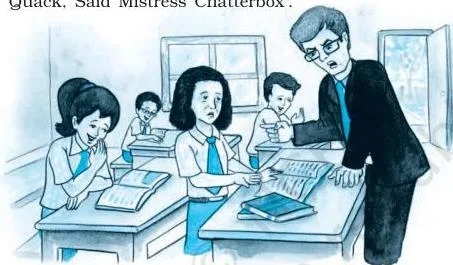
The caption names the timing precisely: Mr Keesing laughs at Anne’s arguments, and the very next clause assigns the second essay. The joke and the raised stakes arrive together, which is why the picture marks the moment the punishment turns into a contest of wit — Anne herself decides “I’d make sure the joke was on him.”
Page 58: The Play Extract That Teaches Contracted Forms

The illustration belongs to the Speaking exercise, where a one-act play has angry neighbours confronting Mary, wife of Joe the Inventor, about his spinning machine.
The printed lines use full forms — “He is sick,” “You would not harm him,” “We are going to smash” — and the task is to convert them to contracted forms — “He’s sick,” “You wouldn’t harm him,” “We’re going to smash” — so the lines sound like actual conversation.
The caption, Mary’s first line, is what the performer opens with. The chapter notes that diaries, plays and novels use contracted forms because they imitate speech.
Definitions: Diary Words, Idioms, and the Four Record Types
The chapter quietly teaches a working vocabulary: the four record types, the diary’s own words, and the poem’s glossary. This section collects them in one place so revision does not send you hunting through margins.
The Four Record Types (p. 49)
The Before You Read activity on page 49 asks you to match four terms with their descriptions, then sort four sample entries. The same definitions are needed again in Thinking about the Text, which compares other personal records with Anne’s diary.
| Record type | What it is |
|---|---|
| Diary | A book with a separate space or page for each day, in which you write your thoughts and feelings or what has happened that day. |
| Journal | A full record of a journey, a period of time or an event, written every day. |
| Log | A written record of events with times and dates, usually official. |
| Memoir(s) | A record of a person’s own life and experiences, usually of a famous person. |
Applied to the four sample entries on page 49:
| Sample entry | Type | Why |
|---|---|---|
| “I woke up very late today… how can I miss the FIFA World Cup matches?” | Diary | It records personal feelings about the day — the mark of a diary. |
| The timed list, 10:30 a.m. to 9:30 p.m. | Log | Events are written with times and dates, the sign of an official record. |
| The Ooty-to-Bangalore ride, with rests every 50 km | Journal | A journey written as it happens, day by day. |
| “This is how Raj Kapoor found me…” | Memoir | A famous person’s life experience told by the person who lived it. |
The Chapter’s Glossary: From Confide to Tranquil
These headwords are glossed in the margins of the extract or in the poem’s glossary. The context line shows how each word is actually used.
| Word | Meaning | In the chapter |
|---|---|---|
| confide (p. 50) | To tell personal things privately to a person you trust. | “We don’t confide in each other” — the very problem that drives Anne to the diary. |
| plunked down (p. 51) | Put down in a casual way (informal). | Anne was plunked down on the table as a birthday present for Margot. |
| quaking in its boots (p. 52) | Shaking with fear and nervousness. | “Our entire class is quaking in its boots” before the promotion meeting. |
| old fogey (p. 52) | An old-fashioned person. | Anne’s private nickname for Mr Keesing, the maths teacher. |
| ramble on (p. 52) | Talk or write aimlessly for a long time. | Anyone could ramble on and leave big spaces between words — Anne wants arguments instead. |
| inherited traits (p. 53) | Qualities, physical or mental, that you get from your parents. | Anne blames her chattiness on inherited traits — her mother talks just as much. |
| incorrigible (p. 53) | Something that cannot be corrected, usually a bad quality. | The second essay title: “An Incorrigible Chatterbox”. |
| ingenuity (p. 53) | Originality and inventiveness. | Anne had “nearly exhausted my ingenuity” on the topic of chatterboxes. |
| languid (p. 61) | Relaxed. | A languid, emerald sea in Amanda’s mermaid daydream. |
| drifting (p. 61) | Moving slowly. | A mermaid drifting blissfully. |
| pattern (p. 61) | Make patterns. | “I pattern soft dust with my hushed, bare feet.” |
| tranquil (p. 61) | Calm. | Life in a tower is “tranquil and rare.” |
Common Mistakes Students Make With This Chapter
Six misreadings trip students up repeatedly. Each row names the mistake, the textual correction, and where the chapter settles it.
| Mistake | Correct rule | How to check your answer |
|---|---|---|
| Anne had no friends at all. | She names her parents, her sixteen-year-old sister and about thirty people she can call friends. Her problem is the lack of one true confidante. | Re-read page 50: “on the surface I seem to have everything, except my one true friend.” |
| Mr Keesing was a cruel or very strict teacher. | The chapter shows him laughing at her arguments, reading her poem to other classes, and joking with her since. The book itself asks “Do you think Mr Keesing was a strict teacher?” (p. 54) — so present both sides. | Track his responses across pages 52–53 from annoyance to laughter. |
| The diary was originally written in German. | The family moved to Holland in 1933, but the note on page 49 says the diary was “eventually translated from its original Dutch.” | Read the bio note under Anne’s photo (p. 49). |
| Anne died in a gas chamber. | Page 49 says she died of typhus in Bergen-Belsen in 1945, within days of her sister Margot. | Check the bio note — it names typhus and Bergen-Belsen. |
| Amanda really is an orphan, a mermaid or Rapunzel. | The parenthesised stanzas are her unspoken daydreams — imagined escapes from the nagging, not reality. | Ask who would be speaking if these lines were real; nothing in the poem shows Amanda leaving home. |
| Phrasal verbs mean what their parts mean. | Phrasal verbs are idiomatic: get on in “get on in life” means succeed, and ran away with in “ran away with the match” means won easily (p. 56). | Look up the verb, not the whole phrase, in a dictionary — the chapter’s own method (p. 57). |
Which Exercises Test Which Skill
If you are revising, work by skill: each block in the chapter trains one thing. In every answer, name the textual evidence — a quoted phrase and its page — because all these questions are answered from the text.
| Exercise (with page) | What it tests |
|---|---|
| Oral Comprehension Check 1 (p. 51) | Recalling why Anne writes and who Kitty is. |
| Oral Comprehension Check 2 (p. 51) | The family sketch — attention to detail, and to Anne’s feelings for her grandmother. |
| Oral Comprehension Check 3 (p. 54) | The Mr Keesing episode — retelling events and forming your own judgment of the teacher. |
| Thinking about the Text (p. 54) | Character inference, theme, comparing diary formats, and evaluating Anne’s own claims about herself. |
| Thinking about Language I–V (pp. 55–58) | Compound words, phrasal verbs, idioms, dictionary skills, contracted forms. |
| Speaking (p. 58) | Converting full forms to contractions so that lines sound like real conversation. |
| Writing (p. 59) | Keeping a diary for a week and using diary language — fragments, contractions, everyday expressions. |
| Listening (pp. 59–60) | The Samuel Pepys extract — listening for dates, numbers and sequence of events. |
| Thinking about the Poem (p. 62) | Speaker, parentheses, and the theme of freedom in Amanda!. |
Textbook contents and the examinable syllabus are not always identical — check the current official syllabus.
Contracted Forms With Two Full Forms
Most contracted forms stand for one pair of words: can’t = cannot, she’s = she is. But a few stand for two. The chapter’s own example is I’d, which can be I would or I had (p. 58), and the exercise asks you to find such two-way forms in Anne’s text.
How to decide which meaning fits: replace I’d in the sentence with each possible full form and keep the one that makes sense. That replacement test is the answer to the chapter’s Contracted Forms exercise.
Finding an Idiom in a Dictionary
Idioms hide under their first meaningful word, and the chapter teaches the method on page 57. For caught my eye, the first real word is caught, a past form — so you look under catch, where the dictionary lists idioms built on it.
- Take the first meaningful word of the idiom; skip grammatical words such as a, the, for.
- If that word is inflected (caught), look up its base form (catch).
- Read past the word’s ordinary meanings to the idiom list at the end of the entry.
Then practise with the heart exercise on page 57: break somebody’s heart, have a heart of stone, your heart goes out to somebody.
The Chapter in Brief
Read this once the night before; it walks the whole chapter — prose and poem — in a single pass.
Anne Frank, a German-born Jewish girl in Amsterdam, receives a diary for her thirteenth birthday and decides it will be her one true friend; she names it Kitty to make the friendship real (p. 50). She sketches her family — father Otto, mother Edith, sister Margot — her Montessori schooling and her grandmother’s death in January 1942 (p. 51).
The 20 June 1942 entry opens with the whole class “quaking in its boots” over the promotion meeting and the boys betting their holiday savings. Then comes Mr Keesing, who punishes Anne’s chattiness with three essays — A Chatterbox, An Incorrigible Chatterbox, and finally Quack, Quack, Quack, Said Mistress Chatterbox, answered in verse with Sanne’s help (pp. 52–53).
He enjoys the joke, shares the poem, and the punishments stop.
The chapter then moves to language work on compound words, phrasal verbs, idioms and contracted forms (pp. 55–58), a speaking, writing and listening block that includes Samuel Pepys’s diary of the Great Fire of London (pp. 58–60), and closes with Robin Klein’s poem Amanda! — an elder’s instructions alternating with Amanda’s imagined escapes as a mermaid, an orphan and Rapunzel (pp. 61–62).
Related Resources
This listing is maintained for the 2026-27 academic session using the NCERT textbook information available to us. NCERT remains the authority for confirming the latest edition.
Continue with the rest of the book: the hub pages below open every chapter and its notes.
- NCERT Class 10 English book hub — all the English textbooks for the class on one page.
- Class 10 study resources hub — notes and books across subjects.
- NCERT books and notes directory — find any class and subject.
- Two Stories about Flying — the previous chapter in First Flight.
- The next chapter in the book is The Hundred Dresses I; also in First Flight is Glimpses of India.
Sources and Data Verification
This page describes chapter 4 of the NCERT Class 10 English textbook First Flight, as published on the official NCERT textbooks portal. The chapter occupies printed pages 49 to 62 and contains the extract from The Diary of a Young Girl, originally written in Dutch, together with the poem Amanda!, the exercises and the language work.
- NCERT settles textbooks, editions and PDFs; CBSE settles curriculum, syllabus and examinations.
- The official NCERT PDF is the source of the section and page references on this page.
- This listing is maintained for the current academic session; the NCERT site is the authority for the edition currently in force.
Reference: NCERT Class 10 First Flight textbook, chapter 4, official edition on ncert.nic.in.
Frequently Asked Questions
Was Anne Frank’s diary originally written in Dutch or English?
Dutch. The bio note on page 49 says the diary was “eventually translated from its original Dutch into many languages”; the English version is called The Diary of a Young Girl.
Why does Anne Frank call her diary Kitty?
She wants the diary to be a real friend, and a name makes that friend concrete (p. 50). She says she is not starting the diary to jot down facts the way most people would, but to make the diary her friend — and she is going to call this friend Kitty.
What were the three essays Mr Keesing assigned to Anne?
A Chatterbox (p. 52), then An Incorrigible Chatterbox (p. 53), then Quack, Quack, Quack, Said Mistress Chatterbox (p. 53). The third was written in verse with Sanne’s help, about ducklings bitten by a father swan for quacking too much.
Who is the speaker in the poem Amanda and what do the brackets mean?
A parent or elder who controls the child — the poem does not name the speaker, and the textbook itself asks who you think it is (p. 62). The bracketed stanzas are Amanda’s unspoken daydreams: mermaid, orphan, Rapunzel.
Is Amanda really an orphan in the poem Amanda?
No. “I am an orphan” is one of her imagined escapes; the surrounding stanzas show a child being nagged at home. The parentheses signal thoughts inside Amanda’s head, not events that actually happen.
How did Anne Frank die, according to the chapter?
She died of typhus in Bergen-Belsen in 1945, within days of her sister Margot (p. 49). The chapter’s opening note gives the cause and place plainly; her father Otto survived the war.
Reference: NCERT Class 10 First Flight textbook, chapter 4, official edition on ncert.nic.in.
Explore Class 10 English Books
- Previous: Two Stories About Flying
- Next: Glimpses of India
Class 10 English on LearnCBSE:
Related chapters:
- A Letter to God
- A Triumph of Surgery