
Madam Rides the Bus Class 10 — this page holds the official NCERT First Flight chapter 7 PDF, straight from the ncert.nic.in portal, free to read or download. The chapter runs from page 95 to page 110 of the printed book and pairs Valli’s first secret bus ride with the comic ballad ‘The Tale of Custard the Dragon’.
Below the download link you will find a map of what the chapter holds, a full story walkthrough with page markers, the three R. K. Laxman illustrations, question guides, word meanings, and a night-before revision recap.
Download the Madam Rides the Bus Class 10 Chapter PDF
Get the official Madam Rides the Bus Class 10 chapter PDF from the NCERT e-textbook portal, where the complete First Flight book is published free of cost and the chapter runs from page 95 to page 110 of the printed edition.
The file you open is the chapter exactly as printed: the story in four parts with its margin word-meanings, the three illustrations, and the poem The Tale of Custard the Dragon with its own question set.
| What the chapter holds | Count | Where it is used |
|---|---|---|
| Printed pages | 17 | |
| Figures with NCERT captions | 3 | |
| Exercise questions | 8 | answered in our NCERT Solutions |
| In-text questions | 12 | |
| Activities | 1 | |
| Official NCERT PDF | Download the chapter PDF | the chapter exactly as NCERT publishes it |
Chapter at a Glance: What the 17 Chapter Pages Hold
This section maps the file you just opened, so you know where each piece of the chapter sits before you start reading.
The chapter block opens on page 94 with the BEFORE YOU READ frame and its prediction activity. The story itself runs from page 95 in four numbered parts; after parts I, II and III the book pauses for an Oral Comprehension Check, and after part IV it moves straight into Thinking about the Text.
The question and activity pages follow — Thinking about the Text, Speaking and Writing on pages 105–106 — and then the chapter’s second text, the poem The Tale of Custard the Dragon, fills pages 108–110 with its Glossary, Thinking about the Poem and a ballad-writing task.
Throughout the story, difficult words are glossed in the margin, and three illustrations carry the action. Use the chapter table below for how much of it all there is; the rest of this page explains what the chapter teaches.
What This Chapter Covers: A Story and a Ballad
Before you read, know this: the chapter is two texts in one — a short story followed by a comic poem. Both read differently, so they revise differently too.
| Text | Title | Writer / attribution | Pages |
|---|---|---|---|
| Prose story | Madam Rides the Bus | Translated from the Tamil by K. S. Sundaram; illustrated by R. K. Laxman | 95–106 |
| Poem | The Tale of Custard the Dragon | Ogden Nash | 108–110 |
The BEFORE YOU READ frame on page 94 sets up the story: an eight-year-old girl’s first bus journey outside her village is also her induction into the mystery of life and death. The frame says she sees the gap between knowing that there is death and understanding it — hold on to that idea; the whole story builds towards it (NCERT, p. 94).
The poem’s opening note (page 108) warns that this is a humorous ballad close to a parody — a song-like story that pokes fun at heroic tales rather than telling one straight (NCERT, p. 108).
The Story in Brief: How Valli Planned Her Secret Bus Ride
The story is a single episode: an eight-year-old plans, takes and completes her first bus journey without telling anyone. These are the beats, with the book’s page numbers so you can follow along.
The opening illustration sets the scene before the story’s first paragraph is done — Valli at the door of her house.
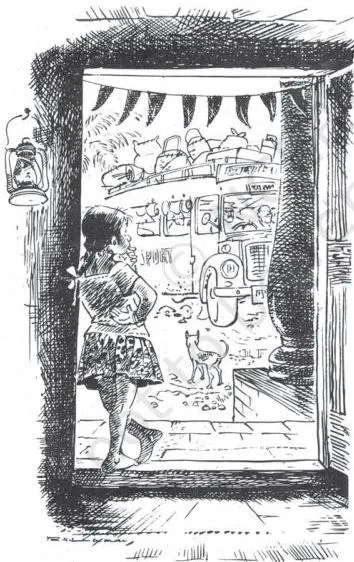
The drawing shows a girl alone in a doorway, with the street in front of her — her whole playground. The caption (NCERT, p. 95) tells us standing there is every bit as enjoyable as any elaborate game.
- Valli (Valliammai), eight years old and very curious, has no playmates. Her favourite pastime is standing in the front doorway, watching the street (NCERT, p. 95).
- The village bus to town passes her street every hour, once each way, and its sight is a source of unending joy. Day after day her wish to ride it grows into an overwhelming desire (NCERT, pp. 95–96).
- She gathers details by listening to regular passengers and asking a few discreet questions: the town is six miles away, the fare is thirty paise one way, the trip takes forty-five minutes, and a return on the same bus costs another thirty paise (NCERT, pp. 95–96).
- Her plan: take the one-o’clock afternoon bus, reach town at one forty-five, and be home again by about two forty-five (NCERT, p. 95).
- She saves sixty paise in all — thirty each way — by thriftily hoarding stray coins and resisting peppermints, toys, balloons and the merry-go-round at the village fair (NCERT, p. 100).
- She slips out while her mother naps, every afternoon from about one to four (NCERT, p. 100).
- Boarding, she raises a tiny hand commandingly and shouts “Stop the bus!”. The conductor, a jolly sort fond of joking, teasingly calls her “madam”; the six or seven other passengers laugh with him (NCERT, p. 97).
- Inside, she stands on her seat to peer over the canvas blind — canal, palm trees, mountains and green fields on one side, a deep ditch on the other. “Oh, it was all so wonderful!” (NCERT, pp. 98–99).
- An elderly man warns her to sit down; she answers haughtily: “There’s nobody here who’s a child. I’ve paid my thirty paise like everyone else.” An elderly woman’s earrings and betel juice she finds absolutely repulsive (NCERT, p. 99).
- On the way to town a young cow runs right in front of the bus, tail high, frightened into running faster by the horn — and Valli laughs until there are tears in her eyes (NCERT, p. 101).
- In town she is struck dumb with wonder at the shops and crowds, but she will not get off the bus. She pays another thirty paise to return, and firmly refuses the conductor’s offer of a cold drink: “No, I don’t have enough money” (NCERT, pp. 101–102).
- On the return she sees the same young cow lying dead by the roadside. The memory haunts her and dampens her enthusiasm; she no longer wants to look out of the window. The bus reaches her village at three forty (NCERT, p. 103).
- At home her mother says we can never know everything, and even what we do know we often cannot understand. Valli breathes “Oh, yes!” and smiles to herself, not wanting anyone to understand her smile (NCERT, p. 104).
Valli’s Character: What Her Words and Actions Show
Question 3 of Thinking about the Text (page 105) asks you to fill blanks in Valli’s own lines — the book says “the words you fill in are the clues to your answer.” Here is that exercise, with the evidence for a character answer.
| Blank from Q3 | Valli’s words | Clue to her character | NCERT page |
|---|---|---|---|
| “a tiny hand was raised ___” | commandingly | She expects to be noticed and obeyed | 97 |
| “Yes, I ___ go to town” | simply have to | The ride is a need, not a whim | 97 |
| “There’s nobody here ___” | who’s a child | She rejects being treated as small | 99 |
| “I can ___” and “she said ___” | get on by myself; irritably | Independence; irritation at being helped | 97, 99 |
| “You needn’t bother about me. I ___” | can take care of myself | Complete self-sufficiency | 99 |
| “Well, sir, I hope ___” | to see you again | Warmth and politeness appear at the end | 104 |
The same evidence builds a fuller portrait. A good character answer names the quality, quotes the line, and says what it shows.
| Trait | Evidence (quote + page) | What it shows |
|---|---|---|
| Curiosity | Standing in the doorway watching the street as her favourite pastime; she “devoured everything with her eyes” (pp. 95, 98) | Her world is small, but her hunger to see it is huge |
| Determination | Saving sixty paise by resisting every treat, even the merry-go-round (p. 100) | She turns a wish into a plan and keeps it |
| Independence | “I can get on by myself”; “I can take care of myself” (pp. 97, 99) | She refuses help and protection alike |
| Pride and bluntness | “There’s nobody here who’s a child”, said haughtily; finding the elderly woman “absolutely repulsive” (p. 99) | An eight-year-old’s sharp, unpolished judgments |
| Envy | Shouting “Proud! proud!” when friends describe the town (p. 96) | She wants what she has not yet had |
| Honesty | “No, I don’t have enough money” when offered the cold drink (p. 102) | She will not accept what she cannot repay |
| Sensitivity | The dead cow “haunted her, dampening her enthusiasm”; the final quiet smile (pp. 103–104) | The journey changes her sense of the world |
The Central Idea: Knowing about Death and Understanding It
The chapter frames the story with an idea: Valli does not merely learn something new on the bus — she grows into it. Knowing that death exists is a fact; understanding what death means is an experience.
On the way to town, the young cow running ahead of the bus is pure comedy to Valli — she laughs and laughs until there are tears in her eyes (NCERT, p. 101). On the way back, the same creature lies dead by the roadside, “legs spreadeagled, a fixed stare in its lifeless eyes” (NCERT, p. 103).
Notice the exact wording: “the memory of the dead cow haunted her, dampening her enthusiasm” — not “she understood death”, but “it haunted her”. She stops looking out of the window. That silence is the gap between knowing and understanding made visible (NCERT, p. 103).
At home, her mother’s remark — that we can never know everything, and even what we know we often cannot understand — gives Valli words she can safely agree with: “I was just agreeing with what you said about things happening without our knowledge” (NCERT, p. 104). She knows something she cannot yet explain, and she keeps that knowledge private in her smile.
For a full answer on this theme, connect the three moments: the laugh (p. 101), the haunting memory (p. 103), and the quiet agreement at home (p. 104).
The Tale of Custard the Dragon: The Ballad in the Same Chapter
The second text is a poem that tells a story in rhyme — the ballad form — but tells it for laughs. Its twist is the opposite of the story’s: here the most unlikely character is the only real hero.
Belinda keeps four pets, each with a comic name: Ink the little black kitten, Blink the little grey mouse, Mustard the little yellow dog — “sharp as Mustard” — and Custard, the realio, trulio little pet dragon (NCERT, p. 108).
Custard looks anything but cowardly: big sharp teeth, spikes on top, scales underneath, a mouth like a fireplace, a chimney for a nose, daggers on his toes. Yet he cries for a nice safe cage, and Belinda, Ink, Blink and Mustard all tease him for it, rudely calling him Percival (NCERT, p. 108).
The twist comes when a pirate climbs in the “winda”. Belinda cries “Help! Help!”, Mustard flees with a terrified yelp, Ink trickles down to the bottom of the household and Blink strategically mouseholes. Custard, snorting like an engine, goes at the pirate “like a robin at a worm” and gobbles him, every bit (NCERT, p. 109).
Then the boasting begins: Mustard would have been twice as brave if he had not been flustered; Ink and Blink three times as brave; and Custard agrees that everybody is braver than him. The final stanza repeats the first almost exactly — a refrain that returns the poem to its opening joke (NCERT, p. 109).
Study the devices here: rhyming couplets (house/mouse, wagon/dragon), the nonsense words “realio, trulio”, exaggeration, and the simile the book itself points to — “Clashed his tail like irons in a dungeon” (NCERT, p. 110). The tone stays light-hearted throughout, which is why the poem is called a humorous ballad close to a parody (NCERT, p. 108).
Nash wrote over four hundred pieces of comic verse, published in fourteen volumes between 1931 and 1972 (NCERT, p. 109).
Figure Walkthrough: The Three Illustrations in the Chapter
The chapter is illustrated by R. K. Laxman. Each drawing shows a real story moment, so reading the pictures is part of reading the text.
The opening drawing shows Valli in the doorway of her house, with the street and the world beyond as her stage. The caption uses the book’s own line (page 95): standing there is her game. She is framed against the outside — the picture makes her curiosity visible before a word of the story is read.

This drawing freezes the moment an elderly man, honestly concerned for her, tells Valli to sit down. Her answer, delivered haughtily (NCERT, p. 99), is the chapter’s clearest proof of who she is: “There’s nobody here who’s a child. I’ve paid my thirty paise like everyone else.”

The third illustration belongs to the Speaking activity on page 105, captioned “Read the conversations carefully.” It pictures the conductor and passengers mid-talk — the raw material for the mimic-a-conversation task that follows the story.
Activities That Come with This Chapter
The book packs this chapter with things to do, not just questions to answer. Three are worth knowing before you revise, because they show where the chapter points your reading.
- Page 94 — BEFORE YOU READ: tick the words and phrases you expect to find in the text (a set of passengers, get on the bus, Tickets, please, a roar and a rattle…), then speak briefly about scenes seen from a fast-moving bus.
- Page 105 — Speaking: read the conversations carefully, then mimic a person who spoke to you and give your own replies. The chapter’s third illustration, captioned “Read the conversations carefully”, belongs to this task.
- Page 106 — What You Can Do: collect used tickets of any kind (bus, train, cinema…), make a collage, classify them by type or price, and write a paragraph from the collage. Pair and group discussions follow: how you spent your pocket money, and an incident that troubled or discouraged you.
These are the book’s own practice tasks, so a student preparing speaking practice or a teacher planning the lesson can use them as they stand.
Word Meanings: The Book’s Margin Glossary and the Poem Glossary
The story prints difficult words as margin notes while you read, and the poem has its own short Glossary at the end (page 110). Here they are collected in one table for revision.
| Word | Meaning | Page |
|---|---|---|
| wistfully | longingly, with a hopeful wish | 95 |
| kindle | set alight; here, stir up feelings | 95 |
| discreet questions | careful, tactful questions | 96 |
| slack time | a time when there is not much work | 97 |
| haughtily | proudly, in a superior way | 98 |
| mimicking | copying someone’s tone or manner | 98 |
| repulsive | causing strong dislike | 99 |
| curtly | sharply, showing displeasure | 99 |
| drivel | silly nonsense | 99 |
| thriftily | spending money carefully | 100 |
| resolutely stifled | suppressed with determination | 100 |
| ventured out | went out cautiously | 100 |
| thoroughfare | a busy public road | 101 |
| merchandise | things offered for sale | 101 |
| spreadeagled | with arms and legs spread out | 103 |
| haunted | returned again and again to her mind | 103 |
| pokes her nose | takes an interest in what does not concern her | 104 |
| grog | a drink typically drunk by sailors | 110 |
| gyrate | to move around in circles | 110 |
The book gives only the poem’s two words as a formal glossary; the story’s words are margin glosses, so while reading, glance at the edge of the page rather than hunting for a word list.
Common Mistakes Students Make in This Chapter
These are the errors students most often make with this chapter — wrong fare, wrong tone, wrong timeline. Catch them now and you will read the text correctly.
| Mistake | Correct rule | How to check your answer |
|---|---|---|
| “The fare was sixty paise one way” | The fare is thirty paise one way; sixty paise is the whole round trip (NCERT, p. 95) | Check the maths: 30 + 30 = 60, and Valli herself saves sixty paise in all (NCERT, p. 100) |
| “The conductor mocks Valli” | He is “a jolly sort, fond of joking” (NCERT, p. 97); calling her madam is affectionate teasing, and Valli gradually joins the laughter (NCERT, p. 98) | Re-read the ending: she hopes to see him again — the journey ends on warm terms (NCERT, p. 104) |
| “Valli got off the bus at town” | She never leaves the bus; she stays in her seat and pays another thirty paise to return (NCERT, p. 101) | The conductor asks “aren’t you ready to get off?” and she answers no |
| “The trip home took the planned two forty-five” | Valli planned to be back by about two forty-five, but the bus reaches the village at three forty (NCERT, p. 103) | Quote both times separately; do not smooth them into one |
| “Custard is a coward throughout” | Custard is the only one who fights the pirate and gobbles him; the others flee or hide (NCERT, p. 109) | Compare reactions in the pirate stanza: Belinda cries Help, Mustard flees, Ink and Blink hide |
| “The poem is a serious heroic ballad” | It is a humorous ballad close to a parody (NCERT, p. 108), though it borrows the ballad form | Check the tone: pet names, “realio, trulio”, and the boasting after the fight are comic, not heroic |
Exam Notes: How the Questions in This Chapter Are Built
This chapter’s question blocks test three different skills: quick recall of an episode, deeper reading of character and theme, and attention to poetic craft. Know which is which and you will answer each type correctly.
The Oral Comprehension Checks close parts I, II and III at NCERT pages 97, 100 and 103 — four questions each. They test close reading of a single episode: facts, motives and feelings you can find in the two or three pages just read.
Thinking about the Text (pages 105–106) asks eight questions that go further:
- Q1–Q2 — desire and planning: hunt exact words and phrases in the text.
- Q3 — character: the fill-in exercise; the blanks are the clues.
- Q4 — why the conductor calls her ‘madam’: a tone question, not a fact question.
- Q5 — enjoyment: find the lines and quote them.
- Q6 — refusing the window: the dead cow episode.
- Q7 — her remark at home: the theme in her own words.
- Q8 — point of view: evidence that an eight-year-old is narrating.
The poem’s nine questions (page 110) test craft: pet names, the simile, rhyme scheme, imagery and tone. When a question asks for a poetic device, name it and quote the line that shows it — as the book’s own simile example does.
The Writing task (page 106) asks for a short personal narrative, and the Speaking task (page 105) for a mimicked conversation. For character answers, quote Valli’s line and say what it shows; for point-of-view answers, quote an eight-year-old’s perception. And remember: textbook contents and the examinable syllabus are not always identical — check the current official CBSE syllabus.
Revision Summary: The Whole Chapter in a Few Minutes
Night before the exam? This is the whole chapter in two compact recaps.
The story.
- Eight-year-old Valli’s favourite pastime is standing in her front doorway watching the street; her strongest desire is to ride the village bus to town, and she shuts friends up with “Proud! proud!” when they describe it (pp. 95–96).
- She saves thirty paise each way — sixty paise in all — by hoarding stray coins and refusing every treat, and plans the ride during her mother’s afternoon nap (p. 100).
- The conductor teases her as “madam”; she pays her fare like everyone else and snaps, “I’m not a child, I tell you” (pp. 97–99).
- Outward, everything delights her: the engine roar, the green fields, the crowds — and a young cow running before the bus that makes her laugh till she cries (pp. 98–101).
- She does not get off at town. On the return she sees the same cow dead by the road, is haunted by the memory, and rides home in silence, arriving at three forty (pp. 101–103).
- At home she agrees with her mother that we cannot understand everything in the world, and smiles to herself — keeping the journey’s meaning private (p. 104).
The poem.
- Belinda keeps a kitten (Ink), a mouse (Blink), a dog (Mustard) and a dragon (Custard), who looks fierce but cries for a safe cage (p. 108).
- A pirate climbs in; Belinda cries for help, Mustard flees and Ink and Blink hide, but Custard attacks like a robin at a worm and gobbles the pirate (p. 109).
- After the fight everyone boasts — twice as brave, three times as brave — and Custard agrees everybody is braver than him (p. 109).
- The poem is a humorous ballad close to a parody: rhyming couplets, the nonsense “realio, trulio”, and a final stanza that repeats the first almost exactly (pp. 108–109).
Related Resources: Other First Flight Chapters
This listing is maintained for the 2026-27 academic session using the NCERT textbook information available to us. NCERT remains the authority for confirming the latest edition.
If you are working through the whole book, these pages take you to the rest of the First Flight unit and the notes that go with it.
- Class 10 English First Flight book page — every chapter of the textbook in one place.
- Class 10 English hub — the NCERT English books for Class 10.
- Class 10 NCERT books index — all Class 10 textbooks on this site.
- The previous First Flight chapter (Chapter 6) — the chapter that comes before this one.
- The next First Flight chapter (Chapter 8) — the chapter that follows it.
- Class 10 notes — revision material across subjects.
- Class 10 English notes — chapter-wise revision notes for English.
- Words and Expressions 2 unit for Madam Rides the Bus — the workbook unit that accompanies this chapter.
- The Sermon at Benares notes — the Class 10 English notes page for that chapter.
- CBSE notes home — the main notes index.
The official source for every printed chapter is the NCERT textbook portal at ncert.nic.in, where First Flight is published in full.
Sources and Data Verification
- The chapter described above is NCERT Class 10 English First Flight, chapter 7, “Madam Rides the Bus”. The chapter block opens on page 94 with the BEFORE YOU READ frame, the story proper runs pages 95–106, and the poem pages 108–110 of the current NCERT edition.
- This page covers the First Flight textbook only — not Footprints without Feet, nor the Words and Expressions workbook, though links to related notes are given above.
- This listing is maintained for the current academic session against the NCERT edition published on the official ncert.nic.in portal.
- NCERT publishes the textbooks, editions and official PDFs; CBSE sets the curriculum, syllabus and examinations. Textbook contents and the examinable syllabus are not always identical — for what is examinable, check the current official CBSE syllabus.
This page is a reading guide to the NCERT edition named above, not a board publication, and it claims no separate review process.
Frequently Asked Questions
Why does the conductor call Valli madam?
The conductor is “a jolly sort, fond of joking” (page 97). Calling an eight-year-old who insists on paying her own fare “madam” is his affectionate teasing — and by the end of the trip Valli is laughing along with it.
Why did Valli not get off the bus at the town?
Her plan was only the ride itself. She was much too afraid to explore the town alone — “All by myself? Oh, I’d be much too afraid” — so she stayed in her seat and paid another thirty paise to return home on the same bus (page 101).
How did Valli save sixty paise for the bus ride?
She thriftily saved whatever stray coins came her way, resisting peppermints, toys, balloons and the merry-go-round at the village fair (page 100). Since the fare was thirty paise each way, sixty paise covered the round trip (page 95).
What did Valli see on her way to town that made her laugh?
A young cow, tail high in the air, running fast in the middle of the road right in front of the bus. The driver’s honking only frightened it into running faster, and Valli laughed until the tears came (page 101).
Why did Valli refuse to look out of the window on the way back?
She had seen the same young cow lying dead by the roadside, and the memory “haunted her, dampening her enthusiasm” (page 103). Looking out would bring the image back.
Who wrote The Tale of Custard the Dragon and why is it called a ballad?
Ogden Nash wrote it (page 109). A ballad is a song or poem that tells a story, and this one is a humorous ballad close to a parody — it uses the ballad form but tells a comic tale of a dragon who turns out to be the only brave one (page 108).
Reference: NCERT Class 10 English First Flight textbook, chapter 7, official edition on ncert.nic.in.
Explore Class 10 English Books
- Previous: Madam Rides the Bus
- Next: The Sermon at Benares
Class 10 English on LearnCBSE:
Related chapters:
- A Letter to God
- A Triumph of Surgery
- A Letter to God