
Footprints without Feet Class 10 is Chapter 5 of the NCERT Class 10 English Supplementary Reader — a six-page science-fiction story by H. G. Wells. It follows Griffin, a scientist who makes his own body invisible.
The story starts with muddy footprints appearing from nowhere in London and ends with Griffin’s unmasking at an inn in Iping. The official chapter PDF from the current NCERT edition is right below; after it, the whole story is laid out in order, with its characters, themes and pointers for every question the book sets.
Footprints without Feet Class 10 Chapter PDF
This file is the official chapter from the NCERT Class 10 English Supplementary Reader — the same text a teacher follows in class — hosted on NCERT’s e-textbook portal at ncert.nic.in.
Download the Footprints without Feet Class 10 chapter PDF from that portal before you start reading.
Keep the PDF open beside this guide while you work through the story, its questions and its vocabulary, so you can check each scene as it is explained.
| What the chapter holds | Count | Where it is used |
|---|---|---|
| Printed pages | 6 | |
| Figures with NCERT captions | 1 | |
| Official NCERT PDF | Download the chapter PDF | the chapter exactly as NCERT publishes it |
What’s Inside the Chapter
Footprints without Feet is a continuous story, not a chapter with numbered sections, so the table below shows at a glance what the chapter holds.
The story opens with a READ AND FIND OUT question block, runs without any headings through Griffin’s London and Iping episodes, and closes with a second READ AND FIND OUT block, Think about it, Talk about it and Suggested reading.
Footprints without Feet: The Story in Order
The plot of this chapter works like a chain — each disaster drives Griffin to the next one, so the order of episodes matters more than any single scene. This is the sequence to keep in your head.
- Muddy footprints in London. Two boys notice fresh, muddy, bare footprints on the steps of a house in the middle of London and watch a new print appear from nowhere. They follow the trail until the mud fades and the footprints disappear.
- The discovery. The boys had been following Griffin, a scientist who proved through experiment after experiment that the human body could become invisible. He swallowed certain rare drugs, and his body became as transparent — and as solid — as glass.
- The crime that cost him everything. Griffin’s landlord tried to eject him, so Griffin set fire to the house. To get away unseen he had to remove his clothes, which left him a homeless wanderer in mid-winter — without clothes, without money, and quite invisible.
- The London store. Seeking warmth, he slipped into a big London store after closing time. He dressed himself in warm clothes from the stock, helped himself to food and wine, and settled down to sleep on a pile of quilts.
- The narrow escape. He slept too long — the assistants were arriving next morning when he woke. He escaped just in time, but the episode ends with the narrator’s warning: ‘If only Griffin had managed to wake up in good time all might have been well.’
- The Drury Lane theatrical shop. Shivering, Griffin hurried to Drury Lane, the centre of the theatre world. He came out wearing bandages, dark glasses, a false nose and big bushy side-whiskers — and to escape unseen he callously attacked the shopkeeper and robbed him of all the money he could find.
- Iping. Eager to get away from crowded London, he took a train to the village of Iping and booked two rooms at the local inn. He told Mrs Hall he wanted solitude, that he must not be disturbed, and that an accident had affected his face.
- The unmasking. Money vanished from the clergyman’s study while the room seemed empty; the furniture attacked Mrs Hall; and when Griffin threw off bandages, whiskers, spectacles and nose, the people in the bar stared at a headless man. Constable Jaffers tried to arrest him anyway, was knocked unconscious, and Griffin vanished.
The story ends with the byline H.G. WELLS, and the chapter’s suggested reading points to his science-fiction novel The Invisible Man as the source of the idea of a scientist who makes himself invisible.
The Big Ideas: Science, Invisibility and Lawlessness
A concept in a story is an idea the writer is testing on the reader. This chapter tests what happens when a brilliant scientist uses his discovery without responsibility.
- Brilliance vs lawlessness. The text gives its own verdict in one line: ‘Brilliant scientist though he was, Griffin was rather a lawless person.’ Every episode after the discovery — the fire, the store theft, the shop robbery — shows a brilliant achievement put to destructive use.
- What makes a person visible. Griffin is invisible, yet the story keeps making him visible again: muddy footprints, then clothes, bandages, a false nose. Dressed in the store’s stock he becomes ‘a fully dressed and visible person’; stripped of everything at the inn he becomes a headless man, then nothing at all.
- Appearance vs reality. Mrs Hall is convinced the room is haunted by spirits, and the neighbours suspect witchcraft. Only the reader knows the plain truth — Griffin has made himself transparent — which is what makes the scenes strange and suspenseful rather than merely frightening.
- The guiding questions. The two READ AND FIND OUT blocks tell the reader exactly what to track: how the invisible man first became visible, why he was wandering the streets, why Mrs Hall finds him eccentric, and what is extraordinary at the inn.
The Illustration and the Turning Point It Marks
The chapter carries one illustration, and it marks the exact moment the plot turns. It shows Griffin asleep on his pile of quilts in the London store, comfortable for the first time since he became invisible.
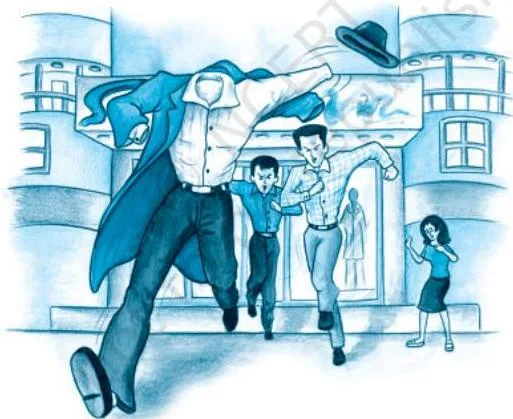
The caption is the narrator’s verdict: ‘If only Griffin had managed to wake up in good time all might have been well.’ He sleeps through closing time, the assistants arrive next morning, and the comfortable night collapses.
That narrow escape is what drives him to the theatrical shop at Drury Lane and, after the robbery there, to Iping — so this single picture sits at the hinge of the plot. Look at it while you read the store scene, and the next two scenes will fall into place.
Who’s Who in the Story and Words to Know
Because this is a story, ‘definitions’ means two things: who each character is and what the story’s key words mean. The table below covers the characters; the list after it covers the vocabulary.
| Character | Who they are | What they do in the story |
|---|---|---|
| Griffin | A scientist who makes his body transparent by swallowing rare drugs | Burns his landlord’s house, robs a London store and a theatrical shop, steals the clergyman’s money, terrorises the inn and escapes arrest |
| Mrs Hall | Landlady of the inn at Iping | Welcomes the stranger for the rent he pays in advance, excuses his strange habits, then is convinced the room is haunted and demands to know what he has done |
| Mr Jaffers | The village constable | Is sent for secretly, tries to arrest a man without a head, and is knocked unconscious trying to hold someone he cannot see |
| The clergyman and his wife | The couple whose study is burgled | Wake to the chink of money being taken from the desk, search an apparently empty room, and find the housekeeping money missing |
| The two boys | London passers-by | Open the story by following the fresh muddy footprints that appear from nowhere |
Key words from the story, with the meaning the story gives them:
- invisible — cannot be seen; Griffin’s body becomes invisible
- transparent — see-through, like a sheet of glass; his body becomes as transparent as glass
- eccentric — odd and unusual in behaviour; Mrs Hall decides her guest is an eccentric scientist
- lawless — ignoring the law; the narrator’s verdict on Griffin
- hysterics — a state of uncontrolled emotion; Mrs Hall almost falls down the stairs in hysterics
- witchcraft — supposed magic; what the neighbours suspect caused the trouble
Common Mistakes to Avoid in This Chapter
These are the points where readers of this chapter most often slip — and where a confused answer misses the point even after the story has been read.
| Mistake | Correct rule | How to check your answer |
|---|---|---|
| Saying the ‘study’ burglary happens in Griffin’s room at the inn | The study belongs to the clergyman; the burglary happens at his house, very early in the morning | Ask who flings open the door — it is the clergyman with a poker, not Mrs Hall |
| Putting Iping before London | The order is London store, then Drury Lane shop, then the train to Iping | Check each stop’s reason — warmth, disguise, escape from London |
| Saying his clothes or the unmasking made him visible first | He first becomes visible through muddy footprints in the street | Re-read the opening scene: the boys see prints appear from nowhere |
| Giving witchcraft as the story’s explanation | Witchcraft and spirits are Mrs Hall’s and the neighbours’ guesses | The real cause is Griffin’s drug-induced transparency — the reader knows this all along |
| Thinking clothes make him invisible | Clothes make him visible again — ‘a fully dressed and visible person’ | He becomes invisible at the inn only after he strips off every garment |
The Chapter’s Own Questions, with Answer Pointers
The chapter sets its own tasks: two Think about it questions and three Talk about it prompts. A good answer states the judgement first, then supports it with evidence from the story in order.
Think about it
1. ‘Griffin was rather a lawless person.’ Comment.
State the verdict, then list the evidence in story order: the fire at his landlord’s house; the theft of clothes, food and wine from the London store; the attack on the theatrical shopkeeper and the robbery of his money; the money taken from the clergyman’s study; and the assault that knocked Constable Jaffers unconscious.
Every crime protects his invisibility or his comfort — that pattern is the point of the comment.
2. How would you assess Griffin as a scientist? Split the answer in two. The text says he carried out ‘experiment after experiment’ until the human body became transparent — that is persistence and real achievement. But he uses the discovery selfishly and destructively: fire, theft and assault.
A full answer concedes the science and condemns the aims, and names the warning the chapter carries: science without responsibility.
Talk about it
- Invisibility: advantages and disadvantages. Ground your answer in what the story shows. Griffin escapes the boys, the store and the arrest, but he shivers without clothes in mid-winter, needs a false nose and bandages to meet anyone, and ends the chapter hunted and alone.
- Invisible forces and invisible matter. Magnetism is invisible, and many aspects of matter cannot be seen with the naked eye either. The prompt asks what the world would be like if we could see them — keep the answer speculative, as the text does.
- Why are glass and water transparent? This is a science question the chapter invites you to research and discuss; the story itself only compares Griffin’s body to glass — ‘as transparent as a sheet of glass’ — without giving the physics.
One practical note: textbook contents and the examinable syllabus are not always identical — check the current official syllabus for what is examinable.
Quick Recap Before You Close the Book
This chapter prints no summary of its own, so here is the night-before version of the plot in six steps.
- Discovery — rare drugs make Griffin’s body transparent, and as solid as glass.
- The crime — he burns his landlord’s house and strips to escape unseen, becoming a homeless invisible wanderer in mid-winter.
- The store — he dresses, feeds himself and sleeps on quilts until the assistants arrive and he barely escapes.
- Drury Lane — he attacks and robs the theatrical shopkeeper, gaining bandages, dark glasses, a false nose and whiskers.
- Iping — the strange guest, the money vanishing from the clergyman’s study, the furniture attacking Mrs Hall, the headless man.
- The escape — Jaffers is knocked unconscious and Griffin vanishes.
Two lines to keep: the theme is science without responsibility, and the guiding questions are how the invisible man first became visible (muddy footprints) and why he was wandering (he had burned his landlord’s house and had no clothes).
Related Chapters and Further Reading
Chapter 4 of the same book, A Question of Trust, also turns on theft and deception — a useful contrast to read alongside this story. The next chapter, The Making of a Scientist, is almost Griffin’s opposite: a young scientist whose success comes from honest, disciplined work.
For other Class 10 English chapters on this site, browse the Class 10 English notes collection, including notes for Glimpses of India and Mijbil the Otter. You can also jump to the Class 10 hub for other subjects or the main CBSE notes collection.
The chapter’s own Suggested reading list proposes three titles worth picking up: The Invisible Man by H. G. Wells, the novel Griffin’s story draws on; ‘As Far As the Human Eye Can See’ by Isaac Asimov; and It Happened Tomorrow, a story collection edited by Bal Phondke. These are suggestions the book offers, not syllabus items.
Sources and Data Verification
This listing is maintained for the 2026-27 academic session using the NCERT textbook information available to us. NCERT remains the authority for confirming the latest edition.
This page describes Chapter 5 of the NCERT Class 10 English Supplementary Reader, Footprints without Feet — the current NCERT edition, with official PDFs on ncert.nic.in. It covers that supplementary reader only, not First Flight or the main coursebook.
The listing is maintained for the current session using NCERT’s published information. NCERT settles textbook editions and PDFs; CBSE settles the syllabus and examinations.
Reference: NCERT Class 10 English textbook, Chapter 5 (Footprints without Feet, Supplementary Reader), official edition on ncert.nic.in.
Footprints without Feet Class 10: Frequently Asked Questions
How did the invisible man first become visible in Footprints without Feet?
He stepped in mud on a London street. The two boys saw fresh, muddy, bare footprints appearing from nowhere, and those footprints are the first sign of the invisible man in the story.
Why was Griffin wandering the streets without clothes?
He had set fire to his landlord’s house and had to remove his clothes to escape unseen. That left him a homeless wanderer in mid-winter, without clothes, without money, and quite invisible.
What curious episode occurs in the study in the chapter?
A clergyman and his wife are woken very early by noises and hear money being taken from the desk of the study. They search the room — it seems completely empty — yet the housekeeping money is missing.
Why does Mrs Hall find the scientist eccentric?
He wants solitude, keeps his room shut and locked, flies into a temper if it is entered, wears bandages over his face, and paid her in advance. That is enough for her to excuse his strange habits and irritable temper.
What other extraordinary things happen at the inn?
The furniture attacks Mrs Hall — the hat on the bedpost leaps into her face, the chair charges at her, and both Halls are pushed out of the room before the door locks itself. Griffin then throws off his disguise and stands as a headless man in front of the horrified people in the bar.
Is the chapter taken from H. G. Wells’s novel The Invisible Man?
Yes — the chapter closes with the byline ‘H.G. WELLS’, and its Suggested reading list points to his novel The Invisible Man as the source of the idea of a scientist who makes himself invisible.
Explore Class 10 English Books
- Previous: Glimpses of
- Next: Mijbil the Otter
Class 10 English on LearnCBSE:
Related chapters:
- A Letter to God
- A Triumph of Surgery