
The Making of a Scientist Class 10 is Chapter 6 of the NCERT English supplementary reader Footprints without Feet.
The official NCERT chapter PDF — all seven pages, from the opening READ AND FIND OUT box to the closing Suggested reading list — is available right here, and below it you will find a section-by-section walkthrough of what the chapter actually contains, its two figures, glossary, and the questions the book itself asks.
Download The Making of a Scientist Class 10 PDF
You can open the Making of a Scientist Class 10 PDF from the NCERT Footprints without Feet reader on the official NCERT website (ncert.nic.in), which is the authoritative source for the current textbook edition of this chapter.
The file is the complete Chapter 6 as it appears in the printed reader, so the page numbers, wording, figures and questions in the PDF match the physical book you may already have.
| What the chapter holds | Count | Where it is used |
|---|---|---|
| Printed pages | 7 | |
| Figures with NCERT captions | 2 | |
| Official NCERT PDF | Download the chapter PDF | the chapter exactly as NCERT publishes it |
Chapter 6 at a Glance: Sections, Figures and Questions
A short biographical prose narrative about Richard Ebright’s journey from butterfly collector to cell biology, this chapter opens with a READ AND FIND OUT box, carries a boxed list of butterfly species and sub-species collected around Reading, Pennsylvania, and closes with Think about it, Talk about it and Suggested reading.
The chapter is prose-based and contains two figures; there is no numbered exercise set, so the checkpoints are the in-text question boxes rather than end-of-chapter problems.
What This Chapter Covers: From Butterfly Collector to Cell Biology
This is the true-life account of how a boy’s butterfly hobby grew into serious science, told mostly in story order so you can read the chapter with orientation. The narrative arc runs as follows:
- Kindergarten collecting: Ebright grew up north of Reading, Pennsylvania, as an only child, and collected butterflies with the same determination he later brought to everything — along with rocks, fossils and coins, and an early interest in astronomy.
- A mother who encouraged learning: She took him on trips, bought him telescopes, microscopes, cameras and mounting materials, and spent nearly every evening at the dining room table finding learning tasks for him.
- The turning point: By second grade he had collected all twenty-five species of butterflies found around his hometown; a children’s book, The Travels of Monarch X, about monarch migration to Central America, then opened the world of science to him.
- Raising monarchs: Because the collecting season around Reading lasts only six weeks, he caught female monarchs and raised their eggs through the full life cycle — egg, caterpillar, pupa, adult — tagging their wings and releasing them, eventually by the hundreds.
- The seventh-grade loss: His county science fair entry, slides of frog tissues, won nothing; he realised the winners had tried real experiments, not neat displays.
- The high school projects: A viral disease in monarch caterpillars (eighth grade), the viceroy-monarch plumage test with a starling (ninth grade), the twelve gold spots on the monarch pupa and the hormone they produce (through junior year), and growing wing cells in culture (senior year).
- The cell-life theory: Studying X-ray photos of the hormone’s chemical structure in his junior year at Harvard gave him the idea of how a cell “reads” the blueprint of its DNA.
- Closing reflection: The ingredients of a scientist — a first-rate mind, curiosity, and the will to win for the right reasons — with Mr Weiherer’s testimony as evidence.
The chapter ends with a Talk about it activity built around children’s questions from Discovered Questions (NCERT, 2006), inviting students to share and answer their own questions.
Key Ideas in The Making of a Scientist
Six ideas in this story reward a second look because they connect the biography to real science. Each is explained below with the printed folio where it appears.
- The turning point: One children’s book redirected a hobby into science. The Travels of Monarch X, which told how monarchs migrate to Central America, “opened the world of science to the eager young collector” (NCERT, p. 54). The lesson: a single well-timed book can change a life’s direction.
- A real experiment versus a neat display: Losing the seventh-grade county fair taught Ebright that the winners had “tried to do real experiments, not simply make a neat display” (NCERT, p. 55). A display shows what you already know; an experiment tests a question you do not yet have the answer to.
- Mimicry: Viceroys resemble monarchs because monarchs taste bad to birds; the more a viceroy looks like a monarch, the less likely it is to be eaten. Ebright tested whether birds would actually eat monarchs and found a starling that would (NCERT, p. 55). Later research by others, the chapter notes, supported the idea that viceroys do copy monarchs.
- The twelve gold spots: Everyone assumed the spots on a monarch pupa were ornamental, but Ebright and another student built a device showing the spots produce “a hormone necessary for the butterfly’s full development” (NCERT, p. 56).
- DNA as the blueprint for life: The chapter’s shorthand is that DNA “determines the form and function of the cell. Thus DNA is the blueprint for life” (NCERT, p. 56). Ebright’s theory concerned how a cell reads that blueprint.
- The recipe for a scientist: The chapter’s closing formula — start with a first-rate mind, add curiosity, and mix in the will to win for the right reasons (NCERT, p. 57).
Practical application: the “real experiment, not a neat display” idea is the chapter’s method and is directly usable in any school science project work — choose a question you can test, run the test, and report what you actually found rather than presenting a polished model.
The Two Figures in This Chapter, Explained
The chapter carries two images, and both support the plot rather than decorate it. The first is the graph that explains why Ebright raised monarchs from eggs; the second records what his starling experiment actually showed.
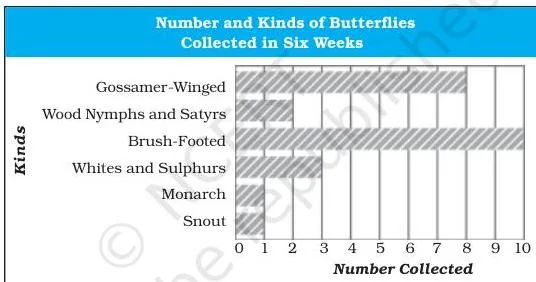
The first figure — the collecting-season graph — is the reason Ebright changed method. If the season lasts only six weeks in late summer, chasing butterflies one by one cannot yield many specimens.
So instead he caught a female monarch, took her eggs, and raised them in his basement through the whole life cycle — egg to caterpillar to pupa to adult — then tagged the wings and let the butterflies go. For several years his basement held thousands of monarchs in different stages of development (NCERT, p. 54).
The graph is the plot device that justifies the rest of the chapter.
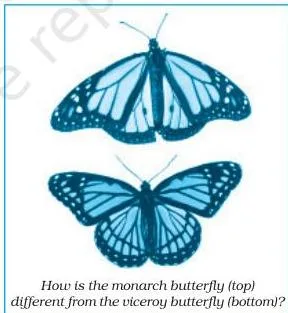
The second figure records Ebright’s ninth-grade project: a starling that would not eat ordinary bird food but would eat all the monarchs it could get (NCERT, p. 55). Note what this did and did not prove.
It showed that at least one bird species will eat monarchs, which was a necessary condition for the mimicry theory — if no bird ate monarchs, looking like one would be pointless protection. But it did not, by itself, prove the full mimicry claim about viceroys; the chapter states that later research by other people showed viceroys probably do copy monarchs.
Read the picture as one piece of evidence in a larger argument, not as the whole proof.
Chapter Glossary: Words and Scientific Terms Explained
This prose chapter footnotes a handful of words and quietly assumes a few science terms that are easy to mix up. Both groups, with meanings in this story’s context, are below.
| Term | Meaning in this chapter |
|---|---|
| leagues | Groups of sports clubs or teams playing matches among themselves; used in the comparison “making the big leagues.” |
| county | Region; the level at which the science fair was held (the county science fair). |
| starling | Common European bird with black, brown-spotted plumage that nests near buildings; the chapter notes it is a good mimic. |
| entomology | The study of insects; Ebright worked at the entomology laboratory of the Walter Reed Army Institute of Research. |
| eureka | A cry of triumph at a discovery, originally attributed to Archimedes; used to say Ebright did not shout “Eureka!” at his theory. |
| canoeist | A person who paddles a canoe; one of Ebright’s other interests. |
| species / sub-species | A species is a distinct kind of organism; a sub-species is a further division within a species. The boxed list records twenty-five species of butterflies found around Reading, grouped by family. |
| monarch / viceroy | Two butterfly species; the monarch is the model that tastes bad to birds, and the viceroy is the mimic that copies its look. |
| pupa | The stage between caterpillar and adult butterfly; monarch pupae carry twelve tiny gold spots, the subject of Ebright’s key research. |
| life cycle | The full sequence from egg to caterpillar to pupa to adult butterfly; Ebright raised monarchs through the cycle in his basement. |
| hormone | A chemical produced by the body that has a specific effect; the gold spots produce a hormone needed for the butterfly’s full development. |
| cell culture | Growing cells outside the body in a controlled medium; Ebright grew cells from a monarch’s wing in a culture for his senior project. |
| DNA | The substance in the nucleus of a cell that controls heredity; the chapter calls it the blueprint for life. |
Common Mistakes Students Make With This Chapter
This story is short, biographical, and dense with experiments that are easy to collapse into one another — so students often blur which project proved what, and when. The confusions below are the ones to watch for, with the correct reading from the chapter.
- Saying the starling experiment proved viceroy mimicry: It actually found a bird that would eat monarchs. The support for viceroy mimicry came from later research by other people, which the chapter mentions in the same passage (NCERT, p. 55).
- Calling the butterfly collection itself the turning point: The turning point was the book The Travels of Monarch X, which his mother gave him. By second grade he had collected all twenty-five local species — the book came after that and redirected the hobby into science (NCERT, p. 54).
- Imagining Ebright shouted “Eureka!”: The chapter is explicit: “Ebright didn’t shout, ‘Eureka!’ or even, ‘I’ve got it!’” The cell-life theory came quietly as he studied X-ray photos of a hormone’s chemical structure (NCERT, p. 56).
- Muddling the life-cycle order: The sequence is egg → caterpillar → pupa → adult butterfly. Raising monarchs meant taking a female’s eggs and carrying them through this cycle, not skipping any stage.
- Forgetting Mr Weiherer’s evidence for “winning for the right reasons”: The teacher’s evidence is concrete — Ebright put in three or four hours a night on debate research on top of his butterfly work, and he competed to do the best job, not for the prize (NCERT, p. 57).
- Describing the cell-life theory as already proved: The book’s own wording is conditional — “If the theory proves correct” — and the chapter reports that Ebright began doing experiments to test it at Harvard Medical School (NCERT, pp. 56–57).
How the Chapter’s Own Questions Are Framed
NCERT frames this chapter’s questions as a map of the reading experience, in the order you meet them:
- First READ AND FIND OUT box (opening): two questions — how did a book become a turning point in Ebright’s life, and how did his mother help him? Both are answered in the first pages of the narrative (NCERT, p. 54).
- Second READ AND FIND OUT box (after the loss): three questions — the lesson from winning nothing at the fair, the experiments and projects that followed, and the qualities that go into making a scientist (NCERT, p. 55).
- Think about it: two broader discussion questions — how anyone becomes a scientist (is it only reading books, or also observing, thinking and experimenting?) and a request to discuss Ebright’s work in the light of what students have studied about cells and DNA, naming a field they would like to work in and why (NCERT, p. 58).
- Talk about it: children’s questions taken from Discovered Questions (NCERT, 2006) — for example, what DNA fingerprinting is, how honeybees identify their own honeycombs, and why rain falls in drops — followed by a classroom-sharing task where students raise and try to answer their own questions (NCERT, p. 58). The answers to the three sample questions are printed on page 75 of the book.
- Suggested reading: a short list of related titles, including “Journey by Night” by Norah Burke and Children Who Made It Big by Thangamani (NCERT, p. 58).
This is a supplementary-reader prose chapter, so the in-text question boxes are its checkpoints rather than a numbered exercise set. As with any textbook chapter, textbook contents and the examinable syllabus are not always identical — check the current official syllabus.
Quick Revision: Ebright’s Journey at a Glance
This chapter has no SUMMARY or POINTS TO PONDER box; its conclusion is the closing reflection on the ingredients of a scientist, and that is what this section rebuilds as a numbered timeline for a night-before revision pass.
- Kindergarten: Ebright begins collecting butterflies, along with rocks, fossils and coins, in Reading, Pennsylvania, where he is an only child.
- Evening learning with his mother: She takes him on trips, buys scientific equipment, and finds learning tasks for him at the dining room table almost every night.
- The book that changed direction: By second grade he has all twenty-five local butterfly species; his mother gives him The Travels of Monarch X, which opens the world of science to him.
- Raising and tagging monarchs: Because the collecting season is only six weeks, he raises monarchs from eggs through the full life cycle in his basement and tags their wings before release.
- Seventh-grade loss: His frog-tissue slide display wins nothing at the county science fair, teaching him that real science means real experiments, not neat displays.
- Eighth grade: He tests whether a beetle carries the viral disease that kills monarch caterpillars; he gets no real results but wins by showing he tried the experiment.
- Ninth grade: His starling experiment tests whether birds eat monarchs, earning first place in the zoology division and third overall at the county fair.
- Sophomore to senior year: He builds a device showing the twelve gold spots on the monarch pupa produce a hormone, identifies work at the Walter Reed entomology laboratory, and in his senior year grows monarch wing cells in culture that develop only when fed that hormone.
- Harvard and the theory: After his freshman year he identifies the hormone’s chemical structure; in his junior year, studying X-ray photos, he forms his theory of how a cell reads the blueprint of its DNA, published with James R. Wong.
- The caveat and the recipe: The chapter stresses that the theory is still being tested — “if the theory proves correct” — and closes with the three ingredients: a first-rate mind, curiosity, and the will to win for the right reasons, echoed by Mr Weiherer’s description of Ebright’s extra effort and clean competitiveness.
Related NCERT Class 10 English Chapters
If you are working through the whole reader or revising for the term, these pages will help you move between chapters of the same book and the wider Class 10 English syllabus.
- All NCERT Class 10 English chapters — the hub for both the First Flight textbook and the Footprints without Feet supplementary reader.
- Class 10 subject hub — every NCERT Class 10 subject on this site.
- Mijbil the Otter — Chapter 4 of Footprints without Feet, a pet-otter memoir that precedes this chapter in the reader.
- Madam Rides the Bus — from the First Flight textbook, another Class 10 English chapter with a strong narrative voice, useful for comparative revision of prose.
Sources and Data Verification
This listing is maintained for the 2026-27 academic session using the NCERT textbook information available to us. NCERT remains the authority for confirming the latest edition.
The chapter described on this page is Chapter 6 of NCERT’s Class 10 English supplementary reader Footprints without Feet, official edition published on ncert.nic.in. This page is maintained for the current academic session from the NCERT edition available to us. NCERT settles textbook editions and PDFs; CBSE settles curriculum and examinations.
This page describes the textbook chapter itself, not the examinable syllabus, and has not been through any external subject-expert review.
Reference: NCERT Class 10 English textbook (Footprints without Feet), chapter 6, official edition on ncert.nic.in.
FAQs: The Making of a Scientist Class 10
How did the book The Travels of Monarch X become a turning point in Richard Ebright’s life?
By second grade, Ebright had collected all twenty-five species of butterflies found around his hometown, and he felt that might have been the end of his collecting.
The children’s book The Travels of Monarch X, which told how monarch butterflies migrate to Central America, then “opened the world of science to the eager young collector” (NCERT, p. 54) — it converted a routine hobby into an interest in how living things travel, migrate and develop, and it is the point the chapter identifies as the start of his scientific career.
How did Ebright’s mother help him collect butterflies and learn science?
She encouraged his interest in learning in practical ways: she took him on trips, bought him telescopes, microscopes, cameras, mounting materials and other equipment, and helped him in many other ways.
She was his only companion until he started school, and after that the two spent almost every evening at the dining room table, where she found learning tasks for him — “not physical work, but learning things” (NCERT, p. 54). It was she who gave him The Travels of Monarch X.
The chapter’s first READ AND FIND OUT box asks exactly these two questions, so this is a checkpoint answer for that box.
What lesson did Ebright learn when he did not win anything at the county science fair?
He learned the difference between a display and a real experiment. His seventh-grade entry was slides of frog tissues shown under a microscope, and it won nothing; he realised the winners “had tried to do real experiments, not simply make a neat display” (NCERT, p. 55).
From then on he committed to entering a real experiment the next year, and he chose the insect work he knew most about.
What experiments and projects did Ebright undertake after his science fair loss?
After writing to Dr Urquhart for ideas, Ebright ran a string of projects through high school: in eighth grade he tested whether a beetle carried the viral disease that kills monarch caterpillars; in ninth grade he tested the viceroy-monarch theory by seeing whether a starling would eat monarchs; in his second year of high school he built a device showing that the twelve gold spots on a monarch pupa produce a hormone needed for full development; and in his senior year he grew cells from a monarch’s wing in a culture, showing they develop into normal wing scales only when fed that hormone (NCERT, pp. 55–56).
Each project fed the next and led to his later theory on cell life.
What are the qualities that go into the making of a scientist?
The chapter’s closing formula names three: start with a first-rate mind, add curiosity, and mix in the will to win for the right reasons (NCERT, p. 57).
Mr Weiherer’s evidence for each is concrete — Ebright put in three or four hours a night on debate research besides his butterfly work (the will to win), and he competed to do the best job he could, not for a prize (the right reasons).
The chapter closes by noting that from the time The Travels of Monarch X opened the world of science to him, Ebright has never lost his scientific curiosity.
Why did Ebright raise monarch butterflies in his basement instead of collecting them from the wild?
Because the butterfly collecting season around Reading lasts only six weeks in late summer — too short a window to catch many butterflies one by one, as the graph shows.
So Ebright would catch a female monarch, take her eggs, and raise them in his basement through the life cycle — egg to caterpillar to pupa to adult — then tag the wings and release the butterflies. For several years his basement was home to thousands of monarchs in different stages of development (NCERT, p. 54).
The graph is the reason he switched from chasing to raising.
Explore Class 10 English Books
- Previous: Mijbil the Otter
- Next: Madam Rides the Bus
Class 10 English on LearnCBSE:
Related chapters:
- A Letter to God
- A Triumph of Surgery