This page collects the pair of linear equations in two variables class 10 formulas: the general form of two linear equations, the ratio conditions that decide whether the solution is unique, infinite or absent, and the substitution and elimination methods that produce that solution. The two-digit-number form used in word problems is included too.
All formulas follow the Rationalised NCERT Class 10 Mathematics textbook, chapter 3 — verify any of them in the official chapter PDF. Below, each formula is grouped by topic with symbol meanings, when-to-use guidance and original worked examples. For the derivations and explanations behind these formulas, see the Pair of Linear Equations in Two Variables notes.
Formulas at a Glance
| Purpose (what you are finding) | Formula |
|---|---|
| General form of the first equation | \(a_1x + b_1y + c_1 = 0\) |
| General form of the second equation | \(a_2x + b_2y + c_2 = 0\) |
| Unique solution — the lines intersect | \(\frac{a_1}{a_2} \neq \frac{b_1}{b_2}\) |
| Infinitely many solutions — the lines coincide | \(\frac{a_1}{a_2} = \frac{b_1}{b_2} = \frac{c_1}{c_2}\) |
| No solution — the lines are parallel | \(\frac{a_1}{a_2} = \frac{b_1}{b_2} \neq \frac{c_1}{c_2}\) |
| Two-digit number from its tens and units digits | \(10x + y\) |
All Formulas, Grouped by Topic
General Form of a Pair of Linear Equations in Two Variables
Every pair in this chapter is compared in this standard form (NCERT, p. 26):
\[ a_1x + b_1y + c_1 = 0 \]
\[ a_2x + b_2y + c_2 = 0 \]
Each equation is linear because \(x\) and \(y\) appear only to the first power. Before reading off \(a, b, c\), move every term to one side: \(3x + 4y = 20\) becomes \(3x + 4y – 20 = 0\).
Graphical Method — Ratio Conditions
The three possible graphs, and the ratio test that identifies each, come from NCERT Table 3.1 (p. 26):
| Comparison of ratios | Graphical representation | Algebraic interpretation | Type of pair |
|---|---|---|---|
| \(\frac{a_1}{a_2} \neq \frac{b_1}{b_2}\) | Intersecting lines | Exactly one solution (unique) | Consistent |
| \(\frac{a_1}{a_2} = \frac{b_1}{b_2} = \frac{c_1}{c_2}\) | Coincident lines | Infinitely many solutions | Dependent (consistent) |
| \(\frac{a_1}{a_2} = \frac{b_1}{b_2} \neq \frac{c_1}{c_2}\) | Parallel lines | No solution | Inconsistent |
A pair with a unique solution is consistent; a pair with no solution is inconsistent; coincident lines form a dependent pair, which is always consistent (NCERT, p. 26).
The test works because the three ratios compare the two equations term by term: when the \(x\) and \(y\) ratios agree, one left-hand side is a multiple of the other, so the lines have the same direction and only the constants decide whether they coincide or stay parallel.
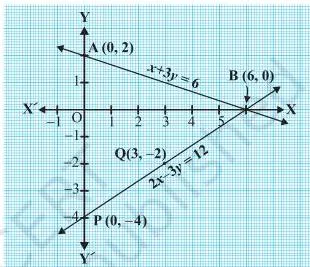
The graph below shows the first row in action. The lines \(x + 3y = 6\) and \(2x – 3y = 12\) from NCERT Example 1 meet at the single point B(6, 0), so the unique solution is \(x = 6, y = 0\) (NCERT, p. 27).
Substitution Method
Use this when one variable is easy to isolate (NCERT, p. 31):
- Choose either equation and express one variable in terms of the other — from \(x + 2y = 3\), write \(x = 3 – 2y\).
- Substitute this expression into the other equation. You now have one equation in one variable; solve it.
- Substitute the value back into the expression from Step 1 to get the second variable.
If Step 2 gives a true statement with no variable, the pair has infinitely many solutions; a false statement means the pair is inconsistent.
Elimination Method
Use this when the coefficients can be matched with small multipliers (NCERT, p. 35):
- Multiply each equation by a suitable non-zero constant so that the coefficients of one variable become equal in magnitude.
- Add or subtract the equations to eliminate that variable. A true statement with no variable means infinitely many solutions; a false statement means no solution.
- Solve the one-variable equation you get.
- Substitute that value into either original equation to obtain the other variable.
Word-Problem Building Blocks
Three reusable forms appear again and again in the problems of this chapter:
- Two-digit numbers: a number with tens digit \(x\) and units digit \(y\) is \(10x + y\); reversing the digits gives \(10y + x\) (NCERT, p. 36).
- Quantities in a ratio \(m : n\): call them \(mx\) and \(nx\), then build equations from the given totals (NCERT Example 8).
- Ages: “seven years ago” is written \(a – 7\), “three years from now” is \(a + 3\) (NCERT Example 5, p. 32).
The chapter’s opening problem is a worked-out example of forming equations from words. If \(x\) is the number of rides Akhila had and \(y\) the number of Hoopla games she played, the situation gives the pair (NCERT, p. 25):
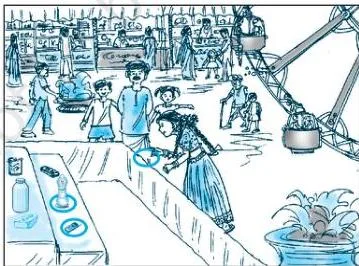
Here \(y = \frac{1}{2}x\) says the number of Hoopla games is half the number of rides, and \(3x + 4y = 20\) uses the costs (₹3 per ride, ₹4 per game) and the ₹20 spent.
What Each Symbol Means
| Symbol | What it means | Unit / nature |
|---|---|---|
| \(x, y\) | The two unknown quantities of the problem — what you solve for | Real numbers |
| \(a_1, b_1\) | Coefficients of \(x\) and \(y\) in the first equation | Real numbers |
| \(c_1\) | Constant term of the first equation, sign included | Real number |
| \(a_2, b_2, c_2\) | Coefficients and constant of the second equation | Real numbers |
| \(\frac{a_1}{a_2}, \frac{b_1}{b_2}, \frac{c_1}{c_2}\) | The three ratios compared to classify the pair | Dimensionless (pure ratios) |
| \(x, y\) in \(10x + y\) | Tens digit and units digit of a two-digit number | Digits: \(x = 1\) to \(9\), \(y = 0\) to \(9\) |
| \(m, n\) in \(mx, nx\) | Scale factors that reproduce the given ratio \(m : n\) | Real numbers |
When to Use Each Formula
| Formula or method | Reach for it when | Condition that must hold |
|---|---|---|
| General form \(a_1x + b_1y + c_1 = 0\), \(a_2x + b_2y + c_2 = 0\) | Before comparing ratios or reading off coefficients | Both equations rewritten in this form first |
| \(\frac{a_1}{a_2} \neq \frac{b_1}{b_2}\) | Asked “consistent?”, “unique solution?”, “do the lines intersect?” | Always gives exactly one solution |
| \(\frac{a_1}{a_2} = \frac{b_1}{b_2} = \frac{c_1}{c_2}\) | One equation is a multiple of the other; the lines coincide | Infinitely many solutions |
| \(\frac{a_1}{a_2} = \frac{b_1}{b_2} \neq \frac{c_1}{c_2}\) | Lines are parallel, e.g. “will the two rails cross?” | No common solution — inconsistent |
| Substitution method | A variable has coefficient 1, or an equation is already written as \(y = \dots\) | Works for every pair; false statement means inconsistent |
| Elimination method | Coefficients match with small multipliers; you want to avoid fractions | True statement → infinitely many; false statement → none |
| \(10x + y\) form | “Sum of the digits”, “number and its reverse” problems | \(x\) is the tens digit (1–9), \(y\) the units digit (0–9) |
Prefer an algebraic method when the solution has non-integral coordinates. The textbook notes that reading a point like \((\sqrt{3}, 2\sqrt{7})\), \((-1.75, 3.3)\) or \(\left(\frac{4}{13}, \frac{1}{19}\right)\) from a graph invites mistakes (NCERT, Section 3.3).
Where each exercise fits:
- Exercise 3.1 — graphical method: compare ratios to classify pairs (Q2, Q3, Q4), form equations from word problems and solve graphically (Q1, Q5, Q7), and write a second equation to force a given relationship (Q6).
- Exercise 3.2 — substitution method: direct pairs (Q1), one solved pair with a follow-up (Q2), and six word problems on numbers, angles, costs, taxi fares, fractions and ages (Q3).
- Exercise 3.3 — both methods on the same pairs (Q1) and elimination word problems (Q2).
Worked Examples
Three quick examples with original numbers: the direct ratio test, the reverse problem (find the missing constant), and a full elimination solve. Practise more on the NCERT solutions for this chapter.
Example 1: Classify a pair by the ratio conditions
Step 1: Both equations are already in standard form: \(2x + 5y – 1 = 0\) and \(4x + 10y – 7 = 0\).
So \(a_1 = 2, b_1 = 5, c_1 = -1\) and \(a_2 = 4, b_2 = 10, c_2 = -7\).
Step 2: Compute the three ratios.
\[ \frac{a_1}{a_2} = \frac{2}{4} = \frac{1}{2}, \qquad \frac{b_1}{b_2} = \frac{5}{10} = \frac{1}{2}, \qquad \frac{c_1}{c_2} = \frac{-1}{-7} = \frac{1}{7} \]
Step 3: Since \(\frac{a_1}{a_2} = \frac{b_1}{b_2} \neq \frac{c_1}{c_2}\), the lines are parallel.
Final answer: The pair has no solution — it is inconsistent. Quick check: the first equation multiplied by 2 gives \(4x + 10y – 2 = 0\), whose constant differs from \(4x + 10y – 7 = 0\).
Example 2: Find the missing constant so the pair has infinitely many solutions
Step 1: Rewrite \(3x + ky = 10\) and \(6x + 4y = 20\) as \(3x + ky – 10 = 0\) and \(6x + 4y – 20 = 0\).
Then \(a_1 = 3, b_1 = k, c_1 = -10\) and \(a_2 = 6, b_2 = 4, c_2 = -20\).
Infinitely many solutions require \(\frac{a_1}{a_2} = \frac{b_1}{b_2} = \frac{c_1}{c_2}\).
Step 2: Compute the two known ratios.
\[ \frac{a_1}{a_2} = \frac{3}{6} = \frac{1}{2}, \qquad \frac{c_1}{c_2} = \frac{-10}{-20} = \frac{1}{2} \]
Step 3: Match the missing ratio: \(\frac{b_1}{b_2} = \frac{k}{4} = \frac{1}{2}\), so \(k = 2\).
Final answer: \(k = 2\). Check: with \(k = 2\), \(\frac{3}{6} = \frac{2}{4} = \frac{-10}{-20} = \frac{1}{2}\), and the second equation is exactly double the first.
Example 3: Solve a pair by the elimination method
Step 1: Solve \(4x + 3y = 18\) and \(2x – 3y = 0\).
The \(y\)-coefficients are \(+3\) and \(-3\) — equal in size, opposite in sign — so add the equations to eliminate \(y\).
\[ (4x + 3y) + (2x – 3y) = 18 + 0 \quad \Rightarrow \quad 6x = 18 \quad \Rightarrow \quad x = 3 \]
Step 2: Substitute \(x = 3\) into \(2x – 3y = 0\).
\[ 2(3) – 3y = 0 \quad \Rightarrow \quad 6 = 3y \quad \Rightarrow \quad y = 2 \]
Final answer: \(x = 3\), \(y = 2\). Check: \(4(3) + 3(2) = 18\) and \(2(3) – 3(2) = 0\), so both original equations are satisfied.
Common Mistakes to Avoid
| Mistake | Correct rule | How to check your answer |
|---|---|---|
| Comparing ratios from equations not in standard form, e.g. reading \(3x + 4y = 20\) without moving the 20. | Rewrite each equation as \(ax + by + c = 0\) before reading \(a, b, c\). | The constant term of \(3x + 4y = 20\) is \(-20\), so \(c_1 = -20\). |
| Dropping the sign of \(c\). | In \(2x + 3y = 8\), \(c = -8\); in \(2x + 3y – 8 = 0\), \(c = -8\). | Put \(x = 0, y = 0\) into the standard form — you must get exactly \(c\). |
| Adding when the matched coefficients have the same sign, or subtracting when they are opposite. | After making coefficients equal in size, add if the signs differ, subtract if they are the same. | Substitute your final \(x, y\) into both original equations — both must give true statements. |
| Writing “dependent and inconsistent” together. | A dependent pair is always consistent: coincident lines mean infinitely many solutions; inconsistent means no solution (parallel). | If elimination ends in a true statement like \(18 = 18\), the pair is dependent and consistent. |
| In digit problems, writing only \(x – y = 2\) and missing \(y – x = 2\). | “The digits differ by 2” gives two equations; solve both and keep every valid number. | Each candidate number must satisfy the original sentence — sum with its reverse and the digit difference. |
Frequently Asked Questions
How do I tell whether a pair of linear equations is consistent?
Compute the three ratios \(\frac{a_1}{a_2}\), \(\frac{b_1}{b_2}\), \(\frac{c_1}{c_2}\). If \(\frac{a_1}{a_2} \neq \frac{b_1}{b_2}\), the pair is consistent with a unique solution. If all three ratios are equal, it is dependent and consistent, with infinitely many solutions.
If only the first two are equal, it is inconsistent — the lines are parallel and there is no solution.
Substitution or elimination — which should I pick?
Substitution is quickest when a variable already has coefficient 1 or an equation is written as \(y = \dots\). Elimination is quickest when small multipliers make the coefficients match. Both methods solve the same pairs — the remark after NCERT Example 8 notes you can often use either (NCERT, p. 35).
Elimination ended in 18 = 18. Is that a mistake?
No. A true statement with no variable left means the two equations represent the same line, so there are infinitely many solutions. A false statement such as \(0 = 9\) means the lines are parallel and the pair has no solution.
Can I always read the answer from a graph?
Only when the intersection point has integral coordinates. For solutions like \(\left(\frac{4}{13}, \frac{1}{19}\right)\) or \((\sqrt{3}, 2\sqrt{7})\), reading the graph invites mistakes, so use substitution or elimination.
Browse the Class 10 Maths Formulas index or the main Maths Formulas page for more sheets.
Reference: NCERT Class 10 Mathematics textbook, chapter Pair of Linear Equations in Two Variables.
Explore Class 10 Maths Formulas
More for this chapter:
Class 10 Maths on LearnCBSE:
Related chapters: