This page collects the Real Numbers Class 10 formulas and the results that go with them: Euclid’s division algorithm, the Fundamental Theorem of Arithmetic, the HCF–LCM relations for two and three numbers, and the facts used to prove irrationality.
Each formula is written as the Rationalised NCERT Class 10 Mathematics textbook presents it, with the meaning of every symbol and the conditions under which the formula is valid.
Use the summary table below for a quick lookup, then go to the grouped list, symbol table, when-to-use guide and worked examples. For full explanations and derivations, see the Real Numbers Class 10 notes; for practice on the textbook’s own questions, use the Real Numbers NCERT solutions.
Real Numbers Class 10 Formulas at a Glance
The table is the quick index. Every row appears again below with its conditions and symbol meanings.
| What you are finding | Formula |
|---|---|
| Quotient and remainder in division | \( a = bq + r,\ 0 \le r \lt b \) |
| Prime factorisation of a composite number | \( x = p_1^{a_1} p_2^{a_2} \cdots p_k^{a_k} \) |
| HCF from prime factorisations | \( \mathrm{HCF}(a,b) = \prod_{p\ \text{common}} p^{\min(e_p, f_p)} \) |
| LCM from prime factorisations | \( \mathrm{LCM}(a,b) = \prod_{p\ \text{present}} p^{\max(e_p, f_p)} \) |
| Relation between HCF and LCM of two numbers | \( \mathrm{HCF}(a,b) \times \mathrm{LCM}(a,b) = a \times b \) |
| LCM when HCF is already known (derived from the relation above) | \( \mathrm{LCM}(a,b) = \frac{a \times b}{\mathrm{HCF}(a,b)} \) |
| LCM of three numbers | \( \mathrm{LCM}(p,q,r) = \frac{p \cdot q \cdot r \cdot \mathrm{HCF}(p,q,r)}{\mathrm{HCF}(p,q) \cdot \mathrm{HCF}(q,r) \cdot \mathrm{HCF}(p,r)} \) |
| HCF of three numbers | \( \mathrm{HCF}(p,q,r) = \frac{p \cdot q \cdot r \cdot \mathrm{LCM}(p,q,r)}{\mathrm{LCM}(p,q) \cdot \mathrm{LCM}(q,r) \cdot \mathrm{LCM}(p,r)} \) |
| Prime that divides a square (used in irrationality proofs) | \( p \mid a^2 \Rightarrow p \mid a \), \( p \) prime |
| Square root of a prime | \( \sqrt{p} \) is irrational, \( p \) prime |
For other chapters, see the Class 10 Maths formulas index or the main Maths formulas hub. The formulas above follow the official chapter PDF (jemh101.pdf) published by NCERT.
All Formulas, Grouped by Topic
Euclid’s Division Algorithm
For positive integers \( a \) and \( b \), there exist whole numbers \( q \) and \( r \) such that \[ a = bq + r,\qquad 0 \le r \lt b \]
This is the formal form of Euclid’s division algorithm from the NCERT introduction (NCERT, p. 1). It is the same statement as ordinary long division, and the chapter uses it mainly to compute the HCF of two positive integers.
The Fundamental Theorem of Arithmetic
Every composite number can be written as a product of primes in exactly one way, apart from the order of the factors (NCERT, p. 3). With the primes written in ascending order and repeated primes combined, a composite number \( x \) takes the form \[ x = p_1^{a_1} p_2^{a_2} \cdots p_k^{a_k} \]
where \( p_1 \lt p_2 \lt \cdots \lt p_k \) are primes and \( a_1, a_2, \dots, a_k \) are positive integers. The factor tree below shows the theorem working: it breaks 32760 into primes 2, 3, 5, 7 and 13, which combine to \( 2^3 \times 3^2 \times 5 \times 7 \times 13 \).
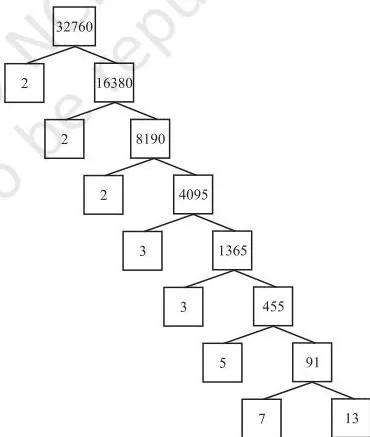
The uniqueness part of the theorem is what lets you conclude that a number such as \( 4^n = (2)^{2n} \) has only the prime 2 in its factorisation, so it can never end with the digit 0, because ending in 0 would require the prime 5 (NCERT, p. 4).
HCF and LCM by Prime Factorisation
The textbook states the rule in words: HCF is the product of the smallest power of each common prime factor, and LCM is the product of the greatest power of each prime factor involved (NCERT, p. 4). In compact notation, for \( a = \prod p^{e_p} \) and \( b = \prod p^{f_p} \):
\[ \mathrm{HCF}(a,b) = \prod_{p\ \text{common}} p^{\min(e_p, f_p)},\qquad \mathrm{LCM}(a,b) = \prod_{p\ \text{present}} p^{\max(e_p, f_p)} \]
For three or more numbers, apply the same idea: HCF takes the smallest exponent among all the numbers for each common prime, and LCM takes the largest exponent for every prime that appears in any of the numbers.
Relation Between HCF and LCM (Two Numbers)
For any two positive integers \( a \) and \( b \):
\[ \mathrm{HCF}(a,b) \times \mathrm{LCM}(a,b) = a \times b \]
This relation is stated in the NCERT text after Example 2 (NCERT, p. 4). Rearranging it gives two derived forms used when one value is already known:
\[ \mathrm{LCM}(a,b) = \frac{a \times b}{\mathrm{HCF}(a,b)},\qquad \mathrm{HCF}(a,b) = \frac{a \times b}{\mathrm{LCM}(a,b)} \]
LCM and HCF of Three Numbers
For three positive integers \( p, q, r \), the two-number product rule does not generalise:
\[ \mathrm{HCF}(p,q,r) \times \mathrm{LCM}(p,q,r) \neq p \times q \times r \]
The NCERT “Note to the Reader” gives the correct relations (NCERT, p. 9):
\[ \mathrm{LCM}(p,q,r) = \frac{p \cdot q \cdot r \cdot \mathrm{HCF}(p,q,r)}{\mathrm{HCF}(p,q) \cdot \mathrm{HCF}(q,r) \cdot \mathrm{HCF}(p,r)} \]
\[ \mathrm{HCF}(p,q,r) = \frac{p \cdot q \cdot r \cdot \mathrm{LCM}(p,q,r)}{\mathrm{LCM}(p,q) \cdot \mathrm{LCM}(q,r) \cdot \mathrm{LCM}(p,r)} \]
Results Used in Irrationality Proofs
Theorem 1.2 (NCERT, p. 6): if \( p \) is a prime number and \( p \) divides \( a^2 \), then \( p \) divides \( a \), where \( a \) is a positive integer.
\[ p \mid a^2 \Rightarrow p \mid a \qquad (p\ \text{prime}) \]
This is the key step in the proof-by-contradiction arguments that show \( \sqrt{2}, \sqrt{3}, \sqrt{5} \), and in general \( \sqrt{p} \) for a prime \( p \), are irrational (NCERT, pp. 6–7). The chapter also uses these Class IX results:
- the sum or difference of a rational and an irrational number is irrational;
- the product and quotient of a non-zero rational and an irrational number is irrational.
What Each Symbol Means
| Symbol | What it means | Unit / nature |
|---|---|---|
| \( a, b \) | Positive integers used in division, HCF and LCM | Whole numbers (counts) |
| \( q \) | Quotient when \( a \) is divided by \( b \) | Whole number (count) |
| \( r \) | Remainder; \( 0 \le r \lt b \) | Whole number (count), smaller than \( b \) |
| \( x \) | A composite number being factorised | Whole number greater than 1 |
| \( p, p_1, \dots, p_k \) | Prime factors, written in ascending order | Prime numbers |
| \( a_1, a_2, \dots, a_k \) | Powers (exponents) of the prime factors | Positive integers (exponents) |
| \( e_p, f_p \) | Exponent of prime \( p \) in the factorisation of the two numbers | Whole numbers; 0 if \( p \) is absent |
| \( \mathrm{HCF}(a,b) \) | Highest common factor (greatest common divisor) | Whole number, no unit |
| \( \mathrm{LCM}(a,b) \) | Lowest common multiple | Whole number, no unit |
| \( p, q, r \) | Any three positive integers in the three-number formulas | Whole numbers (counts) |
| \( n \) | A natural number (in expressions such as \( 6^n \), \( 4^n \)) | Natural number (count) |
| \( \sqrt{p} \) | Square root of a prime \( p \) | Irrational number |
When to Use Each Formula
| Formula or result | Use it when… | Condition to check |
|---|---|---|
| \( a = bq + r \) | You are dividing one positive integer by another and want the quotient and remainder; it is also the basis of the HCF computation | \( b \gt 0 \), \( 0 \le r \lt b \) |
| \( x = p_1^{a_1} \cdots p_k^{a_k} \) | You must express a composite number as a product of primes | \( x \) composite; the order of primes does not matter |
| HCF by prime factorisation | You need the HCF of two or more numbers and already have their prime factorisations | Take only the primes common to all numbers, with the smallest exponent |
| LCM by prime factorisation | You need the LCM of two or more numbers and already have their prime factorisations | Take every prime that appears in any number, with the largest exponent |
| \( \mathrm{HCF}(a,b) \times \mathrm{LCM}(a,b) = a \times b \) | You want to verify an HCF–LCM pair or connect the two values | Exactly two positive integers |
| \( \mathrm{LCM}(a,b) = \frac{a \times b}{\mathrm{HCF}(a,b)} \) | HCF is given and you must find LCM, as in Exercise 1.1 Q4 | Two positive integers; HCF must divide both numbers |
| Three-number LCM and HCF formulas | You need the HCF or LCM of exactly three numbers | First find all three pair-wise HCFs (or LCMs) before substituting |
| \( p \mid a^2 \Rightarrow p \mid a \) | Inside irrationality proofs such as Exercise 1.2 Q1–Q3 | \( p \) must be prime |
| Rational \( \pm \) irrational, rational \( \times \) irrational | Deciding whether a sum, product or quotient is irrational | For product and quotient, the rational number must be non-zero |
Here is where the exercise questions apply these formulas:
| Exercise question | Formula or result it applies |
|---|---|
| Exercise 1.1 Q1 | Prime factorisation \( x = p_1^{a_1} \cdots p_k^{a_k} \) |
| Exercise 1.1 Q2 | Prime factorisation plus \( \mathrm{HCF} \times \mathrm{LCM} = a \times b \) |
| Exercise 1.1 Q3 | Prime factorisation method for three numbers |
| Exercise 1.1 Q4 | \( \mathrm{LCM}(a,b) = \frac{a \times b}{\mathrm{HCF}(a,b)} \) |
| Exercise 1.1 Q5 | Uniqueness part of the Fundamental Theorem of Arithmetic |
| Exercise 1.1 Q6 | Fundamental Theorem of Arithmetic (each expression factorises as a product of primes) |
| Exercise 1.1 Q7 | Common multiples of 18 and 12; the LCM is the first time they meet again at the start |
| Exercise 1.2 Q1–Q3 | Theorem 1.2 and the rational–irrational closure results |
Worked Examples
These examples use original numbers. The textbook’s own questions are worked out in the Real Numbers NCERT solutions.
Example 1: HCF and LCM by prime factorisation
Formula selected: HCF = product of the smallest powers of common primes; LCM = product of the greatest powers of all primes.
\[ 48 = 2^4 \times 3,\qquad 180 = 2^2 \times 3^2 \times 5 \]
\[ \mathrm{HCF}(48,180) = 2^2 \times 3 = 12,\qquad \mathrm{LCM}(48,180) = 2^4 \times 3^2 \times 5 = 720 \]
Final answer: HCF = 12, LCM = 720. Check: \( 12 \times 720 = 8640 = 48 \times 180 \).
Example 2: Finding LCM when HCF is given
Formula selected: \( \mathrm{LCM}(a,b) = \frac{a \times b}{\mathrm{HCF}(a,b)} \), because HCF is already known.
Substitution: With \( a = 255 \), \( b = 357 \) and \( \mathrm{HCF}(255,357) = 51 \):
\[ \mathrm{LCM}(255,357) = \frac{255 \times 357}{51} = \frac{91035}{51} = 1785 \]
Final answer: LCM = 1785. Quick check: \( 255 = 3 \times 5 \times 17 \), \( 357 = 3 \times 7 \times 17 \), so LCM = \( 3 \times 5 \times 7 \times 17 = 1785 \).
Example 3: LCM of three numbers using the three-number formula
Formula selected: Because there are three numbers, use \( \mathrm{LCM}(p,q,r) = \frac{p \cdot q \cdot r \cdot \mathrm{HCF}(p,q,r)}{\mathrm{HCF}(p,q) \cdot \mathrm{HCF}(q,r) \cdot \mathrm{HCF}(p,r)} \).
Pair-wise HCFs: For \( p = 4, q = 10, r = 15 \): \( \mathrm{HCF}(4,10)=2 \), \( \mathrm{HCF}(10,15)=5 \), \( \mathrm{HCF}(4,15)=1 \), and \( \mathrm{HCF}(4,10,15)=1 \).
\[ \mathrm{LCM}(4,10,15) = \frac{4 \times 10 \times 15 \times 1}{2 \times 5 \times 1} = \frac{600}{10} = 60 \]
Final answer: LCM = 60. Check: \( 4 = 2^2 \), \( 10 = 2 \times 5 \), \( 15 = 3 \times 5 \), so LCM = \( 2^2 \times 3 \times 5 = 60 \).
Common Mistakes to Avoid
| Mistake | Correct rule | How to check your answer |
|---|---|---|
| Using \( \mathrm{HCF} \times \mathrm{LCM} = pqr \) for three numbers | The product rule holds only for two numbers; for three numbers use the special three-number formulas | Test with \( (4,10,15) \): \( \mathrm{HCF} \times \mathrm{LCM} = 1 \times 60 = 60 \), but \( 4 \times 10 \times 15 = 600 \) |
| Swapping the HCF and LCM rules | HCF uses the smallest power of common primes; LCM uses the greatest power of every prime present | HCF must divide each original number, and LCM must be a multiple of each original number |
| Applying \( p \mid a^2 \Rightarrow p \mid a \) to a composite \( p \) | The theorem requires \( p \) to be prime | Counterexample: \( 4 \mid 6^2 = 36 \) but \( 4 \nmid 6 \), so the theorem fails for composite \( p \) |
| Starting an irrationality proof without making \( a \) and \( b \) coprime | Assume \( \sqrt{p} = \frac{a}{b} \), divide out common factors, then square and use Theorem 1.2 | Your contradiction should end with “both \( a \) and \( b \) have \( p \) as a common factor”, which contradicts coprimeness |
Frequently Asked Questions
Is HCF \( \times \) LCM always equal to the product of the numbers?
Only for two positive integers. For three numbers \( p, q, r \), \( \mathrm{HCF}(p,q,r) \times \mathrm{LCM}(p,q,r) \neq p \times q \times r \). Use the three-number formulas given in the NCERT “Note to the Reader” (NCERT, p. 9).
Why can \( 6^n \) never end with the digit 0?
If \( 6^n \) ended with 0, it would be divisible by 5, so 5 would have to appear in its prime factorisation. But \( 6^n = (2 \times 3)^n \), so the only primes present are 2 and 3. The uniqueness part of the Fundamental Theorem of Arithmetic forbids any other prime from appearing.
Is \( \sqrt{p} \) irrational for every prime \( p \)?
Yes. The proof runs by contradiction: assume \( \sqrt{p} = \frac{a}{b} \) with coprime integers, square both sides to get \( pb^2 = a^2 \), apply Theorem 1.2 to show \( p \) divides both \( a \) and \( b \), and contradict coprimeness. The same pattern is used for \( \sqrt{2}, \sqrt{3} \) and \( \sqrt{5} \).
Do the three-number formulas need pair-wise HCFs or pair-wise LCMs?
Yes. To use the LCM formula for three numbers, first find \( \mathrm{HCF}(p,q) \), \( \mathrm{HCF}(q,r) \) and \( \mathrm{HCF}(p,r) \). To use the HCF formula, first find the three pair-wise LCMs. Substituting the wrong pair value is the most common error here.
Reference: NCERT Class 10 Mathematics textbook, chapter Real Numbers.
Explore Class 10 Maths Formulas
More for this chapter:
Class 10 Maths on LearnCBSE:
Related chapters:
Official source: download the NCERT textbook free from ncert.nic.in.