This sheet covers the polynomials class 10 formulas you need for revision: the general forms of linear, quadratic and cubic polynomials, the zero of a linear polynomial, the sum and product of zeroes of a quadratic polynomial, all three zero–coefficient relations for a cubic polynomial, and the geometrical rule that connects zeroes with x-axis crossings.
Each formula is grouped by topic, with the meaning of every symbol, guidance on when each formula is used, and three worked examples using original numbers. For derivations and step-by-step explanations, see the Polynomials Class 10 notes. The formulas follow the Rationalised NCERT Class 10 Mathematics textbook; you can verify them in the official book at ncert.nic.in.
Polynomials Class 10 Formulas at a Glance
Use this table as an index. Every formula here appears again in the grouped list below, where its symbols and conditions are explained.
| Purpose | Formula |
|---|---|
| Zero of a linear polynomial | \( k = -\frac{b}{a} \) |
| Value of a polynomial at \(x = k\) | \( p(k) \) |
| Zero condition | \( p(k) = 0 \) |
| General form of a linear polynomial | \( ax + b,\ a \neq 0 \) |
| General form of a quadratic polynomial | \( ax^2 + bx + c,\ a \neq 0 \) |
| General form of a cubic polynomial | \( ax^3 + bx^2 + cx + d,\ a \neq 0 \) |
| Quadratic polynomial from its zeroes (factored form) | \( p(x) = k(x-\alpha)(x-\beta) = k[x^2 – (\alpha+\beta)x + \alpha\beta] \) |
| Sum of zeroes of a quadratic polynomial | \( \alpha + \beta = -\frac{b}{a} \) |
| Product of zeroes of a quadratic polynomial | \( \alpha\beta = \frac{c}{a} \) |
| Sum of zeroes of a cubic polynomial | \( \alpha + \beta + \gamma = -\frac{b}{a} \) |
| Sum of pairwise products of cubic zeroes | \( \alpha\beta + \beta\gamma + \gamma\alpha = \frac{c}{a} \) |
| Product of zeroes of a cubic polynomial | \( \alpha\beta\gamma = -\frac{d}{a} \) |
| Maximum number of zeroes of a degree-\(n\) polynomial | \( n \) |
All Formulas, Grouped by Topic
General Forms of Polynomials
These are the standard forms used throughout the chapter (NCERT, Section 2.1). A polynomial of degree 1, 2 or 3 is called a linear, quadratic or cubic polynomial respectively.
\[ p(x) = ax + b,\ a \neq 0 \]
\[ p(x) = ax^2 + bx + c,\ a \neq 0 \]
\[ p(x) = ax^3 + bx^2 + cx + d,\ a \neq 0 \]
For any real number \(k\), \(p(k)\) is the value obtained by putting \(x = k\) in \(p(x)\). A real number \(k\) is a zero of the polynomial when \(p(k) = 0\).
Zero of a Linear Polynomial
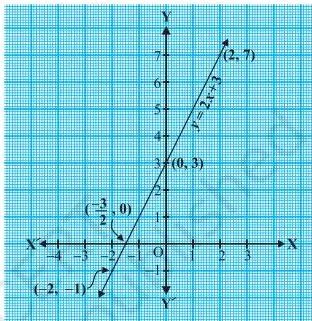
If \(k\) is a zero of \(p(x) = ax + b\), then \(p(k) = ak + b = 0\). Solving gives the zero (NCERT, Section 2.1):
\[ k = -\frac{b}{a} = -\frac{\text{Constant term}}{\text{Coefficient of } x} \]
The graph of \(y = ax + b\) crosses the \(x\)-axis at exactly one point, \(\left(-\frac{b}{a}, 0\right)\), so a linear polynomial has exactly one zero.
Geometrical Meaning of Zeroes
The zeroes of \(p(x)\) are precisely the \(x\)-coordinates of the points where the graph of \(y = p(x)\) intersects the \(x\)-axis (NCERT, Section 2.2). For a quadratic polynomial \(ax^2 + bx + c\), the graph is a parabola. It can cut the \(x\)-axis in two distinct points, touch it at one point, or not meet it at all:
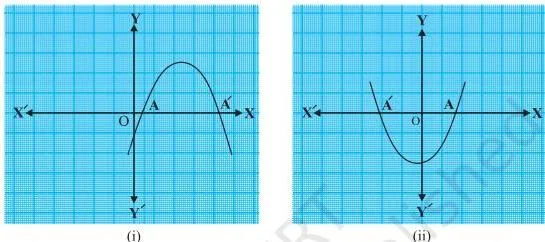
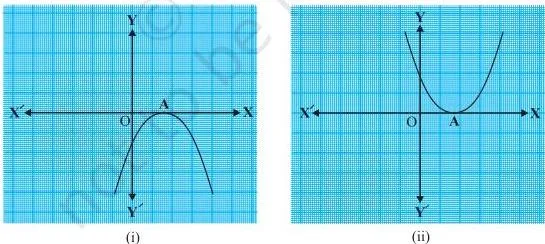
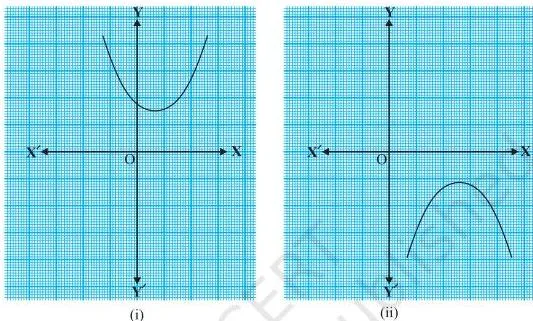
So a quadratic polynomial has either two distinct zeroes, two equal zeroes (one zero), or no zero. In general, a polynomial of degree \(n\) has at most \(n\) zeroes.
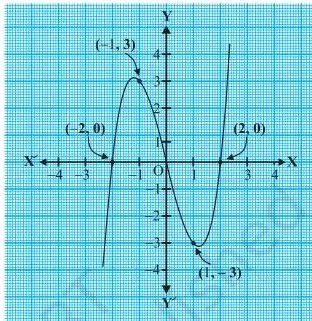
You can read the number of zeroes directly from any polynomial graph by counting the \(x\)-axis intersections, as in the graphs of Example 1 (Fig. 2.9).
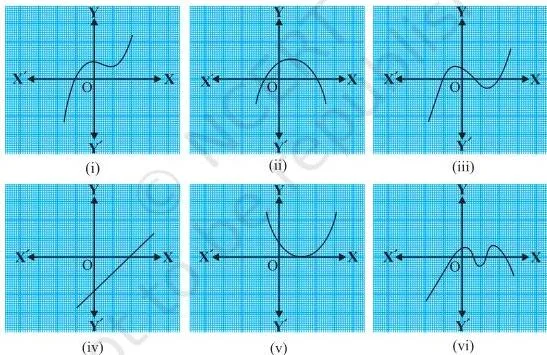
The same counting idea is used in the graphs of Exercise 2.1 (Fig. 2.10).
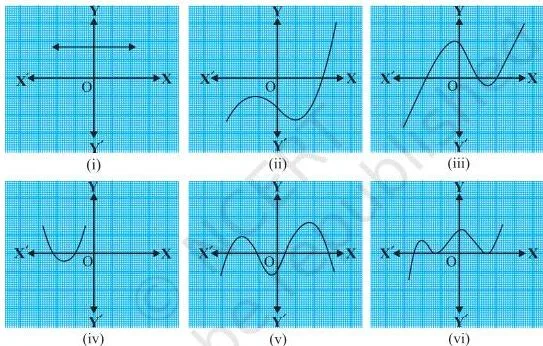
Quadratic Polynomial: Zeroes and Coefficients
If \(\alpha\) and \(\beta\) are the zeroes of \(p(x) = ax^2 + bx + c\), with \(a \neq 0\), then (NCERT, Section 2.3):
\[ \alpha + \beta = -\frac{b}{a}, \qquad \alpha\beta = \frac{c}{a} \]
Why? The polynomial can be written in factored form, where \(k\) is a non-zero real constant equal to the leading coefficient \(a\):
\[ ax^2 + bx + c = k(x-\alpha)(x-\beta) = k[x^2 – (\alpha+\beta)x + \alpha\beta] \]
Comparing coefficients gives \(a = k\), \(b = -k(\alpha+\beta)\) and \(c = k\alpha\beta\), which produces the two relations above.
Cubic Polynomial: Zeroes and Coefficients
If \(\alpha, \beta, \gamma\) are the zeroes of \(p(x) = ax^3 + bx^2 + cx + d\), with \(a \neq 0\), then (NCERT, Section 2.3):
\[ \alpha + \beta + \gamma = -\frac{b}{a} \]
\[ \alpha\beta + \beta\gamma + \gamma\alpha = \frac{c}{a} \]
\[ \alpha\beta\gamma = -\frac{d}{a} \]
For a cubic, the sum of the zeroes, the sum of their products taken two at a time, and the product of all three zeroes are each related to a different coefficient (NCERT, Section 2.4).
What Each Symbol Means
The table below gives the meaning and unit (or nature) of every symbol used in the formulas.
| Symbol | What it means | Unit / nature |
|---|---|---|
| \( p(x) \) | a polynomial in the variable \(x\) | real-valued expression |
| \( x \) | variable of the polynomial | real number |
| \( a, b, c, d \) | coefficients from the general forms; in a quadratic, \(c\) is the constant term; in a cubic, \(c\) is the coefficient of \(x\) and \(d\) is the constant term | real numbers |
| \( k \) | a real number; in \(p(k)\) it is the input value, and in the factored form it is a non-zero constant factor equal to the leading coefficient | real number |
| \( \alpha, \beta \) | zeroes of a quadratic polynomial | real numbers |
| \( \gamma \) | the third zero of a cubic polynomial | real number |
| \( n \) | degree of the polynomial (highest power of \(x\)) | non-negative integer |
When to Use Each Formula
| Formula | Use it when | Condition |
|---|---|---|
| \( k = -\frac{b}{a} \) | you need the zero of \(ax + b = 0\) or the \(x\)-intercept of \(y = ax + b\) | \( a \neq 0 \) |
| \( p(k) = 0 \) | you want to check whether the number \(k\) is a zero of \(p(x)\) | \(k\) is real |
| \( \alpha + \beta = -\frac{b}{a} \), \( \alpha\beta = \frac{c}{a} \) | verifying zeroes of a quadratic polynomial or reading the sum and product directly from its coefficients | \( a \neq 0 \), and \(\alpha, \beta\) are the zeroes |
| \( p(x) = k[x^2 – (\alpha+\beta)x + \alpha\beta] \) | constructing a quadratic polynomial when the sum and product of its zeroes are given | \( k \neq 0 \) |
| \( \alpha+\beta+\gamma = -\frac{b}{a} \), \( \alpha\beta+\beta\gamma+\gamma\alpha = \frac{c}{a} \), \( \alpha\beta\gamma = -\frac{d}{a} \) | verifying zeroes of a cubic polynomial or relating them to its coefficients | \( a \neq 0 \), and \(\alpha, \beta, \gamma\) are the zeroes |
| at most \(n\) zeroes | deciding whether a proposed set of zeroes is possible for a polynomial of degree \(n\) | \(n\) is the degree of the polynomial |
Need a different chapter? Browse the Class 10 Maths formula sheets or return to the main formulas index.
Worked Examples
Three worked examples using original numbers. Practise these formulas on the textbook’s own questions in the NCERT solutions for Polynomials Class 10.
Example 1: Finding Zeroes of a Quadratic Polynomial
Step 1: Take \(p(x) = x^2 – 5x + 6\).
Factorise by splitting the middle term.
\[ x^2 – 5x + 6 = (x-2)(x-3) \]
Step 2: So the zeroes are \(\alpha = 2\) and \(\beta = 3\).
Compare with \(ax^2 + bx + c\): \(a = 1\), \(b = -5\), \(c = 6\).
Step 3: Verify the two coefficient relations.
\[ \alpha + \beta = 2 + 3 = 5 = \frac{-(-5)}{1} = -\frac{b}{a} \]
\[ \alpha\beta = 2 \times 3 = 6 = \frac{6}{1} = \frac{c}{a} \]
Final answer: the zeroes are 2 and 3, and both sum and product match the coefficients.
Example 2: Constructing a Quadratic Polynomial from Sum and Product of Zeroes
Step 1: Given \(\alpha + \beta = \frac{5}{2}\) and \(\alpha\beta = 1\), use the factored form \(p(x) = k[x^2 – (\alpha+\beta)x + \alpha\beta]\).
\[ p(x) = k\left[x^2 – \frac{5}{2}x + 1\right] \]
Step 2: Choose \(k = 2\) to clear the fraction.
\[ 2x^2 – 5x + 2 \]
Step 3: Check: \(2x^2 – 5x + 2 = (2x-1)(x-2)\), so the zeroes are \(\frac{1}{2}\) and 2.
Their sum is \(\frac{5}{2}\) and their product is 1.
Final answer: \(2x^2 – 5x + 2\) works; in fact, \(k\left[x^2 – \frac{5}{2}x + 1\right]\) works for any non-zero real \(k\).
Example 3: Verifying the Zero–Coefficient Relations of a Cubic Polynomial
Step 1: Take \(p(x) = x^3 – 6x^2 + 11x – 6\).
Compare with \(ax^3 + bx^2 + cx + d\): \(a = 1\), \(b = -6\), \(c = 11\), \(d = -6\).
Step 2: Check the proposed zeroes \(\alpha = 1\), \(\beta = 2\), \(\gamma = 3\).
\[ \alpha + \beta + \gamma = 1 + 2 + 3 = 6 = \frac{-(-6)}{1} = -\frac{b}{a} \]
\[ \alpha\beta + \beta\gamma + \gamma\alpha = 2 + 6 + 3 = 11 = \frac{11}{1} = \frac{c}{a} \]
\[ \alpha\beta\gamma = 1 \times 2 \times 3 = 6 = \frac{-(-6)}{1} = -\frac{d}{a} \]
Final answer: 1, 2 and 3 are the zeroes, and all three cubic relations hold.
Common Mistakes to Avoid
| Mistake | Correct rule | How to check your answer |
|---|---|---|
| Writing \(\alpha + \beta = \frac{b}{a}\) and forgetting the minus sign. | \(\alpha + \beta = -\frac{b}{a}\). | For \(x^2 – 5x + 6\), zeroes 2 and 3 give sum 5, and \(-(-5)/1 = 5\). |
| Writing \(\alpha\beta = -\frac{c}{a}\). | The product of zeroes keeps the positive sign: \(\alpha\beta = \frac{c}{a}\). | For \(x^2 – 5x + 6\), the product of 2 and 3 is 6, not \(-6\). |
| Using \(\frac{b}{a}\) without the negative sign for a linear polynomial. | The zero of \(ax + b\) is \(-\frac{b}{a}\). | For \(2x + 3\), the zero is \(-3/2\), not \(3/2\). |
| Assuming every quadratic polynomial must have two zeroes. | A quadratic can have two distinct zeroes, one zero (two equal zeroes), or no zero. | Check the graph: count the actual \(x\)-axis intersections. |
| Putting a negative sign on the cubic pairwise-sum relation. | \(\alpha\beta + \beta\gamma + \gamma\alpha = \frac{c}{a}\), with no minus sign. | For \(x^3 – 6x^2 + 11x – 6\) with zeroes 1, 2, 3, the pairwise sum is \(11 = 11/1\). |
Frequently Asked Questions
What is a zero of a polynomial?
A real number \(k\) is a zero of \(p(x)\) when \(p(k) = 0\). Geometrically, it is the \(x\)-coordinate of a point where the graph of \(y = p(x)\) meets the \(x\)-axis.
Why is the sum of zeroes \(-b/a\) and not \(b/a\)?
When you expand \(k(x-\alpha)(x-\beta)\), the coefficient of \(x\) is \(-k(\alpha+\beta)\). Since this coefficient is \(b\) and \(k = a\), solving gives \(\alpha + \beta = -b/a\).
Can a quadratic polynomial have three zeroes?
No. A polynomial of degree \(n\) has at most \(n\) zeroes, so a quadratic polynomial (degree 2) has at most two zeroes.
How do I form a quadratic polynomial when only the sum and product of zeroes are given?
Use \(p(x) = k[x^2 – (\alpha+\beta)x + \alpha\beta]\) with any non-zero real \(k\). Choosing \(k = 1\) gives the simplest monic polynomial.
Reference: NCERT Class 10 Mathematics textbook, chapter Polynomials.
Explore Class 10 Maths Formulas
More for this chapter:
Class 10 Maths on LearnCBSE:
Related chapters:
Official source: download the NCERT textbook free from ncert.nic.in.