This page gathers the coordinate geometry class 10 formulas from NCERT Mathematics, Chapter 7: the distance between two points, distance from the origin, the section formula in its \( k : 1 \) form, the midpoint formula, and the rhombus-area result used in the exercises.
Each formula is grouped by topic with symbol meanings, when-to-use guidance, worked examples and chapter-specific common mistakes. The derivations and full explanations are on the Coordinate Geometry Class 10 notes; this sheet only keeps what you need to apply them. It is part of the Class 10 Maths formulas collection.
Formulas at a Glance
Six results carry the chapter: the distance formula (with its origin special case), the section formula in two forms, the midpoint, and the rhombus-area hint from Exercise 7.2.
| Purpose | Formula |
|---|---|
| Distance between two points | \( PQ = \sqrt{(x_2 – x_1)^2 + (y_2 – y_1)^2} \) |
| Distance of a point from the origin (special case of the distance formula) | \( OP = \sqrt{x^2 + y^2} \) |
| Point dividing a segment internally in the ratio \( m_1 : m_2 \) | \( \left( \frac{m_1 x_2 + m_2 x_1}{m_1 + m_2}, \frac{m_1 y_2 + m_2 y_1}{m_1 + m_2} \right) \) |
| Same division when the ratio is \( k : 1 \) (derived from the section formula) | \( \left( \frac{k x_2 + x_1}{k + 1}, \frac{k y_2 + y_1}{k + 1} \right) \) |
| Mid-point of a segment (section formula with ratio \( 1 : 1 \)) | \( \left( \frac{x_1 + x_2}{2}, \frac{y_1 + y_2}{2} \right) \) |
| Area of a rhombus (hint given in Exercise 7.2) | \( \text{Area} = \frac{1}{2} \times d_1 \times d_2 \) |
All Formulas, Grouped by Topic
Distance Formula (Section 7.2)
The distance between two points \( P(x_1, y_1) \) and \( Q(x_2, y_2) \) is (NCERT, p. 103):
\[ PQ = \sqrt{(x_2 – x_1)^2 + (y_2 – y_1)^2} \]
The differences are squared, so the order of subtraction does not matter. The textbook gives the equivalent form \( PQ = \sqrt{(x_1 – x_2)^2 + (y_1 – y_2)^2} \) (NCERT, p. 103). Take only the positive square root: distance is never negative.
Distance of a point \( P(x, y) \) from the origin \( O(0, 0) \) is the special case with \( x_1 = 0 \), \( y_1 = 0 \) (NCERT, p. 103):
\[ OP = \sqrt{x^2 + y^2} \]
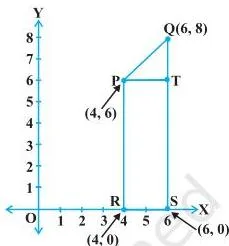
Figure 7.3 shows the construction behind the formula. Perpendiculars from P and Q meet the x-axis at R and S; a perpendicular from P meets QS at T. Then \( PT = x_2 – x_1 \) and \( QT = y_2 – y_1 \), so Pythagoras theorem on right triangle PTQ gives \( PQ^2 = PT^2 + QT^2 \).
The formula also works when the points lie in different quadrants. For P(6, 4) and Q(-5, -3) in Fig. 7.4, the horizontal gap is \( 6 – (-5) = 11 \) units and the vertical gap is \( 4 – (-3) = 7 \) units, so \( PQ = \sqrt{11^2 + 7^2} = \sqrt{170} \) units.
Section Formula (Section 7.3)
If \( P(x, y) \) divides the segment joining \( A(x_1, y_1) \) and \( B(x_2, y_2) \) internally with \( PA : PB = m_1 : m_2 \), then (NCERT, p. 108):
\[ \left( \frac{m_1 x_2 + m_2 x_1}{m_1 + m_2}, \frac{m_1 y_2 + m_2 y_1}{m_1 + m_2} \right) \]
Pairing: \( m_1 \) (the part beside A) multiplies the coordinates of B, and \( m_2 \) multiplies the coordinates of A.
Working form — the derivation of Section 7.3 sets up the proportional relation \[ \frac{x – x_1}{x_2 – x} = \frac{y – y_1}{y_2 – y} = \frac{m_1}{m_2} \]
Use this equation when the ratio is the unknown. With the ratio written as \( k : 1 \), the coordinates become (NCERT, p. 108):
\[ \left( \frac{k x_2 + x_1}{k + 1}, \frac{k y_2 + y_1}{k + 1} \right) \]
Midpoint formula — a midpoint divides the segment in the ratio \( 1 : 1 \), so \( m_1 + m_2 = 2 \) and (NCERT, p. 108):
\[ \left( \frac{x_1 + x_2}{2}, \frac{y_1 + y_2}{2} \right) \]
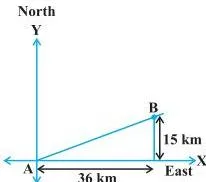
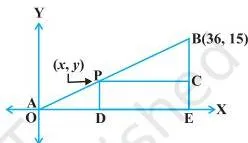
The relay tower problem in Fig. 7.9 is the chapter’s motivating example: a tower at P must sit between A and B so that its distance from B is twice its distance from A, i.e., \( AP : PB = 1 : 2 \). Taking A as the origin and B(36, 15), the section formula gives P(12, 5).
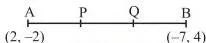
Points of trisection split a segment into three equal parts. In Fig. 7.11, \( AP = PQ = QB \), so P divides AB in the ratio \( 1 : 2 \) and Q divides it in the ratio \( 2 : 1 \) — apply the section formula twice.
This chapter covers internal division only — the dividing point lying between A and B. External division (the point outside the segment) is mentioned in the textbook only to note that it is studied in higher classes (NCERT, “A Note to the Reader”).
Area of a Rhombus (Exercise 7.2 hint)
Exercise 7.2 (Q10) gives the hint that the area of a rhombus is half the product of its diagonals. Find each diagonal with the distance formula, then apply:
\[ \text{Area} = \frac{1}{2} \times d_1 \times d_2 \]
What Each Symbol Means
| Symbol | What it means | Unit / nature |
|---|---|---|
| \( (x_1, y_1) \) | Coordinates of the first point (A or P) | Ordered pair of directed distances (lengths) |
| \( (x_2, y_2) \) | Coordinates of the second point (B or Q) | Ordered pair of directed distances (lengths) |
| \( x, y \) | Coordinates of the dividing point P | Ordered pair of directed distances (lengths) |
| \( x_1, x_2 \) | Abscissae — distances of the points from the y-axis | Length in the chosen unit |
| \( y_1, y_2 \) | Ordinates — distances of the points from the x-axis | Length in the chosen unit |
| \( PQ, OP, AB \) | Distances between the named pairs of points | Length, always non-negative |
| \( m_1, m_2 \) | Parts of the ratio \( m_1 : m_2 \), with \( PA : PB = m_1 : m_2 \) | Dimensionless ratio |
| \( k \) | The ratio written as \( k : 1 \), i.e., \( k = m_1 / m_2 \) | Dimensionless number |
| \( d_1, d_2 \) | Lengths of the two diagonals of a rhombus | Length |
| abscissa / ordinate | x-coordinate (distance from the y-axis) / y-coordinate (distance from the x-axis), NCERT p. 100 | Length |
When to Use Each Formula
| Tool | Reach for it when… | Condition that must hold |
|---|---|---|
| Distance formula | You know the coordinates of two points and need the length between them | Works for points in any quadrant; take the positive square root |
| Distance from origin | One point is the origin and you need the length from the origin to \( P(x, y) \) | Special case of the distance formula with \( x_1 = y_1 = 0 \) |
| Collinearity check | You must decide whether three points lie on one straight line | Compute AB, BC, AC; if the largest equals the sum of the other two (e.g., \( AB + BC = AC \)), the points are collinear (Example 3, Section 7.2) |
| Triangle / right-triangle check | You must decide whether three points form a triangle and what type | Triangle: sum of any two sides exceeds the third; right triangle: \( a^2 + b^2 = c^2 \) by the converse of Pythagoras theorem (Example 1) |
| Quadrilateral check | Four points are given and you must name the shape | Square: all four sides equal and both diagonals equal (Example 2); parallelogram: diagonals bisect each other, so their midpoints coincide (Example 10) |
| Section formula \( m_1 : m_2 \) | A point divides a segment internally in a given ratio and you need its coordinates | The point must lie between A and B; write the ratio in the order \( PA : PB \) |
| Section formula \( k : 1 \) | The ratio is the unknown (e.g., “in what ratio does the y-axis divide the segment?”) or is already written as \( k : 1 \) | Set one coordinate equal to its known value (0 on the y-axis or x-axis), solve for k, then check the other coordinate |
| Midpoint formula | You need the halfway point, the centre of a circle from the ends of a diameter, or a parallelogram vertex from its diagonals | Division ratio is \( 1 : 1 \) |
| Area of a rhombus | The vertices or diagonals of a rhombus are given and you need its area | Find diagonal lengths with the distance formula first; \( \text{Area} = \frac{1}{2} \times d_1 \times d_2 \) |
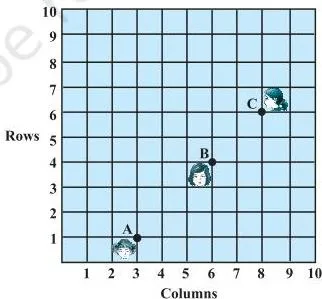
The collinearity check is exactly what settles the classroom-seating question in Fig. 7.6. The desks at \( A(3, 1) \), \( B(6, 4) \) and \( C(8, 6) \) give \( AB = 3\sqrt{2} \), \( BC = 2\sqrt{2} \) and \( AC = 5\sqrt{2} \); since \( AB + BC = AC \), the three seats lie on one line.
Worked Examples
Three lookups that cover the main patterns. For step-by-step answers to the textbook’s own questions, see the Chapter 7 coordinate geometry NCERT solutions.
Example 1: Distance between two points
Step 1: Find the distance between \( A(1, 2) \) and \( B(5, 5) \).
Choose the distance formula with \( x_1 = 1, y_1 = 2, x_2 = 5, y_2 = 5 \).
\[ AB = \sqrt{(x_2 – x_1)^2 + (y_2 – y_1)^2} = \sqrt{(5 – 1)^2 + (5 – 2)^2} \]
\[ = \sqrt{4^2 + 3^2} = \sqrt{16 + 9} = \sqrt{25} = 5 \]
Final answer: \( AB = 5 \) units.
Example 2: Finding the ratio with the k : 1 form
Step 1: \( P(0, 3) \) divides the segment joining \( A(-3, 5) \) and \( B(6, -1) \).
The ratio is unknown, so write it as \( k : 1 \) and use \( \left( \frac{k x_2 + x_1}{k + 1}, \frac{k y_2 + y_1}{k + 1} \right) \) with \( (x_1, y_1) = (-3, 5) \) and \( (x_2, y_2) = (6, -1) \).
Step 2: P lies on the y-axis, so its x-coordinate is 0.
Set the x-coordinate of the formula equal to 0:
\[ 0 = \frac{6k + (-3)}{k + 1} \Rightarrow 6k = 3 \Rightarrow k = \frac{1}{2} \]
Step 3: Check the y-coordinate with \( k = \frac{1}{2} \):
\[ \frac{k(-1) + 5}{k + 1} = \frac{-\frac{1}{2} + 5}{\frac{1}{2} + 1} = \frac{\frac{9}{2}}{\frac{3}{2}} = 3 \]
Final answer: the ratio is \( \frac{1}{2} : 1 \), i.e., \( 1 : 2 \).
Example 3: Midpoint formula used backwards
Step 1: The centre of a circle is \( C(3, -2) \) and one end of a diameter is \( B(1, 4) \).
The centre is the midpoint of the diameter, so let the other end be \( A(x, y) \) and apply the midpoint formula:
\[ \left( \frac{x + 1}{2}, \frac{y + 4}{2} \right) = (3, -2) \]
Step 2: Equate the coordinates and solve:
\[ \frac{x + 1}{2} = 3 \Rightarrow x = 5; \quad \frac{y + 4}{2} = -2 \Rightarrow y = -8 \]
Final answer: the other end is \( A(5, -8) \). Check: midpoint of \( (5, -8) \) and \( (1, 4) \) is \( \left( \frac{5 + 1}{2}, \frac{-8 + 4}{2} \right) = (3, -2) \), the given centre.
Common Mistakes to Avoid
| Mistake | Correct rule | How to check your answer |
|---|---|---|
| Swapping the ratio parts in the section formula | With \( PA : PB = m_1 : m_2 \), \( m_1 \) multiplies the coordinates of B and \( m_2 \) those of A | Try the midpoint case \( 1 : 1 \): the formula must give the average \( \left( \frac{x_1 + x_2}{2}, \frac{y_1 + y_2}{2} \right) \) |
| Ignoring a negative coordinate inside the distance formula | Subtract inside the brackets and square: \( (x_2 – x_1)^2 \) keeps the sign before squaring | Recompute with the order reversed, \( (x_1 – x_2)^2 \); both must give the same value |
| Writing the midpoint as a difference | The midpoint averages: add the coordinates, then halve — not \( \frac{x_2 – x_1}{2} \) | For \( (0, 0) \) and \( (6, 8) \) the midpoint must be \( (3, 4) \), the visible middle of the segment |
| Taking the negative square root | Distance is a length, so only the positive square root is taken (NCERT, p. 103) | A negative distance is impossible — the same squared value always yields the same positive root |
| Putting a point on the x-axis as \( (0, y) \) or on the y-axis as \( (x, 0) \) | The x-axis consists of points \( (x, 0) \); the y-axis consists of points \( (0, y) \) | In an equidistant problem, substitute your point back into the distance formula twice — the two distances must come out equal |
Frequently Asked Questions
What is the difference between the distance formula and the section formula?
The distance formula gives a length — how far apart two points are. The section formula gives a position — the coordinates of a point that divides the join of two points in a given ratio. Both work from the same four coordinates, but they answer different questions.
When should I use the k : 1 form?
Whenever the ratio is the unknown, or the question already phrases it as \( k : 1 \) — for example “in what ratio does the y-axis divide the segment?”. Set one coordinate of the formula equal to its known value (for the y-axis, \( x = 0 \)), solve for k, then substitute back to check the other coordinate.
How do I test whether three points are collinear?
Find the three distances with the distance formula. If the largest distance equals the sum of the other two — \( AB + BC = AC \) — the points lie on one line (Example 3, Section 7.2). If that equality fails, the three points form a triangle.
Is external division part of this chapter?
No. The section formula in this chapter is for internal division, where the dividing point lies between A and B. The textbook’s note to the reader states that external division — the point lying outside the segment — is studied in higher classes.
All formulas on this sheet follow the rationalised NCERT Class 10 Mathematics textbook, Chapter 7 (Coordinate Geometry). You can verify any formula in the official textbook on the NCERT e-textbook portal, and find the other chapters’ sheets on the maths formulas index.
Reference: NCERT Class 10 Mathematics textbook, chapter Coordinate Geometry.
Explore Class 10 Maths Formulas
More for this chapter:
Class 10 Maths on LearnCBSE:
Related chapters: