This chapter covers the key formulas for areas of sectors, segments, and arcs of a circle — quantities you’ll use to find the area of a slice of a circle, the length of a curved boundary, or the region between a chord and its arc.
All formulas are derived from the area \(\pi r^2\) and circumference \(2\pi r\) of a circle of radius \(r\).
Each formula below is grouped by topic, with the meaning of every symbol, when to use it, and original worked examples. For the full explanations and derivations, see the Areas Related to Circles Class 10 notes.
Formulas at a Glance
| Purpose (what you are finding) | Formula |
|---|---|
| Area of a sector of angle \(\theta\) | \(\displaystyle \frac{\theta}{360} \times \pi r^2\) |
| Length of an arc of a sector of angle \(\theta\) | \(\displaystyle \frac{\theta}{360} \times 2\pi r\) |
| Area of the minor segment (when chord subtends angle \(\theta\) at centre) | \(\displaystyle \frac{\theta}{360} \pi r^2 – \text{area of }\triangle\) |
| Area of the major sector | \(\pi r^2 – \text{area of minor sector}\) |
| Area of the major segment | \(\pi r^2 – \text{area of minor segment}\) |
All Formulas, Grouped by Topic
Area of a Sector
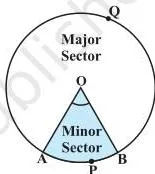
For a circle of radius \(r\) and a sector whose central angle is \(\theta\) (in degrees):
\[ \text{Area of sector} = \frac{\theta}{360} \times \pi r^2 \]
This follows from the unitary method: the full circle (\(360^\circ\)) has area \(\pi r^2\), so a \(\theta^\circ\) sector gets the fraction \(\frac{\theta}{360}\) of that area.
Length of an Arc
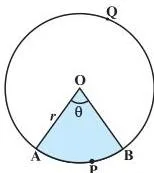
For the same sector, the length of the arc (the curved part of the boundary) is:
\[ \text{Length of arc} = \frac{\theta}{360} \times 2\pi r \]
Again, the full circumference is \(2\pi r\), and the arc takes the same fraction \(\frac{\theta}{360}\).
Area of a Segment
A segment is the region between a chord and its arc. The minor segment (the smaller one) is found by subtracting the triangle formed by the two radii and the chord from the sector:
\[ \text{Area of minor segment} = \frac{\theta}{360} \pi r^2 – \text{area of } \triangle OAB \]
where the triangle \(OAB\) has sides \(r, r\) and included angle \(\theta\). Its area can be computed as \(\frac{1}{2}r^2 \sin\theta\) (when \(\theta\) is in degrees, use \(\sin\theta\) with the degree value).
The major sector and major segment are simply the remainders after subtracting the minor parts from the whole circle:
\[ \text{Area of major sector} = \pi r^2 – \text{area of minor sector} \]
\[ \text{Area of major segment} = \pi r^2 – \text{area of minor segment} \]
Alternatively, the major sector area can be written directly as \(\frac{360-\theta}{360} \pi r^2\).
What Each Symbol Means
| Symbol | What it means | Unit / nature |
|---|---|---|
| \(r\) | Radius of the circle | Length (cm, m, etc.) |
| \(\theta\) | Central angle of the sector (in degrees) | Degrees (\(^\circ\)) |
| \(\pi\) | Pi (≈ 3.14 or \(\frac{22}{7}\) depending on the problem) | Dimensionless constant |
| \(\triangle OAB\) | Area of the triangle formed by the two radii and the chord | Area (same unit as \(r^2\)) |
When to Use Each Formula
- Area of a sector – Use when you need the area of the slice of a circle bounded by two radii and the arc (e.g., a slice of pizza). The only condition is that \(\theta\) is given in degrees.
- Length of an arc – Use when you need the curved distance along the circle’s circumference between two radii (e.g., the length of the minute hand’s path).
- Area of a minor segment – Use when you need the area enclosed between a chord and its corresponding arc. Subtract the triangle area from the sector area. The triangle area can be found using \(\frac{1}{2}r^2 \sin\theta\) or by geometry (e.g., when the chord subtends a special angle like \(60^\circ, 90^\circ, 120^\circ\)).
- Major sector / major segment – Use when the region is the larger part of the circle (the remainder after removing the minor part). Always subtract the minor part from the full circle area.
Worked Examples
Example 1: Area of a sector directly
A circle has radius 7 cm. Find the area of a sector whose central angle is \(45^\circ\). Use \(\pi = \frac{22}{7}\).
Formula: \(\displaystyle \text{Area} = \frac{\theta}{360} \times \pi r^2\) Substitution: \(\theta = 45^\circ,\; r = 7\, \text{cm},\; \pi = \frac{22}{7}\)
\[ \text{Area} = \frac{45}{360} \times \frac{22}{7} \times 7 \times 7 \, \text{cm}^2 \]
\[ = \frac{1}{8} \times 22 \times 7 \, \text{cm}^2 \]
\[ = \frac{154}{8} \, \text{cm}^2 = 19.25\, \text{cm}^2 \]
Answer: \(19.25\, \text{cm}^2\).
Example 2: Length of an arc
A circle of radius 10 cm has a sector that subtends \(60^\circ\) at the centre. Find the length of the arc. Use \(\pi = 3.14\).
Formula: \(\displaystyle \text{Arc length} = \frac{\theta}{360} \times 2\pi r\) Substitution: \(\theta = 60^\circ,\; r = 10\, \text{cm},\; \pi = 3.14\)
\[ \text{Arc length} = \frac{60}{360} \times 2 \times 3.14 \times 10 \, \text{cm} \]
\[ = \frac{1}{6} \times 62.8 \, \text{cm} \]
\[ \approx 10.47\, \text{cm} \]
Answer: \(10.47\, \text{cm}\) (approx.).
Example 3: Area of a minor segment
A chord of a circle of radius 8 cm subtends an angle of \(90^\circ\) at the centre. Find the area of the minor segment. Use \(\pi = 3.14\).
Step 1: Area of sector
\[ \text{Area of sector} = \frac{90}{360} \times 3.14 \times 8^2 \, \text{cm}^2 = \frac{1}{4} \times 3.14 \times 64 \, \text{cm}^2 = 50.24\, \text{cm}^2 \]
Step 2: Area of triangle (the triangle formed by the two radii and the chord is a right-angled isosceles triangle with legs = 8 cm)
\[ \text{Area of } \triangle = \frac{1}{2} \times 8 \times 8 \, \text{cm}^2 = 32\, \text{cm}^2 \]
Step 3: Area of minor segment
\[ \text{Area} = 50.24 – 32 = 18.24\, \text{cm}^2 \]
Answer: \(18.24\, \text{cm}^2\).
Common Mistakes to Avoid
| Mistake | Correct rule | How to check your answer |
|---|---|---|
| Using the angle in radians instead of degrees in the sector formula. | The formula \(\frac{\theta}{360} \pi r^2\) assumes \(\theta\) is in degrees. If the problem gives radians, convert to degrees first. | Verify that the sector area is less than \(\pi r^2\) (for \(\theta \lt 360^\circ\)). If it’s much larger, you likely used radians. |
| Forgetting to subtract the triangle area when finding the segment area. | Segment area = sector area – triangle area. The triangle is the region bounded by the two radii and the chord. | Draw a rough sketch: the segment is the curved part; the triangle is the straight part inside the sector. |
| Confusing major sector with minor sector when the angle is large. | The minor sector corresponds to the central angle \(\theta\) if \(\theta \lt 180^\circ\). The major sector has angle \(360^\circ – \theta\). | Check which region is smaller: the minor sector is always the smaller one. |
| Using \(\pi = \frac{22}{7}\) when the problem specifies \(\pi = 3.14\), or vice versa. | Always use the value of \(\pi\) stated in the problem. If no value is given, you may use either, but be consistent. | Read the problem statement carefully; it usually says “Use \(\pi = \frac{22}{7}\)” or “Use \(\pi = 3.14\)”. |
Frequently Asked Questions
What is the formula for area of a quadrant of a circle?
A quadrant is a sector with angle \(90^\circ\). So its area is \(\frac{90}{360} \pi r^2 = \frac{1}{4} \pi r^2\).
Can I use the same arc length formula for any part of the circle?
Yes, the formula \(\frac{\theta}{360} \times 2\pi r\) works for any arc that corresponds to a central angle \(\theta\) in degrees. For a semicircle (\(\theta = 180^\circ\)), the arc length is \(\frac{1}{2} \times 2\pi r = \pi r\).
How do I find the area of a segment when the angle is \(120^\circ\)?
First find the area of the sector. Then find the area of the triangle using \(\frac{1}{2} r^2 \sin 120^\circ = \frac{1}{2} r^2 \times \frac{\sqrt{3}}{2}\). Subtract the triangle area from the sector area. The formula works for any angle.
What if the chord is a diameter?
If the chord is a diameter, the central angle is \(180^\circ\). The segment is actually a semicircle (the minor segment is the same as the major segment). The area of the segment = area of semicircle – area of triangle formed by the two radii.
But the triangle would have zero area (collinear points), so the segment area equals the sector area = \(\frac{1}{2} \pi r^2\).
Reference: NCERT Class 10 Mathematics textbook, chapter Areas Related to Circles.
Explore Class 10 Maths Formulas
More for this chapter:
Class 10 Maths on LearnCBSE:
Related chapters:
Official source: download the NCERT textbook free from ncert.nic.in.