
These metals and non metals class 10 notes cover NCERT Class 10 Science Chapter 3 in the order you need for revision: physical properties first, then the chemical reactions that build the reactivity series, then ionic bonding and extraction of metals, and finally corrosion.
Almost every section in this chapter leans on one idea — the activity series, the ranking of metals from most reactive to least reactive. Once you know where a metal sits in that series, you can predict how it reacts with oxygen, water and acids, which method will extract it from its ore, and even why it corrodes or resists corrosion.
CBSE board papers usually pull at least one reasoning (‘give reasons’) question and one equation-writing question from this chapter, so both are covered here with worked steps (NCERT, p. 1).
What Chapter 3 Covers and Why the Activity Series Runs Through All of It
The chapter has three connected parts. Part one looks at physical and chemical properties that separate metals from non-metals. Part two explains ionic bonding — how metals and non-metals combine by transferring electrons — and how this knowledge is used to extract metals from ores. Part three deals with corrosion, its causes and how it is prevented.
The link between all three parts is reactivity: a metal’s position in the activity series decides its chemical behaviour, its extraction method, and how easily it corrodes.
Physical Properties: Lustre, Malleability, Ductility, Sonority — and Where the Exceptions Break the Rule
Activities 3.1 to 3.7 in the textbook test six physical properties by handling real metal and non-metal samples.
Metals, in their pure state, show a shining surface called metallic lustre, and most are hard, malleable (can be hammered into sheets), ductile (can be drawn into wires), good conductors of heat and electricity, and sonorous — meaning they produce a ringing sound when struck (NCERT, p. 1–2). Non-metals generally show the opposite set of properties.
The exam trap here is simple: if a question asks you to name a property common to all metals, you are also expected to know the exception. The table below lists both.
| Property | Typical metals | Typical non-metals | Exception to remember |
|---|---|---|---|
| Physical state | Solid at room temperature | Solid or gas | Mercury is a liquid metal; bromine is a liquid non-metal; gallium and caesium melt if kept on your palm (NCERT, p. 3) |
| Lustre | Shiny when freshly cut | Dull surface | Iodine is a lustrous non-metal (p. 3) |
| Hardness | Generally hard | Usually soft or brittle | Alkali metals (lithium, sodium, potassium) are soft enough to cut with a knife (p. 3) |
| Malleability / Ductility | Can be hammered into sheets and drawn into wires | Neither malleable nor ductile | None major — this is a genuinely reliable metal property |
| Conduction (heat and electricity) | Good conductors; silver and copper conduct heat best | Poor conductors | Graphite, a non-metal, conducts electricity (p. 3) |
| Sonority | Produce sound on striking (used for bells) | Do not | None recorded in this chapter |
Why the exceptions matter: carbon exists as different allotropes (forms of the same element with different structures) — diamond is the hardest natural substance with a very high melting point, while graphite conducts electricity, so ‘carbon’ cannot be described with one blanket statement (p. 3). You can read more about carbon’s structures in these Class 10 Carbon and its Compounds notes.
Reactions of Metals with Oxygen, Water and Acids: How the Activity Series Is Built
Activities 3.9 to 3.11 test three separate reagents — oxygen, water and dilute acid — and stack the results together to rank metals from most to least reactive.
With oxygen: almost all metals form a metal oxide on burning.
\[ 2\text{Cu} + \text{O}_2 \rightarrow 2\text{CuO} \]
\[ 4\text{Al} + 3\text{O}_2 \rightarrow 2\text{Al}_2\text{O}_3 \]
Most metal oxides are basic, but aluminium oxide and zinc oxide react with both acids and bases to give a salt and water — these are called amphoteric oxides (p. 5).
\[ \text{Al}_2\text{O}_3 + 6HCl \rightarrow 2AlCl_3 + 3H_2O \]
\[ \text{Al}_2\text{O}_3 + 2NaOH \rightarrow 2NaAlO_2 + H_2O \]
Sodium oxide and potassium oxide are unusual because they dissolve in water to form alkalis directly (p. 5):
\[ Na_2O\text{(s)} + H_2O\text{(l)} \rightarrow 2NaOH\text{(aq)} \]
With water: reactivity decides how violently a metal reacts. Potassium and sodium react so vigorously with cold water that the heat released ignites the hydrogen gas produced (p. 6):
\[ 2K\text{(s)} + 2H_2O\text{(l)} \rightarrow 2KOH\text{(aq)} + H_2\text{(g)} + \text{heat} \]
Calcium reacts less violently and starts floating because hydrogen bubbles stick to its surface; magnesium does not react with cold water but reacts with hot water; aluminium and iron do not react with cold or hot water but do react with steam:
\[ 2Al\text{(s)} + 3H_2O\text{(g)} \rightarrow Al_2O_3\text{(s)} + 3H_2\text{(g)} \]
\[ 3Fe\text{(s)} + 4H_2O\text{(g)} \rightarrow Fe_3O_4\text{(s)} + 4H_2\text{(g)} \]
Lead, copper, silver and gold do not react with water in any form (p. 6).
With dilute acids: reactive metals displace hydrogen from a dilute acid to form a salt and hydrogen gas. The rate of bubble formation in Activity 3.11 places the order as magnesium fastest, followed by aluminium, zinc and iron, while copper does not react with dilute HCl at all (p. 7–8).
Two points examiners like to test here: dilute nitric acid does not release hydrogen gas with most metals because HNO3 is a strong oxidising agent — it oxidises the hydrogen formed into water and is itself reduced to a nitrogen oxide. The only exceptions are magnesium and manganese, which do release hydrogen with very dilute nitric acid (p. 8).
Putting all three tests together gives the reactivity or activity series (Table 3.2 in the textbook), which you must be able to reproduce from memory:
| Order | Metal | Reactivity trend |
|---|---|---|
| 1 | Potassium (K) | Most reactive → decreasing |
| 2 | Sodium (Na) | |
| 3 | Calcium (Ca) | |
| 4 | Magnesium (Mg) | |
| 5 | Aluminium (Al) | |
| 6 | Zinc (Zn) | |
| 7 | Iron (Fe) | → Least reactive |
| 8 | Lead (Pb) | |
| 9 | [Hydrogen] | |
| 10 | Copper (Cu) | |
| 11 | Mercury (Hg) | |
| 12 | Silver (Ag) | |
| 13 | Gold (Au) | Least reactive |
(NCERT, p. 9). You can check whether an acid-reaction rule applies by seeing this table alongside the acid concepts in the Acids, Bases and Salts notes.
Displacement Reactions and Reading the Reactivity Series Correctly
Some metals — like copper, iron, zinc — do not react with water in ways that clearly separate them by reactivity. Activity 3.12 solves this by placing a copper wire in iron sulphate solution and an iron nail in copper sulphate solution.
After twenty minutes, the iron nail gets coated with reddish copper, but the copper wire in iron sulphate shows no change (p. 8–9). This tells us iron is more reactive than copper, because a more reactive metal can push a less reactive metal out of its salt solution.
This is the same displacement reaction idea introduced earlier — see the Chemical Reactions and Equations notes for the general pattern. The rule to remember for every ‘which metal is more reactive’ question:
\[ \text{Metal A} + \text{Salt solution of B} \rightarrow \text{Salt solution of A} + \text{Metal B} \]
This works only when A is more reactive than B (p. 9).
Ionic Bond Formation: Sodium Chloride and Magnesium Chloride Step by Step
Elements react to attain a stable, completely filled outer shell — the same arrangement found in noble gases. This is why sodium (2, 8, 1) loses its one outer electron rather than gaining seven, and chlorine (2, 8, 7) gains one electron rather than losing seven — whichever route needs fewer electrons moved is the one the atom takes (p. 10).
When sodium loses an electron it becomes a positively charged Na+ ion; when chlorine gains that electron it becomes a negatively charged Cl– ion. The oppositely charged ions then attract each other by strong electrostatic force to form sodium chloride.
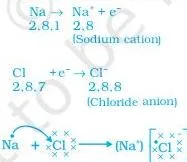
A key point examiners check: sodium chloride does not exist as individual NaCl molecules — it exists as a large, repeating aggregate of Na+ and Cl– ions held together by ionic bonds (p. 11).
Magnesium (2, 8, 2) needs to lose two electrons to reach a stable octet, so it needs two chlorine atoms — each accepting one electron — to form magnesium chloride, MgCl2.
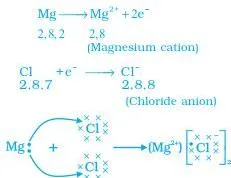
Compounds formed this way, by transfer of electrons from a metal to a non-metal, are called ionic or electrovalent compounds (p. 12).
Properties of Ionic Compounds: Why They Melt High but Conduct Only in Solution or Molten State
Activity 3.13 heats salt samples and tests their solubility and conductivity. The results give four general properties of ionic compounds (p. 12–13):
- Physical nature: solids that are somewhat hard but brittle, because the strong attraction between oppositely charged ions holds them in a rigid structure that shatters rather than bends under pressure.
- Melting and boiling points: high, because breaking the strong inter-ionic force of attraction needs a large amount of energy.
- Solubility: generally soluble in water, but insoluble in kerosene or petrol.
- Conduction of electricity: ionic compounds do not conduct in the solid state, because the ions are locked in a rigid structure and cannot move. They do conduct when dissolved in water or when melted, because the ions are then free to move to the electrodes.
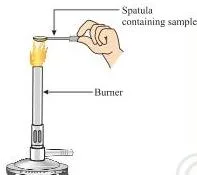
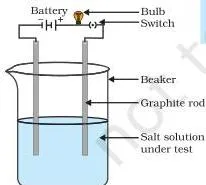
The exact melting and boiling point values from Table 3.4 are worth memorising for a data-based question:
| Ionic compound | Melting point (K) | Boiling point (K) |
|---|---|---|
| NaCl | 1074 | 1686 |
| LiCl | 887 | 1600 |
| CaCl2 | 1045 | 1900 |
| CaO | 2850 | 3120 |
| MgCl2 | 981 | 1685 |
(NCERT, p. 13)
Key Terms: Mineral, Ore, Gangue, Roasting, Calcination, Alloy and Amalgam
- Mineral: an element or compound that occurs naturally in the earth’s crust (p. 13).
- Ore: a mineral that contains a high enough percentage of a metal to make its extraction profitable (p. 13).
- Gangue: the sand, soil and other unwanted rocky material mixed with an ore that must be removed before extraction (p. 14).
- Roasting: heating a sulphide ore strongly in excess air to convert it into a metal oxide, releasing sulphur dioxide gas (p. 15).
- Calcination: heating a carbonate ore strongly in limited air to convert it into a metal oxide, releasing carbon dioxide gas (p. 15).
- Amphoteric oxide: a metal oxide that reacts with both acids and bases to form a salt and water, such as Al2O3 and ZnO (p. 5).
- Alloy: a homogeneous mixture of two or more metals, or a metal and a non-metal, made by melting the primary metal and dissolving the other elements into it in fixed proportions before cooling (p. 18).
- Amalgam: an alloy in which one of the metals used is mercury (p. 18).
- Anodising: an electrolytic process that builds a thicker, protective oxide layer on aluminium, which can also be dyed for finish (p. 5).
- Galvanisation: coating iron or steel with a thin layer of zinc to prevent rusting; the coating protects the iron even if it gets scratched (p. 18).
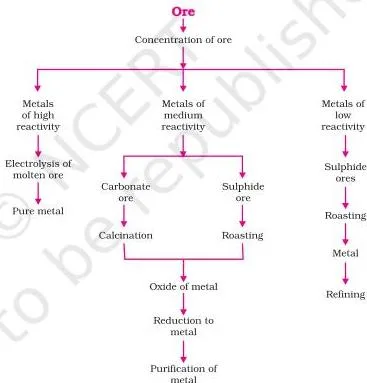
Extracting Metals: Matching the Method to Where the Metal Sits in the Activity Series
Extraction method depends entirely on reactivity. Metals at the bottom of the series occur free or need almost no chemical effort; metals at the top need the most energy-intensive method (p. 13–16).
| Reactivity zone | Example metals | Extraction method | Sample equation |
|---|---|---|---|
| Low reactivity (bottom of series) | Mercury, copper, silver, gold | Heating the ore alone; some (Ag, Au) occur free in nature | \( 2HgS\text{(s)} + 3O_2\text{(g)} \xrightarrow{\text{Heat}} 2HgO\text{(s)} + 2SO_2\text{(g)} \), then \( 2HgO\text{(s)} \xrightarrow{\text{Heat}} 2Hg\text{(l)} + O_2\text{(g)} \) |
| Middle reactivity | Zinc, iron, lead, copper | Roasting (sulphide) or calcination (carbonate) to get the oxide, then reduction with carbon or a more reactive metal | \( ZnO\text{(s)} + C\text{(s)} \rightarrow Zn\text{(s)} + CO\text{(g)} \) |
| High reactivity (top of series) | Sodium, magnesium, calcium, aluminium | Electrolytic reduction of the molten chloride or oxide | Cathode: \( Na^+ + e^- \rightarrow Na \); Anode: \( 2Cl^- \rightarrow Cl_2 + 2e^- \) |
Carbon cannot reduce the oxides of sodium, magnesium, calcium or aluminium because these metals have a greater affinity (attraction) for oxygen than carbon does — carbon simply cannot pull the oxygen away from them (p. 16). This is exactly why the top three rows in the table above use completely different methods.
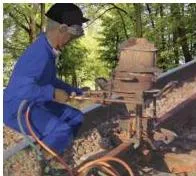
The thermit reaction is the clearest exam example of a highly reactive metal reducing the oxide of a less reactive one, releasing so much heat that the product metal comes out molten:
\[ Fe_2O_3\text{(s)} + 2Al\text{(s)} \rightarrow 2Fe\text{(l)} + Al_2O_3\text{(s)} + \text{Heat} \]
This reaction is used to join railway tracks and repair cracked machine parts (p. 16).
Electrolytic Refining and Corrosion: What Activity 3.14 Actually Proves About Rusting
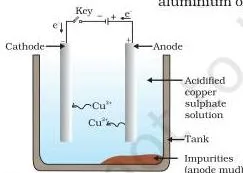
Metals produced by reduction are impure and are purified further by electrolytic refining. The impure metal is made the anode, a thin strip of pure metal is made the cathode, and a solution of the metal salt acts as the electrolyte.
When current passes, pure metal from the anode dissolves into the solution and an equal amount deposits on the cathode; insoluble impurities settle at the bottom of the anode as anode mud (p. 16).
Activity 3.14 tests three iron nails: test tube A has both air and water, test tube B has boiled water covered with oil (so no dissolved air reaches it), and test tube C has dry air with anhydrous calcium chloride to absorb any moisture. After a few days, only the nail in test tube A rusts.
The conclusion is direct: rusting needs both air (oxygen) and water together — remove either one and rusting does not happen (p. 17).
Prevention methods you should be able to list in a two-mark answer: painting, oiling, greasing, galvanising, chrome plating, anodising and alloying (p. 18). Alloying with the right mix even changes properties usefully — pure iron is soft, but mixing in about 0.05% carbon gives hard, strong steel, and adding nickel and chromium gives rust-resistant stainless steel (p. 18).
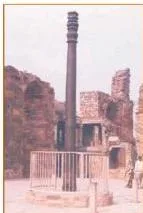
The Delhi iron pillar near the Qutub Minar is a real, quotable example of corrosion resistance for a ‘give reasons’ answer: it is over 1600 years old, 8 metres high, weighs 6 tonnes, and shows almost no rust — evidence of a rust-resisting process developed by ancient Indian iron workers (p. 18).
Chemical Equations You Must Be Able to Write From Memory
Metal with oxygen:
\[ 4Al\text{(s)} + 3O_2\text{(g)} \rightarrow 2Al_2O_3\text{(s)} \]
Metal with water:
\[ Ca\text{(s)} + 2H_2O\text{(l)} \rightarrow Ca(OH)_2\text{(aq)} + H_2\text{(g)} \]
Amphoteric oxide with acid and base:
\[ Al_2O_3 + 6HCl \rightarrow 2AlCl_3 + 3H_2O \]
Roasting (sulphide ore, excess air):
\[ 2ZnS\text{(s)} + 3O_2\text{(g)} \xrightarrow{\text{Heat}} 2ZnO\text{(s)} + 2SO_2\text{(g)} \]
Calcination (carbonate ore, limited air):
\[ ZnCO_3\text{(s)} \xrightarrow{\text{Heat}} ZnO\text{(s)} + CO_2\text{(g)} \]
Reduction with a more reactive metal:
\[ 3MnO_2\text{(s)} + 4Al\text{(s)} \rightarrow 3Mn\text{(l)} + 2Al_2O_3\text{(s)} + \text{Heat} \]
Thermit reaction:
\[ Fe_2O_3\text{(s)} + 2Al\text{(s)} \rightarrow 2Fe\text{(l)} + Al_2O_3\text{(s)} + \text{Heat} \]
Electrolytic reduction at the electrodes:
\[ \text{Cathode: } Na^+ + e^- \rightarrow Na \qquad \text{Anode: } 2Cl^- \rightarrow Cl_2 + 2e^- \]
(NCERT, p. 5–16, checked against Activities 3.9 to 3.14 as cited above).
Worked Examples: Using the Activity Series to Predict Reactions
Example 1: Ranking metals P, Q, R and S from their displacement results
Step 1: Four metals P, Q, R and S are added separately to solutions of iron(II) sulphate, zinc sulphate, copper(II) sulphate and silver nitrate.
The results are:
| Metal | FeSO4 | ZnSO4 | CuSO4 | AgNO3 |
|---|---|---|---|---|
| P | No reaction | No reaction | Displacement | Displacement |
| Q | Displacement | No reaction | Displacement | Displacement |
| R | No reaction | No reaction | No reaction | Displacement |
| S | No reaction | No reaction | No reaction | No reaction |
- Step 1: Apply the rule: a metal displaces another metal from its salt solution only if it is more reactive. Q displaces iron and copper but not zinc, so zinc is more reactive than Q, and Q is more reactive than iron.
- Step 2: P does not displace iron or zinc, but does displace copper and silver, so P sits below iron and zinc but above copper. R only displaces silver, so R is below copper but above silver. S displaces nothing, not even silver, so S is the least reactive of the four.
- Step 3: Chaining these comparisons together: zinc > Q > iron > P > copper > R > silver > S.
Final answer: Decreasing order of reactivity is Q > P > R > S, and among the four, Q is the most reactive metal while S is the least reactive.
Example 2: Mass of iron produced in the thermit reaction from 320 g of iron(III) oxide
Step 1: Write the balanced thermit equation.
\[ Fe_2O_3 + 2Al \rightarrow 2Fe + Al_2O_3 \]
- Step 1: Find the molar mass of \( Fe_2O_3 \): \( 2(56) + 3(16) = 112 + 48 = 160\ \text{g/mol} \).
- Step 2: Convert 320 g of \( Fe_2O_3 \) to moles.
\[ \text{Moles of } Fe_2O_3 = \frac{320\ \text{g}}{160\ \text{g/mol}} = 2\ \text{mol} \]
- Step 1: Use the mole ratio from the equation: 1 mol \( Fe_2O_3 \) gives 2 mol \( Fe \), so 2 mol \( Fe_2O_3 \) gives 4 mol \( Fe \).
- Step 2: Convert moles of iron to mass using molar mass of \( Fe = 56\ \text{g/mol} \).
\[ \text{Mass of Fe} = 4\ \text{mol} \times 56\ \text{g/mol} = 224\ \text{g} \]
Final answer: 320 g of iron(III) oxide produces 224 g of iron in the thermit reaction.
Example 3: Choosing the extraction method for a manganese carbonate ore
- Step 1: Identify the anion in the ore formula, \( MnCO_3 \). It is a carbonate.
- Step 2: Carbonate ores are converted to the metal oxide by calcination (heating strongly in limited air), not roasting, since roasting applies to sulphide ores (p. 15).
- Step 3: Once the oxide is formed, manganese sits in the middle-to-upper part of the activity series, so the oxide is reduced using a suitably reactive reducing agent — the textbook shows manganese dioxide being reduced by aluminium powder rather than by carbon alone, as this reaction is highly exothermic and effective for such oxides (p. 15–16).
Final answer: \( MnCO_3 \) should first be calcined to its oxide, then reduced using a reactive metal reducing agent such as aluminium, following the same principle used for \( MnO_2 \) in the textbook.
Common Mistakes Students Make in This Chapter
| Mistake | Correct rule | How to check your answer |
|---|---|---|
| Assuming every metal releases \( H_2 \) gas with nitric acid | \( HNO_3 \) is a strong oxidiser; it oxidises the \( H_2 \) formed into water instead. Only magnesium and manganese release \( H_2 \) with very dilute \( HNO_3 \) (p. 8) | Before writing metal + \( HNO_3 \rightarrow H_2 \), check if the metal is Mg or Mn; otherwise mention a nitrogen oxide as product |
| Confusing roasting with calcination | Roasting is heating a sulphide ore in excess air; calcination is heating a carbonate ore in limited air (p. 15) | Look at the ore’s anion — S for sulphide means roasting, \( CO_3 \) for carbonate means calcination |
| Mixing up malleability and ductility | Malleable means it can be hammered into sheets; ductile means it can be drawn into wires (p. 2) | Sheet-shape word cues malleable; wire-shape word cues ductile |
| Thinking all non-metals are gases | Non-metals can be solid, liquid or gas; bromine is the one liquid non-metal (p. 3) | Recall bromine specifically whenever a question asks for the exception |
| Forgetting \( Al_2O_3 \) and \( ZnO \) are amphoteric | Amphoteric oxides react with both acids and bases to give a salt and water (p. 5) | If \( Al_2O_3 \) or \( ZnO \) is given with \( NaOH \), write the salt formed — do not say ‘no reaction’ |
| Assuming galvanised iron rusts the moment the coating is scratched | Zinc is more reactive than iron, so it keeps protecting the iron underneath even after the coating is broken (p. 18) | State the reason using reactivity — zinc reacts in place of iron — not just ‘zinc covers the surface’ |
What CBSE Actually Asks From This Chapter (Reasoning and Equation Questions)
The chapter’s own exercise questions fall into clear types, and knowing the type tells you what a full-marks answer needs.
- Direct concept / MCQ style — questions on displacement pairs, rust prevention, and identifying an oxide’s element (exercise Q1–Q4, Q6, Q7, Q10, Q11, Q14) need a short, precise statement, not a paragraph.
- Numerical or stoichiometric reasoning — this chapter’s official exercises don’t carry heavy calculations, but board papers can add a thermit or roasting mass problem like Example 2 above, so practise mole-to-mass conversions.
- ‘Give reasons’ questions — exercise Q12 and Q16 are the classic pattern: why gold, platinum and silver are used for jewellery; why sodium, potassium and lithium are stored under oil; why aluminium is used for cooking utensils despite being reactive; why carbonate and sulphide ores are converted to oxides before reduction; why copper, not steel, is used for hot water tanks (p. 4, 10, 20). Each of these needs one precise chemical reason, not a general description — for example, ‘aluminium forms a protective oxide layer on its surface’ is a complete answer, while ‘aluminium is a good metal’ earns no marks.
- Identify-the-substance / detective questions — the intext question with metals A, B, C, D and the gold-bangle ‘goldsmith’ exercise (Q15) test whether you can work backward from displacement results or reactivity data to name a substance or process. The goldsmith question tests whether you know that only aqua regia — the 3:1 mix of concentrated HCl and \( HNO_3 \) — can dissolve gold, since the fraudulent goldsmith dipped bangles in a solution that dissolved part of the gold, reducing their weight (p. 8, 20).
- Practical/experimental setup questions — Q5 (hammer, battery, bulb, wires and switch) and Q9 (burning sulphur and testing the gas on litmus) expect you to describe the exact test and what result would confirm a metal or a non-metal.
For the exact wording of every official exercise question, you can open the NCERT Class 10 Science Chapter 3 textbook PDF, which is the primary source this page is built from.
Quick Revision: Reactivity Series, Extraction Method and Key Equations in One Table
| Metal position | Example | Reacts with water? | Extraction method |
|---|---|---|---|
| Top of series | Sodium | Reacts violently even with cold water | Electrolytic reduction of the molten compound |
| Middle of series | Iron | No reaction with cold or hot water; reacts with steam | Roasting or calcination, then reduction with carbon |
| Bottom of series | Copper | No reaction with water in any form | Heating the sulphide ore alone; some occur free in nature |
To recall the full order K, Na, Ca, Mg, Al, Zn, Fe, Pb, H, Cu, Hg, Ag, Au, use this sentence: “Kind Nancy called my aunt Zara for pizza; her cousin has a gift.” Each word’s first letter matches the metal symbol in the exact reactivity order.
- Metals above hydrogen in the series can displace hydrogen from dilute acids; metals below it cannot (p. 19).
- A more reactive metal always displaces a less reactive metal from its salt solution (p. 19).
- Non-metals form negative ions by gaining electrons and generally produce acidic or neutral oxides; they do not displace hydrogen from dilute acids (p. 19–20).
Frequently Asked Questions on Metals and Non-metals
Why is sodium metal kept immersed in kerosene oil and not in water?
Sodium reacts so vigorously and exothermically with cold water that the heat released can ignite the hydrogen gas produced. Kerosene oil does not react with sodium, so storing it under kerosene keeps it away from moisture and air and prevents an accidental fire (NCERT, p. 5, 10).
Why does aluminium not corrode easily even though it is high up in the reactivity series?
As soon as aluminium is exposed to air, a thin layer of aluminium oxide forms tightly on its surface. This layer sticks firmly and blocks oxygen and moisture from reaching the metal underneath, so it does not corrode further. Anodising thickens this same oxide layer electrolytically for extra protection (p. 5).
What is the difference between roasting and calcination in metal extraction?
Roasting is heating a sulphide ore strongly in the presence of excess air, releasing sulphur dioxide gas. Calcination is heating a carbonate ore strongly in limited air, releasing carbon dioxide gas. Both processes convert the ore into the metal oxide, which is easier to reduce than the sulphide or carbonate form (p. 15).
Why is copper preferred over an iron alloy like steel for making hot water tanks?
Copper does not react with water even in the form of steam, so it does not corrode from long, repeated exposure to hot water. Iron, on the other hand, reacts with steam to form iron oxide, which means a steel tank would corrode faster over time (p. 6).
How do you decide whether an ore should be roasted, calcined, or reduced directly with carbon?
Check the ore’s chemical form first: a sulphide ore is roasted and a carbonate ore is calcined, both converting the ore to a metal oxide. That oxide is then reduced with carbon if the metal is of moderate reactivity (like zinc or iron).
If the metal is highly reactive (sodium, magnesium, calcium, aluminium), carbon cannot reduce its oxide because these metals bind oxygen more strongly than carbon does, so electrolytic reduction is used instead (p. 15–16).
Why is 22 carat gold used for jewellery instead of pure 24 carat gold?
Pure gold (24 carat) is too soft to hold its shape in jewellery. Alloying it with silver or copper — commonly 22 parts gold to 2 parts of the other metal — makes it hard enough for ornaments while keeping most of the gold content (p. 18).
Reference: NCERT Class 10 Science textbook, chapter Metals and Non-metals.
Explore Class 10 Science Notes
More for this chapter:
Class 10 Science on LearnCBSE:
Related chapters: