
The mijbil the otter class 10 notes on this page give you a fast, exam-ready summary of Chapter 6 from the First Flight reader for the 2026-27 session. Gavin Maxwell’s story is about friendship with an unusual pet, a chaotic flight, and funny reactions of Londoners — all covered below in a structure made for quick revision.
Why Maxwell Wrote About an Otter: Background to the Chapter
Maxwell lived in Camusfearna, a cottage in the West Highlands of Scotland, surrounded by water — an ideal setting for an otter (NCERT, p. 1). After his dog Jonnie died, he was too saddened to keep another dog, yet he found life without a pet lonely.
He decided that an otter, suited to his water-surrounded cottage, would be the right companion. This experiment of domesticating a wild otter forms the heart of the chapter and motivates everything that follows.
For more Class 10 English revision pages, see our index of Class 10 English notes or the wider Class 10 notes hub.

Chapter Overview: From Basra Marshes to London Streets
The story unfolds in three phases, each set in a different location. Mapping this flow is one of the most useful mijbil the otter class 10 notes takeaways, because students often jumble the travel route.
| Phase | Location | What Happens |
|---|---|---|
| 1. Getting the otter | Basra, Iraq | Maxwell waits for European mail for five days; two Arabs deliver the otter in a squirming sack |
| 2. Transporting Mijbil | Basra → Paris → London | Mij injures himself tearing the box; the air hostess lets him out; he causes chaos on the plane |
| 3. Life in London | London flat | Mij invents a ping-pong game with a sloped suitcase, develops compulsive walking habits, and baffles Londoners |
Maxwell’s travel map, not shown in the textbook as a diagram, is crucial: it was Basra → Paris → London, not a direct flight, because the British airline to London refused to fly animals (NCERT, p. 6).
Summary of Mijbil the Otter in Our Own Words
Maxwell travelled to Southern Iraq early in 1956. A friend mentioned that otters were common in the Tigris marshes and often tamed by Arabs, so Maxwell asked for one (NCERT, p. 3).
At Basra, his friend’s mail arrived but Maxwell’s did not. He cabled England, tried to telephone, and faced one breakdown after another — a broken line, a religious holiday, another breakdown. After five days, the mail arrived, and with it came two Arabs holding a sack. A note read: “Here is your otter…”
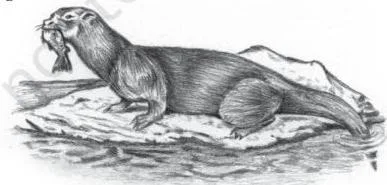
The creature that emerged, coated in pointed scales of dried mud, looked like a small medieval dragon. Maxwell named him Mijbil. For twenty-four hours Mij was neither hostile nor friendly, simply aloof and indifferent, sleeping as far from Maxwell’s bed as possible. The second night, he crept into Maxwell’s bed and slept in the crook of his knees.
That day, he began taking interest in his surroundings.
When taken to the bathroom, Mij went wild with joy, plunging and rolling in the tub. Two days later, he escaped, reached the bathtub, and turned the chromium tap himself to produce a full flow of water (NCERT, p. 4). He also played with a rubber ball like a soccer player and juggled marbles on his belly.
Transporting Mij to England was difficult — the British airline refused animals, so Maxwell booked Basra → Paris, then Paris → London. The airline insisted Mij be packed in a box not more than eighteen inches square. When Maxwell returned from a meal, he found blood trickling from the box; Mij had torn the lining to shreds and injured himself.
With only ten minutes left, Maxwell put the bleeding otter back and rushed to the airport.
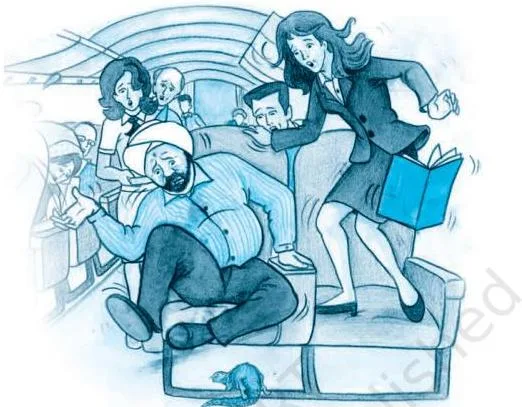
On the plane, the air hostess suggested Mij sit on Maxwell’s knee. Mij escaped, ran down the aisle, and caused a woman to scream “A rat! A rat!” A portly Indian’s curry-covered Maxwell’s face. Eventually, Mij bounded back to Maxwell’s knee and nuzzled his neck (NCERT, p. 6).
In London, Mij invented a game with a ping-pong ball and a sloped suitcase, placing the ball on the high end and ambushing it at the other end. He developed compulsive habits on walks, like galloping on the primary school wall. Londoners failed to recognise him, guessing walrus, baby seal, squirrel, brontosaur, and more (NCERT, p. 8).

Theme Analysis: Human-Animal Bond and Adaptability
The chapter carries three clear themes, each backed by specific evidence.
- Theme 1 — Human-animal companionship: A deep bond grows between Maxwell and Mij. On the plane, when Mij is frightened and confused, he bounded on to Maxwell’s knee and began to nuzzle his neck, seeking comfort — proof that wild animals can show affection (NCERT, p. 6).
- Theme 2 — Animal intelligence and adaptability: Mij learns to turn the bath tap himself, invents a ping-pong game with a sloped suitcase, and develops regular walking rituals. These actions show curiosity and problem-solving, not mere instinct.
- Theme 3 — The comedy of human ignorance: Londoners make absurd guesses about Mij’s species — walrus, hippo, brontosaur — showing how little city people know about wildlife. The humour is gentle but pointed.
For another chapter on human-animal trust, see our Chapter 5 Footprints Without Feet notes or the Chapter 7 Madam Rides the Bus notes.
Character Sketches: Maxwell and Mijbil
The two characters contrast and complement each other — and the chapter’s emotional core is the contrast between Mij’s initial aloofness and his later affection.
| Character | Traits | Evidence |
|---|---|---|
| Maxwell (the narrator) | Patient, observant, devoted to his pet | Meticulously boxes Mij, trusts the air hostess, patiently watches Mij’s play and habits, takes Mij on a lead like a dog |
| Mijbil (the otter) | Aloof at first, then affectionate, intelligent, playful, curious | Sleeps far away on day one, by day two sleeps in Maxwell’s knees; turns the bath tap; juggles marbles; invents the ping-pong game; nuzzles Maxwell on the plane |
This initial aloofness → later affection arc is the backbone of Mij’s character sketch and earns marks when stated explicitly in answers.
Literary Devices: Similes, Metaphors, and Humour
Maxwell uses several devices to make the chapter vivid.
- Simile: “resembled most of all a very small, medievally-conceived, dragon” — comparing the mud-covered otter to a dragon, painting a striking visual image (NCERT, p. 3).
- Simile: “like a ricochetting bullet” — describing the car’s speed through Basra streets to the airport, not the plane’s speed (NCERT, p. 6).
- Humour: The woman screaming “A rat! A rat!” and the labourer’s growled question “Here, Mister — what is that supposed to be?” are exaggerated reactions made comic by contrast (NCERT, p. 6, 8).
- Metaphor: “a thraldom to otters” — bondage or lifelong attachment to otters, suggesting Maxwell sees his otter-fixation as a kind of pleasant slavery (NCERT, p. 3).
- Personification: Mij is described as “a four-footed soccer player” who dribbles the ball with all four paws, giving him human-like playfulness.
Important Quotes from Mijbil the Otter
| Quote | Why It Matters |
|---|---|
| “Here is your otter…” (NCERT, p. 3) | Marks the surprise gift and the start of Maxwell’s otter-fixation |
| “every drop of water must be, so to speak, extended and spread about the place” (NCERT, p. 4) | Captures an otter’s instinct — water must move, not stay still |
| “the very queen of her kind” (NCERT, p. 6) | Maxwell’s praise for the air hostess — calm, kind, resourceful |
| “Here, Mister — what is that supposed to be?” (NCERT, p. 8) | Highlights city ignorance and the comedy of misrecognition |
| “a thraldom to otters” (NCERT, p. 3) | Metaphor showing Maxwell’s lifelong attachment to otters |

How to Approach Textbook Questions (Thinking about the Text)
Use the SCQ method — State, Cite, Quote — to secure full marks on the end-of-chapter questions in the Thinking about the Text section (NCERT, p. 9).
- State: Make your point in one clear sentence. For Question 1 (intelligence), state that Mij is intelligent because he solves problems.
- Cite: Reference a specific event — e.g., Mij turning the bath tap, juggling marbles, inventing the ping-pong game.
- Quote: Use a short, exact phrase from the text to support your point — e.g., “fumbling at the chromium taps”.
For Question 3 (why Mij’s species is called Maxwell’s otter), answer that Mij was of a race previously unknown to science, later christened Lutrogale perspicillata maxwelli by zoologists — state the fact, cite the naming, quote the Latin name (NCERT, p. 3).
You can also check plot details in the Oral Comprehension Check questions on pages 4, 7, and 9 before attempting the main ones.
Common Mistakes Students Make in This Chapter
| Mistake | Correct Rule | How to Check |
|---|---|---|
| Writing the route as Basra → London directly | Route was Basra → Paris → London, because the British airline refused animals | Re-read p. 6: “I booked a flight to Paris on another airline, and from there to London” |
| Calling Mij a common otter | Mij belonged to a race previously unknown to science, later named Maxwell’s otter | Check p. 3 for the Latin name Lutrogale perspicillata maxwelli |
| Saying “ricochetting bullet” describes the plane | It describes the car ride through Basra streets to the airport | Check p. 6 context — the driver “tore through the streets of Basra” |
| Saying Mij was friendly from the start | He was aloof and indifferent for the first twenty-four hours | Check p. 3: he slept “as far from my bed as possible” |

Exam Notes: What Examiners Look For
Exam questions on this chapter are mostly value-based and character-based. Examiners reward specific, evidence-backed answers.
- Value-based questions: “Why is the air hostess called the queen of her kind?” earns marks for citing her calm suggestion to put Mij on Maxwell’s knee, not generic praise about kindness (NCERT, p. 6).
- Character sketch questions: Mention both Mij’s initial aloofness and later affection. Skipping the aloofness loses a mark.
- Antic-based answers: Always link to specific play (tap-turning, marble juggling, ping-pong game, wall-galloping) rather than vague “he was playful”.
- Quote support: One short quote per answer lifts the quality, especially for 5-mark character and theme questions.
Avoid generic answers like “Mij was a good pet.” Examiners look for named antics and textual evidence.
Revision Summary: Quick Recap for the Night Before
Scan this table the evening before your exam to lock the chapter’s key events in memory.
| Event | Location | Key Detail |
|---|---|---|
| Getting the pet | Basra | Arrived in a sack, looked like a dragon, named Mijbil |
| Bathtub fun | Basra | Mij rolls, splashes, turns the chromium tap himself |
| The flight | Basra → Paris → London | Box incident with blood; air hostess helps; Mij escapes, woman screams “A rat!” |
| London life | London flat | Ping-pong game with sloped suitcase; marble juggling; school-wall runs |
| Londoners’ guesses | London streets | Walrus, baby seal, squirrel, hippo, brontosaur — never otter |
Memory device: Remember the route as “B-P-L” (Basra → Paris → London) so you never confuse the itinerary.
For chapter-wise revision across the whole book, visit our CBSE notes index, or the Chapter 5 Glimpses of India notes for another First Flight prose chapter.

Frequently Asked Questions About Mijbil the Otter
Why did Maxwell go to Basra, and why was he delayed there?
Maxwell went to Basra to the Consulate-General to collect and answer his European mail. His friend’s mail arrived, but his own did not. He cabled England, tried to telephone (booking the call twenty-four hours in advance), but the line was out of order, the exchange was closed for a religious holiday, and there was another breakdown.
He waited five days before his mail — and the otter — arrived (NCERT, p. 3).
How did Mijbil react when he was first taken to the bathroom?
Mij went wild with joy. He plunged and rolled in the water, shot up and down the bathtub, and made enough slosh and splash for a hippo. Maxwell learned this is characteristic of otters: they must spread water about, overturn bowls, and keep water on the move (NCERT, p. 4).
What was the ‘appalling spectacle’ Maxwell found on returning from his meal?
When Maxwell returned from a hurried meal before the flight, he found silence from the box, but blood had trickled and dried from the airholes and chinks around the lid. Mij had torn the lining of the box to shreds and injured himself; he whimpered and caught at Maxwell’s leg. This is the appalling spectacle (NCERT, p. 6).
How did Mijbil invent his own game with the ping-pong ball in London?
Maxwell’s damaged suitcase had a lid that sloped from one end to the other. Mij discovered that if he placed the ping-pong ball on the high end, it would run down the length of the suitcase. He would dash to the other end, ambush the ball, grab it, and trot back to the high end to start again (NCERT, p. 8).
Why did the people of London make ridiculous guesses about Mijbil’s species?
Otters belong to a comparatively small group of animals called Mustellines, shared by the badger, mongoose, weasel, stoat, and mink. They are rare in city environments, so the average Londoner had never seen one. So they guessed everything from walrus and baby seal to squirrel, beaver, bear cub, leopard, and even brontosaur — never an otter (NCERT, p. 8).
| Londoners’ Guess | Actual Animal | What This Shows |
|---|---|---|
| Walrus | Otter | Wild misidentification driven by city ignorance |
| Baby seal | Otter | Guess “sprayed” across the Mustellines group — close family, wrong species |
| Squirrel | Otter | A random guess, nowhere near the right family |
| Hippo | Otter | Inspired by Mij’s splashing in the bathtub, not his appearance |
| Brontosaur | Otter | The most absurd guess, reducing Maxwell to giggles |
This contrast between guesses and reality distils the chapter’s theme of human ignorance — people see only what their experience allows them to recognise.
The official NCERT First Flight textbook page for Chapter 6 has the full text for reference.
Reference: NCERT Class 10 First Flight textbook, chapter Mijbil the Otter.
Explore Class 10 English Notes
Class 10 English on LearnCBSE:
Related chapters: