
These a question of trust class 10 notes cover the full scene-wise summary, character sketches, themes, literary devices, and exam pointers for the current CBSE session. Victor Canning’s chapter from the Footprints without Feet supplementary reader tests the old saying “honour among thieves” — and leaves it in tatters.
The story follows a careful, law-abiding burglary specialist who is outsmarted by another thief, turning his own discipline against him.
Chapter Overview: Horace Danby’s Annual Ritual
Before the plot moves, you need to know who Horace Danby is, because his entire personality makes the twist work. He is a fifty-year-old, unmarried locksmith with two helpers — a respectable citizen on the surface (NCERT, p. 20).
| Term | Meaning | Relevance in the story |
|---|---|---|
| Hay fever | An allergy to pollen or dust that causes sneezing (NCERT, p. 24) | Horace sneezes around the flowers at Shotover Grange, which draws the woman’s attention to him |
| Shotover Grange | The large house Horace studies for two weeks before his robbery | Servants go to the movies, giving him a window to enter |
| Rare books | Expensive, hard-to-find books sold through an agent | The only reason Horace robs a safe each year |
Horace robs exactly one safe every year, takes enough to last twelve months, and quietly buys rare, expensive books through an agent (NCERT, p. 20). This yearly ritual is the core of chapter 4, A Question of Trust.
Scene-by-Scene Summary
We retell A Question of Trust in four scenes, so a student revising quickly can follow each turning point without rereading the whole chapter.
Scene 1: The Setup at Shotover Grange
- Horace studies Shotover Grange for two weeks — its rooms, wiring, paths, and garden (NCERT, p. 20).
- On this July afternoon, the two servants (who stay behind while the family is in London) go to the movies.
- He wears gloves, lifts the kitchen key from its hook, calms the dog Sherry by name, and begins work behind a painting hiding the safe (NCERT, p. 21).
Scene 2: The Woman in Red Appears
A young, pretty woman in red walks into the doorway. Sherry rubs against her, and she orders the dog down — making her seem like family (NCERT, p. 22). She speaks with a voice that is quiet and kindly, but with firmness. Horace, already sneezing from hay fever, answers her honestly and then tries to negotiate his escape.
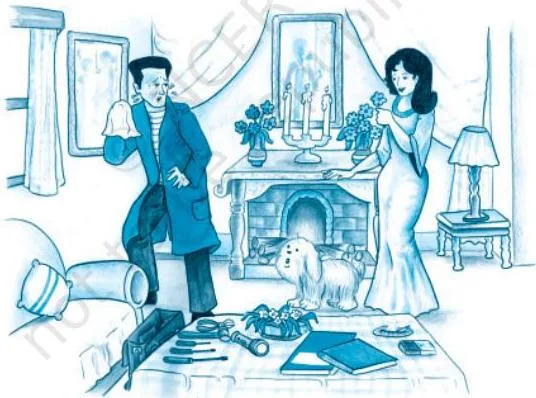
The illustration above captures the precise pivot: the woman stands composed in the doorway while Horace, caught mid-robbery, is thrown off balance. Her calm posture and the dog greeting her sell the illusion — she appears to belong here far more than he does.
Scene 3: The Safe-Opening Favour
The woman first threatens to call the police, then shifts to charm. She says she wants to wear her jewels to a party but has forgotten the safe’s combination. Eager to please her and escape arrest, Horace removes his gloves to offer his lighter when she takes a cigarette (NCERT, p. 23). That single slip breaks his discipline.
He opens the safe, hands her the jewels, and leaves happily, believing he has made a friend.
Scene 4: The Arrest and Reveal
Two days later, the police arrest Horace for the Shotover Grange robbery. His fingerprints cover the safe because he opened it without gloves (NCERT, p. 23). No one believes his story that the owner’s wife asked him to open the safe — because the real wife is a gray-haired, sharp-tongued woman of sixty who calls his story nonsense.
Horace becomes the prison library assistant, brooding over how a clever young thief in his own profession tricked him.
Theme Analysis: Honour Among Thieves, Deception, and the Irony of Trust
Students answering theme questions should always tie the theme back to a specific story event. Reference these Class 10 English notes for broader chapter summaries.
| Theme | Evidence from the story | What it reveals |
|---|---|---|
| No honour among thieves | Another thief tricked Horace into doing her work; Horace later hates hearing the phrase | The brotherhood criminals imagine is fragile — trust inside crime is just as risky as crime itself |
| Meticulous planning can fail | Horace studied the Grange for two weeks but removed his gloves on impulse to please her | Discipline built over fifteen years falls to one emotional decision (NCERT, p. 20, p. 23) |
| Appearances deceive | The woman knew Sherry’s name, stood confidently in red, spoke from upstairs — Horace assumed she was the homeowner (NCERT, p. 22) | Confidence and small clues can sell any lie; Horace trusted his eyes over his caution |
Character Sketches: Horace Danby and the Young Woman in Red
Horace Danby
- Respectable on the surface: fifty, successful locksmith with two helpers (NCERT, p. 20).
- Opportunistic but careful: he robs a safe once a year to buy rare books, planning each robbery to last twelve months.
- Fastidious: wears gloves to avoid fingerprints, studies the target house for two weeks, knows the guard dog’s name.
- Greedy for books: steals purely to fund his collection, not out of poverty.
- Fearful of prison: he begs the woman to let him go, revealing his weak spot.
- Vulnerable to charm: removes his gloves to offer his lighter, betraying his discipline for her approval.
The Young Woman in Red
- Clever opportunist: a fellow thief who enters the same house to rob it and talks her way past Horace.
- Confident actress: stands in red, greets the dog by name, walks to the fireplace to straighten ornaments as if she lives there (NCERT, p. 22).
- Master manipulator: threatens police first, then shifts to charm and asks a favour — pushing Horace to open the safe himself.
- Decisive liar: claims she needs jewels for a party, admits she forgot the combination.
- Escape artist: walks off with the jewels, leaving Horace’s fingerprints on the safe to take the blame.
Literary Devices: Irony, Misdirection, and Foreshadowing in the Story
Each device below is pinned to a quoted line so a student can point to textual proof in an answer.
| Device | Quoted line | What it reveals |
|---|---|---|
| Irony | “I have always liked the wrong kind of people.” | A professional safe-cracker cracks a safe for another thief; the line hints she is no respectable owner. |
| Misdirection | “Down, Sherry” | The dog obeys her, so the reader — like Horace — assumes she is family. |
| Foreshadowing | “Hay fever” | The same sneeze that draws her attention makes Horace remove his gloves later, seeding his capture. |
Important Quotes: What They Mean for Exam Answers
| Quote | Speaker / context | Why it matters for an answer |
|---|---|---|
| “Hay fever” | Horace, replying to the woman’s first question | Shows his honesty even as a thief — his sneeze opens the conversation that exposes him. |
| “You can cure it … if you find out just what plant gives you the disease.” | The woman, pivoting from threat to friendly advice | Builds rapport; the move from firmness to charm is the trap that hooks Horace. |
| “I have always liked the wrong kind of people.” | The woman, after Horace confesses fear of prison | Quietly signals she is not the respectable owner — a hint students should flag. |
| “He gets very angry when anyone talks about honour among thieves.” | The narrator’s closing line | The thematic sting of the chapter — the very idea of trust among thieves mocks Horace now. |
For chapter-to-chapter flow, pair this chapter with chapter 3, The Midnight Visitor or chapter 5, Glimpses of India. You can also browse the complete Class 10 notes hub or our full CBSE notes index.
NCERT Textbook Questions: Think About It — What Examiners Look For
This section maps the four Think about it questions (NCERT, p. 25) to the angle a full-marks answer should take. Detailed step-by-step solutions live in a separate article; here we give the direction.
| Question (NCERT p. 25) | Key answer pointers |
|---|---|
| Q1: Did you suspect the lady was not who Horace took her to be? | Track the cues — she came from upstairs, knew the dog’s name, knew the furnishings, yet didn’t know the safe combination. Suspicion builds from this contradiction. |
| Q2: How did she deceive Horace? | Acted as lady of the house → threatened police → softened with charm → asked a favour (open the safe). Horace never suspected because her confidence sold the role. |
| Q3: Why is “good and respectable — but not completely honest” apt? | He is respected socially and runs an honest business; only his yearly safe-robbing reveals dishonesty. Unlike a typical thief, he plans carefully and steals only from the wealthy. |
| Q4: Where did the meticulous planner go wrong? | His one slip — removing gloves to use the lighter — happened because he trusted her. Planning fell to emotion. |
Common Mistakes Students Make When Writing About This Chapter
| Mistake | Correct rule | How to check your answer |
|---|---|---|
| Calling the woman “the lady of the house” as a fact | She is an unknown thief; the real owner is a gray-haired woman of sixty (NCERT, p. 23) | Re-read: does your answer say “a woman pretending to be the owner”? |
| Saying Horace steals because he is poor | He runs a successful locksmith business with two helpers; he steals only to buy rare books | Check: have you mentioned his two helpers and rare-book obsession? |
| Claiming Horace left fingerprints out of general carelessness | He was meticulous about gloves; he removed them only to offer his lighter to please her | Trace the cause: did your answer link the fingerprints to trusting her? |
| Treating the arrest as bad luck | The arrest follows from trusting the woman and breaking his own discipline — the story’s moral is cause, not chance | Ask: does your ending point to his error (removing gloves) rather than “got caught”? |
Exam Notes: How CBSE Frames ‘A Question of Trust’ in the Paper
- Character sketch of Horace or the young woman is a common long-answer ask; you can find parallel character analyses in our broader Class 10 English notes.
- Irony of the title is a frequent theme question — tie it to “honour among thieves” and the betrayal.
- Q4 (where did he go wrong) maps cleanly to a value-based question: discipline vs trust.
- Marks tip (examiner’s mindset): for a five-mark character sketch, the examiner gives roughly one mark per trait and one mark for the textual evidence behind it — so a trait without an action from the story does not earn full marks.
- Placement: A Question of Trust appears in the Footprints without Feet supplementary reader set. You can confirm the prescribed book on the official NCERT textbook portal.
Revision Summary: Five Things to Remember Before the Test
- Horace Danby — respectable fifty-year-old locksmith; robs one safe a year to fund rare books.
- Shotover Grange — his target; servants out at the movies; family in London.
- Woman in red — posed as the owner; knew the dog Sherry; asked Horace to open the safe.
- The tell — Horace removed his gloves to offer his lighter; fingerprints covered the safe.
- Ending — arrested; real owner is sixty, gray-haired, sharp-tongued; no honour among thieves.
Author Background: Victor Canning and the Thriller Tradition
Victor Canning was a British writer of thrillers and adventure novels. His stories often feature twists and ordinary people drawn into crime, which is why A Question of Trust reads like a caper with an ironic sting rather than a moral lecture.
Moral Message: Can Intentions Justify Wrong Actions?
The textbook’s Talk about it section (NCERT, p. 25) poses the value question: Was Horace unfairly punished, and do good intentions justify wrong actions? Horace believed his rare-book passion excused the yearly theft. The story shows, instead, that crime — even for a “good reason” — carries risk, and one crack in discipline can trigger punishment.
Examiners may frame value-based answers on exactly this tension.
Frequently Asked Questions About the Chapter
Why did Horace Danby steal every year?
Horace stole once a year to buy rare, expensive books through an agent (NCERT, p. 20). He was a successful locksmith with two helpers, not a poor man — his motive was appetite for books, not need.
How did the young woman in red deceive Horace Danby?
She posed as the lady of the house, greeted the dog Sherry by name, and moved around the rooms confidently (NCERT, p. 22). She then shifted from a police threat to charm, asked Horace to open the safe for her, and walked off with the jewels — leaving his fingerprints behind.
Why did Horace remove his gloves at Shotover Grange?
He removed his gloves to offer the woman his cigarette lighter, eager to please her so she would let him go (NCERT, p. 23). That one emotional slip left his fingerprints all over the safe and led to his arrest.
Who was the real culprit in A Question of Trust?
The real culprit was the young woman in red — a fellow thief who took the jewels and tricked Horace into opening the safe. Horace was arrested because the real owner — a gray-haired woman of sixty — dismissed his story as nonsense (NCERT, p. 23).
How is the title ‘A Question of Trust’ justified in the story?
Horace trusted the woman because she acted like the owner, and she trusted that he would obey her request. Both trusts collapse — she tricks him, and his fingerprints betray him. The title questions whether trust is ever safe, especially among thieves.
Reference: NCERT Class 10 English textbook, chapter A Question of Trust.
Explore Class 10 English Notes
Class 10 English on LearnCBSE:
Related chapters: