
These Footprints Without Feet class 10 notes cover H.G. Wells’s chapter from the Footprints Without Feet supplementary reader for the current CBSE academic session. The story follows Griffin, a brilliant scientist who discovers how to become invisible but uses that power to commit theft, arson, and assault.
The page gives you a plot map, phase-wise summary, themes, character sketches, literary devices, quotes, and exam pointers so you can revise the whole chapter in one sitting.
Footprints Without Feet Class 10 Notes: Chapter Introduction
The textbook opens with a central question: Can a man become invisible? The chapter answers this through Griffin, a scientist who discovers a method to make the human body transparent. The story then tests whether he uses or misuses that discovery.
Griffin is brilliant as a scientist but lawless as a person (NCERT, p. 27). His experiments succeed, but his conduct is destructive. He burns down his landlord’s house, breaks into a London store, robs a theatrical shopkeeper, and steals from a clergyman.
The chapter belongs to the Footprints Without Feet supplementary reader for Class 10 English. For the broader set of chapters, see our Class 10 English notes index.
Chapter Overview: The Arc of Griffin’s Escape
The plot moves Griffin through four locations. Use this ordered map as a memory device before you read the phase-wise summary; it tracks his movement from London to the village of Iping.
- London streets (mid-winter): Griffin becomes invisible, burns his landlord’s house, and wanders barefoot — leaving muddy footprints two boys follow.
- A big London store: He slips inside for warmth, dresses and feeds himself, and oversleeps until assistants arrive.
- Theatrical company in Drury Lane: He steals bandages, glasses, a false nose, and whiskers to hide his invisible head, then robs the shopkeeper.
- Iping village inn: He books two rooms for solitude, runs out of money, burgles a clergyman’s study, terrifies Mrs Hall with moving furniture, and finally reveals his headless body before escaping the constable.
Story Summary: From Muddy Footprints to a Headless Man
The Muddy Footprints
Two boys in London see fresh, muddy imprints of bare feet appear on the steps of a house, one after another, with no visible person making them (NCERT, p. 27). They follow the prints until they fade away.
The explanation is that Griffin, a scientist, has swallowed certain rare drugs to make his body transparent — solid still, but invisible. He set fire to his landlord’s house in revenge and removed his clothes to escape unseen, leaving him homeless, penniless, and invisible.
The London Store Incident
Mid-winter London is too cold for a naked man. Griffin slips into a big London store for warmth at closing time. Once the doors shut, he breaks open boxes and fits himself with warm clothes, shoes, an overcoat, and a hat — becoming fully dressed and visible.
He eats cold meat, coffee, sweets, and wine, then sleeps on a pile of quilts.
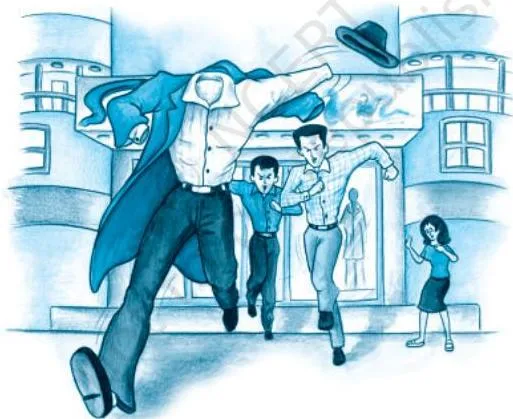
The figure above shows the scene the textbook captions: If only Griffin had managed to wake up in good time all might have been well. He oversleeps. The next morning, assistants arrive and begin approaching him. To escape unseen, he must remove every garment and dash off invisible again.
The Theatrical Company
Now naked and cold once more, Griffin heads to Drury Lane, the centre of the theatre world (NCERT, p. 27). He wants clothes and something to hide the empty space above his shoulders.
He enters a theatrical shop, goes upstairs invisible, and emerges wearing bandages around his forehead, dark glasses, a false nose, bushy side-whiskers, and a large hat. To escape unseen, he callously attacks the shopkeeper from behind and robs him of all the money he can find.
Arrival at Iping Inn
Eager to escape crowded London, Griffin takes a train to the village of Iping and books two rooms at the local inn (NCERT, p. 28). A stranger arriving in winter is unusual, and his appearance sets tongues wagging.
Mrs Hall, the landlord’s wife, tries to be friendly. Griffin refuses conversation, telling her his reason for coming is a desire for solitude, and that an accident has affected his face. Paid in advance, she excuses his strange habits and irritable temper.
The stolen money does not last, and Griffin soon admits he has no ready cash, pretending a cheque is due.
The Burglary and the Furniture
Early one morning, a clergyman and his wife hear the chink of money being taken from the study desk (NCERT, p. 28). The clergyman flings open the door shouting Surrender!, but the room is empty. The housekeeping money is gone — an extraordinary affair.
That same morning, Mrs Hall finds the scientist’s door wide open. She and her husband investigate. A sniff sounds close to her ear; the hat on the bedpost leaps into her face; the bedroom chair springs up and charges at her, legs foremost, pushing them both out of the room and locking the door behind them.
Mrs Hall falls down the stairs in hysterics, convinced spirits haunt the furniture.
The Headless Man and the Arrest
The village constable, Mr Jaffers, is secretly sent for. Mrs Hall confronts Griffin about the chair and the locked room. Furious, he shouts: You don’t understand who or what I am! In one minute he throws off bandages, whiskers, spectacles, and even his nose — leaving people staring at a headless man (NCERT, p. 29).
Jaffers is surprised to arrest a man without a head, but his warrant says he must. As Griffin sheds one garment after another, Jaffers struggles with someone he cannot see. Blows seem to come from nowhere; helpers are hit. Finally Jaffers is knocked unconscious, and Griffin shakes himself free.
You can find related character-focused revision pages alongside our A Triumph of Surgery notes and Mijbil the Otter notes.
Character Sketches: Griffin, Mrs Hall, and Jaffers
| Character | Traits | Textual Evidence |
|---|---|---|
| Griffin | Brilliant scientist, lawless, short-tempered, callous | Sets fire to his landlord’s house; breaks into the London store; attacks the Drury Lane shopkeeper from behind; robs the clergyman; throws off bandages to terrify the inn. |
| Mrs Hall | Hospitable, tolerant, then superstitious and hysterical | Makes every effort to be friendly at first; excuses his temper because he paid in advance; believes spirits haunt her chair when it charges at her. |
| Mr Jaffers | Dutiful, determined, not easily prevented | Arrests a headless man because his magistrate’s warrant ordered it; keeps fighting even as Griffin becomes fully invisible; knocked unconscious in the attempt. |
Theme Analysis: Science Without Conscience
- Misuse of scientific discovery: Griffin’s invisibility is a scientific triumph, but he uses it for revenge and theft. The clearest evidence is when he sets fire to his landlord’s house to escape ejection (NCERT, p. 27) — a discovery meant to advance knowledge becomes a tool of destruction.
- Lawlessness and its consequences: Every location Griffin enters ends in crime. In the London store he breaks open boxes; in Drury Lane he attacks and robs the shopkeeper; in Iping he burgles the clergyman’s desk. His lawlessness turns each safe space into a crime scene.
- Isolation and alienation: Griffin seeks solitude from the start. He tells Mrs Hall My reason for coming to Iping is a desire for solitude (NCERT, p. 28). He rejects friendliness, refuses conversation, and alienates his hosts until he must flee again.
Literary Devices Used in the Chapter
- Suspense and mystery: The chapter opens with fresh muddy imprints appearing from nowhere on the steps of a London house — footprints without feet. The reader, like the two boys, watches a trail form with no visible maker.
- Irony: Griffin’s scientific brilliance secures his invisibility, yet that same gift traps him in a lawless, cold, and homeless life. His greatest achievement enables his worst conditions.
- Humour in horror: Frightening events are given a comic edge — the bedroom chair springing into the air and charging at Mrs Hall legs foremost, and the constable wrestling a man who is steadily disappearing as each shirt flies into the air. The scene is absurd even as it is alarming.
Important Quotes From the Chapter
| Quote | Speaker / Context | Why It Matters |
|---|---|---|
| Brilliant scientist though he was, Griffin was rather a lawless person. | Narrator introducing Griffin (NCERT, p. 27) | The anchor line for any character assessment. It states both halves of his identity in a single sentence and frames every action that follows. |
| My reason for coming to Iping is a desire for solitude. I do not wish to be disturbed in my work. | Griffin to Mrs Hall (NCERT, p. 28) | Shows his deliberate alienation. He seeks isolation, not company, and warns Mrs Hall away from his room. |
| You don’t understand who or what I am! | Griffin shouting before revealing his headless body (NCERT, p. 29) | The turning point where Griffin weaponises his invisibility to terrify his hosts rather than hide from them. |
| If a magistrate’s warrant ordered a person’s arrest, then that person had to be arrested, with or without his head. | Narrator describing Jaffers (NCERT, p. 29) | Captures Jaffers’ dogged duty and adds dark humour to the arrest scene. Examiners reward students who note this blend. |
Brilliance vs Lawlessness: Griffin’s Two Sides
The key analytical point for this chapter is that Griffin’s brilliance as a scientist and his lawlessness as a person appear side by side, repeatedly. Examiners reward students who show the contrast using three named scenes.
| Scene | Brilliance (the scientist) | Lawlessness (the lawless person) |
|---|---|---|
| Burning the landlord’s house | Has just proven the human body can become transparent through experiment after experiment. | Sets fire to the house in revenge for ejection and flees unseen. |
| Drury Lane theatrical shop | Knows exactly how to use theatrical props — bandages, glasses, false nose, whiskers — to cover an invisible head. | Callously attacks the shopkeeper from behind and robs him of all the money he can find. |
| Iping inn reveal | Removes bandages, whiskers, spectacles, and nose in one minute — precise control of his disguise. | Uses the reveal to terrify innocent people instead of simply leaving. |
Textbook Questions: Think About It Pointers
Q1. “Griffin was rather a lawless person.” Comment.
- Open by quoting the line and naming both halves of Griffin’s character.
- Landlord conflict: he sets fire to the house to eject him — a criminal act, not a scientific one.
- London store: breaks open boxes and wrappers, consumes food and wine without paying.
- Drury Lane shop: callously attacked the shopkeeper from behind (NCERT, p. 27) and robbed him.
- Clergyman’s house: steals housekeeping money from the desk.
- Iping reveal: terrifies Mrs Hall and assaults those trying to help Jaffers.
- Conclude that misuse of a great discovery turns Griffin from scientist to criminal.
Q2. How would you assess Griffin as a scientist?
- Brilliance: he carries out experiment after experiment and succeeds in making the body transparent — a genuine scientific breakthrough.
- Irresponsibility: he uses that breakthrough for personal revenge and theft, not for advancing knowledge.
- Method fails: his own body remains as solid as glass, so muddy footprints betray him — the discovery is incomplete.
- Judgement: as a scientist he was gifted; as a human being he was lawless and irresponsible.
For full answers to these textbook questions and the Talk About It discussion prompts, use our chapter notes collection and look for the linked solutions page for this chapter.
Common Mistakes Students Make
| Mistake | Correct rule | How to check your answer |
|---|---|---|
| Writing Griffin was evil. | Griffin was brilliant but lawless — the text calls his conduct lawless, not evil (NCERT, p. 27). | |
| Forgetting the landlord fire as the starting event. | The arson is the trigger of the whole journey — always mention it first when explaining his wandering. | |
| Calling Mrs Hall the landlady of the inn. | The text calls her the landlord’s wife (NCERT, p. 28); the landlord runs the inn with her. | |
| Saying Griffin escaped Jaffers by fighting visibly. | He escaped by throwing off one garment after another until fully invisible — blows came from nowhere (NCERT, p. 29). |
In the first row of the table above, each correction cell pairs a wrongly stated claim with a textbook-anchored correction; claim-and-correction lines, not full sentences, is the shape examiners compute on.
Exam Notes: What Examiners Look For
- Quote the anchor line. Character-sketch questions reward you for quoting Brilliant scientist though he was, Griffin was rather a lawless person as your first line. It gives you the mark for the core judgement immediately.
- Link power and misuse. In a character answer, every trait should link to an action — brilliance to his invisibility method, lawlessness to a specific theft or assault. Unsupported adjectives score poorly.
- Name incidents for themes. A theme answer needs named events: the landlord’s house fire, the London store break-in, the clergyman’s burglary, the Iping furniture chase. Vague theme answers without named evidence lose marks.
- Use textual vocabulary. Words the chapter itself uses — lawless, callously, eccentric, solitude — show the examiner you read the text and readjust answers toward the top band.
Revision Summary: One-Minute Recap
- Griffin discovers how to make the human body transparent using rare drugs.
- He sets fire to his landlord’s house and flees naked and invisible.
- He breaks into a big London store, dresses and feeds himself, but oversleeps.
- In Drury Lane he steals bandages, a false nose, glasses, and whiskers, and attacks the shopkeeper.
- He arrives at the Iping inn seeking solitude and pays Mrs Hall in advance.
- He robs a clergyman’s desk and the next morning his furniture chases Mrs Hall out of his room.
- Griffin reveals himself as a headless man and the constable Jaffers tries to arrest him.
- Griffin sheds every garment, becomes fully invisible, knocks Jaffers unconscious, and escapes.
Author Background: H.G. Wells and Science Fiction
H.G. Wells is widely called a father of science fiction. His novels imagine scientific breakthroughs — invisibility, time travel, alien invasion — and then test their effect on human beings. The chapter is adapted from The Invisible Man, his 1897 novel.
The textbook’s suggested reading list at the end of the chapter points you to more writing in this spirit (NCERT, p. 51): The Invisible Man by H.G. Wells, As Far As the Human Eye Can See by Isaac Asimov, and It Happened Tomorrow edited by Bal Phondke.
You can read the chapter directly on the official NCERT textbook page for the Footprints Without Feet supplementary reader.
Frequently Asked Questions
How did Griffin become invisible in Footprints Without Feet?
Griffin swallowed certain rare drugs that made his body transparent, though still solid (NCERT, p. 27). He had to remove his clothes to become fully invisible because clothes do not become transparent.
Why did Griffin go to the village of Iping?
He wanted to get away from crowded London. He told Mrs Hall his reason for coming to Iping was a desire for solitude and that he did not wish to be disturbed in his work (NCERT, p. 28). So he booked two rooms at the local inn and paid in advance.
What curious episode happened at the clergyman’s house?
Early one morning a clergyman and his wife heard the chink of money being taken from the desk (NCERT, p. 28). The clergyman rushed in with a poker shouting Surrender!, but the room was empty and the housekeeping money was gone.
How did Griffin escape from the constable at the inn?
Griffin threw off his bandages, whiskers, spectacles, and even his nose until he was headless. As the struggle continued he shed more garments until a shirt flew into the air and he became fully invisible (NCERT, p. 29). Blows came from nowhere and Jaffers was knocked unconscious, letting Griffin escape.
Was Griffin a good scientist?
As a scientist he was brilliant — his experiments proved the human body can become transparent. As a person he was lawless and irresponsible, using his discovery for arson, theft, and assault rather than advancing knowledge.
Reference: NCERT Class 10 English textbook, chapter Footprints Without Feet (Supplementary Reader, chapter 5).
Explore Class 10 English Notes
Class 10 English on LearnCBSE:
Related chapters: