
This page brings together complete electrostatic potential and capacitance class 12 notes from the NCERT textbook (Physics Part 1, Chapter 2). It is built for fast revision before a test or the board exam: every key concept, definition, formula table, worked example with fresh numbers, and the common traps that quietly cost marks.
The chapter runs on one logical ladder: potential energy → electrostatic potential → potential due to point charges, dipoles and charge systems → equipotential surfaces → conductors and shielding → dielectrics → capacitors and their combinations → energy stored in the field. Each topic below carries its NCERT page number so you can cross-check anything in seconds.
For the electric-field foundations this chapter uses, revisit Chapter 1 (electric charges and fields).
Electrostatic Potential and Capacitance Class 12 Notes: Chapter Overview
The chapter moves in a fixed order, and every section is based on electrostatics covered in Chapter 1 (Coulomb’s law, electric field, Gauss’s law). Scan the sequence before you start solving:
- Electrostatic potential energy — work done to bring a charge slowly, with no acceleration, against the Coulomb force (NCERT, p. 1–2).
- Electrostatic potential V — the work per unit charge; only potential difference is physically meaningful (p. 3–4).
- Potential due to a point charge, a dipole, and a system of charges — superposition applies to potential as a scalar (p. 4–8).
- Equipotential surfaces and the field–potential relation (p. 10–11).
- Potential energy of a system of charges and of a dipole in an external field (p. 11–16).
- Electrostatics of conductors — field is zero inside, charges sit on the surface, electrostatic shielding (p. 17–20).
- Dielectrics and polarisation (p. 21–22).
- Capacitors — capacitance, parallel-plate form, dielectric effect, series/parallel combinations, and energy stored (p. 23–31).
Key Concepts at a Glance
Potential is a scalar and the field is a vector. That single fact decides how you add them: potentials add as a plain algebraic sum (watch the signs of charges), while fields must be added as vectors. This is why superposition for potential is the easy part of the chapter.
| Term | Meaning | Quick example |
|---|---|---|
| Electrostatic potential V | Work per unit positive charge in bringing it (without acceleration) from infinity to the point; scalar. | \( V = \frac{kQ}{r} \); a 2 \(\mu\)C charge gives \(1.8 \times 10^5\) V at 10 cm. |
| Potential difference | Work per unit charge between two points; path-independent because the Coulomb force is conservative. | Moving 1 C between points needing 5 J of work → \(\Delta V = 5\ V\). |
| Equipotential surface | Surface on which potential is constant; the electric field is normal to it at every point. | Concentric spheres centred on a point charge. |
| Electric dipole moment p | \( \mathbf{p} = q(2a) \), directed from \(-q\) to \(+q\). | Dipole of example 2.6: \(10^{-29}\) C m per molecule. |
| Polarisation P | Net dipole moment per unit volume; \( \mathbf{P} = \varepsilon_0 \chi_e \mathbf{E} \). | Induced surface charge \( \pm\sigma_p \) on a dielectric slab. |
| Capacitance C | Ratio \( Q/V \); fixed purely by geometry for given conductors. | Parallel plate: \( C = \varepsilon_0 A/d \). |
Key Definitions with Examples
The five quantities below are the spine of the chapter. Learn the definition and a quick number for each so you can quote either in an answer.
| Term | Definition | Example (original numbers) |
|---|---|---|
| Potential V (p. 3–4) | Work done by an external force in bringing a unit positive charge from infinity to the point, without acceleration. | \( Q = 2\ \mu\text{C} \) at \( r = 10\ \text{cm} \): \( V = 9 \times 10^9 \times \frac{2 \times 10^{-6}}{0.1} = 1.8 \times 10^5\ \text{V} \). |
| Potential energy U (p. 2) | Work done to bring the specific charge q from infinity to the point; \( U = qV \). | \( q = 5\ \mu\text{C} \) at that point: \( U = 5 \times 10^{-6} \times 1.8 \times 10^5 = 0.9\ \text{J} \). |
| Capacitance C (p. 23) | \( C = Q/V \), the charge stored per unit potential difference. | A 470 \(\mu\)F capacitor holds \( Q = CV = 2.35 \times 10^{-2}\ \text{C} \) at 50 V. |
| Dielectric constant K (p. 26) | \( K = C/C_0 = \varepsilon/\varepsilon_0 \), the factor (\(\gt 1\)) by which capacitance rises when the dielectric fills the space. | Mica (\( K = 6 \)) multiplies the vacuum capacitance by 6. |
| Polarisation P (p. 22) | Dipole moment per unit volume; \( \mathbf{P} = \varepsilon_0 \chi_e \mathbf{E} \), unit C/m². | A uniformly polarised slab produces surface density \( \pm\sigma_p \) but no volume charge. |
Potential vs potential energy: comparison table
Students mix these two more than anything else in the chapter. The difference is one word: per unit charge.
| Point of comparison | Electrostatic potential V | Potential energy U |
|---|---|---|
| Definition | Work per unit positive charge from infinity | Work done on the actual charge q |
| Symbol / unit | V, volt (J/C) | U, joule |
| Depends on | Only the field / charge configuration | The charge q and the field |
| Point-charge formula | \( V = kQ/r \) | \( U = qV = kQq/r \) |
| Physical sense | Property of a point in space | Belongs to the charge placed in that field |
All Important Formulas of This Chapter
Use this as your solving reference. Always substitute \( k = 9 \times 10^9\ \text{N m}^2\text{C}^{-2} \) once, then plug values — it avoids the arithmetic slips that cost marks.
| Formula | Meaning | Key symbols | Unit | NCERT p. |
|---|---|---|---|---|
| \( V = \frac{kQ}{r} \) | Potential due to a point charge | \( Q \) charge, \( r \) distance | V | 4 |
| \( V = \frac{k\,\mathbf{p}\cdot\hat{\mathbf{r}}}{r^2} \) | Potential due to a dipole, \( r \gg a \) | \( \mathbf{p} = q(2a) \) dipole moment | V | 6 |
| \( V = k\sum\frac{q_i}{r_{iP}} \) | Superposition for a system of charges | \( q_i \) charges, \( r_{iP} \) distances | V | 7 |
| \( |\mathbf{E}| = -\frac{\delta V}{\delta l} \) | Field magnitude from potential gradient | \( \delta l \) along normal to surface | V/m | 11 |
| \( \mathbf{E} = \frac{\sigma}{\varepsilon_0}\hat{\mathbf{n}} \) | Field just outside a charged conductor | \( \sigma \) surface charge density | V/m | 19 |
| \( \mathbf{P} = \varepsilon_0 \chi_e \mathbf{E} \) | Polarisation of a linear dielectric | \( \chi_e \) electric susceptibility | C/m² | 22 |
| \( C = \frac{Q}{V} \) | Definition of capacitance | \( Q \) charge, \( V \) potential difference | F = C/V | 23 |
| \( C = \frac{\varepsilon_0 A}{d} \) | Parallel-plate capacitor (vacuum) | \( A \) plate area, \( d \) separation | F | 24 |
| \( C = \frac{K\varepsilon_0 A}{d} \) | Same, with dielectric filling the gap | \( K \) dielectric constant | F | 26 |
| \( \frac{1}{C} = \sum\frac{1}{C_i} \) | Series combination (charge same) | \( C_i \) individual capacitances | F | 28 |
| \( C = \sum C_i \) | Parallel combination (voltage same) | \( C_i \) individual capacitances | F | 28 |
| \( U = \frac{Q^2}{2C} = \frac{1}{2}CV^2 = \frac{1}{2}QV \) | Energy stored in a capacitor | \( C \), \( Q \), \( V \) | J | 29 |
| \( u = \frac{1}{2}\varepsilon_0 E^2 \) | Energy density of an electric field | \( E \) field magnitude | J/m³ | 30 |
Memory aid — series vs parallel: “Series is Smaller, Parallel is the Plain Sum.” In series the result is smaller than the smallest capacitor (you add reciprocals); in parallel the result is larger than the largest (you add straight). Remember the symmetry: series shares charge (same \(Q\) on every capacitor), parallel shares potential (same \(V\) on every capacitor).
Worked Examples (with Original Numerals)
These mirror the board-exam pattern but use fresh numbers, so you practise the method, not the answer.
Example 1: Potential at the midpoint of two opposite-signed charges
Method: superposition of scalar potentials — add each charge’s contribution with its sign.
Step 1: Charges \(+5\ \mu\text{C}\) and \(-3\ \mu\text{C}\) are 8 cm apart.
The midpoint is \(r_1 = r_2 = 4\ \text{cm} = 0.04\ \text{m}\) from each.
Step 2: With \(k = 9 \times 10^9\ \) N m² C⁻², write both terms, signs included:
\[ V = k\left(\frac{Q_1}{r_1} + \frac{Q_2}{r_2}\right) = 9\times 10^9\left(\frac{5\times10^{-6}}{0.04} + \frac{(-3\times10^{-6})}{0.04}\right) \]
\[ = 9\times 10^9 \times \frac{2\times10^{-6}}{0.04} = 9\times 10^9 \times 5\times10^{-5} = 4.5\times10^5\ \text{V} \]
Final answer: \( V = 4.5 \times 10^5\) V. The negative charge lowers the total; without its sign the answer would wrongly be \(1.125\times10^6 + 6.75\times10^5 = 1.8\times10^6\) V.
Trap: a zero potential does not mean a zero field. Potential is a scalar sum; field is a vector sum, and at the midpoint of two unequal charges the fields do not cancel.
Example 2: Three capacitors in series on a 12 V battery
Method: reciprocal sum first, then divide — never add before taking reciprocals.
Step 1: Capacitors \(C_1 = 2\ \mu\text{F}\), \(C_2 = 3\ \mu\text{F}\), \(C_3 = 5\ \mu\text{F}\) in series:
\[ \frac{1}{C} = \frac{1}{2} + \frac{1}{3} + \frac{1}{5} = \frac{15+10+6}{30} = \frac{31}{30}\ \mu\text{F}^{-1} \]
Step 2: Invert to get the equivalent capacitance:
\[ C = \frac{30}{31}\ \mu\text{F} \approx 0.97\ \mu\text{F} \]
Step 3: In series the charge is the same on every capacitor:
\[ Q = CV = \frac{30}{31}\times10^{-6} \times 12 = \frac{360}{31}\ \mu\text{C} \approx 11.6\ \mu\text{C} \]
Step 4: Voltage divides inversely with capacitance:
\[ V_1 = \frac{Q}{C_1} = \frac{11.6}{2} \approx 5.8\ \text{V},\quad V_2 = \frac{11.6}{3} \approx 3.9\ \text{V},\quad V_3 = \frac{11.6}{5} \approx 2.3\ \text{V} \]
Final answer: \( C \approx 0.97\ \mu\text{F}\); check \(5.8 + 3.9 + 2.3 \approx 12\) V ✓. Sanity check: \(0.97 \lt 2\ \mu\text{F}\), the smallest — as the memory aid demands.
Example 3: Energy stored, and energy lost on joining an identical capacitor
Method: charge is conserved, energy is not — this is the classic energy-loss question.
Step 1: A \(470\ \mu\text{F}\) capacitor is charged to \(50\) V.
Energy stored:
\[ U_1 = \frac{1}{2}CV^2 = \frac{1}{2} \times 470\times10^{-6} \times (50)^2 = 0.588\ \text{J} \]
- Step 1: Charge before joining: \( Q = CV = 470\times10^{-6} \times 50 = 2.35\times10^{-2}\ \text{C} \).
- Step 2: Connect to an identical uncharged \(470\ \mu\text{F}\) capacitor.
Total capacitance doubles to \(940\ \mu\text{F}\); the common potential is \[ V’ = \frac{Q}{2C} = \frac{2.35\times10^{-2}}{940\times10^{-6}} = 25\ \text{V} \]
Step 4: Final stored energy:
\[ U_2 = \frac{1}{2} \times 940\times10^{-6} \times (25)^2 = 0.294\ \text{J} \]
Step 5: Energy lost \( = U_1 – U_2 = 0.588 – 0.294 = 0.294\) J.
Final answer: Energy lost \(\approx 0.29\) J — exactly half. Why is energy lost though charge is conserved? During the brief transient, current flows from one capacitor into the other and energy escapes as heat and electromagnetic radiation (NCERT, p. 32).
Common Mistakes Students Make (and How to Avoid Them)
| Mistake | Correct rule | How to check your answer |
|---|---|---|
| Treating potential \(V\) and energy \(U\) as the same thing | \( V = U/q \) — potential is energy per unit charge | Units: volt (J/C) vs joule; always \(U = qV\) |
| Adding series capacitors as \(C = C_1 + C_2\) | Reciprocal sum: \(1/C = \sum 1/C_i\) | In series the result is smaller than the smallest capacitor |
| Dropping the sign of a negative charge in \(V = kQ/r\) | Keep the sign of \(Q\): \(V = k(Q_1/r_1 + Q_2/r_2)\) | A negative charge must pull the total potential down |
| Assuming the field is zero inside every dielectric | \(E = 0\) holds only inside a conductor in the static state; a dielectric only reduces the field | Inside a dielectric \(E = E_0/K\), which is not zero |
| Misplacing \(4\pi\) instead of using \(k\) | \(k = 1/(4\pi\varepsilon_0) = 9 \times 10^9\) N m² C⁻² — substitute it once | For \(\mu\)C charges at cm distances, \(V\) should come out \(10^5\)–\(10^6\) V |
| Giving each series capacitor a different charge | Series capacitors always share the same charge \(Q = C_{\text{eq}}V\) | After finding \(V_i = Q/C_i\), verify \(\sum V_i\) equals the applied voltage |
Sign errors from negative charges are the classic mark-chain breaker. For \(+5\ \mu\text{C}\) and \(-3\ \mu\text{C}\) at the midpoint, the positive charge contributes \(+1.125\times10^6\) V, the negative charge \(-6.75\times10^5\) V. Writing the minus sign is a full step — skip it and the answer changes by \(6.75\times10^5\) V.
State the sign at every term and add as an algebraic sum.
Exam-Focused Revision Notes
- Potential due to an electric dipole is a frequent 2–3 mark question. On the axis, \( V = \pm kp/r^2 \) (positive for \( \theta = 0 \), negative for \( \theta = \pi \)); in the equatorial plane, \( V = 0 \) (NCERT, p. 6). The dipole potential falls as \(1/r^2\), unlike the \(1/r\) of a single charge.
- Energy of a system of charges (assembling charges one by one, as in Example 2.4) is a long-answer favourite. The mark is earned by stating that work done is path-independent and that energy belongs to the final configuration, not the route (p. 12–13).
- Series/parallel combinations appear in almost every paper — a light but regular question. Master the two formulas and the “charge same / voltage same” idea.
- Electrostatic shielding is a dependable one-liner: the field in a charge-free cavity is always zero, whatever the outside field (p. 19–20). The reason is Gauss’s law — any excess charge must sit on the outer surface, so the cavity stays field-free. Note: shielding works one way only; charges inside the cavity are not shielded from the outside by the conductor.
- Energy loss on joining capacitors (Example 2.10) is a hot topic: when two identical capacitors share charge, the final energy is half the initial, lost as heat and electromagnetic radiation during the transient.
- Half the marks in this chapter sit in a stated principle, not arithmetic: “work done by an electrostatic field is independent of the path” and “the energy of a capacitor is stored in the field, with density \(\frac{1}{2}\varepsilon_0 E^2\)” (p. 30). Write the principle, then the numbers.
Capacitors also do essential work in AC circuits — follow that idea into the current electricity chapter. For further revision of the full syllabus, browse the Class 12 Physics notes and the complete Class 12 notes set in our CBSE notes library.
To verify any formula against the official text, open the NCERT Class 12 Physics Part 1 textbook (PDF) — Chapter 2 is the chapter on electrostatic potential and capacitance.
Figure Walkthrough: Equipotential Surfaces
The NCERT diagrams on pages 10–11 are the fastest way to see the field–potential relationship. Walk through each one.
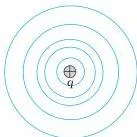
For a single charge, \( V = kq/r \) is constant when \(r\) is constant, so the equipotential surfaces are concentric spheres. The field lines are radial (outward for a positive charge) and meet every sphere at \(90^\circ\) — the geometric statement of “field is normal to the equipotential surface”.

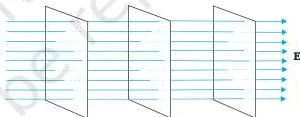
For a uniform field, the surfaces become planes perpendicular to the field. Because the field is uniform, adjacent planes are equally spaced — potential changes at a constant rate, which is why \(E = -\delta V/\delta l\) is a simple division here.

For a dipole (a) and for two identical positive charges (b), the dashed closed curves are equipotentials; the solid field lines cross them at right angles. Around two equal positive charges there is a point halfway between where the field vanishes — the field is zero but the potential is not, a favourite conceptual trap.
This is the proof that \(\mathbf{E}\) is normal to every equipotential surface. If the field had a component lying along the surface, a unit test charge moved sideways would require work — but by definition no work is done between two points of equal potential. The only escape is that \(\mathbf{E}\) has no tangential component.
Revision Summary (One-Page Recap)
Left column — the principles you must be able to state. Right column — the formulas that carry them.
| Principles | Formulas |
|---|---|
| Electrostatic potential — work per unit positive charge from infinity (p. 3). Only potential difference is measurable. | \( V = \frac{kQ}{r} \) — point charge |
| Potential difference — work is path-independent for the conservative Coulomb force (p. 2). | \( V = \frac{k\,\mathbf{p}\cdot\hat{\mathbf{r}}}{r^2} \) — dipole, \(r \gg a\) |
| Equipotential surfaces — field is normal to the surface and points toward steepest potential decrease (p. 10–11). | \( |\mathbf{E}| = -\frac{\delta V}{\delta l} \) |
| Conductor rules — \(E = 0\) inside, charges on the surface, potential constant, cavity shielded (p. 18–20). | \( \mathbf{E} = \frac{\sigma}{\varepsilon_0}\hat{\mathbf{n}} \) at the surface |
| Capacitance — \(C = Q/V\), fixed by geometry; \(C = KC_0\) with dielectric (p. 23–26). | \( C = \frac{\varepsilon_0 A}{d} \), \( C = \frac{K\varepsilon_0 A}{d} \) |
| Combinations — series shares charge and shrinks \(C\); parallel shares voltage and grows \(C\). | \(\frac{1}{C} = \sum\frac{1}{C_i}\) series; \( C = \sum C_i \) parallel |
| Energy — stored in the field, density \(\frac{1}{2}\varepsilon_0 E^2\) (p. 29–30). Joining capacitors loses half the energy as heat + radiation. | \( U = \frac{1}{2}CV^2 = \frac{Q^2}{2C}\); \( u = \frac{1}{2}\varepsilon_0 E^2 \) |
Final memory hooks: potential scalar, field vector · “Series is Smaller, Parallel is the Plain Sum” · “Series Shares charge, Parallel shares Potential” · “field is normal to the equipotential surface” · “cavity shielded, conductor field-free”.
Frequently Asked Questions
What is electrostatic potential?
It is the work done in bringing a unit positive charge, without acceleration, from infinity to that point (NCERT, p. 4). For a point charge it is \( V = kQ/r \). Only the potential difference between two points is physically significant — the zero can be chosen anywhere, and we conventionally set it at infinity.
What is the difference between electric potential and potential energy?
Potential \(V\) is energy per unit charge (\(V = U/q\)); potential energy \(U\) is the work done on the specific charge \(q\) (\(U = qV\)). Potential belongs to the point in the field, while potential energy belongs to the charge placed there — for the same point, a bigger charge stores more energy but the potential is unchanged.
Why does capacitance increase when a dielectric is inserted between the plates?
An external field polarises the dielectric, creating induced surface charges \(\pm\sigma_p\) that set up an opposing field. The net field (and hence the potential difference \(V\)) drops for the same \(Q\), so \( C = Q/V \) rises by the factor \(K\) (NCERT, p. 25–26). This is why \(C = KC_0\).
How do I find equivalent capacitance in a mixed network of capacitors in series and parallel?
Identify which plates are joined directly to the same wire or battery terminal — those capacitors are in parallel and share the same voltage. Capacitors with only a single common junction between them are in series and share the same charge.
Reduce the network step by step: combine each series chain with the reciprocal formula, each parallel group with the direct sum, until one \(C_{\text{eq}}\) remains.
What is the direction of the electric field relative to equipotential surfaces?
The electric field is always normal (perpendicular) to the equipotential surface at every point, and it points in the direction of steepest decrease of potential (NCERT, p. 10–11). If the field had a component along the surface, moving a charge along the surface would do work — contradicting the definition of an equipotential surface.
Reference: NCERT Class 12 Physics textbook, chapter Electrostatic Potential and Capacitance.
Explore Class 12 Physics Notes
More for this chapter:
Class 12 Physics on LearnCBSE:
Related chapters: