
This page gives the complete exercise 10.2 class 10 maths ncert solutions — all 13 questions of Exercise 10.2 from the Circles chapter (NCERT Class 10 Mathematics), solved step by step. Every question is reproduced word for word exactly as it appears in the textbook, and each multiple-choice question carries all four options, so you can attempt it before reading the reasoning.
Each answer opens with the principle that makes the solution work — the tangent theorems — and only then shows the working, so the same idea can be reused on any similar question.
The official NCERT Class 10 Mathematics Chapter 10 (Circles) PDF is published by ncert.nic.in, and every question solved here is taken from that source, so you can compare any answer against the original textbook page by page. This page is part of our full Class 10 Maths solved set, which covers every chapter of the rationalised NCERT textbook the same way.
The chapter’s other exercise pages and worked examples sit in the same notes hub, so you can move straight from one exercise to the next without reopening the search page.
Exercise 10.2 Class 10 Maths NCERT Solutions
Exercise 10.2 applies the two tangent theorems to real questions — recognising the right triangle that a tangent makes with the radius, and using the equality of tangent lengths from an external point (NCERT, p. 152). The workload splits cleanly:
- MCQs (1 mark each): Questions 1, 2 and 3 — each needs one quick inference from the theorems.
- Proofs (3–5 marks each): Questions 4, 5, 8, 9, 10, 11 and 13 — these are the full-answer questions board papers reward, and they mostly reuse Theorem 10.1 and Theorem 10.2.
- Numericals: Questions 6, 7 and 12 — each is a right-triangle + Pythagoras problem after you spot the tangent.
This mixture is typical of how the chapter is examined: one-mark concept checks plus proof questions built on the two theorems. Our Class 10 notes collection covers every chapter this way, and the next chapter, areas related to circles, extends the same circle geometry into sectors and segments.
Theorems You Need for Every Question in This Exercise
Only two theorems drive the whole exercise, plus one remark that follows from them. Learn these and every question below becomes a one-step application.
What a tangent is
A tangent is a line that meets the circle at exactly one point — the point of contact. A secant cuts the circle at two points (the endpoints of a chord); as those two points slide together, the secant becomes a tangent and the chord’s two endpoints merge into the single point of contact.
So a tangent is the limiting position of a secant: a secant whose chord endpoints coincide (NCERT, p. 146). That mental picture is the memory anchor for the whole chapter.
Theorem 10.1 — radius perpendicular to tangent
The tangent at any point of a circle is perpendicular to the radius through the point of contact (NCERT, p. 147).
Why it holds: every other point on the tangent lies outside the circle, so the radius to the point of contact is the shortest distance from the centre to the tangent line, and the shortest segment from a point to a line is the perpendicular one.
This theorem gives you a right angle at every point of contact — the single fact behind Questions 1, 4, 5, 6, 7, 10 and 12.
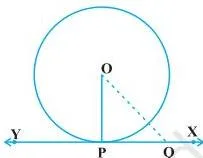
Theorem 10.2 — equal tangents from an external point
The lengths of tangents drawn from an external point to a circle are equal (NCERT, p. 149). Why: the two right triangles formed by the centre, the external point and each point of contact are congruent (equal radii and a common hypotenuse), so the two tangent segments match.
The remark that follows is just as important: the centre lies on the angle bisector of the angle between the two tangents. This theorem and its remark power Questions 2, 3, 8, 9, 11, 12 and 13.
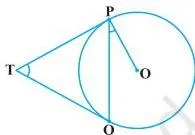
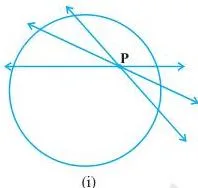
How many tangents from a point?
The three cases decide what is even possible (NCERT, p. 148):
- Point inside the circle: no tangent — every line through it meets the circle twice.
- Point on the circle: exactly one tangent.
- Point outside the circle: exactly two tangents, and they are equal in length.
The Pythagoras consequence. Wherever Theorem 10.1 applies, the radius, the tangent, and the line from the centre to the external point form a right triangle, with the centre-to-point distance as the hypotenuse. That single triangle answers every numeric question in this exercise.
Question 1: From a point Q, the length of the tangent to a circle is 24 cm and the distance of Q from the centre is 25 cm. The radius of the circle is (A) 7 cm (B) 12 cm (C) 15 cm (D) 24.5 cm
Concept: By Theorem 10.1, the tangent is perpendicular to the radius at the point of contact. So the radius \(r\), the tangent (24 cm) and the centre-to-point segment (25 cm) form a right triangle with the 25 cm segment as the hypotenuse.
\[ r^2 + 24^2 = 25^2 \]
\[ r^2 = 625 – 576 = 49 \]
\[ r = 7\ \text{cm} \]
Final answer: (A) 7 cm. Options B, C and D are simply wrong numbers — 12 cm would need a tangent of √(625−144) ≈ 21.9 cm, which is not 24 cm, and the radius can never exceed the 25 cm hypotenuse.
Question 2: In Fig. 10.11, if TP and TQ are the two tangents to a circle with centre O so that ∠POQ = 110°, then ∠PTQ is equal to (A) 60° (B) 70° (C) 80° (D) 90°

Concept: Read the figure before calculating. The two radii OP and OQ meet the tangents at the right angles of Theorem 10.1, so the quadrilateral O–P–T–Q has two 90° angles, the given central angle \(\angle POQ = 110^\circ\), and the unknown \(\angle PTQ\). The four angles of any quadrilateral sum to 360°.
\[ \angle PTQ = 360^\circ – 90^\circ – 90^\circ – 110^\circ = 70^\circ \]
Final answer: (B) 70°. In short, the central angle and the angle between the tangents are supplementary: 110° + 70° = 180°.
Question 3: If tangents PA and PB from a point P to a circle with centre O are inclined to each other at angle of 80°, then ∠POA is equal to (A) 50° (B) 60° (C) 70° (D) 80°
Concept: The angle between the tangents is \(\angle APB = 80^\circ\). The centre lies on the bisector of this angle (remark after Theorem 10.2), so PO splits \(\angle APB\) into two 40° halves. Now use the right triangle POA: \(\angle PAO = 90^\circ\) by Theorem 10.1.
\[ \angle APO = \frac{80^\circ}{2} = 40^\circ \]
\[ \angle POA = 180^\circ – 90^\circ – 40^\circ = 50^\circ \]
Final answer: (A) 50°. Options B and C are distractors from miscounting the bisector; option D (80°) confuses the tangent angle with the half-angle asked for.
Question 4: Prove that the tangents drawn at the ends of a diameter of a circle are parallel.
Concept: Each tangent is perpendicular to its own radius (Theorem 10.1). The two radii that form a diameter lie on one straight line, so the two tangents are both perpendicular to the same line — and two lines perpendicular to the same line are parallel.
Proof: Let AB be a diameter of the circle with centre O, and let the tangents at A and B be \(l\) and \(m\).
- Since \(l\) is a tangent at A and OA is the radius through A, \(OA \perp l\) (Theorem 10.1).
- Since \(m\) is a tangent at B and OB is the radius through B, \(OB \perp m\) (Theorem 10.1).
- O, A and B are collinear because AB is a diameter, so \(l\) and \(m\) are both perpendicular to the line AB.
- Therefore \(l \parallel m\).
Hence proved: the tangents at the ends of a diameter are parallel.
Question 5: Prove that the perpendicular at the point of contact to the tangent to a circle passes through the centre.
Concept: This is the converse of Theorem 10.1, and it follows from the uniqueness of a perpendicular. Through a point on a line there is exactly one perpendicular; Theorem 10.1 already gives one such perpendicular, so it must be the same line.
Proof (uniqueness route): Let the circle have centre O and let the tangent touch it at P.
By Theorem 10.1, the radius OP is perpendicular to the tangent at P.
Through the point P on the tangent line there is exactly one perpendicular.
Hence the perpendicular at P is precisely the line OP, which passes through the centre O.
Proof (contradiction route): Suppose the perpendicular at P does not pass through O.
Then the tangent at P would have two distinct perpendiculars through P — the line OP (by Theorem 10.1) and the supposed perpendicular.
But only one perpendicular to a line can pass through a given point.
Contradiction, so the perpendicular must pass through the centre.
Hence proved: the perpendicular at the point of contact passes through the centre.
Question 6: The length of a tangent from a point A at distance 5 cm from the centre of the circle is 4 cm. Find the radius of the circle.
Concept: The tangent is perpendicular to the radius, so the radius \(r\), the tangent (4 cm) and the centre-to-point distance (5 cm) form a right triangle — with the 5 cm segment as the hypotenuse because it is the longest side. Apply Pythagoras.
\[ r^2 = 5^2 – 4^2 = 25 – 16 = 9 \]
\[ r = 3\ \text{cm} \]
Final answer: the radius of the circle is 3 cm.
Question 7: Two concentric circles are of radii 5 cm and 3 cm. Find the length of the chord of the larger circle which touches the smaller circle.
Concept: The chord of the larger circle that touches the smaller circle is a tangent to the smaller circle. Its point of contact lies at the foot of the perpendicular from the centre, and the perpendicular from the centre to a chord bisects the chord (NCERT, p. 150).
So half the chord, the radius of the smaller circle (3 cm) and the radius of the larger circle (5 cm) form a right triangle.
\[ \text{half-chord} = \sqrt{5^2 – 3^2} = \sqrt{25 – 9} = \sqrt{16} = 4\ \text{cm} \]
\[ \text{full chord} = 2 \times 4 = 8\ \text{cm} \]
Final answer: the chord of the larger circle is 8 cm.
Question 8: A quadrilateral ABCD is drawn to circumscribe a circle (see Fig. 10.12). Prove that AB + CD = AD + BC.
The exercise points to Fig. 10.12, which is not available in our source images. The proof needs no diagram beyond a rough sketch: draw a circle inside a quadrilateral touching all four sides, and label the four contact points.
Concept: From each vertex, the two tangent segments to the circle are equal (Theorem 10.2). Label the tangent segments from A as \(a, a\), from B as \(b, b\), from C as \(c, c\), and from D as \(d, d\). Each side is the sum of the two labels at its ends.
- Let the circle touch AB at P, BC at Q, CD at R and DA at S.
- Equal tangents from A: \(AP = AS = a\); from B: \(BP = BQ = b\); from C: \(CQ = CR = c\); from D: \(DR = DS = d\).
\[ AB = a + b,\quad CD = c + d \]
\[ AD = a + d,\quad BC = b + c \]
\[ AB + CD = (a+b) + (c+d) = a+b+c+d \]
\[ AD + BC = (a+d) + (b+c) = a+b+c+d \]
Hence proved: \(AB + CD = AD + BC\).
Question 9: In Fig. 10.13, XY and X’Y’ are two parallel tangents to a circle with centre O and another tangent AB with point of contact C intersecting XY at A and X’Y’ at B. Prove that ∠AOB = 90°.
The exercise points to Fig. 10.13, which is not available in our source images. Sketch it yourself: two horizontal parallel lines as the tangents XY and X’Y’, a third tangent sloping between them meeting XY at A and X’Y’ at B, and the circle between the parallels touching all three lines.
Concept: Two tangents from A (XY and AB) meet at A, so by the remark after Theorem 10.2, the centre O lies on the bisector of the angle between them — that is, OA bisects \(\angle XAB\). Similarly OB bisects the angle at B. Then use the parallel-line rule: interior angles on the same side of the transversal AB sum to 180°.
Working:
- OA bisects \(\angle XAB\), so \(\angle OAB = \frac{1}{2}\angle XAB\).
- OB bisects \(\angle X’BA\), so \(\angle OBA = \frac{1}{2}\angle X’BA\).
- Since XY ∥ X’Y’ with transversal AB, \(\angle XAB + \angle X’BA = 180^\circ\) (same-side interior angles).
- Hence \(\angle OAB + \angle OBA = \frac{1}{2}(180^\circ) = 90^\circ\).
\[ \angle AOB = 180^\circ – (\angle OAB + \angle OBA) = 180^\circ – 90^\circ = 90^\circ \]
Hence proved: \(\angle AOB = 90^\circ\).
Question 10: Prove that the angle between the two tangents drawn from an external point to a circle is supplementary to the angle subtended by the line-segment joining the points of contact at the centre.
Concept: Let P be the external point and Q, R the points of contact. The quadrilateral P-Q-O-R has right angles at Q and R (Theorem 10.1). Since the four angles of a quadrilateral sum to 360°, the two right angles account for 180°, leaving the other two angles — \(\angle QPR\) (between the tangents) and \(\angle QOR\) (at the centre) — to share the remaining 180°.
They are therefore supplementary.
\[ \angle QPR + \angle QOR = 360^\circ – 90^\circ – 90^\circ = 180^\circ \]
Hence proved: the angle between the tangents and the central angle are supplementary.
Question 11: Prove that the parallelogram circumscribing a circle is a rhombus.
Concept: Combine two facts. First, from Q8, any circumscribed quadrilateral satisfies AB + CD = AD + BC. Second, in a parallelogram the opposite sides are equal: AB = CD and AD = BC. Substituting collapses the Q8 identity and forces every side to be equal.
Working: Let ABCD be the parallelogram circumscribing the circle.
- Parallelogram property: \(AB = CD\) and \(AD = BC\).
- Q8 result: \(AB + CD = AD + BC\).
- Substitute: \(2AB = 2BC\), so \(AB = BC\).
- Hence \(AB = BC = CD = DA\).
Hence proved: all four sides are equal, so the parallelogram is a rhombus.
Question 12: A triangle ABC is drawn to circumscribe a circle of radius 4 cm such that the segments BD and DC into which BC is divided by the point of contact D are of lengths 8 cm and 6 cm respectively (see Fig. 10.14). Find the sides AB and AC.
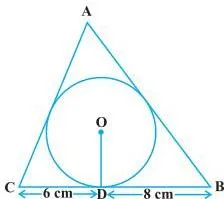
Concept: Read the figure before solving. The incircle touches BC at D, AB at E and AC at F. From B, the two tangents BD and BE are equal; from C, the tangents CD and CF are equal. Let the two equal tangent segments from A be \(x\) cm each.
Then every side is known in terms of \(x\), and the area can be written two ways — as inradius × semiperimeter, and by Heron’s formula.
- \(BD = BE = 8\) cm and \(DC = CF = 6\) cm (equal tangents from B and C).
- Let \(AE = AF = x\) cm. Then \(AB = x + 8\), \(AC = x + 6\), and \(BC = 14\) cm.
- Semiperimeter: \(s = \frac{(x+8)+(x+6)+14}{2} = x + 14\).
Method 1 (area — inradius × semiperimeter and Heron):
\[ \text{Area} = r \cdot s = 4(x+14) \]
\[ \text{Area}^2 = s(s-AB)(s-AC)(s-BC) = (x+14)(6)(8)(x) = 48x(x+14) \]
\[ [4(x+14)]^2 = 48x(x+14) \]
\[ 16(x+14)^2 = 48x(x+14) \]
\[ 16(x+14) = 48x \Rightarrow x = 7 \]
\[ AB = 7 + 8 = 15\ \text{cm},\quad AC = 7 + 6 = 13\ \text{cm} \]
Method 2 (Pythagoras check of the finished triangle): With \(AB = 15\), \(AC = 13\), \(BC = 14\), the area is \(r\cdot s = 4 \times 21 = 84\) cm², so the altitude to BC is \(\frac{2 \times 84}{14} = 12\) cm.
Then \(13^2 = 12^2 + 5^2\) and \(15^2 = 12^2 + 9^2\), with \(5 + 9 = 14\) — every right triangle closes.
The 13-14-15 triangle genuinely has inradius \(\frac{84}{21} = 4\) cm, confirming the answer.
Final answer: \(AB = 15\) cm and \(AC = 13\) cm.
Question 13: Prove that opposite sides of a quadrilateral circumscribing a circle subtend supplementary angles at the centre of the circle.
This question sits beside Fig. 10.14 in the textbook, the same circumscribed-triangle figure shown above; the proof applies the identical tangent structure to a quadrilateral.
Concept: Join the centre O to each vertex A, B, C, D. At vertex A, the two tangents AB and AD are drawn from A, so by the remark after Theorem 10.2, O lies on the bisector of \(\angle A\) — that is, OA bisects \(\angle A\). The same holds at B, C and D.
Write the vertex angles as \(A, B, C, D\); they sum to 360°.
- In \(\triangle AOB\): \(\angle OAB = \frac{A}{2}\), \(\angle OBA = \frac{B}{2}\), so \(\angle AOB = 180^\circ – \frac{A+B}{2}\).
- In \(\triangle COD\): \(\angle COD = 180^\circ – \frac{C+D}{2}\).
\[ \angle AOB + \angle COD = 360^\circ – \frac{A+B+C+D}{2} = 360^\circ – 180^\circ = 180^\circ \]
Hence the opposite sides AB and CD subtend the supplementary central angles \(\angle AOB\) and \(\angle COD\).
Repeating the argument at the other pair gives \(\angle BOC + \angle DOA = 180^\circ\), so the opposite sides BC and DA also subtend supplementary angles.
Hence proved: opposite sides of a circumscribed quadrilateral subtend supplementary angles at the centre.
Method Recap: The Four Moves That Solve This Whole Exercise
Every one of the 13 questions is one of these four moves. Practise recognising which move a question needs before computing anything.
| Move | What it does | Questions that use it |
|---|---|---|
| 1. Spot the right triangle | Radius ⊥ tangent (Theorem 10.1) gives a right triangle; apply Pythagoras. | Q1, Q6, Q7, Q12 |
| 2. Equal tangent lengths | Theorem 10.2 — label equal segments from each vertex as \(a, b, c, d\). | Q8, Q11, Q12, Q13 |
| 3. Quadrilateral angle-sum 360° | Two right angles at the contacts, so tangent-angle + central angle = 180°. | Q2, Q3, Q10 |
| 4. Angle-bisector property | Centre lies on the bisector of the angle between two tangents. | Q9, Q13 |
Fresh worked checks for each move
- Move 1: A tangent from a point 13 cm from the centre is 12 cm long. Then \(r = \sqrt{13^2 – 12^2} = \sqrt{25} = 5\) cm — a clean 5-12-13 triple, the same shape as the 7-24-25 in Q1 and the 3-4-5 in Q6 and Q7.
- Move 2: In a circumscribed quadrilateral with a single labelled tangent segment \(x\) from each vertex (Q8 notation), summing sides gives the identity directly — no angle work needed.
- Move 3: If a central angle is 120°, the angle between the two tangents is \(180^\circ – 120^\circ = 60^\circ\) — check your Q2/Q3 answers against this rule.
- Move 4: Wherever two tangents meet, the centre is on the angle bisector — this is the fact that turns Q9 and Q13 into half-angle algebra.
The same right-triangle and Pythagoras move appears throughout Chapter 9, some applications of trigonometry, so the skill transfers directly.
Common mistakes — and how to catch them
| Mistake | Correct rule | How to check your answer |
|---|---|---|
| Putting the radius on the hypotenuse of the tangent right triangle (Q6) | The centre-to-point distance is the hypotenuse; radius and tangent are the legs | The hypotenuse must be the longest side — 5 cm > 4 cm and 3 cm |
| Taking the tangent angle equal to the central angle (Q2, Q3) | They are supplementary: they add to 180° (Q10) | Add your two answers — they must total 180° |
| Answering the half-length in Q7 instead of the chord | The perpendicular from the centre bisects the chord, so double the half-length | Re-read whether the question asks for the chord or a half |
| Proving Q8 with side relations instead of tangents | Label equal tangent segments from each vertex (Theorem 10.2) | Every side must be written as a sum of two labelled segments |
| Calling Q11’s result a square | Equal sides with unstated angles give a rhombus, not a square | State “all four sides are equal, so it is a rhombus” |
Frequently Asked Questions on Circles Exercise 10.2
How many tangents can be drawn from a point inside, on, and outside a circle?
From a point inside the circle, zero tangents; from a point on the circle, exactly one; from a point outside, exactly two (NCERT, p. 148). A line through an interior point always cuts the circle twice, so it is a secant, never a tangent. The figure shows the three cases side by side.
Why is the angle between two tangents supplementary to the angle subtended at the centre?
Because the two radii to the points of contact are perpendicular to the tangents, the quadrilateral formed by the centre, the external point and the two contact points contains two right angles. The four angles of a quadrilateral sum to 360°, leaving exactly 180° to share between the tangent angle and the central angle.
This is precisely the statement of Q10, and it drives Q2 and Q3.
How do I prove that a parallelogram circumscribing a circle is a rhombus?
Use the result of Q8 — in any circumscribed quadrilateral the sums of opposite sides are equal: AB + CD = AD + BC. For a parallelogram, AB = CD and AD = BC, so the identity collapses to 2AB = 2BC, forcing all four sides equal. That is the definition of a rhombus. It is not automatically a square because the angles are not given as 90°.
Does every question in Exercise 10.2 use the Pythagoras theorem?
No. Only Q1, Q6, Q7 and Q12 need Pythagoras, via the right triangle that Theorem 10.1 creates. Q2, Q3 and Q10 use angle sums, and Q4, Q5, Q8, Q9, Q11 and Q13 are pure proofs relying on the two theorems and the angle-bisector property. Knowing which move a question needs is half the solution.
This page is one exercise in the larger CBSE notes set; every other Class 10 chapter is solved in the same structure.
Reference: NCERT Class 10 Mathematics textbook, chapter Circles.
Explore Class 10 Maths NCERT Solutions
More for this chapter:
Class 10 Maths on LearnCBSE:
Related chapters:
Official source: download the NCERT textbook free from ncert.nic.in.