
These exercise 2.1 class 10 maths ncert solutions take you through the single question in Class 10 Maths Chapter 2, hence giving you the full set of answers you need tonight. The exercise has just one question, but it appears again and again in the board exam because it tests the core geometric idea behind the entire Polynomials chapter.
For the CBSE 2026-27 session, this page solves that one question completely, with every graph panel (i) through (vi) read panel by panel so you can match it to what you see in Fig. 2.10 on page 9.
The exercise shows six separate polynomial graphs in a single composite figure, and asks you to count the zeroes of the polynomial in each panel. You do not need to factor the polynomial, nor even know its formula. You only read its graph against the x-axis.
This page walks you through the principle once, then applies it to every one of the six panels, naming the distinction between a graph that CROSSES the axis and a graph that only TOUCHES it and turns back.
Exercise 2.1 Solutions
This exercise tests the single geometric idea from Section 2.2 of your textbook (pp. 12-17): the zeroes of a polynomial p(x) are the x-coordinates of the points where the graph of y = p(x) meets or touches the x-axis (NCERT, p. 12). You will not factor a single polynomial here. You will just count the meetings between each curve and the x-axis.
- Zero of a polynomial: a real number k is a zero of p(x) when p(k) = 0 (NCERT, p. 11). The zero is a number on the x-axis at which the curve gives zero output.
- Geometric meaning: the zeroes of a polynomial are the x-coordinates of the points where the graph of y = p(x) intersects the x-axis (NCERT, p. 12). Only x-coordinates count. The y-coordinate of the point of contact is always 0.
- Three graph-axis outcomes: a graph can cut the axis at two points (two distinct zeroes), touch the axis at exactly one point and turn back (one repeated zero), or never meet the axis (no zero) (NCERT, p. 14-15). The same logic extends to cubic graphs (NCERT, p. 16-17).
- The degree rule: a polynomial of degree n has at most n zeroes (NCERT, p. 17). So a quadratic has at most two and a cubic has at most three. This is the checking step: the count you read off the graph can never exceed the degree.
- Cross vs touch: a graph that CROSSES the x-axis gives a single distinct zero at that x-coordinate. A graph that only TOUCHES the axis at its vertex and turns back gives ONE repeated zero, not two (NCERT, p. 15).
Question 1: The graphs of y = p(x) are given in Fig. 2.10 below, for some polynomials p(x). Find the number of zeroes of p(x), in each case.
- (i)
- (ii)
- (iii)
- (iv)
- (v)
- (vi)
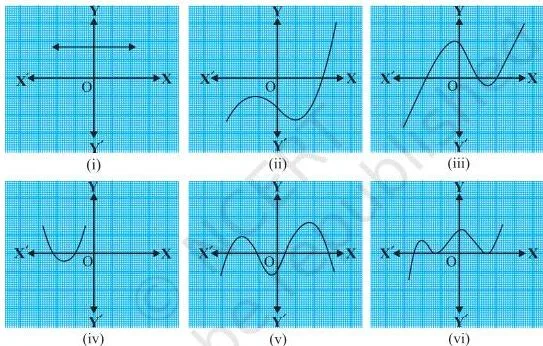
Concept: The zeroes of a polynomial are the x-coordinates where its graph meets or touches the x-axis — not the y-axis, and not the turning points above or below the axis. A graph that crosses the axis at a point produces one distinct zero at that x-value.
A graph that only touches the axis at its vertex and turns back also produces one zero, but that zero is a repeated zero — the two expected zeroes of the quadratic have coincided into one point.
A graph that never meets the axis produces zero zeroes, even though the polynomial itself still exists.
Part (i): The parabola in panel (i) lies completely above the x-axis — it never intersects or touches the axis anywhere.
So the polynomial has 0 zeroes.
Part (ii): The parabola in panel (ii) has its vertex sitting exactly on the x-axis.
It touches the axis at one point but does not cross it — the two expected zeroes have coincided.
So the polynomial has 1 zero (a repeated zero).
Part (iii): The cubic curve in panel (iii) crosses the x-axis at three distinct points.
So the polynomial has 3 zeroes.
Part (iv): The parabola in panel (iv) cuts the x-axis at two distinct points.
So the polynomial has 2 zeroes.
Part (v): The cubic curve in panel (v) touches the x-axis at exactly one point and does not cross it.
So the polynomial has 1 zero (a repeated zero).
Part (vi): The curve in panel (vi) lies completely below the x-axis and never meets it.
So the polynomial has 0 zeroes.
Final answers: (i) 0, (ii) 1, (iii) 3, (iv) 2, (v) 1, (vi) 0.
Method Recap: Reading Zeroes from Polynomial Graphs
The same rule applies to every polynomial graph you will see in this chapter: count only x-axis meetings, and use the degree as a check. The table below maps the three possible x-axis outcomes for a quadratic graph, with the textbook figures as reference.
| Graph Case | x-axis Behaviour | Number of Zeroes | Type of Zeroes |
|---|---|---|---|
| Two distinct cuts (Fig. 2.3, p. 14) | Parabola cuts the x-axis at two distinct points A and A’ | 2 | Distinct |
| One touch point / vertex on axis (Fig. 2.4, p. 15) | Parabola touches the x-axis at exactly one point, the two points coincide | 1 | Repeated |
| Never meets axis (Fig. 2.5, p. 16) | Parabola is completely above or below the x-axis, no point of intersection | 0 | None |
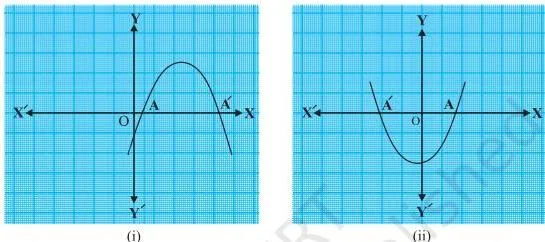
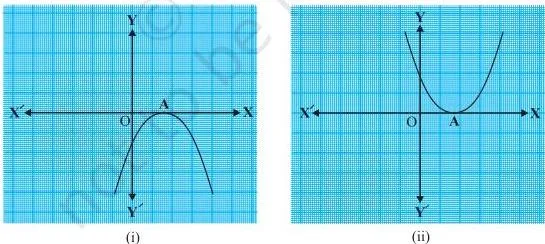
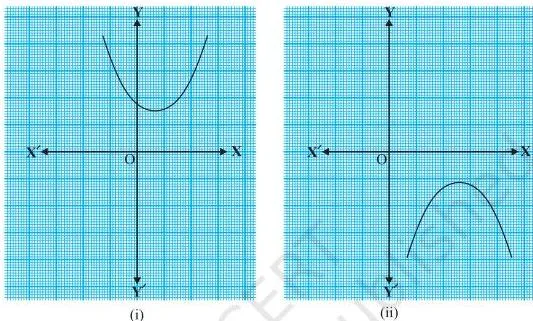
As a sketch-check with fresh numbers: the parabola of y = x² – 4x + 4 has its vertex on the x-axis at x = 2, because (x – 2)² = 0 repeats the same root twice. So the graph touches once and there is a single repeated zero, 2 — never two.
For the official curves in Fig. 2.10, you can verify every graph against the source by opening the NCERT Class 10 Mathematics textbook page on ncert.nic.in, which carries the same six panels exactly as printed. Count the x-axis meetings and never exceed the degree of the polynomial.
FAQs: Common Doubts on Zeroes from Graphs
If a graph touches the x-axis at one point, is that counted as one zero or two?
One point of contact means one repeated zero. The polynomial still has degree 2, so the two expected zeroes coincide at the same x-value — they have not disappeared, they have merged (NCERT, p. 15). Visually, the vertex sits on the axis and the curve turns back, so you see only one meeting point, and the count is 1.
Can a quadratic polynomial have three zeroes?
No. By the remark on page 17, a polynomial of degree n has at most n zeroes (NCERT, p. 17). A quadratic polynomial has degree 2, so it can have at most 2 zeroes — two distinct, one repeated, or zero.
If you think you have counted three from a graph, re-check: one of your cross points is on the y-axis or at a turning point, not an x-intercept.
The graph in Fig 2.10 (i) never meets the x-axis, so how many zeroes does the polynomial have?
Zero. If the curve lies completely above or completely below the x-axis, the polynomial has no real zeroes (Case iii, p. 16). The polynomial itself is still valid — it simply has no real x-value for which p(x) = 0. So panel (i) gives 0 zeroes.
How do I distinguish a zero from a point where the graph touches the y-axis?
A zero is an x-intercept — a point where the curve meets the x-axis and y = 0 on the curve. The y-intercept is where the graph meets the y-axis and x = 0; that is the constant term of the polynomial, not a zero. The only time the y-intercept is also a zero is when the curve passes through the origin (0, 0).
Attribution
Reference: NCERT Class 10 Mathematics textbook, chapter Polynomials (Rationalised NCERT edition).
Explore Class 10 Maths NCERT Solutions
More for this chapter:
Class 10 Maths on LearnCBSE:
Related chapters: