
These Exercise 11.1 Class 10 Maths NCERT Solutions solve every question of the first exercise in Chapter 11, Areas Related to Circles, one at a time. Each answer starts with the idea behind the method, then shows the formula and the substitution with units carried through to the final value.
The exercise has 14 questions, and all of them run on a single idea: a sector or a segment is a fixed fraction of the circle, decided by its central angle. Some questions wrap that idea in a real-life setting — a clock’s minute hand, a horse on a rope, a lighthouse beam — but the mathematics never changes.
Work through the page in order and use the built-in checks printed beside each answer.
For every question, first pull out the sector angle \( \theta \) and the radius \( r \). When no value of \( \pi \) is printed in the question, the exercise instructs you to use \( \pi = \frac{22}{7} \); several questions override that with \( \pi = 3.14 \), and the value is always stated in brackets.
Mixing up the two values of \( \pi \) is the single most common error across these 14 questions.
Exercise 11.1 Class 10 Maths NCERT Solutions
This exercise is the whole heart of Chapter 11: it tests whether you can convert a problem into a sector angle and a radius, and then apply one of three formulas.
You will meet a direct sector question (Q1), a quadrant (Q2), a clock-hand problem (Q3), segment questions (Q4–Q7), a multiple-choice item on the sector formula (Q14), and several applied problems (Q8–Q13). Only three formulas are ever needed — sector area, arc length, and segment = sector − triangle.
Keep the exercise rule in mind: unless stated otherwise, use \( \pi = \frac{22}{7} \) (NCERT, p. 158). Where a question says \( (\text{Use } \pi = 3.14) \), that value replaces the default for that question only.
Sector and segment: the two ideas Exercise 11.1 runs on
A sector is the region enclosed by two radii and the arc between them; the angle between the radii is called the angle of the sector. A segment is the region enclosed between a chord and the arc cut off by that chord.
The textbook remark matters for every question: when the book says “sector” or “segment” alone, it means the minor one (NCERT, p. 155).
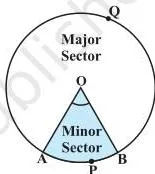
In Figure 11.1, \( \angle AOB \) is the angle of the minor sector, and the angle of the major sector is \( 360^\circ – \angle AOB \). Read that distinction now, because Questions 4 and 6 ask for major parts, and the shortcut for them is always “the major part completes the circle.”
The sector-area formula is not a magic rule — it is a proportion. A full circle is a sector of angle \( 360^\circ \) and has area \( \pi r^2 \), so one degree covers \( \frac{\pi r^2}{360} \), and \( \theta \) degrees cover (NCERT, p. 156):
\[ \text{Area of sector} = \frac{\theta}{360} \times \pi r^2 \]
By the same unitary reasoning, the length of the arc of that sector is the same fraction of the whole circumference \( 2\pi r \) (NCERT, p. 156):
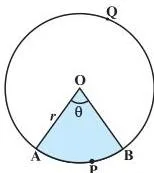
Finally, a segment is a sector with the triangle cut out: the triangle is formed by the two radii and the chord. So the area of a minor segment is (NCERT, p. 156):
\[ \text{Area of segment} = \frac{\theta}{360} \times \pi r^2 – \text{area of } \triangle OAB \]
And the major sector or major segment is simply \( \pi r^2 \) minus the minor part — a check you can use on many answers below. A quadrant is just a \( 90^\circ \) sector, and a semicircle is a \( 180^\circ \) sector.
| Quantity | Formula | Inputs you need |
|---|---|---|
| Area of a sector | \( \frac{\theta}{360} \times \pi r^2 \) | central angle \( \theta \), radius \( r \) |
| Length of an arc | \( \frac{\theta}{360} \times 2\pi r \) | central angle \( \theta \), radius \( r \) |
| Area of a segment | sector area \( – \) triangle area | \( \theta \), \( r \), shape of the chord triangle |
| Major sector / segment | \( \pi r^2 – \) minor part | \( \pi r^2 \), the minor value you computed |
You have already met chords, arcs and radii in Chapter 10 on Circles; this exercise applies that circle geometry to areas. Every formula above is taken word for word from the official NCERT Class 10 Mathematics Chapter 11 PDF, so you can check any formula or any of the printed questions directly against the source chapter.
Question 1: Find the area of a sector of a circle with radius 6 cm if angle of the sector is 60°.
Concept: The sector takes the same fraction of the circle as its angle takes of \( 360^\circ \). Here \( 60^\circ \) is one-sixth of a full turn, so the answer must be one-sixth of \( \pi r^2 \).
Step 1: Write the sector-area formula with \( \theta = 60^\circ \), \( r = 6 \text{ cm} \), \( \pi = \frac{22}{7} \).
\[ \text{Area} = \frac{60}{360} \times \frac{22}{7} \times 6^2 = \frac{1}{6} \times \frac{22}{7} \times 36 \]
\[ = \frac{22 \times 6}{7} = \frac{132}{7} \text{ cm}^2 = 18.86 \text{ cm}^2 \text{ (approx.)} \]
Final answer: Area of the sector \( = \dfrac{132}{7} \text{ cm}^2 \approx 18.86 \text{ cm}^2 \).
Check / common error: Reduce \( \frac{60}{360} \) to \( \frac{1}{6} \) before multiplying — doing the arithmetic on \( \frac{60}{360} \) invites slips. A fast correctness check: because \( 60^\circ \) is one-sixth of the circle, your result should equal \( \pi r^2 / 6 \approx 18.86 \).
Question 2: Find the area of a quadrant of a circle whose circumference is 22 cm.
Concept: A quadrant is a \( 90^\circ \) sector. You cannot feed the sector formula yet, because the radius is not given — the circumference is the only path to it.
Step 1: Recover the radius from \( C = 2\pi r = 22 \) with \( \pi = \frac{22}{7} \).
\[ 2 \times \frac{22}{7} \times r = 22 \;\Rightarrow\; r = 22 \times \frac{7}{44} = \frac{7}{2} \text{ cm} \]
Step 2: A quadrant is \( 90^\circ \), so it takes \( \frac{90}{360} = \frac{1}{4} \) of the circle.
\[ \text{Area} = \frac{90}{360} \times \frac{22}{7} \times \left(\frac{7}{2}\right)^2 = \frac{1}{4} \times \frac{22}{7} \times \frac{49}{4} = \frac{77}{8} \text{ cm}^2 \]
Final answer: Area of the quadrant \( = \dfrac{77}{8} \text{ cm}^2 = 9.625 \text{ cm}^2 \).
Check / common error: A quadrant is a quarter of the area, not a quarter of the circumference. Sanity check: \( \pi r^2 = \frac{22}{7} \times \frac{49}{4} = 38.5 \text{ cm}^2 \), and one quarter of it is \( 9.625 \), which matches.
Question 3: The length of the minute hand of a clock is 14 cm. Find the area swept by the minute hand in 5 minutes.
Concept: The minute hand is the radius, and “area swept” is the area of a sector. The key is converting clock time into an angle: the hand turns \( 360^\circ \) in 60 minutes.
Step 1: In 5 minutes the hand covers \( \frac{5}{60} = \frac{1}{12} \) of a full turn, so \( \theta = 30^\circ \).
\[ \text{Area} = \frac{30}{360} \times \frac{22}{7} \times 14^2 = \frac{1}{12} \times \frac{22}{7} \times 196 \]
\[ = \frac{22 \times 28}{12} = \frac{154}{3} \text{ cm}^2 = 51.33 \text{ cm}^2 \text{ (approx.)} \]
Final answer: Area swept in 5 minutes \( = \dfrac{154}{3} \text{ cm}^2 \approx 51.33 \text{ cm}^2 \).
Check / common error: The hand moves \( 6^\circ \) per minute (since \( 360/60 = 6 \)), so 5 minutes is \( 30^\circ \), never “5 degrees.” Check: \( 30^\circ \) is one-twelfth of the circle, and \( \pi r^2/12 = 51.33 \).
Question 4: A chord of a circle of radius 10 cm subtends a right angle at the centre. Find the area of the corresponding: (i) minor segment (ii) major sector. (Use π = 3.14)
Concept: A segment is a sector minus the triangle made by the two radii and the chord. Because the central angle is a right angle, that triangle is right-angled with legs \( 10 \text{ cm} \) and \( 10 \text{ cm} \), so its area is immediate. Note the \( \pi = 3.14 \) instruction overrides the default.
Part (i): Area of the \( 90^\circ \) sector first.
\[ \text{Sector} = \frac{90}{360} \times 3.14 \times 10^2 = \frac{1}{4} \times 314 = 78.5 \text{ cm}^2 \]
\[ \text{Triangle} = \frac{1}{2} \times 10 \times 10 = 50 \text{ cm}^2 \]
\[ \text{Minor segment} = 78.5 – 50 = 28.5 \text{ cm}^2 \]
Part (ii): The major sector completes the circle, so subtract the minor sector from \( \pi r^2 = 314 \).
\[ \text{Major sector} = 314 – 78.5 = 235.5 \text{ cm}^2 \]
Final answer: (i) Minor segment \( = 28.5 \text{ cm}^2 \); (ii) major sector \( = 235.5 \text{ cm}^2 \).
Check / common error: The most common slip is reporting the sector as the segment — you must subtract the \( 50 \text{ cm}^2 \) triangle. Check part (ii): minor sector \( + \) major sector \( = 78.5 + 235.5 = 314 = \pi r^2 \).
Question 5: In a circle of radius 21 cm, an arc subtends an angle of 60° at the centre. Find: (i) the length of the arc (ii) area of the sector formed by the arc (iii) area of the segment formed by the corresponding chord
Concept: With \( \theta = 60^\circ \), the chord triangle is equilateral: two sides are radii of length 21, and the \( 60^\circ \) angle between them forces the third side to also be 21. So its area is \( \frac{\sqrt{3}}{4}r^2 \). This is where the surd \( \sqrt{3} \) enters the answer.
Part (i): Arc length is \( \frac{60}{360} = \frac{1}{6} \) of the circumference.
\[ \text{Arc} = \frac{60}{360} \times 2 \times \frac{22}{7} \times 21 = \frac{1}{6} \times 132 = 22 \text{ cm} \]
Part (ii): Sector area uses the same fraction but of \( \pi r^2 \), not of \( 2\pi r \).
\[ \text{Sector} = \frac{1}{6} \times \frac{22}{7} \times 441 = \frac{22 \times 63}{6} = 231 \text{ cm}^2 \]
Part (iii): Subtract the equilateral triangle.
\[ \text{Triangle} = \frac{\sqrt{3}}{4} \times 21^2 = \frac{441\sqrt{3}}{4} \text{ cm}^2 \]
\[ \text{Segment} = 231 – \frac{441\sqrt{3}}{4} \text{ cm}^2 \]
Final answer: (i) Arc length \( = 22 \text{ cm} \); (ii) sector area \( = 231 \text{ cm}^2 \); (iii) segment area \( = \left(231 – \dfrac{441\sqrt{3}}{4}\right) \text{ cm}^2 \approx 40.3 \text{ cm}^2 \).
Check / common error: The question does not give \( \sqrt{3} \), so the exact surd form \( 231 – \frac{441\sqrt{3}}{4} \) is the answer the board wants; writing only a decimal loses the exactness. Do not confuse parts (i) and (ii) — one takes \( \frac{1}{6} \) of \( 2\pi r \), the other of \( \pi r^2 \).
Question 6: A chord of a circle of radius 15 cm subtends an angle of 60° at the centre. Find the areas of the corresponding minor and major segments of the circle. (Use π = 3.14 and √3 = 1.73)
Concept: The central angle is again \( 60^\circ \), so the equilateral-triangle idea from Question 5 applies unchanged. This time both \( \pi = 3.14 \) and \( \sqrt{3} = 1.73 \) are given, so the answer is a number, not a surd.
Step 1: Sector area.
\[ \text{Sector} = \frac{60}{360} \times 3.14 \times 15^2 = \frac{1}{6} \times 3.14 \times 225 = 117.75 \text{ cm}^2 \]
Step 2: Equilateral triangle of side 15.
\[ \text{Triangle} = \frac{1.73}{4} \times 225 = 97.3125 \text{ cm}^2 \]
Step 3: Minor segment, then major from the total.
\[ \text{Minor segment} = 117.75 – 97.3125 = 20.44 \text{ cm}^2 \text{ (approx.)} \]
\[ \text{Major segment} = \pi r^2 – \text{minor} = 706.5 – 20.44 = 686.06 \text{ cm}^2 \text{ (approx.)} \]
Final answer: Minor segment \( \approx 20.44 \text{ cm}^2 \), major segment \( \approx 686.06 \text{ cm}^2 \).
Check / common error: The two segments must add to the whole circle \( 706.5 \text{ cm}^2 \); if you subtract the sector from the triangle your result goes negative — the surest sign the order is reversed.
Question 7: A chord of a circle of radius 12 cm subtends an angle of 120° at the centre. Find the area of the corresponding segment of the circle. (Use π = 3.14 and √3 = 1.73)
Concept: Here the angle is \( 120^\circ \), not \( 60^\circ \), so the chord triangle is not equilateral and the \( \frac{\sqrt{3}}{4}r^2 \) shortcut is out. Use the general triangle-area formula with two sides and the included angle: \( \text{area} = \frac{1}{2}r^2 \sin\theta \).
Step 1: Sector area.
\[ \text{Sector} = \frac{120}{360} \times 3.14 \times 12^2 = \frac{1}{3} \times 3.14 \times 144 = 150.72 \text{ cm}^2 \]
Step 2: Triangle area with \( \sin 120^\circ = \sin 60^\circ = \frac{\sqrt{3}}{2} \).
\[ \text{Triangle} = \frac{1}{2} \times 144 \times \sin 120^\circ = 72 \times \frac{\sqrt{3}}{2} = 36\sqrt{3} = 36 \times 1.73 = 62.28 \text{ cm}^2 \]
Step 3: Segment \( = \) sector \( – \) triangle.
\[ \text{Segment} = 150.72 – 62.28 = 88.44 \text{ cm}^2 \]
Final answer: Area of the segment \( = 88.44 \text{ cm}^2 \).
Check / common error: The trap is copying the equilateral shortcut from Questions 5 and 6. The equilateral shortcut works only for a \( 60^\circ \) central angle; for \( 120^\circ \) you must use \( \frac{1}{2}r^2 \sin\theta \) (or the perpendicular-and-trigonometry method from the chapter’s Example 2).
Question 8: A horse is tied to a peg at one corner of a square shaped grass field of side 15 m by means of a 5 m long rope (see Fig. 11.8). Find (i) the area of that part of the field in which the horse can graze. (ii) the increase in the grazing area if the rope were 10 m long instead of 5 m. (Use π = 3.14)

Concept: Read the figure: the peg is at a corner of the square, so the two sides of the field fence the rope in and the horse can reach only a quarter circle — a \( 90^\circ \) sector of radius equal to the rope. Never a full circle, never a half circle.
Part (i): Rope \( 5 \text{ m} \), so the grazing sector has radius 5.
\[ \text{Area} = \frac{90}{360} \times 3.14 \times 5^2 = \frac{1}{4} \times 3.14 \times 25 = 19.625 \text{ m}^2 \]
Part (ii): With a \( 10 \text{ m} \) rope the sector radius becomes 10, and the increase is the difference of the two quarter-circles.
\[ \text{New area} = \frac{1}{4} \times 3.14 \times 100 = 78.5 \text{ m}^2 \]
\[ \text{Increase} = 78.5 – 19.625 = 58.875 \text{ m}^2 \]
Final answer: (i) Grazing area \( = 19.625 \text{ m}^2 \); (ii) increase \( = 58.875 \text{ m}^2 \).
Check / common error: The side length 15 m never enters the calculation, because the rope is shorter than the side — it is a distractor. Notice the increase equals \( \frac{1}{4}\pi(10^2 – 5^2) \), a neat check. Mistaking the quarter circle for a full circle inflates the answer four times.
Question 9: A brooch is made with silver wire in the form of a circle with diameter 35 mm. The wire is also used in making 5 diameters which divide the circle into 10 equal sectors as shown in Fig. 11.9. Find: (i) the total length of the silver wire required. (ii) the area of each sector of the brooch.
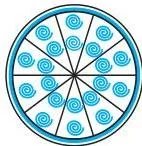
Concept: The figure shows that the wire forms both the circular rim and the five straight diameters. So the total wire is the circumference plus five diameters — the part students forget. The radius is half the given diameter: \( r = 17.5 \text{ mm} \).
Part (i): Circumference plus 5 diameters.
\[ \text{Circumference} = 2 \times \frac{22}{7} \times 17.5 = 110 \text{ mm},\quad 5 \text{ diameters} = 5 \times 35 = 175 \text{ mm} \]
\[ \text{Total wire} = 110 + 175 = 285 \text{ mm} \]
Part (ii): Five diameters split the circle into 10 equal sectors, so each has central angle \( \frac{360^\circ}{10} = 36^\circ \).
\[ \text{Each sector} = \frac{36}{360} \times \frac{22}{7} \times (17.5)^2 = \frac{1}{10} \times \frac{22}{7} \times 306.25 = 96.25 \text{ mm}^2 \]
Final answer: (i) Total length of wire \( = 285 \text{ mm} \); (ii) area of each sector \( = 96.25 \text{ mm}^2 \).
Check / common error: Using 35 mm as the radius instead of 17.5 mm makes every area four times too large. And five diameters give ten sectors, so the per-sector angle is \( 36^\circ \), not \( 72^\circ \).
Question 10: An umbrella has 8 ribs which are equally spaced (see Fig. 11.10). Assuming umbrella to be a flat circle of radius 45 cm, find the area between the two consecutive ribs of the umbrella.
Concept: The question refers to Fig. 11.10, but that figure is not reproduced here — the wording alone is enough to solve it. Eight equally spaced ribs divide the circle into eight congruent sectors, so the area between two consecutive ribs is simply one-eighth of the whole circle.
Step 1: Each sector has angle \( \frac{360^\circ}{8} = 45^\circ \), i.e.
\( \frac{1}{8} \) of the circle, with \( r = 45 \text{ cm} \).
\[ \text{Area} = \frac{45}{360} \times \frac{22}{7} \times 45^2 = \frac{1}{8} \times \frac{22}{7} \times 2025 = \frac{44550}{56} \approx 795.5 \text{ cm}^2 \]
Final answer: Area between two consecutive ribs \( \approx 795.5 \text{ cm}^2 \) (exactly \( \dfrac{22275}{28} \text{ cm}^2 \)).
Check / common error: You need not even compute the angle — the area between two consecutive ribs is \( \pi r^2 / 8 \), which is the same number. The common slip is treating 8 ribs as 8 diameters (which would give 16 sectors) or dividing by 4. A quick sanity check: \( \pi r^2 \approx 6364 \text{ cm}^2 \), and an eighth of that is about 795.
Question 11: A car has two wipers which do not overlap. Each wiper has a blade of length 25 cm sweeping through an angle of 115°. Find the total area cleaned at each sweep of the blades.
Concept: Each blade sweeps a sector of radius 25 cm and angle \( 115^\circ \). The phrase “do not overlap” is the licence to simply double one wiper’s area; an overlap would force you to subtract the common region. The length of the blade is the radius.
Step 1: Area of one sector.
\[ \text{One wiper} = \frac{115}{360} \times \frac{22}{7} \times 25^2 = \frac{23}{72} \times \frac{22}{7} \times 625 \approx 627.5 \text{ cm}^2 \]
Step 2: Double it for two non-overlapping wipers.
\[ \text{Total} = 2 \times 627.5 \approx 1255 \text{ cm}^2 \]
Final answer: Total area cleaned at each sweep \( \approx 1255 \text{ cm}^2 \) (more precisely \( \approx 1254.96 \text{ cm}^2 \)).
Check / common error: The blade length 25 cm must be squared in the sector formula — doubling 25 instead of squaring it is a classic slip. Also, the wipers are two sectors, not two full circles; a full-circle answer would be absurdly large.
Question 12: To warn ships for underwater rocks, a lighthouse spreads a red coloured light over a sector of angle 80° to a distance of 16.5 km. Find the area of the sea over which the ships are warned. (Use π = 3.14)
Concept: The “distance to which the light reaches” is the radius of the sector, and the angle is given directly. So this is a single application of the sector formula — no hidden step.
Step 1: Substitute \( \theta = 80^\circ \), \( r = 16.5 \text{ km} \), \( \pi = 3.14 \), noting \( \frac{80}{360} = \frac{2}{9} \).
\[ \text{Area} = \frac{80}{360} \times 3.14 \times (16.5)^2 = \frac{2}{9} \times 3.14 \times 272.25 \]
\[ = \frac{6.28 \times 272.25}{9} \approx 189.97 \text{ km}^2 \approx 190 \text{ km}^2 \]
Final answer: Area of sea warned \( \approx 190 \text{ km}^2 \).
Check / common error: \( 80^\circ \) is a little less than a quarter of \( 360^\circ \), so the area should be a little less than \( \frac{1}{4}\pi r^2 \approx 213 \text{ km}^2 \) — 190 fits. Forgetting to square 16.5, or writing the unit as km instead of km², are the usual slips.
Question 13: A round table cover has six equal designs as shown in Fig. 11.11. If the radius of the cover is 28 cm, find the cost of making the designs at the rate of ₹ 0.35 per cm². (Use √3 = 1.7)
Concept: The question names Fig. 11.11, which is not reproduced here — the text tells you everything: six equal designs around a circle means six congruent segments, each inside a \( 60^\circ \) sector. Because the angle is \( 60^\circ \), each chord triangle is equilateral with side 28 cm, which is where \( \sqrt{3} = 1.7 \) is used.
Note this question does not override \( \pi \), so the default \( \frac{22}{7} \) stays.
Step 1: Area of one design \( = \) sector \( – \) equilateral triangle.
\[ \text{Sector} = \frac{60}{360} \times \frac{22}{7} \times 28^2 = \frac{1}{6} \times \frac{22}{7} \times 784 = 410.67 \text{ cm}^2 \]
\[ \text{Triangle} = \frac{1.7}{4} \times 784 = 333.2 \text{ cm}^2 \]
\[ \text{One design} = 410.67 – 333.2 = 77.47 \text{ cm}^2 \]
Step 2: Six designs, then apply the rate \( \text{₹} 0.35 \text{ per cm}^2 \).
\[ \text{Total area} = 6 \times 77.47 = 464.8 \text{ cm}^2 \]
\[ \text{Cost} = 464.8 \times 0.35 = \text{₹} 162.68 \approx \text{₹} 162.70 \]
Final answer: Cost of making the designs \( \approx \text{₹} 162.70 \).
Check / common error: Two slips cost marks here. First, forgetting the factor of 6 before applying the rate. Second, substituting \( \sqrt{3} = 1.7 \) too early — keep the surd exact until the final line to avoid rounding drift. Also remember the rate is per cm², so it multiplies the area; it is not divided by it.
Question 14: Tick the correct answer in the following: Area of a sector of angle p (in degrees) of a circle with radius R is (A) (p/180) × 2πR (B) (p/180) × πR² (C) (p/360) × 2πR (D) (p/720) × 2πR²
- (A) \( \dfrac{p}{180} \times 2\pi R \)
- (B) \( \dfrac{p}{180} \times \pi R^2 \)
- (C) \( \dfrac{p}{360} \times 2\pi R \)
- (D) \( \dfrac{p}{720} \times 2\pi R^2 \)
Concept: An area must carry \( R^2 \), not \( R \) — so any option built on \( 2\pi R \) (a circumference, a length) is wrong instantly. The correct form is \( \frac{p}{360}\pi R^2 \). Option (D) hides it in an equivalent disguise.
Step 1: Simplify (D).
\[ \frac{p}{720} \times 2\pi R^2 = \frac{p \times 2\pi R^2}{720} = \frac{p}{360} \pi R^2 \]
Step 2: Reject the others.
(A) and (C) carry \( 2\pi R \), a length, so they cannot be areas.
(B) has the fraction \( \frac{p}{180} \) instead of \( \frac{p}{360} \), which would give twice the true area.
Correct answer: (D) \( \dfrac{p}{720} \times 2\pi R^2 \).
Check / common error: Test any candidate with \( p = 360^\circ \): a full circle must give \( \pi R^2 \). Option (D) gives \( \frac{360}{720} \times 2\pi R^2 = \pi R^2 \), confirming it. The trap is rejecting (D) on looks — it is the standard formula with a “2” shuffled from the denominator into the \( 2\pi R^2 \).
Method recap: the routine that solves every question in Exercise 11.1
Every one of the 14 questions is solved by the same five-step routine:
- Extract \( \theta \) and \( r \). Watch for the radius being half a given diameter (Q9), and for the angle hiding inside a word — “quadrant” means \( 90^\circ \) (Q2), “5 minutes” on a clock means \( 30^\circ \) (Q3).
- Choose \( \pi \). Default \( \frac{22}{7} \) unless the question brackets state \( \pi = 3.14 \) (Q4, Q6, Q7, Q8, Q12) or give \( \sqrt{3} \) (Q13).
- Apply the sector or arc formula — the fraction \( \frac{\theta}{360} \) of \( \pi r^2 \) or of \( 2\pi r \).
- For a segment, subtract the triangle — the equilateral shortcut \( \frac{\sqrt{3}}{4}r^2 \) only when \( \theta = 60^\circ \); for other angles use \( \frac{1}{2}r^2\sin\theta \) (Q7).
- Check a major part by adding it to the minor part — the two must equal \( \pi r^2 \).
| Question | Value of \( \pi \) used |
|---|---|
| Q1, Q2, Q3, Q5, Q9, Q10, Q11, Q13 | default \( \frac{22}{7} \) (no override printed) |
| Q4, Q6, Q7, Q8, Q12 | \( 3.14 \) (printed in the question) |
| Q13 | \( \pi = \frac{22}{7} \) plus the printed \( \sqrt{3} = 1.7 \) |
| Mistake | Correct rule | How to check your answer |
|---|---|---|
| Using \( \pi = \frac{22}{7} \) when the question says 3.14 (or vice versa) | Use the value printed in brackets; default is \( \frac{22}{7} \) | Re-read the bracket after the question before substituting |
| Using the diameter where the radius is needed | Radius \( = \) half the diameter (35 mm \( \rightarrow \) 17.5 mm) | Halve any given diameter before any \( \pi r^2 \) formula |
| Using \( r \) instead of \( r^2 \) | Sector and circle areas always use \( r^2 \) | Square the radius, then multiply by \( \pi \) |
| Treating a segment as a sector | Segment \( = \) sector \( – \) triangle | Draw the two radii and chord; subtract that triangle’s area |
| Using the equilateral shortcut for a non-\( 60^\circ \) angle | \( \frac{\sqrt{3}}{4}r^2 \) only when \( \theta = 60^\circ \); else \( \frac{1}{2}r^2 \sin\theta \) | Confirm the central angle before choosing the triangle method |
If you are moving on, the next chapter, Surface Areas and Volumes, builds directly on the same habit of naming your radius and your fraction before you compute. For the rest of the syllabus, browse all of our Class 10 notes and the complete CBSE notes index.
Frequently asked questions
When do I use π = 22/7 and when π = 3.14 in Exercise 11.1?
The exercise opens with “unless stated otherwise, use \( \pi = \frac{22}{7} \)” (NCERT, p. 158). So the default is \( \frac{22}{7} \). Questions 4, 6, 7, 8 and 12 print \( (\text{Use } \pi = 3.14) \) and override it for those questions only. Question 13 prints only \( \sqrt{3} = 1.7 \), so its \( \pi \) stays the default \( \frac{22}{7} \).
How do I turn 5 minutes on a clock into an angle for the minute-hand question?
The minute hand completes \( 360^\circ \) in 60 minutes, so it moves \( 360/60 = 6^\circ \) per minute. In 5 minutes it sweeps \( 5 \times 6 = 30^\circ \), which is \( \frac{30}{360} = \frac{1}{12} \) of the circle. Your job is to convert the clock time to \( 30^\circ \) first, then apply the sector formula with the hand’s length (14 cm) as the radius.
Why is the segment area the sector area minus the triangle?
A segment is the region between a chord and the arc. The sector (bounded by the two radii and the arc) contains both the segment and the triangle formed by the two radii and the chord. So to isolate the segment you cut the triangle out of the sector: segment \( = \) sector \( – \) triangle (NCERT, p. 156).
How can I check my major sector or major segment answer?
Add the minor and major parts — they must together equal the full circle \( \pi r^2 \). For example, in Question 6 the minor segment \( \approx 20.44 \) and the major segment \( \approx 686.06 \), and \( 20.44 + 686.06 = 706.5 = \pi (15)^2 \). If your two parts do not sum to \( \pi r^2 \), one of them is wrong.
Reference: NCERT Class 10 Mathematics textbook, Chapter 11 (Areas Related to Circles).
Explore Class 10 Maths NCERT Solutions
More for this chapter:
Class 10 Maths on LearnCBSE:
Related chapters: