
Looking for NCERT Solutions for Class 10 Maths Chapter 11 Areas Related to Circles? This chapter holds exactly one exercise — Exercise 11.1 — with fourteen questions. What varies is the method: some questions want the sector-area formula only, some want a segment (sector minus triangle), and the later ones hand you a real-life situation where you have to find the angle yourself.
This page is a directory. It groups the fourteen questions into four clusters, tells you which cluster your homework question sits in, and which method that cluster wants from you. The worked answers live one level down, on the exercise page itself.
| Exercise | What you get |
|---|---|
| Exercise 11.1 | Solved |
What Chapter 11 Is About: Sectors, Segments, and the Unitary Method
Chapter 11 stays on one small corner of geometry: taking slices and slivers out of a circle. Two objects do all the work. A sector is the region enclosed by two radii and the arc between them — like a slice of pie.
A segment is the region enclosed by a chord and the arc it cuts off — what remains when you remove the triangle between the two radii and the chord.
Each comes in a minor and a major version, and NCERT’s remark settles the naming: when the chapter writes ‘sector’ or ‘segment’ it means the minor one unless stated otherwise.
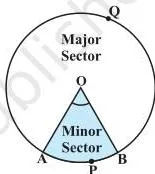
Read the two parts from this figure. The shaded region OAPB is the minor sector, the unshaded region OAQB the major sector, whose angle is \( 360^\circ – \angle AOB \). With the chord AB drawn, region APB is the minor segment and region AQB the major segment.
The single idea that produces every formula is the unitary method. Treat a full circle as a sector whose angle at the centre is 360°; its area is \( \pi r^2 \). So one degree carries \( \frac{\pi r^2}{360} \), and θ degrees carry \( \frac{\theta}{360} \times \pi r^2 \). The same scaling run on the circumference \( 2\pi r \) gives the length of an arc.
A segment has no formula of its own. Its area is always found by subtraction: sector area minus the area of the triangle formed by the two radii and the chord. That is why the questions with 90°, 60° and 120° at the centre pull in trigonometry.
Exercise 11.1: All 14 Questions Grouped by What They Test
Exercise 11.1 is the whole chapter’s only set of questions, and they divide cleanly into four clusters. Jump to the cluster that matches your homework, then check the method map below before opening the solutions page.
Cluster 1 — Q1–Q3: direct sector-area application
These three give you an angle and a radius and ask for the sector area. Q1 is the plainest case, a 60° sector of a given radius. Q2 works backwards: you are handed a circumference, not a radius, so you reach the radius through \( 2\pi r \) first.
Q3 hides the angle in time — five minutes on a clock face means 30°, because the minute hand sweeps 360° in 60 minutes.
Cluster 2 — Q4–Q7: segments, sector minus triangle
These four are segment problems where the chord subtends 90°, 60° or 120° at the centre. Each needs the sector area minus the area of the triangle, which is why trigonometry enters here.
Splitting the isosceles triangle through the centre creates right-angle triangles with \( \sin 60^\circ \) and \( \cos 60^\circ \). Q4 and Q6 also ask for the major sector or major segment, reached by subtracting the minor from \( \pi r^2 \).
Cluster 3 — Q8–Q13: real-life situations
In these six the angle and radius come from the situation, not from the question. Q8’s horse tied at a corner of a square field sweeps a quarter-sector — a 90° slice (see Fig. 11.8). Q9’s brooch splits the circle with five diameters into ten equal sectors, so each sector carries \( 360^\circ/10 \).

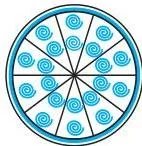
Q10 counts eight umbrella ribs. Q11 doubles two 115° wipers. Q12 spreads a lighthouse beam over 80°. Q13 wraps six table designs around a cost rate of ₹ 0.35 per cm².
Cluster 4 — Q14: the closing MCQ
Q14 asks you to recognise the sector-area formula among four expressions — a recognition test, not a computation. It checks whether you know \( \frac{\theta}{360} \times \pi r^2 \) by sight.
Two questions carry figures in the printed textbook — Q10’s umbrella (Fig. 11.10) and Q13’s table cover (Fig. 11.11) — which are named but not available in this package. The solutions page renders each question’s own figure from the source. No question is solved on this page.
The Method Map: The Formulas Every Question Builds On
The whole chapter runs on three results from the chapter summary. Look at Fig. 11.3: the shaded arc between two radii is the arc of a sector, and its length scales with the angle exactly as the area does.
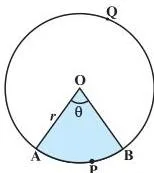
- Length of an arc of a sector: \( \frac{\theta}{360} \times 2\pi r \)
- Area of a sector: \( \frac{\theta}{360} \times \pi r^2 \)
- Area of a segment: area of the corresponding sector − area of the corresponding triangle
Two derived relations complete the set: major sector = \( \pi r^2 \) − minor sector, and major segment = \( \pi r^2 \) − minor segment.
Method to cluster mapping:
- Q1–Q3 use only the sector-area result \( \frac{\theta}{360} \times \pi r^2 \).
- Q4–Q7 use sector-minus-triangle with trigonometry.
- Q8–Q13 use the same two areas with an angle derived from the situation.
- Q14 tests whether you can identify the sector-area formula itself.
Common Mistakes in Sector and Segment Problems
- Confusing the arc-length formula \( \frac{\theta}{360} \times 2\pi r \) with the sector-area formula \( \frac{\theta}{360} \times \pi r^2 \). One gives a length, the other an area.
- In Q2, using 22 cm as the radius — it is the circumference, so find r from \( 2\pi r = 22 \) first.
- In segment questions, stopping at the sector area and forgetting to subtract the triangle.
- In Q3, taking ‘5 minutes’ as 5° — the minute hand sweeps 360° in 60 minutes, so 5 minutes means 30°.
- Not reading the stated constants. The exercise opens with \( \pi = \frac{22}{7} \) unless stated otherwise, then Q4, Q6, Q7, Q8 and Q12 override with \( \pi = 3.14 \), and Q6, Q7, Q13 also supply \( \sqrt{3} \). Reading the bracket is part of the method.
How to Use This Directory Before You Start
- Find the cluster your homework question sits in from the directory above.
- Read the matching row of the method map to know which formula, conversion or stated constant the question wants.
- Only then open the linked solutions page for the worked answer.
A student who reads only this page should be able to say what the chapter is for and which exercise their question lives in. This material builds directly on Circles (Chapter 10) and feeds into Surface Areas and Volumes (Chapter 12).
Browse all Class 10 Maths solutions, the Class 10 hub, or the full revision notes library. To check any formula against the source, open the official NCERT textbook PDF for Chapter 11.
| Exercise | What you get |
|---|---|
| Exercise 11.1 | Solved |
FAQs: Exercise 11.1 in Areas Related to Circles
Does Chapter 11 Areas Related to Circles have more than one exercise?
No. Chapter 11 has exactly one exercise, Exercise 11.1, holding fourteen questions. They group into four clusters: direct sector areas (Q1–Q3), segments with trigonometry (Q4–Q7), real-life applications (Q8–Q13) and one recognition MCQ (Q14).
Which questions in Exercise 11.1 need trigonometry?
Q4–Q7, the segment problems. Their chords subtend 90°, 60° or 120° at the centre, so the triangle between the radii and the chord has to be broken into right-angled triangles using \( \sin 60^\circ \) and \( \cos 60^\circ \).
What is the formula for the area of a segment of a circle?
A segment has no separate formula. It is always the area of the corresponding sector minus the area of the triangle formed by the two radii and the chord.
Why does the exercise state pi as 22 over 7 in some questions and 3.14 in others?
The exercise opens with π = 22/7 “unless stated otherwise”, then individual questions — Q4, Q6, Q7, Q8 and Q12 — switch to π = 3.14, and Q6, Q7 and Q13 also give √3 = 1.73 (Q13 uses 1.7). The bracket is part of the data; check it before you start each question.
Reference: NCERT textbooks (CBSE).