
These are the complete exercise 9.1 class 10 maths ncert solutions — every question of Exercise 9.1 of Chapter 9, Some Applications of Trigonometry, solved in full.
The chapter has exactly one exercise with 15 questions and no separate intext questions, and all 15 are answered here word for word from the official NCERT Class 10 Mathematics textbook, so you can work through the entire exercise without the book open.
Each solution opens with the idea that drives the ratio choice, then shows the full working with units, and closes by naming the slip students most often make on that question.
The exercise builds directly on the trigonometric ratios you studied in Chapter 8 (Introduction to Trigonometry), so make sure you are comfortable choosing sin, cos, tan and cot before you start.
To verify any question or figure against the source, open the official NCERT Class 10 Mathematics textbook on the NCERT website — it carries Chapter 9 exactly as printed, with the definitions, every diagram the exercise refers to and the full question list, so you can match every line of working to the printed problem page by page.
Exercise 9.1 Class 10 Maths NCERT Solutions — What This Exercise Teaches
This single exercise teaches one idea applied in many situations: when you can spot a right triangle in a real-world picture, the trigonometric ratios let you find an unknown height, length or distance without measuring it directly (NCERT, p. 144).
Every question is a right triangle (or two of them) hiding inside a story about poles, towers, slides, kites, ships and buildings.
The two real-world cases are defined by where the line of sight sits. When the observer raises the head and the line of sight runs above the horizontal, the angle with the horizontal is the angle of elevation.
When the observer lowers the head and the line of sight runs below the horizontal, the angle is the angle of depression (NCERT, p. 134).
The 15 questions split into two groups. Questions 1–5 need one ratio applied to a single right triangle. Questions 6–15 are the chapter’s trademark — two angles, two triangles and one shared distance or height that bridges them.
Important Concepts for Exercise 9.1
The line of sight is the straight line drawn from the eye of the observer to the point viewed. The angle of elevation of a point is the angle the line of sight makes with the horizontal when the point is above the horizontal level — the case when you raise your head.
The angle of depression of a point is the angle the line of sight makes with the horizontal when the point is below the horizontal level — the case when you lower your head (NCERT, p. 134).
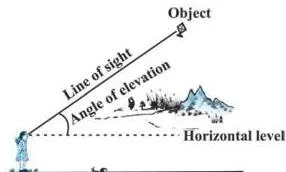
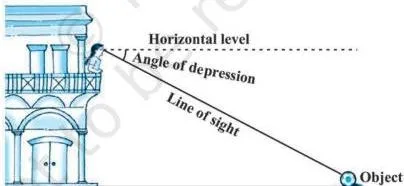
The angle is always measured with the horizontal, never with the vertical — that is the single detail that tells you whether a diagram is showing an elevation or a depression. Once the angle is placed, your only job is to pick the ratio that links the two sides you know to the one you want.
Which ratio to use — for every kind of unknown side
| Unknown side | Sides you have | Ratio |
|---|---|---|
| Opposite the angle | Hypotenuse and angle | \( \sin \theta \) |
| Hypotenuse | Opposite and angle | \( \sin \theta \) rearranged |
| Adjacent to the angle | Hypotenuse and angle | \( \cos \theta \) |
| Hypotenuse | Adjacent and angle | \( \cos \theta \) rearranged |
| Opposite the angle | Adjacent and angle | \( \tan \theta \) |
| Adjacent to the angle | Opposite and angle | \( \cot \theta \) |
The choice is not optional: a question is unsolvable if the wrong ratio is picked, because each ratio links a different pair of sides. The standard values below are used constantly in these 15 questions, so learn them before starting.
| Angle | \( \sin \) | \( \cos \) | \( \tan \) | \( \cot \) |
|---|---|---|---|---|
| \( 30^\circ \) | \( \frac{1}{2} \) | \( \frac{\sqrt{3}}{2} \) | \( \frac{1}{\sqrt{3}} \) | \( \sqrt{3} \) |
| \( 45^\circ \) | \( \frac{1}{\sqrt{2}} \) | \( \frac{1}{\sqrt{2}} \) | \( 1 \) | \( 1 \) |
| \( 60^\circ \) | \( \frac{\sqrt{3}}{2} \) | \( \frac{1}{2} \) | \( \sqrt{3} \) | \( \frac{1}{\sqrt{3}} \) |
Question 1: A circus artist is climbing a 20 m long rope, which is tightly stretched and tied from the top of a vertical pole to the ground. Find the height of the pole, if the angle made by the rope with the ground level is 30° (see Fig. 9.11).
The rope is the hypotenuse of a right triangle — its 20 m length runs from the top of the pole down to the ground. The pole itself is the vertical side directly facing the 30° angle at the ground, so sine is the only ratio that ties the known hypotenuse to the wanted opposite side.

Step 1: Write the ratio that involves the hypotenuse and the opposite side.
\[ \sin 30^\circ = \frac{\text{height of pole}}{\text{rope length}} = \frac{h}{20} \]
Step 2: Substitute \( \sin 30^\circ = \frac{1}{2} \) and solve.
\[ \frac{1}{2} = \frac{h}{20} \Rightarrow h = 20 \times \frac{1}{2} = 10\ \text{m} \]
Final answer: the height of the pole is 10 m.
Common error: reaching for \( \cos 30^\circ = \frac{h}{20} \). That ratio would give the horizontal distance on the ground from the foot of the pole to the rope’s anchor — not the height. Ask what side faces the angle; here it is the pole, so sine.
Question 2: A tree breaks due to storm and the broken part bends so that the top of the tree touches the ground making an angle 30° with it. The distance between the foot of the tree to the point where the top touches the ground is 8 m. Find the height of the tree.
When a tree breaks, the still-upright trunk and the leaning broken part together made up the original height — so the answer is a sum, not a single side. The broken part is now the hypotenuse of the right triangle, and the 8 m along the ground is the side adjacent to the 30° angle.
Step 1: Find the standing trunk using tangent (opposite and adjacent).
\[ \tan 30^\circ = \frac{\text{standing part}}{8} \Rightarrow \text{standing part} = 8\tan 30^\circ = \frac{8}{\sqrt{3}}\ \text{m} \]
Step 2: Find the broken (leaning) part using cosine (adjacent and hypotenuse).
\[ \cos 30^\circ = \frac{8}{\text{broken part}} \Rightarrow \text{broken part} = \frac{8}{\cos 30^\circ} = \frac{16}{\sqrt{3}}\ \text{m} \]
Step 3: Add the two parts.
\[ \frac{8}{\sqrt{3}} + \frac{16}{\sqrt{3}} = \frac{24}{\sqrt{3}} = 8\sqrt{3}\ \text{m} \]
Final answer: the height of the tree is \( 8\sqrt{3} \) m (≈ 13.86 m).
Common error: giving only the leaning part (\( \frac{16}{\sqrt{3}} \)) and forgetting the standing trunk. Draw the two pieces separately; the question asks for the whole tree, so both must be added.
Question 3: A contractor plans to install two slides for the children to play in a park. For the children below the age of 5 years, she prefers to have a slide whose top is at a height of 1.5 m, and is inclined at an angle of 30° to the ground, whereas for elder children, she wants to have a steep slide at a height of 3 m, and inclined at an angle of 60° to the ground. What should be the length of the slide in each case?
Each slide is the hypotenuse of a right triangle: the height of the top is the side opposite the incline angle, and the slide itself runs from the top down to the ground. Sine links the hypotenuse (wanted) to the opposite side (known) in both cases.
Part 1 (younger children): height 1.5 m, angle 30°.
\[ \sin 30^\circ = \frac{1.5}{L} \Rightarrow \frac{1}{2} = \frac{1.5}{L} \Rightarrow L = 3\ \text{m} \]
Part 2 (elder children): height 3 m, angle 60°.
\[ \sin 60^\circ = \frac{3}{L} \Rightarrow \frac{\sqrt{3}}{2} = \frac{3}{L} \Rightarrow L = \frac{6}{\sqrt{3}} = 2\sqrt{3}\ \text{m} \approx 3.46\ \text{m} \]
Final answer: slide lengths are 3 m for the younger children and \( 2\sqrt{3} \) m (≈ 3.46 m) for the elder children.
Sanity check: the steeper 60° slide is shorter than the slacker 30° slide even though its top is twice as high (3 m vs 1.5 m). That is correct because \( \sin 60^\circ \gt \sin 30^\circ \), so the same rise needs less hypotenuse. A result where the steeper slide is longer means you have mis-assigned the angle.
Question 4: The angle of elevation of the top of a tower from a point on the ground, which is 30 m away from the foot of the tower, is 30°. Find the height of the tower.
The ground distance of 30 m is the side adjacent to the 30° angle, and the tower height is the side opposite it. Tangent is the one ratio that links opposite and adjacent, so it is the only choice here.
Step 1: Apply the tangent ratio.
\[ \tan 30^\circ = \frac{h}{30} \Rightarrow \frac{1}{\sqrt{3}} = \frac{h}{30} \Rightarrow h = \frac{30}{\sqrt{3}}\ \text{m} \]
Step 2: Rationalise the denominator.
\[ h = \frac{30}{\sqrt{3}} \times \frac{\sqrt{3}}{\sqrt{3}} = 10\sqrt{3}\ \text{m} \approx 17.32\ \text{m} \]
Final answer: the height of the tower is \( 10\sqrt{3} \) m (≈ 17.32 m).
Common error: writing \( \frac{30}{\sqrt{3}} \) and stopping. Boards expect the rationalised form \( 10\sqrt{3} \); leave the answer exact and quote the decimal only when a question supplies an approximate value for \( \sqrt{3} \).
Question 5: A kite is flying at a height of 60 m above the ground. The string attached to the kite is temporarily tied to a point on the ground. The inclination of the string with the ground is 60°. Find the length of the string, assuming that there is no slack in the string.
“No slack” tells you the string is perfectly straight, so it forms the hypotenuse of a right triangle. The 60 m height is the side opposite the 60° angle, so sine links the known opposite side to the wanted hypotenuse.
Step 1: Apply sine.
\[ \sin 60^\circ = \frac{60}{L} \Rightarrow \frac{\sqrt{3}}{2} = \frac{60}{L} \Rightarrow L = \frac{120}{\sqrt{3}}\ \text{m} \]
Step 2: Rationalise.
\[ L = \frac{120}{\sqrt{3}} \times \frac{\sqrt{3}}{\sqrt{3}} = 40\sqrt{3}\ \text{m} \approx 69.28\ \text{m} \]
Final answer: the length of the string is \( 40\sqrt{3} \) m (≈ 69.28 m).
Common error: using \( \tan 60^\circ \) and solving for the horizontal distance from the anchor to below the kite. The question asks for the string itself, which is the hypotenuse — so sine, not tangent.
Question 6: A 1.5 m tall boy is standing at some distance from a 30 m tall building. The angle of elevation from his eyes to the top of the building increases from 30° to 60° as he walks towards the building. Find the distance he walked towards the building.
Because the boy’s eyes are 1.5 m above the ground, the vertical difference that the angles actually see is 30 − 1.5 = 28.5 m, not 30 m. The two angles describe two positions on the ground, and the distance walked is the difference of the two horizontal distances.
Step 1: Use cotangent to get each ground distance (adjacent from opposite).
\[ d_1 = 28.5\cot 30^\circ = 28.5\sqrt{3}\ \text{m}, \quad d_2 = 28.5\cot 60^\circ = \frac{28.5}{\sqrt{3}}\ \text{m} \]
Step 2: Subtract the nearer distance from the farther one.
\[ d_1 – d_2 = 28.5\left(\sqrt{3} – \frac{1}{\sqrt{3}}\right) = 28.5 \times \frac{2}{\sqrt{3}} = \frac{57}{\sqrt{3}} = 19\sqrt{3}\ \text{m} \]
Final answer: the boy walked \( 19\sqrt{3} \) m (≈ 32.91 m) towards the building.
Common error 1: using 30 m instead of 28.5 m — the angle is measured from the eyes, not the feet. Common error 2: subtracting in the wrong order. As the boy approaches, the angle increases, so the distance decreases; you must subtract the smaller (60°) distance from the larger (30°) one, or you get a negative answer.
Question 7: From a point on the ground, the angles of elevation of the bottom and the top of a transmission tower fixed at the top of a 20 m high building are 45° and 60° respectively. Find the height of the tower.
The 45° angle holds the key: it forms an isosceles right triangle with the 20 m building, so the horizontal distance equals 20 m. The 60° angle then measures to the top of the tower, so the tower alone is the difference between the two heights.
Step 1: Read the horizontal distance from the 45° angle (see \( \tan 45^\circ = 1 \)), so the ground distance equals the 20 m building height.
\[ \tan 45^\circ = \frac{20}{x} \Rightarrow x = 20\ \text{m} \]
Step 2: From the 60° angle, find the total height from ground to tower top.
\[ \tan 60^\circ = \frac{20 + h}{20} \Rightarrow \sqrt{3} = \frac{20 + h}{20} \Rightarrow 20 + h = 20\sqrt{3} \]
Step 3: Subtract the building.
\[ h = 20\sqrt{3} – 20 = 20(\sqrt{3} – 1)\ \text{m} \approx 14.64\ \text{m} \]
Final answer: the height of the transmission tower is \( 20(\sqrt{3} – 1) \) m (≈ 14.64 m).
Common error: reporting the whole \( 20\sqrt{3} \) m as the tower. That is the height of building + tower; the question names only the tower, so the 20 m building must be subtracted.
Question 8: A statue, 1.6 m tall, stands on the top of a pedestal. From a point on the ground, the angle of elevation of the top of the statue is 60° and from the same point the angle of elevation of the top of the pedestal is 45°. Find the height of the pedestal.
Both angles are measured from the same point, so the horizontal distance is common to the two triangles and cancels out of the equations. The 45° angle makes the ground distance equal to the pedestal height; the 60° angle then builds upward to the top of the statue.
Step 1: Let the pedestal height be \( h \).
From the 45° angle, the horizontal distance is \( x = h \).
\[ \tan 45^\circ = \frac{h}{x} \Rightarrow 1 = \frac{h}{x} \Rightarrow x = h \]
Step 2: From the 60° angle, the height to the statue top is \( h + 1.6 \).
\[ \tan 60^\circ = \frac{h + 1.6}{x} = \frac{h + 1.6}{h} \Rightarrow \sqrt{3} = \frac{h + 1.6}{h} \]
Step 3: Solve and rationalise.
\[ h\sqrt{3} = h + 1.6 \Rightarrow h(\sqrt{3} – 1) = 1.6 \Rightarrow h = \frac{1.6}{\sqrt{3} – 1} = \frac{1.6(\sqrt{3} + 1)}{2} = 0.8(\sqrt{3} + 1)\ \text{m} \]
Final answer: the height of the pedestal is \( 0.8(\sqrt{3} + 1) \) m (≈ 2.19 m).
Common error: losing a sign while rationalising \( \frac{1.6}{\sqrt{3} – 1} \). Multiply top and bottom by \( (\sqrt{3} + 1) \), which turns the denominator into \( (\sqrt{3})^2 – 1 = 2 \) — then divide by 2 carefully.
Question 9: The angle of elevation of the top of a building from the foot of the tower is 30° and the angle of elevation of the top of the tower from the foot of the building is 60°. If the tower is 50 m high, find the height of the building.
Each observer looks along their own line of sight, but both triangles share the same ground distance between the two feet. That shared distance is the bridge: find it from the tower (whose 50 m height is known), then use it for the building.
Step 1: The common distance \( d \) from the tower angle.
\[ \tan 60^\circ = \frac{50}{d} \Rightarrow d = \frac{50}{\tan 60^\circ} = \frac{50}{\sqrt{3}}\ \text{m} \]
Step 2: Use this distance for the building.
\[ \tan 30^\circ = \frac{h}{d} \Rightarrow h = d\tan 30^\circ = \frac{50}{\sqrt{3}} \times \frac{1}{\sqrt{3}} = \frac{50}{3}\ \text{m} \]
Final answer: the height of the building is \( \frac{50}{3} \) m (≈ 16.67 m).
Sanity check: resist the symmetric guess of 50 m. The 30° angle is much shallower than the 60° angle, so the building must be far shorter than the tower — \( \frac{50}{3} \) m ≈ 16.7 m fits that expectation.
Question 10: Two poles of equal heights are standing opposite each other on either side of the road, which is 80 m wide. From a point between them on the road, the angles of elevation of the top of the poles are 60° and 30°, respectively. Find the height of the poles and the distances of the point from the poles.
The equal heights let you equate the two tangent expressions, and the two ground distances must add to 80 m because the poles stand on opposite sides. Let the point be \( x \) m from the 60° pole; it is then \( (80 – x) \) m from the 30° pole.
Step 1: Write height from both sides.
\[ h = x\tan 60^\circ = x\sqrt{3}, \quad h = (80 – x)\tan 30^\circ = \frac{80 – x}{\sqrt{3}} \]
Step 2: Equate and solve.
\[ x\sqrt{3} = \frac{80 – x}{\sqrt{3}} \Rightarrow 3x = 80 – x \Rightarrow 4x = 80 \Rightarrow x = 20\ \text{m} \]
Step 3: The other distance and the height.
\[ 80 – x = 60\ \text{m}, \quad h = 20\sqrt{3}\ \text{m} \]
Final answer: the height of each pole is \( 20\sqrt{3} \) m; the point is 20 m from the 60° pole and 60 m from the 30° pole.
Two traps: forgetting that the two distances must total 80 m, and swapping which pole carries the 60° angle. The nearer pole always shows the steeper angle, so the 60° pole is the closer one at 20 m.
Question 11: A TV tower stands vertically on a bank of a canal. From a point on the other bank directly opposite the tower, the angle of elevation of the top of the tower is 60°. From another point 20 m away from this point on the line joining this point to the foot of the tower, the angle of elevation of the top of the tower is 30° (see Fig. 9.12). Find the height of the tower and the width of the canal.
The two observation points lie on the same line as the foot of the tower, so the 20 m separation is the difference of the two ground distances — the farther point, with the smaller angle, is 20 m beyond the nearer one. The distance from the bank directly opposite is the canal width.

Step 1: Let the canal width be \( x \).
From the 60° angle, \( x = \frac{h}{\sqrt{3}} \).
\[ \tan 60^\circ = \frac{h}{x} \Rightarrow x = \frac{h}{\sqrt{3}} \]
Step 2: From the 30° angle, the farther point is \( x + 20 \) from the tower.
\[ \tan 30^\circ = \frac{h}{x + 20} \Rightarrow x + 20 = h\sqrt{3} \]
Step 3: Substitute \( x = \frac{h}{\sqrt{3}} \) and solve.
\[ \frac{h}{\sqrt{3}} + 20 = h\sqrt{3} \Rightarrow 20 = h\sqrt{3} – \frac{h}{\sqrt{3}} = \frac{2h}{\sqrt{3}} \Rightarrow h = 10\sqrt{3}\ \text{m} \]
\[ x = \frac{10\sqrt{3}}{\sqrt{3}} = 10\ \text{m} \]
Final answer: the height of the tower is \( 10\sqrt{3} \) m (≈ 17.32 m) and the width of the canal is 10 m.
Sign check: the 20 m points are on the same side, so you subtract the two distances; if you ever get a negative width, you have subtracted the wrong way around. The smaller 30° angle belongs to the farther point.
Question 12: From the top of a 7 m high building, the angle of elevation of the top of a cable tower is 60° and the angle of depression of its foot is 45°. Determine the height of the tower.
The 45° angle of depression to the foot is equal to the angle of elevation measured back from the foot (alternate angles between parallel lines), so the ground triangle is isosceles and the horizontal distance equals the 7 m building height. Then the 60° angle gives the part of the tower above the building.
Step 1: From the 45° depression angle, the horizontal distance is 7 m.
\[ \tan 45^\circ = \frac{7}{d} \Rightarrow d = 7\ \text{m} \]
Step 2: From the 60° elevation angle, find the tower part above the building, then add the 7 m.
\[ \tan 60^\circ = \frac{\text{above part}}{7} \Rightarrow \text{above part} = 7\sqrt{3}\ \text{m} \]
\[ \text{tower height} = 7 + 7\sqrt{3} = 7(\sqrt{3} + 1)\ \text{m} \approx 19.13\ \text{m} \]
Final answer: the height of the cable tower is \( 7(\sqrt{3} + 1) \) m (≈ 19.13 m).
Common error: reporting \( 7\sqrt{3} \) m and forgetting the 7 m building the observer stands on. The 60° angle sees only the tower above eye level; the full height needs the building added back.
Question 13: As observed from the top of a 75 m high lighthouse from the sea-level, the angles of depression of two ships are 30° and 45°. If one ship is exactly behind the other on the same side of the lighthouse, find the distance between the two ships.
The phrase “exactly behind the other on the same side” decides the operation: both ships lie on one side of the lighthouse, so their separation is the difference of their two distances from the lighthouse foot. (If they were on opposite sides, you would add.)
Step 1: Use cotangent to get each ship’s horizontal distance from the foot.
\[ d_{45} = 75\cot 45^\circ = 75\ \text{m}, \quad d_{30} = 75\cot 30^\circ = 75\sqrt{3}\ \text{m} \]
Step 2: Subtract the nearer from the farther.
\[ d_{30} – d_{45} = 75\sqrt{3} – 75 = 75(\sqrt{3} – 1)\ \text{m} \approx 54.9\ \text{m} \]
Final answer: the distance between the two ships is \( 75(\sqrt{3} – 1) \) m (≈ 54.9 m).
Common error: adding the two distances. Always re-read whether the objects are on the same side (subtract) or opposite sides (add) of the reference point before writing the final step.
Question 14: A 1.2 m tall girl spots a balloon moving with the wind in a horizontal line at a height of 88.2 m from the ground. The angle of elevation of the balloon from the eyes of the girl at any instant is 60°. After some time, the angle of elevation reduces to 30° (see Fig. 9.13). Find the distance travelled by the balloon during the interval.
The balloon drifts horizontally at a constant height, so the change in the angle comes only from its horizontal motion — the distance travelled is the difference of the two horizontal distances. Because the angle is measured from the girl’s eyes, the working height is \( 88.2 – 1.2 = 87 \) m, not 88.2 m.
Step 1: Work with the effective height 87 m and find each horizontal distance by cotangent.
\[ d_{60} = 87\cot 60^\circ = \frac{87}{\sqrt{3}}\ \text{m}, \quad d_{30} = 87\cot 30^\circ = 87\sqrt{3}\ \text{m} \]
Step 2: Subtract: the smaller 60° distance is the earlier (closer) position.
\[ \text{distance travelled} = 87\left(\sqrt{3} – \frac{1}{\sqrt{3}}\right) = 87 \times \frac{2}{\sqrt{3}} = \frac{174}{\sqrt{3}} = 58\sqrt{3}\ \text{m} \]
Final answer: the balloon travels \( 58\sqrt{3} \) m (≈ 100.5 m) during the interval.
Common error: using 88.2 m instead of 87 m. The elevation angle is taken from the girl’s eyes at a height of 1.2 m, so that height must be subtracted before any ratio is applied.
(The question’s Fig. 9.13 appears in the textbook but is not reproduced here; the geometry it shows — the balloon at two positions on the same horizontal line — is fully captured by this working.)
Question 15: A straight highway leads to the foot of a tower. A man standing at the top of the tower observes a car at an angle of depression of 30°, which is approaching the foot of the tower with a uniform speed. Six seconds later, the angle of depression of the car is found to be 60°. Find the time taken by the car to reach the foot of the tower from this point.
Because the car moves at uniform speed, time is proportional to distance — so you never need the tower height. You only need the ratio of the remaining distance to the distance already covered in the 6 seconds.
Step 1: Let the tower height be \( h \).
Write each ground distance with cotangent.
\[ \text{initial distance} = h\cot 30^\circ = h\sqrt{3}, \quad \text{final distance} = h\cot 60^\circ = \frac{h}{\sqrt{3}} \]
Step 2: Distance covered in 6 s and distance remaining.
\[ \text{covered in 6 s} = h\sqrt{3} – \frac{h}{\sqrt{3}} = \frac{2h}{\sqrt{3}}, \quad \text{remaining} = \frac{h}{\sqrt{3}} \]
Step 3: The remaining distance is exactly half of the covered distance, so the time is half of 6 s.
\[ \text{time} = \frac{6}{2} = 3\ \text{s} \]
Final answer: the car takes 3 s more to reach the foot of the tower.
Board-exam trick: the covered distance is 2 × the remaining distance, so the answer needs no tower height at all. Students who solve for \( h \) first are wasting steps and risk unit errors with the radical.
Method Recap: The Four Steps That Solve Every Exercise 9.1 Question
Every heights-and-distances problem in this exercise is the same four-step routine. The diagram below — the minar and the line of sight from the chapter opening — shows the two objects you always start by identifying: the horizontal and the line of sight (NCERT, p. 134).
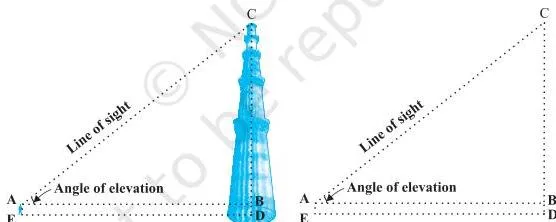
- Mark the right triangle and the horizontal. Find the right angle — usually where the vertical object meets the ground. Draw the horizontal line through the observer’s eye.
- Decide elevation or depression. If the line of sight runs above the horizontal, the angle is an elevation; below it, a depression. Either way the angle sits on the horizontal.
- Choose the ratio that links what you know to what you want. If the hypotenuse is in the question (rope, string, ladder), use sin or cos; if not, use tan or cot. Match the sides with the table above.
- Add or subtract the observer’s height. Do this only when the observation point is not at ground level (Q6, Q12, Q14) — work with the height above eye level first.
Reading the diagrams. In Fig. 9.11, the vertical side is the object whose height you want, the horizontal side is the ground distance, and the marked angle sits at the ground between them — the side opposite that angle is the height, the side adjacent is the ground distance.
In Fig. 9.12, the two angles belong to two observers on the same line as the tower’s foot: the 20 m gap between them is the difference of the two horizontal distances, and the distance from the bank directly opposite the tower is the canal width.
Worked example: a 12 m flagpole on a building, solved from scratch
Try the method on a fresh problem. A 12 m flagpole stands on top of a building. From a point on the ground 30 m from the foot of the building, the angle of elevation of the top of the flagpole is 45°. Find the height of the building.
- Step 1: The vertical side of the triangle is building + flag = \( h + 12 \); the horizontal side is the 30 m ground distance.
- Step 2: The question has no hypotenuse, so use tangent.
\[ \tan 45^\circ = \frac{h + 12}{30} \Rightarrow 1 = \frac{h + 12}{30} \Rightarrow h + 12 = 30 \]
Step 3: Solve.
\[ h = 18\ \text{m} \]
Final answer: the building is 18 m tall.
Check: 18 m building + 12 m flag = 30 m, which matches the horizontal distance because \( \tan 45^\circ = 1 \) makes the triangle isosceles. The classic slip here is forgetting that the 30 m distance sees the whole structure, not just the building.
Common mistakes in Exercise 9.1 — and how to catch them
| Common mistake | Correct rule | How to check your answer |
|---|---|---|
| Picking cos when the wanted side is opposite the angle | sin links hypotenuse–opposite; tan links adjacent–opposite; cos links hypotenuse–adjacent | Name the side facing the angle; if that is the side you want, use sin or tan, not cos |
| Forgetting to add the observer’s height (Q6, Q12, Q14) | Work with the height above the eye, then add the observer’s height at the end | Does your answer exceed the eye-level height by at least the observer’s height? |
| Adding distances that should be subtracted (Q11, Q13, Q15) | Points on the same side of the object differ; points on opposite sides sum | Re-read the question: are both points on one side of the object? |
| Stopping at \( \frac{30}{\sqrt{3}} \) without rationalising | Rationalise: \( \frac{30}{\sqrt{3}} = 10\sqrt{3} \) | Is the denominator free of a radical? |
| Reporting the taller triangle’s whole height (Q7, Q8, Q12) | Subtract the lower structure’s height | Does your answer name exactly the object asked for (the tower, not the building)? |
Exam pattern note
Board papers recycle two families from this exercise. The single-ratio questions (roughly Q1–Q5) test whether you can pick the correct ratio for one right triangle.
The two-triangle questions (Q6, Q7, Q9, Q10, Q11, Q13, Q14, Q15) are the chapter’s trademark — two lines of sight from one point, or one object seen from two points, with a shared horizontal distance or equal height as the bridge between the triangles.
A full-marks answer to a long question must show the right triangle named, the ratio chosen, the equation formed, and the final value with its unit — the steps carry the marks, so never skip to a bare answer.
For more practice on the whole chapter, browse the Class 10 Maths notes. Heights-and-distances thinking also returns in geometry-heavy chapters, so keep the two-triangle habit in mind when you reach Chapter 10 Circles.
Frequently Asked Questions
Why are some answers left as 10√3 m instead of a decimal like 17.32 m?
The angles in this exercise have exact ratio values, so the exact answer is a surd such as \( 10\sqrt{3} \) m. Boards accept the exact form and mark it complete; convert to a decimal only when a question supplies a value like \( \sqrt{3} = 1.73 \) and asks for an approximate answer.
How do I decide between tan and sin when solving a heights and distances question?
Look at the sides the question gives you. If a hypotenuse appears — a rope, a string, a ladder, the broken part of a tree — use sin (opposite over hypotenuse) or cos (adjacent over hypotenuse). If no hypotenuse is mentioned — almost every tower or building question — use tan (opposite over adjacent) or cot (adjacent over opposite).
How can I tell from a diagram whether an angle is an angle of elevation or an angle of depression?
If the line of sight runs above the horizontal — you raise your head to look — it is an elevation. If it runs below the horizontal — you lower your head — it is a depression. The angle is always measured with the horizontal, never with the vertical, and that horizontal line is the one to locate first.
In which questions do I need to add the observer’s height to my final answer?
Whenever the observer’s eye is not at ground level: Q6 (a 1.5 m boy), Q12 (the top of a 7 m building) and Q14 (a 1.2 m girl). Work with the height above eye level, then add the observer’s height at the very end. Forgetting this is one of the most common lost marks in the whole exercise.
What is the quick way to solve two-triangle problems like Question 15 with the car?
Uniform speed means time is proportional to distance, so you never need the tower height. The remaining distance is exactly half of the distance already covered in 6 s, so the car needs 3 s more. The same “shared quantity as bridge” idea — a common ground distance, or equal heights — is the key to Q6, Q9, Q10 and Q11 as well.
What exactly is the line of sight and why does it matter for choosing the angle?
The line of sight is the straight line drawn from the observer’s eye to the point viewed (NCERT, p. 134).
It matters because the whole exercise is built on it: the angle this line makes with the horizontal is the angle of elevation (line above the horizontal) or depression (line below it), and that is the angle that goes into your trigonometric ratio. Identify the line of sight first and the right triangle appears.
Looking for the bigger picture? Scanned the full set of Class 10 notes or jump to the CBSE notes index for every subject and chapter.
Reference: NCERT Class 10 Mathematics textbook, chapter Some Applications of Trigonometry.
Explore Class 10 Maths NCERT Solutions
More for this chapter:
Class 10 Maths on LearnCBSE:
Related chapters: