
This page gives you complete, step-by-step exercise 3.1 class 10 maths ncert solutions for the graphical method of solving a pair of linear equations in two variables. All seven questions are reproduced word for word from the textbook, and every lettered part is solved with the reasoning shown — not just the final answer.
Start with the graphical method and the ratio test, which the whole exercise leans on. Then work each question in order; every solution ends with a quick way to check your own result by substituting back into the equations.
Every question solved here is reproduced from the official NCERT Class 10 Mathematics textbook chapter PDF (jemh103.pdf), so you can open the source and check each line against the printed page while you practise.
Exercise 3.1 Solutions
This exercise teaches the graphical method for solving a pair of linear equations in two variables. You take each sentence of a word problem and turn it into one linear equation, so two separate conditions give you two separate equations.
Then you draw both lines on the same graph and read the answer: the point where the two lines cross is the common solution (NCERT, p. 29).
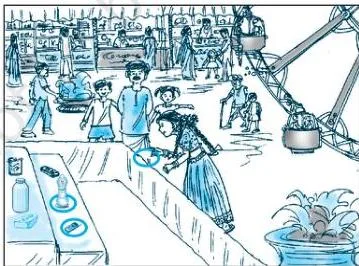
The chapter opens with Akhila at a fair. Her rides on the Giant Wheel (₹ 3 each) and games of Hoopla (₹ 4 each), with her time constraint and total spend of ₹ 20, become the pair \( y = \frac{1}{2}x \) and \( 3x + 4y = 20 \). Question 1 asks you to do exactly that conversion for two fresh situations — that is the core skill of this exercise.
The exercise also trains you to predict the outcome before drawing. Comparing the ratios of the coefficients of the two equations tells you whether the lines will intersect, coincide or stay parallel. Questions 2 to 4 drill this ratio test; Questions 1, 5 and 7 ask you to build and draw the lines.
Graphical method: the three line cases and the ratio test
Three definitions from the chapter carry the whole exercise (NCERT, p. 26):
- A pair of linear equations which has a solution is a consistent pair.
- A pair which has no solution is an inconsistent pair.
- If the two equations are equivalent — they describe the same line — they share infinitely many common solutions; such a pair is called dependent, and a dependent pair is always consistent.
The two lines of a pair can behave in only three ways (NCERT, p. 26): they can intersect in a single point (unique solution, consistent), they can be parallel (no solution, inconsistent), or they can coincide (infinitely many solutions, dependent and consistent). The ratio test from Table 3.1 decides which case you are in without drawing anything (NCERT, p. 27).
| Ratio condition | Line position | Number of solutions | Pair type | Example from Q2 |
|---|---|---|---|---|
| \( \frac{a_1}{a_2} \neq \frac{b_1}{b_2} \) | Intersecting | Exactly one (unique) | Consistent | \( 5x – 4y + 8 = 0 \), \( 7x + 6y – 9 = 0 \) |
| \( \frac{a_1}{a_2} = \frac{b_1}{b_2} = \frac{c_1}{c_2} \) | Coincident | Infinitely many | Dependent (consistent) | \( 9x + 3y + 12 = 0 \), \( 18x + 6y + 24 = 0 \) |
| \( \frac{a_1}{a_2} = \frac{b_1}{b_2} \neq \frac{c_1}{c_2} \) | Parallel | None | Inconsistent | \( 6x – 3y + 10 = 0 \), \( 2x – y + 9 = 0 \) |
A graph can only show a solution when the lines actually meet. The worked example below (with new numbers, not from your textbook) shows the reading step you will use in Questions 1, 4 and 7.
Worked example: Plot \( y = 2x – 1 \) and \( y = -x + 5 \).
Points for line 1: \( (0,-1) \) and \( (1,1) \), since \( 2(0)-1 = -1 \) and \( 2(1)-1 = 1 \).
Points for line 2: \( (0,5) \) and \( (3,2) \), since \( -(0)+5 = 5 \) and \( -(3)+5 = 2 \).
Read the crossing: the lines meet at \( (2,3) \), because \( 2(2)-1 = 3 \) and \( -(2)+5 = 3 \).
Final answer: solution \( x = 2 \), \( y = 3 \) — the single point common to both lines.
Fig. 3.1 below is the textbook’s own picture of this idea. The line AB (from \( x + 3y = 6 \)) and the line PQ (from \( 2x – 3y = 12 \)) cross at B(6, 0). That shared point is the unique solution: \( x = 6 \), \( y = 0 \) (NCERT, p. 27).
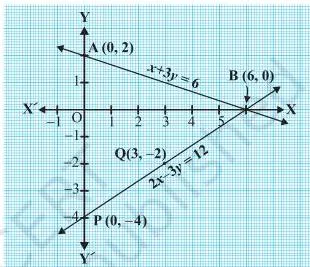
As the diagram illustrates, each line is fixed by two plotted points, and where the two lines share a point the coordinates of that point satisfy both equations at once.
A graph that touches instead of crossing, or never meets, behaves differently — you will classify those cases with the ratio test first, which is why you rarely need to draw a parallel or coincident pair.
You first met the idea of reading a graph for polynomial zeroes in the Chapter 2 polynomials notes; a line is just a polynomial of degree one.
Question 1: Form the pair of linear equations in the following problems, and find their solutions graphically. (i) 10 students of Class X took part in a Mathematics quiz. If the number of girls is 4 more than the number of boys, find the number of boys and girls who took part in the quiz. (ii) 5 pencils and 7 pens together cost ₹ 50, whereas 7 pencils and 5 pens together cost ₹ 46. Find the cost of one pencil and that of one pen.
Each sentence in a word problem becomes one linear equation: the sentence about totals gives one equation, and the sentence about the relationship gives a second. The pair is solved graphically by drawing both lines — the point where they cross is the only pair of values that satisfies both conditions at once.
Part (i): Name the variables.
Let \( x \) = number of girls and \( y \) = number of boys.
First equation — the total: \( x + y = 10 \).
Second equation — the relationship: ‘girls is 4 more than boys’ means \( x = y + 4 \), i.e.
\( x – y = 4 \).
Draw both lines.
For \( x + y = 10 \) plot \( (0,10) \) and \( (10,0) \).
For \( x – y = 4 \) plot \( (0,-4) \) and \( (4,0) \).
Read the crossing.
Adding the two equations: \( 2x = 14 \), so \( x = 7 \), and \( 7 + y = 10 \) gives \( y = 3 \).
The lines meet at \( (7,3) \).
Part (i) answer: 7 girls and 3 boys took part in the quiz.
Part (ii): Name the variables.
Let \( x \) = cost of one pencil and \( y \) = cost of one pen (in rupees).
First equation: \( 5x + 7y = 50 \).
Second equation: \( 7x + 5y = 46 \).
Draw both lines.
For \( 5x + 7y = 50 \) plot \( (3,5) \) and \( (10,0) \).
For \( 7x + 5y = 46 \) plot \( (3,5) \) and \( (8,-2) \).
Read the crossing.
The point \( (3,5) \) lies on both lines, so \( x = 3 \), \( y = 5 \).
Part (ii) answer: one pencil costs ₹ 3 and one pen costs ₹ 5.
Check: (i) \( 7 + 3 = 10 \) and \( 7 = 3 + 4 \). (ii) \( 5(3) + 7(5) = 50 \) and \( 7(3) + 5(5) = 46 \). Both original equations are satisfied.
Common error: writing the ‘4 more’ condition backwards as \( y = x + 4 \). Read the sentence subject-first: the number of girls is 4 more than the number of boys, so \( x = y + 4 \).
Question 2: On comparing the ratios a1/a2, b1/b2 and c1/c2, find out whether the lines representing the following pairs of linear equations intersect at a point, are parallel or coincident: (i) 5x − 4y + 8 = 0, 7x + 6y − 9 = 0 (ii) 9x + 3y + 12 = 0, 18x + 6y + 24 = 0 (iii) 6x − 3y + 10 = 0, 2x − y + 9 = 0
The three ratios \( \frac{a_1}{a_2} \), \( \frac{b_1}{b_2} \) and \( \frac{c_1}{c_2} \) compare the coefficients of the two equations, written in the general form \( a_1x + b_1y + c_1 = 0 \) and \( a_2x + b_2y + c_2 = 0 \). Compare \( \frac{a_1}{a_2} \) and \( \frac{b_1}{b_2} \) first: if those two differ, the lines cannot be parallel — they must intersect at a point.
Only when they are equal do you check \( \frac{c_1}{c_2} \) to separate coincident from parallel.
Part (i): \( \frac{a_1}{a_2} = \frac{5}{7} \), \( \frac{b_1}{b_2} = \frac{-4}{6} = -\frac{2}{3} \), \( \frac{c_1}{c_2} = \frac{8}{-9} \).
Since \( \frac{5}{7} \neq -\frac{2}{3} \), the lines intersect at a point.
Part (ii): \( \frac{a_1}{a_2} = \frac{9}{18} = \frac{1}{2} \), \( \frac{b_1}{b_2} = \frac{3}{6} = \frac{1}{2} \), \( \frac{c_1}{c_2} = \frac{12}{24} = \frac{1}{2} \).
All three are equal, so the lines are coincident.
Part (iii): \( \frac{a_1}{a_2} = \frac{6}{2} = 3 \), \( \frac{b_1}{b_2} = \frac{-3}{-1} = 3 \), \( \frac{c_1}{c_2} = \frac{10}{9} \).
The first two ratios match but the third does not, so the lines are parallel.
Final answers: (i) intersect at a point; (ii) coincident; (iii) parallel.
Check: in part (ii), the second equation is exactly \( 2 \times \) the first, so the lines must coincide. In part (iii), \( 6x – 3y + 10 = 0 \) is \( 3(2x – y) + 10 = 0 \) while the other is \( 2x – y + 9 = 0 \) — same slope, different intercept, hence parallel.
Common error: dropping signs while reducing \( \frac{b_1}{b_2} \). Write each ratio as a single reduced fraction before comparing; \( \frac{-4}{6} \) must be seen as \( -\frac{2}{3} \), not \( \frac{2}{3} \).
Question 3: On comparing the ratios a1/a2, b1/b2 and c1/c2, find out whether the following pair of linear equations are consistent, or inconsistent. (i) 3x + 2y = 5; 2x − 3y = 7 (ii) 2x − 3y = 8; 4x − 6y = 9 (iii) (3/2)x + (5/3)y = 7; 9x − 10y = 14 (iv) 5x − 3y = 11; −10x + 6y = −22 (v) (4/3)x + 2y = 8; 2x + 3y = 12
Consistent simply means the pair has at least one common solution — which is exactly the intersecting or coincident case. Inconsistent means the lines are parallel and share no point. So this question is the same ratio test from Question 2, with the verdict worded as consistent or inconsistent.
Part (i): \( \frac{a_1}{a_2} = \frac{3}{2} \), \( \frac{b_1}{b_2} = \frac{2}{-3} = -\frac{2}{3} \).
They differ, so the lines intersect: consistent.
Part (ii): \( \frac{a_1}{a_2} = \frac{2}{4} = \frac{1}{2} \), \( \frac{b_1}{b_2} = \frac{-3}{-6} = \frac{1}{2} \), \( \frac{c_1}{c_2} = \frac{-8}{-9} = \frac{8}{9} \).
The a and b ratios match but the c ratio does not, so the lines are parallel: inconsistent.
Part (iii): \( \frac{a_1}{a_2} = \frac{3/2}{9} = \frac{1}{6} \), \( \frac{b_1}{b_2} = \frac{5/3}{-10} = -\frac{1}{6} \).
They differ, so the lines intersect: consistent.
Part (iv): \( \frac{a_1}{a_2} = \frac{5}{-10} = -\frac{1}{2} \), \( \frac{b_1}{b_2} = \frac{-3}{6} = -\frac{1}{2} \), \( \frac{c_1}{c_2} = \frac{-11}{22} = -\frac{1}{2} \).
All three are equal, so the lines coincide: the pair is dependent, hence consistent.
Part (v): \( \frac{a_1}{a_2} = \frac{4/3}{2} = \frac{2}{3} \), \( \frac{b_1}{b_2} = \frac{2}{3} \), \( \frac{c_1}{c_2} = \frac{-8}{-12} = \frac{2}{3} \).
All three are equal, so the lines coincide: the pair is dependent, hence consistent.
Final answers: (i) consistent; (ii) inconsistent; (iii) consistent; (iv) consistent; (v) consistent.
Check: in parts (iv) and (v), the second equation is \( -2 \times \) or \( 3/2 \times \) the first, so both describe the same line — any solution of one solves the other, which is why they are consistent.
Common error: calling a pair ‘inconsistent’ because the signs look different. Signs must be compared inside each ratio: \( \frac{-3}{-6} = \frac{1}{2} \), not \( -\frac{1}{2} \).
Question 4: Which of the following pairs of linear equations are consistent/inconsistent? If consistent, obtain the solution graphically: (i) x + y = 5, 2x + 2y = 10 (ii) x − y = 8, 3x − 3y = 16 (iii) 2x + y − 6 = 0, 4x − 2y − 4 = 0 (iv) 2x − 2y − 2 = 0, 4x − 4y − 5 = 0
A graph can only display a solution if the two lines actually meet. Coincident lines meet everywhere — every point on the line is a solution. Parallel lines meet nowhere. So first use the ratio test to decide whether drawing is even worth the effort, then draw only the consistent pairs.
Part (i): \( \frac{a_1}{a_2} = \frac{1}{2} \), \( \frac{b_1}{b_2} = \frac{1}{2} \), \( \frac{c_1}{c_2} = \frac{-5}{-10} = \frac{1}{2} \).
All equal, so the lines are coincident and consistent — infinitely many solutions.
Every point on \( x + y = 5 \) works, for example \( (0,5) \), \( (3,2) \), \( (5,0) \); you need draw only one line.
Part (ii): \( \frac{a_1}{a_2} = \frac{1}{3} \), \( \frac{b_1}{b_2} = \frac{-1}{-3} = \frac{1}{3} \), \( \frac{c_1}{c_2} = \frac{-8}{-16} = \frac{1}{2} \).
The a and b ratios match but the c ratio differs, so the lines are parallel and inconsistent — no solution, so there is nothing to draw.
Part (iii): \( \frac{a_1}{a_2} = \frac{2}{4} = \frac{1}{2} \), \( \frac{b_1}{b_2} = \frac{1}{-2} = -\frac{1}{2} \).
They differ, so the lines intersect: consistent.
Draw \( 2x + y = 6 \) through \( (0,6) \) and \( (3,0) \), and \( 4x – 2y = 4 \) (i.e. \( y = 2x – 2 \)) through \( (0,-2) \) and \( (1,0) \).
Solving \( 6 – 2x = 2x – 2 \) gives \( x = 2 \), \( y = 2 \).
Part (iii) solution: the lines meet at \( (2,2) \).
Part (iv): \( \frac{a_1}{a_2} = \frac{2}{4} = \frac{1}{2} \), \( \frac{b_1}{b_2} = \frac{-2}{-4} = \frac{1}{2} \), \( \frac{c_1}{c_2} = \frac{-2}{-5} = \frac{2}{5} \).
The a and b ratios match but the c ratio does not, so the lines are parallel and inconsistent — no solution.
Final answers: (i) consistent — infinitely many solutions; (ii) inconsistent; (iii) consistent — \( (2,2) \); (iv) inconsistent.
Check: the drawn intersection of part (iii) is the same pattern as Fig. 3.1 — two plotted lines sharing one common point, which you read directly off the graph.
Common error: drawing parallel lines as if they met. An inconsistent pair has no crossing point to report; if the ratio test says parallel, stop and state ‘no solution’ rather than forcing an intersection.
Question 5: Half the perimeter of a rectangular garden, whose length is 4 m more than its width, is 36 m. Find the dimensions of the garden.
Half the perimeter of a rectangle is just one length plus one width, because the full perimeter is \( 2(x + y) \). So ‘half the perimeter is 36 m’ translates directly to \( x + y = 36 \), not \( x + y = 72 \).
Name the variables: let \( x \) = length and \( y \) = width, in metres.
First equation — half the perimeter: \( x + y = 36 \).
Second equation — length 4 m more than width: \( x = y + 4 \).
Substitute: \( (y + 4) + y = 36 \), so \( 2y = 32 \) and \( y = 16 \).
Then \( x = 16 + 4 = 20 \).
Final answer: the garden is 20 m long and 16 m wide.
Check: \( 20 – 16 = 4 \) (length is 4 m more) and \( 20 + 16 = 36 \) (half the perimeter). Full perimeter \( 2(20 + 16) = 72 \) m, half of which is 36 m.
Common error: forgetting the factor 2 in the perimeter and writing \( x + y = 72 \), or typing ‘width is 4 more than length’ as \( y = x + 4 \).
Question 6: Given the linear equation 2x + 3y − 8 = 0, write another linear equation in two variables such that the geometrical representation of the pair so formed is: (i) intersecting lines (ii) parallel lines (iii) coincident lines
The coefficients of a line decide everything, and the ratio test tells you exactly which coefficients to choose. Against \( a_1 = 2 \), \( b_1 = 3 \), \( c_1 = -8 \), any new equation with coefficients \( a_2 \), \( b_2 \), \( c_2 \) has to force one of the three ratio conditions. There are infinitely many correct answers; here is one valid equation for each case (NCERT, p. 29).
Part (i) — intersecting: need \( \frac{a_1}{a_2} \neq \frac{b_1}{b_2} \).
Take \( x + y – 8 = 0 \): \( \frac{1}{1} = 1 \neq \frac{2}{3} \), so the lines intersect.
Part (ii) — parallel: need \( \frac{a_1}{a_2} = \frac{b_1}{b_2} \) with \( \frac{c_1}{c_2} \) different.
Take \( 4x + 6y – 9 = 0 \): \( \frac{2}{4} = \frac{1}{2} \), \( \frac{3}{6} = \frac{1}{2} \), but \( \frac{-8}{-9} = \frac{8}{9} \neq \frac{1}{2} \).
Part (iii) — coincident: any non-zero multiple of the original equation works.
Take \( 4x + 6y – 16 = 0 \), which is exactly \( 2 \times (2x + 3y – 8 = 0) \).
One valid set of answers: (i) \( x + y – 8 = 0 \); (ii) \( 4x + 6y – 9 = 0 \); (iii) \( 4x + 6y – 16 = 0 \).
Check: for whatever equation you write, run its own ratio test against \( 2x + 3y – 8 = 0 \). Parallel needs the a and b ratios equal but the c ratio different; coincident needs all three equal — that is the only difference between the two cases.
Common error: offering a multiple of the given equation for the ‘parallel’ part. A multiple like \( 4x + 6y – 16 = 0 \) gives equal c ratios too, so it is coincident, not parallel.
Question 7: Draw the graphs of the equations x − y + 1 = 0 and 3x + 2y − 12 = 0. Determine the coordinates of the vertices of the triangle formed by these lines and the x-axis, and shade the triangular region.
Every straight line is fixed by two points, and the easiest points are usually the intercepts. The triangle’s three vertices are: the point where each line cuts the x-axis, and the point where the two lines cross — the same reading you practised with Fig. 3.1.
Rewrite in slope form: \( x – y + 1 = 0 \) becomes \( y = x + 1 \); \( 3x + 2y – 12 = 0 \) becomes \( y = \frac{12 – 3x}{2} \).
Where line 1 cuts the x-axis (y = 0): \( x + 1 = 0 \), so \( x = -1 \).
Point \( (-1, 0) \).
Where line 2 cuts the x-axis (y = 0): \( 3x – 12 = 0 \), so \( x = 4 \).
Point \( (4, 0) \).
Where the lines cross: set \( x + 1 = \frac{12 – 3x}{2} \).
Then \( 2x + 2 = 12 – 3x \), so \( 5x = 10 \) and \( x = 2 \), giving \( y = 3 \).
Point \( (2, 3) \).
Plot and shade: draw \( y = x + 1 \) through \( (-1,0) \) and \( (2,3) \); draw \( y = \frac{12-3x}{2} \) through \( (4,0) \) and \( (2,3) \).
Shade the triangle bounded by these two lines and the x-axis.
Final answer: the vertices of the triangle are \( (-1, 0) \), \( (4, 0) \) and \( (2, 3) \); shade the region enclosed by them.
Check: the base of the triangle runs from \( (-1,0) \) to \( (4,0) \), so its length is 5 units, and the height to \( (2,3) \) is 3 units. Area \( = \frac{1}{2} \times 5 \times 3 = 7.5 \) square units — a sensible check that your three points are correct.
Common error: misreading the x-intercept of \( x – y + 1 = 0 \) as \( x = 1 \). Putting \( y = 0 \) gives \( x + 1 = 0 \), so \( x = -1 \), not \( 1 \).
Method recap: the ratio test in one table
The entire exercise rests on one decision rule. For a pair \( a_1x + b_1y + c_1 = 0 \) and \( a_2x + b_2y + c_2 = 0 \) (NCERT, p. 28):
| Ratio condition | Line position | Number of solutions | Consistency |
|---|---|---|---|
| \( \frac{a_1}{a_2} \neq \frac{b_1}{b_2} \) | Intersecting | Unique solution | Consistent |
| \( \frac{a_1}{a_2} = \frac{b_1}{b_2} = \frac{c_1}{c_2} \) | Coincident | Infinitely many | Dependent (consistent) |
| \( \frac{a_1}{a_2} = \frac{b_1}{b_2} \neq \frac{c_1}{c_2} \) | Parallel | None | Inconsistent |
Ratios are the fastest route for Questions 2 to 4 — they answer in one line. Drawing a graph is only needed when the question asks for a graphical solution, which is exactly Questions 1, 4(iii) and 7.
Question 2 and 3 are pure ratio-test drills; Question 4 mixes the ratio test with drawing; Questions 1 and 5 are word problems (form then solve); Question 6 is a design task; Question 7 is pure graph work.
The mistakes that cost marks in this exercise, and how to catch them:
| Mistake | Correct rule | How to check your answer |
|---|---|---|
| Writing ‘4 more than’ backwards as \( y = x + 4 \) | Girls = boys + 4, so \( x = y + 4 \) | Substitute your final values back: does \( 7 = 3 + 4 \)? |
| Calling a coincident pair ‘inconsistent’ | All three ratios equal → dependent, consistent | Is one equation a multiple of the other? If yes, they coincide. |
| Mixing up parallel and coincident (both start with equal a and b ratios) | Check \( c_1/c_2 \): equal → coincident; different → parallel | Do the lines share any point at all? None → parallel. |
| Misreading the x-intercept of \( x – y + 1 = 0 \) as \( x = 1 \) | Put \( y = 0 \) and solve: \( x = -1 \) | Substitute the point into the line’s equation. |
The parallel and coincident conditions both begin with \( \frac{a_1}{a_2} = \frac{b_1}{b_2} \), which is exactly why students mix them up. The single extra comparison of \( \frac{c_1}{c_2} \) is the whole difference.
Frequently asked questions about Exercise 3.1
How can I tell whether a pair of linear equations is consistent without drawing a graph?
Compare the three ratios. If \( \frac{a_1}{a_2} \neq \frac{b_1}{b_2} \), the lines intersect — consistent. If all three ratios are equal, the lines coincide — dependent, hence consistent. A pair is inconsistent only when \( \frac{a_1}{a_2} = \frac{b_1}{b_2} \) but \( \frac{c_1}{c_2} \) differs, which is the parallel case.
What is the difference between coincident lines and parallel lines in Exercise 3.1?
Both cases begin with \( \frac{a_1}{a_2} = \frac{b_1}{b_2} \), so the a and b ratios alone cannot separate them. For coincident lines the c ratio matches as well and the lines are the same line with infinitely many shared points (dependent, consistent). For parallel lines the c ratio differs, so the lines never meet and share no point — inconsistent.
Only \( \frac{c_1}{c_2} \) tells them apart.
Question 6 has many correct answers — how do I know the equation I wrote is acceptable?
Any equation whose coefficients satisfy the required ratio condition is correct. For intersecting, pick \( a_2, b_2 \) not in the ratio \( 2 : 3 \). For parallel, keep \( a_2 : b_2 = 2 : 3 \) but choose \( c_2 \) so that \( \frac{c_1}{c_2} \) differs from \( \frac{a_1}{a_2} \). For coincident, use any non-zero multiple of \( 2x + 3y – 8 = 0 \).
Verify by running the ratio test on your chosen equation before writing it down.
Do I have to shade the triangular region in Question 7, and how do I find its vertices?
Yes — the question explicitly says to shade the triangular region, so a complete answer shades it between the two lines and the x-axis. The three vertices are: put \( y = 0 \) in each line to get its x-intercept (\( (-1,0) \) and \( (4,0) \)), then solve the pair together to get the crossing point \( (2,3) \).
The same graph-meets-axis idea returns when you solve quadratic equations — see the Chapter 4 quadratic equations solutions for how a parabola’s intersection with the x-axis gives its roots.
Next: algebraic methods in Exercise 3.2
Graph reading is quick when the solution lands on whole numbers, but when the meeting point has awkward coordinates like \( (\sqrt{3}, 2\sqrt{7}) \), reading it from a graph invites mistakes (NCERT, p. 31). That is why the next section replaces drawing with algebra: the substitution and elimination methods.
For step-by-step working through the substitution and elimination methods, see the Exercise 3.2 solutions (substitution and elimination methods).
For the rest of the chapter’s guides, browse the class 10 maths study material, the wider class 10 resources, or start from the main study notes index.
Reference: NCERT Class 10 Mathematics textbook, chapter Pair of Linear Equations in Two Variables.
Explore Class 10 Maths NCERT Solutions
More for this chapter:
Class 10 Maths on LearnCBSE:
Related chapters: