
Here are the exercise 10.1 class 10 maths NCERT solutions for Circles, Chapter 10 of the Class 10 Mathematics book. All four questions of this exercise are solved below, step by step, with the reasoning behind every answer — not just the final result.
Exercise 10.1 is the vocabulary-and-first-theorem exercise of the Circles chapter. It pins down the meaning of tangent, secant and point of contact, counts the tangents a circle and a point can have, and applies Theorem 10.1 to one right-angled triangle. The proof-heavy results, such as equal tangent lengths from an external point, follow in Exercise 10.2.
All four questions below are reproduced word for word from the official NCERT Class 10 Mathematics textbook, hosted on ncert.nic.in, so you can check the exact wording of every question and option against the source. For the surrounding material, see the Class 10 Maths resources on this site or start from the main Class 10 page.
Exercise 10.1 Class 10 Maths NCERT Solutions — What This Exercise Teaches
A line and a circle can meet in zero, one, or two points, and which case you get decides the name of the line. Each question in this exercise tests one piece of that picture.
- Question 1 — a direct concept question: count the tangents of the whole circle.
- Question 2 — a direct concept question: fix the vocabulary of tangent, secant, parallel tangents and point of contact.
- Question 3 — the only multiple-choice and the only numerical question: apply the radius–tangent right angle to a Pythagoras calculation.
- Question 4 — a construction question: draw one tangent and one secant parallel to a given line.
For Question 3 a full-marks answer names the correct option and justifies it with Pythagoras; for the others, the reasoning matters more than the one-word answer.
Key concepts you need before solving: tangent, secant, point of contact
Fix these three positions of a line relative to a circle (NCERT, p. 145):
| Position of the line | Common points with the circle | Name of the line |
|---|---|---|
| The line and the circle do not meet | 0 | Non-intersecting line |
| The line cuts the circle at A and B | 2 | Secant |
| The line touches the circle at A only | 1 | Tangent |
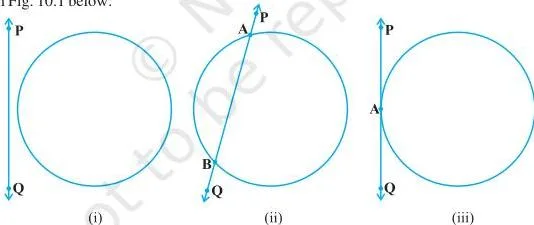
The single common point in the third case is the point of contact, and the line is said to touch the circle there (NCERT, p. 146). Think of a tangent as the limiting case of a secant: as the two intersection points of a secant slide together and merge into one, the secant becomes a tangent (NCERT, p. 146).
Theorem 10.1: the tangent at any point of a circle is perpendicular to the radius through the point of contact (NCERT, p. 147).
Why it holds: take any other point Q on the tangent. If Q were inside the circle, the line would meet the circle twice and would be a secant, not a tangent. Every such Q lies outside, so \( OQ \gt OP \) for every Q except P.
That makes OP the shortest distance from the centre O to the tangent. The shortest distance from a point to a line is along the perpendicular, so OP is perpendicular to the tangent (NCERT, p. 147).
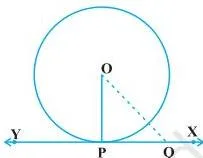
Two consequences matter here. First, at any one point of a circle there is exactly one tangent (NCERT, p. 148). Second, whether a tangent can be drawn through a given point depends on where the point lies (NCERT, p. 148):
| Position of the point | Number of tangents through it |
|---|---|
| Inside the circle | None |
| On the circle | Exactly one |
| Outside the circle | Exactly two |
Question 1: How many tangents can a circle have?
Concept: a tangent is defined at a point of the circle, and exactly one tangent passes through each point of the circle (NCERT, p. 148). Since a circle has infinitely many points, it has infinitely many tangents in all.
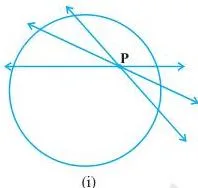
Reading the figure: Fig. 10.6 shows the three cases for a single point P.
From a point inside, no tangent exists.
From a point on the circle, exactly one tangent can be drawn.
From a point outside, exactly two tangents can be drawn, touching at T1 and T2 (NCERT, p. 148).
Final answer: A circle has infinitely many tangents.
Common error: answering “two”.
Two is the number of tangents from one external point, as in Fig. 10.6(iii).
The question asks about the whole circle, so you must count every point of the circumference, not one chosen point.
Checking rule: if the question says “from a point”, the answer is 0, 1 or 2 depending on the point’s position. If it asks about the circle itself, remember the circle has infinitely many points, each carrying one tangent.
Question 2: Fill in the blanks: (i) A tangent to a circle intersects it in _________ point (s). (ii) A line intersecting a circle in two points is called a _________. (iii) A circle can have _________ parallel tangents at the most. (iv) The common point of a tangent to a circle and the circle is called _________.
Every blank is answered by the three-position picture in Fig. 10.1 and the definition of the point of contact.
Part (i): one point.
A tangent intersects the circle in exactly one point; that single intersection is what makes it a tangent.
The “(s)” in the question allows either form, but the definition fixes the singular.
Part (ii): secant.
A line that intersects a circle in two points is called a secant (NCERT, p. 145).
Two common points is the middle case of Fig. 10.1.
Part (iii): two.
Lines parallel to a given secant cut shorter and shorter chords as they move toward the circle, and the chord length becomes zero at exactly two positions — one on each side of the circle.
Those two positions are the tangents, so there cannot be more than two tangents parallel to a given secant (NCERT, p. 146).
Part (iv): point of contact.
The common point of a tangent and the circle is called the point of contact (NCERT, p. 146).
It is the one point where the tangent touches the circle.
Answers: (i) one, (ii) secant, (iii) two, (iv) point of contact.
Checking rule: read each completed sentence aloud. If “a line intersecting a circle in two points is called a tangent” sounds wrong, you have mixed up the cases — two common points always mean secant.
Question 3: A tangent PQ at a point P of a circle of radius 5 cm meets a line through the centre O at a point Q so that OQ = 12 cm. Length PQ is: (A) 12 cm (B) 13 cm (C) 8.5 cm (D) √119 cm.
Concept: Theorem 10.1 makes the radius OP perpendicular to the tangent PQ at the point of contact P. So triangle OPQ is right-angled at P, and the side opposite that right angle, OQ, is the hypotenuse. The radius is one leg of the triangle — never the hypotenuse.
Step 1: Write the given lengths.
Radius \( OP = 5\text{ cm} \); \( OQ = 12\text{ cm} \) is the hypotenuse.
Step 2: Apply Pythagoras to find the unknown leg PQ.
\[ PQ^2 = OQ^2 – OP^2 = 12^2 – 5^2 = 144 – 25 = 119 \]
\[ PQ = \sqrt{119}\text{ cm} \]
Correct option: (D) \( \sqrt{119} \) cm.
Why the other options fail:
- (A) 12 cm — repeats the given OQ. PQ is a leg of the triangle, and a leg is always shorter than the hypotenuse 12 cm.
- (B) 13 cm — the classic distractor: \( 5^2 + 12^2 = 169 \), giving 13. That is the hypotenuse of a 5–12–13 triangle, but OQ is already the hypotenuse here, so 13 cm would be longer than the hypotenuse — impossible.
- (C) 8.5 cm — half of 17, with no basis in the given data.
- (D) \( \sqrt{119} \) cm — correct: 119 lies between 100 and 121, so \( \sqrt{119} \approx 10.9\text{ cm} \), less than 12 cm as a leg must be.
Common error: adding instead of subtracting.
The moment you write 25 + 144 you are treating OP as a leg that needs a hypotenuse — but OP is already perpendicular to PQ, the right angle is at P, and OQ must be the hypotenuse.
Mark the right angle in the figure before calculating.
Checking rule: substitute each option into Pythagoras and keep the one that satisfies \( OQ^2 = OP^2 + PQ^2 \). Only (D) works: \( 5^2 + 119 = 144 = 12^2 \).
Question 4: Draw a circle and two lines parallel to a given line such that one is a tangent and the other, a secant to the circle.
Concept: for lines parallel to a given line, everything depends on the perpendicular distance from the centre. A line whose distance from the centre equals the radius touches the circle at one point — a tangent. A line closer than the radius cuts it at two points — a secant. A line farther out misses the circle.
Construction, using a circle of radius 3 cm and a given line l:
- Draw a circle with centre O and radius 3 cm, and draw a line l outside the circle.
- From O, drop a perpendicular to l. Let it meet l at M.
- Draw the line through the point where OM meets the circle, parallel to l. Its distance from O is 3 cm, equal to the radius, so it touches the circle at exactly one point — the tangent.
- Draw a second line parallel to l at a smaller distance from O, say 1.5 cm. Since 1.5 cm is less than the radius 3 cm, this line cuts the circle in two points — the secant.

Fig. 10.3(ii) explains why the method works.
Parallel lines on both sides of a secant cut chords that shorten as the line approaches the circle.
In the two extreme positions the chord length becomes zero and the two intersection points merge into one — those are the tangents, one on each side of the circle (NCERT, p. 146).
Common error: drawing the “parallel” lines freehand so they are not truly parallel, or placing the secant so far from the centre that it never meets the circle.
Check the perpendicular distance of each new line from O: equal to the radius for the tangent, less than the radius for the secant.
Final note: two tangents parallel to l are possible, one on each side of the circle — the same fact as the answer to Q2(iii).
Checking rule: after drawing, measure the perpendicular distance from O to each new line. You should read 3 cm for the tangent and 1.5 cm for the secant. If either measurement is wrong, the line is not correctly parallel to l.
Method recap: how these ideas carry into the rest of Circles
Exercise 10.1 supplies four facts that every later circle problem reuses:
- A tangent touches the circle at exactly one point, called the point of contact.
- Theorem 10.1: the radius through the point of contact is perpendicular to the tangent (NCERT, p. 147). This turns every tangent problem into a right-triangle problem, exactly as in Question 3.
- Number of tangents through a point: 0 from inside the circle, 1 from a point on the circle, 2 from an external point (NCERT, p. 148).
- Theorem 10.2: the lengths of the two tangents drawn from an external point are equal (NCERT, p. 149). Stated here for reference; the proof and its uses belong to Exercise 10.2.
The mistakes that cost marks in this exercise, and how to catch them:
| Mistake | Correct rule | How to check your answer |
|---|---|---|
| Answering “two” in Q1 | Every point of the circle has one tangent, and the points are infinite in number | Ask: does the question mean from one point, or for the whole circle? |
| Calling a two-point line a tangent in Q2 | Two common points = secant; only one common point = tangent | Count the common points in the diagram before naming the line |
| Q3: adding \( 25 + 144 \) and choosing 13 cm | The radius is perpendicular to the tangent, so subtract: \( PQ^2 = 12^2 – 5^2 \) | Check the hypotenuse is the longest side: \( \sqrt{119} \approx 10.9 \lt 12 \) |
| Q4: calling any parallel line a secant | A line is a secant only when its distance from the centre is less than the radius | Measure the perpendicular distance from O and compare it with the radius |
These same tools carry straight into Exercise 10.2, where tangent lengths are proved equal and the radius–tangent right angle drives the angle proofs. The construction habit from Question 4 also returns in Areas Related to Circles (Chapter 11).
The right-triangle habit is the same one you use again in Some Applications of Trigonometry (Chapter 9). If you need to revise any earlier topic, the full set of Class 10 study material is on this site.
FAQs: circles exercise 10.1
Why does a circle have infinitely many tangents but only two parallel to a given line?
One tangent passes through each point of the circle, and a circle has infinitely many points, so the total number of tangents is infinite. These tangents point in every possible direction, because the tangent at a point is perpendicular to the radius there.
A given line fixes one direction, and only two tangents — one on each side of the circle — can be parallel to it (NCERT, p. 146).
How many tangents can be drawn from a point inside the circle?
None. Every line through an interior point cuts the circle at two points, so every such line is a secant; no line through that point can touch the circle at exactly one point (NCERT, p. 148).
Why is the answer to Question 3 option (D) and not 13 cm?
13 cm is the distractor you get by adding the squares: \( 25 + 144 = 169 \). That would be the hypotenuse of a 5–12–13 triangle, but here the radius OP is already perpendicular to the tangent PQ, so the hypotenuse is OQ = 12 cm and OP = 5 cm is a leg.
The missing leg comes from subtraction: \( PQ^2 = 12^2 – 5^2 = 119 \), so \( PQ = \sqrt{119} \) cm. A leg is always shorter than the hypotenuse, and \( \sqrt{119} \approx 10.9 \text{ cm} \lt 12 \text{ cm} \) confirms the answer.
What is the point of contact in a circle?
The point of contact is the single common point of a tangent and the circle — the one point where the tangent touches the circle, shown as point A in Fig. 10.1(iii) (NCERT, p. 146). By Theorem 10.1, the radius drawn through this point is perpendicular to the tangent.
Reference: NCERT Class 10 Mathematics textbook, chapter Circles.
Explore Class 10 Maths NCERT Solutions
More for this chapter:
Class 10 Maths on LearnCBSE:
Related chapters: