
The End of Bipolarity Class 12 PDF is right here: the official NCERT chapter, 14 printed pages from Contemporary World Politics, Class 12 Political Science. This page also maps the chapter section by section, explains the five key ideas, and reads every NCERT figure, so you can see exactly what the file contains before you open it.
| What the chapter holds | Count | Where it is used |
|---|---|---|
| Printed pages | 14 | |
| Figures with NCERT captions | 5 | |
| Exercise questions | 6 | answered in our NCERT Solutions |
| Official NCERT PDF | Download the chapter PDF | the chapter exactly as NCERT publishes it |
The End of Bipolarity Class 12: NCERT Chapter 1 PDF
This is the official textbook file for Chapter 1 of Contemporary World Politics. The chapter runs from the toppling of the Berlin Wall in 1989 to the exercises on page 13.
Download the NCERT Class 12 Political Science Chapter 1 The End of Bipolarity PDF from ncert.nic.in, the publisher’s own portal, where every chapter of the complete Contemporary World Politics book is published.
Reference: NCERT Class 12 Political Science textbook, chapter 1, official edition on ncert.nic.in.
Chapter at a glance: what is inside the PDF
The chapter runs 14 printed pages. The table below maps each main section to the NCERT page where it begins, so you can jump straight to the part you need.
| Section in the chapter | NCERT page |
|---|---|
| Overview | p. 1 |
| What Was the Soviet System? | p. 2 |
| Gorbachev and the Disintegration | p. 3 |
| Why Did the Soviet Union Disintegrate? | p. 4 |
| Timeline of Disintegration | p. 6 |
| Consequences of Disintegration | p. 7 |
| Shock Therapy in Post-Communist Regimes | p. 8 |
| Consequences of Shock Therapy | p. 9 |
| Tensions and Conflicts | p. 10 |
| India and Post-Communist Countries | p. 11 |
| Exercises | p. 13 |
Beyond the main text, the chapter carries marginal boxes: portraits of six Soviet leaders from Lenin to Yeltsin, jokes and cartoons, and short one-line questions that open up debates. These boxes are teaching hooks — the sections below use them.
What this chapter covers and how it is organised
The chapter has one arc. It explains the meaning, causes and consequences of the collapse of the “second world”, then what happened to that part of the world after communism fell, then how India relates to the post-Soviet countries today (NCERT, p. 1).
A striking point in the overview: the Cold War ended not by military means but through mass actions by ordinary men and women — one after another, the eight East European countries of the Soviet bloc replaced their communist governments in response to mass demonstrations (NCERT, p. 1).
Three built-in activities sit inside the chapter and are often used for internal assessment:
- the map-location task beside the map of the Commonwealth of Independent States — locate the five Central Asian republics (p. 8-9);
- “LET’S DO IT” — list the similarities between India and the USSR in political and economic ideology (p. 11);
- STEPS — a class project on five Cold War allies each of the USSR and the US, profiling every country before and after communism collapsed (p. 12).
Key concepts: five ideas that hold this chapter together
These five ideas are the skeleton of the chapter. Each one is developed fully in a section below, with its NCERT page given here for quick reference.
- The Soviet system — one-party rule over a state-planned economy, with no opposition allowed (p. 2).
- The second world — the socialist bloc of East European states modelled on the USSR and bound by the Warsaw Pact (p. 2).
- Gorbachev’s reforms — perestroika (restructuring) and glasnost (openness), meant to save the system (p. 6).
- Shock therapy — the World Bank- and IMF-influenced transition from socialism to capitalism (p. 8).
- A multipolar world order — the vision India and Russia share, of several powers coexisting without any one power dominating (p. 11).
The Soviet system: one party, a planned economy and the second world
The chapter starts here because you cannot understand the collapse without knowing what the USSR was built to be. The Union of Soviet Socialist Republics came into being after the socialist revolution in Russia in 1917 (NCERT, p. 2).
Its makers wanted a society based on the ideas of socialism and equality. This was perhaps the biggest attempt in history to abolish the institution of private property and consciously design such a society (NCERT, p. 2). In practice, that meant:
- primacy of the state and the Communist Party;
- no other political party or opposition permitted;
- an economy planned and controlled by the state.
After the Second World War, the East European countries liberated by the Soviet army modelled their systems on the USSR. Together they formed the second world, or the “socialist bloc”, held together by the Warsaw Pact, a military alliance led by the USSR (NCERT, p. 2).
The system had real strengths. The Soviet Union became a great power, with energy resources, iron and steel, machinery production and an efficient transport network. It guaranteed a minimum standard of living, subsidising health, education and childcare, and state ownership covered land and productive assets (NCERT, p. 2-3).
But the same system carried fatal weaknesses that the chapter lists one after another:
- it became bureaucratic and authoritarian, with no democracy and no freedom of speech — so people expressed their dissent in jokes and cartoons (p. 3);
- the Communist Party was unaccountable and refused the fifteen republics the right to manage their own affairs; in reality Russia dominated everything (p. 3);
- the arms race with the US came at great cost, while technology, infrastructure and citizens’ aspirations lagged behind the West (p. 3);
- the invasion of Afghanistan in 1979 weakened the system further; consumer goods ran short, food imports rose, and the economy became stagnant by the late 1970s (p. 3).
NCERT’s own evidence of silent protest is the potato joke on page 4. A party bureaucrat asks a farmer about the harvest; the farmer answers “by the grace of God, we had mountains of potatoes” — and when the official insists there is no God, the farmer replies that there are no mountains of potatoes either.
Gorbachev’s reforms and the disintegration of the Soviet Union
Here is the chapter’s central paradox: Gorbachev diagnosed the illness correctly, reformed to catch up with the West, and the system still collapsed. The book says the answers become controversial here, and historians will debate them (NCERT, p. 5).
Gorbachev became General Secretary in March 1985. The steps that followed, in order, took the USSR from reform to dissolution:
- Gorbachev launched perestroika (restructuring) and glasnost (openness) to modernise the economy and politics (p. 6).
- East European populations protested against their own governments and Soviet control. This time, unlike in the past, the USSR did not intervene, and the communist regimes collapsed one after another (p. 3).
- In August 1991, Communist Party hardliners staged a coup against Gorbachev. People who had tasted freedom refused the old-style rule, and Boris Yeltsin emerged as the hero of the resistance (p. 3).
- In December 1991, Russia, Ukraine and Belarus declared the Soviet Union disbanded. The Communist Party was banned, and capitalism and democracy were adopted as the basis of the new republics (p. 3).
- The declaration took the other republics by surprise, especially the Central Asian ones. They were made founding members of the Commonwealth of Independent States (CIS) (p. 4).
- Russia was accepted as the successor state: it inherited the USSR’s UN Security Council seat, accepted all Soviet treaties, and remained the only nuclear state of the post-Soviet space (p. 4).
Why did it happen? The chapter gives four causes, and their order matters:
| Cause | What the chapter says | NCERT page |
|---|---|---|
| Internal economic weakness | Long economic stagnation, severe consumer shortages, and a huge burden from maintaining the nuclear and military arsenal and the satellite states, including the five Central Asian republics. Citizens saw Western prosperity and felt a political and psychological shock. | p. 4-5 |
| Political stagnation | The party ruled for over 70 years without accountability; corruption, stifling administration and privileged bureaucrats alienated ordinary people, and the government lost popular backing. | p. 5 |
| Gorbachev’s reforms | The reforms set in motion forces that became impossible to control — too fast for party members, too slow for reformers. In this “tug of war”, Gorbachev lost support on all sides. | p. 5 |
| Nationalism | The final and most immediate cause. Against Cold War expectations, nationalist feeling was strongest not in Central Asia but in the European, prosperous republics — Russia, the Baltic states, Ukraine and Georgia. | p. 5-6 |
Timeline of disintegration: from March 1985 to December 1991
The sequence matters: Exercise 2 asks for chronological order. Learn the timeline as a chain, not as isolated dates.
| Year / Date | Event |
|---|---|
| 1985 March | Gorbachev elected General Secretary of the Communist Party; appoints Yeltsin head of the Moscow party; a series of reforms begins. |
| 1988 June | Independence movement begins in Lithuania; later spreads to Estonia and Latvia. |
| 1989 October | The Soviet Union declares Warsaw Pact members free to decide their own futures; the Berlin Wall falls in November. |
| 1990 February | Gorbachev ends the Communist Party’s 72-year monopoly on power by permitting multi-party politics. |
| 1990 March | Lithuania becomes the first of the fifteen republics to declare independence. |
| 1990 June | The Russian parliament declares its independence from the Soviet Union. |
| 1991 June | Yeltsin, no longer in the Communist Party, becomes President of Russia. |
| 1991 August | Communist Party hardliners stage an abortive coup against Gorbachev. |
| 1991 September | Estonia, Latvia and Lithuania join the UN (they join NATO in March 2004). |
| 1991 December | Russia, Belarus and Ukraine annul the 1922 Treaty on the Creation of the USSR and establish the CIS; Armenia, Azerbaijan, Moldova, Kazakhstan, Kyrgyzstan, Tajikistan, Turkmenistan and Uzbekistan join (Georgia in 1993); Russia takes over the USSR’s UN seat. |
| 25 December 1991 | Gorbachev resigns as President of the Soviet Union; the Soviet Union ends. |
Consequences of the disintegration: three changes that reshaped world politics
The collapse changed world politics in three broad ways, and the chapter says each carried too many effects to list (NCERT, p. 7).
| Change | What it meant | NCERT page |
|---|---|---|
| End of Cold War confrontations | The ideological contest between socialism and capitalism stopped being the central issue; so did the arms race and the logic of military blocs. | p. 7 |
| Changed power relations | Only two paths remained — a unipolar system with the US dominant, or a multipolar system. As it turned out, the US became the sole superpower, capitalism the dominant economic system, the World Bank and IMF powerful advisors, and liberal democracy the favoured political model. | p. 7 |
| Emergence of many new countries | Baltic and East European states sought EU and NATO membership; Central Asian states kept close ties with Russia while opening to the West, the US and China. | p. 7 |
A marginal question on page 8 asks: “I heard someone say ‘The end of the Soviet Union does not mean the end of socialism.’ Is that possible?” Treat it as an open debate, not a trick. The chapter elsewhere notes that the transition ruled out a “third way” — it was excluded, not disproved.
Shock therapy: the transition model and what it did to people
Shock therapy is the name for the model of transition from authoritarian socialism to democratic capitalism applied in Russia, Central Asia and eastern Europe, influenced by the World Bank and the IMF (NCERT, p. 8). It varied in speed and intensity, but not in direction.
What the model required:
- a total shift to capitalism, rooting out completely the structures built during the Soviet period;
- private ownership as the dominant form, with immediate privatisation of state assets;
- collective farms replaced by private farming and capitalism in agriculture;
- no alternative or “third way” between state-controlled socialism and capitalism;
- a sudden switch to free trade, openness to foreign investment, deregulation and currency convertibility;
- break-up of the old bloc trade alliances, with each state linked directly to the West;
- gradual absorption into the Western economic system, guided through Western agencies (p. 8-9).
What it did to people — the chapter’s evidence:
- Russia’s state-controlled industrial complex almost collapsed, as about 90 per cent of its industries were sold to private buyers — called “the largest garage sale in history” because valuable industries sold at throwaway prices; citizens’ vouchers ended up in the black market (p. 9).
- The ruble collapsed and inflation was so high that people lost all their savings (p. 9).
- Collective farms disintegrated and Russia began to import food; real GDP in 1999 was below its 1989 level (p. 9).
- The system of social welfare was systematically destroyed; withdrawing subsidies pushed large sections of the people into poverty, and the middle classes were pushed to the periphery (p. 9).
- A mafia emerged and began controlling economic activity; privatisation created new disparities, and some regions became rich while others stayed poor (p. 9).
- Democratic institutions were built hastily — strong executive presidents with weak parliaments; in Turkmenistan and Uzbekistan presidents extended their own ten-year terms and allowed no dissent (p. 9).
The revival came only around 2000, ten years after independence, driven by exports of oil, natural gas and minerals (p. 9).
NCERT’s own comment on this trade-off is the marginal joke on page 10: “I can see the shock. But where is the therapy?”
Tensions and conflicts after the Soviet Union
Most former Soviet republics are prone to conflict, the chapter says, and the involvement of outside powers makes the picture worse (NCERT, p. 10). The conflict map, briefly:
- Russia: violent secessionist movements in Chechnya and Dagestan; Moscow’s indiscriminate military bombings led to human rights violations without deterring them (p. 10).
- Tajikistan: a civil war lasting ten years, until 2001; the wider region has many sectarian conflicts (p. 10).
- Azerbaijan: in Nagorno-Karabakh, local Armenians want to secede and join Armenia (p. 10).
- Georgia: two provinces demand independence; there are protest movements in Ukraine, Kyrgyzstan and Georgia, and states fight over river waters (p. 10).
Why the region drew outside powers:
- After 11 September 2001, the US paid Central Asian governments for military bases and overflights during the wars in Afghanistan and Iraq (p. 11).
- Russia treats the region as its “Near Abroad” and believes it should stay under Russian influence; China wants the oil and has settled and traded near the borders (p. 11).
In eastern Europe, Czechoslovakia split peacefully into two countries. Yugoslavia went the other way — an inter-ethnic civil war, a massacre of non-Serb Bosnians, and NATO bombing (p. 10-11).
To see the geography behind this competition, open the chapter’s map of the CIS and locate the five Central Asian republics — the figure walkthrough below reads it for you.
India and the post-Soviet world: from the Flashback to the multipolar vision
India has good relations with all post-communist countries, but its strongest relations are still with Russia, built on a history of trust and common interests that ordinary people recognise (NCERT, p. 11).
The chapter’s “Flashback” box (p. 12) recalls the four dimensions of the Cold War relationship:
| Dimension | What the USSR did | NCERT page |
|---|---|---|
| Economic | Aid and technical assistance for the Bhilai, Bokaro and Visakhapatnam steel plants and for Bharat Heavy Electricals Ltd; accepted Indian currency when India was short of foreign exchange. | p. 12 |
| Political | Supported India’s position on Kashmir in the UN and supported India during major conflicts, especially the 1971 war with Pakistan; India supported Soviet foreign policy in indirect ways. | p. 12 |
| Military | Supplied most of India’s military hardware at a time when few countries would, and signed agreements for joint production. | p. 12 |
| Cultural | Hindi films and Indian culture were popular in the Soviet Union; many Indian writers and artists visited. | p. 12 |
After the USSR ended, the relationship did not fade. The Indo-Russian Strategic Agreement of 2001 rests on more than 80 bilateral agreements (p. 11). The two countries share a vision of a multipolar world order — coexistence of several powers, collective security, greater regionalism, negotiated settlement of conflicts, independent foreign policies, and a strengthened, democratised UN (p. 11).
- What India gains: support on Kashmir, energy supplies, information on international terrorism, access to Central Asia, and a balance in relations with China (p. 11).
- What Russia gains: India as its second largest arms market, partnership and investment in oilfields, and collaboration on India’s nuclear energy plans and space industry, including the cryogenic rocket (p. 11).
A human detail closes the section: the “Bollywood stirs Uzbek passions” box (p. 11-12) reports that Hindi films and Raj Kapoor stayed household names in Central Asia years after the USSR collapsed — culture outlived the system.
Reading the NCERT figures in this chapter
The chapter teaches partly through images and maps. Each figure below is read for what it shows and why the textbook placed it where it did.
The Berlin Wall: the chapter’s opening image
Page 1 carries three photographs: people making a tiny hole in the wall, a section opened to allow free movement, and the wall as it stood before 1989. Built in 1961 to separate East Berlin from West Berlin, the wall ran more than 150 kilometres and stood for 28 years before people broke it on 9 November 1989 (NCERT, p. 1).
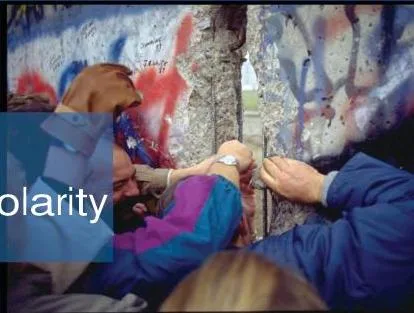
The chapter opens here because the wall was the Cold War’s greatest symbol. Its fall triggered the whole chain of events the chapter narrates: German unification, the replacement of communist governments in eight East European countries, and the eventual collapse of the second world (p. 1).
The leader-profile boxes: Lenin to Yeltsin
The chapter profiles six Soviet leaders in marginal boxes — a quick-revision strip for the whole Soviet era. Khrushchev’s portrait sits on page 4, inside the disintegration story.

Each box gives the leader’s years and a one-sentence legacy. Read together, they date the whole period: Lenin founded the system, Stalin consolidated it, Khrushchev denounced and reformed, Brezhnev brought détente and Afghanistan, Gorbachev ended the Cold War, and Yeltsin dissolved the USSR.
| Leader | Years | Role in the story | NCERT page |
|---|---|---|---|
| Vladimir Lenin | 1870-1924 | Founder of the Bolshevik Communist Party, leader of the 1917 Russian Revolution and founder-head of the USSR (1917-1924). | p. 2 |
| Joseph Stalin | 1879-1953 | Successor to Lenin; led consolidation (1924-53); rapid industrialisation and forcible collectivisation; credited with the Second World War victory; held responsible for the Great Terror of the 1930s. | p. 3 |
| Nikita Khrushchev | 1894-1971 | Leader 1953-64; denounced Stalin’s style, introduced reforms in 1956, proposed “peaceful coexistence”, suppressed rebellion in Hungary and faced the Cuban missile crisis. | p. 4 |
| Leonid Brezhnev | 1964-82 | Proposed Asian Collective Security; associated with détente with the US; suppressed rebellion in Czechoslovakia and invaded Afghanistan. | p. 5 |
| Mikhail Gorbachev | born 1931 | Last leader 1985-91; introduced perestroika and glasnost, stopped the arms race, withdrew troops from Afghanistan and eastern Europe, helped unify Germany; blamed for the disintegration. | p. 6 |
| Boris Yeltsin | 1991-1999 | First elected President of Russia; left the Communist Party, led the protests against the regime in 1991, played a key role in dissolving the USSR; blamed for the hardships of transition. | p. 7 |
The map of the CIS
Page 8 carries the map of Central, Eastern Europe and the Commonwealth of Independent States. The chapter’s map task is to locate the Central Asian republics.
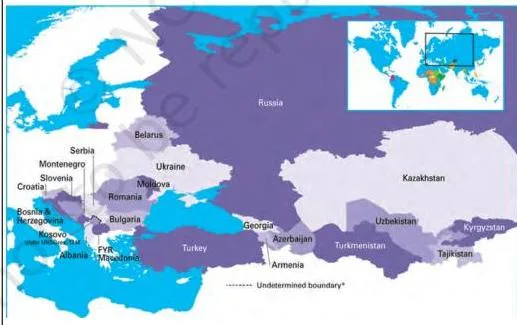
The five Central Asian republics — Kazakhstan, Kyrgyzstan, Tajikistan, Turkmenistan and Uzbekistan — sit between Russia, China, Afghanistan and Pakistan. That geography makes the region a competition zone: the US sought bases there after 11 September 2001, Russia calls it its “Near Abroad”, and China wants the oil (p. 10-11).
The cost of shock therapy: two images
The shock-therapy section carries two images that make the statistics human.

The first, captioned “The old system of social welfare was systematically destroyed” (p. 9), shows what the withdrawal of government subsidies meant: large sections of the people fell into poverty and the middle classes were pushed to the periphery of society.
The second is the photograph of Inkombank (p. 10). Shock therapy bankrupted about half of Russia’s 1,500 banks and financial institutions; Inkombank, Russia’s second largest bank, failed in 1998, and the money of 10,000 corporate and private shareholders was lost along with customers’ deposits. Quote this in Question 9 as concrete evidence of the therapy’s costs.
Key terms and definitions
The vocabulary below is what the exercises expect you to recognise. Each term is defined in plain words with the NCERT page where it appears.
| Term | Definition | NCERT page |
|---|---|---|
| Second world / socialist bloc | The group of East European countries whose political and economic systems were modelled on the USSR and which was held together by the Warsaw Pact. | p. 2 |
| Warsaw Pact | The military alliance that bound the socialist bloc together; the USSR was its leader. | p. 2 |
| Planned economy | An economy whose production, prices and distribution are planned and controlled by the state. | p. 2 |
| Perestroika and glasnost | Gorbachev’s reform policies of restructuring the economy (perestroika) and opening up the political system (glasnost). | p. 6 |
| Commonwealth of Independent States (CIS) | The organisation created in December 1991 by Russia, Belarus and Ukraine after the USSR was disbanded; the other republics, including all five Central Asian ones, joined it as founding members. | p. 6-7 |
| Shock therapy | The model of transition from authoritarian socialism to democratic capitalism, influenced by the World Bank and the IMF, applied across Russia, Central Asia and eastern Europe. | p. 8 |
| Multipolar world order | A world with several coexisting powers — reached through collective security, greater regionalism, negotiated settlements, independent foreign policies and a strengthened UN. | p. 11 |
| Collective security | The principle that an attack on any one country is a threat to all countries and requires a collective response. | p. 11 |
| Secessionism | The demand of a region or group to break away from the state it belongs to. | p. 10 |
Common mistakes students make in this chapter
Most marks are lost on five misreadings rather than on missing facts. Each row pairs the mistake with the page where the chapter says otherwise.
| Mistake | What the chapter actually says | How to check your answer |
|---|---|---|
| “The Central Asian republics broke up the USSR.” | They did not ask for independence and wanted to remain in the Soviet Federation; the December 1991 declaration surprised them (p. 3-4). Nationalist feeling was strongest in the European, prosperous republics — Russia, the Baltics, Ukraine and Georgia (p. 5-6). | When you list the causes of disintegration, name the European republics as the seat of nationalism — never Central Asia. |
| “The Berlin Wall fell and the USSR ended in the same year.” | The wall was broken on 9 November 1989; the USSR was disbanded in December 1991 by the declaration of Russia, Ukraine and Belarus (p. 6-7). | Quiz yourself with the timeline table; Exercise 2 tests the exact chronological order. |
| “The August 1991 coup ended the Soviet Union.” | The coup was an attempt by Communist Party hardliners to stop Gorbachev. It failed, Yeltsin became its hero, and the dissolution came through the December declaration (p. 3-4). | Say it back: failed coup in August, dissolution in December — two separate events. |
| “Shock therapy was just Russia’s painful transition.” | It was a deliberate model influenced by the World Bank and the IMF, applied across Russia, Central Asia and eastern Europe — identical in direction, varied only in intensity and speed (p. 8). | In your answer to Question 9, name the region-wide application, not only Russia. |
| “The end of the USSR proved socialism was finished.” | The chapter’s own marginal question challenges this, and the transition “ruled out” a third way rather than disproving it (p. 8). | Treat the page 8 question as an open debate in your answer, not a settled fact. |
One refinement for essays: the chapter notes the difference between nationalism and secessionism — “if you succeed, you are celebrated as a nationalist hero, and if you fail you are condemned for crimes of secessionism” (p. 10). Use that contrast when discussing Chechnya or Nagorno-Karabakh.
Exam notes: what the exercises actually test
These notes map each end-of-chapter exercise to the section that answers it, so revision time goes to the right place. They promise nothing about which questions will appear in an exam — textbook contents and the examinable syllabus are not always identical, so check the current official Class 12 Political Science syllabus on cbse.gov.in.
| Exercise | What it tests | Where the answer is built |
|---|---|---|
| Q1 — wrong statement about the Soviet economy | The defining features of the planned economy. The wrong option is (c): people enjoyed economic freedom. | The Soviet system section |
| Q2 — chronological order | The dated sequence: Russian Revolution (1917) → Soviet invasion of Afghanistan (1979) → fall of the Berlin Wall (1989) → disintegration of the USSR (1991). | The timeline table |
| Q3 — NOT an outcome of disintegration | The three consequences. The odd one out is (d): crises in the Middle East. | The consequences section |
| Q4 — matching | Leaders and key terms: Gorbachev–introduced reforms; Shock Therapy–economic model; Russia–successor of USSR; Yeltsin–President of Russia; Warsaw–military pact. | The leader boxes and key terms table |
| Q5 — fill in the blanks | Key terms: socialist; Warsaw Pact; Communist Party; Gorbachev; Berlin Wall. | The key terms section |
| Q6 — three features of the Soviet economy | How a planned, state-owned economy differs from a capitalist one: state planning, state ownership, subsidised welfare, controlled consumption. | The Soviet system section |
| Q7 — factors behind Gorbachev’s reforms | The causes of the crisis: economic stagnation, the arms and satellite burden, political stagnation, and the need to catch up with the West. | The Gorbachev and causes section |
| Q8 — consequences for India | The India section: good ties with all post-communist countries, strongest with Russia, and the 2001 strategic agreement. | The India section |
| Q9 — shock therapy: what was it and was it the best way? | A definition plus a balanced judgement, not a one-line opinion. A complete answer states what shock therapy was, names its intended “therapy” — a market economy with democracy — and then weighs the chapter’s recorded results against that promise (p. 9), ending with your own conclusion. | The shock-therapy section |
| Q10 — essay: the US or Russia? | Both sides of the argument, using the Flashback and the multipolar vision as evidence. See the framework below. | The India section |
Essay framework for Question 10. The proposition: with the second world gone, India should prefer US friendship over traditional Russia ties. A full answer argues both sides before concluding.
(1) For the proposition: the US is the sole superpower, capitalism is the dominant economic system, and liberal democracy is the favoured political model (p. 7) — aligning with the US aligns India with the emerging order.
(2) Against it: the Flashback shows the USSR stood by India on Kashmir and in the 1971 war, supplied most of India’s military hardware, and helped build its public sector (p. 12); the 2001 strategic agreement and the shared multipolar vision show the relationship deepening, not ending (p. 11).
(3) Conclude with the chapter’s own direction: it presents the Russia relationship as continuing and pragmatically valuable, while multipolarity leaves room for all powers, including the US.
The chapter’s built-in activities — the map task, LET’S DO IT and the STEPS project — are often used for internal assessment, so they are worth preparing even though they are not questions from the exercise block. For a quicker pre-exam read, the Class 12 Political Science notes hub collects the chapter summaries together.
What to remember: the chapter in brief
The whole chapter in four movements:
| Movement | What happened | Where it ended |
|---|---|---|
| The Soviet system | One-party rule, a state-planned economy, a second world bound by the Warsaw Pact; real strengths — great-power status and welfare guarantees — and fatal weaknesses: authoritarian rule, neglect of the republics, a costly arms race. | A superpower whose economy stagnated by the late 1970s. |
| Why it fell | Economic and political stagnation; the military and satellite burden; Gorbachev’s reforms that nobody could control; nationalism in the European, prosperous republics. | Russia, Ukraine and Belarus declared the USSR disbanded in December 1991; the CIS replaced it. |
| What replaced it | Shock therapy’s ruinous transition; weak parliaments and strong presidents; secessionist wars and outside intervention. | Revival from 2000 on oil, gas and minerals; new states now inside the global economy. |
| India’s place | Flashback-era trust — Kashmir, the 1971 war, military hardware, economic aid; the 2001 strategic agreement; a shared multipolar vision. | India-Russia ties continuing and deepening, with India gaining energy, security and technology cooperation. |
If you remember nothing else: the USSR was a one-party planned state that stagnated, reformed, and was ended by nationalism in its European republics; shock therapy made the transition painful; and India kept Russia as its most trusted partner.
Related resources
This listing is maintained for the 2026-27 academic session using the NCERT textbook information available to us. NCERT remains the authority for confirming the latest edition.
Continue revising with the Contemporary World Politics material on this site:
- Class 12 Political Science notes — chapter-wise notes for Contemporary World Politics.
- Class 12 notes hub — the Class 12 resources on this site in one place.
- CBSE notes index — the starting point for every class and subject.
- Contemporary Centres of Power Class 12 notes — the chapter that follows The End of Bipolarity.
Sources and data verification
- Textbook described: the figures on this page describe the NCERT Class 12 Political Science textbook Contemporary World Politics, official edition published on ncert.nic.in.
- Coverage: this page covers Chapter 1 only — not the whole book, and not the other Class 12 Political Science book, Politics in India Since Independence.
- Maintenance: maintained for the current session using the NCERT information available to us.
- Authority: NCERT settles textbooks, editions and official PDFs; CBSE settles curriculum, syllabus and examinations.
Download the official chapter again from the NCERT textbook page for Contemporary World Politics whenever you want to verify anything on this page.
Frequently asked questions about the end of bipolarity
Why did the Soviet Union disintegrate in 1991?
The short answer is a chain: long-run internal weakness, then reforms that unleashed forces nobody could control, then nationalism in the European republics. The chapter gives four causes — economic stagnation, political stagnation, Gorbachev’s reforms, and nationalism as the final and most immediate cause (NCERT, p. 4-6).
The formal end came on 25 December 1991, when Gorbachev resigned after Russia, Ukraine and Belarus had declared the USSR disbanded.
What was shock therapy and why is it criticised?
Shock therapy was the World Bank- and IMF-influenced model of transition from state socialism to capitalism used across Russia, Central Asia and eastern Europe (p. 8). It demanded privatisation, free trade and the dismantling of collective farms, with no third way allowed.
It is criticised because it brought ruin and hardship rather than the promised utopia: industries were sold off cheaply, savings were destroyed by inflation, the welfare system collapsed, and a mafia took over economic activity (p. 9).
Which countries formed the Commonwealth of Independent States and what happened to the USSR’s UN seat?
Russia, Belarus and Ukraine created the Commonwealth of Independent States in December 1991. Armenia, Azerbaijan, Moldova, Kazakhstan, Kyrgyzstan, Tajikistan, Turkmenistan and Uzbekistan joined immediately, with Georgia joining in 1993 (p. 6). Russia was accepted as the successor state and inherited the Soviet Union’s seat in the UN Security Council (p. 4).
Did the Central Asian republics want independence from the Soviet Union?
No. The chapter says the Central Asian republics did not ask for independence and wanted to remain in the Soviet Federation (p. 3). The December 1991 declaration surprised them, and the issue of their exclusion was solved quickly by making them founding members of the CIS (p. 4).
What were the consequences of the Soviet disintegration for India?
India kept good relations with all post-communist countries, and its strongest ties remained with Russia (p. 11). The relationship deepened through the Indo-Russian Strategic Agreement of 2001 and a shared vision of a multipolar world order; India gains on Kashmir, energy and terrorism information, while Russia gains its second largest arms market (p. 11).
What is the difference between the fall of the Berlin Wall and the disintegration of the USSR?
The Berlin Wall fell on 9 November 1989 — the symbol of Cold War division was broken by the people, and Germany was unified (p. 1). The USSR itself was disbanded in December 1991, when Russia, Ukraine and Belarus annulled the 1922 treaty and Gorbachev resigned on 25 December (p. 6). The two events are often merged in student answers; the timeline table above keeps them separate.
Reference: NCERT Class 12 Political Science textbook, chapter 1, official edition on ncert.nic.in.
Explore Class 12 Political Science Books
Related chapters:
- Challenges of Nation Building
- Era of One-Party Dominance
- Contemporary South Asia