
Environment and Natural Resources Class 12 is Chapter 6 of the NCERT Political Science textbook Contemporary World Politics, printed across 18 pages (NCERT pages 80–98). The official chapter PDF is on this page, followed by a section-by-section walkthrough of the chapter, its figures and its exercises, so you can use the book faster.
Download the Environment and Natural Resources Class 12 PDF
This listing is maintained for the 2026-27 academic session using the NCERT textbook information available to us. NCERT remains the authority for confirming the latest edition.
Open the official Environment and Natural Resources Class 12 chapter PDF when you want to read the chapter exactly as NCERT printed it, with its cartoons, tables and classroom activities, in a clean free file from NCERT’s own website.
You can also open the official index page for Contemporary World Politics on NCERT’s website, which lists every chapter of the book so you can verify the edition and find the rest of the volume.
| What the chapter holds | Count | Where it is used |
|---|---|---|
| Printed pages | 18 | |
| Figures with NCERT captions | 11 | |
| Exercise questions | 9 | answered in our NCERT Solutions |
| Official NCERT PDF | Download the chapter PDF | the chapter exactly as NCERT publishes it |
Chapter 6 at a Glance
The table below lists what the chapter holds — its printed pages, sections, figures and exercise questions — so you can see the size of the file at a glance.
| What the chapter holds | Count |
|---|---|
| Printed pages | 18 (NCERT pages 80–98) |
| Content sections, boxes and activities | 17 |
| Figures | 11 |
| Exercise questions | 9 |
What This Chapter Covers, Section by Section
This table maps every named section of the chapter to the NCERT page where it begins, with what each part teaches in one line. Use it to jump straight to the part a question is asking about.
| Section (NCERT heading) | NCERT page | What it teaches |
|---|---|---|
| Overview | 80–82 | What the chapter will argue: environment and resource issues now shape world politics, with the 1992 Earth Summit as the turning point. |
| Environmental Concerns in Global Politics | 82–84 | The evidence of degradation, why these are political questions, and the rise of environmentalism from the 1960s to Rio. |
| The Protection of Global Commons | 84–86 | Shared spaces outside any state — the atmosphere, Antarctica, the ocean floor, outer space — and why cooperation is hard. |
| Antarctica (box) | 85–86 | The continent’s scale and ecology, rival ownership claims, and the 1959 limits on activity there. |
| Common but Differentiated Responsibilities | 87–88 | The North–South disagreement and the Rio principle that those who caused more damage must do more to fix it. |
| Common Property Resources | 88 | Community-owned resources where members hold both rights and duties; why these are shrinking. |
| India’s Stand on Environmental Issues | 88–90 | Historical responsibility, India’s emissions figures, Kyoto ratification, domestic programmes, Paris 2016. |
| Sacred Groves in India | 88–89 | Forest parcels protected for religious reasons and traditionally managed by village communities. |
| Environmental Movements: One or Many? | 90–92 | Forest, minerals and mega-dam struggles; India’s movements share the idea of non-violence. |
| Are Forests ‘Wilderness’? | 91–93 | The Northern idea of nature without people versus Southern forests where people live. |
| Resource Geopolitics | 93–95 | Who gets what: oil’s strategic grip and the possibility of ‘water wars’. |
| Everyone is Playing Crude! | 94–95 | A satirical feature on oil: royal producer, corporate buyer, consumer and armed groups. |
| The Indigenous Peoples and their Rights | 96–98 | UN definition, the scale of indigenous populations, land loss, India’s Scheduled Tribes. |
| Spoonful of Ecology | 96–97 | A short cartoon feature on urban greed for nature. |
| STEPS | 97–98 | A classroom activity: calculate the natural resources behind ten everyday items. |
| Ideas for the Teacher | 97–98 | Extending that calculation from one class to a school, a country and the world. |
| Exercises | 98 | The nine end-of-chapter questions. |
Key Concepts Explained
Here is the chapter’s core argument in one place: environment and resource questions are political because they decide who causes damage, who pays for it, who corrects it, and who gets to use the Earth’s resources — and no single government can fix the problem on its own (NCERT, p. 83).
Each subsection below explains one big idea, with the NCERT page to follow along in your book.
Why the environment became a global political issue
Before the 1960s, environmental decay was treated mostly as a scientific or local problem. This section explains what changed, and why governments were forced to treat the environment as a political subject (NCERT, p. 83).
The chapter opens with evidence that degradation is everywhere (NCERT, p. 82): cultivable land is barely expanding and much of it is losing fertility; grasslands are overgrazed and fisheries over-harvested; water bodies are depleted and polluted.
Two figures from the Human Development Report 2016 carry the human cost: 663 million people in developing countries have no access to safe water, and 2.4 billion have no sanitation — contributing to the deaths of more than three million children every year (NCERT, p. 82).
Natural forests are being cut, biodiversity is falling, ozone in the stratosphere is declining, and coastal pollution is rising. None of these stops at a border, so no single state can solve them (NCERT, p. 82–83).
The book then names the four questions that make the subject political: who causes the degradation, who pays the price, who is responsible for correcting it, and who gets to use how much of the Earth’s resources (NCERT, p. 83).
Three milestones shaped the politics (NCERT, p. 83–84): the Club of Rome’s Limits to Growth (1972), the conferences of the UN Environment Programme, and the Brundtland Report, Our Common Future (1987), which warned that existing growth patterns were not sustainable.
The turning point was the 1992 Earth Summit in Rio de Janeiro — formally the UN Conference on Environment and Development — attended by 170 states, thousands of NGOs and many multinational corporations.
The North and the South arrived with different agendas: the rich countries of the global North pushed ozone depletion and global warming, while the poor countries of the global South pushed the relationship between economic development and environmental management (NCERT, p. 84).
Rio produced conventions on climate change, biodiversity and forestry, plus a list of recommended practices called Agenda 21. The shared slogan was sustainable development — growth combined with ecological responsibility — though critics said Agenda 21 was biased towards growth (NCERT, p. 84). The book also asks you to collect news clippings linking environment and politics in your own locality (NCERT, p. 83).
The environmental agreements timeline that runs through this chapter spans 1972 to 2016. Each row in the table below is one step the book describes, with what it did.
| Year | Agreement or event | What it did |
|---|---|---|
| 1972 | Club of Rome publishes Limits to Growth | Dramatised the risk of resource depletion against a rapidly growing world population (NCERT, p. 83). |
| 1987 | Brundtland Report, Our Common Future | Warned that traditional patterns of economic growth were not sustainable (NCERT, p. 84). |
| 1987 | Montreal Protocol | A path-breaking agreement protecting the global commons (NCERT, p. 85). |
| 1992 | Rio Earth Summit | Attended by 170 states, thousands of NGOs and many MNCs; produced conventions on climate, biodiversity and forestry, plus Agenda 21 (NCERT, p. 84). |
| 1992 | UNFCCC | Committed parties to act on equity and in accordance with their common but differentiated responsibilities (NCERT, p. 87). |
| 1997 | Kyoto Protocol | Set emission-cutting targets for industrialised countries only; exempted China and India (NCERT, p. 88). |
| 2002 | India ratifies the Kyoto Protocol | India signed and ratified it in August 2002 (NCERT, p. 88). |
| 2016 | India ratifies the Paris Climate Agreement | Ratified on 2 October 2016 (NCERT, p. 90). |
Global commons: atmosphere, Antarctica, ocean floor and outer space
Some resources belong to no one and everyone at once. The book calls these the global commons, and shows why they are the hardest spaces of all to govern (NCERT, p. 84–85).
A common is any resource not owned by anyone but shared by a community — a park, a community centre, a river. When such a space lies outside the sovereign jurisdiction of every state, it becomes part of the global commons, the res communis humanitatis. The chapter lists four: the Earth’s atmosphere, Antarctica, the ocean floor and outer space (NCERT, p. 84–85).
Governance has come through hard-won agreements: the 1959 Antarctic Treaty, the 1987 Montreal Protocol and the 1991 Antarctic Environmental Protocol. Cooperation is slow because the science is vague and nations work on different time frames; the discovery of the ozone hole over Antarctica in the mid-1980s showed both the danger and the opportunity (NCERT, p. 85).
Outer space shows the same North–South inequality as the atmosphere and the ocean floor: the crucial issue is technology and industrial development, and the benefits of exploitation are far from equal (NCERT, p. 86).
The Antarctica box gives the scale that makes the continent matter (NCERT, p. 85–86): 14 million square kilometres, 26 per cent of the world’s wilderness area, 90 per cent of all terrestrial ice and 70 per cent of planetary fresh water, plus 36 million square kilometres of ocean.
Krill sit at the centre of its marine food chain, and deep ice cores record greenhouse gas concentrations from hundreds of thousands of years ago.
Seven states — the UK, Argentina, Chile, Norway, France, Australia and New Zealand — claim sovereign rights, while most others call Antarctica part of the global commons. Since 1959, activity has been limited to scientific research, fishing and tourism, yet even that has left parts of the region degraded by waste from oil spills (NCERT, p. 85–86).
Common but differentiated responsibilities
This is the chapter’s central negotiating principle, and the one definition you must be able to write in your own words. It settles who should do more about climate change, and why (NCERT, p. 87).
The disagreement is simple. The North wants to discuss the environment as it stands now, with everyone equally responsible. The South answers that most degradation is the product of the developed countries’ industrialisation: more damage caused means more responsibility to undo it, and countries still industrialising must not face the same restrictions (NCERT, p. 87).
Rio accepted the Southern argument. The Rio Declaration (1992) states that, in view of the different contributions to global environmental degradation, states have common but differentiated responsibilities, and the developed countries acknowledge the responsibility they bear (NCERT, p. 87).
The UNFCCC, also from 1992, uses the same language: parties should protect the climate system on the basis of equity and in accordance with their common but differentiated responsibilities and respective capabilities (NCERT, p. 87).
That logic built the Kyoto Protocol (1997). It set emission-cutting targets for industrialised countries only, and exempted China and India. The gases the book names — carbon dioxide, methane and hydrofluorocarbons — are held at least partly responsible for global warming (NCERT, p. 87–88).
Common property resources and sacred groves
Students often merge this idea with the global commons. The difference is who shares the resource: a global common belongs to everyone; a common property resource belongs to one defined community that manages it together (NCERT, p. 88).
Common property is shared by a specific group whose members have both rights and duties over the nature of the resource, the level of its use and its maintenance. Centuries of practice let many Indian village communities define those rights and duties precisely (NCERT, p. 88).
Four forces shrink common property: privatisation, agricultural intensification, population growth and ecosystem degradation (NCERT, p. 88).
Sacred groves are the chapter’s working example: parcels of uncut forest kept in the name of certain deities or natural and ancestral spirits. Along South India’s forest belt they are traditionally managed by village communities; they range from clumps of a few trees to several hundred acres and can preserve biodiversity, ecological functions and cultural diversity (NCERT, p. 88–89).
The modern problem: legal ownership and operational control sit with different entities — the state owns the forest land, the community runs the grove — and the two have different policy norms and motives (NCERT, p. 89).
India’s stand on environmental issues
India’s position looks contradictory: it signed the Kyoto Protocol yet rejects binding emission cuts. The chapter shows both moves come from the same principle (NCERT, p. 88–90).
India signed and ratified the Kyoto Protocol in August 2002, and was exempt from its targets because its emissions during the industrialisation period were not significant. At the G-8 meeting in June 2005, India added that the per-capita emission rates of developing countries are a tiny fraction of those of the developed world (NCERT, p. 88–89).
India’s whole position rests on historical responsibility as enshrined in UNFCCC: developed countries caused most historical and current emissions, so the major responsibility for cuts rests with them, and “economic and social development are the first and overriding priorities of the developing country parties” (NCERT, p. 89).
The numbers to quote in an answer: India’s emissions were 0.9 tonnes per capita in 2000 and are predicted to rise to 1.6 tonnes per capita in 2030 — still less than half the world average of 3.8 tonnes in 2000 (NCERT, p. 90).
That is why India is wary of binding commitments on rapidly industrialising countries such as Brazil, China and India.
Yet India also runs real domestic programmes: the National Auto-fuel Policy, the Energy Conservation Act 2001, the Electricity Act 2003, a planned National Mission on Biodiesel, one of the largest renewable energy programmes in the world, and ratification of the Paris Climate Agreement on 2 October 2016 (NCERT, p. 88–90).
India also asks developed countries to transfer financial resources and clean technology on concessional terms, and wants the SAARC countries to adopt a common position on major global environmental issues (NCERT, p. 90).
Environmental movements: one or many?
Governments are not the only actors in this chapter. The book asks whether environmental movements form one movement — and its answer is that they are many (NCERT, p. 90–91).
The examples are deliberately diverse (NCERT, p. 90–92): forest movements in Mexico, Chile, Brazil, Malaysia, Indonesia, continental Africa and India; the minerals industry, with the Philippines campaign against the Australia-based Western Mining Corporation; and anti-mega-dam movements, from the Franklin River campaign in Australia in the early 1980s (the first in the North) to India’s Narmada Bachao Andolan.
Two points tie them together: environmental movements are among the most vibrant and diverse social movements in the world today, and in Indian environmental movements the most important shared idea is non-violence (NCERT, p. 90–92). The book also asks you to find out about the Chipko Movement on your own.
Are forests ‘wilderness’?
The word ‘wilderness’ sounds neutral, but the chapter shows it carries a political argument: nature seen as a place without people. That assumption divides the North from the South (NCERT, p. 91–92).
Northern forest movements treat forests as a ‘wild place’ where people do not live; the environment is ‘somewhere out there’, to be protected from humans through parks and reserves. Southern environmental issues start from the opposite assumption — people live in the forests (NCERT, p. 91).
Wilderness thinking dominates in Australia, Scandinavia, North America and New Zealand, but wilderness campaigns are not absent in the South: the Philippines protects eagles, India the Bengal tiger, Africa battles the ivory trade, and Brazil and Indonesia fight for their forests.
Many such campaigns have been renamed biodiversity issues, because ‘wilderness’ has proved difficult to sell in the South, and NGOs such as WWF often initiate and fund them in association with local people (NCERT, p. 91–92).
Resource geopolitics: oil and water
The chapter now turns from protecting the environment to fighting over its resources. Resource geopolitics is all about who gets what, when, where and how (NCERT, p. 93).
Oil has been the most important resource in global strategy. West Asia — specifically the Gulf region — produces about 30 per cent of global oil but holds about 64 per cent of the planet’s known reserves, making it the only region able to satisfy any substantial rise in oil demand.
Saudi Arabia holds a quarter of the world’s total reserves and is the single largest producer; Iraq’s reserves are second only to Saudi Arabia’s and may be larger, since parts of Iraq are yet to be fully explored. The consumers — the US, Europe, Japan and increasingly India and China — sit at a considerable distance from the region (NCERT, p. 93–94).
During the Cold War the North secured supply by deploying military forces near exploitation sites and along sea lanes, stockpiling strategic resources, propping up friendly governments and supporting multinational companies (NCERT, p. 93).
Water is the second flashpoint. Commentators use the phrase ‘water wars’ for possible conflicts over this life-sustaining resource. The classic pattern is a downstream (lower riparian) state objecting to pollution, excessive irrigation or dams built by an upstream (upper riparian) state.
The book’s examples: Israel, Syria and Jordan in the 1950s and 1960s over the Jordan and Yarmuk rivers, and threats between Turkey, Syria and Iraq over dams on the Euphrates. Studies show countries that share rivers are more often involved in military conflicts with each other (NCERT, p. 94–95).
Indigenous peoples and their rights
The chapter closes where environment, resources and politics meet people: the claims of indigenous communities to land, identity and equal standing (NCERT, p. 96).
The UN definition: indigenous peoples are the descendants of the peoples who inhabited a territory before others arrived there from other parts of the world and overcame them, and who live more by their own customs than by the institutions of the country they now form part of (NCERT, p. 96).
The scale is global — about 30 crore indigenous people worldwide. The book’s examples: 20 lakh in the Cordillera region of the Philippines, 10 lakh Mapuche in Chile, six lakh in the Chittagong Hill Tracts of Bangladesh, 35 lakh North American natives, 50,000 Kuna east of the Panama Canal, and 10 lakh Small Peoples of the Soviet North (NCERT, p. 96).
Their key demand is admission to the world community as equals. ‘Since times immemorial’ is their phrase for continued occupancy of their lands, and the loss of land means the loss of an economic resource base — the most obvious threat to their survival (NCERT, p. 96).
In India, ‘indigenous people’ usually means the Scheduled Tribes, about 8 per cent of the population. They enjoy constitutional protection in political representation but few benefits of development, and are the single largest group displaced by development projects since independence (NCERT, p. 96–97).
The World Council of Indigenous Peoples was formed in 1975, and became the first of 11 indigenous NGOs to receive consultative status in the UN. The chapter notes that many movements against globalisation — discussed in Chapter 7 — have focused on the rights of indigenous people (NCERT, p. 97).
Figure Walkthrough: What the Chapter’s Illustrations Show
This chapter is unusually visual: its cartoons carry arguments, not decoration. Each figure below is the illustration in your own copy of the book, with NCERT’s caption, followed by what the book wants you to see in it.
The opening images: rainforest and mangroves
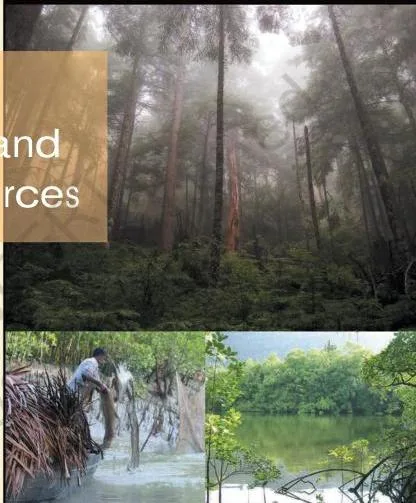
The book pairs these two ecosystems with the 1992 Earth Summit to make its first point (NCERT, p. 81): the environment is centre-stage in global politics, not scenery. Both rainforests and mangroves are exactly the kind of ecosystems under pressure that this chapter is about.
The global warming cartoon: chimneys for fingers, a world as lighter
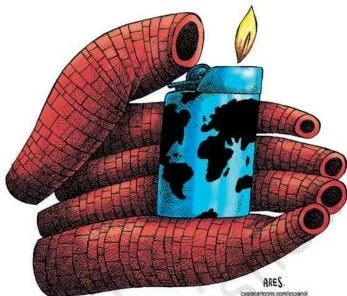
The book asks the question itself: “Why do you think the fingers are designed like chimneys and the world made into a lighter?” The answer the chapter builds is that industrial economies (chimney fingers) treat the whole planet as something to be burned up (NCERT, p. 83). The cartoon introduces the North’s concern with ozone depletion and global warming.
Antarctica: the continent that belongs to everyone
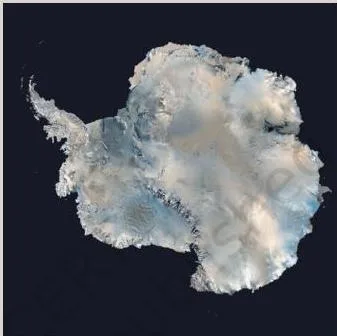
This figure is the evidence for why Antarctica matters as a global common: its sheer scale, its ice cores as a climate record and its krill-based marine food chain (NCERT, p. 85–86). It appears beside the rival claims over who owns the coldest, farthest and windiest continent.
‘Cooperation over the global commons is not easy’

Here the caption is the lesson. It sits exactly where the book explains that consensus on common environmental agendas is hard to reach because scientific evidence is vague and nations work on different time frames (NCERT, p. 85). The 1959, 1987 and 1991 agreements show cooperation is possible, but slow.
The UNFCCC: equity and shared responsibility

The caption quotes the Convention itself. This one sentence is the bridge between the North–South argument and the Kyoto Protocol’s exemption of developing countries (NCERT, p. 87–88).
India’s negotiating position

The figure gives the chapter’s label for India’s argument: historical responsibility as enshrined in UNFCCC (NCERT, p. 89). The chapter’s own commentary beside it — “First they destroyed the earth, now it is our turn to do the same! Is that our stand?” (NCERT, p. 90) — is the test question: can you explain why India’s position is not anti-environment?
Pair the figure with the numbers: India’s emissions were 0.9 tonnes per capita in 2000 and are predicted to reach 1.6 tonnes by 2030, against a world average of 3.8 tonnes in 2000 (NCERT, p. 90).
The wilderness cartoon: who lives in the forest?
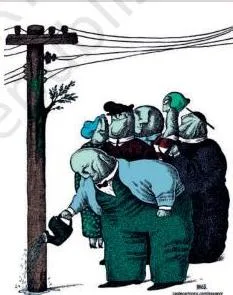
Alongside this cartoon the book asks: “Do you agree with the efforts made by ecologists? Do you agree with the way ecologists are portrayed here?” (NCERT, p. 91). The underlying contrast is the chapter’s: the North pictures nature as wild and empty, to be protected from humans, while the South starts from the fact that people live in forests (NCERT, p. 91–92).
The oil cartoon: the 20th-century economy that ran on petroleum
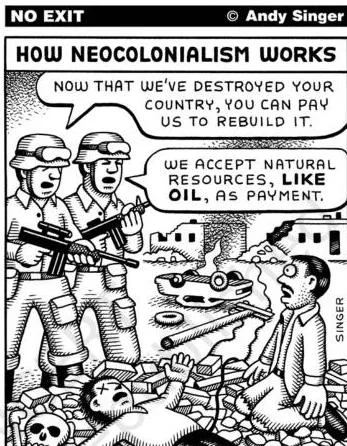
The figure marks the chapter’s pivot from environmental politics to resource struggle (NCERT, p. 93). Underneath it sit the key statistics: West Asia’s 30 per cent of production and 64 per cent of known reserves, Saudi Arabia’s quarter share, and consumers half a world away.
Sheikh Petrodollah: the ‘King of the land of Black Gold’

The satirical feature ‘Everyone is Playing Crude!’ gives the king his own words: “I belong to the Royal Family of the Kingdom of Black Gold… They armed me to the teeth till it hurt… Bigoil and sons get to buy all my oil and loyalty” (NCERT, p. 94).
The satire shows how oil wealth and Western corporate and military interests prop up autocratic rule — both sides gain while ordinary subjects pay.
Mr and Mrs Gobbledoo: the consumer side of the oil story

The consumer panel speaks: “A new beauty is parked outside our garage… It is low on emissions too… gentle on the atmosphere, you know. Global warming and all that stuff” (NCERT, p. 94). The point: the consumer wants the car, the status and the clean conscience together. Demand, not just supply, drives oil geopolitics.
The indigenous peoples cartoon

The caption closes the chapter’s argument: environment, resources and politics meet in people, not just states (NCERT, p. 95). Beside it the book asks why we hear so little about indigenous movements, and whether the media is biased against them (NCERT, p. 96).
Key Terms and Definitions
These are the words you must be able to define in your own sentences. The table lists each term, what it means in plain words, and the NCERT page where the chapter explains it.
| Term | What it means | NCERT page |
|---|---|---|
| Global commons (res communis humanitatis) | The Earth’s atmosphere, Antarctica, the ocean floor and outer space — areas outside any single state’s jurisdiction, requiring common governance by the international community. | 84–85 |
| Common property resources | Resources shared by a specific community whose members hold both rights and duties over use and maintenance. | 88 |
| Common but differentiated responsibilities | The Rio principle that all states share responsibility for the Earth’s ecosystem, but developed countries bear more because they caused more of the degradation. | 87 |
| Sustainable development | Development that combines economic growth with ecological responsibility. | 84 |
| Earth Summit / Rio Summit | The 1992 UN Conference on Environment and Development in Rio de Janeiro, attended by 170 states, thousands of NGOs and many multinational corporations. | 84 |
| Agenda 21 | The list of development practices recommended at Rio; critics say it was biased in favour of economic growth. | 84 |
| Brundtland Report (Our Common Future) | The 1987 report that warned traditional patterns of economic growth were not sustainable in the long term. | 83 |
| Kyoto Protocol | The 1997 agreement setting emission-cutting targets for industrialised countries only. | 88 |
| UNFCCC | The 1992 UN Framework Convention on Climate Change, whose equity principle underpins differentiated responsibilities. | 88 |
| Environmental refugees | People forced to flee their homelands when the environment can no longer support agriculture or life; the term spread after the 1970s drought in Africa. | 86 |
| Wilderness | The Northern idea of nature as a ‘wild place’ where people do not live. | 91–92 |
| Indigenous peoples | Descendants of peoples who inhabited a territory before others arrived and overcame them, who live more by their own customs and traditions. | 96 |
Common Mistakes Students Make in This Chapter
These are the seven confusions the chapter reliably produces, with the correction each time. Every correction below comes from the book itself.
| Mistake | Correct rule | How to check your answer |
|---|---|---|
| “Global commons and common property resources are the same thing.” | Global commons lie outside every state’s jurisdiction and belong to the international community (p. 84–85); common property belongs to one specific community whose members hold rights and duties (p. 88). | Ask: who owns it? If no one, it is a global common. If a defined community, it is common property. |
| “The Kyoto Protocol forced India and China to cut emissions.” | It set targets for industrialised countries only; India and China were exempt because their historical and per-capita emissions were low (p. 88). | Add the G-8 argument: developing countries’ per-capita emissions are a tiny fraction of the developed world’s (p. 89). |
| “Environmental politics began with the 1992 Earth Summit.” | Concerns have a long history, but awareness became political from the 1960s onwards; the Summit firmly consolidated it (p. 83–84). | List the earlier steps — 1972 Limits to Growth, 1987 Brundtland Report — before mentioning Rio. |
| “India is against environmental protection.” | India rejects binding commitments on historical-responsibility grounds but runs major domestic programmes and ratified Paris in 2016 (p. 88–90). | Name two domestic laws (Energy Conservation Act 2001, Electricity Act 2003) in any answer on India’s stand. |
| “Environmental movements form one single movement.” | The chapter asks ‘one or many?’ and answers many: forest, minerals and mega-dam movements in different settings (p. 90–91). | If your answer describes only forest-style struggles, you have missed the diversity point. |
| “Forests are uninhabited wilderness, so protecting them means removing people.” | Southern forests are peopled; the ‘wild place’ idea belongs mainly to the North (p. 91–92). | Check whose assumption you used: does your answer let people live in the forest? |
| “1972, 1987, 1992 and 1997 all mean the same thing.” | Each marks a different step: Limits to Growth (1972), Brundtland Report (1987), Rio Summit (1992), Kyoto Protocol (1997); India ratified Kyoto in 2002 and Paris in 2016. | Say what each agreement did, not just its year. |
How the Exercise Questions Map to This Chapter
The nine exercises at the end of the chapter (NCERT, p. 98) test specific sections. Use this map to send yourself straight back to the right page. And note: textbook contents and the examinable syllabus are not always identical — check the current official CBSE syllabus.
| Question | What it tests | NCERT page | Pointer |
|---|---|---|---|
| Q1 | The reason for growing environmental concern | 82 | Answer (c): degradation has become pervasive and dangerous — that is exactly the opening evidence on p. 82. |
| Q2 | Earth Summit facts — correct or wrong statements | 84 | Check each statement against p. 84: 170 states, thousands of NGOs, many MNCs; the formal UN name; firm political consolidation; the name ‘Earth Summit’. |
| Q3 | Global commons — which statements are true | 85 | Atmosphere, Antarctica, ocean floor and outer space; outside sovereign jurisdiction; management reflects the North–South divide. Option (d) is an opinion, not a stated fact. |
| Q4 | Outcomes of the Rio Summit | 84 | Conventions on climate change, biodiversity and forestry; Agenda 21; unresolved North–South differences. |
| Q5 | Global commons: meaning and pollution | 85–86 | Definition on p. 84–85; pollution through the atmosphere, oil-spill waste degrading Antarctica, and unequal benefits from exploiting the ocean floor and outer space. |
| Q6 | Common but differentiated responsibilities | 87–88 | Define the Rio principle, then show implementation: differentiated targets based on historical contribution, per-capita emissions, and transfer of money and technology. |
| Q7 | Why environmental protection became a priority since the 1990s | 82–84 | Pervasive degradation plus firm consolidation of environmental issues at the political level at Rio. |
| Q8 | Compromise and accommodation in North–South negotiations | 87–90 | Show both sides conceding: Kyoto’s differentiated targets, and India’s domestic action despite rejecting binding cuts. |
| Q9 | Development without environmental damage | 84, 89–90 | Sustainable development plus India’s own examples: cleaner auto fuel, energy efficiency, renewable electricity, Paris ratification. |
Quick Recap of the Chapter’s Key Points
One-glance revision table: each theme of the chapter, the point to remember, and the page to re-read if it does not stick.
| Theme | Key point in one line | NCERT page |
|---|---|---|
| The environment as politics | Environmental decisions decide who causes damage, who pays and who gets resources — and no single state can fix them. | 82–84 |
| Global commons | The atmosphere, Antarctica, the ocean floor and outer space lie outside any state; cooperation is slow but possible. | 84–86 |
| Common but differentiated responsibilities | Those who caused most degradation must do most to undo it. | 87–88 |
| Common property and sacred groves | Communities manage shared resources with rights and duties; sacred groves are a working example. | 88–89 |
| India’s stand | Historical responsibility, low per-capita emissions, real domestic programmes, Paris 2016. | 88–90 |
| Environmental movements — many, not one | Forest, minerals and mega-dam struggles, with non-violence shared across India’s movements. | 90–92 |
| Wilderness vs peopled forests | The North sees nature without people; the South assumes people live in forests. | 91–93 |
| Oil and water geopolitics | West Asia holds most reserves while consumers sit far away; shared rivers carry conflict risk. | 93–95 |
| Indigenous peoples | Land loss is loss of an economic base; India’s Scheduled Tribes are the largest group displaced by development. | 96–98 |
Related Chapters and Resources
This chapter sits in the middle of Contemporary World Politics. Chapter 5, which the book says expanded world politics to include poverty and epidemics, comes just before it (NCERT, p. 82) — both chapters are in the same textbook.
Continue to the next chapter: Globalisation (Chapter 7) — the book itself says many movements against globalisation have focused on indigenous rights (NCERT, p. 97).
For the rest of the book and the site: Class 12 Political Science notes, the Class 12 NCERT books hub, and the main NCERT books directory. In the companion textbook Politics in India Since Independence, another Class 12 chapter on this site is Challenges to and Restoration of the Congress System.
You reached this page through: NCERT Books → Class 12 → Political Science → Chapter 6: Environment and Natural Resources.
Sources and Data Verification
This page describes the NCERT Class 12 Political Science textbook Contemporary World Politics, Chapter 6, “Environment and Natural Resources”, official edition published on ncert.nic.in (printed pages 80–98). The figures and page references on this page follow that edition.
What this page covers: one chapter of one textbook. It does not cover the full CBSE scheme of studies, and it does not cover the companion book Politics in India Since Independence.
Maintained for: the current academic session, on the basis of the NCERT edition available on ncert.nic.in.
Who settles what: NCERT settles textbooks, editions and PDFs; CBSE settles curriculum, syllabus and examinations. A chapter appearing in an NCERT textbook is not proof that every part of it is examinable this session.
Reference: NCERT Class 12 Political Science textbook, chapter 6, official edition on ncert.nic.in.
Frequently Asked Questions
What is the difference between global commons and common property resources?
The two differ in who shares the resource. Global commons — the Earth’s atmosphere, Antarctica, the ocean floor and outer space — lie outside the sovereign jurisdiction of every state and are shared by the whole international community (NCERT, p. 84–85).
Common property resources are shared by one specific community, whose members hold both rights and duties over how much the resource is used and how it is maintained (NCERT, p. 88).
What does ‘common but differentiated responsibilities’ mean?
It means every state shares responsibility for protecting the Earth’s ecosystem, but not equally: those whose past and present actions caused more degradation must do more to fix it.
The principle was written into the Rio Declaration (1992) and repeated in the UNFCCC’s formula of acting “on the basis of equity and in accordance with their common but differentiated responsibilities and respective capabilities” (NCERT, p. 87). It is why the Kyoto Protocol set targets for industrialised countries only.
Why were India and China exempt from the Kyoto Protocol?
Because their contribution to greenhouse gas emissions during the industrialisation period was not significant. The parties to the UNFCCC agreed that the largest share of historical and current emissions originated in developed countries, and that per-capita emissions in developing countries were still low — so China and India were exempt from Kyoto’s targets (NCERT, p. 87–88).
What is India’s stand on environmental issues at international negotiations?
India’s stand rests on historical responsibility as enshrined in UNFCCC: developed countries caused most past and current emissions, so the major responsibility for cuts rests with them (NCERT, p. 89).
India ratified Kyoto in August 2002, rejects binding commitments on rapidly industrialising countries, and points to its low per-capita emissions — 0.9 tonnes in 2000 rising to a predicted 1.6 tonnes in 2030, against a world average of 3.8 tonnes in 2000. It also runs domestic programmes and ratified the Paris Climate Agreement on 2 October 2016 (NCERT, p. 88–90).
What does the chapter say about ‘water wars’?
‘Water wars’ is the phrase commentators use for the possibility of violent conflict over shared water in the 21st century. The typical pattern is a downstream (lower riparian) state objecting to pollution, excessive irrigation or dams built by an upstream (upper riparian) state.
The book cites Israel, Syria and Jordan over the Jordan and Yarmuk rivers, and Turkey, Syria and Iraq over dams on the Euphrates, and notes that countries sharing rivers are more often in military conflict with each other (NCERT, p. 94–95).
Is the Environment and Natural Resources chapter part of the Class 12 Political Science syllabus this year?
It is Chapter 6 of the NCERT book Contemporary World Politics used in Class 12 Political Science, but a textbook chapter and the examinable syllabus are not always identical. CBSE sets the syllabus separately, so check the current official CBSE syllabus to confirm what is examinable this year.
Explore Class 12 Political Science Books
- Previous: Challenges to and Restoration of the Congress System
- Next: Globalisation
Related chapters:
- The End of Bipolarity
- Challenges of Nation Building
- Contemporary Social and Economic Centres of Power