
Need the Security in the Contemporary World class 12 chapter? This is NCERT Class 12 Political Science (Contemporary World Politics), Chapter 5, printed on pages 63–80 of the book. It asks what “security” really means, who decides what counts as a threat, and why traditional and non-traditional answers disagree. The official NCERT PDF is linked directly below.
Download Security in the Contemporary World Class 12 PDF
The official NCERT edition of Chapter 5 — the same book CBSE schools use — is published on the NCERT website. Open this NCERT Class 12 Political Science Chapter 5 Security in the Contemporary World PDF on the official NCERT site and save or print the chapter exactly as printed in the textbook.
| What the chapter holds | Count | Where it is used |
|---|---|---|
| Printed pages | 18 | |
| Figures with NCERT captions | 15 | |
| Exercise questions | 12 | answered in our NCERT Solutions |
| Official NCERT PDF | Download the chapter PDF | the chapter exactly as NCERT publishes it |
Chapter at a Glance
The table below shows the size of the chapter — how many printed pages it runs, how many sections it is divided into, how many figures it carries and how many exercise questions close it — so you know what is inside the file before opening it.
What This Chapter Covers: Section by Section
The chapter’s central question is simple: what counts as a security threat, and who gets to decide? From there it builds two competing frameworks — traditional security, centred on the state and military force, and non-traditional security, centred on people and global dangers — and ends by applying both to India.
The table below maps every section and the margin boxes beside them, with the printed page numbers of the NCERT book.
| Section | NCERT pages | What it teaches |
|---|---|---|
| Overview and What is Security | 63–65 | Why “security” is often used to stop debate; security as freedom from threats; the “core values” test; the warning that security is a “slippery idea” (with the “Taming Peace” box) |
| Traditional Notions: External | 65–67 | The state as referent; military threat to sovereignty and territory; the three choices of a threatened government; deterrence, defence, balance of power and alliance building (with the “Economy of war” box) |
| Traditional Notions: Internal | 67–68 | Why internal peace matters; the Cold War context; new states, neighbour wars and separatist wars |
| Traditional Security and Cooperation | 68–70 | Limits on the ends and means of war; disarmament versus arms control; the NPT; confidence building |
| Non-Traditional Notions | 70–71 | Human security and global security; narrow versus broad human security |
| New Sources of Threats | 71–75 | Terrorism, human rights, global poverty, migration and refugees, health epidemics; the minimum criterion for a security threat (with the refugee map) |
| Cooperative Security | 76 | Why non-traditional threats need cooperation, not force; the range of players involved |
| India’s Security Strategy | 76–78 | Four components: military capability, international norms and institutions, internal unity through democracy, economic development |
| STEPS village activity | 78 | A classroom simulation of four villages that models the security dilemma of states |
| Exercises | 80 | The chapter’s own questions, ending with a cartoon-based question on war and terrorism |
Key Concepts: The Two Views of Security and India’s Strategy
These are the ideas the chapter turns on, in the order the book presents them. Each subsection names the NCERT page so you can follow along with your finger on the book.
What counts as security (NCERT pp. 64–65)
Security at its most basic means freedom from threats. But the book immediately narrows this: if every danger counted, the world would be saturated with security issues. Only threats to “core values” serious enough to damage them beyond repair belong in a discussion of security.
Yet values are not fixed — a government’s core values may not be the ordinary citizen’s, and the chapter calls security a “slippery idea” because its meaning changes with context and with whoever is asking. That is why the book groups all answers into two camps: traditional and non-traditional.
Traditional security: the external view (NCERT pp. 65–67)
This is the view most people picture when they hear “national security”: the state is the referent, and the greatest danger is military attack from another country against its sovereignty, independence and territorial integrity.
A threatened government has three choices: surrender, deter the attacker by promising unacceptable costs of war, or defend when war breaks out. From these follow the four classic tools:
- Deterrence — preventing war (NCERT p. 66).
- Defence — limiting or ending a war once it starts (NCERT p. 66).
- Balance of power — keeping a favourable distribution of military, economic and technological strength, because powerful states may turn aggressive later (NCERT pp. 65–66).
- Alliance building — coalitions of states that coordinate to deter or defend, formalised in treaties and based on national interest, so they can change (NCERT pp. 66–67). The book’s example: the US backed Islamic militants in Afghanistan in the 1980s, then attacked Al Qaeda after the 9/11 strikes.
States must rely on these tools because the international system is a “brutal arena” with no central authority over states. The UN is “a creature of its members”, with only the authority members allow — so each state is ultimately responsible for its own security (NCERT p. 67).
Traditional security: the internal view (NCERT pp. 67–68)
Internal security matters because a society torn by violence inside cannot defend itself from outside. The book explains why it was neglected after 1945: the US, the Soviet Union and most of Western Europe felt secure within their borders, so the great powers looked outward at the Cold War.
Newly independent states did not have that luxury. They faced two distinct challenges:
- War with neighbours over borders, territory or populations;
- Internal separatist wars — movements wanting to form independent countries, sometimes instigated by neighbours, so external and internal threats merged.
The book’s key statistic: internal wars now make up more than 95 per cent of all armed conflicts worldwide, and civil wars rose twelve-fold between 1946 and 1991 (NCERT p. 68).
Cooperation inside traditional security (NCERT pp. 68–70)
Even the traditional view accepts limits: states should fight only for right reasons (self-defence, or protecting others from genocide), must avoid harming civilians, and should use force only after alternatives fail. Beyond that, three cooperative tools developed:
- Disarmament — giving up entire classes of weapons;
- Arms control — regulating how weapons are acquired or developed;
- Confidence building — sharing information with rivals so neither side misreads the other’s intentions and stumbles into war.
The treaty table below separates the disarmament treaties from the arms control ones — a distinction the exercises test directly.
| Type | Treaty | Year | What it did |
|---|---|---|---|
| Disarmament | Biological Weapons Convention (BWC) | 1972 | Banned the production and possession of biological weapons; more than 155 states joined |
| Disarmament | Chemical Weapons Convention (CWC) | 1997 | Banned chemical weapons; 193 states joined |
| Arms control | Anti-Ballistic Missile (ABM) Treaty | 1972 | Stopped the US and USSR from large-scale deployment of ballistic-missile defensive systems |
| Arms control | SALT II and START | — | Limited and then reduced strategic (long-range) arms between the two superpowers |
| Arms control | Nuclear Non-Proliferation Treaty (NPT) | 1968 | Regulated the acquisition of nuclear weapons — it did not abolish them |
Two points about the NPT are easy to get wrong. It is an arms control treaty, not a disarmament one: countries that had tested and manufactured nuclear weapons before 1967 kept them, while everyone else gave up the right to acquire them. The NPT did not abolish nuclear weapons; it limited the number of countries allowed to have them (NCERT pp. 69–70).
Non-traditional security: human and global (NCERT pp. 70–71)
Non-traditional security begins with a different question: security for whom? The answer expands the referent from the state to individuals, communities and all of humankind.
Human security is the protection of people more than of states. The chapter’s sharpest warning: secure states do not automatically mean secure people — in the last 100 years more people have been killed by their own governments than by foreign armies (NCERT pp. 70–71). Proponents disagree on scope:
- Narrow view — protection of individuals and communities from internal violence;
- Broad view — protection also from hunger, disease and natural disasters, which kill far more people than war and terrorism combined; in its widest form it means “freedom from want” and “freedom from fear”.
Global security emerged in the 1990s for threats no state can solve alone — global warming, international terrorism, epidemics like AIDS and bird flu. The book’s example: a sea-level rise of 1.5–2.0 metres would flood 20 per cent of Bangladesh, inundate most of the Maldives and threaten nearly half of Thailand’s population (NCERT p. 71).
Put side by side, the two frameworks answer three questions differently:
| Question the chapter asks | Traditional security | Non-traditional security |
|---|---|---|
| Security for whom? (the referent) | The state — its sovereignty, independence and territorial integrity | Individuals, communities, all of humankind |
| Threats from what? | Mainly military attack by other states; internally, separatist war | Violence, but also poverty, disease, natural disasters, migration and environmental degradation |
| Security by what means? | Deterrence, defence, balance of power, alliances, arms control, disarmament | Cooperation from bilateral to global; force only as a collectively sanctioned last resort |
New sources of threats (NCERT pp. 71–75)
The non-traditional agenda names five kinds of threat, different in nature but similar in demanding a wider definition of security.
- Terrorism — political violence that targets civilians deliberately and indiscriminately; international terrorism involves more than one country. Civilians are chosen to terrorise the public so that public unhappiness becomes a weapon against governments (NCERT pp. 71–72).
- Human rights abuses — rights are classified into three types: political; economic and social; and the rights of colonised people or ethnic and indigenous minorities. There is no agreement on which set is universal or when the international community should intervene — the debate was opened by Iraq’s invasion of Kuwait, the Rwanda genocide and events in East Timor (NCERT pp. 72–73).
- Global poverty — population growth is concentrated in the poorest countries; half the world’s growth occurs in just six countries, including India, China, Pakistan, Nigeria, Bangladesh and Indonesia. The result is a widening North–South gap, with sub-Saharan Africa both the poorest region and the site of most armed conflicts (NCERT pp. 73–74).
- Migration and refugees — poverty pushes people from South to North and creates political friction; the legal line between migrants, refugees and internally displaced people matters because states must accept refugees but not migrants (NCERT p. 74).
- Health epidemics — HIV-AIDS, SARS and bird flu spread through migration, business, tourism and military operations; by 2003 an estimated 4 crore people were living with HIV-AIDS worldwide, two-thirds of them in Africa (NCERT pp. 74–75).
The chapter then sets the boundary: not every disease or distress is a security issue. To qualify, a problem must meet a minimum criterion — it must threaten the very existence of the referent, whether that referent is a state or a group of people (NCERT p. 75).
Context still decides: a rising sea threatens the Maldives’ existence, HIV-AIDS threatens southern African societies, and in 1994 nearly five lakh Tutsi were killed in Rwanda within weeks.
Cooperative security (NCERT p. 76)
Force cannot alleviate poverty, manage migration or control epidemics — in most such cases using force would make matters worse. So non-traditional threats demand international cooperation, which can be bilateral, regional, continental or global depending on the threat.
The players are far wider than states: international organisations (the UN, the WHO, the World Bank, the IMF), non-governmental organisations (Amnesty International, the Red Cross, charities, religious organisations, trade unions), businesses and even great personalities.
Force is not ruled out, but it is a last resort, and it works better when the international community sanctions it collectively than when one country acts alone (NCERT p. 76).
India’s security strategy (NCERT pp. 76–78)
India has faced traditional and non-traditional threats from inside and outside its borders. Its strategy has four broad components, used in varying combination:
- Military capability — built through wars with Pakistan in 1947–48, 1965, 1971 and 1999 and with China in 1962. India first tested a nuclear device in 1974 and conducted further nuclear tests in 1998, justified by the government as safeguarding national security in a region of nuclear-armed states (NCERT pp. 76–77).
- Strengthening international norms and institutions — Nehru’s support for Asian solidarity, decolonisation, disarmament and the UN; the demand for a universal, non-discriminatory non-proliferation regime; the call for a New International Economic Order (NIEO); non-alignment as an area of peace outside bloc politics; signing and ratifying the 1997 Kyoto Protocol on greenhouse gas emissions; and contributing troops to UN peacekeeping missions (NCERT p. 77).
- Meeting internal challenges — militant groups in Nagaland, Mizoram, Punjab and Kashmir have sought to break away at different times; India’s response has been a democratic political system that lets communities articulate grievances and share power, preserving national unity (NCERT p. 77).
- Economic development — lifting citizens out of poverty and preventing huge inequalities, with democratic pressure on governments to combine economic growth with human development, making democracy itself a form of security (NCERT pp. 77–78).
Figures in This Chapter: Reading the Cartoons and the Refugee Map
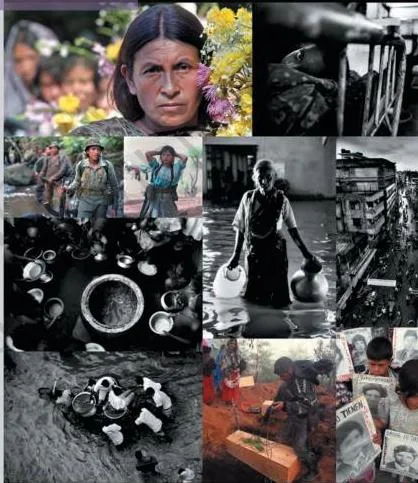






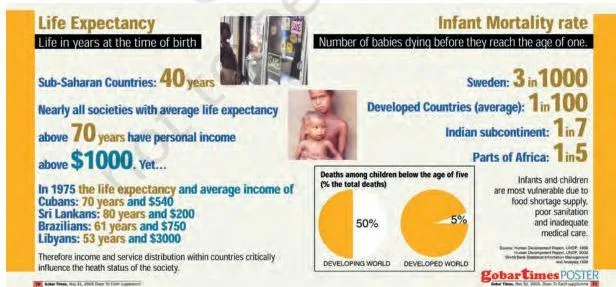
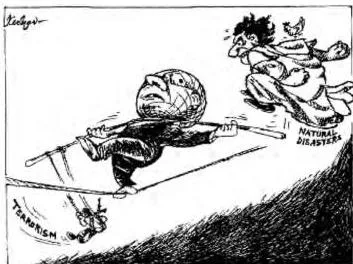
This chapter argues largely through political cartoons, and reading them is a tested skill — the final exercise asks you to take a position on a cartoon’s claim about war and terrorism. Each figure below makes one of the chapter’s points in picture form.
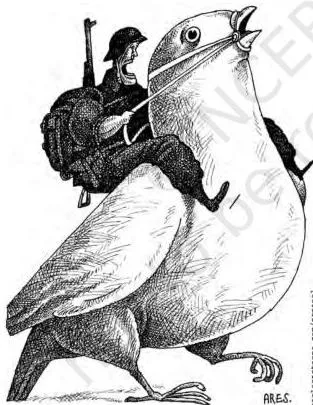
The joke of this cartoon is the “slippery idea” warning itself: anyone can declare almost anything a security issue. It is printed right after the chapter explains that a too-broad definition would make the world look full of dangers — the cartoon is the visual version of that warning (NCERT p. 64).

The boxed text beside this cartoon explains the joke: the Terror Meter takes the uncertainty out of knowing how terrified you should be — you simply move the indicator to match the required level of fear.
It satirises how security warnings can manage public fear, which connects to the chapter’s opening point that “security” is often used to control debate (NCERT p. 69).
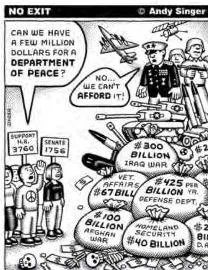
One speaker dismisses the earlier talk of weapons treaties; the second cheers what he calls “real security for real human beings”. The book’s caption explains the joke: the cartoon comments on the massive expenditure on defence and the lack of money for peace-related initiatives in the US — and asks whether India is any different (NCERT p. 70).
Use that margin question as a revision prompt: how does India’s traditional security spending compare with what it spends on poverty, health and education?

A figure in chains is told “He doesn’t exist!” — the book’s way of showing the gap between rights that are declared and rights that are enforced.
It sits beside the discussion of human rights classification and the argument over whether the international community should intervene when rights are violated, and the margin question asks why we look abroad for examples of violations when we have our own (NCERT p. 72).
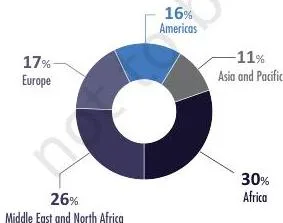
Read this map as data, not decoration. It sits beside the book’s claim that the world refugee map tallies almost perfectly with the world conflict map — wars in the South have generated millions of refugees seeking safe haven (NCERT p. 74).
The supporting numbers are worth learning: from 1990 to 1995, 70 states were involved in 93 wars that killed about 55 lakh people, and in the 1990s all but three of 60 refugee flows coincided with an internal armed conflict. The regions hosting the most displaced people are precisely the regions where armed conflict concentrates.

The speaker is happy his country has nuclear weapons but admits he cannot say how that makes him and his family more secure.
The chapter places it with the discussion of India’s military capability as a form of doubt: possession of nuclear weapons is treated as security, yet the connection between the weapon and the safety of ordinary people is unclear. That doubt is exactly what exercise 10 explores — the limited use of nuclear deterrence against contemporary threats (NCERT p. 76).
Key Terms and Definitions
The table below collects the terms you must be able to define in your own words, with the NCERT page where each is developed.
| Term | Definition in student words | NCERT page |
|---|---|---|
| Security | Freedom from threats; in serious discussion, only threats to core values that could damage them beyond repair | 64 |
| Traditional security | The view that the state is the referent and military threats from other states are the main danger | 65 |
| Deterrence | Policy of preventing war by making the costs of an attack unacceptable | 65–66 |
| Defence | Policy of limiting or ending a war once it has begun | 66 |
| Balance of power | Maintaining a favourable distribution of military, economic and technological strength among states | 66 |
| Alliance | A coalition of states that coordinates to deter or defend against military attack, usually in a written treaty | 66–67 |
| Disarmament | Giving up entire classes of weapons | 69 |
| Arms control | Regulating the acquisition or development of weapons | 69 |
| Confidence building measures | Sharing information with rivals about military intentions and plans to avoid war by misunderstanding | 70 |
| Human security | Protection of people rather than states — from violence, and in the broad view from hunger, disease and disaster | 70–71 |
| Global security | Security of all humankind against threats no single state can solve | 71 |
| Terrorism | Political violence that deliberately and indiscriminately targets civilians | 71–72 |
| Migrant | A person who voluntarily leaves their home country, usually for better economic opportunities | 74 |
| Refugee | A person who flees from war, natural disaster or political persecution | 74 |
| Internally displaced person | A person who has fled their home but remains inside their own country’s borders | 74 |
| Cooperative security | International cooperation, from bilateral to global, against threats that force cannot solve | 76 |
Common Mistakes Students Make in This Chapter
These are the points where a rushed reading of the chapter goes wrong. The book flags nearly all of them explicitly, so each one is reversible.
| Mistake | Correct rule | How to check your answer |
|---|---|---|
| Treating every danger as a security threat | Only threats to core values that could damage them beyond repair count; a real security problem must threaten the very existence of its referent | Ask: would the state or group actually cease to exist? The book warns the concept loses its coherence if everything counts (pp. 64–65, 75) |
| Believing the UN stands above states | The UN is a creature of its members with only the authority members allow; no central authority exists above states | Recall the book’s description of the international system as a “brutal arena” (p. 67) |
| Confusing disarmament with arms control | Disarmament gives up whole classes of weapons; arms control regulates acquisition or development | Sort the treaties: BWC and CWC are disarmament; ABM, SALT II, START and NPT are arms control (pp. 69–70) |
| Saying the NPT abolished nuclear weapons | It limited the number of countries allowed to keep or acquire them | The book says it directly: the NPT did not abolish nuclear weapons (pp. 69–70) |
| Assuming secure states mean secure people | The opposite: more people have been killed by their own governments in the last 100 years than by foreign armies | Give one example where the state’s security and a citizen’s security pull apart (pp. 70–71) |
| Using “migrant” and “refugee” interchangeably | Migrants leave voluntarily; refugees flee war, disaster or persecution; those who stay inside their own country are internally displaced people | Ask why the person left, and whether they crossed a border (p. 74) |
Exam Notes: How the Exercises Test These Concepts
The chapter’s closing exercises, printed on page 80, are the book’s own statement of what it considers important. Use the mapping below to see what each question targets, then check the two worked guides that follow.
| Questions | What they test | Where the ideas are |
|---|---|---|
| Q1 | The four cooperation terms — CBM, arms control, alliance, disarmament | pp. 66, 69–70 |
| Q2 | Classifying situations as traditional, non-traditional or not a threat | pp. 65–75 |
| Q3 | The difference between the two frameworks; where alliances belong | pp. 65–71 |
| Q4 | Different threats in the First World and the Third World | pp. 67–74 |
| Q5 | Where terrorism sits in the two frameworks | pp. 71–72 |
| Q6 | The three choices available to a threatened state | pp. 65–66 |
| Q7 | Balance of power and how a state achieves it | pp. 65–66 |
| Q8 | Objectives of military alliances plus an example | pp. 66–67 |
| Q9 | Environmental degradation as a security threat | pp. 71, 74–75 |
| Q10 | The limits of nuclear weapons as deterrence or defence | pp. 65–66, 76 |
| Q11 | Whether India has prioritised traditional or non-traditional security | pp. 76–78 |
| Q12 | Reading a cartoon on the connection between war and terrorism | pp. 76, 80 |
Matching the terms (Question 1), step by step
This exercise gives four terms and four meanings. Work through each meaning’s key words:
- “Giving up certain types of weapons” — the words “giving up” are the test. Disarmament means states give up entire classes of weapons, as the BWC and CWC examples show (NCERT p. 69). Answer: iv — Disarmament.
- “A process of exchanging information on defence matters between nations on a regular basis” — “exchanging information” and “regular” are the clues. Confidence building is exactly that: sharing intentions and plans so rivals never go to war through misunderstanding (NCERT p. 70). Answer: i — Confidence Building Measures.
- “A coalition of nations meant to deter or defend against military attacks” — “coalition of nations” is the definition of an alliance, formalised in treaties and built to deter or defend (NCERT pp. 66–67). Answer: iii — Alliance.
- “Regulates the acquisition or development of weapons” — “regulates” and “acquisition” are the exact language of arms control: it does not give weapons up, it regulates how they are acquired or developed (NCERT p. 69). Answer: ii — Arms Control.
Final match: i–b, ii–d, iii–c, iv–a.
Classifying the examples (Question 2)
Use the referent test from pp. 65–71 (security for whom?) plus the minimum criterion on p. 75:
- (a) The spread of chikungunya / dengue fever — non-traditional. Health epidemics are a new source of threat; the book groups them with HIV-AIDS, SARS and bird flu, which spread across borders and need cooperation (NCERT pp. 71, 74–75).
- (b) Inflow of workers from a neighbouring nation — non-traditional. Large-scale migration is treated as a security-related issue of the new agenda: it has created international political frictions, and states are not obliged to accept migrants (NCERT p. 74).
- (c) A group demanding nationhood for its region — traditional (internal). Separatist movements wanting to form independent countries are exactly what the book counts as an internal threat to the state (NCERT pp. 67–68).
- (d) A group demanding autonomy for its region — not by itself a security threat. Autonomy is a demand for power-sharing within the same state, and the book presents India’s answer as democracy: communities are allowed to articulate grievances and share political power. It is a political challenge, not a threat to the state’s existence (NCERT p. 77).
- (e) A newspaper critical of the armed forces — not a threat. The chapter opens by warning that “security” is often used to stop debate; freedom to criticise is exactly what the democratic system protects (NCERT pp. 63, 77–78).
The STEPS village activity as a model
The STEPS simulation (NCERT p. 78) dramatises the security dilemma with four villages — Kotabagh, Gewali, Kandali and Goppa — settled along one river. The resources are abundant at first, but they do not expand as the villages’ populations do.
Each village claims a bigger share on different grounds: Kotabagh as first settlers, Kandali and Gewali by population size, Goppa by need. The claims clash, peace of mind is lost, and nobody can return to the earlier “golden age”.
In class, each group represents a village and negotiates freely for a fixed time. The possible outcomes are the point: either an amicable agreement that accommodates everyone’s demands (which seldom happens), or a negotiation that collapses.
The “Ideas for the Teacher” box links the villages to nations — territory, access to natural resources and insurgency — and asks how far states behave like the villages (NCERT p. 78).
How to structure long answers
For the reasoning questions (Q3–Q11), a full answer has three parts: define the term, classify it as traditional or non-traditional, and support it with one chapter example — a treaty, a war, a statistic or a cartoon.
For Q12, state the cartoon’s claim about war and terrorism, take your position, then defend it with two points from the chapter — for instance, the refugee map’s link between war and displacement, or the limits of military force against non-traditional threats.
Three “Let’s Do It” activities in the chapter work as self-testing: scan a week’s newspaper for external and internal conflicts (p. 67), plot threats to people’s security on a map of Africa (p. 74), and compare Indian government expenditure on traditional versus non-traditional security (p. 77).
One caution: textbook contents and the examinable syllabus are not always identical — check the current official CBSE syllabus before revising, and treat these exercises as the book’s own checklist rather than a promise of exam questions.
Revision Summary: What the Chapter Concludes
The chapter’s whole argument in eight steps, in our words — reread this the night before an exam.
- Security means freedom from threats, but only extreme threats to core values qualify — and what counts changes with context, because security is a “slippery idea” (NCERT pp. 63–65).
- Traditional security puts the state first and worries mainly about military threats from other states (NCERT p. 65).
- Its tools are deterrence, defence, balance of power and alliances — in the traditional view, force is both the main threat and the main remedy (NCERT pp. 65–67).
- Internal security is also traditional: new states faced neighbour wars and separatist wars, and most armed conflicts today are internal (NCERT pp. 67–68).
- Even traditional security accepts cooperation: disarmament, arms control and confidence building (NCERT pp. 68–70).
- Non-traditional security widens the referent from the state to people and all humankind — human security and global security (NCERT pp. 70–71).
- New threats — terrorism, human rights abuse, poverty, migration and epidemics — need cooperative responses, and force is only a last resort, best used collectively (NCERT pp. 71–76).
- India’s strategy has four parts: military strength; international norms and institutions; internal unity through democracy; and economic development (NCERT pp. 76–78).
Related Resources
This listing is maintained for the 2026-27 academic session using the NCERT textbook information available to us. NCERT remains the authority for confirming the latest edition.
Continue revising in the same area: the Class 12 Political Science notes hub holds the chapters of Contemporary World Politics, the Class 12 notes hub covers every subject, and the CBSE notes index links all classes.
For chapters that pick up this one’s themes, see the India’s External Relations page (on how India built its foreign policy) and the Environment and Natural Resources page (on security and the environment).
The official book page for Contemporary World Politics and the Class 12 NCERT books hub show the full textbook set.
Sources and Data Verification
Four points about where this page’s facts come from:
- The page references and figure captions describe the NCERT Class 12 Political Science textbook Contemporary World Politics, Chapter 5 (Security in the Contemporary World), pages 63–80 of the printed edition — the edition carrying the NCERT “Review 2020-21” mark.
- This page covers Chapter 5 only, not the full book or the entire Class 12 Political Science syllabus.
- The listing is maintained for the current academic session using the NCERT information available to us.
- NCERT settles textbooks, editions and official PDFs; CBSE settles the curriculum, syllabus and examinations.
FAQs on Security in the Contemporary World
What is the difference between traditional and non-traditional security?
Traditional security protects the state from military attack by other states, using deterrence, defence, balance of power and alliances (NCERT p. 65). Non-traditional security protects people and all humankind from a wider range of threats, including poverty, disease, migration and environmental degradation, and it relies on cooperation rather than force (NCERT pp. 70–71).
The difference shows in three answers: security for whom, from what, and by what means.
Is terrorism a traditional or non-traditional threat to security?
The chapter places terrorism under non-traditional threats because it is political violence that deliberately and indiscriminately targets civilians, rather than a military attack by one state on another (NCERT pp. 71–72).
At the same time, the traditional toolbox of force is the most common state response — the US attacked Al Qaeda and those who harboured it — and cooperative security allows force as a collectively sanctioned last resort against terrorists (NCERT p. 76).
What are the four components of India’s security strategy?
They are: strengthening military capability (wars with Pakistan in 1947–48, 1965, 1971 and 1999 and with China in 1962; nuclear tests in 1974 and 1998); strengthening international norms and institutions (non-alignment, the NIEO demand, the 1997 Kyoto Protocol, UN peacekeeping); meeting internal challenges through democracy (militancy in Nagaland, Mizoram, Punjab and Kashmir); and developing the economy so citizens are lifted out of poverty (NCERT pp. 76–78).
What is the difference between disarmament and arms control?
Disarmament means giving up entire classes of weapons — the 1972 Biological Weapons Convention and the 1997 Chemical Weapons Convention banned the production and possession of those weapons. Arms control means regulating how weapons are acquired or developed, as the 1972 ABM Treaty, SALT II, START and the 1968 NPT did.
The NPT is the classic exam example: it limited the number of countries allowed to have nuclear weapons instead of abolishing them (NCERT pp. 69–70).
What is the difference between a refugee, a migrant and an internally displaced person?
A migrant leaves home voluntarily, usually for better economic opportunities; a refugee flees from war, natural disaster or political persecution; an internally displaced person has fled their home but remains inside their own country’s borders. International law says states are generally supposed to accept refugees, but they do not have to accept migrants.
The book’s example of an internally displaced community is the Kashmiri Pandits who fled the Kashmir Valley in the early 1990s (NCERT p. 74).
Why is the Nuclear Non-Proliferation Treaty called discriminatory?
Because it creates two classes of states: countries that had tested and manufactured nuclear weapons before 1967 kept them, while all others had to give up the right to acquire them (NCERT pp. 69–70).
India argued instead for a universal and non-discriminatory non-proliferation regime in which all countries would have the same rights and obligations with respect to weapons of mass destruction (NCERT p. 77).
Reference: NCERT Class 12 Political Science textbook, chapter 5, official edition on ncert.nic.in.
Explore Class 12 Political Science Books
- Previous: India's External Relations
- Next: Environment and Natural Resources
Related chapters:
- The End of Bipolarity
- Challenges of Nation Building
- Contemporary Social and Economic Centres of Power