
Contemporary South Asia is Chapter 3 of NCERT’s Class 12 Political Science book Contemporary World Politics. The chapter starts on page 28 of the printed NCERT edition, and its exercises close the chapter on page 44.
If you need the official text, the file is right here — and below it, this page maps the chapter section by section, explains its cartoons and key terms, and shows you what to revise.
The official file is the NCERT Class 12 Political Science Chapter 3 Contemporary South Asia PDF. This PDF is the official NCERT edition of the chapter — the same text that appears in the printed book — and it is the version to quote when you cite a page in your answer. Keep it open while you work through the section map below.
| What the chapter holds | Count | Where it is used |
|---|---|---|
| Printed pages | 16 | |
| Figures with NCERT captions | 13 | |
| Tables | 1 | |
| Exercise questions | 9 | answered in our NCERT Solutions |
| Official NCERT PDF | Download the chapter PDF | the chapter exactly as NCERT publishes it |
What Is Inside the Contemporary South Asia Chapter
The table below lists what this chapter holds — its sections, figures and exercise questions — so you can see the size of the file before you open it. The chapter text itself runs from page 28 to the exercise page on page 44.
For parents and teachers checking the book: this is Chapter 3 of NCERT Class 12 Political Science, Contemporary World Politics, the official NCERT edition. The chapter begins on page 28 of the printed book, and the PDF linked above is the same text.
What This Chapter Covers, Section by Section
The chapter builds its argument in one direction: it defines the region, then studies the domestic politics of its big countries, then India’s bilateral conflicts, and finally regional cooperation. Each block below names the book page where it starts.
- Overview (p. 29): why South Asia became a focus of global attention after India and Pakistan joined the nuclear club; the region as both turbulent and hopeful.
- What is South Asia? (p. 30): the seven countries, the natural insularity from the Himalayas and the oceans, and the idea of one geopolitical space.
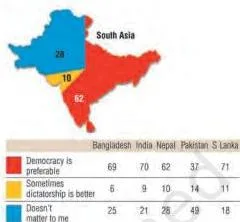
- Survey graphs (p. 31): the State of Democracy survey of more than 19,000 citizens in five countries, showing widespread support for democracy.
- Timeline of South Asia since 1947 (p. 32): one long chronological spine from independence to the 18th SAARC Summit in Kathmandu in 2014.
- The Military and Democracy in Pakistan (pp. 33-34): repeated army takeovers and the reasons behind Pakistan’s unstable democracy.
- Democracy in Bangladesh (pp. 34-35): the Bengali struggle, the 1971 war, the assassination of Sheikh Mujib, and multi-party democracy from 1991.
- Monarchy and Democracy in Nepal (pp. 35-36): the 1990 constitution, the Maoist insurgency, the 2006 movement, and the abolition of the monarchy in 2008.
- Ethnic Conflict and Democracy in Sri Lanka (pp. 36-37): the Sinhala-Tamil conflict, the LTTE, the IPKF intervention, and the end of the armed conflict in 2009.
- India-Pakistan Conflicts (pp. 37-39): Kashmir, the wars, nuclear tests, the Indus Waters Treaty, Siachen, Sir Creek, and mutual accusations.
- India and its Other Neighbours (pp. 39-42): relations with Bangladesh, Nepal, Sri Lanka, Bhutan and the Maldives.
- Peace and Cooperation (pp. 42-44): SAARC, SAFTA, confidence building measures, and the role of China and the United States.
The chapter also includes a classroom activity called STEPS, with ideas for teachers (pp. 42-43 in the running text): divide the class into groups named after the South Asian countries, give each group a country profile, and let them negotiate a dispute from the chapter. Teachers often use this to turn the chapter’s conflicts into a live negotiation.
Key Concepts: Conflict and Cooperation in South Asia
The chapter’s big question is simple: why is this region so turbulent, and why do its people keep choosing democracy and cooperation anyway? The six ideas below are the ones you need before the details make sense.
What “South Asia” means in this chapter
For the book, South Asia means exactly seven countries: Bangladesh, Bhutan, India, the Maldives, Nepal, Pakistan and Sri Lanka (p. 30). The Himalayas in the north and the Indian Ocean, Arabian Sea and Bay of Bengal in the other directions give the region a natural insularity that explains much of its shared character.
Afghanistan and Myanmar are sometimes discussed alongside the region but are not counted as part of it. The phrase the chapter keeps returning to is that South Asia “stands for diversity in every sense and yet constitutes one geopolitical space.”
The survey evidence: democracy is preferred across the region
The book uses one striking piece of evidence: a survey of more than 19,000 ordinary citizens in the five big countries, reported in the State of Democracy in South Asia study (p. 31). Ordinary citizens, rich and poor, from different religions, prefer democracy over dictatorship and think democracy is suitable for their own country.
Why this matters: it was once assumed that democracy could flourish only in prosperous countries. The South Asian data pushed back against that assumption, and the chapter says the region’s experience has “expanded the global imagination of democracy” (p. 32).
Four country stories, one pattern
After India, the chapter tells four country stories. Pakistan cycles between civilian and military rule. Bangladesh took until 1991 to make multi-party democracy work. Nepal abolished its monarchy in 2008 and became a republic. Sri Lanka’s challenge is different — its democracy survived, but ethnic conflict and a separatist war tested it.
The trend line is the point: democracy keeps getting restored across the region.
Democracy in the seven countries at a glance
This comparison table gathers the country profiles the chapter spreads across pages 30 to 37, so you can revise all seven in one look.
| Country | Form of government described | Turning point year | Status as the chapter presents it |
|---|---|---|---|
| India | Parliamentary democracy since independence (p. 30) | 1947 | Remained a democracy throughout its independent existence |
| Sri Lanka | Democracy since independence (p. 30) | 1948 | Democratic, but tested by ethnic conflict and separatism |
| Pakistan | Civilian and military rulers (pp. 32-33) | 1999 coup; 2008 return to civilian rule | Democratically elected leaders since 2008 |
| Bangladesh | Military rule, then multi-party democracy (pp. 34-35) | 1991 elections | Representative democracy based on multi-party elections since 1991 |
| Nepal | Constitutional monarchy, then republic (pp. 35-36) | 2008 monarchy abolished | Democratic republic; new constitution adopted in 2015 |
| Bhutan | Monarchy to constitutional monarchy (p. 31) | 2008 | Constitutional monarchy that emerged as a multi-party democracy |
| Maldives | Sultanate, then republic (p. 31) | 1968 republic; 2005 multi-party system | Republic; the Maldivian Democratic Party won the 2018 elections |
Why India is central to every conflict
Geography is the reason. India is the only South Asian country that borders all the others, so most conflicts in the region involve India (p. 42). The smaller neighbours suspect India of wanting to dominate; India, in turn, feels exploited by its neighbours and fears their instability lets outside powers in (p. 41).
This mutual suspicion, not any single dispute, is what makes India central.
SAARC and SAFTA: cooperation with limits
The South Asian Association for Regional Cooperation (SAARC) began in 1985 as the region’s main multilateral initiative (p. 42). The chapter calls its record a limited one: persisting political differences among members stopped it from achieving much.
SAFTA — the South Asian Free Trade Agreement — was signed in 2004 and came into effect on 1 January 2006, with the aim of lowering trade tariffs across the region. The two are not the same thing: SAARC is the forum, SAFTA is a specific trade agreement reached through it.
Some neighbours fear SAFTA is really a way for India to enter their markets; India argues that freer trade will improve political cooperation.
Outside players: China and the United States
No region exists in a vacuum, the chapter argues (p. 43). China’s strategic partnership with Pakistan remains a major irritant for India, even though Sino-Indian economic ties have grown rapidly since 1991. American involvement in South Asia increased after the Cold War: the US has good relations with both India and Pakistan and increasingly works as a moderator between them.
Walking Through the Chapter’s Images and Cartoons





NCERT teaches parts of this chapter through images — mostly editorial cartoons and photographs — and then asks you to decode them. Each image below is explained so you can answer the book’s own prompts.
The chapter’s opening image
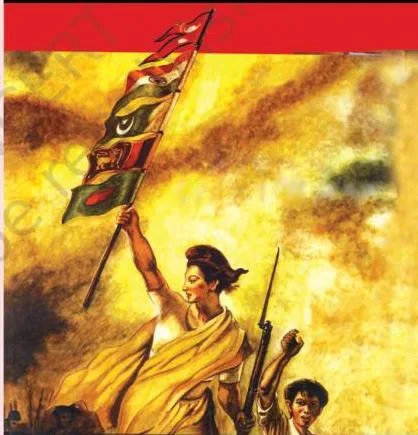
The opening image is Subhas Rai’s adaptation of Delacroix’s famous painting, courtesy of Himal Southasian. The original painting shows Liberty leading the people of Paris; this version shifts that image of popular aspiration onto South Asia.
The chapter places it above the Overview, so read it as a visual statement of the region’s democratic hope before the text starts listing the conflicts.
The survey graph
The graph on page 31 answers one question: do South Asians actually want democracy? The bars show that in all five big countries surveyed, a clear majority agrees with statements supporting democracy over dictatorship. The source line under the graph gives the evidence base — more than 19,000 ordinary citizens interviewed for the State of Democracy in South Asia study.
This graph is the chapter’s proof that support for democracy in the region is broad, not elite.
Musharraf’s two hats
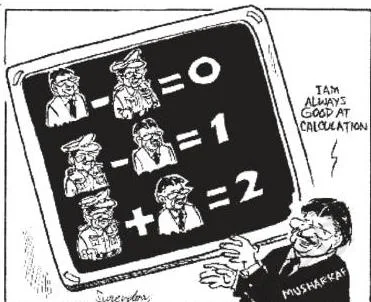
The cartoon on page 33 shows Pervez Musharraf in a double role — President of the country and army General. The book asks you to read the equations under the cartoon carefully and write down its message. The point is that Musharraf’s rule combined both offices, which is exactly why the chapter calls it military rule wearing a democratic face.
The surrounding text adds the context: the lack of genuine international support for democratic rule in Pakistan encouraged the military to keep its dominance.
One activist, two movements
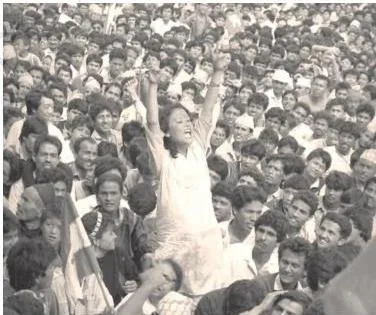
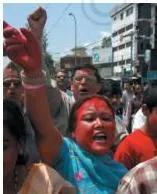
This pair of photographs shows the same activist, Durga Thapa, in two different years: 1990, participating in the first pro-democracy rally, and 2006, celebrating the success of the second movement. Sixteen years passed between the two pictures. The photographs make the chapter’s point about Nepal visually — democratisation was not one event but a long struggle, and the 2006 movement achieved what 1990 could not.
The Lion and the Tiger
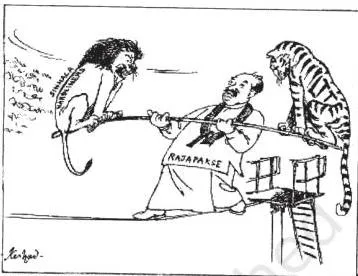
The page 37 cartoon sums up Sri Lanka’s crisis in one image: the negotiator sits between the Lion — Sinhala hardliners — and the Tiger — Tamil militants of the LTTE. The caption explains the dilemma: the leadership had to balance both sides while negotiating peace, and was squeezed from both directions.
The cartoon is the visual version of the point that Sri Lanka’s challenge was ethnic separatism, not military rule.
From bunkers to dialogue tables
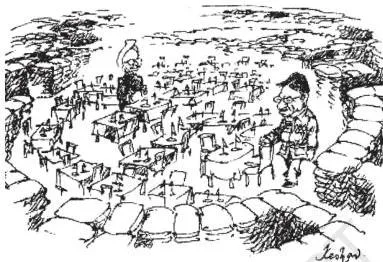
This cartoon comments on the state of India-Pakistan relations: the relationship moving from a “make of bunkers” to a “make of dialogue tables.” Read it with the chapter’s argument in mind — after the nuclear tests of 1998, the possibility of full-scale war declined, and both sides began managing tensions through summits, bus routes and confidence building measures.
The cartoon captures that shift without pretending the distrust is gone.
Two views of regional cooperation

The last pair of cartoons — one from an Indian paper, one from a Pakistani paper — is set side by side. The book asks whether you notice any commonality between their perspectives. Both cartoons treat the same two countries as the key players in South Asian cooperation, but each nation’s cartoonist sees the other as the obstacle.
That mirror-image suspicion is exactly what the chapter has been describing all along.
Key Terms and Definitions
This chapter is dense with acronyms and proper nouns. Here they are in one place, with the book page where each is explained.
| Term | What it means in this chapter |
|---|---|
| South Asia (p. 30) | The seven countries the chapter studies: Bangladesh, Bhutan, India, the Maldives, Nepal, Pakistan and Sri Lanka |
| Sultanate (p. 31) | The Maldives’ form of government until 1968, when the islands became a republic |
| Multi-party system (p. 31) | A system in which several parties compete for power; Bhutan and the Maldives moved to this in the 2000s |
| Constitutional monarchy (p. 35) | A monarchy whose powers are limited by a constitution — Nepal’s position until 2008 |
| SEATO and CENTO (p. 32) | The Cold War military blocs Pakistan joined in 1954-55 |
| Indus Waters Treaty (p. 39) | The 1960 agreement, reached with World Bank help, on sharing the rivers of the Indus basin |
| LTTE (p. 37) | Liberation Tigers of Tamil Eelam — the militant organisation fighting for a separate Tamil Eelam in Sri Lanka |
| IPKF (p. 37) | Indian Peace Keeping Force — Indian troops sent to Sri Lanka in 1987, withdrawn in 1989 without attaining their objective |
| Line of Control (p. 38) | The line that divided Kashmir after the 1947-48 war into Pakistan-occupied Kashmir and Indian Jammu and Kashmir |
| ISI (p. 39) | Inter Services Intelligence — Pakistan’s spy agency, which India accuses of running anti-India campaigns |
| SAARC (p. 42) | South Asian Association for Regional Cooperation — the regional forum founded in 1985 |
| SAFTA (p. 42) | South Asian Free Trade Agreement — signed in 2004, in effect from 1 January 2006, aiming to lower trade tariffs |
| Confidence building measures (p. 43) | Steps India and Pakistan agreed on to reduce the risk of war between them |
| Look East / Act East (p. 39) | India’s policy of linking up with Southeast Asia via Myanmar — renamed Act East since 2014 |
Common Mistakes Students Make in This Chapter
Most errors in this chapter are date errors and country mix-ups. The table below names the wrong belief, the correction, and a quick way to check yourself.
| Mistake | Correct rule | How to check your answer |
|---|---|---|
| Mixing up the 1947-48, 1965 and 1971 wars | The 1947-48 war divided Kashmir at the Line of Control; the 1971 war ended with the liberation of Bangladesh (p. 38) | Ask which war produced a new country — the answer is 1971 |
| Thinking Bangladesh has been democratic since 1971 | Mujib was assassinated in 1975, then came military rule; multi-party democracy has worked only since 1991 (pp. 34-35) | The chapter repeats “since 1991” whenever it summarises Bangladesh |
| Thinking Nepal’s monarchy ended in 1990 | 1990 brought a democratic constitution under the king; the monarchy was abolished only in 2008 (pp. 35-36) | “Abolished” is paired with 2008, never with 1990 |
| Calling Sri Lanka’s conflict religious | It is ethnic — Sinhala versus Tamil — with the LTTE demanding a separate Tamil Eelam (p. 37) | The chapter’s own heading says “Ethnic Conflict and Democracy in Sri Lanka” |
| Treating SAARC and SAFTA as the same thing | SAARC is the regional forum started in 1985; SAFTA is the free-trade agreement signed in 2004, in effect from 2006 (p. 42) | SAFTA was “signed at” a SAARC summit — one is the venue, the other is the deal |
| Forgetting the Maldives dates | The Maldives was a Sultanate till 1968, became a republic, and voted in a multi-party system in June 2005 (p. 31) | Two dates anchor the Maldives: 1968 and 2005 |
| Reading 1988-91 as isolated events | Democracy was restored across Pakistan, Bangladesh and Nepal in the same period — one regional wave (pp. 32-33) | The timeline groups all three countries under “1988-91” |
The chapter also ends its country survey with a question aimed at you: if the chapter on the US was called “US Hegemony,” why is this chapter not called “Indian Hegemony”? The material for an answer is in the chapter itself.
India is the only country that borders all the others (p. 42), and the smaller countries openly fear a regionally dominant India (p. 41).
But the chapter also shows that centrality is not the same as control — SAARC’s failures, India’s own complaints of being exploited, and the mutual suspicion between India and its neighbours all point to a relationship of suspicion, not one-sided domination.
Exam Notes: What You Should Be Able to Do After This Chapter
The chapter’s exercises on page 44 show exactly which skills it expects. Revise by question type rather than by re-reading the whole chapter.
- Q1 — Identify the country: tests the country profiles across pp. 30-37. Know which country is landlocked, which liberalised its economy first, which had a Sultan, and which is centrally located.
- Q2 — Multiple choice: the wrong statement is (a) — “all the countries in South Asia are democratic” — because Pakistan experienced repeated military rule (pp. 30-33).
- Q3 — Bangladesh and Pakistan compared: use the democratic experience sections on pp. 33-35. Both had military rulers; Bangladesh has held stable multi-party elections since 1991, while Pakistan returned to civilian rule only since 2008.
- Q4 — Three challenges to democracy in Nepal: the king’s control over government, the Maoist armed insurgency, and the triangular conflict among monarchists, democrats and Maoists (pp. 35-36).
- Q5 — Sri Lanka’s conflict: principal players are the Sinhala-dominated state and the LTTE; assess prospects using the 2009 end of the armed conflict and the failed IPKF intervention (pp. 36-37).
- Q6 — India-Pakistan agreements: deals exist — the Indus Waters Treaty, the Simla Agreement, the Lahore Peace Declaration, bus routes — but the chapter warns that suspicion continues (pp. 37-39, 42-43).
- Q7 — India and Bangladesh: two areas each of cooperation and disagreement; use pp. 39-40.
- Q8 — External powers: take one example — China’s partnership with Pakistan or the US as moderator — and show how it affects bilateral relations (p. 43).
- Q9 — SAARC: state its role as the 1985 regional forum and its limitation of persisting political differences (p. 42).
- Q10 — India’s neighbours’ impression: a reasoned-view question drawing on pp. 41-42 — the smaller countries’ fear of domination versus India’s sense of being exploited.
For Q7, a clean answer structure is: (1) name two areas of cooperation — improved economic relations and regular cooperation on disaster management and environmental issues; (2) name two areas of disagreement — sharing of the Ganga and Brahmaputra river waters and India’s unhappiness over denied transit through Bangladeshi territory; (3) close with a fact that shows the relationship is being managed — the exchange of enclaves in 2015 (pp. 39-40).
One honest caution: textbook contents and the examinable syllabus are not always identical — check the current official syllabus on the CBSE website before you decide what to prioritise. This page describes what the NCERT chapter contains; it does not promise which parts will appear in any examination.
The Whole Chapter in Five Reading Blocks
The chapter tells one story: a turbulent region that keeps choosing democracy and cooperation. If you read nothing else, hold onto these five blocks.
1. Defining the region (pp. 29-31)
Seven countries, naturally insulated by the Himalayas and the oceans, different in every way yet one geopolitical space. Politically they differ — India and Sri Lanka stayed democratic, the others took different routes — but a survey shows the people of all five big countries prefer democracy.
2. The democracy wave (pp. 33-37)
Pakistan cycled through military rulers; Bangladesh reached multi-party democracy in 1991; Nepal abolished its monarchy in 2008; Bhutan and the Maldives moved toward multi-party systems in the 2000s. Sri Lanka is the exception — its democracy survived, but ethnic conflict and separatism were the challenge.
3. The India-Pakistan knot (pp. 37-39)
Kashmir, three wars, nuclear tests in 1998, the Indus Waters Treaty, Siachen, Sir Creek, and mutual accusations of meddling. And yet the relationship has moved from bunkers to dialogue tables, with summits, bus routes and confidence building measures.
4. India and its smaller neighbours (pp. 39-42)
With Bangladesh there are water disputes and transit problems but also growing economic ties. With Nepal, a special open-border relationship shadowed by suspicion. Sri Lanka, Bhutan and the Maldives have their own mixes of cooperation and friction. India’s geography — bordering everyone — explains why it feature in most conflicts.
5. Cooperation and outside powers (pp. 42-44)
SAARC promised multilateral cooperation but delivered limited results because of political differences. SAFTA is the region’s free-trade hope. China and the United States both have stakes in the region, but the chapter’s final line is that South Asia’s future depends more on its own people and governments than on any outside power.
Related Resources and Sources
This listing is maintained for the 2026-27 academic session using the NCERT textbook information available to us. NCERT remains the authority for confirming the latest edition.
For the rest of this book, use the Class 12 Political Science notes page to move between chapters, and the Class 12 hub for the other subjects. The chapter that follows in Contemporary World Politics is International Organisations. For the second Class 12 Political Science textbook, Politics in India Since Independence, the Era of One Party Dominance page is the natural starting point.
You can also browse all subjects from the main CBSE notes page.
You can verify any page number against the official NCERT chapter PDF on ncert.nic.in, which is the authoritative source for this textbook text.
Sources and data verification
- Which edition this page describes: NCERT Class 12 Political Science, Contemporary World Politics, rationalised edition — Chapter 3, “Contemporary South Asia,” pages 28-44.
- What this page covers: Chapter 3 only. Other chapters of Contemporary World Politics, and the second Class 12 Political Science textbook (Politics in India Since Independence), have their own pages.
- Academic session: this page is maintained for the current academic session, using the NCERT textbook information available to us. Textbook contents and the examinable syllabus are not always identical — check the official CBSE syllabus for session-specific requirements.
- Which authority settles what: NCERT settles textbook content, editions and PDFs; CBSE settles the curriculum, syllabus and examinations.
FAQs: Contemporary South Asia Class 12, Answered
Which countries are included in South Asia in this chapter?
Bangladesh, Bhutan, India, the Maldives, Nepal, Pakistan and Sri Lanka (p. 30). Afghanistan and Myanmar are sometimes discussed alongside the region but are not counted as part of it in this chapter.
Why has Pakistan struggled to build a stable democracy?
The chapter gives three connected reasons (pp. 33-34): the social dominance of the military, clergy and landowning aristocracy; Pakistan’s conflict with India, which strengthened pro-military groups; and a lack of genuine international support for democratic rule, with outside powers seeing the military regime as a protector of Western interests.
Was the Sri Lankan conflict religious or ethnic?
Ethnic, not religious. It is a conflict between the Sinhala majority and the Tamil minority, with the LTTE fighting for a separate Tamil Eelam (pp. 36-37). That is why the chapter’s heading calls it “Ethnic Conflict and Democracy in Sri Lanka.”
When and how did Nepal become a democratic republic?
In 2008, after abolishing the monarchy (p. 36). The path was long: a democratic constitution under the king in 1990, a violent Maoist insurgency, massive pro-democracy protests in April 2006 that forced the king to restore the House of Representatives, and then a constituent assembly that drafted a new constitution, adopted in 2015.
What is the difference between SAARC and SAFTA?
SAARC is the South Asian Association for Regional Cooperation, the regional forum founded in 1985. SAFTA is the South Asian Free Trade Agreement — a specific deal signed in 2004, in effect from 1 January 2006, that aims to lower trade tariffs across the region (p. 42). SAFTA was signed at a SAARC summit, so SAARC is the forum and SAFTA is one of its agreements.
What does the chapter say about India’s relations with Bangladesh?
There are real disagreements — sharing the Ganga and Brahmaputra river waters, transit through Bangladeshi territory, and mutual accusations of interference (p. 39). But the chapter also stresses cooperation: improved economic relations, regular cooperation on disaster management and environmental issues, and the 2015 exchange of enclaves (pp. 39-40). The relationship is one of both cooperation and disagreement, not either-or.
Reference: NCERT Class 12 Political Science textbook, Chapter 3 (Contemporary South Asia), official edition on ncert.nic.in.
Explore Class 12 Political Science Books
- Previous: Era of One-Party Dominance
- Next: International Organisations
Related chapters:
- The End of Bipolarity
- Challenges of Nation Building
- Contemporary Social and Economic Centres of Power