
International Organisations Class 12 is Chapter 4 of the NCERT Political Science book Contemporary World Politics. The chapter runs to 18 printed pages, and the official PDF is right below. This guide, maintained for the current academic session, maps every section of it so you can revise the UN, the veto and India’s Security Council bid quickly.
Download the International Organisations Class 12 Chapter PDF
This is the official NCERT chapter — the same text published on ncert.nic.in, not a scanned or third-party copy — so the page numbers and exercises match your printed book exactly. You can download the International Organisations Class 12 chapter PDF from the NCERT website and open it on any phone, tablet or computer for offline revision.
| What the chapter holds | Count | Where it is used |
|---|---|---|
| Printed pages | 18 | |
| Figures with NCERT captions | 14 | |
| Tables | 1 | |
| Exercise questions | 22 | answered in our NCERT Solutions |
| Official NCERT PDF | Download the chapter PDF | the chapter exactly as NCERT publishes it |
Chapter 4 at a glance: what is inside the PDF
The table below lists what the chapter contains — its sections, figures and exercise questions — so you can see the size of the material before opening the PDF. The chapter is text-led, with cartoons and organisation logos carrying much of the argument.
What this chapter covers: a page-by-page map
Use this table when you want to jump straight to one topic. Every page number refers to the printed NCERT edition, and the rows follow the chapter’s own order.
| Topic | NCERT printed page |
|---|---|
| Why states create international organisations | 46–47 |
| The International Monetary Fund (IMF) | 47 |
| Founding of the United Nations | 48–49 |
| Evolution of the UN and the UN system | 48–50 |
| Reform of the UN after the Cold War | 50–52 |
| The UN Secretaries-General | 51–52 |
| The Security Council reform debate | 52–55 |
| The World Bank and major UN budget contributors | 53–54 |
| Jurisdiction of the UN and the 2005 summit | 55–56 |
| UN peacekeeping operations | 56–57 |
| India and UN reforms; the WTO | 57–58 |
| The IAEA | 58 |
| The UN in a unipolar world | 58–59 |
| Amnesty International and Human Rights Watch | 59–60 |
| Exercises | 61–62 |
Key concepts in this chapter
These are the ideas the exercise questions build on. Work through the six blocks in order — why organisations exist, how the UN is built, the two reform debates, India’s claim, the UN’s limits and the organisations around the UN — and the end-of-chapter questions become much easier to answer.
Why states create international organisations
Before any detail about the UN, the chapter makes a single core point: an international organisation is not a super-state with authority over its members. It is created by states, it responds to states, and it comes into being only when states agree to create it (NCERT, p. 46).
That starting point explains the two jobs such organisations do. First, they help member states resolve conflicts and differences peacefully instead of going to war.
Second, they make cooperation possible on problems no single country can solve alone — the chapter’s examples are disease, where everyone must vaccinate together, and global warming, where rising sea levels could submerge coastal cities (NCERT, p. 47).
Cooperation also has a practical problem: states rarely agree on how to share costs and benefits, or how to stop others from cheating. An international organisation helps by providing information, rules, mechanisms and a bureaucracy that make agreements more trustworthy (NCERT, p. 47).
Two insiders quoted in the chapter make the same point. Dag Hammarskjöld, the UN’s second Secretary-General, said the UN “was not created to take humanity to heaven, but to save it from hell.” Shashi Tharoor, a former UN Under-Secretary-General, answers the charge that the UN is a “talking shop”: jaw-jaw is better than war-war (NCERT, p. 46).
How the UN is organised: organs, agencies and the veto
The most useful picture in this chapter is the UN System chart on NCERT page 50. It shows the six principal organs at the centre, with specialised agencies, programmes and related organisations attached around them. Learn this chart and the matching exercise (Question 7) is mostly done.
| Principal organ | What it does | Key feature |
|---|---|---|
| General Assembly | Debates and discusses global issues | All 193 member states, one vote each; major decisions need a two-thirds majority; decisions are not binding |
| Security Council | Preserves international peace and security | 15 members — five permanent (with veto) and ten elected for two-year terms; decisions bind all UN members |
| Economic and Social Council | Looks into the economic and social welfare of member countries | 54 seats, elected by the General Assembly for overlapping three-year terms on a geographical basis |
| International Court of Justice | Resolves disputes between and among member countries | 15 judges elected for nine years; based in The Hague |
| Secretariat | Administration and coordination of UN affairs | International staff headed by the Secretary-General, appointed for a five-year renewable term |
| Trusteeship Council | Oversaw UN trust territories | Suspended on 1 November 1994 after Palau, the last trust territory, became independent |
The veto is what gives the Security Council its special character. Every Council member has one vote, but any permanent member can vote negatively, so that even if all other members support a decision, that one negative vote stalls it (NCERT, p. 55).
The five permanent members — the United States, Russia, the United Kingdom, France and China — hold permanent seats because they were the most powerful states after the Second World War and were its victors (NCERT, p. 49).
The UN System chart also separates the principal organs from the wider family of agencies. This is where Question 7’s matching pairs come from.
| Group | What it is | Examples from the chapter |
|---|---|---|
| Specialised agencies (non-subsidiary) | Independent organisations that work in specific fields alongside the UN | ILO, FAO, UNESCO, WHO, World Bank Group, IMF, IMO, WMO, ITU |
| Related organisations | Organisations attached to the UN that report to its organs | IAEA — reports to both the Security Council and the General Assembly; OPCW |
| Programmes and funds | UN bodies that deliver work on the ground | UNCTAD, UNEP, UNDP, UNICEF, UNFPA, UNHCR, WFP, UNRWA |
| Functional commissions | Expert bodies under the Economic and Social Council | Human Rights, Narcotic Drugs, Sustainable Development, Status of Women |
| Regional commissions | Economic bodies for different world regions | Economic commissions for Africa, Europe, Latin America and the Caribbean; for Asia and the Pacific and Western Asia |
Notice the difference between the two deliberating bodies. War, peace and differences between member states are discussed in the General Assembly as well as the Security Council — but Assembly decisions are not binding, while Security Council decisions bind every UN member (NCERT, p. 50).
The two reform debates: structures, and what falls inside the UN’s jurisdiction
Reform sounds simple, but the chapter shows it is really two separate arguments. One is reform of structures and processes — above all the Security Council’s size and the veto. The other is a review of issues within the UN’s jurisdiction — what the organisation should do (NCERT, p. 50).
Almost everyone agrees both are necessary; nobody agrees what, how or when (NCERT, p. 51).
The Security Council debate began in earnest with a 1992 General Assembly resolution carrying three complaints: the Council no longer represents contemporary political realities; its decisions reflect only Western values and interests and are dominated by a few powers; and it lacks equitable representation (NCERT, p. 52).
Since then, six criteria have been proposed for new permanent and non-permanent members (NCERT, pp. 52–53):
- a major economic power
- a major military power
- a substantial contributor to the UN budget
- a large population
- respect for democracy and human rights
- a country that makes the Council more representative of the world’s diversity — geographical, economic and cultural
Each criterion has problems of its own. How big is “major”? Does a large budget contribution let a state buy its way in? Is a big population an asset or a liability? And would the most virtuous democracies actually make effective Council members (NCERT, p. 53)?
Then there is representation itself: should new seats go by continent, by region, or by level of economic development? And should the veto be abolished? Many see it as conflicting with democracy and sovereign equality.
The counter-argument is blunt: the permanent members will not agree to give it up, and without the veto the great powers might lose interest and act outside the UN, leaving the body ineffective (NCERT, p. 55).
One fact to keep close: the Security Council grew from 11 to 15 members in 1965, but the number of permanent members did not change, and the Council’s size has stayed stationary ever since (NCERT, p. 57).
At the September 2005 summit, held as the UN completed 60 years, member states agreed on a set of concrete steps (NCERT, pp. 55–56):
- creation of a Peacebuilding Commission
- acceptance of the international community’s responsibility when national governments fail to protect their own citizens from atrocities
- establishment of a Human Rights Council (operational since 19 June 2006)
- agreement to achieve the Millennium Development Goals (MDGs)
- condemnation of terrorism in all its forms
- creation of a Democracy Fund
- agreement to wind up the Trusteeship Council
Each step is itself contentious, the chapter notes — which conflicts should the Peacebuilding Commission enter, who can agree on a definition of terrorism, and how realistic are development goals such as the MDGs (NCERT, p. 56)?
India’s case for a permanent Security Council seat
India’s claim is the most India-specific material in this chapter, and it directly feeds Questions 3 and 9. India argues the Security Council’s composition has remained largely static while the General Assembly has expanded, harming the Council’s representative character (NCERT, p. 57).
The chapter lists India’s grounds (NCERT, pp. 57–58):
- the world’s most populous country, almost one-fifth of humanity
- the world’s largest democracy
- participation in virtually all UN initiatives
- a long and substantial record in UN peacekeeping
- its economic emergence on the world stage
- regular financial contributions, never faltering on payments
- the symbolic value of a permanent seat — the reputation for being powerful makes a country more influential
The objections are equally clear (NCERT, p. 58). Pakistan, with which India has troubled relations, is reluctant. Some countries worry about India’s nuclear weapons capabilities. Others think the India–Pakistan rivalry would make India ineffective in the Council.
There is also a domino argument: if India gets in, Brazil, Germany, Japan and possibly South Africa must also be accommodated. Africa and South America, the only continents without permanent representation, press their own claims.
The chapter’s verdict is that it may not be very easy for India or anyone else to become a permanent member in the near future (NCERT, p. 58).
The UN’s limits in a unipolar world
The chapter’s closing argument asks whether the UN can balance a world dominated by one superpower — the United States, left without serious rivals after the Soviet Union collapsed. Its answer: US power cannot easily be checked (NCERT, p. 58).
Why (NCERT, pp. 58–59):
- as the sole superpower, the US can use its military and economic power to ignore the UN
- it is the single largest contributor to the UN budget — 22.0% of the regular budget for 2019, against India’s 0.8% (NCERT, p. 53)
- the UN is physically located on US territory
- many US nationals work in the UN bureaucracy
- its veto can stop anything it finds annoying or damaging
- it has a large say in choosing the Secretary-General and uses its power to “split” the rest of the world
The chapter’s balance: the UN is not a great balance to the US, yet it still brings the US and the rest of the world into discussion. It provides an arena where US attitudes and policies can be shaped, and where compromises and concessions can be negotiated (NCERT, p. 59).
The concluding judgment is plain: the UN is an imperfect body, but without it the world would be worse off, and growing interdependence will only increase its importance (NCERT, p. 60).
The other organisations: IMF, World Bank, WTO, IAEA and human rights NGOs
The chapter profiles six organisations around the UN, each with a logo in the text. This table lines up what each one does and the criticism raised against it — exactly the kind of pairing Question 7 asks you to make.
| Organisation | What it does | Criticism / key fact |
|---|---|---|
| IMF | Oversees financial institutions and regulations acting at the international level (p. 47) | 190 members (as on 19 February 2024) but no equal say — the G-7 holds 41.29% of the votes (p. 47) |
| World Bank | Created in 1944 during the Second World War; gives loans and grants, focused on developing countries (p. 53) | Criticised for setting the economic agenda of poorer nations, attaching stringent conditions and forcing free-market reforms (p. 53) |
| WTO | Sets rules for global trade; set up in 1995 as successor to GATT; decisions taken unanimously (p. 57) | Developing countries complain of non-transparent procedures and of being pushed around by big powers (p. 57) |
| IAEA | Established in 1957 under Eisenhower’s “Atoms for Peace” proposal; promotes peaceful nuclear use, prevents military use, inspects nuclear facilities (p. 58) | A related organisation, not a principal organ — it reports to both the Security Council and the General Assembly (p. 50) |
| Amnesty International | NGO campaigning for human rights worldwide; publishes reports whose main focus is misconduct by government authorities (p. 59) | Governments are not always happy with its reports (p. 59) |
| Human Rights Watch | International NGO doing human rights research and advocacy; draws global media attention to abuses (p. 60) | Helped build coalitions to ban landmines, stop child soldiers and create the International Criminal Court (p. 60) |
Notice the chapter’s grouping: the IMF and World Bank are specialised agencies of the UN, the IAEA is a related organisation, and the last two are NGOs outside the UN that still do crucial work on the issues the UN discusses.
Figure walkthrough: what the cartoons and logos mean
This chapter argues partly through pictures. The logos identify the organisations profiled beside them; the cartoons carry opinions — usually the very opinions the chapter then questions. Read them with the text, not past it.
Figures from pages 45 to 48: the UN’s symbols and origins
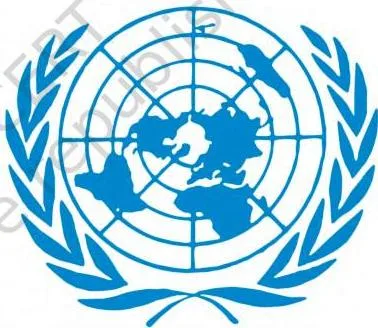
The chapter opens with the UN emblem. The map claims to represent the whole planet, and the olive branches around it are the classic symbol of peace. Together they state the UN’s purpose before a single word of argument begins (NCERT, p. 45).

Both cartoons target the UN’s ineffectiveness in the 2006 Lebanon crisis. The facts behind them: Israel attacked Lebanon in June 2006, many civilians were killed, the UN passed a resolution only in August, and Israeli troops withdrew only in October (NCERT, p. 46).
One cartoon calls the UN a “talking shop”; the other comments on the Secretary-General’s role in the episode. Together they pose the chapter’s opening question — if the UN is this slow, why do we still need it?

The IMF logo sits beside the chapter’s profile of the fund. Its mandate is to oversee the financial institutions and regulations that work at the international level. The key criticism follows in the same paragraph: the IMF’s 190 members do not have an equal say, with the G-7 countries holding 41.29% of the votes (NCERT, p. 47).
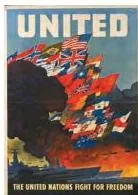
The poster on this page was made by the US Office of War Information during the Second World War, under the Declaration by United Nations of 1942. It shows the flags of every Allied nation and reflects the belligerent origins of the UN — an organisation born out of war, not after peace had already arrived (NCERT, p. 48).
Figures from pages 50 to 57: cartoons about reform and membership
The cartoon in the reform section makes a third, deliberately provocative proposal: “Cold War or no Cold War, one reform is needed above all. Only democratic leaders should be allowed to represent their countries in the UN.” It invites you to notice how hard reform is — everyone agrees something must change, but nobody can agree on what (NCERT, p. 50).

The World Bank logo marks the profile of the bank on NCERT page 53. Created during the Second World War in 1944, it lends and grants money to developing countries, but is criticised for setting their economic agenda, attaching stringent conditions and forcing free-market reforms.

The speaker in this cartoon answers the anti-veto argument from the other side: “It’s actually the weaker countries who need a veto, not those who already have so much power.” The chapter explains why the veto is so hard to touch — the permanent members will not surrender it, and without it they might lose interest in the UN (NCERT, p. 55).

The WTO logo identifies the organisation that sets the rules for global trade. Set up in 1995 as the successor to GATT, it decides unanimously in theory, but developing countries complain of non-transparent procedures and of being pushed around by big powers (NCERT, p. 57).
This cartoon in the India section captures the country’s dilemma in one line: “Do we want to oppose the bossism of the big five or do we want to join them and become another boss?” India wants a permanent seat, yet the cartoon reminds you that joining the club is itself a political choice open to criticism (NCERT, p. 57).
Figures from pages 58 to 60: US power and the human rights NGOs

The IAEA logo introduces the agency established in 1957 to implement President Eisenhower’s “Atoms for Peace” proposal. Its teams regularly inspect nuclear facilities to make sure civilian reactors are not used for military purposes (NCERT, p. 58).
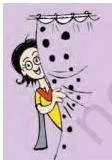
This cartoon makes the unipolar argument concrete: “What happens if the UN invites someone to New York but the US does not issue a visa?” The joke rests on a real fact in the text — the UN is physically located on US territory, which gives Washington an extra lever of influence over it (NCERT, p. 58).
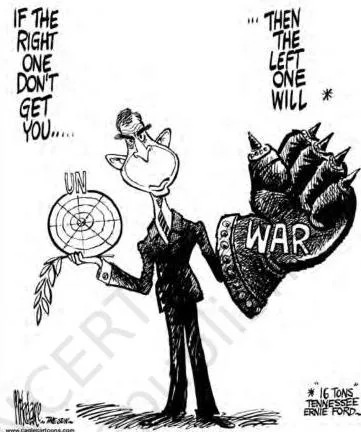
The chapter’s own verdict is drawn as a cartoon: the UN is not a great balance to US power. But the text immediately adds the qualification — the UN still provides a space where arguments against specific US policies are heard and compromises can be shaped (NCERT, p. 59).
Amnesty International’s logo introduces the first of two human rights NGOs. It promotes all the rights in the Universal Declaration of Human Rights and publishes reports whose main focus is the misconduct of government authorities — which is why governments are not always happy with them (NCERT, p. 59).

Human Rights Watch is the largest international human rights organisation in the US. Its reports draw global media attention to abuses, and it helped build coalitions to ban landmines, stop child soldiers and establish the International Criminal Court (NCERT, p. 60).
Key terms defined: the language of the chapter
These terms appear again and again in the exercises. Each definition is short enough to reuse in an answer, with the NCERT page where the chapter introduces it.
- International organisation — an organisation created by and responding to states, not a super-state with authority over its members; it helps states resolve disputes peacefully and cooperate (p. 46).
- UN Charter — the founding document of the UN, signed on 26 June 1945 by 50 nations; Poland signed on 15 October, making 51 original members (p. 48).
- Permanent members — the five states holding permanent Security Council seats and the veto: the US, Russia, the UK, France and China (p. 49).
- Non-permanent members — ten members elected by the General Assembly for two-year terms; they cannot be immediately re-elected, hold no veto, and are chosen to represent all continents (p. 55).
- Veto — the negative vote of a permanent member that can stall a Security Council decision even if every other member votes for it (p. 55).
- General Assembly — the organ of all 193 member states, one vote each, whose decisions are not binding (p. 50).
- Security Council — the 15-member organ whose decisions are binding on all UN members; five permanent and ten elected members (p. 50).
- Specialised agencies — independent organisations linked to the UN that work in specific fields, such as the WHO, IMF and ILO (p. 50).
- Related organisations — organisations attached to the UN system that report to its organs, such as the IAEA, which reports to both the Security Council and the General Assembly (p. 50).
- Peacebuilding Commission — a body created at the 2005 summit; the chapter asks which of the world’s many conflicts it should intervene in (p. 56).
- Human Rights Council — established at the 2005 summit and operational since 19 June 2006 (p. 56).
Common mistakes in this chapter and the correction
Most marks are lost in this chapter on the veto and on who belongs to which UN organ. The true/false exercise (Questions 1 and 2) is built around exactly these errors, and so is this table.
| Mistake | Correct rule | How to check your answer |
|---|---|---|
| The Secretary-General can use the veto. | Only the five permanent members of the Security Council possess the veto; the Secretary-General heads the Secretariat. | Ask who holds a permanent seat: only the US, Russia, the UK, France and China. Tested in Q1(a) and Q1(c). |
| One veto cannot stop a decision. | One negative vote by any permanent member can stall a Security Council resolution, even if all other members vote for it. | Re-read the veto definition on p. 55 — any permanent member’s negative vote can stall the decision. Tested in Q1(d). |
| All peace and security issues are handled only in the Security Council. | War, peace and differences between member states are discussed in the General Assembly as well as the Security Council. | Look at the UN System chart on p. 50, which lists both organs under war and peace. Tested in Q2(a). |
| General Assembly members automatically belong to every other UN organ and agency. | Each organ has its own membership: the Security Council has 15 members, ECOSOC has 54, the ICJ has 15 judges. | Check how each organ chooses its members — none takes all GA members automatically. Tested in Q2(d). |
| The IAEA is a principal organ of the UN. | The IAEA is a related organisation that reports to both the Security Council and the General Assembly. | Find the IAEA on the UN System chart — it sits under related organisations, not principal organs (p. 50). |
| The 1965 expansion added permanent members. | The Security Council grew from 11 to 15 members in 1965, but the number of permanent members did not change, and the size has stayed static since. | Count the permanent members today: five, the same five as in 1945 (p. 57). |
Exam notes: what the exercise questions are testing
The chapter’s own exercises (pp. 61–62) show what the book considers important. This table maps each question to the concept it tests. Textbook contents and the examinable portion of the syllabus are not always identical — check the current official CBSE syllabus before you finalise your revision plan.
| Questions | What they test |
|---|---|
| Q1–Q2 | The veto and the way the UN functions, through true/false statements |
| Q3, Q9 | India’s case for a permanent Security Council seat — the grounds and the objections |
| Q4 | The IAEA’s mandate of safe and peaceful nuclear technology |
| Q5 | The WTO as the successor to GATT |
| Q6 | Basic facts: the UN’s objective, the Secretary-General, Council membership |
| Q7 | Matching organs and agencies to their functions |
| Q8 | The Security Council’s functions |
| Q10, Q12 | The reform debate — the difficulties, and whether restructuring the Council is the whole of reform |
| Q11 | Why the UN remains indispensable despite its failures |
For the reasoning questions (Q8–Q12), a full answer names the organ or organisation, states its function, and supports it with one fact from the chapter — a number, a year or a criticism.
An answer on the Security Council, for instance, should mention its 15 members, the five permanent seats with the veto, the two-year elected terms and the fact that its decisions bind all UN members.
The STEPS activity on NCERT page 54 is also worth thinking through: six groups apply six proposed criteria and produce six different lists of permanent members. It shows why the criteria debate has no easy answer.
Worked answers: Questions 1 and 2 (true/false)
These two questions are the chapter’s own check on the veto and the UN’s structure. Each answer below gives the verdict and the reason from the text.
| Q1 statement | Mark | Why |
|---|---|---|
| (a) Only the permanent members of the Security Council possess the veto power. | Correct | The chapter states this directly — “most importantly, the non-permanent members do not have the veto power” (p. 55). |
| (b) It’s a kind of negative power. | Correct | The permanent members “can vote in a negative manner” to block a decision (p. 55). |
| (c) The Secretary-General uses this power when not satisfied with any decision. | Wrong | Only the five permanent members hold the veto; the Secretary-General heads the Secretariat and has no vote in Council decisions. |
| (d) One veto can stall a Security Council resolution. | Correct | “Any permanent member’s negative vote can stall the decision” even if all other members vote for it (p. 55). |
| Q2 statement | Mark | Why |
|---|---|---|
| (a) All security and peace related issues are dealt with in the Security Council. | Wrong | War, peace and differences between member states are discussed in the General Assembly as well as the Security Council (p. 49). |
| (b) Humanitarian policies are implemented by the main organs and specialised agencies spread across the globe. | Correct | The UN System chart shows programmes and funds such as UNHCR and WFP delivering humanitarian work worldwide (p. 50). |
| (c) Having consensus among the five permanent members on security issues is vital for its implementation. | Correct | Because any one permanent member’s negative vote can stall a decision, the five must agree before a security decision can go through (p. 55). |
| (d) The members of the General Assembly are automatically the members of all other principal organs and specialised agencies of the UN. | Wrong | Each organ has its own membership — the Council has 15 members, ECOSOC has 54, the ICJ has 15 judges (p. 50). |
Answers to the remaining objective questions, straight from the text:
- Q3 — (d) India’s growing economic power and stable political system, the only option the chapter actually lists as a justification; nuclear capability appears among the concerns others raise (p. 58).
- Q4 — (b) the International Atomic Energy Agency.
- Q5 — (a) the General Agreement on Trade and Tariffs, of which the WTO is the successor (p. 57).
- Q6 — (a) to prevent international conflict and facilitate cooperation among states; (b) the Secretary-General; (c) five permanent and ten non-permanent members; (d) António Guterres.
For Q7, the matching pairs, in the order the organs and agencies appear in the exercise:
| Organ / agency | Function |
|---|---|
| General Assembly | (g) Debates and discusses global issues |
| Security Council | (b) Preservation of international peace and security |
| Economic and Social Council | (c) Looks into the economic and social welfare of the member countries |
| International Court of Justice | (e) Resolves disputes between and among member countries |
| Secretariat | (h) Administration and coordination of UN affairs |
| International Atomic Energy Agency | (d) Safety and peaceful use of nuclear technology |
| UN High Commission for Refugees | (f) Provides shelter and medical help during emergencies |
| World Trade Organisation | (j) Facilitates free trade among member countries |
| International Monetary Fund | (a) Oversees the global financial system |
| World Health Organisation | (i) Providing good health for all |
For Q12, the chapter supplies the framework: reform has two parts, so restructuring the Security Council is one side of it, not the whole of it. A good answer discusses both sides — what restructuring would change, and what the jurisdiction debate would add.
Quick revision summary: the chapter in ten points
- States create international organisations, and the organisations respond to states — they are not super-states. Their two jobs are peaceful conflict resolution and cooperation on problems like disease and global warming (pp. 46–47).
- The UN was founded in 1945 as the successor to the League of Nations, which had failed to prevent the Second World War; 51 states signed its Charter (p. 48).
- The UN has six principal organs: the General Assembly, Security Council, Economic and Social Council, International Court of Justice, Secretariat and Trusteeship Council, suspended in 1994 (p. 50).
- The Security Council has 15 members — five permanent (the US, Russia, the UK, France and China) with veto power, and ten elected for two-year terms. The veto lets any permanent member stall a decision by a negative vote even if all others vote for it (pp. 49–50, 55).
- Two kinds of reform face the UN: reform of structures and processes, and a review of the issues within its jurisdiction (p. 50).
- Proposed criteria for new Security Council members include economic power, military power, budget contribution, population, democracy and human rights, and geographical and cultural diversity (pp. 52–53).
- At the 2005 summit the UN created a Peacebuilding Commission and a Human Rights Council, accepted a responsibility to protect, and agreed on the MDGs, a Democracy Fund, condemnation of terrorism and winding up the Trusteeship Council (pp. 55–56).
- India claims a permanent seat on grounds of population, democracy, peacekeeping, economic emergence and reliable payments, but faces objections over Pakistan, nuclear capability and the claims of Brazil, Germany, Japan and South Africa (pp. 57–58).
- In a unipolar world the UN is not a great balance to US power, yet it still brings nations into discussion — and without it, the chapter says, the world would be worse off (pp. 59–60).
- The IMF, World Bank, WTO and IAEA work alongside the UN, while Amnesty International and Human Rights Watch campaign on human rights from outside it (pp. 47, 53, 57, 58, 59, 60).
Related chapters and resources
This listing is maintained for the 2026-27 academic session using the NCERT textbook information available to us. NCERT remains the authority for confirming the latest edition.
The chapters around this one build the same argument: US Hegemony in World Politics explains how the US became the sole superpower, and Security in the Contemporary World carries the reform agenda forward. Open both from the Class 12 Political Science notes page, which covers the whole of Contemporary World Politics.
For the other prescribed textbook in Class 12 Political Science, see the notes on Politics of Planned Development. To revise the whole course, use the Class 12 hub or browse the full collection of CBSE notes.
The official sources are the International Organisations Class 12 chapter PDF on ncert.nic.in, the United Nations website — which the chapter itself recommends for details of the UN system — and the official CBSE website for the current syllabus.
Sources and data verification
This page describes Chapter 4, International Organisations, of the NCERT Class 12 Political Science textbook Contemporary World Politics, in the official edition published on ncert.nic.in. It covers only this chapter; the book’s other chapters each have their own guide.
The figures above are the chapter’s own emblem, posters, cartoons and logos as printed in that edition. NCERT settles textbook editions, contents and the official PDF, while CBSE settles the curriculum, syllabus and examinations. For your board exam, the current syllabus on cbse.gov.in is the final authority, because textbook contents and the examinable syllabus are not always identical.
Frequently asked questions about International Organisations Class 12
What is the veto power and which countries have it?
The veto is the negative vote of a permanent member of the Security Council. If any permanent member votes against a decision, the decision is stalled even if all other members vote for it (NCERT, p. 55). The five permanent members are the United States, Russia, the United Kingdom, France and China (NCERT, p. 49).
Why does India want a permanent seat in the Security Council?
India is the world’s most populous country and largest democracy, has participated in virtually all UN initiatives, has a long peacekeeping record and has never faltered on payments. Its economic emergence and the symbolic status a permanent seat brings strengthen the claim (NCERT, pp. 57–58).
The obstacles are Pakistan’s reluctance, concerns about India’s nuclear capability and the demand that Brazil, Germany, Japan and South Africa also be accommodated (NCERT, p. 58).
What is the difference between the General Assembly and the Security Council?
The General Assembly has all 193 member states, one vote each, and its decisions are not binding. The Security Council has 15 members — five permanent with veto power and ten elected for two-year terms — and its decisions bind all UN members (NCERT, p. 50). Both discuss war, peace and differences between member states (NCERT, p. 49).
Is the IMF a part of the United Nations?
Yes. The UN System chart classifies the IMF as a specialised agency (non-subsidiary) of the UN (NCERT, p. 50). It oversees financial institutions and regulations that act at the international level, but its members do not have an equal say — the G-7 countries together hold 41.29% of the votes (NCERT, p. 47).
What are the two kinds of UN reforms discussed in the chapter?
Reform of the organisation’s structures and processes — mainly the Security Council’s membership and the veto — and a review of the issues that fall within the UN’s jurisdiction, such as whether the UN should do more on peace and security or stay with development and humanitarian work (NCERT, p. 50).
Why is the UN called indispensable even though it has failed to prevent wars?
Because it is the one place where more than 190 nations can meet to discuss conflict and development, and it provides an arena where US attitudes and policies can be modified through discussion and compromise. As the chapter puts it, the UN is an imperfect body, but without it the world would be worse off (NCERT, pp. 59–60).
Reference: NCERT Class 12 Political Science textbook, chapter 4, official edition on ncert.nic.in.
Explore Class 12 Political Science Books
- Previous: Politics of Planned Development
- Next: Security in the Contemporary World
Related chapters:
- The End of Bipolarity
- Challenges of Nation Building
- Contemporary Social and Economic Centres of Power