
Chapter 2, Contemporary Social and Economic Centres of Power Class 12, is the second chapter of the NCERT Class 12 Political Science book Contemporary World Politics, printed on NCERT pages 15–28. The official chapter PDF is right below, figures, cartoons and exercises included.
Note that the running head on the printed pages reads ‘Contemporary Centres of Power’ — it is the same chapter, so you are not lost if your book shows the shorter name.
Download Contemporary Social and Economic Centres of Power Class 12 PDF
The complete chapter is a free official NCERT download.
Open the NCERT Class 12 Political Science Chapter 2 Contemporary Social and Economic Centres of Power Class 12 PDF on ncert.nic.in to read all 14 printed pages exactly as in the book — the maps, cartoons, timeline and the exercises at the end included.
| What the chapter holds | Count | Where it is used |
|---|---|---|
| Printed pages | 14 | |
| Figures with NCERT captions | 9 | |
| Exercise questions | 14 | answered in our NCERT Solutions |
| Official NCERT PDF | Download the chapter PDF | the chapter exactly as NCERT publishes it |
Chapter at a Glance
The table below shows at a glance what this file holds — its sections, its figures and its exercise questions. What a table cannot show is the context, so here it is: Chapter 2 sits on NCERT pages 15–28 of Contemporary World Politics, and its exercises begin on page 28.
Two naming details are worth knowing. The running head on the printed pages reads ‘Contemporary Centres of Power’ while the full title reads ‘Contemporary Social and Economic Centres of Power’ — same chapter, two names.
And this chapter has no printed summary; it closes straight into the exercises, so the five-minute recap further down is built from the section text in our own words.
What This Chapter Covers
The chapter asks one question: what happens to world politics after the end of the bipolar structure of world politics in the early 1990s? Its answer is that alternative centres of political and economic power — the European Union in Europe, ASEAN in Asia and a rising China — have emerged and can limit America’s dominance (NCERT, p. 15).
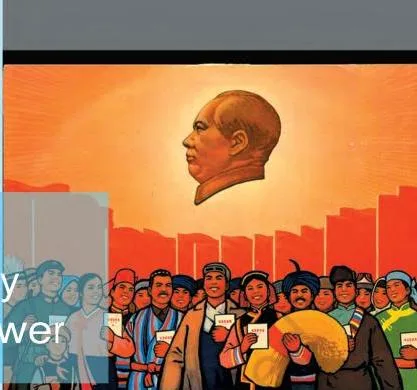
The two images represent two phases of China’s history. The red poster shows the ideology that guided China in its early phase after the Revolution; the photograph of Shanghai symbolises the economic power it built later (NCERT, p. 15). That pairing — a revolutionary state transforming itself into an economic powerhouse — is the chapter’s central theme.
Here is the chapter in eight blocks, with the printed pages where each section appears:
- European Union (NCERT pp 16–19) — how a continent ruined by war rebuilt itself into an economic and political bloc, with four kinds of influence and their limits.
- Timeline of European Integration (NCERT pp 18–19) — dated steps from the European Coal and Steel Community in 1951 to the Brexit referendum in 2016.
- ASEAN (NCERT pp 19–22) — ten Southeast Asian states cooperating without supranational structures, and the three pillars of the ASEAN Community.
- East Asia–Pacific map (NCERT p. 20) — an activity map for locating the ASEAN members and the ASEAN Secretariat.
- Rise of the Chinese Economy (NCERT pp 22–25) — the path from the Soviet model to the open door policy, and the costs of the reforms.
- India–China Relations (NCERT pp 25–27) — from the 1962 border conflict to strategic and economic engagement.
- Japan (NCERT pp 27–28) — the high-technology economy that renounces war under Article 9.
- South Korea (NCERT pp 27–28) — the Miracle on the Han River.
Key Concepts: The European Union, ASEAN and China
These three bodies are the chapter’s alternative centres of power. The EU is built on regional integration, ASEAN on regional cooperation without loss of sovereignty, and China on state-led economic growth. Understand how each one works, and you have understood the chapter.
The European Union: from post-war cooperation to supranational union
This section answers one question: how did a continent ruined by war rebuild itself into a single political and economic bloc? The EU is the chapter’s first example of regional cooperation turning into a centre of power.
As the Second World War ended, European leaders faced the ‘Question of Europe’: return to old rivalries, or rebuild on institutions that made a positive international order possible? The war had shattered both the assumptions and the structures of European relations.
American Marshall Plan money flowed through the Organisation for European Economic Cooperation (OEEC), set up in 1948, and the Council of Europe followed in 1949.
Economic integration then proceeded step by step: the European Economic Community (EEC) in 1957, the addition of a directly elected European Parliament, and — after the collapse of the Soviet bloc — the European Union itself in 1992, created by the Treaty of Maastricht with a single currency to come (NCERT pp 16–18).
The EU now has its own flag, anthem, founding date and currency, even though the attempt to write a constitution failed (NCERT, p. 16). The chapter gives it four kinds of influence:
- Economic — the EU’s GDP is projected at about 19.35 trillion dollars for 2024, its currency the euro can threaten the US dollar, its share of world trade is larger than the US’s, and it acts as an important bloc in the World Trade Organisation (NCERT p. 17).
- Political and diplomatic — France holds a permanent seat on the United Nations Security Council and other EU members serve as non-permanent members; the EU influenced the US position on Iran’s nuclear programme and prefers diplomacy, economic investments and negotiation over coercion (NCERT p. 18).
- Military — the EU’s combined armed forces are the second largest in the world, its defence spending is second after the US, and France holds nuclear arsenals of about 335 warheads (NCERT p. 18).
- Supranational — as a supranational organisation, the EU can intervene in economic, political and social areas of its member states (NCERT p. 19).

This graphic is the number behind the first bullet above: a projected GDP of about 19.35 trillion dollars in 2024. It establishes the EU’s economic weight before the chapter turns to its political, military and supranational influence.
But the EU is not a nation-state. Member states keep their own foreign and defence policies: Britain’s Tony Blair was America’s partner in the Iraq invasion while Germany and France opposed it.
Euro-skepticism runs deep in parts of Europe. Margaret Thatcher kept the UK out of the European Market; Denmark and Sweden resisted the Maastricht Treaty and the euro; and in 2016 a British referendum chose Brexit by 51.9 per cent (NCERT p. 19).
ASEAN: the ASEAN Way and the three pillars
ASEAN is the Asian contrast to the EU: regional cooperation that works without giving up national sovereignty. Where the EU built supranational structures, ASEAN deliberately refused them.
Before and during the Second World War, Southeast Asia suffered the economic and political consequences of repeated colonialisms, both European and Japanese. After the war came nation-building, poverty and the pressure to align with one great power or another in the Cold War — a recipe for conflict.
Broad efforts such as the Bandung Conference and the Non-Aligned Movement were ineffective for establishing conventions of informal cooperation, so the region made its own (NCERT pp 19–20).
ASEAN was established in 1967 when Indonesia, Malaysia, the Philippines, Singapore and Thailand signed the Bangkok Declaration. Its primary objective was to accelerate economic growth and, through that, social progress and cultural development; a secondary objective was regional peace and stability based on the rule of law and the principles of the UN Charter.
Brunei Darussalam, Vietnam, Lao PDR, Myanmar (Burma) and Cambodia joined later, taking ASEAN to ten members (NCERT p. 20).
Unlike the EU, ASEAN has little desire for supranational institutions. Its working style is the ASEAN Way — a form of interaction that is informal, non-confrontationist and cooperative, with respect for national sovereignty critical to its functioning (NCERT pp 20–21).

The logo makes the membership concrete: ten stalks of paddy for ten member states, bound in a circle of unity. It is a visual reminder that ASEAN’s strength comes from solidarity, not from overriding its members.
In 2003 ASEAN agreed to establish an ASEAN Community with three pillars: the ASEAN Security Community, the ASEAN Economic Community and the ASEAN Socio-Cultural Community. The security community rests on the conviction that territorial disputes should not escalate into armed confrontation. The ASEAN Regional Forum (ARF), established in 1994, carries out coordination of security and foreign policy (NCERT p. 21).
ASEAN remains principally an economic association. Its economy is much smaller than the US, EU or Japan, but it is growing much faster, which is the source of its rising influence.
The Economic Community aims at a common market and production base, an improved dispute settlement mechanism, and a Free Trade Area for investment, labour and services; the US and China have already moved fast to negotiate FTAs with ASEAN (NCERT p. 21).
Its Vision 2020 defines an outward-looking role. ASEAN has mediated the end of the Cambodian conflict and the East Timor crisis, and it is the only regional association in Asia that provides a political forum where Asian countries and major powers can discuss political and security concerns (NCERT p. 22).
India’s connection comes late in the section. The ‘Look East’ policy from the early 1990s, upgraded to the ‘Act East’ policy since 2014, led to greater economic interaction with ASEAN, China, Japan and South Korea; the ASEAN-India Free Trade Agreement came into effect in 2010 (NCERT p. 22).
The chapter also asks why ASEAN succeeded whereas SAARC did not (p. 22). Its answer points to ASEAN’s strength: policies of interaction and consultation with member states, with dialogue partners and with non-regional organisations.
China’s economic rise: from the Soviet model to the open door
China matters to this chapter because it has been the fastest growing economy since reforms began in 1978 and is projected to overtake the US as the world’s largest economy by 2040. The question is how that growth was built, and at what cost (NCERT p. 22).
After the 1949 revolution under Mao, China’s economy was based on the Soviet model. The state built a heavy industry sector from capital accumulated from agriculture, substituted domestic goods for imports, and assured employment and welfare to all citizens. China moved ahead of most developing countries in education and health.
But the model had limits: growth of 5–6 per cent ran against population growth of 2–3 per cent, agriculture produced no surplus for industry, and by the 1970s industrial production was too slow, trade minimal and per capita income very low. The chapter compares this directly to the crisis of the state-controlled economy in the USSR, discussed in its Chapter 1 (NCERT pp 22–23).
Three moves broke the deadlock: relations with the United States in 1972, Zhou Enlai’s four modernisations of 1973 (agriculture, industry, science and technology, and military), and Deng Xiaoping’s open door policy of 1978, which aimed at higher productivity through investments of capital and technology from abroad (NCERT p. 23).
China did not adopt shock therapy. It opened its economy step by step, with the state playing the central role: privatisation of agriculture in 1982, privatisation of industry in 1998, and trade barriers eliminated only inside Special Economic Zones (SEZs) where foreign investors could set up enterprises (NCERT pp 23–24).
The results were dramatic. Privatisation of agriculture raised agricultural production and rural incomes; high rural savings fed an exponential growth in rural industry; and the new trading laws and SEZs produced a phenomenal rise in foreign trade.
China became the world’s most important destination for foreign direct investment (FDI), built large foreign exchange reserves, and joined the WTO in 2001 (NCERT pp 24–25).
The chapter is honest about the costs: nearly 100 million people looking for jobs, female working conditions as bad as in eighteenth- and nineteenth-century Europe, environmental degradation, corruption, and inequality between rural and urban residents and between coastal and inland provinces (NCERT p. 25).
Regionally, China is now the driver of East Asian growth; it supported the ASEAN economies after the 1997 financial crisis, invests in Latin America and Africa, and hopes to integrate Taiwan into its economy. Keep the in-text comparison handy: 6 SEZs in China against more than 200 approved in India — the book asks whether that is good for India (NCERT pp 24–25).
India–China relations: from 1962 to strategic engagement
This section explains why India’s biggest neighbour is both a partner and a problem. The chapter moves from ancient distance, through the shock of 1962, to today’s strategic and economic engagement.
Both were great powers before Western imperialism. China’s tributary system brought Mongolia, Korea, parts of Indo-China and Tibet under its authority at different times, while Indian kingdoms extended their influence too. The regions each influenced rarely overlapped, so the two civilisations knew little of each other (NCERT p. 25).
After independence the slogan ‘Hindi-Chini bhai-bhai’ was briefly popular. Then came the Chinese takeover of Tibet in 1950, and the border conflict of 1962 over competing territorial claims principally in Arunachal Pradesh and in the Aksai Chin region of Ladakh (NCERT pp 25–26).
India suffered military reverses, and diplomatic relations stayed downgraded until 1976. China’s leadership became more pragmatic from the mid-1970s, border talks began in 1981, and Rajiv Gandhi’s visit of December 1988 was the turning point (NCERT p. 26).
Since then both sides have maintained ‘peace and tranquility’ on the border, signed cultural and science-technology agreements, and opened four border posts for trade. Trade has grown about 30 per cent a year since 1999, from 338 million dollars in 1992 to over 84 billion dollars in 2017 (NCERT p. 26).
The complications never derailed the relationship. India’s 1998 nuclear tests were justified on the grounds of a threat from China; China contributed to Pakistan’s nuclear programme and kept military relations with Bangladesh and Myanmar that India viewed as hostile.
Yet boundary talks continued without interruption, military-to-military cooperation grew, and leaders now visit each other with greater frequency (NCERT pp 26–27). The chapter also names recent frictions: border disputes, the China-Pakistan economic corridor, and China’s support to Pakistan in the UN against India’s move on counter-terrorism (NCERT p. 27).
Japan and South Korea: the other Asian centres
The chapter closes with two Asian economies that reached power through technology and industrial policy — not through size or natural resources.
Japan has very few natural resources and imports most of its raw materials, yet it became the third largest economy in 2017, an OECD member since 1964, the only Asian member of the G-7 and the eleventh most populous nation.
It is also the only nation that suffered destruction by nuclear bombs, and the second largest contributor to the UN’s regular budget at about 10 per cent (NCERT pp 27–28).
As per Article 9 of the Japanese Constitution, “the Japanese people forever renounce war as a sovereign right of the nation and the threat or use of force as means of settling international disputes.”
Japan has had a security alliance with the US since 1951, and its military spending of only one per cent of GDP is still the world’s seventh largest (NCERT p. 27).
The book then asks whether Japan can effectively function as an alternative centre of power. The evidence for is its economic and technological strength; the evidence against is a constitution that renounces war and an alliance that ties its security to the US.
South Korea was divided from the North along the 38th Parallel at the end of the Second World War; the Korean War of 1950–53 deepened the rivalry, and both Koreas joined the UN on 17 September 1991. Between the 1960s and the 1980s South Korea rapidly developed into an economic power — the Miracle on the Han River.
South Korea joined the OECD in 1996; in 2017 it had the eleventh largest economy and the tenth largest military expenditure, with an HDI rank of 18 in the 2016 Human Development Report. The book credits successful land reforms, rural development, extensive human resources development, rapid equitable economic growth, export orientation, strong redistribution policies, public infrastructure development, and effective institutions and governance (NCERT p. 28).
Figure Walkthrough: Reading the Chapter’s Cartoons and Photos
The images in this chapter are not decoration — NCERT prints a question beside most of them. This section reads each image with the chapter’s own text.
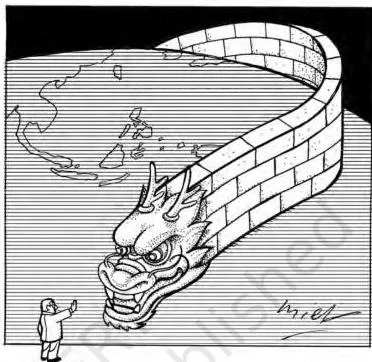
The chapter’s caption asks who the little man is and whether he can stop the dragon. The book does not name him. Its evidence suggests the point: no one has stopped the rise — China has been the fastest growing economy since 1978, is the world’s most important destination for foreign direct investment, and joined the WTO in 2001 (NCERT pp 23–25).

The book places this cartoon against two passages: the new economic policies helped the Chinese economy to break from stagnation, and privatisation of agriculture led to a remarkable rise in agricultural production and rural incomes (NCERT pp 23–24). The ‘then’ panel is the Soviet-model economy; the ‘now’ panel is the economy of SEZs, foreign investment and phenomenal trade growth.
The bicycle duality (NCERT p. 25, discussed in prose only). China is the largest user of bicycles in the world, and the cartoon uses the bicycle to comment on a duality in today’s China: socialist everyday life beside capitalist economic power. The book asks whether this is a contradiction.
The chapter’s answer is that the two coexist — China did not replace the state with the market; the state played and continues to play a central role in setting up a market economy (NCERT pp 23–24).
The Titanic cartoon (NCERT p. 19, discussed in prose only). The cartoon appeared in 2003, when the EU’s initiative to draft a common constitution failed. The Titanic was the grandest ship of its age, built to be unsinkable — and it sank on its maiden voyage.
The cartoonist pictures the EU as a magnificent project heading for disaster, with the failed constitution as the first iceberg. The chapter’s counter-evidence: the EU continued, keeping its flag, anthem, founding date and currency, and acting as an influential bloc (NCERT pp 17–19).

This image sits beside a passage whose point is in one line: the 1998 tests did not stop greater interaction. The tests, China’s contribution to Pakistan’s nuclear programme and its military ties with Bangladesh and Myanmar all failed to derail the relationship — boundary talks continued, military-to-military cooperation grew, and leaders visit each other more often (NCERT pp 26–27).

Japan’s route to power is technology. The chapter opens the Japan section with brands such as Sony, Panasonic, Canon, Suzuki, Honda, Toyota and Mazda, all known for high-technology products; ASIMO, Honda’s humanoid robot, is that story in one image.
Japan has very few natural resources and imports most of its raw materials, yet it became the third largest economy in 2017 by selling technology, not resources (NCERT p. 27).
South Korea’s rise between the 1960s and the 1980s is called the Miracle on the Han River, and Seoul sits on that river. The skyline is the visible result of rapid, equitable economic growth, export orientation and strong public infrastructure — the factors that lifted South Korea’s HDI rank to 18 in the 2016 report (NCERT p. 28).
Finally, the East Asia–Pacific map on NCERT p. 20 is an activity, not a reading map. The box beside it asks you to locate the ASEAN members and find the location of the ASEAN Secretariat — a useful self-test for the names of the ten members.
Definitions: Key Terms from the Chapter
These terms repeat throughout the chapter, and the chapter itself has no printed glossary. Here is what each means as the book uses it.
| Term | Meaning as the book uses it | NCERT page |
|---|---|---|
| Supranational organisation | An organisation that can intervene in the economic, political and social areas of its member states; the EU is the chapter’s example. | p. 19 |
| Schengen visa | Under the Schengen agreement, one visa from a single EU country allows entry into most other EU member states. | p. 18 |
| Euro-skepticism | Deep-seated resistance in parts of Europe to the EU’s integrationist agenda; Denmark and Sweden, for example, resisted the euro. | p. 19 |
| ASEAN Way | The informal, non-confrontationist and cooperative form of interaction among ASEAN members, with respect for national sovereignty. | pp 20–21 |
| ASEAN Regional Forum (ARF) | Established 1994; the organisation that carries out coordination of security and foreign policy for ASEAN. | p. 21 |
| Special Economic Zone (SEZ) | An area where China eliminated trade barriers so foreign investors could set up enterprises; the engine of its foreign trade. | pp 23–24 |
| Four modernisations | Zhou Enlai’s 1973 proposal to modernise agriculture, industry, science and technology, and the military. | p. 23 |
| Open door policy | Deng Xiaoping’s 1978 policy of economic reforms to generate higher productivity through capital and technology from abroad. | p. 23 |
| Tributary system | China’s historical arrangement by which states on its borders — Mongolia, Korea, parts of Indo-China and Tibet — accepted its authority. | p. 25 |
| Article 9 | The Japanese constitution’s clause renouncing war as a sovereign right and the use of force to settle international disputes. | p. 27 |
| Miracle on the Han River | The term for South Korea’s rapid development into an economic power between the 1960s and the 1980s. | p. 28 |
Common Mistakes Students Make in This Chapter
The chapter’s dates, initials and names are easy to scramble. These are the mix-ups students actually make, with the correction and where to check it.
| Mistake | Correct rule | How to check your answer |
|---|---|---|
| Placing the EEC after the EU | The EEC came first (Treaties of Rome, 1957); the EU was created by the Maastricht Treaty in 1992; ARF came in 1994; China entered the WTO in 2001. | Timeline, NCERT pp 18–19; exercise Q1. |
| Calling the ASEAN Way a defence policy | The ASEAN Way is informal, non-confrontationist and cooperative interaction. Security is the business of the ASEAN Security Community and the ARF. | NCERT pp 20–21; exercise Q2. |
| Claiming China used shock therapy | China opened step by step, with the state central: agriculture in 1982, industry in 1998, SEZs for foreign investment. | NCERT pp 23–24; exercises Q3 and Q9. |
| Saying ASEAN was founded by ten countries | Five states signed the Bangkok Declaration in 1967; ten members were reached only after later accessions. | NCERT p. 20. |
| Treating the EU as a single nation-state | The EU is supranational in some areas, but member states keep their own foreign and defence policies, and Euro-skeptics remain inside. | NCERT p. 19. |
| Mixing up the 1962 disputed regions | The conflict was over claims principally in Arunachal Pradesh and the Aksai Chin region of Ladakh. | NCERT pp 25–26; exercise Q4(a). |
| Treating Look East and Act East as the same policy | Look East began in the early 1990s; Act East came in 2014; the ASEAN-India FTA followed in 2010. | NCERT p. 22. |
| Reading Article 9 as proof Japan has no military | Japan renounces war under Article 9, yet its military spending of one per cent of GDP is the world’s seventh largest. | NCERT pp 27–28. |
Exam Notes: What to Practise from This Chapter
The chapter’s exercise questions are the best check of whether you have understood it, and the first four are answered directly by the text. The answers below are worked from the chapter’s own dates and definitions.
Q1. Chronological order (exercise Q1)
Order the four milestones by their dates:
- b. Establishment of the EEC — 1957, by the Treaties of Rome (NCERT p. 18).
- c. Establishment of the EU — 1992, by the Treaty of Maastricht (NCERT p. 18).
- d. Birth of ARF — 1994 (NCERT p. 21).
- a. China’s accession to WTO — 2001 (NCERT p. 24).
Q2. The ASEAN Way (exercise Q2)
Answer: (b) — a form of interaction among ASEAN members that is informal and cooperative. Option (c) confuses the ASEAN Way with the separate security institutions; (a) and (d) describe no concept in the chapter.
Q3. Open door policy (exercise Q3)
Answer: (a) China — Deng Xiaoping announced the open door policy in 1978 (NCERT p. 23).
Q4. Fill in the blanks (exercise Q4)
- a. Arunachal Pradesh and the Aksai Chin region (NCERT pp 25–26).
- b. 1994 (NCERT p. 21).
- c. The United States, in 1972 (NCERT p. 23).
- d. Marshall Plan, which influenced the establishment of the OEEC in 1948 (NCERT p. 16).
- e. The ASEAN Regional Forum (ARF) (NCERT p. 21).
Q5–Q14. The descriptive questions
Each descriptive question draws on a few pages of the chapter. A full answer should state the point first, then support it with the chapter’s dates and numbers.
| Question | Ask it about | Draws on | Two or three points a full answer needs |
|---|---|---|---|
| Q5 | Objectives of regional organisations | NCERT pp 15, 19–20 | Alternative centres limiting US dominance; economic growth and social progress; peace and stability based on the rule of law and UN Charter principles. |
| Q6 | Geographical proximity | NCERT pp 19–20 | Shared colonial experience in Southeast Asia; common problems of nation-building and poverty; nearness makes informal cooperation possible. |
| Q7 | ASEAN Vision 2020 | NCERT p. 22 | Outward-looking role; negotiation over conflicts; mediation in the Cambodian conflict and East Timor crisis; annual East Asian cooperation talks. |
| Q8 | Pillars of the ASEAN Community | NCERT p. 21 | Security, Economic and Socio-Cultural pillars; no armed escalation of territorial disputes; common market and production base; dispute settlement mechanism. |
| Q9 | Present vs command economy | NCERT pp 22–25 | Then: state-owned heavy industry, import substitution, assured employment, 5–6 per cent growth. Now: privatised agriculture and industry, SEZs, FDI, WTO 2001, plus the social costs. |
| Q10 | EU formation | NCERT pp 16–19 | The ‘Question of Europe’; Marshall Plan and OEEC 1948; Council of Europe 1949; EEC 1957; European Parliament; Maastricht 1992 and the single currency. |
| Q11 | EU influence | NCERT pp 18–19 | The four kinds: economic (19.35 trillion dollar GDP projection for 2024, euro, world trade share), political-diplomatic (France’s permanent UNSC seat), military (second largest forces, about 335 warheads), supranational reach. |
| Q12 | China and India challenging the unipolar world | NCERT pp 15, 22–27 | Post-bipolar alternative centres; China’s growth since 1978, projected to overtake the US by 2040; India-China trade growth and strategic dimension; both rising powers wanting a major role. |
| Q13 | Regional organisations for peace and prosperity | NCERT pp 15, 19–22 | ASEAN’s mediation record; the EU’s transformation of a ruined continent; regional organisations as an alternative approach to peace and security. |
| Q14 | Contentious India-China issues | NCERT pp 25–27 | Border disputes since 1962; the China-Pakistan economic corridor; China’s support to Pakistan in the UN; fixes: continued boundary talks, ‘peace and tranquility’, deeper trade and exchanges. |
How to study the chapter
Work in this order: the timeline first (it anchors every date), then the EU, ASEAN, China, India-China, Japan and South Korea.
Use the book’s in-text checkpoints as self-tests: the Schengen visa box (p. 18), locating the ASEAN members on the map (p. 20), the SEZ comparison of 6 against more than 200 (p. 24), the Modi-Xi visits and their agreements (p. 26), and the question of whether Japan can be an alternative centre (p. 27).
Textbook contents and the examinable syllabus are not always identical — check the current official CBSE syllabus for Class 12 Political Science. No page can guarantee which questions an exam will ask.
Chapter 2 in Five Minutes: The Argument in Order
This chapter has no printed summary — it closes straight into its exercises — so this recap is built from the section text in our own words, following the chapter’s own logic.
1. The starting point. After the end of the bipolar structure of world politics in the early 1990s, alternative centres of political and economic power emerged that could limit America’s dominance (NCERT p. 15).
2. The European Union. A ruined post-war Europe rebuilt itself through US aid and step-by-step integration into a supranational union with economic, political, diplomatic and military weight — but with member states still keeping their own foreign and defence policies (NCERT pp 16–19).
3. ASEAN. Ten Southeast Asian states cooperate through the informal, cooperative ASEAN Way rather than supranational structures, and moved in 2003 to a three-pillar ASEAN Community (NCERT pp 19–22).
4. China. From the Soviet model to a state-led market economy under the open door policy, China became the fastest growing economy and a global player — with unemployment, inequality and corruption as the costs (NCERT pp 22–25).
5. India-China. The 1962 border conflict gave way to strategic and economic engagement, with trade crossing 84 billion dollars by 2017 — and recent frictions over borders, the China-Pakistan economic corridor and UN votes (NCERT pp 25–27).
6. Japan and South Korea. Both show that power can be built on technology and industrial policy: Japan through high-technology exports under Article 9, South Korea through the Miracle on the Han River (NCERT pp 27–28).
In-Class Activity: Fact Files on the EU, ASEAN and SAARC
The chapter ends with a group activity before its exercises, worth doing because it fixes the objectives and functions of three regional organisations. The NCERT activity (p. 27) runs in four steps:
- Divide the classroom into three groups.
- Assign each group one organisation — the EU, ASEAN and SAARC.
- Each group prepares a fact file on the objectives, functions and recent activities of its organisation, collecting pictures of conferences or summit meetings.
- Each group presents its fact file before the class.
The teacher’s notes on the same page steer the discussion: focus on the functions of these organisations, draw attention to their achievements, link their role to the overall development of member countries, and present them as an alternative approach to the peace and security of the world.
The SAARC fact file links naturally to the later chapter on Contemporary South Asia, which tells SAARC’s own story — and the chapter itself asks why ASEAN succeeded where SAARC did not (p. 22).
Related Resources
This listing is maintained for the 2026-27 academic session using the NCERT textbook information available to us. NCERT remains the authority for confirming the latest edition.
Continue with the rest of the book from here:
- NCERT Class 12 Political Science book page — browse all chapters of Contemporary World Politics.
- All Class 12 NCERT books — the full class hub.
- Chapter 1 of Contemporary World Politics (The End of Bipolarity) — this chapter builds on it when it compares China’s economic crisis to the USSR’s (NCERT p. 23).
For revision, use the Class 12 Political Science notes, the Class 12 notes hub or the main CBSE notes index.
Sources and Data Verification
The textbook these figures describe: NCERT Contemporary World Politics, Class 12 Political Science, rationalised edition in print for the current academic session — Chapter 2, printed on pages 15–28.
What this page covers and what it does not: only this chapter of Contemporary World Politics. It does not cover the companion book Politics in India Since Independence, which opens with Challenges of Nation Building, and it is not a listing of the full CBSE scheme.
Which authority settles what: NCERT settles textbooks, editions and official PDFs; CBSE settles the curriculum, syllabus and examinations for Class 12. A chapter appearing in an NCERT textbook does not prove that every part of it is examinable this session — textbook contents and the examinable syllabus are not always identical, so check the current official CBSE syllabus.
Reference: NCERT Class 12 Political Science textbook (Contemporary World Politics), chapter 2, official edition on ncert.nic.in.
FAQs on Contemporary Social and Economic Centres of Power
Answers to the questions students search most often, each tied to the chapter page where the book says it.
What is the ASEAN Way?
The ASEAN Way is the form of interaction used by ASEAN members — informal, non-confrontationist and cooperative, with respect for national sovereignty critical to its functioning. It is not a defence policy (NCERT pp 20–21).
What are the three pillars of the ASEAN Community?
The ASEAN Security Community, the ASEAN Economic Community and the ASEAN Socio-Cultural Community, agreed in 2003. The security community rests on the conviction that territorial disputes should not escalate into armed confrontation (NCERT p. 21).
How did China’s open door policy work?
Deng Xiaoping announced it in 1978 to generate higher productivity through capital and technology from abroad. China opened step by step rather than by shock therapy — agriculture in 1982, industry in 1998, and trade barriers lifted only inside Special Economic Zones (NCERT pp 23–24).
Why did the 1962 India-China border conflict happen?
The conflict followed the Chinese takeover of Tibet in 1950 and arose from competing territorial claims, principally in Arunachal Pradesh and the Aksai Chin region of Ladakh. India suffered military reverses, and diplomatic relations stayed downgraded until 1976 (NCERT pp 25–26).
What makes the European Union an influential organisation?
The EU’s projected GDP of 19.35 trillion dollars for 2024, France’s permanent seat on the UN Security Council, the second largest combined armed forces in the world and France’s nuclear arsenals of about 335 warheads. Its limit: member states keep their own foreign and defence policies (NCERT pp 18–19).
What is a Schengen visa?
Under the Schengen agreement, one visa obtained from a single EU country allows entry into most other European Union countries (NCERT p. 18).
Is every section of Chapter 2 examinable?
Textbook contents and the examinable syllabus are not always identical. Check the current official CBSE syllabus for Class 12 Political Science — no page can guarantee what a specific exam will ask.
Explore Class 12 Political Science Books
- Previous: Challenges of Nation Building
- Next: Contemporary South Asia
Related chapters:
- The End of Bipolarity
- Era of One-Party Dominance
- Politics of Planned Development