
Outcomes of Democracy Class 10 is the official NCERT chapter you are looking for, from the Democratic Politics textbook (Social Science, Chapter 5). It runs across printed pages 63 to 74, and the official PDF is right below.
After the file you will find a plain-language walkthrough of the chapter: what it argues, what its cartoons and graphs mean, and how to turn its arguments into board answers.
Download the Outcomes of Democracy Class 10 PDF
The chapter file is published by NCERT on its official portal. Open the NCERT Class 10 Democratic Politics Chapter 5 Outcomes of Democracy PDF at ncert.nic.in to read the pages, cartoons, tables and closing exercises exactly as they are printed in the book.
You can read it on screen or save it; the same official portal hosts the NCERT textbooks for every class and subject.
| What the chapter holds | Count | Where it is used |
|---|---|---|
| Printed pages | 12 | |
| Figures with NCERT captions | 11 | |
| Tables | 3 | |
| Exercise questions | not fully captured | our text of this chapter is incomplete; the printed book has more |
| Official NCERT PDF | Download the chapter PDF | the chapter exactly as NCERT publishes it |
At a Glance: What’s Inside the Outcomes of Democracy Chapter
The table on this page lists the chapter’s size — its sections, figures, tables and exercise questions — so you can see what you are downloading before you open it. In the book, the chapter opens with how to assess democracy’s outcomes, then tests democracy against five outcome areas, and closes with its exercises on pages 73 to 74.
- How do we assess democracy’s outcomes?
- Accountable, responsive and legitimate government (including Governmental Secrecy)
- Economic growth and development
- Economic outcomes of democracy
- Reduction of inequality and poverty (with the boxed item Voice of the Poor)
- Accommodation of social diversity
- Dignity and freedom of the citizens
- Exercises
The printed chapter runs from page 63 to page 74, so the whole file is a slim, self-contained reading.
What This Chapter Covers: The Dilemma of Democracy
The chapter opens with a dilemma that shapes everything after it. Most people prefer democracy to rule by a monarch, military or religious leaders, yet far fewer are satisfied with the democracy they actually live under — good in principle, not so good in practice (NCERT, p. 64).
The first step is not to blame the idea of democracy when expectations fail. Democracy, the book insists, is just a form of government; it can only create conditions for achieving something, and citizens have to take advantage of those conditions and reach the goals themselves (NCERT, p. 64).
Over a hundred countries today practise some kind of democratic politics, with formal constitutions, elections, parties and guaranteed rights, yet they differ widely in social situations, economic achievements and culture.
So the chapter asks what we can expect from every democracy just because it is a democracy, and whether we support it only for moral reasons or for prudential ones as well (NCERT, p. 64).
The Class IX textbook left us with five expectations of democracy, and this chapter checks each one against evidence:
- Promotes equality among citizens
- Enhances the dignity of the individual
- Improves the quality of decision-making
- Provides a method to resolve conflicts
- Allows room to correct mistakes
The cartoon below warns that fascination with democracy pushes people into expecting it to address all socio-economic and political problems. When results fall short, people either blame the idea of democracy or doubt they are living in one (NCERT, p. 64).
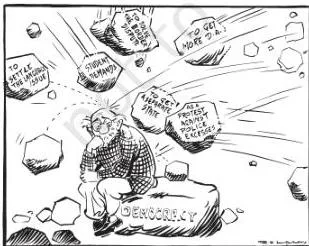
Notice the frame: democracy’s job is to create conditions, not to guarantee outcomes. That is why the chapter can be honest about failures without rejecting democracy itself.
Key Concepts: What Democracy Can and Cannot Deliver
The five outcome areas below are the heart of the chapter, and each has a definite conclusion in the book. Every subsection opens with what the idea means and closes with the page where NCERT settles it. The cartoons and graphs that carry the visual evidence are decoded in the walkthrough right after these sections.
Accountable, Responsive and Legitimate Government — the Terms the Chapter Builds On
The most basic outcome of democracy is a government the people choose and can control. This is the first test in the chapter, because every other outcome depends on it.
Accountability means citizens can examine whether decisions followed correct procedures. The chapter calls the right to know how decisions are made transparency, and notes that this right and these means are missing from a non-democratic government (NCERT, p. 65).
Is democratic government inefficient? A non-democratic ruler need not bother about assemblies, majorities or public opinion, so decisions come fast. Democracy is based on deliberation and negotiation, so delay is built in — but the time spent following procedures makes decisions more acceptable and more effective (NCERT, p. 65).
Responsiveness is where the record turns mixed. A responsive government is attentive to people’s needs and largely free of corruption; the book’s judgment is that democracies often frustrate needs and ignore the demands of a majority, while there is nothing to show that non-democracies are less corrupt or more sensitive (NCERT, p. 66).
Legitimacy is the one respect in which democracy is certainly better than its alternatives. A democratic government may be slow, less efficient, not always responsive or clean, but it is the people’s own government — and that is why support for democracy is overwhelming all over the world, in countries with and without democratic regimes (NCERT, p. 66).
The South Asia survey on page 66 backs this with numbers. In every country surveyed, more people preferred democracy than preferred dictatorship; Pakistan stands apart because there the largest group, 49 per cent, said the regime type does not matter to them (NCERT, p. 66).
Economic Growth and Economic Outcomes: What the Evidence Shows
If democracy produces good government, should it not also produce development? The chapter’s answer is honest: the evidence does not clearly say yes, and it explains why the gap is not a reason to reject democracy.
Between 1950 and 2000, all democratic regimes grew at about 3.95 per cent a year and all dictatorial regimes at about 4.42 per cent. Among poor countries alone the gap nearly vanishes: 4.28 per cent under democracy against 4.34 per cent under dictatorship (NCERT, p. 68).
| Type of regime and countries | Growth rate per year, 1950–2000 |
|---|---|
| All democratic regimes | 3.95% |
| All dictatorial regimes | 4.42% |
| Poor countries under democracy | 4.28% |
| Poor countries under dictatorship | 4.34% |
Data from NCERT, p. 68, Table 1.
Why the figures do not prove dictatorship is better: economic development depends on population size, the global situation, cooperation from other countries and a country’s own priorities — not only on the form of government.
The conclusion is that democracy is no guarantee of development, but it should not be expected to lag behind dictatorship, and it carries other positive outcomes besides growth (NCERT, pp. 67-68).
The chapter adds a second table to fault democracies for something else: high internal inequality. In South Africa the top 20 per cent take 64.8 per cent of national income and the bottom 20 per cent receive 2.9 per cent; Brazil is similar at 63.0 and 2.6. Denmark (34.5 and 9.6) and Hungary (34.4 and 10.0) show democracies can be far more equal (NCERT, p. 68, Table 2).
Before leaving the economy, NCERT poses a verdict question: if you judged democracy purely on economic performance — growth and equal distribution — what would you say? The question is left for you to answer (NCERT, p. 68).
Reduction of Inequality and Poverty: The Unmet Expectation
This section delivers the chapter’s biggest disappointment. Democracies rest on political equality — every individual has equal weight in electing representatives — yet economic inequalities keep growing alongside it.
The chapter describes the pattern plainly: a small number of ultra-rich enjoy a highly disproportionate and rising share of wealth and income, while those at the bottom have little to depend on and sometimes cannot meet basic needs such as food, clothing, house, education and health (NCERT, p. 69).
Here is the puzzle. The poor constitute a large proportion of voters, so no party can afford to lose their votes — yet democratically elected governments are not as keen to address poverty as you would expect. In Bangladesh, more than half the population lives in poverty (NCERT, p. 69).
The cartoon leaves the question open, in the chapter’s own words: democracy is rule of the majority, the poor are the majority, so democracy must be a rule of the poor — how can this not be the case? The chapter presents the gap as a real problem, not as something it has solved (NCERT, p. 69).
Accommodation of Social Diversity: When Democracy Produces Harmony
Can a divided society live together peacefully under democracy? The chapter answers yes, and states exactly the conditions that make it possible.
Democracies usually develop a procedure to conduct their competition, and that reduces the chance of tensions becoming explosive or violent. Non-democratic regimes more often turn a blind eye to internal social differences or suppress them, so handling social divisions is a definite plus of democratic regimes (NCERT, p. 70).
But Sri Lanka reminds the chapter that this outcome is not automatic. Two conditions must hold:
- The majority must work with the minority, so that government functions to represent the general view; majority and minority opinions are not permanent (NCERT, p. 70).
- Rule by majority must not become rule by a majority community in terms of religion, race or language. In every decision or election, different groups may form a majority; democracy remains democracy only as long as every citizen has a chance of being in a majority at some point. Anyone barred from that by birth is not accommodated (NCERT, pp. 70-71).
Belgium is the chapter’s positive example of a democracy that negotiated ethnic differences successfully; Sri Lanka is the warning that even a democracy can fail the test when a community is permanently excluded from power (NCERT, p. 70).
Dignity and Freedom of Citizens: Democracy’s Distinctive Achievement
Democracy stands much superior to any other form of government in promoting the dignity and freedom of the individual. The chapter’s point is not that everyone is treated with respect, but that claims to equal treatment now carry legal and moral force.
For societies built on subordination and domination, recognising that all individuals are equal is not simple.
Long struggles by women created the sensitivity that respect and equal treatment of women are necessary ingredients of a democratic society; once the principle is recognised, struggles against what is now unacceptable gain a legal basis they would not have in a non-democracy (NCERT, p. 71).
The same applies to caste in India. Democracy has strengthened the claims of disadvantaged and discriminated castes for equal status and opportunity; caste-based inequalities and atrocities still occur, but they now lack moral and legal foundations (NCERT, pp. 71-72).
Then comes the chapter’s twist: expectations from democracy also work as criteria for judging it, so its examination never gets over. As democracy passes one test it produces another, and people keep asking for more (NCERT, p. 72).
The fact that people complain is itself a testimony to success — it shows they have developed awareness and the ability to look critically at power holders, and it transforms people from subjects into citizens. Most individuals today believe their vote makes a difference to how the government is run (NCERT, p. 72).
Cartoon Walkthrough: Reading the Images and Graphs in This Chapter
Democratic Politics teaches through cartoons and graphs as much as through prose, and an answer that reads a figure well shows real understanding. Below, each image from pages 66 to 72 is decoded: what you are looking at, and which argument of the chapter it supports. The opening cartoon on page 64 is explained in the previous section.
Legitimacy in Cartoons and Graphs
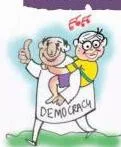
The punchline mocks the search for grander results: after all the “mental gymnastics”, the best outcome discovered is that democracy remains a democracy. The joke makes the chapter’s serious point — a government that is slow and imperfect may still be worth having because it is the people’s own (NCERT, p. 66).
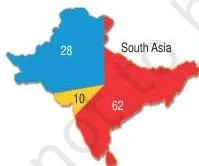
This figure states the chapter’s strongest claim in one line: in one respect democracy is certainly better than its alternatives, and that respect is legitimacy. Every concession the chapter makes — slow, less efficient, not always responsive or clean — leads to this single advantage (NCERT, p. 66).
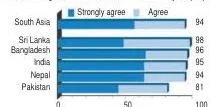
The bar graph shows overwhelming support for rule by leaders elected by the people across South Asia. NCERT reads this as democracy’s ability to generate its own support: the support exists both in countries with democratic regimes and in countries without them, and that is itself an outcome that cannot be ignored (NCERT, p. 66).
The Economy and Inequality in Cartoons

The chapter prints this cartoon under the question of whether the gains of economic growth should be evenly distributed. “The Rich Get Buff” pictures the rich growing stronger while the poor are left behind; the surrounding questions ask how the poor can get a voice for a better share of the nation’s wealth (NCERT, p. 67).

The caption is the section’s conclusion in one line: in actual life, democracies do not appear to be very successful in reducing economic inequalities. The cartoon dramatises the gap between the political equality of one person-one vote and the economic inequality that voting does not remove (NCERT, p. 69).
Diversity, Dignity and the Citizen in Cartoons and Graphs

A listener objects that democracy only ensures people do not break each other’s heads — that this is not harmony. The chapter’s reply is that no society can fully and permanently resolve conflicts among groups; what democracy does is evolve mechanisms to negotiate the differences so that tensions do not explode into violence (NCERT, p. 70).

The paired images “Enemies” and “Greeting” show two different effects democratic politics can have on social divisions — deepening them or managing them. NCERT turns the images into an exercise: take one example for each and write a paragraph on the outcome of democratic politics in both situations (NCERT, p. 71).

A student anxious about board exams is reminded that democracy itself has so many exams, and millions of examiners. The figure carries the point that expectations from democracy work as criteria for judging it, so democracy’s examination never gets over — each success produces a new test (NCERT, p. 72).
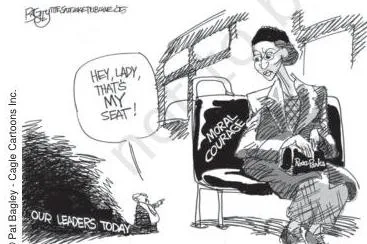
Rosa Parks, whose refusal to give up her seat became a symbol of the long struggle against subordination, still inspires. NCERT places her under dignity and freedom: democracy gives claims for equal treatment legal and moral force, which is why such struggles keep their legitimacy long after they begin (NCERT, p. 72).

The graph “Those who say that their vote makes a difference” reports that most individuals believe their vote affects the way the government is run and their own self-interest. NCERT connects the belief to the success of democracy: people complain and participate because they believe participation matters, and that is what turns subjects into citizens (NCERT, p. 72).
Key Terms and Definitions From the Chapter
This is a quick reference for short answers. Each term below keeps the meaning the chapter gives it, with the page where it appears.
| Term | What it means in this chapter | NCERT page |
|---|---|---|
| Accountable government | Government the people choose and can control; citizens can examine whether decisions followed correct procedures. | p. 65 |
| Responsive government | Government attentive to the needs and demands of the people and largely free of corruption; the record is mixed. | p. 66 |
| Legitimate government | The people’s own government, accepted because it was chosen by them even when it is slow or imperfect. | p. 66 |
| Transparency | The citizen’s right and means to examine how decisions are made, because decision-making follows norms and procedures. | p. 65 |
| Political equality | All individuals have equal weight in electing representatives. | p. 69 |
| Accommodation of social diversity | Handling social differences through procedures and negotiation so that tensions do not become violent. | pp. 70-71 |
| Majority rule vs majority community | Rule by majority means different groups can form a majority in different decisions or elections; it must not become the permanent rule of one religious, racial or linguistic community. | pp. 70-71 |
Common Mistakes Students Make in Outcomes of Democracy
These are the errors the chapter itself warns against, plus the over-promise about conflicts. Each row names the mistake and the exact page that corrects it.
| Mistake | Correct rule | How to check your answer |
|---|---|---|
| “Democracy is inefficient because it is slow.” | The time cost buys acceptability and effectiveness; decisions that follow procedures are more likely to be accepted and to work (NCERT, p. 65). | Ask: would fast decisions that people reject be more efficient in the end? |
| “Dictatorship is better because its growth rate is slightly higher.” | The gap between 4.42% and 3.95% nearly disappears among poor countries (4.34% vs 4.28%), and growth depends on many factors, not regime type alone (NCERT, p. 68). | Check whether the comparison uses all regimes or only poor countries. |
| “Democracy must rule for the poor because the poor are the majority.” | The chapter shows the opposite in practice: political equality coexists with growing inequality, and democratic governments have not been as keen on poverty as expected (NCERT, p. 69). | Compare what majority rule predicts with what actual democracies have done. |
| “Rule by majority means the majority community rules.” | Majority rule means different groups can be a majority in different decisions; every citizen must have a chance to be in a majority, and none may be barred by birth (NCERT, pp. 70-71). | Test: can every citizen, in principle, be part of a winning majority on some issue? |
| “People complaining about democracy proves it failed.” | Complaints show awareness and the ability to judge power holders; they transform subjects into citizens (NCERT, p. 72). | Ask what the complaint itself shows about the citizen, not only about the government. |
| “Democracy should remove all conflicts.” | No society can fully and permanently resolve conflicts; democracy’s plus is negotiating differences and preventing them from becoming violent (NCERT, p. 70). | Check whether the claim demands total harmony or a mechanism to handle differences. |
Answering the Exercises: Using This Chapter for Board Answers
The exercises run across pages 73 to 74 and mostly ask you to apply the chapter’s arguments rather than recall facts. Here is how each one maps to what the chapter taught.
Question 1: Accountable, Responsive and Legitimate Government
This is a three-part answer — write one paragraph per term, each with its own reasoning (NCERT, pp. 65-66):
- Accountable: people choose their rulers and can find out whether decisions followed correct procedures; transparency gives citizens the right and the means to examine the process.
- Responsive: government should be attentive to needs and largely free of corruption; the record is mixed, but there is nothing to show that non-democracies are less corrupt or more sensitive.
- Legitimate: the people’s own government — slow, but acceptable and effective; overwhelming worldwide support shows legitimacy is its strongest point.
Question 2: Conditions for Accommodating Social Diversity
State the two conditions from pages 70 to 71 as numbered points, then close with the general principle: democracy stays democratic only while every citizen has a chance to be in a majority at some point (NCERT, pp. 70-71).
- The majority must work with the minority so that government represents the general view.
- Rule by majority must not become rule by a majority community in terms of religion, race or language.
Question 3: Assertions to Support or Oppose
Each assertion needs at least one line on each side. Use the chapter’s evidence to build them:
| Assertion | The chapter’s evidence | How to argue |
|---|---|---|
| Industrialised countries can afford democracy but the poor need dictatorship to become rich. | Non-democratic rulers decide fast without deliberation (p. 65); among poor countries the growth gap nearly vanishes (4.34 vs 4.28, p. 68). | Oppose with the vanishing gap and democracy’s other positive outcomes; support with the speed of non-democratic decisions — then rebut it. |
| Democracy can’t reduce inequality of incomes. | Table 2 shows democracies like South Africa and Brazil are highly unequal (p. 68). | Support with Table 2; oppose with democracy’s legal and moral force behind claims for equal treatment (pp. 71-72). |
| Poor countries should spend less on poverty reduction, health and education and more on industries and infrastructure. | The chapter gives no direct verdict on spending priorities; it notes the poor are a large share of voters (p. 69). | Argue that abandoning the poor is politically risky for any elected government — the chapter’s own logic. |
| One vote for every citizen means absence of domination and conflict. | One vote gives political equality, but economic inequalities and social conflicts persist (pp. 69-70). | Oppose: democracy provides procedures to manage conflicts, not to remove them; one vote has not ended inequality. |
Questions 4 to 7: Applying the Ideas Quickly
| Question | What it tests | Where the answer lies |
|---|---|---|
| Q4 — Identify challenges to democracy and suggest mechanisms | Applying transparency and accountability to real situations: separate temple entry doors (social inequality), farmer suicides (economic distress), fake encounter (police accountability). | Chapter’s mechanisms of transparency and accountability, p. 65 |
| Q5 — Single-answer choice: what democracies have eliminated | The correct option is the idea of political inequality; conflicts, economic inequalities and differences of opinion about marginalised sections still exist. | Political equality is achieved (p. 69); conflicts are managed, not removed (p. 70) |
| Q6 — Which is the odd one out | Majority rule is the odd one out; democracy also needs free and fair elections, dignity of the individual and equal treatment before law. | Democracy is not simply rule by majority opinion, pp. 70-71 |
| Q7 — Single-answer choice: studies on political and social inequalities | The supported statement is that inequalities exist in democracies; Table 2 shows democracies can be highly unequal. | NCERT, p. 68, Table 2 |
Question 8 — Worked Answer: What Nannu’s Example Shows
The passage gives you a complete story, so a full answer needs to state what the example shows and what impact Nannu’s action had on the officials, using the chapter’s terms.
What the example shows: Nannu’s case is accountability made real.
For three months the clerks and officials would not even look at him; the moment he filed an application under the Right to Information Act asking about the daily progress of his application, the names of the officials responsible and the action to be taken against them, the card was made within a week.
Transparency — the citizen’s right to examine the process of decision-making — forced the officials to act (NCERT, p. 65).
Impact on officials: once Nannu could see the process and name the officials, inaction carried a cost. An inspector visited him at home, the card was ready the next day, and the Food and Supply Officer offered him tea and asked him to withdraw the application.
Officials who had ignored him for months suddenly treated him warmly — behaviour changed because the work had become visible.
One-line conclusion: Nannu’s example shows that democracy gives citizens the right and the means to check whether decisions follow correct procedures, and that exercising that right makes government responsive.
What to Remember From Outcomes of Democracy
The table below groups the chapter’s conclusions by outcome area, so the five sections revise from one screen. Each row is worth learning as a complete sentence.
| Outcome area | What the chapter concludes | NCERT page |
|---|---|---|
| Framework | Democracy is supported in principle but felt to be weak in practice; it is a form of government that creates conditions, and citizens must use them. | p. 64 |
| Government | Democracy should give an accountable, responsive and legitimate government; legitimacy is its strongest point, and support for democracy is self-generated. | pp. 65-66 |
| Economic growth | Democracy is no guarantee of development, but it should not lag behind dictatorship; among poor countries the growth gap nearly vanishes. | pp. 67-68 |
| Inequality and poverty | Democracies have not clearly reduced economic inequalities; political equality coexists with deep economic inequality. | p. 69 |
| Social diversity | Democracy handles social differences through procedures; it stays democratic only while every citizen has a chance to be in a majority. | pp. 70-71 |
| Dignity and freedom | Democracy gives claims for equal treatment legal and moral force; complaints about it show citizens, not subjects. | pp. 71-72 |
Related NCERT Chapters and Resources
Outcomes of Democracy is the final political chapter of the Class 10 Democratic Politics book, so it pulls together ideas from earlier chapters and classes.
The opening recalls the Class IX discussion of why democracy is better than dictatorship — equality, dignity, better decisions, resolving conflicts and room to correct mistakes — and this page’s sections on government and diversity build on what the book taught about power-sharing and political parties (NCERT, p. 64).
For the rest of the subject, the Class 10 Social Science notes hub groups the Democratic Politics chapters together with the Economics chapters such as globalisation and the Indian economy notes and the Geography chapter on manufacturing industries notes. The wider Class 10 notes hub carries every subject, and the CBSE notes home is the entry point for all classes.
Sources and Data Verification
This page describes the NCERT Class 10 Social Science textbook Democratic Politics, Chapter 5 (Outcomes of Democracy), official edition published on ncert.nic.in. The page numbers, figure captions, tables and exercise questions all come from that book, which is the only book this page covers — not the other Class 10 Social Science textbooks.
The listing is maintained for the 2026-27 academic session using the NCERT information available to us. NCERT settles textbooks, editions and PDFs; CBSE settles the curriculum and syllabus. Textbook contents and the examinable syllabus are not always identical — check the current official CBSE syllabus before planning what to study.
Frequently Asked Questions About Outcomes of Democracy Class 10
What are the outcomes of democracy for Class 10?
The chapter examines what democracy delivers in five outcome areas: accountable, responsive and legitimate government; economic growth and development; economic equality and poverty reduction; accommodation of social diversity; and dignity and freedom of citizens (NCERT, pp. 65-72). Its overall verdict is mixed: democracy is supported in principle, yet its record is uneven in practice (NCERT, p. 64).
Why is democracy called a legitimate government even when it is slow?
Because legitimacy does not come from speed; it comes from the government being the people’s own. Democracy is based on deliberation and negotiation, so it takes time, but the time cost buys decisions that are more acceptable and more effective (NCERT, p. 65).
A government that is slow but chosen by the people is legitimate in a way a fast non-democratic government is not (NCERT, p. 66).
Do democracies reduce economic inequality and poverty?
Not clearly, says the chapter. Political equality gives every individual equal weight in elections, yet economic inequalities grow and the ultra-rich’s share increases. The poor form a large share of voters, so no party wants to lose their votes — but democratically elected governments have not been as keen to address poverty as expected (NCERT, p. 69).
What two conditions must democracy fulfil to accommodate social diversity?
The two conditions on pages 70 to 71: the majority must work with the minority so government represents the general view, and rule by majority must not become rule by a majority community in terms of religion, race or language. Democracy works only while every citizen has a chance to be in a majority at some point (NCERT, pp. 70-71).
What does Nannu’s example teach about transparency and accountability?
It shows transparency turning accountability into practice. Officials ignored Nannu for three months; after he filed an RTI application asking for daily progress, the officials’ names and the action to be taken, the card was made within a week.
Once the process became visible and officials could be named, they responded — and even asked him to withdraw the application (NCERT, pp. 65, 74).
Why does the chapter say people’s complaints about democracy show its success?
Because complaints show people have developed awareness and the ability to judge power holders. A public expression of dissatisfaction shows the success of the democratic project: it transforms people from the status of subjects into that of citizens, and most people today believe their vote makes a difference (NCERT, p. 72).
Reference: NCERT Class 10 Social Science textbook, Democratic Politics, chapter 5, official edition on ncert.nic.in.
Explore Class 10 Social Science Books
Class 10 Social Science on LearnCBSE:
Related chapters: