
Democratic Politics Class 10 — this page is about Chapter 4, Political Parties, from the NCERT Democratic Politics textbook (pages 45–62). It explains what the chapter teaches and gives you the official chapter PDF here, so you can read the book and this guide side by side.
Download the Class 10 Democratic Politics Chapter 4 Political Parties PDF from the official NCERT textbook portal, where the current edition of the whole book is available free.
| What the chapter holds | Count | Where it is used |
|---|---|---|
| Printed pages | 17 | |
| Figures with NCERT captions | 11 | |
| Tables | 2 | |
| Exercise questions | not fully captured | our text of this chapter is incomplete; the printed book has more |
| Official NCERT PDF | Download the chapter PDF | the chapter exactly as NCERT publishes it |
What this chapter covers
This chapter asks two questions and then answers them: why do we need political parties? and how many parties are good for a democracy? (NCERT, p. 45). The rest of the chapter answers two more: who the recognised parties in India are, and what is wrong with parties and how they can be fixed.
In the book’s own order, the chapter moves through five blocks:
- Why do we need parties? — the definition, the three components, and the seven functions (pages 46–49).
- How many parties should we have? — one-party, two-party and multiparty systems (pages 50–51).
- National parties and State parties — the Election Commission’s recognition criteria and profiles of the recognised parties (pages 53–56).
- Challenges to political parties — four problem areas (pages 57–59).
- How can parties be reformed? — legal steps already taken, suggestions not yet accepted, and what citizens can do (pages 59–61).
The chapter also connects back to your earlier work: you met political parties in Class IX, and this book has already shown them as vehicles of federal power-sharing and as negotiators of social divisions (NCERT, p. 45). The book’s own table above shows how many figures and pages the chapter holds.
Why do we need political parties?
Before judging parties, the chapter makes you define them. A political party is a group of people who come together to contest elections and hold power in the government, agreeing on policies and programmes that promote the collective good (NCERT, p. 47).
Since people differ on what is good for society, parties try to persuade voters that their policies are better than others, and win support through elections.
Every party has three components (NCERT, p. 47):
- the leaders,
- the active members, and
- the followers.

The word partisan matters here. A party stands for only a part of society, so it is by definition partisan — committed to one side. The glossary defines a partisan as a person strongly committed to a party, group or faction, and partisanship as the tendency to take a side and lose a balanced view (NCERT, p. 48).
The cartoon above voices the criticism of parties — “partial, partisan and lead to partitions” — which the whole chapter then answers.
The book’s strongest argument for necessity is a thought experiment: imagine elections with only independent candidates. No one can promise any major policy change, a government may form but its utility stays uncertain, and while each representative answers for their own constituency, no one is responsible for how the country is run (NCERT, p. 49).
Even in non-party panchayat elections, villages split into factions that put up “panels” of candidates — exactly what a party does. So parties are not a defect of democracy; they are a necessary condition for any representative government (NCERT, p. 49).

The wall-writing photographs (above) make a smaller but real point: parties are everywhere, even in how campaigns are fought — and the Election Commission has had to regulate even the walls (NCERT, p. 47).

The figure above states the heart of the section in one line: large and complex societies need representative democracy, and representative democracy needs parties to gather views, form a responsible government, and support or restrain it (NCERT, p. 49).
The seven functions of a political party
Parties fill political offices and exercise power by doing seven things. This list is the answer to the exercise question “State the various functions political parties perform in a democracy” (NCERT, p. 61).
- Contest elections. In most democracies, elections are fought mainly among candidates put up by parties (NCERT, p. 48).
- Put forward policies and programmes. Parties reduce a vast multitude of opinions into a few basic positions, and voters choose between them (NCERT, p. 48).
- Make laws. Laws are formally passed by the legislature, but members usually follow the direction of their party leadership (NCERT, p. 48).
- Form and run governments. Parties recruit leaders, train them and make them ministers (NCERT, p. 49).
- Act as opposition. Losing parties voice different views, criticise the government and mobilise opposition to it (NCERT, p. 49).
- Shape public opinion. Parties raise and highlight issues; lakhs of members and activists spread opinions, and pressure groups are often their extensions (NCERT, p. 49).
- Give people access to government machinery and welfare schemes. An ordinary citizen finds it easier to approach a local party leader than a government officer — which is why people feel close to parties even when they do not fully trust them (NCERT, p. 49).
To recall the seven in order, use the mnemonic C-P-L-G-O-S-A: Contest elections, Policies and programmes, Laws, Government, Opposition, Shape opinion, Access to welfare schemes.
The activity on page 49 asks you to match three news photographs to functions: a protest by BJP Mahila Morcha activists against price rise (function 6, shaping public opinion), a minister distributing compensation cheques to hooch victims (function 7, access to welfare schemes), and a rally in Bhubaneswar protesting a steel company’s export permission (function 5, mobilising opposition).
Try finding one local news clipping for each of the seven.
How many parties should a democracy have?
More than 750 parties are registered with the Election Commission of India, but only a handful seriously contest elections and can form a government (NCERT, p. 50). The chapter compares three systems:
| Party system | What it means | Examples | Chapter’s judgement |
|---|---|---|---|
| One-party system | Only one party is allowed to control and run the government | China (only the Communist Party rules) | Not a democratic option — any democratic system must allow at least two parties to compete (p. 50) |
| Two-party system | Power usually alternates between two main parties; others win only a few seats | USA, United Kingdom | One of the common arrangements in large democracies (p. 50) |
| Multiparty system | Several parties compete; more than two have a reasonable chance of power, often through coalitions | India | Messy and sometimes unstable, but allows a variety of interests to be represented (pp. 50–51) |
When several parties in a multiparty system join hands to contest elections, the combination is called an alliance or a front. In the 2004 parliamentary elections India had three major alliances: the National Democratic Alliance (NDA), the United Progressive Alliance (UPA) and the Left Front (NCERT, p. 51).
The chapter’s key judgement — and a likely exam point — is that a party system is not something a country can choose. It evolves over a long time, shaped by the nature of society, its social and regional divisions, its history and its electoral system.
India has a multiparty system because its social and geographical diversity cannot be absorbed by two or even three parties (NCERT, p. 51). The book sets a state-level exercise: find at least two states for each of (a) a two-party system, (b) a multiparty system with two alliances, and (c) a multiparty system.
National parties and State parties: how the Election Commission classifies them
Federal democracies tend to have two kinds of parties: those present in only one federal unit, and those present in several or all units. Every party in India must register with the Election Commission, which treats all parties equally but gives large, established parties special facilities, including a unique election symbol that only its official candidates may use.
Parties that get this privilege are called recognised political parties (NCERT, p. 53).
| Level of recognition | Vote criterion | Seat criterion |
|---|---|---|
| State party | At least 6% of the total votes in an election to the Legislative Assembly of a State | At least two seats in that Assembly |
| National party | At least 6% of the total votes in Lok Sabha elections or in Assembly elections in four States | At least four seats in the Lok Sabha |
Notice the pattern: both levels use the same 6% vote test; they differ in the seat numbers and the arena — two Assembly seats for a State party, four Lok Sabha seats for a national party (NCERT, p. 53).
As per the Election Commission’s notification issued in 2023, there are six recognised national parties (NCERT, p. 53):
| National party | Founded / inspiration | Support base and 2019 Lok Sabha result |
|---|---|---|
| Aam Aadmi Party (AAP) | Formed 26 November 2012 after the 2011 anti-corruption movement; built on accountability, clean administration, transparency and good governance | Second largest party in Delhi; formed governments in Delhi and Punjab; 1 Lok Sabha seat in 2019 (p. 54) |
| Bahujan Samaj Party (BSP) | Formed 1984 under Kanshi Ram; draws on Sahu Maharaj, Mahatma Phule, Periyar and Babasaheb Ambedkar | Main base in Uttar Pradesh; seeks power for the bahujan samaj — dalits, adivasis, OBCs and minorities; about 3.63% votes and 10 Lok Sabha seats in 2019 (p. 54) |
| Bharatiya Janata Party (BJP) | Founded 1980, reviving the Bharatiya Jana Sangh of Syama Prasad Mukherjee (1951); inspired by integral humanism and Antyodaya; cultural nationalism important to it | Support base expanded from north and west to the south, east and north-east; largest party with 303 members in the 2019 Lok Sabha elections; currently leads the ruling NDA at the Centre (p. 54) |
| Communist Party of India (Marxist) — CPI(M) | Founded 1964; believes in Marxism-Leninism, socialism, secularism and democracy | Strong support in West Bengal, Kerala and Tripura among workers, farmers, agricultural labourers and the intelligentsia; ruled West Bengal for 34 continuous years; about 1.75% votes and 3 seats in 2019 (pp. 54–55) |
| Indian National Congress (INC) | Founded 1885; one of the oldest parties in the world; a centrist party | Present across the country cutting across social divisions; led the UPA government from 2004 to 2019; won 19.5% votes and 52 seats in 2019 (p. 55) |
| National People’s Party (NPP) | Formed July 2013 under P. A. Sangma; first party from North East India to become a national party | Believes in the country’s diversity and different regional challenges; formed government in Meghalaya; 1 Lok Sabha seat in 2019 (p. 55) |
Most other major parties are classified as State parties, commonly called regional parties — but the chapter warns that they need not be regional in ideology or outlook.
Some, like the Samajwadi Party and Rashtriya Janata Dal, have national-level organisation with units in several states; others, like Biju Janata Dal, Sikkim Democratic Front, Mizo National Front and Telangana Rashtra Samithi, are conscious of their State identity (NCERT, p. 55).
Over the last three decades these parties have grown in number and strength, making Parliament more diverse.
No national party could secure a Lok Sabha majority on its own until 2014, so national parties have been forced into alliances with State parties — and since 1996 nearly every State party has been part of a national coalition government, which the book says has strengthened federalism and democracy in India (NCERT, p. 55).
A map on page 56 shows these party details across states.
Figure walkthrough: reading the cartoons and survey data

This chapter is unusually visual for a civics chapter — its political cartoons and survey graphs carry part of the argument, and several in-text questions ask you to read them. Here is what each type of figure is doing.
Cartoons make the chapter’s point sharper. The page 47 cartoon (“So, you agree with me”) puts the anti-party view in four speakers’ mouths — parties are partial, partisan and lead to partitions — and the rest of the chapter is the rebuttal. The wall-writing photographs show the Election Commission’s ban on wall graffiti during elections.
Both are reproduced in the “Why do we need political parties?” section above.
Survey graphs on page 52 address a common belief. People often say parties are in crisis because citizens are indifferent to them. The book tests this with large-sample survey evidence and finds the belief is only partly true for India (NCERT, p. 52):
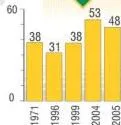


Read the three graphs together and they tell one story: Indians do not trust parties much, yet they increasingly participate in them. Trust in parties is low across South Asia and in most democracies — parties are among the least trusted institutions everywhere.
But the proportion of people who say they are party members is higher in India than in Canada, Japan, Spain and South Korea, and both membership and the feeling of being “close to a party” have risen steadily in India over three decades (NCERT, p. 52).
The book then asks whether the cartoon beside these graphs reflects the data — a good check of whether you can separate an opinion from evidence.
Cartoons also diagnose the four challenges, and the book explicitly asks you to identify which challenge each cartoon highlights (NCERT, p. 59). The table in the next section maps cartoons to challenges.
Challenges to political parties: the four problem areas
Because parties are the most visible face of democracy, people blame them for whatever goes wrong — and the chapter says this dissatisfaction is justified. Popular criticism has focused on four problem areas, and parties must overcome these to remain effective instruments of democracy (NCERT, p. 57):
- Lack of internal democracy. Power tends to concentrate in one or a few leaders at the top. Parties do not keep membership registers, hold organisational meetings or conduct internal elections regularly; ordinary members get no information and cannot influence decisions, so personal loyalty to the leader matters more than loyalty to principles (NCERT, p. 57).
- Dynastic succession. Because party functioning is not open and transparent, ordinary workers have few ways to rise to the top, and leaders are unfairly placed to favour their own family members. In many parties, top positions are controlled by one family — bad for the party and bad for democracy, since people without experience or popular support reach positions of power. This exists in some measure all over the world, even in older democracies (NCERT, p. 58).
- Money and muscle power. Parties focused only on winning use short-cuts: they nominate candidates who have or can raise money, rich funders influence party decisions, and in some cases parties support criminals who can win elections (NCERT, p. 58).
- No meaningful choice. Ideological differences among parties have shrunk — the book’s example is the Labour and Conservative parties in Britain, which agree on fundamentals and differ only in details. In India too, differences among major parties on economic policy have reduced, and the same leaders keep shifting from one party to another (NCERT, p. 58).
| Challenge | Cartoon that illustrates it | What the cartoon shows |
|---|---|---|
| 1. Lack of internal democracy | “Berlusconi Puppet Theatre” (p. 57) | One leader — Italy’s Prime Minister and top businessman — controls the party, television channels, a publishing company, a football club and a bank, so power is concentrated in a single person |
| 3. Money and muscle power | The money cartoon (p. 58) | A candidate is asked why, with so much money already, he wants to contest elections — pointing at wealth as the route to power |
| 4. No meaningful choice | The “meaningful choice” cartoon (p. 58) | Parties do not seem to offer voters significantly different options |
The chapter’s observation that matters for a full answer: these challenges exist all over the world, including in the older democracies — so they are not a uniquely Indian failure, but a general crisis of parties (NCERT, p. 58).
The book also asks how the misuse of money and muscle power could be curbed — a question that leads straight into the reforms section.

How can parties be reformed?
Students routinely mix up what has actually been done with what has only been suggested. The chapter keeps the two lists separate, and so should you.
Already in force — three legal and administrative steps:
- The Constitution was amended to prevent elected MLAs and MPs from changing parties. Before this, many representatives indulged in defection — switching parties to become ministers or for cash rewards. Now an MLA or MP who changes parties loses their seat. The law reduced defection, but the book adds the caveat that it has also made dissent more difficult: members must accept whatever the party leadership decides (NCERT, p. 59).
- The Supreme Court made it mandatory for every candidate to file an affidavit — a signed, sworn statement — giving details of property and of criminal cases pending against them. This has made much information public, but there is no system to check whether the information is true, and it is not yet clear whether it has reduced the influence of the rich and criminals (NCERT, p. 60).
- The Election Commission ordered parties to hold their organisational elections and file income tax returns. Parties have started doing so, but sometimes it is mere formality, and it is unclear if internal democracy has improved (NCERT, p. 60).

Suggested but not yet accepted — three proposals (NCERT, pp. 60–61):
- A law to regulate the internal affairs of parties: a register of members, following the party’s own constitution, an independent authority to judge party disputes, and open elections to the highest posts.
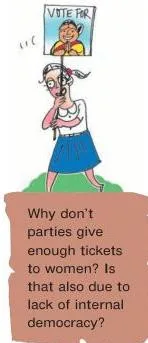
- A mandatory minimum of about one-third tickets for women candidates, plus a quota for women in party decision-making bodies.
- State funding of elections — the government giving parties money (in cash or in kind such as petrol, paper and telephone) to support election expenses, based on votes secured in the last election.
And two non-legal routes remain. First, citizens can put pressure on parties through petitions, publicity and agitations — ordinary citizens, pressure groups, movements and the media can all push parties to take reforms seriously. Second, citizens can join parties.
The chapter ends with its most quotable line of reasoning: the problem of bad politics can be solved by more and better politics — the quality of democracy depends on the degree of public participation (NCERT, p. 61).

One warning the chapter insists on: over-regulation can be counter-productive. If legal rules become too heavy, parties will find ways to cheat the law, and parties will never agree to pass a law they do not like (NCERT, p. 61).
Key definitions from the chapter
These are the terms the book itself defines in its margin glossaries — the ones a short-answer question can directly ask you to define.
| Term | Definition in plain words | NCERT page |
|---|---|---|
| Political party | A group of people who come together to contest elections and hold power in the government, agreeing on policies and programmes for the collective good | p. 47 |
| Partisan / partisanship | A partisan is strongly committed to a party, group or faction; partisanship is the tendency to take a side and the inability to take a balanced view | p. 48 |
| Ruling party | The political party that runs the government | p. 49 |
| Recognition (State / national party) | Recognition by the Election Commission, based on a minimum 6% of votes and minimum seats — two seats for a State party, four Lok Sabha seats for a national party | p. 53 |
| Defection | Changing party allegiance from the party on which a person got elected to a different party | p. 59 |
| Affidavit | A signed document submitted to an officer, in which a person makes a sworn statement about their personal information | p. 60 |
Common mistakes students make in this chapter
Most marks are lost not on facts but on small mix-ups. Here are the characteristic errors, named before you make them.
| Mistake | Correct rule | How to check your answer |
|---|---|---|
| Swapping the recognition criteria — giving a State party four seats or a national party two | State party: 6% votes + 2 Assembly seats. National party: 6% votes + 4 Lok Sabha seats | Ask yourself: which arena does the seat belong to? Assembly seats for State parties, Lok Sabha seats for national parties |
| Reading “regional parties” literally as parties with a regional outlook | The book says many State parties are all-India parties that only succeeded in some states — e.g. Samajwadi Party and Rashtriya Janata Dal have national organisation | Check the example: a party with units in several states cannot be “regional” in outlook |
| Treating all reform measures as already in force | Only the anti-defection amendment, the Supreme Court affidavit order and the Election Commission’s income-tax / organisational-election order are in force; the women’s quota, internal-regulation law and state funding are only suggestions | Scan for the words “should” and “suggested” in the chapter — those items are proposals, not law |
| Concluding from the survey graphs that Indians are indifferent to parties | The data shows trust is low but participation is high and rising — the belief that citizens are indifferent is only partly true | Read all three graphs on p. 52: membership is higher in India than in Canada, Japan, Spain and South Korea, and has risen for three decades |
| Treating the one-party system as a legitimate option | The chapter says one-party rule is not a democratic option — any democratic system must allow at least two parties to compete fairly | Remember the China example: parties may be legally free, but the electoral system allows no free competition |
Exam notes: what the chapter’s exercises actually ask
The exercises for this chapter are printed inside the book itself, on pages 61–62 — there is no separate exercise block. They cover a wide range of formats, and a full answer needs different things for each:
- Definition questions (Q4, Q6): “What is a political party?” and the fill-in-the-blank on the same definition. Answer with the exact three-part idea: a group that comes together to contest elections and hold power, agreeing on policies and programmes for the collective good.
- Short-answer questions (Q1–Q3, Q5): state the seven functions, the four challenges, suggested reforms, and the characteristics of a party. The characteristics of a party are effectively the three components (leaders, active members, followers) plus its partisan nature.
- Matching exercise (Q7): pairs Congress with UPA, BJP with NDA, CPI(M) with Left Front, and Telugu Desam with State party. This tests whether you know which outfit each party belongs to.
- MCQs (Q8–Q10): the founder of the Bahujan Samaj Party is Kanshi Ram; the guiding philosophy of the BJP is integral humanism; and on parties, the correct statements are that parties do not enjoy much trust and are often rocked by scandals — while statement C (“parties are not necessary to run governments”) contradicts the whole chapter.
- Passage-based question (Q11): a short case on Muhammad Yunus launching his Nagarik Shakti party in Bangladesh. It asks for your judgement plus an organisation plan — a full answer should say whether you agree with his decision, how the party should be organised to be different, and how you would defend it.
The “identify the challenge in this cartoon” questions on pages 57–59 are how the book tests the four challenges visually — practise mapping each cartoon to its challenge before you sit for the exam. One caution applies to every chapter: textbook contents and the examinable syllabus are not always identical, so check the current official syllabus for what is examinable this session.
Revision summary: the chapter in one page
Revising the night before? This is the whole argument in five lines, in the book’s own order.
- Parties are necessary, not optional. Every representative government needs an agency to gather different views, form a responsible government, and support or restrain it; the rise of parties is directly linked to the rise of representative democracy (NCERT, p. 49).
- India’s system is multiparty because of its diversity. Party systems evolve over time and cannot be chosen; India’s social and geographical diversity cannot be absorbed by two or three parties (NCERT, p. 51).
- The Election Commission recognises parties by vote and seat criteria — 6% of votes plus two Assembly seats for a State party, 6% plus four Lok Sabha seats for a national party (NCERT, p. 53).
- Four challenges weaken parties: lack of internal democracy, dynastic succession, money and muscle power, and no meaningful choice (NCERT, pp. 57–59).
- Reform works at three levels: what the Constitution, Supreme Court and Election Commission have already done; what has been suggested but not accepted; and what citizens can do — pressure parties from outside and join them from inside (NCERT, pp. 59–61).
Sources and data verification
This listing is maintained for the 2026-27 academic session using the NCERT textbook information available to us. NCERT remains the authority for confirming the latest edition.
Four plain facts about where this page’s information comes from:
- This page describes the NCERT Class 10 Democratic Politics textbook, Chapter 4, Political Parties (pages 45–62), official edition available on ncert.nic.in.
- It covers this chapter only — it is not a description of the full CBSE curriculum.
- It is maintained for the current academic session using the NCERT information available to us.
- NCERT settles textbooks, editions and PDFs; CBSE settles curriculum, syllabus and examinations.
FAQs
What is the six per cent rule for recognising a national party in India?
A party is recognised as a national party if it secures at least 6% of the total votes in Lok Sabha elections or in Assembly elections in four States, and wins at least four seats in the Lok Sabha (NCERT, p. 53). The same 6% vote test applies to a State party, but the seat test is smaller: two Assembly seats.
What is the difference between a national party and a state party?
A national party has units across several or all states following one national strategy, while a State party is present mainly in one federal unit.
The Election Commission distinguishes them by criteria: a State party needs 6% votes in a Legislative Assembly election plus two seats; a national party needs 6% votes in Lok Sabha elections or Assembly elections in four states, plus four Lok Sabha seats (NCERT, p. 53).
Why does India have a multiparty system while the USA has a two-party system?
Because a party system is not chosen — it evolves from a country’s society, its social and regional divisions, its history and its election system. India’s social and geographical diversity cannot be absorbed by two or even three parties, so several parties with a reasonable chance of power have emerged (NCERT, p. 51).
The USA and UK, with different histories, developed two-party systems.
What do the survey graphs in this chapter show about Indians and political parties?
They show that the common belief that citizens are indifferent to parties is only partly true.
Trust in parties is low across South Asia, but participation is high: party membership in India is higher than in Canada, Japan, Spain and South Korea, and both membership and feeling close to a party have risen steadily in India over three decades (NCERT, p. 52).
Which reforms to political parties are already in force and which are only suggestions?
In force: the constitutional amendment against defection, the Supreme Court’s affidavit order for candidates, and the Election Commission’s orders on organisational elections and income tax returns. Only suggestions: a law regulating internal party affairs, one-third tickets for women, and state funding of elections (NCERT, pp. 59–61).
Reference: NCERT Class 10 Democratic Politics textbook, chapter 4, official edition on ncert.nic.in.
Explore Class 10 Social Science Books
Class 10 Social Science on LearnCBSE:
Related chapters: