
This page is about federalism — Chapter 2 of NCERT Class 10 Social Science (Democratic Politics). The chapter runs over 16 printed pages, from an overview that builds on the power-sharing ideas of Chapter 1 to the exercises at the end.
The official Federalism Class 10 PDF is below, and the rest of the page shows what the chapter teaches, section by section, with the textbook page numbers so you can follow along. This listing is maintained for the current academic session using the NCERT edition on ncert.nic.in.
Federalism Class 10 PDF: official NCERT chapter download
The official Federalism Class 10 PDF (Democratic Politics, Chapter 2) is published by NCERT and contains the whole chapter — the opening overview on page 13, the teaching sections on pages 14 to 26, and the exercises on pages 27 and 28 — so you can read it online or download it without hunting through the full book.
| What the chapter holds | Count | Where it is used |
|---|---|---|
| Printed pages | 16 | |
| Figures with NCERT captions | 10 | |
| Tables | 5 | |
| Exercise questions | 3 | answered in our NCERT Solutions |
| Official NCERT PDF | Download the chapter PDF | the chapter exactly as NCERT publishes it |
What is inside the chapter: Federalism at a glance
The table below is generated from the NCERT chapter data and shows at a glance how much the chapter holds — its sections, figures and exercise questions.
Here is where each topic sits in the printed book:
- Overview — p. 13: places federalism inside the vertical power-sharing discussion of Chapter 1.
- What is federalism? — pp. 14–15: the definition, its seven key features, and the two routes by which federations form.
- What makes India a federal country? — pp. 16–18: the three lists, residuary subjects, special-status states, Union Territories and the amendment procedure.
- How is federalism practised? — pp. 19–21: linguistic states, language policy and centre-state relations.
- Linguistic diversity of India — pp. 22–24: the 2011 Census picture and the Scheduled Languages table.
- Decentralisation in India — pp. 25–26: the 1992 constitutional amendment and the third tier of government.
- Exercises — pp. 27–28: the questions that test every idea above.
What this chapter covers: from power sharing to panchayats
If you have not read the chapter yet, this is the argument it builds, in order:
- Federalism in general (pp. 14–15): the chapter defines federalism, contrasts it with unitary government, lists its seven key features and explains the two routes by which federations are formed (NCERT, p. 14).
- Federalism tested against India (pp. 16–17): the definition is checked against the Constitution — the three lists that divide legislative power, residuary subjects, special-status states and Union Territories.
- The key claim (pp. 19–21): constitutional provisions alone are not enough. Three cases — linguistic states, language policy and centre-state relations — show that democratic practice made Indian federalism work (NCERT, p. 19).
- Linguistic diversity (pp. 22–24): the 2011 Census data on India’s mother tongues, with a table of the 22 Scheduled Languages to read, not memorise.
- Decentralisation (pp. 25–26): the argument moves down to the local level — why a third tier was needed, what the 1992 amendment changed, and how panchayati raj is structured.
- Exercises (pp. 27–28): the chapter closes with questions that test everything above, from the three lists to the difference between federal and unitary government.
Key concepts in Federalism Class 10
Federations exist to solve a hard problem: how a country stays united while allowing its regions to remain different. Federalism answers it by dividing power between levels of government, so that unity and regional diversity survive together (NCERT, p. 14). The ideas below are the ones the chapter uses to build that answer, in the order the book teaches them.
Federalism and unitary government: the core definition
Federalism is a system of government in which power is divided between a central authority and the constituent units of the country (NCERT, p. 14). A federation usually has two levels: a government for the whole country, and governments at the level of provinces or states.
Each tier has its own jurisdiction — the area over which it has legal authority — in matters of legislation, taxation and administration, and each enjoys its power independently of the other.
Against this stands the unitary system: either there is only one level of government, or the sub-units are subordinate to the central government, which can pass orders down to them. In a federation the centre cannot order a state government to do something; the state has powers of its own and is answerable to its people.
The chapter lists seven key features of federalism (NCERT, p. 14):
- Two or more tiers of government.
- Different tiers govern the same citizens, but each has its own jurisdiction in specific matters of legislation, taxation and administration.
- Jurisdictions are constitutional — the existence and authority of each tier is guaranteed by the Constitution.
- No unilateral change — fundamental provisions need the consent of both levels of government.
- Courts as umpire — the highest court settles disputes between levels of government.
- Clearly specified revenue sources for each level, to keep it financially autonomous.
- Dual objectives — safeguard the unity of the country while accommodating regional diversity.
Why does size not decide this? The book points to Belgium: a small country that adopted federalism in 1993 to manage its regional diversity, after earlier powers given to regional governments could still be withdrawn by the centre (NCERT, p. 15). Federalism answers diversity, not bigness.
Only 25 of the world’s 193 countries are federations, yet their citizens make up about 40 per cent of the world’s population (NCERT, p. 14).
Two routes to a federation: coming together and holding together
Federations are not all built the same way. The balance of power between centre and units depends on the historical route by which the federation was formed (NCERT, p. 15).
In the coming together route, independent states pool their sovereignty to create a larger unit, keeping their identity while gaining security. In the holding together route, a large country divides its power between the constituent states and the national government.
| Route | How the federation forms | Examples | Typical balance of power | Do units have equal power? |
|---|---|---|---|---|
| Coming together | Independent states pool sovereignty to form a bigger unit, retaining their identity | USA, Switzerland, Australia | Constituent states are strong vis-à-vis the federal government | Usually yes |
| Holding together | A large country divides power between its constituent states and the national government | India, Spain, Belgium | The central government tends to be more powerful; some units get special powers | Usually no |
The practical consequence: in coming-together federations the states usually hold equal power, while in holding-together federations the centre tends to dominate and some units are granted special powers — which is exactly the situation the next section shows in India.
What makes India a federal country: the three lists and residuary powers
India’s Constitution declares it a ‘Union of States’ and never uses the word federation, yet all seven federal features apply to it (NCERT, p. 16). What makes India federal is the constitutional machinery, not the label. The heart of that machinery is a three-fold division of legislative powers:
| List | What it covers | Who can make laws |
|---|---|---|
| Union List | Subjects of national importance — defence, foreign affairs, banking, communications, currency — where one uniform policy is needed across the country | The Union Government alone |
| State List | Subjects of state and local importance — police, trade, commerce, agriculture, irrigation | State Governments alone |
| Concurrent List | Subjects of common interest — education, forest, trade unions, marriage, adoption, succession | Both Union and State; the Union law prevails if they conflict |
Residuary subjects. What about a subject that is in none of the three lists — computer software, for instance, which did not exist when the Constitution was written? The Union Government has the power to legislate on such residuary subjects (NCERT, p. 17). The same test applies to any new field.
Suppose the regulation of artificial intelligence became a live policy question tomorrow. The rule works in two steps: first check all three lists for the subject; if no list names it, the residuary clause puts it with the Union, and only the Union Government can make laws on it. One rule, two steps — list check, then residuary fallback.
Not all units are equal. Assam, Nagaland, Arunachal Pradesh and Mizoram enjoy special powers under Article 371 — over land rights of indigenous peoples, their culture, and preferential employment in government services; even buying land there as a non-resident is restricted (NCERT, p. 17).
At the other extreme, Union Territories such as Chandigarh, Lakshadweep or Delhi have very little power of their own, and the Central Government has special authority in running them.
The two-step amendment procedure. The division of power is basic to the Constitution, so neither level can change it alone. Any change must first be passed by both Houses of Parliament with at least a two-thirds majority, and then ratified by the legislatures of at least half of the total states (NCERT, p. 17).
Memory hooks. For the lists, think U–S–C: Union (national importance), State (local importance), Concurrent (shared) — the scope narrows as you go down. For the amendment, think P–R: first Pass the change in both Houses with a two-thirds majority, then Ratify it in at least half the states.
How federalism is practised: linguistic states, language policy and centre-state relations
The chapter’s central claim is that constitutional provisions are necessary but not sufficient for the success of federalism. In India the real success came from democratic politics, which made respect for diversity and the desire to live together shared ideals (NCERT, p. 19). The book tests that claim with three episodes.
1. Linguistic states (p. 19). The first major test was re-organising states so that people speaking the same language lived in the same state. National leaders initially feared this would disintegrate the country. Experience proved the opposite: linguistic states made the country more united and made administration easier.
Some states, such as Nagaland, Uttarakhand and Jharkhand, were created not on language but on culture, ethnicity or geography.
2. Language policy (p. 20). The Constitution gave no language the status of national language. Hindi was identified as the official language, but since it is the mother tongue of only about 40 per cent of Indians, safeguards protected the other 21 Scheduled Languages.
English was to stop in 1965, yet non-Hindi states demanded its continuation — in Tamil Nadu the movement turned violent — and the Centre agreed to continue English alongside Hindi. This flexibility helped India avoid the kind of conflict Sri Lanka faces.
3. Centre-state relations (pp. 20–21). For a long time the same party ruled the Centre and most states, so state governments did not exercise their autonomy, and governments run by rival parties were sometimes dismissed arbitrarily by the Centre. All this changed after 1990, with the rise of regional parties and coalition governments at the Centre.
A major Supreme Court judgement then made arbitrary dismissal of state governments difficult. Federal power-sharing is more effective today than in the early years after the Constitution came into force.
Linguistic diversity: reading the numbers
How many languages does India have? The answer depends on how you count, and the chapter wants you to read the census data rather than memorise it (NCERT, p. 22). The 2011 Census recorded more than 1,300 distinct mother tongues, which were grouped into 121 major languages. Of these, 22 are in the Eighth Schedule of the Constitution and are called Scheduled Languages.
The key reading of the table is this: no single language is the mother tongue of a majority of Indians. Hindi, the largest, stands at 43.63 per cent — still under half. The next five are Bengali (8.03), Marathi (6.86), Telugu (6.70), Tamil (5.70) and Urdu (4.19). No second language even reaches 10 per cent.
Adding everyone who knows Hindi as a second or third language, the total was still less than 50 per cent in 2011. English was recorded as the mother tongue of just 0.02 per cent of Indians, and Sanskrit’s share is negligible. Diversity is the norm, not the exception.
The chapter suggests turning the table into a bar or pie chart, shading a map of India by language region, and finding three languages spoken in India that are not in the table (NCERT, p. 22).
Decentralisation: the third tier of Indian federalism
States in India are as large as independent European countries and are internally very diverse, so two tiers are not enough. Many problems are best settled at the local level, where people know their locality and can take part in decisions directly — this is the principle of local self-government (NCERT, p. 25).
When power is taken away from the central and state governments and given to local government, it is called decentralisation.
Panchayats and municipalities existed before 1992, but they were directly under state control, elections were not held regularly, and they had no real powers or resources of their own. The 1992 constitutional amendment changed this (NCERT, p. 25):
- Regular elections to local bodies became constitutionally mandatory.
- Seats were reserved for the Scheduled Castes, Scheduled Tribes and Other Backward Classes.
- At least one-third of all positions were reserved for women.
- An independent State Election Commission was created in each state.
- State governments were required to share some powers and revenue with local bodies, in a pattern that varies from state to state.
Rural local government is called panchayati raj. The gram panchayat — a council of ward members (panch) and a president (sarpanch) — is the decision-making body for the village, working under the supervision of the gram sabha, which is made up of all the voters of the village.
A few gram panchayats form a panchayat samiti (block or mandal), and all the panchayat samitis in a district form the zilla parishad. For towns there are municipalities; big cities have municipal corporations headed by a mayor (NCERT, p. 25).
The chapter closes with an honest balance sheet (NCERT, p. 26): there are now about 36 lakh elected representatives in local bodies, making this the largest experiment in democracy conducted anywhere, and participatory-budget experiments in Porto Alegre (Brazil) and parts of Kerala show what is possible.
Yet gram sabhas are not held regularly, and most state governments have not transferred significant powers or adequate resources to local government. The ideal of self-government is still a long way off.
The figures in this chapter and what they teach
The chapter teaches through images as much as through text: two definitional diagrams, a map that shows how much India’s boundaries changed, and several editorial cartoons that carry the argument about practice and power. Each figure below is explained, because the cartoons are part of the content, not decoration.
The three diagrams that define federalism
The first diagram, at the top of page 14, is the chapter’s opening definition made visual: federalism is a system of government in which the power is divided between a central authority and various constituent units of the country.

Read it as two levels sharing the country between them, not one level ruling the other. That non-hierarchical picture — each tier with its own jurisdiction, independent of the other — is the heart of the definition.
The second diagram, on page 15, shows the holding-together route: a large country decides to divide its power between the constituent states and the national government.

Here the division starts from the single country and moves down to the states — the opposite direction from the coming-together route, where states build the union upward. This is the route India, Spain and Belgium follow, and it is why the centre tends to be stronger in them.
The third diagram, on page 17, shows the judiciary’s role: the courts oversee the implementation of constitutional provisions and procedures.

This is the chapter’s ‘court as umpire’ feature in picture form. If the Union and a state disagree about the division of powers, the High Courts and the Supreme Court decide (NCERT, p. 17) — the referee that keeps both levels playing by the same rules.
The map and the cartoons: federalism in practice
One map and four cartoons carry the chapter’s second half — the argument that practice, not just provisions, makes federalism work.
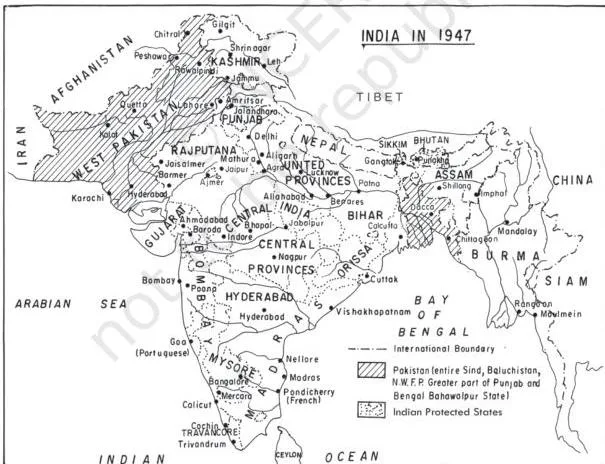
The map on page 19 is the visual proof behind the linguistic-states story: in 1947, the boundaries of several old states of India were changed in order to create new states.
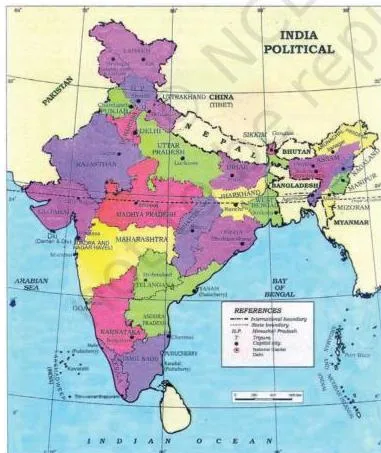
Comparing 1947 with 2019 shows old states vanishing and new ones appearing, as people who spoke the same language came to live in the same state. Leaders feared disintegration; the chapter’s verdict is that the country became more united and easier to administer (NCERT, p. 19).
The first cartoon, in the activity box on page 18, pictures the police question directly: suppose the Chief Ministers of Andhra Pradesh, Chhattisgarh and Orissa have different policies on how their state police should respond to the naxalites.
Can the Prime Minister pass an order all the Chief Ministers must obey? No — because police is a State List subject, the states alone legislate on it. The cartoon teaches jurisdiction by asking who actually holds a given power (NCERT, p. 18).
The second cartoon, on page 20, accompanies the questions of whether a state must go to the Centre with a begging bowl and how a coalition leader keeps partners satisfied.

Both questions are about dependence: states that depend on the Centre for resources, and coalition governments that must keep regional partners happy in a common programme. The chapter’s answer is that these relationships became more respectful of state autonomy after 1990, when regional parties and coalitions changed the political culture (NCERT, pp. 20–21).
The third cartoon, on page 21, is about the old abuse of power by the Central Government — dismissing state governments in an arbitrary manner.

The Supreme Court’s major judgement made that misuse difficult, and the cartoon marks the turning point: from then on, federal power-sharing became more effective than it was in the early years after the Constitution came into force (NCERT, p. 21).
The fourth cartoon, on page 25, opens with the line ‘Prime Minister runs the country’ and pushes the logic one step down: if that is so, the chairperson of the zilla parishad should run the district.

The answer is the difference between two kinds of authority. The zilla parishad chairperson is the elected political head of the district body, while the DM or Collector is a state-appointed administrative officer who actually administers the district. Elected leadership and appointed administration are not the same office (NCERT, p. 25).
The urban local government diagram
On the same page 25, a diagram shows that local government bodies exist for urban areas as well.

Towns are organised into municipalities and big cities into municipal corporations; both are controlled by elected bodies of people’s representatives. The municipal chairperson is the political head of a municipality, and in a corporation that officer is the mayor (NCERT, p. 25) — the urban counterpart of the panchayati raj ladder.
The boxed reading: Ramachandra Guha on linguistic states
Page 23 prints excerpts from an article by the historian Ramachandra Guha that appeared in the Times of India on November 1, 2006, and turns it into a source-based exercise.
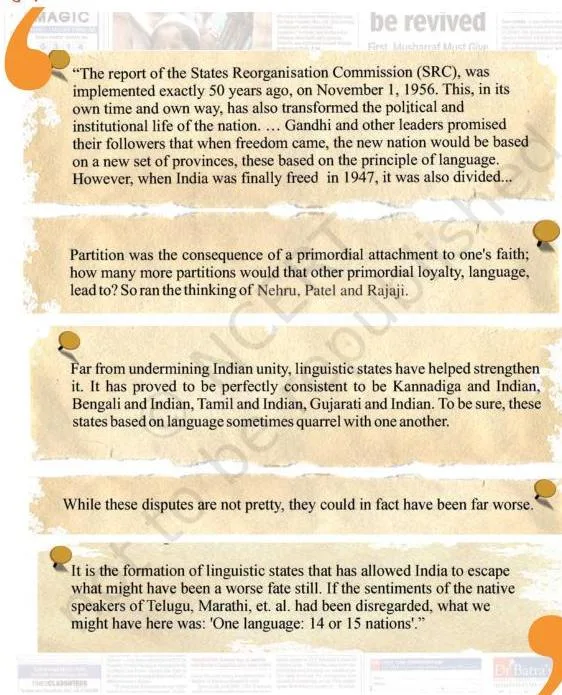
The task is to take your own state, or any state affected by linguistic reorganisation, and write a short note for or against the author’s argument on the basis of that example (NCERT, p. 23).
The exercise deliberately treats the linguistic-states debate as an open historical argument rather than a settled fact — you are asked to use evidence, not just recall a conclusion.
Terms the chapter defines, in one place
A quick-lookup glossary of the terms the chapter itself defines, each in plain words with the page where it appears.
| Term | Meaning | NCERT page |
|---|---|---|
| Federalism | Power divided between a central authority and the constituent units of a country | p. 14 |
| Unitary government | One level of government, or sub-units subordinate to the central government | p. 14 |
| Jurisdiction | The area over which a government has legal authority, defined geographically or by subjects | p. 15 |
| Coming together federation | Independent states pool sovereignty to form a bigger unit | p. 15 |
| Holding together federation | A large country divides power between its constituent states and the national government | p. 15 |
| Union, State and Concurrent Lists | The three lists dividing legislative subjects between the Union and the states | p. 16 |
| Residuary subjects | Subjects that are in none of the three lists; the Union alone legislates on them | p. 17 |
| Union Territory | A unit of the Indian Union with very little power, run with special Central Government authority | p. 17 |
| Coalition government | A government formed by the coming together of at least two parties with a common programme | p. 20 |
| Scheduled Languages | The 22 languages listed in the Eighth Schedule of the Constitution | p. 22 |
| Decentralisation | Power taken away from central and state governments and given to local government | p. 25 |
| Gram panchayat | The village council of ward members and a sarpanch, the decision-making body for the village | p. 25 |
| Gram sabha | All the voters of the village, who supervise the gram panchayat and approve its budget | p. 25 |
| Panchayat samiti | A block or mandal body formed by grouping several gram panchayats | p. 25 |
| Zilla parishad | The district-level body formed by all the panchayat samitis of a district | p. 25 |
| Municipality / municipal corporation / mayor | Town-level elected body / big-city elected body / its political head | p. 25 |
Mistakes students make while reading this chapter
The book itself flags several confusions in its margin boxes, and the exercises quietly test them. Naming them before you trip on them is the fastest way to avoid them.
The most common confusion is between an official language and a national language:
- Official is not national. The Constitution gave no language the status of national language; Hindi was identified only as the official language (NCERT, p. 20).
- Hindi has no majority behind it. It is the mother tongue of only about 40 per cent of Indians, so 21 other Scheduled Languages are protected alongside it.
- English did not stop in 1965. The Constitution planned for English to end, but non-Hindi states — Tamil Nadu most forcefully — got it continued alongside Hindi.
| Mistake | Correct rule | How to check your answer |
|---|---|---|
| Hindi is the national language of India | The Constitution gave no language national status; Hindi is the official language | Re-read p. 20 — the word is ‘official’, never ‘national’ |
| Dividing a country into provinces makes it a federation | Sri Lanka has provinces and is still a unitary system | Ask who holds final power; if the centre can overrule, it is unitary |
| Federalism only works in big countries | Belgium is small and adopted federalism to manage diversity | Recall the Belgium box on p. 15 |
| The Constitution avoids the word ‘federation’, so India is not federal | The Constitution says ‘Union of States’, yet all seven federal features apply | Re-read the p. 16 discussion of the seven features |
| Union ministers for agriculture or commerce prove those are Union subjects | They are State subjects; Union ministers make policy and coordinate, but legislation belongs to the states | Check the State List on p. 16 — agriculture and trade are there |
| The zilla parishad chairperson should administer the district | The chairperson is the elected political head; the DM/Collector is the state-appointed administrative officer | Re-read the p. 25 margin question |
| Residuary powers go to local governments | Residuary subjects belong to the Union alone | Exercise 10 pairs local governments with residuary powers — the wrongly matched pair |
| Panchayats were created by the 1992 amendment | Panchayats existed earlier but with irregular elections and no resources; 1992 made them effective | The chapter calls 1992 ‘a major step’, not a beginning (p. 25) |
Exam notes: what the chapter’s exercises test
The exercises on pages 27–28 are a revision map of the whole chapter. Each one targets a single concept, so the way to prepare is to know which idea each question checks and then go back to that page of the book. This page maps the exercises to their concepts; it does not replace working them out from the chapter.
| Exercise (pages 27–28) | Concept it tests |
|---|---|
| Locating Manipur, Sikkim, Chhattisgarh and Goa on a blank map of India | Reading the present political map — these are current states with their present boundaries |
| Shading three federal countries (other than India) on a world map | Applying the definition of federalism to countries beyond India |
| Pointing out one similar and one different feature of federalism in India and Belgium | Comparing two federations in practice, not just on paper |
| Explaining the federal-versus-unitary difference with an example | The core contrast from p. 14 |
| Stating two differences in local government before and after the 1992 amendment | The changes brought by the 1992 constitutional amendment |
| Filling in blanks on the United States and India as types of federation | The two routes from p. 15 and where each country’s states stand vis-à-vis the centre |
| Giving an argument and an example for one of three positions on language policy | Taking one of three views and defending it with a case from the chapter |
| Objective question: the distinguishing feature of a federal government | Power divided between different levels of government (not among legislature, executive and judiciary) |
| Grouping defence, police, agriculture, education, banking, forests, communications, trade and marriages into the three lists | Applying the Union, State and Concurrent classification from p. 16 |
| Objective question: which level-of-government and list pair is wrongly matched | Residuary powers belong to the Union — pairing them with local governments is the trap |
| Matching levels of government to their political heads | Union of India (Prime Minister), State (Governor), Municipal Corporation (Mayor), Gram Panchayat (Sarpanch) |
| Judging statements about India, Sri Lanka and local government | What actually makes a country federal — provinces alone do not, and devolving powers to local bodies does not end federalism |
How to attempt the argument question. For the language-policy exercise, take one side and support it with one specific case from the chapter — the continuation of English alongside Hindi after 1965, or the way creating linguistic states brought speakers of several languages their own administrative regions.
A complete answer names the position and then anchors it in an example; a vague generalisation does not.
One honest note: textbook contents and the examinable syllabus are not always identical. Check the current official CBSE syllabus before you decide what to revise. No question or marks can be guaranteed from any chapter list.
The chapter’s argument in brief: section by section
The chapter closes with exercises rather than a printed summary, so here is its line of argument in one place:
- Federalism defined (p. 14): power divided between a central authority and constituent units, each with its own jurisdiction in legislation, taxation and administration.
- Two routes (p. 15): coming-together federations (USA, Switzerland, Australia) versus holding-together federations (India, Spain, Belgium).
- India’s machinery (pp. 16–17): the three lists, residuary subjects with the Union, special status under Article 371, Union Territories, and the two-step amendment procedure.
- Practice over provisions (pp. 19–21): linguistic states united the country, language policy avoided Sri Lanka’s fate, and post-1990 coalition politics plus a Supreme Court judgement strengthened state autonomy.
- Linguistic diversity (p. 22): no single language is the mother tongue of a majority; 22 Scheduled Languages coexist.
- Third tier (p. 25): the 1992 amendment made local government effective — from gram panchayat to zilla parishad, from municipality to municipal corporation.
Related NCERT chapters and books
The chapter opens by building directly on the previous chapter’s discussion of power-sharing (NCERT, p. 13), and it sits in the Class 10 Social Science notes between Power-sharing (Chapter 1) and Gender, Religion and Caste (Chapter 3) of Democratic Politics. For the rest of the Class 10 syllabus, use the Class 10 notes hub or browse all CBSE notes by subject.
Geography connects with federalism too — local resources and administration come up in the Water Resources chapter. Teachers working through this book may also want the notes for the teacher section.
Sources and data verification
This listing is maintained for the 2026-27 academic session using the NCERT textbook information available to us. NCERT remains the authority for confirming the latest edition.
The chapter described on this page is Federalism, Chapter 2 of the NCERT Class 10 Social Science textbook Democratic Politics, as published in the official PDF on ncert.nic.in (the file whose name begins with jess402). This page covers that one chapter; it does not cover the other Class 10 Social Science textbooks.
The listing is maintained for the current academic session using the NCERT edition available on ncert.nic.in. NCERT is the authority for textbooks, editions and official PDFs; CBSE is the authority for the curriculum, syllabus and examinations. No claim of independent expert review or complete syllabus alignment is made.
Frequently asked questions about Federalism Class 10
Which pages does the Federalism chapter cover in the NCERT Class 10 Democratic Politics book?
Federalism runs from page 13 to page 28 of Democratic Politics. The overview is on page 13, the teaching sections run from page 14 through page 26, and the exercises fill pages 27 and 28.
What is the difference between the Union List, State List and Concurrent List in the Federalism chapter?
The three lists divide legislative subjects between the two levels of government (NCERT, p. 16). The Union List covers national subjects such as defence, foreign affairs, banking, communications and currency, on which only the Union can legislate. The State List covers local subjects such as police, trade, agriculture and irrigation, on which only states can legislate.
The Concurrent List covers shared subjects such as education and forests, on which both can legislate — but the Union law prevails if the two conflict.
Is Hindi the national language of India?
No. The Constitution did not give national-language status to any language. Hindi was identified as the official language, with 21 other Scheduled Languages protected alongside it, and English was continued for official purposes after 1965 (NCERT, p. 20).
What is decentralisation according to the Class 10 Federalism chapter?
Decentralisation is taking power away from the central and state governments and giving it to local government (NCERT, p. 25). The idea behind it is that many problems are best settled at the local level, where people know their locality and can participate in decisions directly — the democratic principle of local self-government.
What changes did the 1992 constitutional amendment bring for local government?
After 1992, regular elections to local bodies became constitutionally mandatory; seats were reserved for the Scheduled Castes, Scheduled Tribes and Other Backward Classes; at least one-third of all positions were reserved for women; an independent State Election Commission was created in each state; and state governments were required to share some powers and revenue with local bodies (NCERT, p. 25).
Why is India called a federation even though the Constitution says ‘Union of States’?
The Constitution declared India a ‘Union of States’ and avoided the word federation, yet all seven federal features apply to it (NCERT, p. 16). The Constitution provides tiers of government with separate jurisdictions, the three lists divide legislative power, the courts act as umpire, and neither level can change the arrangement unilaterally — so India is federal in design, whatever the label.
Reference: NCERT Class 10 Social Science (Democratic Politics) textbook, chapter 2, official edition on ncert.nic.in.
Explore Class 10 Social Science Books
Class 10 Social Science on LearnCBSE:
Related chapters: