
This page carries the official Gender, Religion and Caste Class 10 PDF — NCERT Democratic Politics-II, Chapter 3 — with a full breakdown of what the chapter contains: its sections, figures, key concepts and end-of-chapter exercises. The chapter runs from page 28 to page 45 and asks whether political expression of social differences based on gender, religion and caste is healthy or unhealthy for democracy.
This page is maintained for the current academic session.
Download the Gender, Religion and Caste Class 10 PDF (NCERT Chapter 3)
The official chapter file is published by NCERT on its textbook portal. Open Gender, Religion and Caste Class 10 PDF to download Democratic Politics-II Chapter 3 directly from ncert.nic.in — the same source schools and teachers use, so you know it is the current edition.
Reference: NCERT Class 10 Social Science (Democratic Politics-II) textbook, chapter 3, official edition on ncert.nic.in.
| What the chapter holds | Count | Where it is used |
|---|---|---|
| Printed pages | 17 | |
| Figures with NCERT captions | 10 | |
| Tables | 4 | |
| Exercise questions | 12 | answered in our NCERT Solutions |
| Official NCERT PDF | Download the chapter PDF | the chapter exactly as NCERT publishes it |
Chapter at a glance: what is inside this chapter
The counts table on this page shows how much the chapter holds — its sections, figures and exercise questions. What matters for understanding is how the chapter is built: it opens with a claim about democracy itself, then applies it to three Indian social divisions one by one.
The chapter’s opening claim is that the existence of social diversity does not threaten democracy — political expression of social differences can even be desirable (NCERT, pp. 28-29). The three divisions it then examines are:
- Gender and politics (pp. 30-35) — how a division often treated as natural is really social, and how raising it in politics brought legal and political gains.
- Religion, communalism and the secular state (pp. 36-37) — the line between legitimate religion-politics links and communal politics, and the constitutional answer of a secular state.
- Caste and politics (pp. 38-43) — why caste is special to India, how caste inequality persists, and the two-way relationship between caste and politics.
The chapter closes with exercises on pages 44-45. Its evidence is visual: a time-use table (p. 32), a child sex ratio map (p. 33), a world parliaments graph (p. 34), a religious-communities pie chart (p. 39), a caste and poverty table (p. 41), plus glossary boxes and dialogue cartoons that carry some of the chapter’s sharpest points.
What this chapter covers: three social divisions, one question
One question drives the whole chapter: is the political expression of social differences healthy or unhealthy in a democracy? Each block below answers it for one division. This is a map to help you find your way; the chapter itself does the arguing.
Gender and politics: pages 30 to 35
The first and longest block argues that gender division is social, not biological. Boys and girls are brought up to believe that housework and child-rearing are women’s work and that men belong outside the home — a sexual division of labour (NCERT, p. 30).
The chapter even defends discussing household power in a Political Science textbook: if politics is about power, then male dominance in the household is political.
The poster that opens the gender block affirms women’s strength; its caption states the problem the block will tackle — women are half of humanity, yet their role in public life, especially politics, is minimal in most societies.
Women in different parts of the world organised and agitated for equal rights; these movements are called feminist movements, and a feminist is any woman or man who believes in equal rights and opportunities for both (p. 31). India remains a male-dominated, patriarchal society, and women face disadvantage, discrimination and oppression in several ways (pp. 31-33):
- a literacy gap — 54 per cent for women against 76 per cent for men, and more girls dropping out of higher studies;
- unequal pay — the Equal Remuneration Act, 1976 says equal work must get equal wages, but women are paid less in almost every field;
- unpaid work — a time-use survey in six states found an average woman works a little over seven and a half hours a day against a man’s six and a half, yet her household work stays unpaid and invisible (p. 32);
- violence and sex-selective abortion — parents who prefer sons abort girl children, pulling the national child sex ratio down to 919 girls per thousand boys (p. 33).
The chapter also suggests running the same time-use survey at home: observe the adult men and women in your family for a week and see who works more.
The block closes with representation. Women’s share in the Lok Sabha touched 14.36 per cent for the first time in 2019, and it is below 5 per cent in state assemblies (p. 34).
One-third of seats in panchayats and municipalities are reserved for women — more than 10 lakh elected women representatives — and the Nari Shakti Vandan Adhiniyam (Women’s Reservation Act, 2023) provides 33 per cent reservation in the Lok Sabha, State Legislative Assemblies and the Delhi Assembly (p. 35).
The caption above is the chapter’s conclusion for the whole gender block: gender division is an example of a social division that needed to be expressed in politics — the gains listed above followed once the issue was raised (p. 35).
Religion, communalism and the secular state: pages 36 to 37
The second block starts from a puzzle: not every religion-politics link is wrong. Gandhiji held that religion can never be separated from politics — but he meant the moral values common to all religions, not any one faith (NCERT, p. 36). Protecting minorities and reforming discriminatory family laws are also legitimate religion-politics links, as long as every religion is treated equally.
The problem begins with communal politics: religion expressed in exclusive and partisan terms, one religion and its followers pitted against another (p. 36). Its four forms:
- everyday beliefs — religious prejudices, stereotypes of communities, belief in the superiority of one’s own religion;
- quest for political dominance — majoritarian dominance for the majority community, a desire for a separate political unit for a minority;
- political mobilisation on religious lines — sacred symbols, religious leaders, emotional appeal and fear used to unite one religion’s followers in the political arena;
- communal violence — riots and massacres, from the Partition riots to large-scale communal violence after Independence (pp. 36-37).
The constitutional answer is a secular state: no official religion, freedom to profess, practice and propagate any religion or none, no discrimination on grounds of religion, and state power to intervene for equality within communities (p. 37).
The chapter adds a warning: a secular Constitution is necessary but not sufficient. Communal prejudices must be countered in everyday life and religion-based mobilisation in the political arena (p. 37).
Caste and politics: pages 38 to 43
The third block argues that caste division is special to India: a hereditary occupational division sanctioned by rituals, built on the exclusion of ‘outcaste’ groups through untouchability (NCERT, p. 38).
Reformers such as Jotiba Phule, Gandhiji, B.R. Ambedkar and Periyar Ramaswami Naicker worked to build a society without caste inequality. Economic development, urbanisation, literacy, occupational mobility and weaker landlords have since broken down the old caste hierarchy (p. 38).
Caste groups are also demographically large: the Scheduled Castes were 16.6 per cent and the Scheduled Tribes 8.6 per cent of the population in 2011, with the OBCs estimated at about 41 per cent — together about two-thirds of the country’s population (p. 39).
Yet caste persists: most people still marry within their own caste, untouchability has not ended despite constitutional prohibition, and access to education still tracks the old caste order (pp. 40-41). The chapter then examines the two-way street between caste and politics:
- Caste in politics — parties choose candidates with the caste composition of the electorate in mind, make appeals to caste sentiment, and one-person-one-vote brought new consciousness among castes treated as inferior (pp. 40-42). Still, caste alone cannot decide elections: no constituency has a single-caste majority, no party wins a whole caste’s votes, and ruling parties and sitting MPs or MLAs frequently lose (p. 42).
- Politics in caste — politics politicises caste: caste groups merge with neighbouring castes, enter coalitions, and new ‘backward’ and ‘forward’ groupings emerge. This has helped Dalits and OBCs gain better access to decision-making, but exclusive attention to caste can divert attention from poverty, development and corruption and can lead to tension and violence (pp. 42-43).
Key concepts in the chapter, explained in plain words
These are the ideas the whole chapter builds on. Know these and the chapter reads quickly.
Gender: the terms behind the division
Sexual division of labour (p. 30) is the system in which all work inside the home is done by the women of the family, or organised by them through domestic helpers. It rests on a public/private division: women are assigned the private world of the home while men dominate public life — which is why women’s role in politics stays minimal.
Patriarchy (p. 32) literally means “rule by father”; the chapter uses it for a system that values men more and gives them power over women.
Feminist (p. 31) is a glossary word worth quoting exactly: a woman or a man who believes in equal rights and opportunities for women and men. Feminist movements (pp. 31-32) are the organised agitations for equal rights — some demanded legal and political equality, more radical ones equality in personal and family life too.
The figure below is the chapter’s first piece of evidence for why such movements are still needed:

This figure states the opening statistic of the disadvantage list: the literacy rate among women is only 54 per cent compared with 76 per cent among men (NCERT, p. 32). Notice the chapter’s argument structure — it lists the disadvantage first, then argues that unless women control power, their problems will not get adequate attention.
Communalism: four forms in one table
Communalism (p. 36) is using religion in politics in exclusive and partisan terms — the belief that religion is the principal basis of social community. Its four forms, with the chapter’s own examples:
| Form of communalism | What it looks like | Example from the chapter |
|---|---|---|
| Everyday beliefs | Religious prejudices, stereotypes, belief that one’s own religion is superior | Prejudices so routine we fail to notice them even when we hold them |
| Quest for political dominance | Seeking dominance for one’s own religious community | Majoritarian dominance for the majority; a separate political unit for a minority |
| Political mobilisation on religious lines | Using sacred symbols, religious leaders, emotional appeal and fear | Special appeals to the interests or emotions of voters of one religion in elections |
| Communal violence | Riots and massacres | The worst riots at Partition; large-scale communal violence after Independence |

The figure above is the chapter’s core definition in visual form (NCERT, p. 36). The chapter calls this belief fundamentally flawed: people of one religion do not share the same interests in every context, everyone has several other roles and identities, and every community contains many voices that have a right to be heard.
The secular state: four constitutional provisions
A secular state (p. 37) is the Constitution’s answer to communalism. Its four provisions:
- There is no official religion for the Indian state — unlike the status of Buddhism in Sri Lanka, Islam in Pakistan or Christianity in England.
- All individuals and communities have freedom to profess, practice and propagate any religion, or not to follow any.
- The state prohibits discrimination on grounds of religion.
- The state may intervene in religion to ensure equality within religious communities — for example, it bans untouchability.
Caste: the terms that explain persistence and change
Caste hierarchy (p. 40) is a ladder-like formation placing all caste groups from ‘highest’ to ‘lowest’. Two forces broke it down: urbanisation, the shift of population from rural to urban areas, and occupational mobility, a new generation taking up occupations other than their ancestors’ (both p. 40).
Casteism (p. 40) is the belief that caste is the sole basis of social community — the caste version of communalism.
The chapter’s most important distinction is between two directions of influence (pp. 42-43):
- Caste in politics — caste influencing politics: candidate choice, caste-based appeals, and the new consciousness one-person-one-vote gave to castes treated as inferior.
- Politics in caste — politics politicising caste: caste groups merging, forming coalitions, and organising into new ‘backward’ and ‘forward’ groupings.
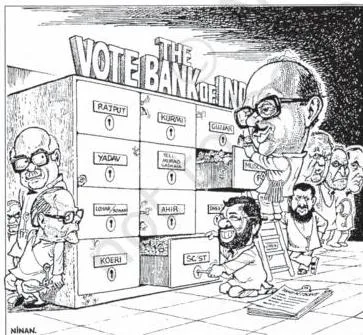
The caption of this figure is the chapter’s own hinge: “we have so far looked at what caste does to politics” — the next step is what politics does to caste (NCERT, p. 42).
Figure walkthrough: reading the maps, graphs and cartoons
The chapter argues with data, and these visuals carry its evidence. Exam answers often quote the conclusions they support, so each one is worth reading properly once.
The child sex ratio map (NCERT page 33)
This map is the chapter’s hard evidence for sex-selective abortion.
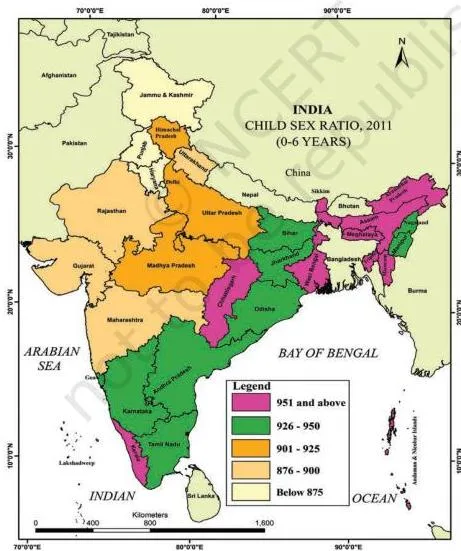
The map shows the child sex ratio — the number of girl children per thousand boys — across Indian states, from the Census Report of 2011. The chapter links the falling ratio to parents preferring sons and aborting girl children before birth: the national ratio fell to 919, and the map shows it below 850 or even 800 in some states (NCERT, p. 33).
The chapter’s in-text questions are worth doing: find your own state on the map, identify the states with a ratio below 900, and compare the map with the poster on the next page — both tell the same story.
Women in national parliaments graph (NCERT page 34)
This graph places India in a world comparison on women’s representation.
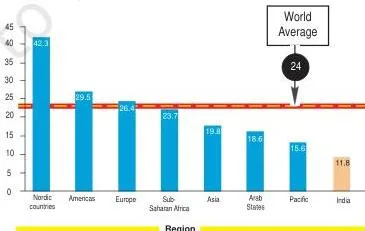
The bars give the percentage of women in the directly elected houses of parliament by world region, as on 1 October 2018 (source: IPU).
The chapter’s point: India sits among the bottom group of nations, behind the averages of several developing countries of Africa and Latin America, and cabinets stay largely all-male even when a woman becomes Chief Minister or Prime Minister (NCERT, p. 34).
The remedy the chapter offers is legally binding reservation — the one-third of local-body seats already reserved in Panchayati Raj has produced more than 10 lakh elected women representatives, and the 2023 Act extends the same principle to the Lok Sabha, State Assemblies and the Delhi Assembly (pp. 34-35).
Religious communities pie chart, 2011 (NCERT page 39)
This pie chart answers a common misconception about population balance.
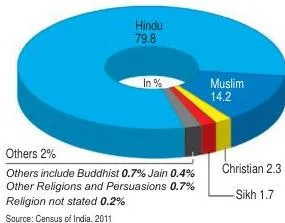
The chart presents the population proportion of the six major religious communities from the 2011 Census. The chapter’s conclusion: since Independence every community’s absolute population has grown, but the proportions have barely changed (NCERT, p. 39).
Expert estimates for the Sachar Committee show the Muslim share is expected to rise by only about 3 to 4 per cent over the next 50 years — so the common impression that the Muslim proportion will overtake other communities is mistaken.
Two cartoons that make the chapter’s point (NCERT pages 33 and 40)
These two cartoons carry the chapter’s argument in dialogue form. Read them before you see the point they make.
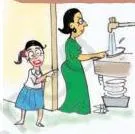
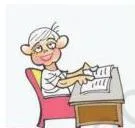
The first cartoon shows a child who hears her mother tell outsiders, “I don’t work. I am a housewife” — while watching her work non-stop (NCERT, p. 33). It makes the chapter’s point about the time-use data in one image: women’s household work is real, but it is unpaid and therefore invisible and unvalued.
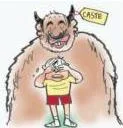
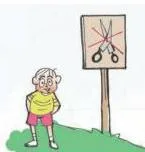
The second cartoon answers a student who asks why the textbook discusses caste at all (NCERT, p. 40). The reply: wherever there is domination, Political Science should discuss it — and caste will not disappear if we stay silent. It is the chapter’s justification for studying caste, and it sets up the distinction between examining caste and promoting casteism.
Definitions: the chapter’s glossary in plain words
These are the chapter’s own defined terms, reworded for fast revision. Six come from the glossary boxes; the rest are central phrases you must be able to define.
| Term | Plain definition | NCERT page |
|---|---|---|
| Sexual division of labour | The system in which all work inside the home is done by the women of the family, or organised by them through domestic helpers | p. 30 |
| Feminist | A woman or a man who believes in equal rights and opportunities for women and men | p. 31 |
| Patriarchy | Literally “rule by father”; a system that values men more and gives them power over women | p. 32 |
| Family laws | Laws dealing with family matters such as marriage, divorce, adoption and inheritance; different religions have different family laws in India | p. 37 |
| Communalism | Using religion in politics in exclusive and partisan terms, pitting one religion and its followers against another | p. 36 |
| Secular state | A state with no official religion, freedom of religion for all, no religious discrimination, and the power to intervene for equality within communities | p. 37 |
| Caste hierarchy | A ladder-like formation placing all caste groups from ‘highest’ to ‘lowest’ | p. 40 |
| Urbanisation | Shift of population from rural areas to urban areas | p. 40 |
| Occupational mobility | Shift from one occupation to another, usually when a new generation takes up occupations other than their ancestors’ | p. 40 |
| Casteism | The belief that caste is the sole basis of social community | p. 40 |
Common mistakes students make in this chapter
These are the confusions the chapter’s own pages warn about. Name them before they cost you marks.
| Common mistake | Correct rule | How to check your answer |
|---|---|---|
| Thinking gender division is biological | Gender division is not based on biology but on social expectations and stereotypes (p. 30) | Exercise Q7 — correct option (b), unequal roles assigned by society |
| Thinking a feminist is a woman who opposes men | A feminist is a woman or a man who believes in equal rights and opportunities for women and men (p. 31) | Glossary box, p. 31; matching Q12 item 1 → B |
| Confusing Gandhiji’s “religion in politics” with a theocracy | Gandhiji meant the moral values common to all religions; the Constitution gives no official status to any religion (pp. 36-37) | Compare the Gandhiji passage (p. 36) with the secular-state list (p. 37) |
| Believing caste alone decides elections | Four reasons it cannot — no constituency has a single-caste majority, no party wins a whole caste’s votes, and ruling parties frequently lose (p. 42) | Exercise Q4 asks for two of those reasons |
| Confusing panchayat reservation with the 2023 Act | One-third of seats in panchayats and municipalities are already reserved; the 2023 Act provides 33 per cent in the Lok Sabha, State Assemblies and Delhi Assembly (p. 35) | Exercise Q8 — the reservation in force is (d), Panchayati Raj bodies |
| Treating any discussion of caste as casteism | Studying caste is not casteism; discussing domination is exactly what Political Science is for (pp. 40, 42-43) | The “Now you don’t like it!” cartoon on p. 40 answers this directly |
Exam notes: mapping every exercise to the pages that answer it
Every end-of-chapter exercise is answered inside the chapter’s own pages; this map shows where, and gives the objective answers with reasoning. Textbook contents and the examinable syllabus are not always identical — check the current official syllabus before you decide what to revise.
Short-answer exercises 1 to 6: where each answer lives
| Exercise | What it asks | Where the answer is |
|---|---|---|
| 1 | Aspects of life in which women are discriminated or disadvantaged | pp. 31-33 — the four disadvantages: literacy gap, dropout rates, unequal pay, violence and sex-selective abortion |
| 2 | Forms of communal politics with one example each | pp. 36-37 — the four forms in the table above |
| 3 | How caste inequalities are still continuing | pp. 40-41 — same-caste marriage, unfinished elimination of untouchability, unequal access to education, caste closely linked to economic status |
| 4 | Two reasons caste alone cannot determine election results | p. 42 — no constituency has a single-caste majority; no party wins all voters of a caste; ruling parties and sitting MPs or MLAs frequently lose |
| 5 | Status of women’s representation in legislative bodies | p. 34 — 14.36 per cent in the Lok Sabha in 2019, below 5 per cent in state assemblies, one-third of local-body seats reserved |
| 6 | Two constitutional provisions that make India a secular state | p. 37 — any two of the four provisions listed above |
For the short-answer questions, a complete answer names the chapter’s concepts and quotes its data — for Q5, for example, give both the Lok Sabha figure and the state-assembly figure, not just one.
Objective questions 7 to 12, answered with reasoning
Q7. Gender divisions refer to — (b) unequal roles assigned by the society to men and women. The chapter says gender division is not based on biology but on social expectations and stereotypes (p. 30), which is exactly what option (b) describes.
Q8. Seats are reserved for women in — (d) Panchayati Raj bodies. One-third of seats in panchayats and municipalities are reserved for women (pp. 34-35). The 2023 Act provides 33 per cent reservation in the Lok Sabha, State Legislative Assemblies and the Delhi Assembly, but the reservation already in operation is in local bodies.
Q9. Communal politics statements — (c) A and C are correct. Communalism presents one religion as superior to others (A) and holds that followers of a particular religion constitute one community (C).
Statements B and D are the opposite of what communal politics believes: it holds that people of different religions cannot live as equal citizens in one nation, and that state power is used to establish the domination of one religious group (p. 36).
Q10. The wrong statement about the Constitution is — (b) it gives official status to one religion. The Constitution gives no official religion to the Indian state (p. 37); the other three options are genuine provisions.
Q11. Social divisions based on caste are peculiar to India. The chapter says caste division is special to India — a hereditary occupational division sanctioned by rituals (p. 38).
Q12. Matching — (b) 1-B, 2-A, 3-D, 4-C. Equal rights for women and men is a feminist (1-B); religion as the principal basis of community is a communalist (2-A); caste as the principal basis of community is a casteist (3-D); no discrimination on religious beliefs is a secularist (4-C).
Data points worth quoting in answers
A precise answer quotes the chapter’s own statistics. These appear repeatedly in the chapter:
| Statistic | Value | Source and page |
|---|---|---|
| Women’s literacy rate | 54 per cent (men: 76 per cent) | p. 32 |
| Child sex ratio, India | 919 girls per thousand boys; below 850 or even 800 in some states | Census 2011, p. 33 |
| Average daily work | Women a little over seven and a half hours; men six and a half hours | Time Use Survey, 1998-99, p. 32 |
| Women in the Lok Sabha | 14.36 per cent (2019); below 5 per cent in state assemblies | p. 34 |
| Elected women representatives in local bodies | More than 10 lakh | p. 35 |
| Scheduled Castes | 16.6 per cent of the population | Census 2011, p. 39 |
| Scheduled Tribes | 8.6 per cent of the population | Census 2011, p. 39 |
| Other Backward Classes | About 41 per cent | NSS 2004-05, p. 39 |
| SC, ST and OBC together | About two-thirds of the population; about three-fourths of the Hindu population | p. 39 |
| Muslim population projection | Rise of about 3 to 4 per cent over the next 50 years | Sachar Committee estimates, p. 39 |
Revision summary: the chapter’s argument in five points
The chapter has no formal summary block; these five points compress its argument from the opening claim to the closing verdict.
- Diversity is not the enemy of democracy. The existence of social diversity does not threaten democracy; political expression of social differences is possible and sometimes quite desirable (NCERT, p. 29).
- Gender division is social, not biological. Once raised in politics it brought real gains — the Equal Remuneration Act, reservation in panchayats and municipalities, and the Women’s Reservation Act, 2023 (pp. 30-35).
- Communalism is the negative case. Religion expressed in exclusive, partisan terms threatens the very idea of India; the secular state is the constitutional answer, necessary but not sufficient (pp. 36-37).
- Caste is both inequality and resource. Caste still tracks economic status, yet its politicisation has given Dalits and OBCs better access to decision-making (pp. 38-43).
- The verdict: expression decides. Whether a division is healthy depends on how it is expressed — exclusive attention to caste can divert attention from poverty, development and corruption and can lead to tension and violence (pp. 42-43).
Related resources: other Class 10 chapters and books
This listing is maintained for the 2026-27 academic session using the NCERT textbook information available to us. NCERT remains the authority for confirming the latest edition.
This chapter is the third in Democratic Politics-II, the Class 10 Social Science civics book, part of the Class 10 NCERT books hub. It follows Chapter 2, Federalism, and leads into Chapter 4, Political Parties.
It also refers back to Class 9 civics — untouchability and the OBCs — and to the Northern Ireland example the book discussed earlier, where most people share one religion yet differ over how it is practised.
For revision, the Class 10 Social Science notes page collects chapter-wise notes for this subject, the Class 10 notes hub collects study material for the class, and the main CBSE notes index is the starting point for the whole site. The economics chapters Sectors of the Indian Economy and Agriculture sit alongside this book in the Class 10 Social Science syllabus.
Sources and data verification
What this page’s facts rest on, stated plainly:
- The figures, tables and page numbers on this page come from the NCERT Class 10 Social Science textbook Democratic Politics-II, chapter 3 “Gender, Religion and Caste”, pages 28-45, official edition on ncert.nic.in.
- This page covers that one chapter of that one book — not the full CBSE Class 10 Social Science scheme.
- The page is kept current using the NCERT information available to us.
- NCERT settles textbooks, editions and PDFs; CBSE settles the curriculum, syllabus and examinations.
Frequently asked questions about Gender, Religion and Caste
Is gender division the same as the biological difference between men and women?
No. The chapter says gender division is not based on biology but on social expectations and stereotypes (NCERT, p. 30). Society brings up boys and girls to believe that housework and child-rearing are women’s work, which produces unequal roles. Exercise question 7 tests exactly this — the correct option is (b).
What are the forms of communalism in Indian politics?
Communalism takes four forms (pp. 36-37): everyday beliefs and stereotypes; a quest for political dominance of one’s own religious community; political mobilisation on religious lines using sacred symbols, religious leaders and emotional appeal; and communal violence, riots and massacre.
Which constitutional provisions make India a secular state?
Four provisions (p. 37): the state has no official religion; everyone has freedom to profess, practice and propagate any religion or none; discrimination on grounds of religion is prohibited; and the state may intervene in religion to ensure equality within communities — for example, by banning untouchability.
What does the Women’s Reservation Act, 2023 provide?
The Nari Shakti Vandan Adhiniyam (Women’s Reservation Act, 2023) provides 33 per cent reservation of seats for women in the Lok Sabha, State Legislative Assemblies and the Delhi Assembly (p. 35). One-third of seats in panchayats and municipalities are already reserved for women.
Why does caste alone not decide election results?
Because no parliamentary constituency has a clear majority of one single caste; no party wins the votes of all voters of a caste; voters may have several candidates from their own caste or none at all; and ruling parties and sitting MPs or MLAs frequently lose — impossible if caste preferences were frozen (p. 42).
Does discussing caste in a textbook promote casteism?
No. The chapter’s cartoon answers this directly (p. 40): wherever there is domination, Political Science should discuss it, and caste will not disappear if we stay silent. The chapter separates studying caste from exclusive caste politics, which can divert attention from poverty, development and corruption (pp. 42-43).
Reference: NCERT Class 10 Social Science (Democratic Politics-II) textbook, chapter 3, official edition on ncert.nic.in.
Explore Class 10 Social Science Books
Class 10 Social Science on LearnCBSE:
Related chapters: