
These how forces affect motion class 9 notes cover the whole of Chapter 6 in one place: Newton’s three laws, balanced and unbalanced forces, friction, and the system approach for connected objects. Each idea below comes with its formula, its SI unit and a worked example so you can revise fast.
You also get a list of the marks-gaining steps for the calculation patterns this chapter keeps using, the classic mistakes that cost students marks, and a one-page recap to read minutes before the exam. Every statement carries its NCERT page reference.
If you want to verify any detail against the official text, open the Class 9 Science book on the NCERT textbook portal.
How Forces Affect Motion Class 9 Notes: From Motion to Forces
In Chapter 4 you learnt to describe motion with position, velocity and acceleration. This chapter asks the next question: what causes motion to start, stop or change direction? The answer is force (NCERT, p. 1).
These notes follow the teaching order that gets you to the formulas fastest. Each idea builds on the one before it:
- Force as a vector — it needs magnitude, direction and unit.
- Balanced vs unbalanced forces — when forces cancel or combine into a net force.
- Friction — the ever-present opposing force that explains why real objects stop.
- First law — zero net force means no change in velocity.
- Second law — \( F = ma \) links net force to acceleration and does all the arithmetic.
- Third law — forces come in equal-opposite pairs on two different objects.
- System approach — treat connected objects as one mass.
This order beats the textbook’s for revision because friction makes sense of the first law’s “ideal” world, the second law gives you the numbers, and the third law explains everyday motion like walking and rockets.
All the Class 9 Science notes live in the hub, including earlier chapters such as exploring mixtures and their separation and the next topic, work, energy and simple machines, which builds on these force ideas. For every subject, browse the Class 9 hub and the full CBSE notes index.
Force: A Vector with Magnitude and Direction
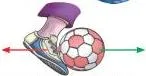
Force can make an object move from rest, change the speed or direction of a moving object, and it can even change an object’s shape (NCERT, p. 1). A ball stays still until you kick it, a cricket bat changes the ball’s direction, and your fingers squeeze a lemon flat.

Because force needs a direction along with its magnitude and unit, it is a vector quantity — exactly like position, displacement, velocity and acceleration from Chapter 4 (NCERT, p. 1). If the magnitude, the direction, or both change, the effect of the force changes too (NCERT, p. 2).
The SI unit of force is the newton, symbol N. The full name is written lowercase even though the unit is named after Isaac Newton; only the symbol is capitalised (NCERT, p. 7). The magnitude of a force expresses its strength.
A spring balance measures the magnitude of a force. Weight is the gravitational force with which the Earth pulls an object, and the spring balance reads it; pull on the free end and it reads your pull too (NCERT, p. 2).
Balanced and Unbalanced Forces: Finding the Net Force

Two forces that are equal in magnitude and opposite in direction on the same object are balanced forces — like two equal teams in a tug of war, the rope does not move (NCERT, p. 2). The moment one team pulls harder, the forces become unbalanced and the rope moves toward the bigger pull.
Unbalanced forces produce a non-zero net force — the single force that has the same effect as all the forces acting together (NCERT, p. 3). Many forces may act on an object, but its motion depends only on the net force (NCERT, p. 4).
| Situation (forces parallel) | Net force magnitude | Direction |
|---|---|---|
| Same direction, 8 N and 3 N | \( 8 + 3 = 11\ \)N | Along both forces |
| Opposite directions, 8 N and 3 N | \( 8 – 3 = 5\ \)N | Along the larger (8 N) force |
| Opposite directions, equal 8 N and 8 N | 0 N | No motion (balanced) |
Two rules cover parallel forces (NCERT, p. 3): same direction adds; opposite direction subtracts, and the net force points along the larger force. When forces act at an angle to each other, you learn the full calculation in higher grades (NCERT, p. 3).
Equal and opposite forces on the two ends of an extended object make it rotate — that is how a handlebar or a tap turns (NCERT, p. 3).
Friction: The Force You Cannot Ignore
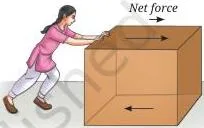
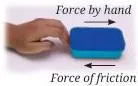
Push a box on a floor and it may not move at first. The force resisting you is friction, which arises between the bottom of the box and the floor and acts opposite to the direction you push (NCERT, p. 4). The box starts moving only when your force is larger than friction, so a net force acts forward.
Stop pushing and friction still acts on the box, so it slows and comes to rest. That is why a bicycle you stop pedalling eventually stops — you do not need a force to keep something moving, only to beat friction.
Activities 6.1 and 6.2 show that friction depends on the nature of the surfaces in contact. The conclusion: when friction is smaller, the velocity of a moving object decreases more slowly and the object travels a larger distance before stopping (NCERT, p. 6).
Friction can also help you move. While walking you push the ground backwards; friction from the ground acts forwards on your foot (NCERT, p. 14). That is why grooves on shoe soles and treads on tyres increase friction, and why wet or icy floors are dangerous (NCERT, p. 14).
On a surface, the object’s weight acts downwards while the normal force from the surface acts upwards, perpendicular to it; the two balance. Air friction on a moving box is usually so small it can be neglected (NCERT, p. 4).
Newton’s First Law: No Net Force, No Change
Newton’s first law of motion: an object at rest remains at rest, and an object in motion continues to move with a constant velocity, unless a net force acts upon it (NCERT, p. 7). Constant velocity means no change in magnitude or direction — straight-line motion at the same speed (NCERT, p. 7).
Newton used the word inertia for the tendency of objects to resist change in their state of rest or uniform motion (NCERT, p. 7). Before Newton, many thought a force was needed to keep an object moving at constant velocity; Galileo argued through thought experiments that with all impediments removed, a body on a horizontal plane moves indefinitely (NCERT, p. 7).
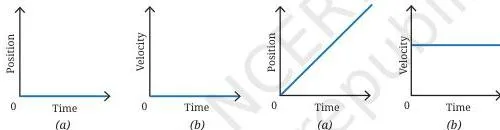
With zero net force, two things are possible: the object stays at rest, or it keeps moving with constant velocity. At rest, the position-time graph is flat and the velocity-time graph is flat at zero. In constant motion, the position-time graph is a straight sloping line and the velocity-time graph is flat at that speed (NCERT, p. 8).
In both cases the acceleration is zero.
Example 6.2 shows the logic in action: a person pushes a moving box forward with a force exactly equal to friction. The two forces are equal and opposite, the net force is zero, and the box continues with constant velocity (NCERT, p. 7).
If friction were zero, a net force is needed to start an object moving from rest, but once moving no force is needed to keep it at constant velocity. Force is needed only to change or stop the motion (NCERT, p. 8).
Newton’s Second Law: F = ma, the Workhorse Formula
The first law answers “what if there is no net force?”; the second law answers “what if there is?”. A net force makes an object accelerate in the direction of the force. The magnitude of the acceleration is proportional to the net force and inversely proportional to the mass (NCERT, p. 10).
\[ a = \frac{F}{m} \quad (6.1) \]
\[ F = ma \quad (6.2) \]
In \( F = ma \), \( F \) is the net force in newtons (N), \( m \) is the mass in kilograms (kg), and \( a \) is the acceleration in m/s² (NCERT, p. 10). The acceleration points along the net force.
Why does the equation hold? Force is the cause of acceleration. A heavier object needs a bigger force to reach the same acceleration, and the same force gives a lighter object a bigger acceleration — exactly what Activities 6.3 and 6.4 show (NCERT, pp. 9–11).
One newton is the force that produces an acceleration of 1 m/s² on a mass of 1 kg (NCERT, p. 10). In units, \( 1\ \text{N} = 1\ \text{kg m/s}^2 \). You can feel roughly one newton — holding a 100 g mass in your palm (NCERT, p. 11).
Weight is the gravitational force of the Earth on a mass, given by \( F = mg \) (Eq. 6.3). Here \( g \) is the acceleration due to the gravitational force by the Earth, \( g = 9.8\ \text{m/s}^2 \), taken as nearly constant near the surface. For quick estimates use \( g = 10\ \text{m/s}^2 \) (NCERT, p. 11).
Importantly, \( g \) does not depend on the object’s mass (NCERT, p. 11). From \( a = F/m = mg/m = g \), the mass cancels: a heavier object feels a larger gravitational force but resists more, and the two effects balance.

Real-life safety devices use \( F = ma \) backwards. A cricket fielder pulls their hands back after catching to increase the time over which the ball stops — longer time, smaller acceleration, smaller force on the hands (NCERT, p. 11). An airbag does the same: it spreads the impact over more time and lowers the force on the passenger (NCERT, p. 12).
A coconut cracked in one go stops in a very short time, so the ground’s force on it is huge (NCERT, p. 12).
A more complete form of the second law uses momentum, mass times velocity; it states that the rate of change of momentum is proportional to the net force and takes place in its direction. This form works even when mass changes (NCERT, p. 11).
Newton’s Third Law: Equal and Opposite, on Different Objects
Newton’s third law of motion: whenever one object exerts a force on a second object, the second object simultaneously exerts an equal and opposite force on the first (NCERT, p. 15).
The point that catches students out: the two forces act on two different objects, so they can never cancel. Cancelling needs both forces on the same object (NCERT, pp. 15–16).
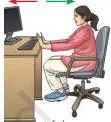
- Chair and table: sit on a wheeled chair, push the table away, and the table pushes you back — the chair rolls in the opposite direction (Activity 6.5; NCERT, p. 14).
- Rowing a canoe: the paddle pushes water backwards; the water pushes the paddle forward with an equal force, moving the canoe forward (NCERT, pp. 15–16).
- Balloon and rocket: the shrinking balloon pushes air out; the escaping air pushes the balloon the other way. A rocket expels gas downwards and the gas pushes the rocket upwards (NCERT, p. 16).
- Climbing a tree: your feet push down on the trunk, and friction pushes you up (NCERT, p. 15).
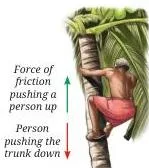
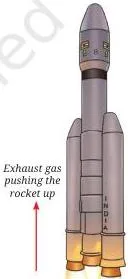
The third law holds for non-contact forces too. Two bar magnets, two similarly charged balloons, and the Earth and a falling fruit all exert equal and opposite forces on each other (NCERT, p. 17). The Earth–fruit puzzle: the forces are equal, but the Earth’s mass is so huge that its acceleration is negligible (NCERT, p. 17).
Equal forces do not mean equal accelerations when masses differ. In Example 6.8, a recoil force of 2 N gives the 5 kg gun an acceleration of \( 0.4\ \text{m/s}^2 \) but the 0.1 kg bullet an acceleration of \( 20\ \text{m/s}^2 \) because \( a = F/m \) divides by each object’s own mass (NCERT, p. 17).
Connected Objects: The System Trick
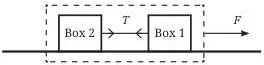
Newton’s laws apply to connected objects as well. Two boxes of masses \( m_1 \) and \( m_2 \) sit on a frictionless floor, joined by a string. A force \( F \) pulls the first box, and the string transmits a force called tension \( T \) between the boxes (NCERT, p. 18).
Treat the two boxes and the string as one system. Tension is an internal force between the boxes, so you can ignore it; only external forces matter. The only external force along the motion is \( F \), so (NCERT, p. 18):
\[ a = \frac{F}{m_1 + m_2} \quad (6.4) \]
The system accelerates exactly like a single object of mass \( m_1 + m_2 \). Analysing each box separately would give the same result (NCERT, p. 18). Vertically, the total weight \( (m_1 + m_2)g \) is balanced by the normal force from the ground (NCERT, p. 18).
Why is the trick valid? The internal tension keeps the boxes’ accelerations linked, so a force from outside is all that changes the total motion. Walking is a real-world version: your arms and legs move in complex ways, yet your whole body can be studied as one object (NCERT, p. 18).
Key Terms and Definitions at a Glance
| Term | Meaning | Example |
|---|---|---|
| Force | A push or pull that can change motion or shape | Kicking a ball |
| Balanced forces | Equal in magnitude, opposite in direction, on the same object | Tug of war with equal teams |
| Unbalanced forces | Forces whose net effect is non-zero | One team pulling harder |
| Net force | The single force with the same effect as all acting forces | \( 8\ \)N and \( 3\ \)N opposite give \( 5\ \)N |
| Friction | Force opposing motion between surfaces in contact | A box slowing on a floor |
| Inertia | Tendency to resist change in state of rest or motion | Body lurching when a bus stops |
| Tension | Force transmitted through a string or rope | String between two boxes |
| Newton (N) | SI unit of force; \( 1\ \text{N} = 1\ \text{kg m/s}^2 \) | Force to give 1 kg an acceleration of 1 m/s² |
| \( g \) | Acceleration due to gravitational force by the Earth, \( 9.8\ \text{m/s}^2 \) | Weight of 1 kg is about 9.8 N |
Formulas with Symbols and Units
| Formula | Symbols | SI units | What it tells you |
|---|---|---|---|
| \( a = \frac{F}{m} \) (6.1) | \( F \) net force, \( m \) mass, \( a \) acceleration | N, kg, m/s² | Acceleration from net force and mass |
| \( F = ma \) (6.2) | same as above | kg m/s² = N | Net force that produces a given acceleration |
| \( F = mg \) (6.3) | \( g = 9.8\ \text{m/s}^2 \) | N | Weight (gravitational force) of a mass |
| \( a = \frac{F}{m_1 + m_2} \) (6.4) | \( m_1, m_2 \) masses of connected boxes | m/s² | Acceleration of a connected system |
| \( v = u + at \) | \( u \) initial, \( v \) final velocity, \( t \) time | m/s, m/s, s | Final velocity under constant acceleration |
| \( s = ut + \frac{1}{2}at^2 \) | \( s \) displacement | m | Displacement under constant acceleration |
Worked Examples: Solved Step by Step with Original Numbers
Example A: Net force, acceleration and displacement of a pushed box
Method: find the net force, apply \( a = F/m \), then use \( s = ut + \frac{1}{2}at^2 \).
Step 1: Write the forces.
A 40 kg box on a horizontal floor is pushed forward with 80 N while friction acts backward with 30 N.
Friction opposes motion, so:
\[ F_{\text{net}} = 80\ \text{N} – 30\ \text{N} = 50\ \text{N forward} \]
Step 2: Find the acceleration with \( a = F/m \):
\[ a = \frac{50\ \text{N}}{40\ \text{kg}} = 1.25\ \text{m/s}^2 \text{ forward} \]
Step 3: Find the displacement in 3 s with \( s = ut + \frac{1}{2}at^2 \), starting from rest so \( u = 0 \):
\[ s = 0 + \frac{1}{2} \times 1.25\ \text{m/s}^2 \times (3\ \text{s})^2 = \frac{1}{2} \times 1.25 \times 9 = 5.625\ \text{m} \]
Final answer: net force 50 N forward; acceleration 1.25 m/s² forward; displacement 5.625 m forward in 3 s.
Example B: Force from a three-interval velocity-time graph
Method: read the acceleration from each slope of the velocity-time graph using \( v = u + at \), then apply \( F = ma \).
Step 1 (0–4 s, speeding up): a 1200 kg car goes from 0 to 12 m/s in 4 s.
\[ a = \frac{v – u}{t} = \frac{12 – 0}{4} = 3\ \text{m/s}^2 \]
\[ F = ma = 1200\ \text{kg} \times 3\ \text{m/s}^2 = 3600\ \text{N forward} \]
Step 2 (4–7 s, constant velocity): velocity stays 12 m/s, so \( a = 0 \) and \( F = 0\ \text{N} \).
Step 3 (7–13 s, braking): the car slows from 12 m/s to 0 in 6 s.
\[ a = \frac{0 – 12}{6} = -2\ \text{m/s}^2 \]
\[ F = 1200\ \text{kg} \times (-2\ \text{m/s}^2) = -2400\ \text{N} \]
Step 4: read the sign.
Negative here means opposite to the direction of motion, so the force is 2400 N against the motion.
Final answer: 3600 N forward (0–4 s), 0 N (4–7 s), 2400 N opposite to motion (7–13 s).
Common Mistakes: What Students Write vs What Is Correct
| Mistake | Correct rule | How to check your answer |
|---|---|---|
| “Action and reaction forces cancel each other out.” | They act on two different objects, so they never cancel; only equal-opposite forces on the same object cancel (NCERT, p. 16). | Ask where each force sits. Different objects → no cancelling. |
| “A force must keep pushing an object to keep it moving.” | Zero net force means constant velocity continues; you only need a force to beat friction (NCERT, p. 7). | Is the net force zero? If yes, motion continues without a push. |
| “Ignoring friction when calculating the net force.” | Friction always opposes motion, so subtract it: net force = applied − friction (NCERT, p. 4). | Write both forces and their directions before substituting into \( F = ma \). |
| “Writing the unit as ‘N’ in words.” | The full name is newton, lowercase; the symbol is N, capitalised (NCERT, p. 7). | In a sentence write “newton”; in a calculation write N. |
| “Equal forces always produce equal accelerations.” | \( a = F/m \), so acceleration depends on each object’s own mass — gun and bullet differ (NCERT, p. 17). | Divide the force by the mass of the object you are asked about. |
| “Picking the wrong direction for the net force.” | The net force points along the larger force (NCERT, p. 3). | State both directions, subtract magnitudes, keep the larger force’s direction. |
Exam Notes: How This Chapter Is Asked
This chapter’s numericals repeat a small set of patterns. Below are the calculation types the textbook itself keeps using, with the step that earns the mark in each. This describes observed patterns in the textbook; it is not a prediction of any paper.
Pattern 1: Net force from two opposite forces
Example 6.1 (NCERT, p. 3). Two forces on a block — subtract the magnitudes. The mark-earning step is stating the direction of the larger force with the value: “net force = 4 N towards the right” earns the full mark; a bare number does not.
Pattern 2: Force from a velocity-time graph
Example 6.6 (NCERT, p. 12). First compute the acceleration from the slope using \( v = u + at \), then substitute into \( F = ma \). A horizontal segment means \( a = 0 \), so \( F = 0 \); a falling segment gives a negative acceleration, so write the force as opposite to motion.
Pattern 3: Recoil of gun and bullet
Example 6.8 (NCERT, p. 17). Use the third law to assign the same force magnitude to both objects, then divide by each object’s own mass. Equal forces, different masses → different accelerations.
Pattern 4: Constant velocity means zero net force
Revise questions 1 and 3 (NCERT, p. 19). The mark-earning step is linking “moving at constant velocity” to “acceleration = 0 → net force = 0”. For a table moved at constant velocity, the frictional force equals the applied force.
Pattern 5: Displacement from a net force
Example 6.5 (NCERT, p. 12) and the pushed-box revision question. The mark-earning step is the chain: net force → \( a = F/m \) → \( s = ut + \frac{1}{2}at^2 \). Keep the units in every line.
These force ideas return in the next chapter, work, energy and simple machines, which we also cover in the Class 9 Science hub.
Activities 6.1 to 6.7: What They Demonstrate
Each activity backs one core idea. Know what each one proves for experiment-based questions:
- 6.1 (coins on a rubber band, different surfaces): friction depends on the nature of the surfaces; smaller friction → the coin stack travels farther before stopping (NCERT, p. 5).
- 6.2 (spring balance pulling a block): the reading gives the magnitude of friction, which differs by surface; a smaller reading means smaller friction (NCERT, p. 6).
- 6.3 (cart and pulley, doubling the force): acceleration increases as the net force on a fixed mass increases (NCERT, p. 9).
- 6.4 (cart and pulley, doubling the mass): with the same force, acceleration decreases as mass increases (NCERT, p. 10).
- 6.5 (chair with wheels, push the table): action and reaction — the table pushes you back and the chair moves opposite (NCERT, p. 14).
- 6.6 (two spring balances hooked together): the readings are equal, proving action–reaction forces are equal in magnitude (NCERT, p. 15).
- 6.7 (balloon rocket): air rushing out exerts an equal opposite force on the balloon, which moves the other way — the model of a rocket launch (NCERT, p. 16).
Figure Walkthrough: Reading the Forces on a Block

The diagram above is the textbook’s Example 6.1 block, which shows two forces acting in three arrangements (NCERT, p. 3). The textbook uses 10 N and 6 N. Here is the same logic with a fresh pair of numbers, 12 N and 5 N:
- Both forces to the right: net force = 12 + 5 = 17 N to the right.
- 12 N right, 5 N left: net force = 12 − 5 = 7 N to the right.
- 12 N left, 5 N right: net force = 12 − 5 = 7 N to the left.
Whatever the pair of numbers, the rule is the same: same direction → add; opposite direction → subtract; the larger force chooses the direction of the net force. Remember too that equal and opposite forces on the two ends of an extended object make it rotate instead of translating (NCERT, p. 3).
One-Page Revision Summary
| Idea | One-line meaning | Formula / value | Example |
|---|---|---|---|
| First law | No net force → no change in velocity | \( F_{\text{net}} = 0 \) | Box moving at constant velocity |
| Second law | Acceleration ∝ force, ∝ 1/mass | \( F = ma \) | Pushing a cart harder gives more acceleration |
| Third law | Equal and opposite forces on two objects | Action–reaction pairs | Rowing a canoe |
| Friction | Opposes motion; depends on surfaces | Net = applied − friction | Bicycle slowing when you stop pedalling |
| System of objects | Add masses, ignore internal tension | \( a = \frac{F}{m_1 + m_2} \) | Two boxes pulled by a rope |
| \( g \) | Free-fall acceleration near Earth’s surface | \( g = 9.8\ \text{m/s}^2 \) (≈ 10) | Falling objects accelerate downward |
Night-before mnemonic — the 1-2-3 of forces:
- 1 — no change: no net force → no change in velocity (first law).
- 2 — F = ma: the second law does all the arithmetic.
- 3 — pair up: every action force has an equal, opposite reaction on the other object (third law).
FAQs: Quick Answers for Revision
Why does a moving bicycle come to rest when I stop pedalling, if Newton’s first law says it should keep moving?
The first law applies only when the net force is zero. Once you stop pedalling, friction and air resistance still act on the bicycle, so the net force is not zero; they slow it down until it stops. On a perfectly frictionless road it would keep going.
Do action and reaction forces cancel each other out?
No. They act on two different objects, and forces can cancel only when they act on the same object (NCERT, p. 16). That is why a canoe moves forward — the water’s push on the paddle and the paddle’s push on the water are on different objects, so nothing cancels.
How do I find the force acting on an object from a velocity-time graph?
Take the slope of a straight segment — that slope is the acceleration, from \( v = u + at \) — then multiply by the mass: \( F = ma \). A flat segment means zero acceleration and zero force; a falling segment means the force opposes the motion.
Is Newton’s third law valid for non-contact forces like gravity and magnetism?
Yes. The third law applies to all types of forces — contact or non-contact. Two bar magnets, two charged balloons, and the Earth and a falling fruit all exert equal and opposite forces on each other (NCERT, p. 17).
When should I use g = 9.8 m/s^2 and when g = 10 m/s^2?
Use \( g = 9.8\ \text{m/s}^2 \) in exam calculations so your answers match accepted values; use \( g = 10\ \text{m/s}^2 \) only for quick mental estimates. The textbook states both values (NCERT, p. 11).
Reference: NCERT Class 9 Science textbook, chapter How Forces Affect Motion.
Explore Class 9 Science Notes
More for this chapter:
Class 9 Science on LearnCBSE:
Related chapters: