
These Class 9 Science Chapter 1 notes cover Exploration: Entering the World of Secondary Science, the opening chapter of the rationalised NCERT Science textbook. This is an orientation chapter with no heavy formulas. It teaches how science works — how models simplify the world, how precise language makes ideas shareable, and how estimation keeps answers honest.
Use this page the way you would use a revision partner. Read the section you feel weak in, do the two worked examples, then run through the night-before recap at the end. Every key idea is tied to its NCERT page number so you can cross-check fast.
Class 9 Science Chapter 1 Notes: What This Chapter Explores
Chapter 1 is the launch pad for the whole textbook. It introduces six big ideas that every later chapter leans on.
- Models and deliberate simplification — science ignores details on purpose to make questions answerable (NCERT, pp. 1–2).
- The precise language of symbols and units — why a kilogram must mean the same amount everywhere (NCERT, pp. 2–3).
- Laws, theories and principles — three terms with strict scientific meanings (NCERT, pp. 3–4).
- Predictions and their testing — reasoned expectations, not guesswork (NCERT, pp. 4–5).
- Rough estimation — the habit of checking whether an answer makes sense (NCERT, pp. 5–6).
- The connections between branches of science — real problems mix physics, chemistry, biology and more (NCERT, pp. 6–7).
The textbook frames every page number with two symbols. The magnifying glass stands for careful observation — noticing patterns and details that are easy to miss. The compass stands for direction — choosing the right model, asking the right question, and knowing where an idea stops applying.
Together the two symbols say that exploration is not aimless wandering; it means making sense of the world with care and purpose (NCERT, p. 1).
The chapter’s core message: science is not just a collection of facts, equations or experiments. It is a human activity of asking questions, testing ideas, sharing results and revising them as new evidence arrives (NCERT, p. 7). Keep our Class 9 Science notes hub open while you revise the full syllabus.
Models: Why Science Ignores Details on Purpose
A model is a simplified representation of a real system that keeps only the details that matter for the question you are asking. The assumptions made and the details ignored are features, not mistakes — they are chosen on purpose to keep the question answerable (NCERT, p. 1).
Each branch of science has its own standard simplification:
- Physics: a moving car may be represented as a single point.
- Chemistry: atoms and molecules are drawn as spheres and bonds.
- Biology: cells are shown as diagrams highlighting key parts.
- Earth science: the Earth may be treated as a smooth sphere layered into regions.
When physicist Meghnad Saha studied starlight, he did not try to model every atom, reaction and movement inside a star. He treated the star’s matter as a hot gas and focused only on temperature, pressure and how atoms form ions. That simplification let him explain how the colour of a star connects to its temperature (NCERT, p. 2).
Example 1.1 (cricket shot) shows the same thinking. To decide whether a hit ball crosses the boundary without touching the ground:
- Keep: the mass of the ball, and the speed and direction in which it is hit.
- Ignore: the brand of the bat, the colour of the ball, the amount of grass on the field.
- Add later for accuracy: air resistance, the spin of the ball, and the stitching of the seam.
The kept details change where the ball lands; the ignored ones do not. More complex models simply add more details (NCERT, p. 2).
You will meet the same logic in biology: our cell — the building block of life notes show cells drawn as simplified diagrams because highlighting key parts keeps the subject manageable. Then try Activity 1.1 (NCERT, p. 2) — model the bicycle ride from school to home, list what to keep and ignore, and explain why ignoring details helps.
Scientific Language: Symbols, Units and the Kilogram That Means the Same Everywhere
Science chooses its words carefully. Everyday words such as force, work, cell and reaction have strict scientific meanings, because ideas must be communicated clearly and unambiguously. Quantities are given symbols — mass \(m\), velocity \(v\), force \(F\), electric current \(I\) — each tied to a defined unit (NCERT, p. 2).
Symbols often come from history and international agreement. The speed of light is written \(c\) because it comes from the Latin word celeritas, meaning speed. It is not a convenient abbreviation; it is a constant defined to be exactly \(299792458\ \text{m/s}\) (NCERT, p. 3).
Standard units also protect daily life. In a well-known incident, a passenger aircraft ran out of fuel mid-flight because the ground crew used the fuel’s density in pounds per litre instead of kilograms per litre. The flight needed 22,300 kg of fuel but was about 15,000 litres short, and had to glide to an emergency landing (NCERT, p. 3).
Using standard SI units everywhere avoids exactly this kind of conversion error.
The buying-rice example makes the same point at the vegetable shop. We expect a kilogram to mean the same amount everywhere (Fig 1.1). If every market used a local standard, trade would be unfair. Agreed international standards let scientific results be compared and keep daily life fair (NCERT, p. 3).

The chapter also asks you to drop the fear of maths. Mathematics in science is a language, not a hurdle. An equation is a compact statement about how quantities are related — used to describe motion, rates of chemical reactions, population growth or energy changes.
The trick is to understand the situation first, identify the relevant quantities, and then let the equation reason for you (NCERT, p. 2).
Laws, Theories and Principles: Terms with Strict Meanings
Three terms appear all through secondary science, and each has one strict meaning:
- A law usually describes a regular pattern in nature, often as words or a mathematical relationship. Newton’s laws of motion, for example, explain the jerk you feel when a bus stops suddenly (NCERT, p. 3).
- A theory goes further: it explains why a pattern occurs, based on evidence gathered over time. The atomic theory, for instance, explains how molecules are formed (NCERT, p. 3).
- A principle is a broad guiding idea applied to a situation. The principle of conservation of energy guides what happens when you climb stairs (NCERT, p. 4).
| Term | What it does | Chapter example |
|---|---|---|
| Law | Describes a regular pattern in nature, often mathematically | Newton’s laws of motion explain the jerk when a bus stops |
| Theory | Explains why a pattern occurs, using evidence | Atomic theory explains how molecules are formed |
| Principle | Gives a broad guiding idea for a situation | Conservation of energy when climbing stairs |
Remember: “Laws describe, theories explain, principles guide.”
Misconception autopsy: Students often write “a theory is just a guess” or “a law is a theory that got proved.” Both are wrong. A theory is not an untested idea — it is an explanation based on careful testing and critical examination, and it stays open to change as new evidence arrives (NCERT, p. 4).
A law and a theory are not two stages of the same idea; they answer different questions. The law says what pattern happens; the theory says why it happens.
Predictions: Evidence-Based Expectations, Not Guesswork
Predictions are reasoned expectations based on evidence and careful thinking — never guesses (NCERT, p. 4). When a prediction matches observation, confidence in the underlying science grows. When it fails, scientists re-examine their assumptions, models or measurements. That is why failed predictions still drive science forward.
Example 1.2 (Varsha and Meghna): Varsha says it will rain because the clouds look dark. To make this prediction testable, Meghna should ask for measurable data and past patterns (NCERT, p. 4):
- What was the sky like the last time it rained?
- What is today’s humidity — was it above 80 per cent before the recent rains?
- What are today’s wind speed and direction?
- Is the temperature dropping as it did before the last rains?
Simple yes-or-no questions are far less useful than these.
The same pattern works at home. “The neem tree will flower early because the winter was short” becomes testable only as questions: How much shorter was this winter than the last five? In earlier short winters, did the tree flower early? What temperature and rainfall followed those winters? Each question collects evidence instead of opinion.
Why weather forecasts go wrong: weather depends on many changing factors — temperature, pressure, humidity and wind. Tiny differences in starting conditions can grow over time and produce completely different weather. Forecasts are therefore reliable for hours or a few days, but less certain further into the future (NCERT, p. 4).
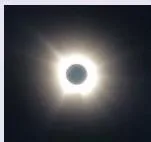
The eclipse claim is a full disproof case. A widely shared message says food becomes harmful if eaten during an eclipse (Fig 1.2). The disproof comes from asking simple scientific questions (NCERT, p. 5):
An eclipse is just a play of shadows. Does any physical change occur during it? Does temperature change significantly? Does food kept in a shadow go bad? No physical, chemical or biological mechanism supports the claim, so it fails (NCERT, p. 5).
Estimation: The “Does This Answer Make Sense?” Habit
The chapter’s estimation habit has three steps (NCERT, p. 5):
- Understand the situation being studied.
- Identify the quantities that matter.
- Estimate roughly and check whether the answer makes sense.
Exact values are not the goal. An approximate answer is often enough to tell whether a result is reasonable or impossible, and it builds intuition and catches errors. Science values careful reasoning more than accurate calculation (NCERT, p. 5). Remember the three steps as UQE — Understand, Quantify, Estimate. Say it as “You Quickly Estimate.”
The textbook poses one estimation question without solving it: how much rice would feed a family of four for a month? The plan: assume all their calorie needs come from rice alone; an average adult needs about 2000–2500 kcal per day; find the calories in 100 g of rice; scale up.
The aim is to check that the answer is sensible — 100 g for a month is clearly too little, a few tonnes far too much (NCERT, p. 5). The textbook shows rice being cooked on a gas stove as a reminder that everyday cooking is a perfectly good estimation problem (Fig 1.3).

Example 1.3 (air we breathe) shows the method end to end:
- At rest we take about 12–15 breaths per minute (NCERT, p. 5).
- There are \(60 \times 24 = 1440\) minutes in a day.
- That gives roughly 18,000–22,000, or about 20,000, breaths a day.
- About 4–5 breaths fill a typical party balloon of about 2 litres, so one breath is roughly 0.5 litre.
- About 20,000 breaths × 0.5 litre ≈ 10,000 litres of air a day.
Cross-check: you can blow up about 3 balloons a minute, so \(\frac{3\ \text{balloons}}{\text{minute}} \times \frac{2\ \text{litres}}{\text{balloon}} \times \frac{1440\ \text{minutes}}{\text{day}} \approx 8640\) litres a day — close to 10,000 litres, so the estimate is reasonable (NCERT, p. 5).
Science Has No Subject Boundaries: The Mask, Climate and Medicines
The natural world has no subject boundaries. Physics, chemistry, biology and earth science are labels we created to organise knowledge; they are not independent worlds (NCERT, p. 6).
The mask example proves the point. Understanding how a surgical mask works needs all four branches at once (NCERT, p. 7):
- Physics: particle motion and electrostatic attraction.
- Chemistry: the properties of polymer fibres.
- Biology: the size and behaviour of viruses.
- Mathematics: modelling airflow and filtration efficiency.

Big real-world problems work the same way. Climate change, developing medicines and designing sustainable technologies all require several disciplines together. Science also connects naturally with mathematics, technology, arts and social sciences (NCERT, p. 6).
Self-test: choose a pressure cooker, a mobile phone or a traffic jam near your school, sketch it, and list the physics, chemistry, biology, earth science and mathematics ideas it involves. Then show how at least two branches connect (NCERT, p. 6).
Definitions Table: Words with Specific Meanings in Science
Here are the terms you must be able to define, in your own words, from this chapter.
| Term | Meaning in simple words | Example from the chapter |
|---|---|---|
| Model | A simplified representation that keeps only the details that matter for a question | A moving car treated as a single point in physics |
| Assumption | Deliberately ignoring certain details to keep a question answerable | Neglecting air resistance while studying a falling object |
| Symbol | A letter that stands for a quantity | \(m\) for mass, \(v\) for velocity, \(F\) for force, \(I\) for current |
| Unit | A defined standard used to measure a quantity | Kilogram, litre |
| Law | Describes a regular pattern in nature, often mathematically | Newton’s laws of motion |
| Theory | An evidence-based explanation of why a pattern occurs | Atomic theory |
| Principle | A broad guiding idea for making sense of a situation | Conservation of energy |
| Prediction | A reasoned expectation about what will happen, based on evidence | Predicting how far a kicked football will travel |
| Estimation | A rough calculation made to check whether an answer is reasonable | About 10,000 litres of air breathed per day |
| SI units | The agreed international system of standard units | Kilogram as the unit of mass |
Everyday versus scientific meaning — the chapter lists four words that behave differently in science (NCERT, p. 2):
| Word | Everyday meaning | Scientific meaning |
|---|---|---|
| Force | Physical strength or a push | A quantity (symbol \(F\)) with one strict definition, built on in later chapters |
| Work | Any effort or job | A specific physics quantity with its own strict definition |
| Cell | A small room, or a phone | The basic unit of life shown in biology diagrams |
| Reaction | A response to something | A chemical change between substances |
Notice what the chapter does not do: it does not define these quantities yet. It only warns you that the scientific meanings are strict, and later chapters build on them.
The Only Formulas Here: Two Estimation Calculations
Honest statement: this chapter contains no equations to solve. The only calculations are estimation chains, and there are exactly two of them in the textbook (NCERT, p. 5).
| Calculation | Working | What it means |
|---|---|---|
| Minutes in a day | \(60 \times 24 = 1440\) minutes | Converts per-minute rates into per-day totals |
| Balloon cross-check | \(\frac{3\ \text{balloons}}{\text{minute}} \times \frac{2\ \text{litres}}{\text{balloon}} \times \frac{1440\ \text{minutes}}{\text{day}} \approx 8640\) litres/day | A second path to the air estimate, close to the 10,000 litres/day figure |
In an exam, you would not reproduce these numbers. You would show the same reasoning — state your assumed values, multiply with units, and end with an approximate answer.
Worked Examples: Modelling and Estimating with Fresh Numbers
Worked Example A: building a model of a pressure cooker
Method: model building — decide what to keep, what to ignore, and what to add later for accuracy.
Step 1: State the question.
How long does a pressure cooker take to cook dal?
Step 2: Make keep, ignore and add-later decisions, each with a reason:
| Decision | Detail | Reason |
|---|---|---|
| Keep | Quantity of dal | More dal needs more cooking time |
| Keep | Volume of water | Water must heat to boiling and transfers heat to the dal |
| Keep | Flame size | A bigger flame supplies heat faster |
| Ignore | Brand, colour, handle design, scratches | None of these changes how heat reaches the dal |
| Add later | Altitude of the place | Just as cricket adds air resistance later, altitude can be added later for accuracy when it matters |
Step 3: Check the model: every kept detail changes the answer; every ignored detail does not.
Final answer: A simple model keeps dal quantity, water volume and flame size, ignores brand and appearance, and can add altitude if needed.
Worked Example B: estimating water used for baths by a family of four
Method: estimation — understand, quantify, estimate, then cross-check.
Step 1: Understand the situation.
Four people in the family take bucket baths.
- Step 1: Identify the quantities that matter: 4 people; 2 buckets per person per day; 10 litres per bucket.
- Step 2: Estimate the daily use: \(4 \times 2 \times 10 = 80\) litres per day.
- Step 3: Estimate the monthly use: \(80 \times 30 = 2400\) litres per month.
- Step 4: Cross-check: a 1,000-litre tank lasts \(1000 \div 80 = 12.5\) days, so 2,400 litres a month is a sensible answer.
Final answer: The family uses about 2,400 litres of water for baths in one month. The pattern is UQE — Understand, Quantify, Estimate — then judge whether the answer makes sense.
Common Mistakes: Error and Correction Pairs
These are the confusions this chapter creates most often.
| What students write | What is correct | Why |
|---|---|---|
| “A theory is just a guess.” | A theory is an evidence-based explanation that stays open to revision. | It rests on careful testing, not opinion (NCERT, p. 4). |
| “A law is a theory that got proved.” | Laws and theories do different jobs. | Laws describe patterns; theories explain why (NCERT, pp. 3–4). |
| “Ignoring details in a model is a mistake.” | Simplification is deliberate and useful. | It makes the question answerable (NCERT, p. 1). |
| “A model with more details is always better.” | Details matter only when they affect the answer. | Extra details are added only for greater accuracy (NCERT, p. 2). |
| “Estimation must give the exact answer.” | The goal is a reasonable check. | Approximate values judge whether a result is sensible (NCERT, p. 5). |
| “A failed prediction means the idea is useless.” | Failures drive science forward. | Scientists re-examine assumptions, models and measurements (NCERT, pp. 4–5). |
| “Physics, chemistry and biology are separate worlds.” | The divisions organise knowledge only. | Real problems mix all branches (NCERT, p. 6). |
Practice Strands: Activities and Pause and Ponder as Self-Tests
Use the textbook’s own prompts as a self-test. Each pointer below tells you what a good answer must contain.
- Activity 1.1 (bicycle ride model, NCERT p. 2): list the details you keep (things that change travel time) and the details you ignore (things that do not), then explain why dropping details helps.
- Pause and Ponder 1 (a prediction you or your family made, NCERT p. 4): judge the cricket-match prediction by one test — does it rest on evidence and reasoning, or mainly on guesswork?
- Pause and Ponder 2 (approximate versus exact, NCERT p. 6): good answers are estimating the litres of water needed for a trip (approximate is fine) versus measuring a medicine dose (exact is needed).
- Pause and Ponder 3 (pressure cooker, mobile phone or traffic jam sketch, NCERT p. 6): your sketch must name ideas from at least two branches and show how those branches connect.
Exam Notes: How This Chapter Can Be Asked
Honest note: this is a new rationalised chapter, so there is no past-year question pattern to quote. The list below comes from the chapter’s own Example boxes, Pause and Ponder prompts and Activity 1.1 — it is a pattern list, not a promise.
The likely asks, based on the textbook’s own apparatus:
- Definitions of law, theory, principle and model.
- Keep-versus-ignore reasoning about an everyday object.
- Why the speed of light is denoted by \(c\).
- The airplane fuel units mix-up story.
- Why food is not harmed during an eclipse.
- A small estimation-reasoning question.
Which step earns the mark:
- For definitions, write the distinguishing clause — law describes a pattern, theory explains why, principle guides.
- For model questions, attach a reason to every choice you make.
- For estimation, state your assumptions first and give an approximate answer. A false precise answer is worse than an honest estimate.
Revision Summary: The Night-Before Recap
The whole chapter in one table.
| Big idea | One-line takeaway | Textbook page |
|---|---|---|
| Models and deliberate simplification | Science ignores details on purpose to keep a question answerable | pp. 1–2 |
| Symbols, units and standard measures | A shared scientific language lets results be compared everywhere | pp. 2–3 |
| Law versus theory versus principle | Laws describe, theories explain, principles guide | pp. 3–4 |
| Predictions and their testing | Predictions are reasoned expectations; failures revise ideas | pp. 4–5 |
| The estimation habit | Understand, quantify, estimate, then check if the answer makes sense | pp. 5–6 |
| Science across subject boundaries | Real problems mix physics, chemistry, biology and more | pp. 6–7 |
Need to check the chapter’s exact wording? Download the official PDF from the NCERT portal. Revising other subjects too? Start from the Class 9 notes page, or browse the full CBSE notes collection. Whatever you read next, keep UQE in your head — You Quickly Estimate, and you check whether answers make sense.
FAQs on Exploration: Entering the World of Secondary Science
What is the difference between a law, a theory and a principle in Class 9 Science Chapter 1?
A law describes a regular pattern in nature, often as a mathematical relationship. A theory explains why that pattern occurs, based on evidence. A principle is a broad guiding idea applied to a situation. Memory line: laws describe, theories explain, principles guide (NCERT, pp. 3–4).
Why is the speed of light denoted by the symbol c?
Because the symbol comes from the Latin word celeritas, meaning speed. It was chosen by history and international agreement, not as a convenient abbreviation, and it is defined to be exactly \(299792458\ \text{m/s}\) (NCERT, p. 3).
Why do weather forecasts sometimes go wrong?
Because weather depends on many changing factors — temperature, pressure, humidity and wind — and very tiny differences in conditions can grow over time. Forecasts are reliable for a few hours or days, but less certain further into the future (NCERT, p. 4).
Is it harmful to eat food during an eclipse?
No. An eclipse is just a play of shadows. No physical, chemical or biological mechanism changes food during an eclipse, so the viral claim fails (NCERT, p. 5).
What do the magnifying glass and compass symbols mean in the NCERT Exploration textbook?
The magnifying glass symbolises careful observation — noticing patterns and details that would otherwise be missed. The compass symbolises direction — choosing appropriate models, asking the right questions and knowing the limits of an idea. Together they show that scientific exploration is purposeful, not aimless (NCERT, p. 1).
Does Class 9 Science have separate chapters for physics, chemistry and biology?
No. The NCERT Class 9 Science book Exploration is a single integrated textbook. Some chapters focus on physics, chemistry, biology or earth science areas, but the chapter insists these divisions only organise knowledge — real problems mix the branches (NCERT, p. 6).
Reference: NCERT Class 9 Science textbook, chapter Exploration: Entering the World of Secondary Science.
Explore Class 9 Science Notes
Class 9 Science on LearnCBSE:
Related chapters: