
These work energy and simple machines class 9 notes compress Chapter 7 of the Rationalised NCERT Class 9 Science book into what you need for revision: definitions, formulas, units, solved numerics with fresh numbers, and examiner’s tips. Read this page the night before a test: scan the one-page map, then the formula sheet, then the worked examples.
The chapter runs on one idea chain. Work done on an object changes its energy; energy is the capacity to do work; power is how fast that work is done; and simple machines change the magnitude or direction of a force so the same work feels easier. Hold that chain and every section below becomes detail.
Work Energy and Simple Machines: One-Page Map of the Chapter
The chapter opens (NCERT, p. 1) with three questions about a child sliding down a slide. One result answers all of them: on a frictionless slide, the child’s speed at the bottom depends only on the slide’s height. The chapter then builds four ideas in order.
- Work connects force and displacement: \( W = F \times s \). It is how energy moves into or out of an object.
- Energy is the capacity to do work. The mechanical form splits into kinetic (motion) and potential (position or deformation).
- Power adds time: how quickly work is done.
- Simple machines — pulley, inclined plane, lever — reshape force, never total work.

The figure above is the chapter’s opening claim (NCERT, p. 1): energy lies at the heart of almost every activity, and the chapter is about quantifying it. These ideas build directly on Chapter 6, How Forces Affect Motion, where you met kinematic equations and Newton’s laws — you will reuse both in the kinetic-energy derivation below.
Work Done by a Constant Force: Definition and Units
Build the definition from the textbook’s wheat-bag example (NCERT, p. 2). Lifting one 5 kg bag to a height of 1 m needs an upward force equal to the bag’s weight \( mg \). Lift three bags one after another to the same height and you do three times the work; lift the same bag to 3 m and the work triples again.
So work grows proportionally with force and with displacement.
The scientific definition follows directly (NCERT, p. 2):
Work done by a constant force on an object = force applied × displacement in the direction of the force.
\[ W = F \times s \]
The SI unit of work is the joule (J). One joule is the work done when a force of 1 newton displaces an object by 1 metre in the direction of the force (NCERT, p. 3).
\[ 1\ \text{J} = 1\ \text{N} \times 1\ \text{m} = 1\ \text{kg m}^2\ \text{s}^{-2} \]
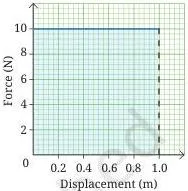
Why a graph? When force is constant, work is a simple product. When the force changes with position, the area under the force–displacement graph still gives the work (NCERT, p. 3). While describing work, always name the force doing the work and the object on which it is done (NCERT, p. 2).
Zero, Positive and Negative Work: Reading the Sign
Work is zero in exactly three situations (NCERT, p. 3):
- F = 0 — no force, so no work.
- s = 0 — you push a rigid wall with all your strength and the wall does not move.
- Force perpendicular to displacement — a girl carries a box while walking: her upward force balances the box’s weight, but the box moves horizontally, so there is no displacement in the direction of the force (NCERT, p. 3).
Feeling tired is not the same as doing scientific work. Pushing a wall exhausts your muscles, which keep expanding and contracting and spend your body’s internal energy — yet the work done on the wall is zero (NCERT, p. 3).
The sign of work depends on direction:
- Positive work: force and displacement in the same direction — pushing a wheelchair (NCERT, p. 3).
- Negative work: force opposite to the displacement — a goalkeeper stopping a football. Take the displacement negative in \( W = F \times s \), so the product carries a minus sign (NCERT, p. 4).
Work has magnitude and sign but no direction — it is a scalar (NCERT, p. 3).
The Work-Energy Theorem: Work Changes Energy
A fielder throws a cricket ball at the wickets, and the moving ball knocks them down. A flowerpot raised to a height can damage whatever is below it. Both the ball and the pot have gained the capacity to do work, which is what energy means (NCERT, p. 5).
Work done on an object = change in its energy (NCERT, p. 5). This is the work-energy theorem.
- Positive work → the object gains energy (the ball gains kinetic energy from the fielder’s throw).
- Negative work → the object loses energy (the goalkeeper’s hands drain energy from the ball).
- The theorem holds even for changing forces and for whole systems, which makes it a powerful shortcut (NCERT, p. 5).
The SI unit of energy is the same as that of work: the joule (J) (NCERT, p. 5). Work is only one route for transferring energy — energy also moves as heat, radiation, electric currents, sound, and in nuclear reactions (NCERT, p. 5). Nuclear energy, stored in the nuclei of atoms, is taken up in Chapter 8, Journey Inside the Atom.
Kinetic Energy: The Energy of Motion
Kinetic energy is the energy an object has because of its motion (NCERT, p. 6) — a moving bicycle, a rolling ball, a cricket ball in flight.

To quantify it, combine two earlier ideas (NCERT, p. 6). From kinematics, \( v^2 = u^2 + 2as \), so \( s = \frac{v^2 – u^2}{2a} \). The work done is \( W = F \times s = ma \times s \). Substituting gives:
\[ W = \frac{1}{2}m(v^2 – u^2) \]
By the work-energy theorem, this work is the change in kinetic energy. If the object starts from rest (\( u = 0 \)):
\[ K = \frac{1}{2}mv^2 \]
Key results to carry into the exam:
- Doubling the speed quadruples the kinetic energy, because \( v \) is squared: \( \frac{1}{2}m(2v)^2 = 4 \times \frac{1}{2}mv^2 \) (NCERT, p. 6).
- Kinetic energy is scalar — it has no direction (NCERT, p. 6).
- Positive work increases K, negative work decreases it, zero work leaves it unchanged (NCERT, p. 6).
Potential Energy: Stored Energy of Position and Shape
Potential energy is energy stored because of a deformation, or because objects in a system occupy certain relative positions (NCERT, p. 9). Two families of examples:
- From deformation: a stretched slingshot band, a bent bow, a compressed spring. The work you did to deform the object is stored in it and released as kinetic energy of whatever it pushes (NCERT, p. 8).
- From relative position: separated unlike poles of two magnets, separated electric charges, and the Earth–ball system. Work done against the internal forces of the system stores energy that can be released (NCERT, p. 9).
Gravitational potential energy is the simplest case. To raise a mass \( m \) slowly through height \( h \), you apply an upward force \( mg \), so the work done is \( mg \times h \). By the work-energy theorem, this becomes stored potential energy (NCERT, p. 10):
\[ U = mgh \]
The unit is the joule (J). Two limits to remember:
- \( U = mgh \) is valid only near the Earth’s surface — far away, \( g \) itself decreases and the formula changes (NCERT, p. 11).
- Work done against friction does not store potential energy (NCERT, p. 11).
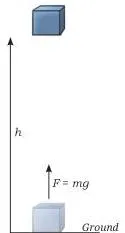
The sand experiment in Fig. 7.17 demonstrates the idea: a ball dropped from 2 m makes a deeper depression than one dropped from 1 m, because raising the ball higher required more work, so it carried more potential energy (NCERT, p. 10).
Kinetic Energy vs Potential Energy: Quick Comparison
| Basis | Kinetic energy | Potential energy |
|---|---|---|
| Meaning | Energy of motion | Stored energy of position or shape |
| Present when | The object is moving | The object is raised, stretched, compressed or separated |
| Formula | \( K = \frac{1}{2}mv^2 \) | \( U = mgh \) (near Earth’s surface) |
| Zero when | The object is at rest | At the reference level (h = 0) or undeformed |
| Everyday example | Rolling ball, moving bicycle | Raised flowerpot, stretched spring |
| Changes with | Speed (squared!) | Height and mass |
Conservation of Mechanical Energy: Energy That Stays Put
Mechanical energy is the sum of an object’s kinetic and potential energy (NCERT, p. 11). For a freely falling object it stays constant.
Take mass \( m \) dropped from point A at height \( h \). At A: PE = \( mgh \), KE = 0, so ME = \( mgh \). After falling for time \( t \), the object is lower and faster; its height is \( h’ = h – \frac{1}{2}gt^2 \), and:
\[ \text{PE} = mgh – \frac{1}{2}mg^2t^2, \qquad \text{KE} = \frac{1}{2}mg^2t^2 \]
\[ \text{ME} = \left(mgh – \frac{1}{2}mg^2t^2\right) + \frac{1}{2}mg^2t^2 = mgh \]
Why it works: the potential energy lost is exactly equal to the kinetic energy gained (NCERT, p. 11). Conservation of mechanical energy holds when no other external forces act.
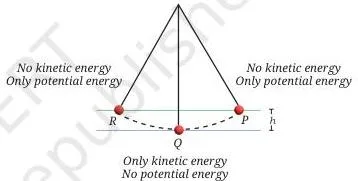
The pendulum in Fig. 7.20 shows the same balance. At the release point P the bob has potential energy \( mgh \); at the bottom Q it is all kinetic; at R it stops with potential energy \( mgh \) again. A real pendulum slowly stops because friction at the support and air resistance drain energy (NCERT, p. 12).
Conservation gives a rapid route to speeds. For a child sliding from the top of a slide of height \( h \), equate PE at the top with KE at the bottom, \( \frac{1}{2}mv^2 = mgh \), so:
\[ v = \sqrt{2gh} \]
The mass cancels and the shape does not matter — the speed at the bottom depends only on the height of the slide (NCERT, p. 13). This one result answers all three opening questions of the chapter (NCERT, p. 1).
To watch conservation in action with friction turned up and down, the chapter’s Journey Beyond section recommends PhET simulations (Energy Skate Park, Pendulum Lab, Masses and Springs) at phet.colorado.edu (NCERT, p. 24).
Power: How Fast Work Is Done
Running up a flight of stairs takes about a minute; walking up takes five. The work against gravity is the same — what differs is the rate. Power is the rate at which work is done (NCERT, p. 14):
\[ P = \frac{W}{t} \]
- SI unit: the watt (W); \( 1\ \text{W} = 1\ \text{J s}^{-1} \) (NCERT, p. 14).
- An older unit, horsepower, is still used for car engines: 1 hp = 746 W (NCERT, p. 14).
- The watt is named after James Watt, who built an efficient steam engine (NCERT, p. 15).
Work and energy say nothing about time; power is the quantity that compares how quickly two people or machines do the same job.
Simple Machines: Pulley, Inclined Plane and Lever
A simple machine makes a task feel easier by changing the magnitude or direction of the force you apply — the total work stays the same (NCERT, p. 15). Two terms set the stage:
- Effort: the force you apply to the machine.
- Load: the force the machine must overcome.
Mechanical advantage = load ÷ effort (NCERT, p. 15).
Pulley
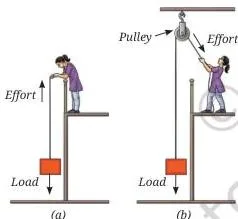
A fixed pulley does not reduce the force — it changes only the direction, letting you pull down instead of lifting up. Since effort equals load, its mechanical advantage is 1 (NCERT, p. 15). A movable pulley or a system of pulleys can give MA greater than 1, lifting much heavier loads with a smaller effort — the principle behind elevators and cranes (NCERT, p. 15).
Inclined plane
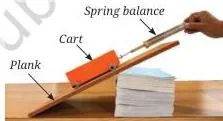
If a box is too heavy to lift vertically, push it up a ramp. Ignoring friction, the work you put in (\( F’ \times L \)) equals the potential energy gained (\( mgh \)), which gives:
\[ \text{MA} = \frac{\text{load}}{\text{effort}} = \frac{L}{h} \]
Because \( L \) is longer than \( h \), MA is greater than 1 — a shallower, longer ramp needs less effort over more distance (NCERT, p. 16). The work done remains the same whichever path you take (NCERT, p. 17).
Lever
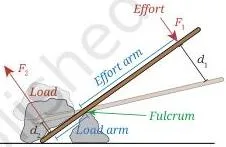
A lever is a rigid bar that rotates about a fixed point, the fulcrum (NCERT, p. 18). The load arm is the fulcrum-to-load distance; the effort arm is the fulcrum-to-effort distance. The small effort moves through a large distance and the large load through a small one, so the work is equal on both ends (NCERT, p. 18):
\[ \text{effort} \times \text{effort arm} = \text{load} \times \text{load arm} \]
\[ \text{MA} = \frac{\text{effort arm}}{\text{load arm}} \]
Levers fall into three classes by the position of their parts (NCERT, p. 20):
| Class | Which part is in the middle | Examples |
|---|---|---|
| Class I | Fulcrum | Scissors, crowbar, pliers, balance scale, seesaw, tongs |
| Class II | Load | Lemon squeezer, wheelbarrow, bottle opener |
| Class III | Effort | Tongs, tweezers, broom, hammer, oar |
The chapter’s honest summary: machines do not create energy — they help you use it more effectively, and every real machine loses some energy to friction, which is why a perpetual motion machine cannot work (NCERT, p. 20).
Work Energy and Simple Machines Class 9 Notes: Key Terms at a Glance
| Term | Meaning in one line | Example |
|---|---|---|
| Work | Force × displacement in the direction of the force (NCERT, p. 2) | Pushing a wheelchair |
| Energy | Capacity to do work (NCERT, p. 5) | A moving cricket ball knocks down wickets |
| Kinetic energy | Energy of motion (NCERT, p. 6) | Rolling ball, moving bicycle |
| Potential energy | Stored energy from deformation or relative position (NCERT, p. 9) | Stretched spring, raised flowerpot |
| Mechanical energy | Sum of kinetic and potential energy (NCERT, p. 11) | A falling ball converts PE into KE |
| Power | Rate of doing work (NCERT, p. 14) | A 200 W lamp uses 200 J every second |
| Effort | Force applied to a machine (NCERT, p. 15) | Pulling the rope of a pulley |
| Load | Force overcome by a machine (NCERT, p. 15) | Weight of the flag being raised |
| Mechanical advantage | Load ÷ effort (NCERT, p. 15) | A ramp with MA 3 needs one-third the effort |
| Fulcrum | Fixed point about which a lever rotates (NCERT, p. 18) | The pencil under the scale |
For the full set of companion pages, browse the Class 9 Science notes hub.
Formula Sheet: Work, Energy, Power and Machines
| Quantity | Formula | Symbols and SI units |
|---|---|---|
| Work | \( W = F \times s \) | F in N, s in m; W in J (N·m) |
| Joule definition | \( 1\ \text{J} = 1\ \text{N} \times 1\ \text{m} \) | \( = 1\ \text{kg m}^2\text{s}^{-2} \) |
| Work-energy theorem | Work done = change in energy | J |
| Kinetic energy | \( K = \frac{1}{2}mv^2 \) | m in kg, v in m/s; K in J |
| Potential energy | \( U = mgh \) | m in kg, g in m/s², h in m; U in J (near Earth only) |
| Mechanical energy | ME = KE + PE | J |
| Speed from a height | \( v = \sqrt{2gh} \) | Free fall or frictionless slide |
| Power | \( P = \frac{W}{t} \) | W in J, t in s; P in W = J/s |
| Mechanical advantage | \( \text{MA} = \frac{\text{load}}{\text{effort}} \) | No unit (ratio) |
| Inclined plane | \( \text{MA} = \frac{L}{h} \) | L length, h height of plane |
| Lever balance | effort × effort arm = load × load arm | Distances in the same unit |
| Lever mechanical advantage | \( \text{MA} = \frac{\text{effort arm}}{\text{load arm}} \) | No unit (ratio) |
Every formula above appears in the printed chapter — verify each against the Rationalised NCERT Class 9 Science textbook (Chapter 7, Work, Energy, and Simple Machines) at ncert.nic.in.
Mnemonic for the four equations (recall them in one scan):
- Work: Work Feels Strenuous — \( W = F \times s \). Force and stretch are the two ingredients.
- Kinetic: Kinetic Mass moves with Velocity squared — \( K = \frac{1}{2}mv^2 \). The squared \( v \) is the part to fear: double speed = quadruple energy.
- Potential: Uphill, Mass × Gravity × Height — \( U = mgh \). Energy that wants to fall.
- Power: Power is Work over Time — \( P = \frac{W}{t} \). Any equation with “per second” in its unit is a rate.
Solved Examples: Applying the Formulas Step by Step
Which formula should I use? A five-step decision flow
- Force + displacement in the force’s direction? → work, \( W = F \times s \). Decide the sign first: same direction positive, opposite negative.
- Object moving, mass and speed given? → kinetic energy, \( K = \frac{1}{2}mv^2 \).
- Object raised or about to fall? → potential energy, \( U = mgh \).
- Time given alongside work or energy? → power, \( P = \frac{W}{t} \).
- A machine with load and effort? → MA = load ÷ effort (lever: effort arm ÷ load arm; ramp: \( L/h \)). If an object falls or slides between two heights, use conservation of mechanical energy instead.
Solved Example 1: Work done pushing a cart
Step 1: The force and displacement are horizontal and in the same direction, so use \( W = F \times s \).
Step 2: Substitute with units: \( F = 60\ \text{N} \), \( s = 5\ \text{m} \).
\[ W = 60\ \text{N} \times 5\ \text{m} = 300\ \text{J} \]
Final answer: Work done = 300 J.
Solved Example 2: Negative work by a fielder
Step 1: The fielder’s force opposes the ball’s motion, so the work is negative.
Take the displacement negative: \( s = -2\ \text{m} \).
Step 2: Substitute \( F = 25\ \text{N} \) and \( s = -2\ \text{m} \) into \( W = F \times s \).
\[ W = 25\ \text{N} \times (-2\ \text{m}) = -50\ \text{J} \]
Final answer: Work done on the ball = −50 J; the ball loses 50 J of energy.
Solved Example 3: Kinetic energy and doubled speed
Step 1: Total mass \( m = 80\ \text{kg} \), speed \( v = 10\ \text{m/s} \).
Use \( K = \frac{1}{2}mv^2 \).
\[ K = \frac{1}{2} \times 80 \times 10^2 = 4000\ \text{J} \]
Step 2: Double the speed to \( 20\ \text{m/s} \).
\[ K = \frac{1}{2} \times 80 \times 20^2 = 16000\ \text{J} \]
Final answer: 4000 J at 10 m/s and 16000 J at 20 m/s — exactly four times, because speed is squared.
Solved Example 4: Gravitational potential energy of a book
Step 1: Use \( U = mgh \) with \( m = 1.5\ \text{kg} \), \( g = 10\ \text{m/s}^2 \), \( h = 2\ \text{m} \).
\[ U = 1.5 \times 10 \times 2 = 30\ \text{J} \]
Final answer: The book stores 30 J relative to the floor.
Solved Example 5: Speed at the bottom of a slide (conservation)
Step 1: Treat the slide as frictionless.
Potential energy at top = kinetic energy at bottom: \( mgh = \frac{1}{2}mv^2 \).
Step 2: Cancel \( m \) and solve \( v = \sqrt{2gh} \) with \( h = 5\ \text{m} \), \( g = 10\ \text{m/s}^2 \).
\[ v = \sqrt{2 \times 10 \times 5} = \sqrt{100} = 10\ \text{m/s} \]
Final answer: 10 m/s. The mass cancelled along the way, so any child reaches the same speed from the same height.
Solved Example 6: Power of a crane
Step 1: Work done against gravity: \( W = mgh = 30 \times 10 \times 4 = 1200\ \text{J} \).
Step 2: Power is work per time: \( P = \frac{W}{t} \).
\[ P = \frac{1200\ \text{J}}{6\ \text{s}} = 200\ \text{W} \]
Final answer: The crane delivers 200 W.
Solved Example 7: Mechanical advantage of a lever and a ramp
Step 1: Lever: MA = effort arm ÷ load arm = \( \frac{60}{15} = 4 \).
Step 2: Ramp: MA = length ÷ height = \( \frac{3}{1} = 3 \).
Final answer: The lever multiplies the effort 4 times; the ramp 3 times. Each trades distance for force — total work is unchanged.
Common Mistakes Students Make in Work and Energy
| Students write | Correct rule | How to check your answer |
|---|---|---|
| “Holding a heavy box still does work because I feel tired.” | No displacement, so W = 0. Muscles burn internal energy, but no work is done on the box (NCERT, p. 3). | Ask: did the object move in the direction of the force? No movement → 0 J. |
| “In U = mgh, m is the force.” | The force is the weight \( mg \), in newtons; \( m \) is the mass in kg. | Units: kg × m/s² × m = J. If the unit is not joule, you substituted the wrong quantity. |
| “Work is always positive.” | Force opposite to displacement gives negative work (NCERT, p. 4). | Compare the directions. If opposite, write the displacement negative before multiplying. |
| “Carrying a box while walking does work on the box.” | The upward force is perpendicular to the horizontal displacement — zero work (NCERT, p. 3). | Is there any displacement in the force’s direction? None → 0 J. |
| “To change km/h to m/s, multiply by 3.6.” | Divide by 3.6: 154.8 km/h = 43 m/s (NCERT, p. 8). | The m/s value is always the smaller number: 72 km/h = 20 m/s. |
| “A lever or ramp reduces the total work.” | It reduces the force; the distance increases, so \( F \times s \) is unchanged (NCERT, p. 17). | Compare work with and without the machine (ignoring friction) — it is equal. |
Exam Notes: What the Marking Looks For
The end-of-chapter exercise (NCERT, p. 21) maps directly onto the formulas above. Use this table to aim your revision — each item type tests one idea.
| Exercise item | What it tests | Formula or concept to reach for |
|---|---|---|
| Q1 True/False | Definition of work; joule for both work and energy; a motionless stretched rubber band has no kinetic energy | Work needs displacement; \( K = \frac{1}{2}mv^2 \) |
| Q2 Fill in the blanks | Core definitions of the chapter | \( W = F \times s \); 1 J = 1 N × 1 m; \( \frac{1}{2}mv^2 \); \( mgh \); rate |
| Q3 Ball at its highest point | Energy at the turning point | KE = 0, PE maximum; gravity still acts |
| Q4 Energy transformations | Recognising energy forms | Chemical, elastic, sound, light, electrical |
| Q5 Elevator vs stairs | Potential energy gain is path-independent | \( U = mgh \); same height → same gain |
| Q6 Crane to 10th vs 20th floor | Energy and power scaling | Double height → double energy; double time → same power |
| Q7 Flagpole and pulley | Factors that decide work; effect of speed | \( W = F \times s \); doubling speed halves time, doubling power |
| Q8 Scooter fuel on two days | Kinetic energy ratio of two masses | \( K = \frac{1}{2}mv^2 \) with total mass 160 kg vs 200 kg |
| Q9 Seesaw balance | Lever balance rule | effort × effort arm = load × load arm |
| Q10 Ball thrown upward | Sign of work; work by air resistance | Positive/negative work; W = change in KE |
| Q11 Variable-force graph | Area under a force-displacement graph | Work = area under graph |
| Q12 Throw on the Moon | Potential energy with \( g/6 \) | \( U = mgh \); same KE → height becomes 6 times |
| Q13 Car braking | Work by brakes equals change in kinetic energy | \( KE = \frac{1}{2}mv^2 \); W = ΔK |
| Q14 Potential energy–displacement graph | Conservation of mechanical energy | KE = ME − PE; \( v = \sqrt{2(\text{ME} – \text{PE})/m} \) |
| Q15 Coconut into sand | Speed from height; work stopping the coconut | \( v = \sqrt{2gh} \); work = force × depth |
The steps that earn the mark:
- Write the formula with symbols first.
- Substitute values with units — including the sign for work (negative if force opposes displacement).
- State the final answer with its unit.
- For conservation problems, state what you equate (PE at top = KE at bottom) before substituting.
Revision Summary: The Chapter in One Look
| Concept | Formula or key idea | One-line takeaway |
|---|---|---|
| Work | \( W = F \times s \) (J) | Displacement must be in the direction of the force. |
| Work-energy theorem | Work = change in energy | Positive work adds energy; negative work removes it. |
| Kinetic energy | \( K = \frac{1}{2}mv^2 \) | Double the speed → four times the energy. |
| Potential energy | \( U = mgh \) | Valid near the Earth’s surface only. |
| Conservation of ME | KE + PE = constant | No friction → speed at the bottom = \( \sqrt{2gh} \). |
| Power | \( P = \frac{W}{t} \) (W) | 1 W = 1 J/s; 1 hp = 746 W. |
| Mechanical advantage | MA = load ÷ effort | Pulley: 1 (direction only); ramp: \( L/h \); lever: effort arm ÷ load arm. |
| Simple machines | Reduce force, never total work | Machines do not create energy — friction makes perpetual motion impossible. |
Close with the chapter’s honest bottom line (NCERT, p. 20): machines never create energy, they only help you use it more effectively, and every real machine wastes some energy to friction — which is why no perpetual motion machine can work. For the surrounding chapters, see the all Class 9 notes and the CBSE notes hub.
Frequently Asked Questions
Why is no work done when you hold a heavy object still, even though you feel tired?
Work is force × displacement in the direction of the force (NCERT, p. 2). When you hold an object still, displacement \( s = 0 \), so W = 0. Your muscles expand and contract, spending internal energy — that is why you tire — but no energy is transferred to the object.
Does kinetic energy double when an object’s speed doubles? Why not?
No — it becomes four times larger. \( K = \frac{1}{2}mv^2 \) and the speed is squared, so \( \frac{1}{2}m(2v)^2 = 4 \times \frac{1}{2}mv^2 \) (NCERT, p. 6). Triple the speed and kinetic energy becomes nine times.
Why do simple machines not reduce the total work done?
Because work = force × distance. A ramp or lever lowers the force but lengthens the distance, so the product stays the same (NCERT, p. 17). A machine with MA = 4 needs one-quarter of the effort — over four times the distance.
Does the shape of a slide or the child’s mass change the speed at the bottom of the slide?
No. Equating PE at the top with KE at the bottom gives \( \frac{1}{2}mv^2 = mgh \), and the mass cancels: \( v = \sqrt{2gh} \) (NCERT, p. 13). Only the vertical height matters, when friction is negligible.
What is the difference between mass and weight in work and energy calculations?
Mass (kg) is the amount of matter; weight is the gravitational force on it, \( mg \), measured in newtons. In \( U = mgh \) you use the mass in kg and multiply by \( g \); the force you actually lift against is the weight \( mg \). Unit check: kg × m/s² × m = J.
Why do real machines and pendulums eventually stop if mechanical energy is conserved?
Conservation of mechanical energy holds only when no other external forces act (NCERT, p. 11). Real pendulums lose energy to friction at the support and air resistance (NCERT, p. 12); real machines do the same, converting mechanical energy into thermal energy. That is also why a perpetual motion machine cannot work (NCERT, p. 20).
Reference: NCERT Class 9 Science textbook, chapter 7, Work, Energy, and Simple Machines.
Explore Class 9 Science Notes
More for this chapter:
Class 9 Science on LearnCBSE:
Related chapters:
Official source: download the NCERT textbook free from ncert.nic.in.