Revising for a test? The How Forces Affect Motion Class 9 formulas you need are collected here: net force from two forces, Newton’s second law in the forms \( F = ma \) and \( a = \frac{F}{m} \), the weight formula \( F = mg \), and the acceleration of a connected system \( a = \frac{F}{m_1 + m_2} \).
Each formula is grouped under the textbook section it belongs to, with the meaning and unit of every symbol and a line telling you when to use it. Three worked examples with fresh numbers show the steps. The fuller explanations live in the Class 9 physics formulas collection, organised under the main physics formulas index.
Formulas at a Glance
This is the whole sheet in one table. Each formula appears again below with its conditions, symbol meanings and usage.
| Purpose (what you are finding) | Formula |
|---|---|
| Net force of two forces acting in the same direction | \( F_{\text{net}} = F_1 + F_2 \) |
| Net force of two forces acting in opposite directions (direction of the larger force) | \( F_{\text{net}} = F_1 – F_2 \) |
| Balanced forces: condition for zero acceleration | \( F_{\text{net}} = 0 \) |
| Acceleration produced by a net force | \( a = \frac{F}{m} \) |
| Force needed to produce a given acceleration | \( F = ma \) |
| Gravitational force on a mass near the Earth (weight) | \( F = mg \) |
| Acceleration of connected objects pulled by one external force | \( a = \frac{F}{m_1 + m_2} \) |
| Third-law pair: forces two objects exert on each other | \( F_{\text{on B by A}} = -F_{\text{on A by B}} \) |
| Final velocity under constant acceleration (motion-chapter equation used in force numericals) | \( v = u + at \) |
| Displacement under constant acceleration (motion-chapter equation used in force numericals) | \( s = ut + \frac{1}{2}at^2 \) |
| Ratio of accelerations in two trials with the same distance and zero initial velocity (derived from \( s = ut + \frac{1}{2}at^2 \)) | \( \frac{a_1}{a_2} = \frac{T_2^2}{T_1^2} \) |
All Formulas, Grouped by Topic
Balanced and Unbalanced Forces
Force is a quantity that carries direction as well as magnitude and unit (NCERT, p. 95). So before applying any law, combine the forces acting on one object along a straight line.
Two forces acting in the same direction add up:
\[ F_{\text{net}} = F_1 + F_2 \]
The net force points in the same direction as the two forces.
Two forces acting in opposite directions subtract; the net force points along the larger force:
\[ F_{\text{net}} = F_1 – F_2 \quad (F_1 \gt F_2) \]
Balanced forces are equal in magnitude and opposite in direction on the same object, so their net force is zero (NCERT, p. 97):
\[ F_{\text{net}} = 0 \]
The tug-of-war below shows the idea: equal pulls leave the rope at rest; a stronger pull gives a non-zero net force in that direction.

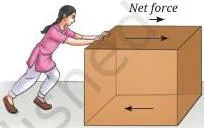
The block in Fig. 6.6 shows both rules in one diagram: in (a) both forces point right, so \( F_{\text{net}} = 10\ \text{N} + 6\ \text{N} = 16\ \text{N} \) to the right; in (b) and (c) the forces oppose, so \( F_{\text{net}} = 10\ \text{N} – 6\ \text{N} = 4\ \text{N} \), along the 10 N force.

Newton’s First Law of Motion
The law states (NCERT, p. 100):
An object at rest remains at rest, and an object in motion continues to move with a constant velocity, unless a net force acts upon the object.
In formula form, the law says that when the net force is zero, the acceleration is zero:
\[ F_{\text{net}} = 0 \quad\Rightarrow\quad a = 0 \]
This covers two situations: an object at rest stays at rest, and an object already moving keeps the same velocity (same speed, same direction). A constant velocity needs no force to maintain it — a force is needed only to change velocity.
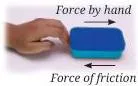
The box being pushed below shows why real objects stop: when you stop pushing, friction is still acting, and that unbalanced friction is a net force that slows the box down.
Newton’s Second Law of Motion
The second law (NCERT, p. 104) sums up what the chapter’s activities test: for the same mass, a larger net force gives a larger acceleration; for the same force, a larger mass gives a smaller acceleration.
\[ a = \frac{F}{m} \qquad (6.1) \]
\[ F = ma \qquad (6.2) \]
Both forms state the same law — pick the one that gives the unknown you need. The direction of the acceleration is the same as the direction of the net force.
One newton is defined from this relation: the force that produces an acceleration of \( 1\ \text{m s}^{-2} \) on a mass of \( 1\ \text{kg} \). So the unit itself is:
\[ 1\ \text{N} = 1\ \text{kg m s}^{-2} \]
The gravitational force on an object — its weight — is the same law applied with \( g \), the acceleration due to the gravitational force by the Earth:
\[ F = mg \qquad (6.3) \]
Near the Earth’s surface \( g = 9.8\ \text{m s}^{-2} \), and \( g = 10\ \text{m s}^{-2} \) works for quick estimates. The value of \( g \) does not depend on the mass of the object (NCERT, p. 104) — a heavy object and a light object falling near the Earth have the same \( g \).
A spring balance measures the magnitude of a force, so it can measure weight directly (NCERT, p. 95): the larger the gravitational pull, the more the spring stretches.
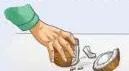
The same law explains safety devices such as airbags: a passenger stopping against a soft airbag takes more time to stop, so the acceleration is smaller and the force on the person is smaller.
Newton’s Third Law of Motion
The law states (NCERT, p. 108):
Whenever one object is exerting a force on a second object, the second object is simultaneously exerting an equal and opposite force on the first object.
The chapter gives the law in words; the same statement in symbols is:
\[ F_{\text{on B by A}} = -F_{\text{on A by B}} \]
The critical condition: the two forces act on two different objects, so they never cancel each other. Equal forces also do not mean equal accelerations — acceleration is \( a = F/m \), so the lighter object accelerates more (NCERT, p. 110).
In the diagrams below, the girl’s push on the table and the table’s push on the girl are the action–reaction pair — equal in magnitude, opposite in direction, and acting on two different objects.
Forces Acting on a System of Objects
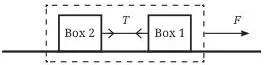
For two boxes of masses \( m_1 \) and \( m_2 \) connected by a string and pulled by one external force \( F \), the simpler route is to treat both boxes as a single system (NCERT, p. 111):
\[ a = \frac{F}{m_1 + m_2} \qquad (6.4) \]
Why this works: the tension in the string is an internal force — it pulls equally and oppositely on the two boxes, so it cancels inside the system. Only the external force \( F \) remains. The figure below shows the arrangement.
Equations of Motion Used in the Numerical Problems
This chapter does not derive these equations; it imports them from the motion chapter to connect acceleration with measurable quantities. For constant acceleration:
\[ v = u + at \]
\[ s = ut + \frac{1}{2}at^2 \]
They do two jobs here: finding acceleration from a velocity–time graph (then using \( F = ma \)), and finding displacement once the acceleration is known.
The cart experiment also uses a ratio form derived from \( s = ut + \frac{1}{2}at^2 \) when the cart starts from rest and covers the same distance twice:
\[ \frac{a_1}{a_2} = \frac{T_2^2}{T_1^2} \]
Condition for this derived form: \( u = 0 \) and the same distance \( s \) in both trials (NCERT, p. 103).
What Each Symbol Means
Every symbol used on this sheet, with its meaning and SI unit. Force quantities also carry a direction.
| Symbol | What it means | Unit |
|---|---|---|
| \( F \) | force (in the second-law formulas, the net force) | newton (\( \text{N} \)) = \( \text{kg m s}^{-2} \) |
| \( F_{\text{net}} \) | net (resultant) force — the combined effect of all forces on an object | \( \text{N} \) |
| \( F_1, F_2 \) | two individual forces acting on the same object along one line | \( \text{N} \) |
| \( F_{\text{applied}} \) | the force you push or pull with | \( \text{N} \) |
| \( f_{\text{friction}} \) | the force of friction opposing motion | \( \text{N} \) |
| \( m \) | mass of the object | \( \text{kg} \) |
| \( a \) | acceleration produced by the net force | \( \text{m s}^{-2} \) |
| \( g \) | acceleration due to the gravitational force by the Earth near its surface | \( \text{m s}^{-2} \) (\( 9.8 \) normally, \( 10 \) for estimates) |
| \( u \) | initial velocity | \( \text{m s}^{-1} \) |
| \( v \) | final velocity | \( \text{m s}^{-1} \) |
| \( t \) | time interval | \( \text{s} \) |
| \( s \) | displacement | \( \text{m} \) |
| \( m_1, m_2 \) | masses of the connected objects treated as one system | \( \text{kg} \) |
| \( T \) | tension in the string joining the objects (an internal force in the system approach) | \( \text{N} \) |
| \( F_{\text{on B by A}} \) | force exerted by object A on object B (third-law pair) | \( \text{N} \) |
When to Use Each Formula
| Formula | Reach for it when… | Condition that must hold |
|---|---|---|
| \( F_{\text{net}} = F_1 + F_2 \) | two forces push or pull the same object along one line in the same direction | same line, same direction |
| \( F_{\text{net}} = F_1 – F_2 \) | two forces on the same object act along one line in opposite directions | subtract the smaller magnitude; net force follows the larger one |
| \( F_{\text{net}} = 0 \) | the object is at rest or moving with constant velocity | first law: zero net force means zero acceleration |
| \( a = \frac{F}{m} \) | the question gives forces and mass and asks for acceleration | use the net force — subtract friction before substituting |
| \( F = ma \) | the question gives mass and acceleration and asks for force | direction of the force = direction of the acceleration |
| \( F = mg \) | you need the gravitational force (weight) on a mass near the Earth’s surface — spring-balance readings, holding objects steady | near the Earth’s surface; \( g = 9.8\ \text{m s}^{-2} \) |
| \( a = \frac{F}{m_1 + m_2} \) | two or more objects are connected (string, towing) and pulled by one external force | tension is internal and cancels; only external forces remain |
| \( v = u + at \) | you have velocities and time and need acceleration before using \( F = ma \) (velocity–time graph problems) | constant acceleration — a straight line on a v–t graph |
| \( s = ut + \frac{1}{2}at^2 \) | you know acceleration and time and need displacement | constant acceleration; \( u \) may be zero |
Worked Examples
Three original problems covering the patterns you will meet: net force to acceleration, force from a velocity change, and weight. More formula sheets across chapters sit in the physics formulas hub.
The chapter’s end questions split into concept checks (Q2, Q3, Q5, Q6, Q9) and numericals (Q4, Q11–Q15); the numericals all use the formulas on this sheet, usually after combining forces.
Worked Example 1: Acceleration from Net Force
Given: a 5 kg box on a floor is pushed with a horizontal force of 40 N.
Friction opposes the motion with 15 N.
Find the acceleration.
Step 1: combine the forces first.
They act in opposite directions, so subtract: \( F_{\text{net}} = 40\ \text{N} – 15\ \text{N} = 25\ \text{N} \), in the push direction.
Step 2: the question gives force and mass and asks for acceleration, so use \( a = \frac{F}{m} \).
\[ a = \frac{F_{\text{net}}}{m} = \frac{25\ \text{N}}{5\ \text{kg}} = \frac{25\ \text{kg m s}^{-2}}{5\ \text{kg}} = 5\ \text{m s}^{-2} \]
Final answer: the box accelerates at \( 5\ \text{m s}^{-2} \) in the direction of the push.
Worked Example 2: Force from a Change in Velocity
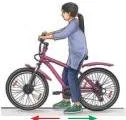
Given: a bicycle with rider of total mass 60 kg speeds up from \( 4\ \text{m s}^{-1} \) to \( 10\ \text{m s}^{-1} \) in 3 s on a straight road.
What net force acts on them?
Step 1: find the acceleration first, using \( v = u + at \):
\[ a = \frac{v – u}{t} = \frac{10\ \text{m s}^{-1} – 4\ \text{m s}^{-1}}{3\ \text{s}} = 2\ \text{m s}^{-2} \]
Step 2: the question gives mass and acceleration and asks for force, so use \( F = ma \):
\[ F = ma = 60\ \text{kg} \times 2\ \text{m s}^{-2} = 120\ \text{N} \]
Final answer: a net force of \( 120\ \text{N} \) in the direction of motion. If friction were present, the applied force would need to be larger — the net force is what causes the acceleration.
Worked Example 3: Weight from Mass
Given: a watermelon of mass 2.5 kg hangs from a spring balance.
What reading does the balance show?
Take \( g = 9.8\ \text{m s}^{-2} \).
Step 1: the force pulling the spring is the gravitational force on the watermelon — its weight — so use \( F = mg \).
\[ F = mg = 2.5\ \text{kg} \times 9.8\ \text{m s}^{-2} = 24.5\ \text{N} \]
Step 2: a spring balance measures the magnitude of a force, so its reading is this weight.
Final answer: the spring balance reads \( 24.5\ \text{N} \). For a quick estimate with \( g = 10\ \text{m s}^{-2} \), the reading would be \( 25\ \text{N} \).
Common Mistakes to Avoid
These are the errors this chapter’s numericals actually invite — each with the correction and a quick self-check.
| Mistake | Correct rule | How to check your answer |
|---|---|---|
| Using the applied force in \( F = ma \) without removing friction. | \( F \) in \( F = ma \) is the net force. When friction opposes motion, \( F_{\text{net}} = F_{\text{applied}} – f_{\text{friction}} \). | If the object moves at constant velocity, the net force is zero, so the applied force must equal friction. |
| Adding the magnitudes of two forces that oppose each other. | Opposing forces subtract; the net force points along the larger force. | With opposing forces, the net magnitude can never exceed the larger individual force. |
| Giving a force answer without its direction. | Force, net force and acceleration all carry direction; state it after the value. | Re-read the question — if it asks “in which direction”, your final line needs a direction word. |
| Writing weight in kilograms (“weight = 5 kg”). | Weight is a force: \( F = mg \), unit newton. Mass is the quantity of matter, unit kg. | Any answer called weight or gravitational force must carry the unit \( \text{N} \), never kg. |
| Treating an action–reaction pair as forces that cancel. | Third-law forces act on two different objects, so they cannot cancel. Only equal and opposite forces on the same object balance. | Ask: do both forces act on the same object? Different objects → third-law pair, not a balanced pair. |
Frequently Asked Questions
What is the difference between balanced and unbalanced forces?
Balanced forces are equal in magnitude and opposite in direction on the same object, so the net force is zero and the object does not accelerate — it stays at rest or keeps moving with constant velocity. Unbalanced forces leave a non-zero net force, so the object accelerates in the direction of that net force (NCERT, p. 97).
Which How Forces Affect Motion Class 9 formulas do I need for numericals?
The two core forms are \( F = ma \) and \( a = F/m \), always with the net force substituted. Most numericals also need \( v = u + at \) to get acceleration from a velocity change, and \( s = ut + \frac{1}{2}at^2 \) when displacement is asked. Weight problems switch the same law to \( F = mg \), and connected-object problems use \( a = F/(m_1 + m_2) \).
Why does the Earth not move towards a falling fruit if the forces are equal and opposite?
The gravitational forces on the Earth and the fruit are equal in magnitude, but acceleration is \( a = F/m \). The Earth’s mass is so large that the same force produces an extremely small acceleration, while the fruit’s small mass gives it a visible one. Equal forces do not mean equal accelerations (NCERT, p. 110).
Do action–reaction forces cancel each other?
No. The two forces in a third-law pair act on two different objects, so they cannot cancel on either object. Forces cancel only when equal and opposite forces act on the same object — that is the balanced-forces case (NCERT, p. 108).
All formulas follow the Rationalised NCERT Class 9 Science textbook; the same document is available for verification on the official NCERT website (ncert.nic.in).
Reference: NCERT Class 9 Science textbook, chapter How Forces Affect Motion.
Explore Class 9 Physics Formulas
More for this chapter:
Class 9 Physics on LearnCBSE:
Related chapters: